Feeds:
Posts
Comments

My Thanksgiving Dinner

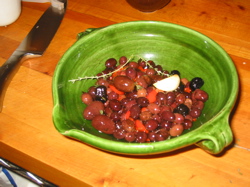
Olives.
Olives to go with Thanksgiving dinner.

Recipes:

Black Olives with Chilies and Cognac
Almonds with Rosemary, Salt, and Sugar
Fennel Baked with Parmigiano and Moscato
Carrots with Marsala and Capers
Pear, Pancetta, and Fennel Stuffing
Endive and Watercress Salad with Pomegranate Seeds

When I was a kid my grandmother always made Thanksgiving dinner into a very complicated affair. Like most Italian-Americans she felt obligated to work homeland dishes like ravioli, lasagne, or stuffed artichokes into the day, out of a subconscious need to inject it with an alternate patriotism, I think. And I still in 2005 feel a strong desire to include garlic, Parmigiano, and olive oil in my Thanksgiving meal, more for spunk than for patriotism. Continue Reading »

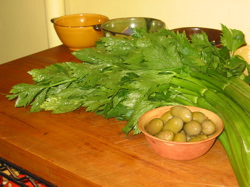
Salad ingredients.
Ingredients for my Warm Cerignolo Olive Salad with Celery Leaves.

Recipes:

Pear and Fennel Salad with Asiago and Marsala Vinaigrette
Warm Cerignolo Olive Salad with Celery Leaves
Red Grape and Arugula Salad with Fennel Seeds and Ricotta Salata

My desire to create fusion cooking usually goes just as far as blending flavors from Sicily with those of Puglia or Campania. Not much of a leap. I don’t often venture outside my world of flavors; I just keep reinventing with the tastes that mean the most to me. My flavors are what anyone would categorize as classically Southern Italian, no messing around: Extra-virgin olive oil, garlic, tomatoes, capers, oranges, lemons, anchovies, sweet and hot chiles, black pepper, fennel, saffron, sea salt, all manner of seafood, salami, nutmeg and cinnamon, pancetta, Pecorino and caciocavallo, ricotta and mozzarella, basil and mint, parsley, oregano, marjoram, bay leaves, rosemary, raisins, pine nuts, pistachios, almonds, wine and vinegar, and honey. I think reining in your choices can do wonders for creativity, but even so this basket of tastes from Southern Italy is a lot to work with, really a lifetime’s worth of possible culinary improvisations. Except that now and again I’m tempted to add something new. Continue Reading »

September Song for Tomatoes

Barbara’s tomatoes.
Barbara’s Red Pear tomatoes.

Recipes:

Bucatini with End-of-Season Tomatoes, Mussels, and Pancetta
Farro Penne with Green Zebra Tomatoes, Marjoram, Almonds, and Ricotta Salata

September is a great month for tomatoes in New York, but it’s also a sad one, because you know it’s all coming to an end soon. Once October rolls in I start hoarding the remaining tomatoes at the markets. I don’t bottle and preserve them; that would seem excessive for a family of two, and it’s really not me anyway, but I do try to cook with them as much as possible during those dwindling tomato days. Continue Reading »

I Love Eggplant Parmigiano

Eggplants.
New York–grown Italian eggplants.

Recipe:

Erica and Mo’s Eggplant Parmigiano

I don’t ruminate over my childhood now the way I did when I was in my twenties; that type of self-analysis feels more like a dead end as life goes on. But childhood food memories do pop up all the time. I seem to remember tastes and smells more than I do words and actions; maybe that’s one reason I chose cooking for a career. Lately I’ve been thinking about my mother’s eggplant parmigiano. It was my all-time favorite dish as a kid, her version of an exemplary classic of the Southern Italian kitchen. Continue Reading »

Cantaloupes.
Summer cantaloupes at Union Square.

Recipes:

Cantaloupe and Tomato Salad with Black Olives and Tarragon
Cantaloupe Salad with Prosciutto, Frisée, and Basil
Spaghetti with Cantaloupe and Hot Chilies

My grandfather always salted his cantaloupe. As a child I found this weird. It seemed so old-world for an elegantly turned-out man who had in many ways become an urbane New Yorker. When I got a little older and was introduced to prosciutto with melon, I reasoned that his salty cantaloupe was likely a Southern Italian peasant version of this wonderful pairing. There are several dishes like this in the Southern repertoire. One, called pasta che sardi a mari, translating roughly as pasta with the sardines still in the sea, is a cut-rate but delicious vegetarian version of the elaborate Sicilian pasta con le sarde, and it’s a good example of the Southerner’s ability to create elegance from poverty (the pasta includes wild fennel, raisins, pine nuts, and sometimes tomato or cauliflower). Continue Reading »

The Motivated Cook

I was first drawn to cooking when I was a teenager and was maybe even more lost than most people that age. I gravitated toward the aromas of my family’s Italian-American kitchen in what now looks like an obvious attempt to find an identity amid the churnings of adolescence. I reproduced my mother’s eggplant parmigiano. I sweated over simmering pots of braciole. I rolled tiny meatballs just like my grandmother made and dropped them into clear broth, and I even found myself up at three in the morning watching my pizza dough rise, occasionally bringing the bowls of dough out to the family car and locking us both in for solitude. I asked relatives about forgotten recipes I wanted to revitalize, and I hunted through cookbooks for more direction. I remember being especially excited by Ada Boni’s Talisman Italian Cookbook, a slim volume my mother had hanging around the house, with somewhat vague yet romantic recipes. My attention to preparing food perplexed my family, and I realized myself that it was a bit obsessive, since I’d sometimes cook an extremely large amount of food even when there was nobody home to eat it. At around the same time, my younger sister was diagnosed with obsessive-compulsive disorder, a condition I got wise to when I noticed she was spending hours each day wiping water spots out of the bathroom sinks. I always wondered if my cooking wasn’t just an alternate form of this condition, but the truth was I didn’t care, since it was such a great feeling to lose myself in the kitchen.

A few years later I began to travel to Italy, so I could smell and taste the country’s food in its original home. Visiting the dry little hill town in Campania where my grandmother was born had a profound effect on me. It deepened my desire to cook. And I kept returning to Southern Italy, visiting Puglia, Basilicata, and Sicily several times. Every visit reconfirmed my love of Southern Italy’s flavors and the bold, open-arms approach of its cooks. Basil, lemons, olives, tomatoes, garlic, almonds, anchovies, fennel, Pecorino cheese, and capers: These were some of the flavors that motivated my cooking. Over the years, as my cooking has evolved, I’ve found myself really zeroing in on the flavors of Southern Italy, while altering them with my New York sensibility to produce a not necessarily traditional but very personal take on Italian cooking. The compulsive aspect of my cooking still exists, but in a more civilized form. It’s not something I dwell on. If I want to cook fifteen recipes a week using red bell peppers, who cares? I’m not hurting anyone, except maybe my own digestion. Motivation, I suppose, is considered by most people to fall into either of two categories: healthy or unhealthy (traveling to Italy to learn about cooking is healthy, if expensive; watching bread rise in your father’s Cadillac at 3 a.m. is not). But ultimately that doesn’t matter. I welcome anything that drives my desire to learn more. I feel lucky to have that desire.
Red peppers.
Peppers roasted with caciocavallo, black olives, and thyme

Recipes:

Peppers Roasted with Caciocavallo, Black Olives, and Thyme
Grilled Peppers with Salt-Packed Anchovies and Marjoram
Grilled Peppers with Honey, Almonds, and Rosemary
Couscous with Grilled Peppers, Ginger, Basil, and Merguez Sausage
Wheat Berry Salad with Roasted Peppers, Soppressata, and Parsley

Certain vegetables perplex many American cooks. Not their mere existence, but how to cook them. Eggplant is one, artichoke another. Bell peppers seem to be a third; they look so beautiful, almost too shiny and colorful to even put a thumb print on. Most people I know just slice them up and throw them into a salad. But I’m a cook who doesn’t like bell peppers raw, and I say grill them or roast them. Do anything to rid them of their rawness. In my opinion, if they’ve still got a crunch, they’re not at their best. I’m talking about the red, ripe ones. I really don’t care for green bell peppers, raw or cooked. To me their smell is strangely unfood-like, and their flavor really has legs, traveling all over your plate, spreading its essence. When I eat a green bell pepper I sense I’m burping up something vaguely like gasoline for several hours after. The only sweet green peppers I do like are the long Italian frying ones, like my father used to grow in his backyard garden. He picked them when they were just faintly tinged with specks of red. Then my mother slow-roasted or sautéed them, along with onions and sometimes sausages, until they almost seemed dissolved (a truly Italian-American approach). Continue Reading »

The Real Arugula

Arugula.
Ruchetta selvatica from Mountain Sweet Berry Farm.

Recipes:

Wild Arugula Salad with Ricotta, Strawberries, and Pine Nuts
Wild Arugula with Shrimp, Cherry Tomatoes, and Parmigiano
Cavatelli with Wild Arugula, Mussels, and Sweet Bread Crumbs

I had my first taste of wild arugula as a child on Long Island, and I’ve loved it ever since. The Mastellones, our neighbors across the street, took a trip to their hometown of Sorrento, Italy, sometime in the late l960s and smuggled back clumps of wild arugula, relocating it in their backyard garden. The stuff took off like the weed that it is and has been thriving there ever since, some summers almost taking over the entire garden. They gave cuttings out to all the Italian neighbors, and soon the entire block was growing it. This was before even domestic arugula appeared in supermarkets, so it was a real novelty on Long Island. We called it rucchetta, which is what arugula usually goes by in Rome and in parts of Southern Italy. Either rucchetta selvatica or rucola selvatica is how you refer in Italian to this wild variety, with its intense, addictive bite. I’ve picked up seed packages of a cultivated form of wild arugula in Italy to hand out to friends with gardens (I can also sometimes find these on Arthur Avenue in the Bronx, in the garden department of the indoor shopping mall). I’ve grown tiny pots of wild arugula on my window sills in the city. What they need is plenty of sun, which is what I’ve got (a little more space would be nice too). When the seeds first sprout they look like clover, with rounded leaves, but as they shoot up they develop skinny, spiky, dark green leaves, resembling a more refined-looking dandelion. The aroma is so pungent I get whiffs of it coming in through the open window. Continue Reading »

Summer Potato Salads

Recipes:

Fingerling Potato Salad with White Wine, Thyme, and Shallots
Red New Potato Salad with Tarragon Mayonnaise and Capers
Yukon Gold Potato Salad with Wild Arugula and Summer Garlic

One reason I love making potato salad is because it gives such a great opportunity to show off extra-virgin olive oil. I dress the potatoes while they’re still warm and let them soak up the oil and whatever other seasoning I’ve decided on. My current favorite oil is Maussane-les-Alpilles from Provence. It’s a gentle, golden oil, very olivey, without the bite of a green Tuscan oil, a taste I find too strong for the starchy sweetness of potatoes. I am also still crazy about my all-time favorite Sicilian oil, Ravida, which is a bit grassier than the Provence oil but still lush and mellow. You can order both of these great oils from Zingermans. Continue Reading »

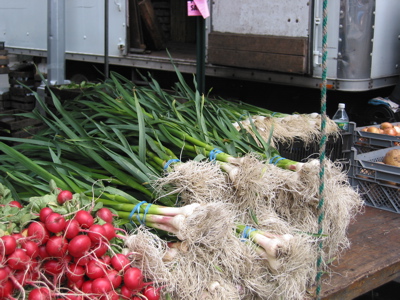
Spring garlic.
Spring Garlic at the Union Square Greenmarket.

Recipes:

Snap Peas with Pancetta, Young Garlic, and Mint
Cavatelli with Shell Peas, Squid, and Young Garlic
Grilled Trout with Black Olives and Tarragon and Young Garlic Vinaigrette
Chicken Roasted with Limoncello and Young Garlic

Fresh young garlic is absolutely my favorite warm-weather vegetable, and I wait for it all year, dreaming of its fragrance. In early June the first, skinny garlic heads, with their long green stalks, start piling up in stalls at the Union Square Greenmarket. They have a sweet, fresh garlic taste and a juiciness you always guessed garlic must possess at some point in its development. They look almost exactly like scallions. The great thing about them is that you can eat a lot of them without feeling garlicked out. I slice them, stalk and all, and scatter them raw over a salad, something I would never in a million years do with the dry, sharp, garlic I find in the supermarket in the winter. (In fact, often in the dead of winter I forgo garlic altogether, turning to leeks or shallots for that flavor base.) Continue Reading »