
John’s Basilicata-Canadian eggplant?
Recipe:
Melanzane a Scapece Colapinto Style
Erica!
I love the lost recipes idea. I checked out the link you sent. Awesome. So here’s my question to you. Continue Reading »
John’s Basilicata-Canadian eggplant?
Recipe:
Melanzane a Scapece Colapinto Style
Erica!
I love the lost recipes idea. I checked out the link you sent. Awesome. So here’s my question to you. Continue Reading »
Posted in Lost Recipes Found | 2 Comments »

A stuffed artichoke for Gloria.
Recipe:
Stuffed Artichokes with Parsley, White Wine, and Bread Crumbs
Ciao Erica,
My mother, from Siracusa, made the best stuffed artichokes ever eaten. All I remember is grating the cheese, dicing parsley, and grating stale Italian bread into breadcrumbs. Some recipes I’ve read add green olives, eggs. . . . I do not recall either of those ingredients.
Could you please forward your recipe? Grazie.
Gloria Paine
Okay, this is a pretty bare-bones request for an elegantly simple, excellent thing to eat. But this delicate stuffed artichoke treatment is not what I grew up eating, nor did many of my Southern Italian-American friends. The Neapolitan-American style artichokes my grandmother turned out were among the heaviest, greasiest things I’ve ever eaten, stuffed to overflow, huge as a baby’s head (why would I say that?), with sausage, garlic, bread, and cheese, all sort of glued into a ball and all in one piece. They were like what I’d have been served at most red-sauce type places when I was a kid, and even now, as a matter of fact. (Where else could you get an artichoke like that nowadays?) When I think of what would be the opposite of delicate, I think of this artichoke. Solid, very solid. A meal in itself, except that it never was; it was always a starter at my grandmother’s. It’s not that I didn’t like it, exactly, but it was just so solid . Sometimes she’d even serve it topped with a tomato and green-pea sauce. Oh boy. Lovely for a sweltering afternoon in Napoli.
Gloria’s mother was from Siracusa, Sicily. Well that makes sense. Ortigia, the old part of the city, is one of the most gorgeous places I’ve ever seen, and it has gorgeous pointy purple artichokes in its markets. I don’t remember eating stuffed artichokes there, but I did have sautéed ones, which seemed to be cooked in nothing but a little garlic, olive oil, and parsley. I have to say they may have been the best artichokes in my life. (Isn’t it funny how the best whatever in your life is never something that comes out of your own kitchen?)
I never had the pared-down artichokes Gloria describes at home. Even though my mother’s family is part Sicilian, the Neapolitans-my father’s side-took over in the kitchen, often with excellent results, except maybe where artichokes were concerned (they really shone with braciole and meatballs). But I tasted the things around town in fancier Italian restaurants, and I got the idea. Leave out the meat, go easy on the cheese and garlic, and let the artichokes do most of the talking. Fresh herbs, mainly parsley, are very important for flavor and for lightness. Oregano, mint, and/or rosemary are often included in smaller amounts. I’ve added a few sprigs of fresh marjoram, a floral-smelling herb that has become my standard replacement for the ubiquitous dried oregano that perfumes much of Southern Italian cooking, a taste I’ve become thoroughly sick of. Bread crumbs are an extremely important ingredient in many Sicilian dishes, serving as a carrier of flavor, a texture maker, and a stretcher for expensive protein (not in this case, though), and also valued for their own subtle flavor. I toast them lightly before stuffing so they don’t get too packed down and soggy, and to give them a nutty taste.
Going through my big and growing pile of Sicilian cookbooks, I found many artichoke recipes. Since it’s an old Sicilian crop, they’ve had plenty of time to get creative. One of my favorite Sicilian books, one I picked up from a souvenir seller on the beach in Mondello, outside Palermo, was written by a person named Eufemia Azzolina Pupella (I swear that’s her name), and it’s loaded with great photos and strangely translated recipes that have taken me much effort to figure out but have been worth it. Her recipe for stuffed artichokes, called Carciofi Bellavista in Tagame (tagame is a skillet), was the model for my own. She includes anchovies in the breadcrumb mix, something I often add. Capers and olives are also both usual additions, but I tend to leave them out, finding their flavors overpowering. To sum up my feelings about stuffed artichoke cooking, I’d have to say that the less you add, the more you receive in true artichoke flavor. The most important ingredients are extra-virgin olive oil, crumbs made from good bread, and salt.
Gloria, here’s my recipe. I hope it brings back memories for you.
Stuffed Artichokes with Parsley, White Wine, and Bread Crumbs
(Serves 4 as a substantial first course or a lunch)
The juice and zest from 1 large lemon
Salt
4 globe artichokes (on the small side)
Extra-virgin olive oil
1 cup dry white wine
2 small fresh garlic cloves, minced
1 1/4 cups homemade, dry bread crumbs, lightly toasted
1 cup grated Grana Padano cheese
1 packed cup flat-leaf parsley leaves, well chopped
5 sprigs fresh marjoram, the leaves chopped
Freshly ground black pepper
Set up a large pot of water and bring it to a boil. Add half the lemon juice and a sprinkling of salt. Cut the stems off the artichokes so they can sit upright, and trim about 1/2 inch from their tops. Add the artichokes to the boiling water, and boil for about 15 minutes, or until you can easily pull off an outer leaf (I usually weight them with a small colander so they don’t keep bobbing up). Drain the artichokes and run them under cool water. Now turn them, top end down, on some paper towels, so all the water can drain out. Remove about three layers of tough outer leaves, and then gently open the artichokes up so the leaves spread out.
Preheat the oven to 350 degrees.
Coat a baking dish with olive oil and sit the artichokes in it upright. Pour the white wine over the artichokes, letting the wine pool in the bottom of the dish, and then season them lightly with salt and black pepper.
In a small bowl, mix together the garlic, bread crumbs, Grana Padano, parsley, marjoram, and lemon zest. Season well with salt and black pepper. Add 1/2 cup of olive oil, and mix until everything is just blended. Stuff this mixture in between the leaves (there should be just enough for a light stuffing; you don’t want to overdo it and drown out the artichoke flavor). Drizzle with a little more olive oil, and give them a another little seasoning of salt and black pepper. Squeeze on the remaining lemon juice. Bake, uncovered, until lightly browned and fragrant, about 30 minutes, adding a little warm water to the bottom of the dish if the wine evaporates. Spoon the dish juices over each artichoke several times, and then let them sit about 10 minutes before serving. Serve hot or at room temperature.
Posted in Lost Recipes Found | 2 Comments »
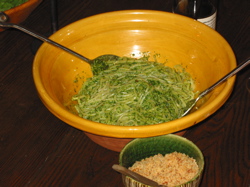
Francesca’s Uncle’s Dish?
Recipe:
Spaghetti with Parsley, Almond, and Anchovy Pesto
Hi, Erica,
My Uncle Ollie use to make this seafood pasta dish. It had a green sauce that looked like a pesto sauce but had fish in it or was fish-tasting. He was Sicilian, so maybe that will help. It was served over spaghetti and served with Parmesan cheese. Continue Reading »
Posted in Lost Recipes Found | 3 Comments »

My Christmas Eve baccalà.
Recipe:
Baccalà with Sweet Onion and Little Tomatoes
This Christmas I received two e-mails from readers whose Christmas Eve baccalà recipes had gone awry. I think I know why: People don’t often cook salt cod anymore, so when they try tackling a family recipe for a special occasion they don’t bring to the effort any experience working with the stuff. I decided to look into the matter and try an analyze what went wrong. Both letters were from people whose families were from the Naples area, one from Sorrento, the other from around Gaeta, so we’re really entrenched in Southern Italian style here. Both recipes used similar ingredients and were quite like the baccalà dish I often make for my own Christmas Eve dinner. So I thought I’d have a go at them. Continue Reading »
Posted in Lost Recipes Found | 1 Comment »

My good-luck pizza, ready to go into the oven.
Recipe:
Pizza in the Round with Pancetta, Onion, and Buffalo Mozzarella
Every year on New Year’s Day I struggle with my superstitions and try to put together some sort of good-luck meal. As a kid I always heard from my family that we were supposed to eat lentils that day, but we never bothered, so I guess nobody in my family actually thought you could eat your way to good luck. You can certainly eat your way to bad luck, as my 460-pound, five-foot-four cousin “Joe Beef” did a few years ago when he dropped dead of a heart attack at age 37. Continue Reading »
Posted in 2006 | Leave a Comment »
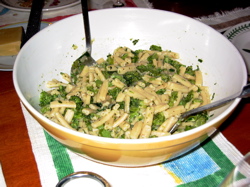
Greg’s long-lost pasta dish.
Recipe:
Penne with Broccoli, Shallots, and Emmenthaler
Dear Erica:
When I was in Italy I had a tremendous dish, a penne with broccoli sauce. The sauce had no cream, jus an intense broccoli flavor, a little olive oil, and, I assume, some butter. The trick is how to get the intense flavor in the sauce. Merely cooking broccoli in olive oil and butter doesn’t do it. I tried. Most likely some garlic was sautéed in the sauce, but it wasn’t the dominant flavor. I can put all these ingredients together, but something is always lacking.
Thank you.
Greg Sinicrope Continue Reading »
Posted in Lost Recipes Found | 6 Comments »
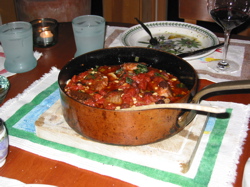
Braised tuna with marsala, mint, and black olives.
Recipes:
Winter Panzanella with Burst Cherry Tomatoes, Black Olives, and Caciocavallo
Braised Tuna with Marsala, Mint, and Black Olives
My black olive craving has really taken hold in this winter. At this time in my life just about everything tastes better with a few black olives thrown in. I’ve been experimenting using them in some dishes where I wouldn’t think they’d make sense at all, and in fact in some cases they didn’t make sense at all. For instance I recently made a sweet yeast bread, a type of foccacia, and instead of topping it with grapes, as I usually do (this is a type of Tuscan wine-harvest bread I make in the fall), I tried black olives. It was actually awful. The sugary dough and salty olives proved to be an unappealing match. A little sweetness with olives is good; too much, I discovered, is just weird. I first discovered one wonderful use of sweetness with black olives in a pizza rustica my family always bought for Easter; it had a very sweet pastry crust, but the filling of ricotta, salami, black olives, and provolone was strictly savory; it was perfect. I was thinking about this pizza rustica when I tried the focaccia idea, but in this case there wasn’t enough savory to balance the sweetness. Live and learn about black olives.
In my last month’s posting about black olives I went on a bit about how hard it is to find great Italian olives in this country. I’ve since checked in with my friends at Gustiamo.com, my favorite Italian food mail-order source, and procured myself a few jars of their black olives from the Cilento region of Campania, grown and put up at the Masseria Maida near Paestum. They sure made me happy. They’re dark, plump, and packed in the fruity extra-virgin olive oil from the region, with a subtle touch of garlic. These delicious olives were the inspiration for the two additional black olive recipes I offer you now and will be discussing momentarily (see also my Pappardelle with Black Olives, Lemon, and Cream, from my November 19 web posting).
In cold weather I find myself working black olives into almost all my pasta dishes, pasta with tomatoes, with sausage, with fish, with ragus. It does get a little monotonous, and I wish I would stop, but it’s not really the olives I tire of; it’s the pasta. So when I get sick of pasta with olives, I make panzanella, a Tuscan bread salad, with olives, just to wake things up a bit. I enjoy taking summer dishes and transforming them into cold-weather fare. What makes a panzanella successful, I believe, is good olive oil and juicy summer tomatoes (plus high-quality bread), so in winter months I use supermarket cherry tomatoes, which are almost always sweet, and give them a quick sauté just until they burst, concentrating their sweetness without sacrificing their much-needed juices that will soak into the stale bread. I trade the light and refreshing qualities of summer panzanella for a rich, almost meaty version, adding, of course, black olives (there’s something about the mix of black olives and seared or roasted tomatoes that tastes a little like a steak to me).
When I’ve had it with starch-and-olive variations, I turn to my long list of seafood-and-olive variations, a time-honored pairing if there ever was one. This week I played around with a dish my family sometimes serves as part of our Christmas Eve fish dinner, a braised cod, either fresh or dried, with tomatoes, black olives, Marsala, and mint, a real Sicilian mix of flavors. Tuna is wonderful when slowly braised, so I substituted it for the cod and it worked out nicely, and I think it’s a nice change from the semi-raw tuna I’m almost always served in restaurants. If you’re looking for something new for your Christmas Eve fish extravaganza, you might want to include this. I recently served it with couscous flavored with pistachios, a pinch of cinnamon, and a little more fresh mint, just to keep the theme going.
Have a happy black olive Christmas.
Winter Panzanella with Burst Cherry Tomatoes, Black Olives, and Caciocavallo
(Serves 4 as a first course, lunch, or light supper)
4 cups crusty Italian bread, cut into 1-inch cubes
Extra-virgin olive oil
2 pints cherry tomatoes, stemmed
Salt
Black pepper
1 garlic clove, minced
1 shallot, thinly sliced
A generous splash of dry white wine
A handful of black olives, pitted and cut in half
A palmful of capers, preferably salt-packed
A large sprig of marjoram, the leaves lightly chopped
A handful of flat leaf parsley leaves, lightly chopped
1/4 pound caciocavallo cheese, cut into tiny cubes (I chose a Sicilian Ragusano for this)
Preheat the oven to 325 degrees.
Place the bread cubes on a sheet pan, spreading them out in one layer. Dry them out in the oven, just until they’re crisp but a bit of softness still remains in the center. Let them cool.
Place the bread cubes in a large, shallow serving bowl.
In a large skillet, heat about 3 tablespoons of olive oil over high heat. When very hot, add the cherry tomatoes, salt, black pepper, the garlic, and the shallots, and sauté, shaking them around a lot, until the tomatoes start to burst and let off juice, about 4 minutes. Add the white wine and let it bubble for a few seconds. Pour the tomatoes and all the skillet juices over the bread cubes, and give them a toss. Add the olives, capers, marjoram, parsley, and caciocavallo, give everything a generous drizzle of fresh olive oil, and toss again. Let the panzanella sit for about 10 minutes before serving, to give the juices a chance to soak into the bread.
Braised Tuna with Marsala, Mint, and Black Olives
(Serves 4 as a main course)
1/2 cup all-purpose flour
Salt
A generous pinch of sugar
A pinch of Cayenne or Aleppo pepper
1 1/2 pounds thick tuna steak, cut into approximately 2-inch chunks
Extra-virgin olive oil
1 large leek, cleaned and chopped, using only the white and the tender light green parts
1 garlic clove, thinly sliced
1/2 cinnamon stick
1/4 cup sweet Marsala (if you have only dry Marsala, add a pinch of sugar)
1 35-ounce can Italian plum tomatoes, chopped, with the juice
A handful of black olives
A palmful of pine nuts, lightly toasted
A handful of fresh mint leaves, lightly chopped, plus a few whole sprigs for garnish
Sprinkle the flour on a large plate, and mix in the salt, sugar, and Cayenne, or Aleppo. Toss the tuna chunks in the flour, shaking off excess flour.
In a large skillet, heat about 2 tablespoons of olive oil over medium high heat. When hot, add the tuna, and brown it on both sides. Take the tuna out of the pan (it will still be quite rare). Pour out the excess oil and add 2 tablespoons of fresh oil. Add the leek, garlic, and the cinnamon stick, and sauté until everything is fragrant, about 4 minutes. Add the Marsala, and let it bubble away. Add the tomatoes, and season with salt and a pinch more Cayenne or Aleppo. Simmer uncovered on medium heat for about 6 or 7 minutes. Turn off the heat, and add the tuna, the olives, the pine nuts, and the chopped mint. Give it a stir, and cover the skillet. Let it sit for five minutes. The heat from the sauce will gently finish cooking the tuna. Remove the tuna chunks, and place them on a large platter. Pour the sauce over the top, and garnish with mint sprigs.
Posted in 2006 | Leave a Comment »

Liti’s missing recipe.
Recipe:
Cinnamon and Ricotta Ravioli with Basil
Dear Erica,
Since you’ve started your “Lost Recipes Found” feature, I can’t stop thinking about the cinnamon and ricotta ravioli Mom has told us about but never actually cooked for us, mainly because she doesn’t know how to make it. I thought this would be a good opportunity for you to figure out that recipe, and then we could have it for Thanksgiving or Christmas. I know you published a savory version of these ravioli in your last book, but since then Mom has been telling me about another version she thinks she remembers her grandmother making, a sweet ravioli, topped not with tomatoes but with butter, cinnamon, and sugar. She says she thinks she remembers it that way but can’t be sure. I don’t care if she remembers it or not. I want to taste it. Can you figure out a recipe for it? Please? Continue Reading »
Posted in Lost Recipes Found | 5 Comments »

Olives at the market in Nice.
Recipe:
Papardelle with Black Olives, Lemon, and Cream
I sometimes take naps on Saturday afternoons, and when I wake up from one I always seem to have a food craving. In the warm weather months I want something sweet, like a caramel or a swig of maple syrup; in winter months, I crave black olives. There is a black olive cold weather association in my mind. I haven’t been able to get to the bottom of it (it may have something to do with my mother always putting out a Thanksgiving day bowl of black olives with raw fennel, but I’m really not sure), but I’m grateful for it nonetheless. I’ll have my olives after a winter nap, but I’ll also cook with them much more than I do in the summer, scattering them over antipasto platters and stirring them into stews and pastas, making olivata (olive paste) in the food processor and smearing it on bread and folding some into omelettes (the best, especially if I include a slice of mozzarella). Black olives are a beautiful thing, something delicious for me to want and love in the cold months, my winter fruit of choice, warm and ripe.
Strangely, I know several very little kids, five and six years old, who love black olives. That says a lot about the fruits’ deliciousness. They won’t eat broccoli, but they love olives, and kids understand about the pits. They enjoy spitting them out.
From the short list of black olives available in this country, I’d have to say the little Niçoise ones are my favorites, although a pain if you need to pit a whole lot of them. The giant, bland bella di Cerignolas from Puglia, which are almost impossible to pit, have a taste that’s just a notch above that of California canned olives, but they have their place. I often put a bowl of them out, along with mozzarella, roasted peppers, and salami, for a classic Italian-American-style antipasto. People can never quite believe how huge they are. They’re not much of a challenge to the palate, but maybe that’s why I sometimes want them.
While visiting Puglia for my book on Southern Italian cooking, I sampled at least ten different varieties of black table olives; Corotina and Cima di Melfi are names I recall (those big Cerignola things seem to be more popular here than there). I wish I could find some of those rich tasting Puglian olives that always showed up along with platters of salumi in restaurants. I buy oil-cured, wrinkled Moroccan olives that occasionally have a curious undertone of single-malt scotch (why would that be?). I really love them, but they’re harder to cook with, since their lush intensity floats all over a dish. When I do include them in cooking, it’s usually only to scatter them over the top of a finished dish. Halkadiki is a Moroccan-style oil cured in oil that’s less wrinkly and a little fruitier than most. Sometimes these are just the thing. Most of the wrinkly types I buy from Kalustyan’s, an excellent Middle Eastern shop in Manhattan (and you can mail order from www.kalustyans.com). My favorite winter antipasto incorporates rich, wrinkled black olives, raw fennel, and slices of a spicy coppa, excellent with a deep pink Italian rosato wine, Believe me, this little grouping of flavors will make you very happy.
Gaetas are another excellent black olive choice. The ones I find here seem less nuanced then the Gaetas I’ve eaten in Southern and Central Italy, but they’re fine, or better than fine, a great olive to enhance stewed rabbit or to stir into a lamb ragù. When I get myself down to Despana, an excellent Spanish food shop in SoHo (at 408 Broome Street, if you’re in the neighborhood), I always check out their olives first (although their cured Spanish sausages and hams are the best I’ve found in the city). I very much like the brownish Arbequina olives and the fully ripe, black, mellow Empeltre variety, since they both blend seamlessly with most of my Southern Italian cooking. I recently made a chicken cacciatore with tomatoes, marjoram, and Arbequinas, which was pretty good on a cool, windy night, with a bottle of dolcetto. Black olives need to be washed down with wine, although I’ve seen kids take them with milk or orange juice, which is fine, as long as they take them.
Papardelle with Black Olives, Lemon, and Cream
This is definitely a first-course pasta, like any pasta with cream in it, but its lemon and olive flavors set up your palate to follow it with something lean but vibrant, maybe with more lemon, something like a whole roasted fish stuffed with lemon and rosemary, or chicken with lemon and garlic.
(Serves 5 as a first course)
2 tablespoons unsalted butter
1 garlic clove, minced
The grated zest from 2 large lemons
A few gratings of nutmeg
1 cup black olives (Gaetas are a good choice), pitted and hand-minced (you can mince them in a food processor, but stop pulsing before they turn into a paste)
1/4 cup cognac or brandy
1 cup heavy cream
Freshly ground black pepper
2 tablespoons freshly grated Parmigiano Reggiano cheese
8 large sprigs flat-leaf parsley, the leaves lightly chopped
Salt, if needed
1 pound homemade or fresh store-bought pappardelle pasta
Set up a large pot of pasta cooking water and bring it to a boil.
In a large skillet, melt the butter over medium heat. Add the garlic, lemon zest, and nutmeg, and sauté to release their flavors, about a minute. Add the olives, and sauté about a minute longer. Add the cognac or brandy, and let it bubble away. Add the cream. Turn off the heat, give the sauce a stir, and let it sit while you cook the pasta.
Add a generous amount of salt to the pasta water and drop in the pappardelle. When tender, drain and add the pappardelle to the skillet, saving about 1/2 cup of the cooking water. Toss briefly, just to coat the pasta well, and pour into a large serving bowl. Add the Parmigiano and the parsley. Toss gently. Taste for seasoning, adding salt if needed (if your olives are salty, you probably won’t need it). If the pasta has become too dry, add a drizzle of pasta cooking water and toss again. Serve right away.
Posted in 2006 | Leave a Comment »
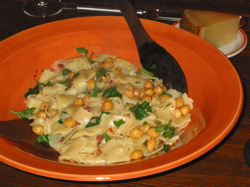
Joseph’s mother’s lagane e ceci.
Recipe:
Lagane e ceci
Dear Erica,
I’m very happy to read about your new website feature, “Lost Recipes Found.” One recipe in particular, something my mother made often, I really, really miss. It’s a pasta with chickpeas in a white sauce of some sort, and no tomatoes. I’ve tried making it myself, but I can’t get it right. My sister can’t either. The pasta looked like fettuccine, only cut shorter. I can’t remember if my mother made the pasta fresh herself or not. There was parsley and hot pepper in the sauce, but other than that mainly chickpeas and I guess olive oil (I never paid much attention to her cooking; I was only interested in eating). I grew up in the Bronx. My mother’s family came from Salerno, near Naples. If you could help me recreate this pasta, I’d be really grateful. Continue Reading »
Posted in Lost Recipes Found | 4 Comments »


