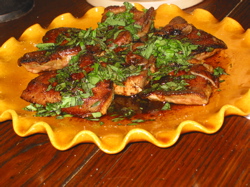
Vincent’s family’s Easter liver dish.
Recipe:
Fegato a Scapece Vicidomini
Dear Erica,
Something in one of your Lost Recipes struck a chord with me. It was about Southern Italians using strong vinegar in certain dishes. My grandfather who lived with us came from Southern Italy, from the island of Procida in the Bay of Naples. He is long deceased, but I still retain wonderful memories of his foods. One of the ritual dishes he made was at Easter, specifically a week before, since it needed to marinate. The recipe was ofliver pieces marinated in a “sauce” of vinegar, mint, and garlic. God only knows why I liked it at the time. Perhaps it was because my grandfather made it. It was the only liver I would eat, and liver was almost a health food in the 1940s. Parents tried to force feed it to you because as a source of dietary iron.
Anyway, it was made a week before Easter to be served at lunch on Holy Saturday, along with other cured meats and cheeses, mostly ricotta salata and soppresata. I’ve tried to duplicate the recipe, but I never get it quite right. My memory is that small pieces of liver were sautéed rather quickly and set aside. Then garlic was added to the pan, and the pan was deglazed with copious amounts of red-wine vinegar. Chopped mint was added (dried, I believe), and the mixture was poured over the liver pieces in a jar and kept in the refrigerator for a week. The pieces were about two by three inches and fairly thick. I remember them being slightly pink on the inside when cut. The sauce was very much like an emulsion, not thick but not thin like vinegar. I think when I tried to make it I used calf’s liver, and it did not have the texture I remember. The pieces were slightly chewy. My guess was that he used beef liver. Have you run across this food in your travels? I’m really projecting current cooking techniques on my memory of my grandfather making this dish. My mind’s eye sees him at the stove, and I can smell the vinegar cooking. Next thing I remember is a week had passed and I had eaten it. Any suggestions on the technique for emulsifying the marinade? Thanks for any tips you might have. Love your website and your books.
Best regards,
Vincent Vicidomini
Dear Vincent,
I really enjoyed reading your note. You’re a good descriptive writer. I don’t know this exact dish, but I’m familiar with things quite like it, belonging to a category of Southern Italian dishes usually called a scapece, where fish, meat, or a vegetable is first sautéed and then doused with a hot vinegary sauce and left to marinate. It’s a way of preserving food. My grandmother used to make something very similar to what you describe with small whole fish. I hated it as a kid, but I love it now. I believe your grandfather’s liver was an a scapece. Those dishes are very common to the Naples area and to Sicily. I’m going to look into this for you and try to come up with a traditional recipe. But I do have a few questions for you.
Do you recall this having any sweet aspect to it? Often these vinegary dishes contain something sweet like sugar or honey, or raisins. In that case they’re usually referred to as agrodolce (sweet and sour). In Venice a sweet-and-sour liver dish is made, but it goes by the name in saor (and often includes pine nuts and raisins). Can you recall any ingredients besides the mint, garlic, and vinegar? If not, it’s probably a straight a scapece technique.
I think you’re correct about your grandfather using beef liver. That’s what my family often bought since it was less expensive and would make the dish more chewy.
Most a scapece dishes are served at room temperature, not hot. Was this the case with your liver dish?
Procida is a beautiful Island. I wish I were there right now. Oh well. If you can answer these few questions for me, I’ll start looking into this and try to work out a good recipe for you.
Happy spring to you.
Erica De Mane
Thank you for the reply, and for the compliment! All those years of Catholic school education paid off!! Sister Aloysius and Sister Alphonse Liguori are bursting with pride!! The reference to “a scapece” in one of your lost recipes was what triggered the memory. No one in the family ever called it that, that I remember, but you must certainly be correct. There was no hint of sweetness to the liver dish that I remember. The vinegar was overwhelmingly present and it was a store-bought red-wine vinegar. I believe the mint was dried only because fresh mint was not readily available around Easter back in the late 1940s. There were no raisins. I’m sure of that. Another memory that was triggered by this discussion was a fish dish-a whole fish, roasted in the oven with red vinegar and mint. That dish wasn’t very vinegary but had just enough vinegar to make it palatable to a six-year-old. Was it something from Procida or Ischia, or even Capri, that encouraged using vinegar? Did all their wine spoil once and the result was a million recipes using vinegar? Or a Sicilian influence? Again, any preparation tips to get that liver marinade right would be appreciated. Thank goodness for Spring. Enjoy it. I have a feeling that we will be moving into summer weather rather quickly-at least in the suburbs of New York where I live. Best regards,
Vincent
When I first read Vincent’s e-mail I thought, ‘Oh, I know this dish exactly. It’s a classic. The blend of garlic, vinegar, and mint is typical of many dishes made in Southern Italy, ones that fall into two categories, a scapece, a vinegary treatment for lightly preserving food, and agrodolce, another vinegary dish, but this one including a sweet element, such as sugar or honey. Since Vincent’s liver dish didn’t contain any sweetness, I figured it fell into the a scapece group. But then when I started poking around my usual sources, I couldn’t find any reference to this exact dish made in the Naples area. Most of the a scapece dishes I’ve come across around Naples and in Sicily, where this style is also popular, were made with fish or vegetables, such as zucchini or eggplant. Agrodolce dishes are more likely to be made with meat, especially rabbit, but I did find several recipes for fegato agrodolce (fegato is Italian for liver). I had first run across this recipe several years ago when I was researching my book The Flavors of Southern Italy, and I was amazed to learned that the fegato in this dish is actually pumpkin. It’s one of those ironic cucina povera dishes, like “pasta che sardi a mari” (pasta with sardines still in the sea) from Sicily, vegetable dishes designed to mimic the flavors of ones preferably made with a costly protein. I devised a version for my book; it is made by pouring a hot, reduced vinegar, garlic, and sugar mixture over slices of sautéed pumpkin, finishing it with a scattering of fresh mint, and then leaving it to marinate. In theory it is very much like Vincent’s liver dish. I kept thinking the fancier liver version, which is still made in the South, would probably taste a lot better.
I was still frustrated that I was finding no exact reference to this “classic dish,” so I asked Arthur Schwartz, author of the excellent book Naples at Table, if he had every run across it, figuring since he knows so much about Campanian home cooking he certainly would have encountered this in his travels, but he had never heard of a scapece made with liver either (he is still looking into it for me, so maybe something will turn up). I also have a ton of Neapolitan cookbooks I brought back from various trips to Italy, and I went through all of them, finding two references to fegato agrodolce made with actual liver and garnished with raisins and pine nuts, but nothing for the more austere, sugarless treatment. Nevertheless I went about creating a recipe for fegato a scapece because it obviously existed on the beautiful little island of Procida, and probably still does.
As far as the type of liver to use, Vincent was probably correct in guessing his grandfather made his with beef liver. It is much less expensive than calf’s liver, and since it is older and spongier it would lend itself nicely to a long marinating process. But I couldn’t find any in fancy old Manhattan, so I went with calf’s liver. I remember eating lamb liver in Campania in a fritto misto (a mixed fried skewer that also included cauliflower). The taste was mild and delicious. I suppose that would make an interesting agrodolce or a scapece as well.
I cut the liver into thickish chunks, as Vincent directed, dusted them lightly in seasoned flour, and gave them a quick sear in olive oil. I then removed them from the pan, added garlic, red wine vinegar, and a tiny splash of balsamic and one of red wine, just to take the edge off, swirling everything around to reduce and pick up all the crusty liver cooking bits. I got a powerful, syrupy sauce whose intensity went right up my nostrils. I put the liver in a shallow glass dish, scattered on fresh mint and a much smaller amount of basil (just to soften the chewing-gum taste of the mint we get here), and poured on the vinegar mixture. I sensed that in one respect I hadn’t quite followed Vincent’s directions. His grandfather had placed the liver pieces in a jar, pouring the vinegar on top in what sounds like a total immersion. I was afraid that would produce something too powerful and maybe with a mushy texture, so I chose to lay the pieces out in a shallow glass dish and pour on a vinegar mix that wouldn’t quite cover them but would be sufficient to soak in a good strong flavor.
One thing I did find odd in Vincent’s description was his memory of the dish’s having been made a week before eating. I understand the marination process does to a certain extent preserve food, and many scapece or agrodolce preparations are made ahead, a day or two, to develop flavor, but an entire week, especially for a meat dish, seemed like a precariously long time. He might be correct in this, but I didn’t feel comfortable waiting and then tasting it. I marinated it overnight in the refrigerator and then let it come to room temperature before trying a piece. It was really delicious and not overly vinegary, as I had feared. I served it with chunks of provolone, olives, and toasted sliced of good Italian bread brushed with olive oil. This was a lovely antipasto. I tried it again the next day. It was a touch stronger in flavor but still really good.
I’m posting this recipe without my usual historical trackings mainly because it’s unusual and delicious. I also want to bring it to the attention of my other site readers, many of whom are of Neapolitan background. Does this liver recipe ring a bell with you? Let us know.
Fegato a Scapece Vicidomini
(Serves 4 as an appetizer)
1 pound calf’s liver, sliced 1/2 inch thick and then cut into approximately 3-inch pieces
1/2 cup milk
1/2 cup all-purpose flour
Salt
Freshly ground black Pepper
A pinch of cayenne
Extra-virgin olive oil
2 garlic cloves, thinly sliced
3 tablespoons high quality red-wine vinegar
1 tablespoon balsamic vinegar
A splash of dry red wine
5 large sprigs fresh mint, the leaves chopped
A few basil leaves, choppedPlace the liver pieces in a shallow bowl, and pour on the milk. Let it soak for about 20 minutes (this will subtly sweeten the liver, removing excess bitterness). Lift the liver from the milk, and dry the pieces well. Sprinkle the flour out onto a plate. Season it with salt, black pepper, and the cayenne. Coat the liver on all sides in the flour, shaking off excess flour.
In a medium skillet, heat 2 tablespoons of olive oil over medium-high heat. When hot, add the liver, and brown well on one side, about 2 minutes. Flip the pieces, and brown well on the other side, about 2 minutes longer. The liver should be just cooked through and tender, with a touch of pink at the center (in other words, you don’t want rare liver for the dish, but you don’t want it hammered either). Take the liver from the skillet and place it in a shallow dish with low sides, more or less in one layer with some overlapping.
Pour off any excess oil from the skillet, and add 2 tablespoons of fresh olive oil over medium high heat. Add the garlic and sauté until it just starts to turn golden. Add the red-wine vinegar, the balsamic vinegar, and the splash of wine, and let it all bubble until reduced by half. Add a pinch of salt and some freshly ground black pepper. Turn off the heat.
Scatter the mint and basil over the liver and pour the vinegar mixture over the top. Cover and refrigerate overnight or for up to two days. Bring the liver to room temperature before serving. The dish is especially good served with hot bruschetta, slices of good Italian bread simply grilled and brushed with olive oil.
Garnish options: Vincent didn’t mention any other ingredients, and it really doesn’t need any, since the herbs and vinegar give the liver a lot of good flavor. But for those who like to gild the lily, a scattering of capers and pine nuts just before bringing it to the table is a nice touch.





 Erica De Mane