Feeds:
Posts
Comments

Women with Fish

fish2_mini-1

Evolution, Ted Sabarese

Haven’t you pretty much had it with photos of people who look like their dogs? Dopey, right? But take a look at this. This lady looks like her fish. Isn’t that special? There’s really no cuteness here, I guess because the fish is dead. I wonder what people would think of those dog photos if the dogs were dead, or if the people who were supposed to look like their dogs were dead? Now that would be a horse of a different color. We’ve come to expect fish to be dead because we eat them. And actually now that I think about it, if this woman’s fish were alive it would be depressing, because then I might think the fish was her pet, or her lover. Pet fish are no fun. I’ve never had a fish as a lover. I wouldn’t know how to approach one. I think she’s going to eat this fish raw. I sure hope she saves the eyeballs just  in case she ever needs a transplant.

green food

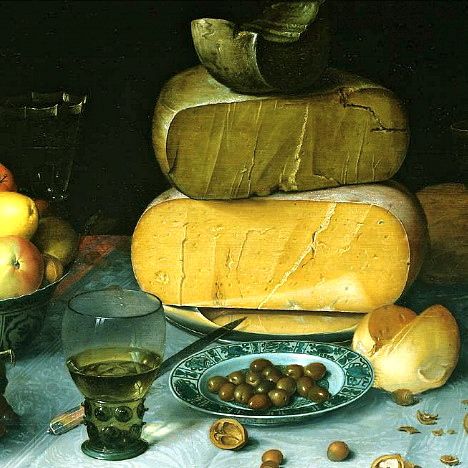
Still Life with Cheese and Olives, Floris Van Dijck, 1615-1620.

The Color of Food, Part One

Recipe: Orecchiette with Broccoli, Bay Scallops, and My Ras el Hanout

I’ve been visualizing the spring greenery that will soon make an appearance at my farmers’ market. I love all the shades of green that nature dreams up, the silvery green of olive leaves, the emerald green of damp moss, the gentle gray green of a stinky, moldy cheese. Green is said to be soothing. That isn’t true for me. I find it invigorating. Green kicks my brain into gear. Looking at green things, like a handful of fresh chervil or a bunch of spring asparagus, focuses me. It seems to make it easier for me to create good food. I usually don’t get stuck in a cooking stupor when I’m confronted with a variety of green, with olives, parsley, capers, green olive oil. I know what to do with green. I’ll make a salsa verde.

I’ve always had strong attachments to colors, associating certain ones with numbers, and the number-color pairings that came to me as a kid still hold: Red is 5, 3 is yellow, 7 is purple, 9 is green. The numbers come up in my head in their numerical form, not written out. I didn’t have numbers for some colors, such as blue. I’m not sure why. Maybe because there isn’t much blue food out there.

I especially like being close to green, my number 9, not necessarily wearing it, since it blends too well with my olive complexion, making me look sickly, but I love sunlight on green glass, and I collect green pottery, and when it comes to food, green is a catalyst for me. Which somehow brings to mind my grandmother’s sautéed broccoli, so soaked with flavor, with garlic, olive oil, white wine, flecks of anchovy, a sprinkling of hot pepper. So delicious. And, oh, the color, so gray.

To preserve the Southern Italian flavor of her homeland, she perpetuated the long, slow cooking style of her ancestors, infusing every fiber of that broccoli—stalks, leaves, and all—with richness. What a glorious sloppy mess it was. As a kid I loved the taste of that broccoli, but now I find it depressing even to think about. What I do to broccoli, I’m sure, would have my grandmother shaking her head in disgust. I blanch it and then shock it in ice water to preserve its brilliant green color. This seems kind of ludicrous even to me, but I can’t stop myself. I want that color. I don’t go so far as to serve crunchy vegetables with no flavor. That would be an Italian culinary sin, but neither do I cook them for hours, as she seemed to do. She’d put on the broccoli, cover the pot, and then go watch As the World Turns and Search for Tomorrow and The Edge of Night.

Harnessing the color of food can be a losing battle, but sometimes it should be. Electric-green roman cauliflower turns pale green when cooked, even with my compulsive blanching. That’s the way it is. It’s a pretty color, certainly not as amazing as when uncooked but not bad. Green beans go gray if you don’t blanch them first. Just ask my grandmother, who would simmer them in tomato sauce for what seemed like days. They were fabulous, but boy were they ugly. My goal as a cook is to capture color while creating flavor. Heat both robs and begets. I’m still trying to work out that delicate little balance.

Orecchiette with Broccoli, Bay Scallops, and My Ras el Hanout

(Serves 4 or 5 as a main-course pasta)

1 pound broccoli, cut into small flowerets, stems trimmed and peeled and cut into small cubes
Salt
2 tablespoons butter
Extra-virgin olive oil
1 Vidalia onion, cut into small dice
2 garlic cloves, thinly sliced
3 anchovy fillets, chopped
About 6 large thyme sprigs, leaves chopped
1 teaspoon my ras el hanout (see note and recipe below)
Dried hot chili flakes, such as Aleppo
1 pound orecchiette
1 pound bay scallops
A splash of dry white wine
½ cup chicken broth
A squeeze of lemon juice
½ cup lightly toasted pine nuts

Set up a large pot of pasta cooking water, and bring it to a boil. Drop in the broccoli, and blanch it for about a  minute. Scoop it from the water with a large strainer spoon, into a colander, and run cold water over it. Now let it drain on paper towels.

Add a generous amount of salt to the water, and bring it back to a boil

In a large skillet, heat the butter and about 2 tablespoons of olive oil over medium heat. Add the onion, and let it soften for about a minute. Add the broccoli, garlic, anchovies, thyme, and ras el hanout, and sauté for about two minutes longer.

Drop the orecchiette into the pot.

Add the scallops to the skillet, season everything with salt and hot chili to taste, and sauté until the scallops are just tender, about a minute. Add the wine, and let it bubble a few seconds. Add the chicken broth, and turn off the heat.

When the orecchiette is al dente, drain it, and add it to the skillet, along with a little lemon juice and the pine nuts. Toss everything well over low heat for about 30 seconds. Transfer to a warmed pasta bowl. Serve hot or warm.

Note: Ras el hanout, a Moroccan spice mix used for couscous and tagines, is a wonderful thing to include in Southern Italian cooking. I make my own, leaving out the usual cumin and cardamom and concentrating more on spices such as cinnamon, nutmeg, black pepper, fennel, and anise, flavors more at home in a Sicilian kitchen. I use it in small doses, not wanting to overwhelm the flavors of the main ingredients, and doing so is also more Sicilian than North African in style. My recipe for ras el hanout makes more than you’ll need for this dish, but consider that a plus. Play with it. I can tell you from experience, it’s great as a dry rub on grilled lamb, or worked into a chicken stew, one containing fennel and olives for instance, or as a flavoring for braised eggplant.

My Ras el Hanout

1 tablespoon anise seeds, lightly toasted
1 tablespoon fennel seeds, lightly toasted
1 tablespoon black peppercorns
1 tablespoon coriander seeds
¼ stick cinnamon
1 tablespoon ground nutmeg
1 teaspoon ground ginger

Put all the whole spices in a spice grinder, and grind to a powder. Add the ground nutmeg and ginger, and mix well. This will stay fresh in a covered spice jar for about a month.

cover

Pasta Improv is now available as a Kindle book on Amazon and a bunch of other places. So if you’re looking to wake up your sleepy pasta head, this is a good place to turn. And  it’s a great deal at only $3.99.

chardin soup

Here‘s my April article for Diane magazine, the publication of Curves Fitness. I’m doing a monthly column called “A Meal in a Bowl.” It’s a full meal for 400 calories. I’m trying my hardest to pack these recipes with flavor and keep to a contemporary Mediterranean style. I hope you like them.

Easter Biscotti

Recipe: Biscotti with Candied Orange and Pine Nuts

I devised these biscotti using the flavors of the Easter Pastiera I love so much but just didn’t have time to make this year. I worked orange flower water, vanilla, and candied orange into these simple biscotti. They’ll give the house the aroma of Easter without the work required for making a real Easter dinner, which, because my mom is sick this year, I’m not finding possible. Friends and family can stop by, have a biscotti and a glass of prosecco, and all will be as well as it can be.

Happy Easter, and grab as much free will as you can.

Biscotti with Candied Orange and Pine Nuts

1 cup all-purpose flour
½ cup sugar, plus a bit extra
A pinch of salt
½ teaspoon baking powder
3 tablespoons cold, unsalted butter, cut into tiny pieces, plus extra for buttering the pan
½ cup candied orange peel, well chopped
1 large egg
The grated zest from 1 large orange
1 teaspoon high-quality vanilla extract
½ teaspoon orange flower water
1 tablespoon orange liqueur
½ cup lightly toasted pine nuts

Preheat the oven to 350 degrees. Butter a  standard-size sheet pan.

Place the flour, 1/2 cup sugar, salt, and baking powder in the bowl of a food processor, and pulse briefly to blend. Add the chopped butter, and pulse a few times, just until the butter is broken down into very tiny bits. In a small bowl, whisk together the egg, vanilla, orange zest, and orange peel, orange flower water, orange liqueur, and pine nuts. Add this to the food processor, and pulse very briefly, just to blend. The mixture should be moist but crumbly. Turn it out onto a flat surface and press it together. Press the dough away from you using the palm of your hand once or twice, so everything  is well moistened. Form the dough into a ball. Cut the dough  in half, and roll each section into a 1-inch-thick rope. If the  dough seems too sticky, dust your hands with flour while rolling  it. Place the two ropes on the sheet pan a few inches apart.  Flatten the tops slightly. Sprinkle lightly with sugar, and bake  until very lightly golden, about 25 minutes. Take the pan from  the oven and let sit for about 5 minutes to cool slightly (if the logs are too hot when you try to slice them, they can break).

When the two ropes are cool enough to remove  from the sheet pan without breaking, place them on a flat surface, and cut them into approximately ¼-inch slices, cutting on an angle using a quick, clean stroke with a sharp chef’s knife (don’t try a sawing motion or you may cause the biscotti to break up).  Place the cut biscotti, cut side up, back on the sheet pan, and  bake for about 10 minutes longer, or until they are lightly browned.  When cool, store in a cookie box, or a basket covered with a  tea towel. They’ll keep about a week.

You can easily double this recipe, but maybe don’t double the orange flower water. It’ll be too strong. Add only a few drops extra.

Women with Fish

Italian woman with fish
Italian Woman Carrying Fish, by Gerard Dillon.

It’s almost Easter. This will be the first year I don’t make Easter dinner. My mother is sick, and she can’t eat, so it seems a little pointless, or at least the pleasure has gone out of it. Being an atheist, I don’t need much to get my mind off of Easter. The food has always been the thing, so now that I’m free to let my mind wander, I find it moving toward women with fish, as it often does. I’m thinking about Italian women and the sea. This is me with a wooden bowl filled with freshly caught branzino. I can tell it’s me in the painting because I own that skirt (Agnes B., bought on eBay),  and I often wear it when I go fishing near Bari (the cross is an Italian fashion statement). My plan is to give most of these fish away. I’ll keep one and grill it whole, stuffed with marjoram and lemon, and I’ll make a simple sauce with marjoram, capers, and olive oil to drizzle over the top. That will be my dinner, to eat alone, outside, sitting on a busted-up wooden chair, while everyone else in Bari is inside celebrating Easter in the usual Puglian way, with artichokes, lamb, fava beans. For a while I was a bit worried about Easter. It seemed odd not to be preparing something traditional like a pastiera. But now that I’ve got a plan, everything will be all right. It’s nice to mix it up a bit.

Happy Easter to you.

Fashionable Food

il_fullxfull.196243594

Hello Italian food fashionistas. A profile of me, along with  one of my recipes for spring garlic, is now up on the Fashion Institute of Technology’s website. Before I embarked on my career as a Southern Italian cooking diva, I considered going into textile design and graduated from FIT. I guess they wondered what happened. Well, they finally found me. Take a look.


A Meal in a Bowl

tumblr_mhxr2n0RYE1qbyk5qo1_500

Hi to all my Italian food loving friends.

I’m now writing a monthly column called “A Meal in Bowl” for Diane magazine, published by Curves Fitness. Just 400 calories a serving. That should be a challenge. Take a look. Next month I’m offering Minestrone with Lamb, Chickpeas, and Spring Greens.

Why I Became a Cook

Medieval-Woman-cooking-with-cat-nearby

Why I Became a Cook, Part One

Often from around age ten to, I guess, close to nineteen, when I was in that wake-dream state right before falling asleep, I’d smell what I can only describe as burning rubber, something like when you drive a car and forget to take the brake off. This would happen five or six times a year. Though the smell began as burning rubber it quickly blended with something more like the aroma of meatballs browning in olive oil. And then I’d fall asleep. This didn’t frighten me, exactly, but I did mention it to a bunch of people, including several school psychologists. I got a lot of shoulder-shrugging and “Oh, that’s pretty weird”-type responses. I tried to find a connection between burning rubber and the wonderful smell of cooking meatballs, but I couldn’t come up with anything even remotely plausible except that these were the years when I first got interested in cooking. Now, that might explain the meatballs, but as for the burning rubber…it’s really hard to say. All I know is that when this occurrence (or was it a visitation?) gradually ended, I missed it. I wanted it to come back. Despite its eeriness, and I suppose out of repetition, those recurring smells became a comfort for me. It also occurred to me, many years after these nighttime smells went away, that this was a sign that aromas and flavors would play a big part in my life, the meatballs possibly representing my victories, the burning rubber standing for my defeats. Wow—a little farfetched, maybe, but it makes as much sense as any other explanation I can come up with.

As a kid cooking became a way to cushion my unease about the future. It stole me away from my clumsy, jittery self to a better place, one with a semblance of grace. Grace was what I went looking for when my young mind was so taut in my own head that I’d wake up with an imaginary vise tightening across my temples. But I could have picked any pastime to blow off steam, making wacky mobiles, collecting Indian dresses, shooting heroin—all popular girlie hobbies on Long Island in the early 1970s. However, the Southern Italian cooking that came from our kitchen smelled and tasted great. This was one aspect of life I had no gripe with.  And here was a craft that could be solitary and social, plus both thrifty and extravagant, and which, in retrospect, was perfect for me. Cooking is a brilliant occupation for an insecure showoff. Ask any chef.

So somewhere in there, between college, CBGB’s,  gallons of cheap booze, and a early ulcer, I decided that cooking it would be. I  put all my meatballs in one basket and tended them anxiously but lovingly (I’m still not sure what I did with all that burning rubber).

And speaking of meatballs, here’s a favorite recipe of mine. It’s not an old family favorite (my mother would never have put rosemary in meatballs. She always used parsley and a pinch of oregano), but something I’ve come up with after years of tinkering with this classic Southern Italian dish. Marsala and rosemary make a beautiful marriage, full of warmth and mutual trust.

Penne and Meatballs in a Rosemary Marsala Sauce

When I’ve ordered pasta with meatballs in Southern Italy it’s always been served, not with spaghetti but with a chunky, sturdy pasta like penne or rigatoni, and the meatballs have most of the time come in a separate bowl (the exception tends to be with baked pasta where the meatballs are mixed in).  But my point is that pasta with meatballs is for real. This is not an American invention (it’s what many American’s have done to it that’s surreal).  My family either mixed small  meatballs (and small is key here) with pasta, or at times, the pasta was tossed with some of the meatball cooking sauce, and then the meatballs were presented as a second attraction, usually along with a salad or cooked greens such as escarole. This will serve four to five people.

For the meatballs:

1 slice country Italian bread (about an inch thick), crust removed
¾ pound ground beef chuck
¾ pound ground veal
3 very thin slices Prosciutto di Parma, excess fat removed and saved to use in the sauce, the meat well chopped
1 small shallot, minced
The leaves from 1 large sprig of rosemary, minced
The leaves from a few large flat-leaf parsley sprigs, well chopped
1 clove, ground to powder
1 large egg
½ cup grated grana Padano cheese
Salt
Freshly ground black pepper
1 tablespoon extra-virgin olive oil, plus about ½ cup or so for sautéing the meatballs

For the sauce:

Extra-virgin olive oil
The prosciutto fat from the meatball recipe, well chopped
1 large shallot, minced
1 small carrot, peeled and cut into small dice
1 large garlic clove, very thinly sliced
2 large sprigs rosemary, leaves well chopped
1 bay leaf, preferably fresh
3 allspice, ground to powder
½ cup dry Marsala
2 28-ounce cans plum tomatoes, with juice, roughly chopped
Salt
Freshly ground black pepper
1 pound penne, ziti, or rigatoni
A handful of flat-leaf parsley leaves, very lightly chopped
1 large chunk of grana Padano cheese for grating

To make the meatballs:  Soak the bread in warm water until it’s nice and mushy. Now squeeze out the excess moisture and break it into little bits. Put this and all the other ingredients in a large bowl and mix it with your hands just until everything is well distributed.  Try not to over work it. You want a loose mixture so the meat isn’t compact. This will make your meatballs cook up tough. And take care to season well with salt and black pepper (I always taste a bit of the raw mix. It’s the best way to check. If this freaks you out for some reason, you can cook a little nugget instead). Shape the mix into approximately half-inch balls and refrigerate until you cook them.

To make the sauce: In a large saucepot or casserole, heat about 2 tablespoons of olive oil over medium flame. Add the prosciutto fat, shallot, and carrot and sauté until the vegetables have softened and the fat has dissolved, about 5 minutes. Add the garlic, rosemary, bay leaf, and ground allspice and sauté a minute or so longer, just until fragrant. Add the Marsala and let it boil for a few seconds. Add the tomatoes, season with salt and black pepper, and cook at a lively simmer, uncovered, for 20 minutes.

While the sauce is simmering, set up a large skillet over medium-high flame and pour in about a half cup of olive oil (you’ll want about ½ inch of oil covering the bottom). When the oil is hot add the meatballs and brown them all over (you may need to do this in batches). When the meatballs are browned add them to the sauce, turn the heat down to low, and simmer, partially covered, until tender, about 30 minutes. Taste the sauce, adding a bit more salt and some freshly ground pepper if needed.

Set up a large pot of water for cooking the pasta and add a generous amount of salt. Bring to a boil and add the ziti.

Using a slotted spoon,  scoop the meatballs from the pot into a bowl.

When the ziti is al dente, drain it and  pour it into a warmed serving bowl. Add a drizzle of fresh olive oil, grate on a little grana Padano, and give it a toss. Spoon on enough of the sauce to coat the pasta well and toss. Return the meatballs to the pot.

Serve the ziti first, with the remaining chunk of Grana Padano brought to the table.

Gently reheat the meatballs in the remaining sauce and transfer them to a serving platter. Garnish them with the chopped parsley and serve with a vegetable such as sautéed escarole or broccoli rabe, or a green salad.

Women with Fish

tumblr_lcoahdmndi1qdlpaqWoman with Small Breasts, Joel-Peter Witkins, 2007

In my opinion this woman has perfect breasts. It’s the fish that are small.