 Woman Loves Fish, Maggie Taylor, 2003.
 Still Life with Tomatoes, Artichokes, and Green Beans, Luis Egidio Melendez, 1716-1780.
Recipe: Romano Beans Braised with Tomatoes, Sweet Vermouth, and Marjoram
Long, flat, and fuzzy, that’s how I like my green beans. Romano beans, a happy memory of my dad’s little backyard garden and a vegetable that oddly creeped out a few of my non-Italian girlfriends when I was a kid. Was it the fuzz? Yes, I think it was the fuzz, but these things are really delicious, especially prepared the way my grandmother and mother always made them, slow simmered, a braise really, with garlic, summer tomatoes, sometimes basil, sometimes dried oregano, occasionally a mix of both. The flavor was deep, the texture soft, amazing with pork chops straight off the grill.
I found Romano beans at Migliorelli’s farm stand at the Union Square market this week, so I went right ahead and prepared them in this old mezzogiorno style, very Campanian (my grandparents came from a sad little town on the border of Campania and Puglia, so their cooking had elements from both regions). These string beans were vital to their summer table. Sometimes my family threw in little cubes of potato. That was good too. Sometimes bacon was added (not even pancetta!), but I thought that was too much and kind of ruined the all around vegetableness of the dish. A little pancetta can be nice, but the smoky flavor of American bacon is, sorry Nanny, overwhelming here.
I play around with this dish every summer, and this year I’m including onion, garlic, a splash of sweet vermouth, and the season’s first tomatoes, and then finishing it off with a scattering of fresh marjoram, which is much better, in my opinion, than dried oregano. I know the dried version of this herb is almost ubiquitous in Southern Italian cooking, but it can be harsh, and why be harsh in high produce season? I’d rather be fresh.
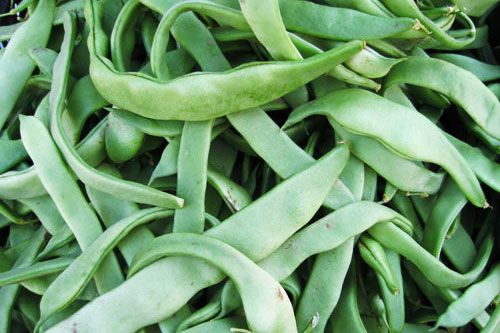
Romano Beans Braised with Tomatoes, Sweet Vermouth, and Marjoram
(Serves 4 or 5 as a first course or side dish)
1½ pounds Romano beans, the ends trimmed
Extra-virgin olive oil
1 medium summer onion, cut into small dice
1 large fresh summer garlic clove, thinly sliced
Salt
⅛ teaspoon freshly grated nutmeg
Freshly ground black pepper
¼ cup sweet red vermouth
3 medium summer tomatoes, skinned, seeded, and cut into medium dice (don’t drain them; you’ll want their juice for this)
About 6 or 7 large sprigs of marjoram, the leaves very lightly chopped
1 tablespoon grated grana Padano cheese
Set up a medium sized pot of water, and bring it to a boil. Drop in the Romano beans, and blanch them for about 3 minutes. Drain them into a colander, and run cold water over them to bring up their green color. Drain well.
In a large sauté pan, heat 2 tablespoons of olive oil over medium flame. Add the onion, and sauté until just starting to soften, about a minute or so. Now add the garlic and the Romano beans, seasoning them with a little salt, the nutmeg, and a few grindings of black pepper. Sauté the beans about a minute, just to infuse them with flavor. Add the vermouth, and let it bubble for a minute.
Now add the tomatoes, and simmer, uncovered, until the beans are very tender, about 5 or 6 minutes. The tomatoes should stay a bit wet, so if they’re too dry, add a little hot water. You might want to turn the heat down a notch if it starts to move into a high boil.
Turn off the heat, add a generous drizzle of fresh olive oil and a few more grindings of black pepper, and let the pan sit on the stove for a minute or so. This well help the flavors develop. Now taste to see if it needs more salt. Add the marjoram, and give everything a stir. Pour the beans, with all their sauce, into a serving bowl, and scatter on the grana Padano. Serve warm.
Posted in Skinny Guinea | 8 Comments »
 Lots of healthy basil on Rosemary’s roof garden.
Rosemary’s
18 Greenwich Avenue (at 10th Street)
New York, NY 10011
(212) 647-1818
On July 4, Oliver, my 90-year-old father-in-law, decided he was strong enough to go out to dinner for the first time after having heart surgery seven weeks earlier. I chose to take him to Rosemary’s, a new Italian place a few blocks from my apartment in the West Village, because he loves to try new places, and because I had applied for a job there, sort of.
My initial interaction with Rosemary’s took place a few weeks before it opened. I saw a write-up in The New York Times dining section mentioning that the new restaurant was thinking about giving cooking classes for kids. Rosemary’s has a rooftop garden where they’re growing herbs, lettuces, and vegetables to use in the restaurant, and the classes are to center on showing local kids how vegetables grow and then teaching them to cook with them. (Considering that most of these local West Village kids also have lovely country homes, I’m not sure how groundbreaking these vegetable demos will be for them, but no matter.) The idea appealed to me, so I walked in while they were still hammering the place together and asked for the e-mail address of Wade Moises, the former chef de cuisine at Eataly and now in charge of Rosemary’s kitchen. I wanted to offer up my considerable teaching expertise. Weeks went by, the place opened, my father-in-law had heart surgery, and I haven’t heard from Mr. Moises. Oh well, you never know. I still might.
So here are some preliminary thoughts about Rosemary’s, based on a pre-opening go see and one dinner since. Not enough for a standard restaurant review, but I never write true critiques. What I do is focus on one special aspect of a place. In the case of Rosemary’s that would be its local produce (very local, since much of it comes from the roof) and its house-made items.
The place is big and airy, with lots of faux rustico touches that are really quite pretty if you don’t examine them too closely. It isn’t the Disneyland of Italian food that Eataly can feel like. My first mission, after procuring a glass of sparkling rosato, was to check out the upstairs garden. It was lush and thriving. It certainly wasn’t big enough to carry the produce load for a large place like this, but it did contain a ton of beautiful basil, and also tomatoes and zucchini blossoms, lots of baby arugula, and herbs, many of which made appearances in our dinner dishes. Everything looked well tended. I’m eager to see how the garden comes together in the future.
There is a flavor of Southern Italy at Rosemary’s. It doesn’t advertise itself as Southern Italian, but its hits of raisins, pine nuts, hot chilies, almonds, anchovies, basil, and lots of lemon are the brash hallmarks of Southern Italian cooking. And there are dishes like caponata, and several labeled as Sicilian.
The menu is broken down into small dishes, salads, pastas, main courses, cheeses, and salumi. I loved the spaghetti with preserved lemon and pickled chilies that Deborah, my mother-in-law, ordered. A touch of parmigiano blended with good olive oil rounded out the stronger flavors for a really nice plate of pasta. I often make something similar that I learned in Palermo years ago, with a flavor that is predominantly fresh lemon. Rosemary’s is more forte. Orecchietti with sausage and broccoli rabe is something we’ve all tasted often. It appears on plenty of Italian menus in this city. But taking the trouble to make both the orecchietti and the sausage on the premises makes a huge difference. The sausage had serious depth of flavor.
Oliver ordered cavatelli with peas, asparagus, and ricotta, and the pasta and ricotta were both homemade, so the result was a chewy pasta with a rich, creamy slick of ricotta—and not too much ricotta, either, so the texture stayed light, not clunky. Deborah started with a chopped salad that was loaded with cubes of ricotta salata and olives, escarole, and capers, another very Southern dish. I love escarole used as a salad green—my mother often served it—so this was a fine combination, as far as I was concerned. I ordered a small dish of cabbage with almonds, raisins, hot chilies, and a little pecorino. It was delicious, and its intense flavor made its small size right. My husband had a celery root and celery salad tossed with anchovy dressing, what they call a celery Caesar. I love anchovy with celery. It’s a combination I often use in my own cooking, but a little goes a long way, and this salad was big. Next time I’d split it.
I followed with two small fish dishes. The first was olive-oil-poached tuna tossed with capers, fried chickpeas, olives, and parsley. The tuna was soft and lovely against the bracing capers and olives, and it was rightly served in a small portion. An octopus salami, called that I imagine because the octopus was sliced really thin, was topped with a sharp sauce of preserved lemon and tomato that to my palate was a little overpowering and salty. We also ordered a house-made capacolla that was very gentle in flavor except for its spicy red dried chili coating. I found it off balance. They also make their own testa, which I’m eager to sample.
On this first try here I found all the dishes well prepared, extremely flavorful, and assembled with high-quality ingredients such as fine olive oil, excellent anchovies and capers, and Maldon sea salt. My only complaint, and it’s not an insubstantial one, is that across the board I found every dish a little too salty. At first I thought it was just the place’s emphasis on salty ingredients, but the three pastas, none containing anything innately salty, were each too salty for me (I think my father-in-law’s taste buds aren’t what they used to be, so he had no problem). This is a common trick used in restaurants to allow flavors to jump out at you and to ensure that the food makes a lasting impression (hopefully a good one). I’m not fond of the trick. I’m trusting, though that at Rosemary’s it’s just a kink that the kitchen will work out as the place settles in. The place hasn’t been open for even a month yet.
Posted in Skinny Guinea | 2 Comments »

Woman with Fish Hat (and kitty), John Bellany, 1987.
Posted in Skinny Guinea | 2 Comments »
 Zucchini Troop, Isabel Bannerman, 2012.
Recipe: Zucchini Sautéed with Fennel, Anchovies, and Mint
I went all Arabo-Siculi on myself this week after finding tiny-as-can-be zucchini and fennel at the Union Square Greenmarket. It’s baby vegetable time again, still pre-tomato, so all is still in shades of green, from pale to profoundly deep.
I came up with a quick sauté with surprisingly complex flavor, using toasted fennel seed and cumin, anchovies, fresh hot green chili, and mint. Toasting and then grinding fennel and cumin seeds together produces a deep, sensual aroma, the whole being, in my culinary opinion, greater than the sum of the parts. And then if you go ahead and layer on anchovy and mint, well, then you’re really cooking with Sicilian benzina. I hope you enjoy this. It’s great served along side a boned-out grilled leg of lamb (perhaps marinated in garlic, rosemary, and red wine).
Zucchini Sautéed with Fennel, Anchovies, and Mint
(Serves 5 or 6)
Extra-virgin olive oil
1 large spring bulb onion, chopped, using much of the tender green stem
2 very tiny fennel bulbs, cut into small dice
1 fresh medium hot green chili (jalapeño is a good choice), thinly sliced
About 10 baby zucchini, cut into small cubes
¼ teaspoon each, fennel and cumin seeds, lightly toasted and then ground in a mortar and pestle.
4 oil-packed anchovy fillets, minced
Salt
A squeeze of fresh lemon juice
A small handful of fresh spearmint leaves, cut into chiffonade.
In a very large, shallow sauté pan, heat about 4 tablespoons of olive oil over medium-high flame. Add the onion, fennel bulb, green chili, and zucchini, and sauté everything together until it’s just starting to brown. Add the spices and the anchovy and a sprinkling of salt, and continue sautéing just until the vegetables are tender and fragrant, about 3 minutes. Add a squeeze of lemon juice, and pour everything into a serving bowl. Add the mint and a drizzle of fresh olive oil, and toss gently. Serve hot or at room temperature.
Posted in Skinny Guinea | 3 Comments »

 Cannellini beans cooking with olive oil and allspice. Beautifully spooky.
Recipe: Cannellini Salad with Sage, Celery Leaves, and Red Shallot
Making cannellini bean salad was one of my tasks while working at Le Madri restaurant in Chelsea many moons ago. It was a pleasant job. I like the way beans smell when they’re simmering, and more important I learned how to cook them so they didn’t get all mushy and explode. This is important esthetically, since you ideally want a neat presentation. They should look like big freshwater pearls, or at least they shouldn’t be a mess of cracked shells and broken, half dissolved beans floating in a pot of sludge.
One way to achieve this, or at least to have a better shot at reaching this goal, is by soaking the beans overnight. I don’t always soak beans, especially if they’ll wind up in a purée, but I find that soaking does plump them up so they can then simmer without having their outsides overcook while their insides remain hard. And it also cuts down on cooking time. Soaking is especially important if you’re using run-of-the-mill supermarket beans, which are what I often wind up with. Usually they’re quite old, dry and brittle, not the previous season harvest you get from small bean growers like Rancho Gordo or Phipps. On the rare occasions when I get my act together, I order from those two (www.ranchogordo.com and www.phippscountry.com). They also have heirloom varieties you won’t ever see on your supermarket shelves, which can make bean cooking a little more romantic.
But I’ve got to say that as lovely as some of these fancy beans can be, I’ve gotten great results using, for instance, Goya, as long as I treat them with dignity. And while I’m on the subject of bean etiquette, I was taught that you never, never add salt or acidy stuff, such as vinegar or lemon, while the beans are cooking. That toughens the skins and can evidently prolong cooking time. I have, however, seen many chefs and home cooks season beans while rock hard with all those things and they’ve come out perfectly tender, so it’s really hard for me to give you a solid opinion on this issue. I never used to add salt, but now I add a little at the beginning of cooking, plus a big drizzle of olive oil and sometimes small shots of herbs or spices. That has a big effect on the taste. When the beans are just tender, I add more salt, turn off the heat, and let them sit in their warm cooking liquid to become really tender and infused with flavor.
The cannellini salad I made at Le Madri was always the same. I’d toss the cooked beans with Tuscan olive oil, celery leaves, sage, red onion, and black pepper. That is still one of my favorite warm weather salads. The mix of celery and sage produces a deep musky flavor. But of course, once you get your beans cooked to perfection, you can flavor them in any number of ways. The only advice I have for you on this subject is not to add a whole bunch of things. You want to taste the beans and the good olive oil.
This recipe is a beauty, but other good bean salads I’ve made have included rings of tender calamari and flat-leaf parsley, or a few chopped anchovies, a handful of capers, and a little fresh marjoram. I also like a mix of black olives, chopped raw summer tomatoes, and basil. Roasted sweet red peppers and fresh rosemary make another great flavoring.
Cannellini Salad with Sage, Celery Leaves, and Red Shallot
(Serves 6 as part of an antipasto offering)
2 cups dried cannellini beans, soaked overnight in lots of cool water
Salt
Extra-virgin olive oil ( I used Ravida, an estate bottled Sicilian oil, for this)
About 5 whole allspice
2 tender inner celery stalks, chopped, plus ½ cup celery leaves, lightly chopped
1 small red shallot, finely chopped
A dozen sage leaves, lightly chopped
The grated zest from 1 large lemon
Freshly ground black pepper
Drain the beans, and put them in a big pot with enough fresh water to cover them by at least 4 inches. Pour on about 3 tablespoons of olive oil, and sprinkle on a little salt. Add the allspice, and bring the water to a boil over high heat. Turn the heat to low, partially cover the top, and simmer, very gently, until the beans are tender. If the water gets low at any point, just add some extra hot water to the pot. The cooking time can vary wildly, depending on how hard your beans were to begin with, but start testing after about 40 minutes. You’ll want to test a few beans, since they can cook up a bit unevenly. When you’ve tasted 4 or 5 beans and they’ve all seemed tender, you’re good. Now, turn off the heat, add a bit more salt, and let the beans sit for about 20 minutes to soak in the salt and to become even more tender. Then drain them well, and see if you can find and remove the allspice. No big deal if you can’t. I like biting into one. It’s a pleasant jolt of flavor.
Drizzle the beans with about 4 tablespoons of really good olive oil. Add all the other ingredients, seasoning well with black pepper. Toss gently. I use my fingers, which work much better than a spoon for minimizing breakage. Taste to see if the beans need more salt.
These beans are wonderful served with a platter of prosciutto and good Italian bread to soak up all the herby olive oil.
Posted in Skinny Guinea | 9 Comments »

A Sense of Place
Part One
New York is certainly a fine place. It instilled in me a taste for expensive shoes, but it never gave me a sense of soil, of a food culture sprung from the ground, the supposedly essential interaction between man and nature that produces lovely things like buffalo mozzarella. I, like many Americans, straddle a gray area between two worlds, one of my ever more remote immigrant past and the other of American overkill. As a cook, I find this split perplexing. I’m not perplexed by what I want to cook. That I’m almost certain will always be inspired by my Southern Italian roots. What upsets me, and makes me really, really jealous at times, is that I perceive I lack the deep connection with my land that real Italians take for granted. At least I think they do. They say they do. What must it feel like, to believe that the dirt where you were born, the soil that grows the grapes that makes the wines where your family has lived for generations, that that soil is in your bones and in your wine? Your ancestors’ ashes are part of the cheese you eat, the wine you drink. Here we feast on everyone’s remains, and no one’s in particular. Is that why most New York State wines taste so terrible to me?
My people, as they say, arrived here through Ellis Island. They may or may not have dragged along some Puglian and Sicilian soil, lodged in their sad, worn-out Southern Italian shoes, but they most certainly brought with them a very fixed idea about what food was supposed to be. How that food changed once it got from the Mezzogiorno to Westchester is something that never became clear to me until I started traveling to Southern Italy and tasting my grandparents’ food on its own turf. The food was similar but different. Was my Italian-American family’s fare a shadow of its former self? I guess you could say it was. Was it something altered but not half bad on its own terms? Yes, that’s a better description.
Good Italian ingredients weren’t available when my grandparents arrived in New York in the 1910s. Bad olive oil (or no olive oil), bad cheeses, bad pasta, and bad wine were all around them, causing grief and frustration in every Italian immigrant community. The solution was to grow it and make it all yourself, as best you could. Everyone planted gardens, made wine, wrapped fig trees to endure the Northeast winters. My family may not have been cooking traditional “nostrano” melanzane alla parmigiano with the eggplants they grew in their mole-riddled Westchester soil, a soil completely lacking in volcanic ash, earthquake residue, and dead relatives, but it tasted great to me (and the eggplants my family produced were huge and lush). In retrospect, the cheeses, olives, and nitrite-heavy salumi my family had no choice but to purchase when I was a kid were terribly harsh, sometimes mouth-sore-inducing, but the heart and the will to carry on as if nothing had changed was inspiring. The aromas from my grandparents’ and parents’ kitchens, and now from mine, both good and not so good, are, it seems forever etched in my soul.
Visiting Castelfranco, the poor, dusty town on the Puglia-Campania boarder where my father’s parents were born, was thrilling. The place had a peculiar aroma, I believe from cooks cooking the same things year after year. It permeated the walls, the ratty little rugs, and the streets in a comforting but I would guess possibly also claustrophobic way. After a few days living in the shadows of my forebears, eating olive-oil-laced taralli and home-made orecchiette with zucchini and wild mint, and drinking their mineraly white wine, and, I must say, loving their truly excellent caciocavallo (a specialty of the region and a cheese now protected by Slow Food), I felt connected, but not as fully as I wished.
As delicious and romantic as I find that food to be (and I swear I will someday make it to Castelfranco’s annual Caciocavallo festival), I couldn’t help but think how miserable I’d be with that unvarying diet. I know that my New York mind would start craving hot dogs and kimchi. Possibly the thought of living within the confines of a regional cuisine scares me. But still I sense that I’m missing out on a core culinary right. And at times it feels like a huge occupational misfortune.
Within my sometimes gnawing sense of soullessness, one thing I do know for certain is that no matter where we live, there is no real sense of place without people. Earth–dirt–has substance but no emotional life without the character of the folks who work and mold it, creating their regional cuisine. And once a culture gets inside you, as a cook, then no matter where you move, no matter how crappy the raw materials you come up against, you will, no doubt, like my family, hold onto the spirit as best you can.
So I’ve talked myself into what I now consider a fact, whether a for-real fact or a whitewash concocted in my own head: Regional cooking evolves from culture more than from nature. This is true, right? But still, that jealousy lingers. Can I live with it? Sometimes.
Calamari Crumble
This is what can happen when an Italian-American is let wild in the kitchen, a morphing of fried calamari and apple crisp, without the apples, thank god.
(Serves 4 as a first course)
Extra virgin olive oil
2 pounds very small, tender squid, cleaned and cut into rings, the tentacles left whole
The juice and zest from 1 lemon
1 cup home-made breadcrumbs, not too finely ground
1 garlic clove, thinly sliced
A small handful slivered almonds, well chopped
½ a medium hot, fresh red chili (a peperoncino is ideal), minced
Salt
A few large mint sprigs, the leaves lightly chopped
1 lemon, cut into wedges
Preheat the oven to 500 degrees.
Choose a large, very shallow baking dish that will hold the calamari on more or less one level (or use four smaller dishes to make individual servings). I use a large, round, Spanish brown-glazed terracotta dish. Drizzle a little olive oil into the dish to coat its surface lightly. Add the calamari, and drizzle on the lemon juice. Toss well.
In a small bowl, mix together the lemon zest, breadcrumbs, chopped almonds, fresh chili, about ¼ cup of olive oil, and a little salt. Scatter half of this over the calamari, and toss gently. Sprinkle the rest of the crumbs over the top. Drizzle with a little fresh olive oil, and bake just until the crumbs are crisp and lightly golden and the calamari is tender, about 3 to 4 minutes. Garnish with the mint leaves and lemon wedges. Serve hot
Posted in Uncategorized | 10 Comments »

Happy Memorial day weekend everyone. I hope you’re planning a for real nice Italian style barbeque. Here’s the way they do it in Genoa.
Posted in Uncategorized | 2 Comments »
 Strawberries, Elizabeth Wilson, 2010.
Recipe: Strawberries with White Wine, Vanilla, Basil, and Orange Flower Syrup
Strawberries are my favorite fruit. I find it amazing that I can say a particular fruit is my absolute favorite, since in my opinion all fruits are unique and delicious, but the strawberry, with its aroma, taste, its crimson color, feels custom made for me. Just about everything I love about life is embodied in a ripe strawberry (except possibly some of life’s alluring darker aspects). Its beauty inspires me, but ultimately I find I don’t, culinarily speaking, do much with it. I prefer strawberries raw. Local ones, the ones I’m finding now at the Greenmarket, are best that way, and organic ones are worth seeking out. I don’t want to contribute to the bad deeds of the mega California strawberry growers who pump the soil with an excess of chemicals instead of rotating their fields.
When I’m not eating strawberries nudo, I like to hull them, pile them in a big bowl, and then make a syrup, usually with some kind of wine as its base. I pour it over the berries right before serving. It’s a nice way to do something to them without doing much. I chill the syrup before dousing them so they stay perfectly uncooked.
I’ve played with different flavorings for my syrups. Red, white, and rosé wines all reduce nicely with sugar to become glossy and thick, with an attractive acidic edge. Vanilla is an especially nice addition because it’s not intrusive the way, say, cinnamon might be. Mint is a good thing to add at the end, but lately I’ve found I like basil much better.
I look for small strawberries and leave them whole. In the spring and even throughout the summer you may find very tiny ones at your farmers’ market that go by the name of Tristar. They’re a cultivated variety bred from wild stock, and they’re generally quite sweet , with the subtle perfume that wild strawberries tend to have. They’re a special treat in this recipe, but any local strawberry, as long as it’s juicy and ripe, will be excellent.
Strawberries with White Wine, Vanilla, Basil, and Orange Flower Syrup
(Serves 4 or 5)
½ bottle dry, non-oaky white wine
⅔ cup sugar
½ a moist vanilla bean, split lengthwise
½ teaspoon orange flower water
2 long strips orange peel
2 pints small strawberries, hulled but left whole
A handful of small basil leaves, left whole (or larger ones ripped in two)
Place the wine, sugar, vanilla bean, orange flower water, and orange peel in a saucepan. Bring to a boil over high heat. Turn the heat down a touch, and let the mixture bubble, uncovered, until reduced by about half (which should leave about a cup or so of liquid). Let cool completely. When cooled it should have the consistency of a loose syrup.
When you’re ready to serve, put the strawberries in a serving bowl, add the basil leaves, and pour the wine syrup over the berries, giving them a gentle stir. Spoon the strawberries, with some of their syrup, into wine or parfait glasses.
Posted in Skinny Guinea | 2 Comments »
-
Welcome to Ericademane.com

I am a chef, food writer, and herb lover who specializes in improvisational Italian cooking. I am the author of The Flavors of Southern Italy and Pasta Improvvisata, as well as Williams-Sonoma Pasta, which is available at Williams-Sonoma stores. A member of the Association of Culinary Professionals, The New York Women's Culinary Alliance, The New York Culinary Historians, The Herb Society of America, and the Italian-based International Slow Food Movement, I live in New York City.
For more about me, see About Erica De Mane.

Buy a copy of The Flavors of Southern Italy.

Buy a copy of Pasta Improvvisata.

Buy a copy of Williams-Sonoma Pasta.Buy a copy of my ebook, Pasta Improv

 Erica De Mane