![photo[3]](https://ericademane.com/wp-content/uploads/2013/12/photo3.jpg) This beautiful photo is by Lisa Silvestri
This beautiful photo is by Lisa Silvestri
Here’s my December column for Curves magazine. It’s for a boeuf Bourguignon, lightened down to 400 calories per serving, but with all the flavor intact. Enjoy!
This beautiful photo is by Lisa Silvestri
Here’s my December column for Curves magazine. It’s for a boeuf Bourguignon, lightened down to 400 calories per serving, but with all the flavor intact. Enjoy!
Posted in Uncategorized | Leave a Comment »

This lovely fish lady looks happy, but actually she’s had a rough life. Pammy was a friend of my godmother, Regina, who also worked at Marineland, not as a mermaid but as a dolphin feeder. Pam’s struggle to keep her weight low enough to slither into her costume, month after month, year after year, was common knowledge among the other Marineland employees. The diet pills she lived on made her jittery and short-tempered, sometimes causing dramatic confrontations that would bring Regina to tears, even though they were truly the best of friends. Pam once accused my godmother of feeding the dolphins putrid pompano innards, an accusation that I’m sure was simply not true. Regina loved her dolphins and only served them the best.
Pammy’s head was full of noise, and it was the noise deep in her brain, the anxious whooshing of the ocean, the constant chattering of seagulls, commotion that couldn’t be tamped down by shots of the best scotch, that was the worst side-effect of all the medication. Her head was full of the sea, preventing sleep, destroying her smile. Poor Pam was becoming the Judy Garland of the marine world.
Pammy often spoke with Regina about her weight problem. Why, Pam wondered, couldn’t they just give her a slightly bigger fish tail, something with a little breathing room? Ask the boss, Regina urged, but when she finally got enough courage to face down the big man, he told her, “That, Pam, would be defeating the purpose.” She understood, sort of, and she struggled, holding on to her sometimes humiliating but lucrative job for too long.
As the years went by, Regina watched helpless as her friend turned into a bitter and exhausted, but still svelte, older mermaid. Pammy was clearly spent. But she carried on, until one sultry day, right after New Year’s, when she just disappeared. Regina suspected she had been knocked up by a dolphin trainer she’d lately been drinking Kahlua with, but if anyone knew for sure, no one was saying. Her five fishtail outfits were missing. Strange. Where would she need a wardrobe like that, except at Marineland, my godmother wondered. Several months went by. Detectives showed up, long lost cousins called, and her tiny cottage in the Las Olas Riverfront section of Fort Lauderdale was turned upside down; nothing. Regina was distressed. Could she be gone?
Then in the middle of the dull month of March, Regina got a surprise phone call. It was Pammy. She was, as Regina initially thought, pregnant with the Kahlua man’s child, and she had a new job. Pam now held a position at Sea World in San Diego, working as a mermaid. Regina couldn’t believe she had left for the same damn job. But, as Pammy pointed out, “here they’ll let me keep my child,” and, she proudly added, ” they don’t care that I’m getting fat. I might even give up the diet pills”. Well, my godmother thought, that is more or less some pretty decent news.
Posted in Skinny Guinea | 5 Comments »
 Radicchio di Treviso with a Bowl, Jo Young, 2011.
Recipe: Radicchio di Treviso Roasted with Anchovies, Butter, and Parmigiano Breadcrumbs
Thanksgiving dinner is okay, but truthfully it’s never been my favorite collection of flavors. In my opinion it always needs a few anchovies.
I’m just now finding the pleasurably bitter, wine-red-colored radicchio called rosso di Treviso in my markets. It’s really a beautiful thing, like a cross between a Belgian endive (which it’s related to) and a red tulip. I specifically mean the Treviso variety named Precoce, I believe because it’s the first to be harvested. There’s also a type called Tardivo that resembles a dark red and white cluster of long, skinny fingers. It’s a knockout, but unfortunately I can’t find it very often. Still, I’m happy with the compact Precoce. It’s excellent either grilled or roasted. For Thanksgiving, roasting is my choice.
Radicchio can handle heavy seasoning, and even the addition of anchovies won’t mask all that wonderful Italian bitterness. The salty little fish meld with it, producing a taste that’s truly greater than the sum of its parts—as often happens when you combine profound flavors. You so need a dish like this to cut through all the stuffing, turkey, gravy, and mess of gentle, somewhat sweet, soft vegetables that always show up on the Thanksgiving table. I see it as an Italian version of cranberry sauce, serving the same jolting purpose but in a more elegant way.
Happy Thanksgiving to you.
Radicchio di Treviso Roasted with Anchovies, Butter, and Parmigiano Breadcrumbs
(Serves 6 or 7 as a side dish)
Extra-virgin olive oil
8 radicchio di Treviso, cut in half lengthwise (I used small ones; their size varies greatly, and if you can only find large radicchio, judge how much you’ll need and add a few minutes to the cooking time)
½ cup dry vermouth
3 tablespoons unsalted butter
1 garlic clove, peeled and lightly crushed
6 oil-packed anchovies, minced
½ cup homemade, not too finely ground breadcrumbs
Salt
Freshly ground black pepper
½ cup grated Parmigiano Reggiano cheese
A few large thyme sprigs, leaves chopped
Preheat the oven to 400 degrees.
Choose a shallow baking dish that will fit all the cut radicchio in one layer. Coat it with a little olive oil. Lay the radicchio in the dish, cut side up. Pour the vermouth over the radicchio.
In a small saucepan, heat about 2 tablespoons of olive oil with the butter, the garlic clove, and the anchovies, just until melted. Press down on the garlic a bit to release its flavor, and then discard it. Pour the butter mixture over the radicchio.
Bake, uncovered, until the radicchio is wilted and tender when poked with a knife, about 12 to 15 minutes .
Mix the breadcrumbs with the cheese, a drizzle of olive oil, and the thyme. Season with a pinch of salt (remember, you’ve already added anchovies) and more liberally with black pepper. Sprinkle this over the top. Run the radicchio under a broiler, just until the crumbs are lightly golden and crisp, about a minute or so. Serve hot or warm.
Posted in Skinny Guinea | 10 Comments »
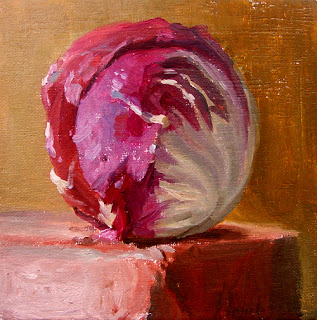
Radicchio, Noah Verrier, 2008.
Recipe: Cavatappi with Radicchio, Fontina, and Walnuts
Radicchio sometimes has me stumped. Bringing those pretty red things into my kitchen can send me straight to cooking block hell. Another salad with a scattering of radicchio? That’s just not how it’s supposed to be. In Italy, no matter how popular the tre colore salad has become there, most people serve radicchio cooked. But when it’s heated, its bitter taste and diminished beauty can be disheartening. However, I took a vow many years ago never to be defeated by any vegetable. And so it will be.
The challenge is to find flavors that marry well with radicchio’s bitterness. That isn’t an issue when I’m just throwing it into a salad, but cook it and its flavor opens up, wandering all over the dish, making it hard to imagine served any way other than unadorned. Still, I’ve had my triumphs, getting my best results by adding strong or rich contrasting flavors such as anchovies, pancetta, and certain distinct cheeses, like gorgonzola or the fontina I’ve used in this pasta. Fontina is very umami. It’s a complex and truly savory cheese. It tempers the cooked radicchio, making it alluringly bitter, not overbearingly so. It melts into a creamy sauce, clinging to the pasta and to the vegetables but without the one-note quality you can get when you simply add a flood of cream.
I find three types of radicchio, a member of the chicory family, in my markets, although in Italy there are many more. The round, tightly wound Chioggia variety is a constant presence in all food shops. The long, dark, red-striped Rosso di Treviso I see mostly in cool months. The radicchio that looks like a glamorous, fully blooming rose, white with thin pinkish striping, the one from Castelfranco, I find only occasionally. These and all the other varieties were originally developed in the Veneto and Trentino regions.
With its rich, well-defined flavors, this dish is for me a clear example of a pasta best as a first course, the way it’s almost always served in Italy. In my effort to balance carbs, proteins, and fats in my own diet, I’ve been trying to reacquaint myself with the true Mediterranean diet. Pasta, except on holidays, was a main course in my family, and that’s what I got used to growing up. Reining in my Italian-American habit of eating has not always been successful. I still love sitting down to a huge bowl of pasta and nothing else. But in Italian tradition, one pound of pasta serves six. (Really.) That’s not such a hardship. Small can be big. It makes me delight in every mouthful. I’d follow this pasta with a piece of roasted chicken and a green salad. That’s a well balanced meal.
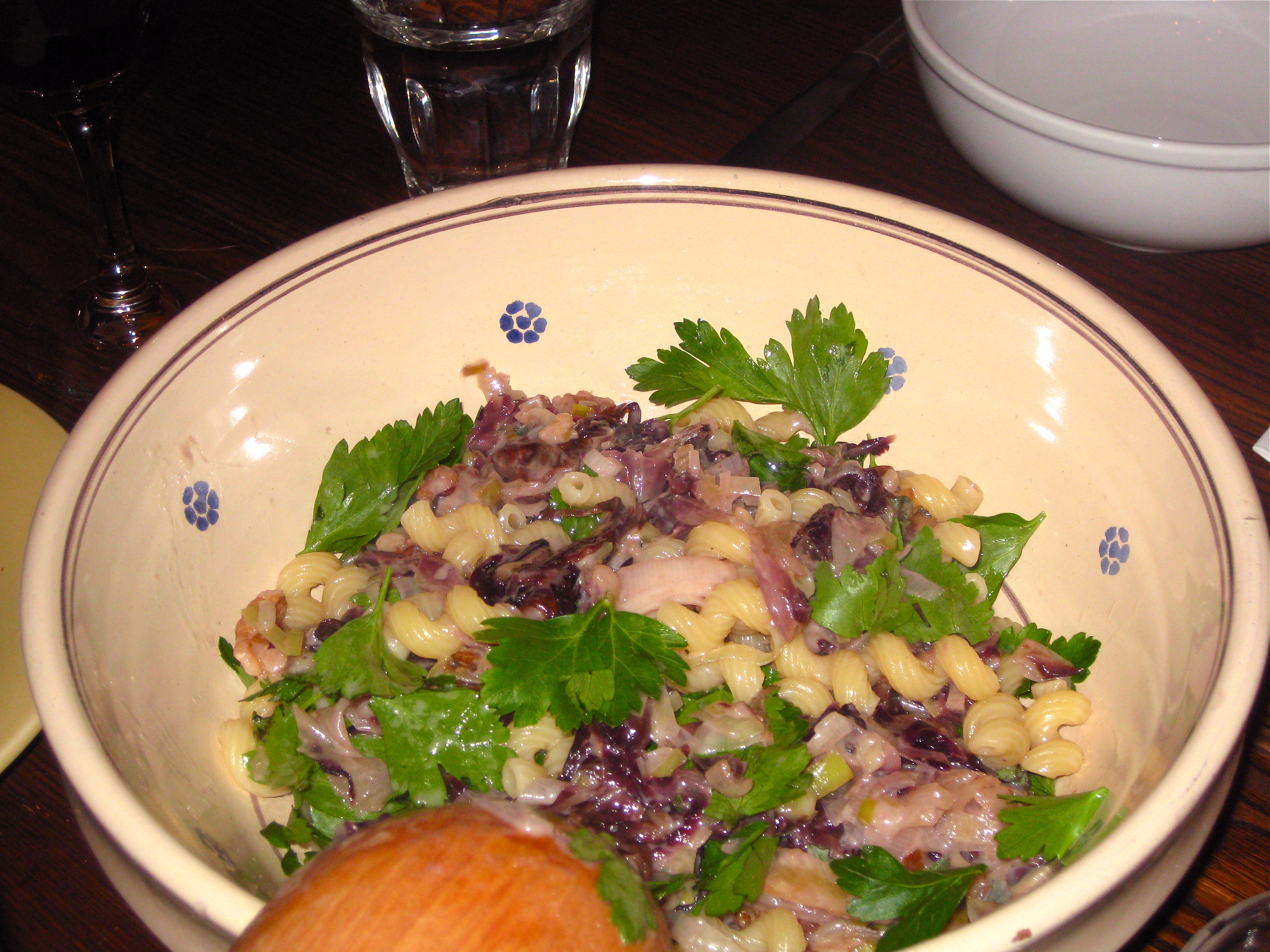
Cavatappi with Radicchio, Fontina, and Walnuts
(Serves 6)
Salt
1 pound cavatappi
Extra-virgin olive oil
2 medium-size round radicchio, cored and cut into approximately 1-inch-thick strips
2 large leeks, the white and tender green parts, diced
1 cup really fresh walnut halves
A splash of sweet Marsala, or another semi-sweet wine
A few big scrapings of fresh nutmeg
½ pound fontina Val d’Aosta cheese, cut into small cubes
A generous handful of flat-leaf parsley, lightly chopped
A few sage leaves, lightly chopped
Set up a large pot of pasta cooking water. Add a generous amount of salt, and bring it to a boil. Drop in the cavatappi, and give it a stir so it doesn’t stick together.
In a large skillet, heat about 2 tablespoons of olive oil over medium flame. Add the leeks, and sauté until just starting to soften, about 3 minutes. Add the radicchio and the walnuts, seasoning with a little salt. Sauté until the walnuts are fragrant and the radicchio has wilted, about another 4 minutes. Add the Marsala and the nutmeg, and cook about a minute longer.
Turn the heat to low, and add the fontina, stirring it around to help it melt. Turn off the heat.
When the cavatappi is al dente, drain it, saving about a cup of the cooking water. Add the pasta to the skillet, along with enough pasta cooking water to loosen the sauce. Stir until the fontina has melted (off the heat should work well, as the heat from the pasta and the skillet will be just enough to finish cooking the sauce). Transfer to a big bowl, add the fresh herbs, and toss gently. Serve hot.
Posted in Skinny Guinea | 8 Comments »
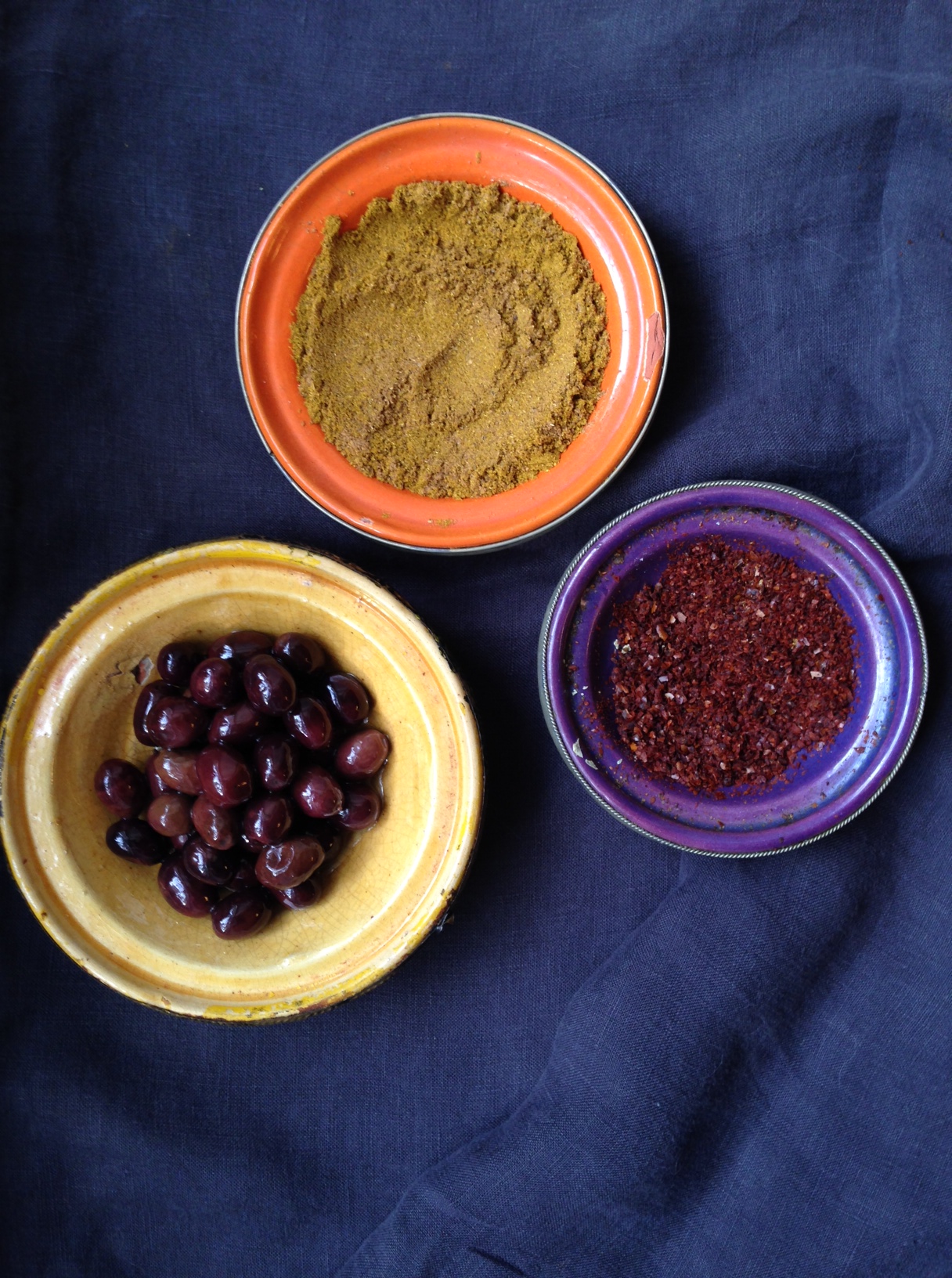 This lovely photo is by Lisa Silvestri
Here’s my November column for Curves magazine. It’s a recipe for Moroccan leg of lamb with roasted fall vegetables, heavy on the parsnips, my favorite. It’s got a spiced yogurt sauce. But best of all, it’s only 400 calories a serving. Enjoy.
Posted in Uncategorized | 2 Comments »
 Woman Gathering Herbs, Camille Pissarro, 1880.
Recipe: Escarole Salad with Sautéed Rosemary Pears, Pine Nuts, and Ricotta Salata
Italian-Americans were way ahead of everyone else in their love of bitter, a cooking angle that’s recently been taken up by restaurant chefs around the country. Bitter greens are now trendy, but their pull has always been in my blood. And on it goes, a bittersweet holdover from my ancestors’ days spent foraging for wild greens on sun-baked hillsides. Arugula, broccoli rabe, dandelions, escarole, and chicories of all sorts were on my family table when I was a kid, cooked and raw. Arugula wasn’t available at all in most markets in the sixties and seventies. My father planted cuttings that our neighbors had smuggled in from Sorrento. The stuff grew like the weed it is, taking over his little garden. Dandelions we picked from our lawn. I adored all those greens back then, and my admiration just grows. I’m constantly looking for new ways to serve them, stepping away easily from the traditional garlic and olive oil treatment.
My mother made raw escarole salads, usually with red onion, tomato, and maybe a handful of cubed provolone (this was before it was popular to shave cheese), tossing it all in a simple vinaigrette, whose only drawback, as far as I was concerned, was the presence of dried oregano, never a favorite taste for me. It was a great salad, and escarole is my favorite salad green. I love its ruffly edged, sturdy leaves, and light green color. It is faintly bitter when raw but also juicy, and it’s a really good mixer. Capacollo, pecorino, fruit, nuts—whatever you want to add, it can take it, so it’s an excellent base for improvisation.
Here’s my new fall take on the escarole salad.
Escarole Salad with Sautéed Rosemary Pears, Pine Nuts, and Ricotta Salata
(Serves 4)
2 ripe but firm pears (green or red Anjou, Bartlett, or Bosc would be my choice), unpeeled and cut into approximately ¼-inch-thick slices
Extra-virgin olive oil
A small shallot, red if available, thinly sliced
Salt
Freshly ground black pepper
A big pinch of sugar
2 sprigs rosemary, leaves well chopped
1 large head escarole, torn into small pieces
A big handful of pine nuts, lightly toasted
¼ pound ricotta salata, crumbled
1½ teaspoons Spanish sherry vinegar
½ teaspoon soy sauce
A few scrapings of nutmeg
1 garlic clove, peeled and crushed
In a medium skillet, heat about a tablespoon of olive oil over high flame. When hot, add the pears and shallots, and season with a tiny pinch of salt, black pepper, a big pinch of sugar, and the rosemary. Sauté quickly, just until the rosemary gives off its aroma, about a minute or so. You only want to take the raw edge off the pears, not cook them through.
Place the escarole, pine nuts, and ricotta salata in a large salad bowl. Add the pears.
Whisk together the vinegar, soy sauce, nutmeg, garlic clove, and about 2 tablespoons or so of olive oil, seasoning with salt and black pepper. Pour this over the salad. Toss gently.
Posted in Skinny Guinea | 10 Comments »

Italy in the fall.
Recipe: Broccoli Rabe with Serrano Ham, Black Olives, and Piment d’Espelette.
Are you in a fall vegetable rut? Squash and cabbage got you down? I hear you. How about this, for the moment: Put those impenetrable pumpkins aside and focus on the bitter cool weather vegetables broccoli rabe, escarole, chicory, and radicchio. Aren’t they a little more exciting? I think so, but sometimes figuring out how to get a new slant on a bitter vegetable can be difficult. Their natural flavor is so profound that I tend to think it best not to try to one-up it. Just let their bitter beauty shine, unadorned. But you needn’t be held hostage by radicchio or broccoli rabe.
Broccoli rabe is a vegetable that inhabited my childhood, like many Italian-Americans’. It was always on the table, seasoned simply with sliced garlic, olive oil, and sometimes a few anchovies. It seemed to go well with everything. (Now that I think about it, I suppose that’s because my family always made Southern Italian food.) Everyone who ate at my family’s table encountered broccoli rabe, either as a side dish or tossed with pasta. Non-Italians almost always pulled back, maybe nibbling a bit but inevitably not caring much for it. I can only say I’ll bet they’re eating it now. It’s on every trendy restaurant menu. It’s a gorgeous and amazing work of nature. Orecchietti with broccoli rabe and anchovies remains to this day one of my all-time favorite pastas.
As much as I love broccoli rabe, it can sometimes take a little prepping to bring out its best flavor. When it’s not cooked enough or not cooked properly, I often detect a slight Clorox taste. That taste, it seems to me, only emerges when I (or somebody else) sautés the greens without blanching them first. I always blanch them, just for about two minutes. Not enough to break down the broccoli rabe, but enough to wash away that flavor. What does that chlorine taste come from, I wonder? I never taste it in regular broccoli. Have you noticed it? I became curious, so I decided to find out what exactly is in broccoli rabe. It turns out it contains pantothenic acid, zinc, copper, vitamins A, E, C, K, and B6. It also has thiamin, riboflavin, niacin, folate, calcium, iron, magnesium, phosphorus, potassium, and manganese. Wow. Sorry I asked. Very healthy stuff. Clorox is primarily chlorine and sodium hydroxide, so, gee, any scientists out there?
To my palate, bitter blends best with sweet or salty. For my broccoli rabe I chose to go salty, adding Serrano ham and a handful of black Niçoise olives. I find Serrano ham sturdier than prosciutto. It doesn’t get spoiled by a little heat, and you can actually chop it into neat strips. And Niçoise olives have a nice mellow note, not taking over a dish the way, for instance, kalamatas might. I finished it off with my current favorite mild pepper, piment d’Espelette, from the Basque region. (I know. You’re asking, do I have to go out and buy this? Yes. You’ll be doing yourself a big favor. It’s a sweet, deeply flavored but only mildly hot paprika, perfect when you want just a touch of heat but a lot of savoriness.)
I sometimes like to make one well-thought-out vegetable dish my entire dinner. It’s a great way to lose weight without boring yourself to tears. (Steamed vegetables? Not for me, thanks.)
Broccoli Rabe with Serrano Ham, Black Olives, and Piment d’Espelette
(Serves 2 as a main course)
1 large bunch broccoli rabe, tough stems removed
Extra-virgin olive oil
2 garlic cloves, thinly sliced
A splash of chicken broth
3 thin slices Serrano ham, cut into thin strips
The grated zest from 1 lemon
A dozen or so black Niçoise olives, pitted
Piment d’Espelette pepper
Salt, if needed
Blanch the broccoli rabe in a large pot of boiling water for 2 minutes. Drain it, and plunge it into ice water to stop the cooking. Now squeeze out as much water as you can. Cut down any really big pieces to a more manageable size.
In a large skillet, heat a tablespoon or so of olive oil over medium-high heat. Add the garlic, and cook just until it gives off an aroma but doesn’t brown. Add the broccoli rabe, and sauté for about 2 to 3 minutes. Add a splash of chicken broth (just enough to add a touch of moisture). Turn off the heat, and add the ham, lemon zest, olives, and a generous pinch of piment d’Espelette. Toss well. Taste for salt. You might not need it.
Serve with slices of garlic-rubbed bruschetta. Follow with a ripe pear and a chunk of Fontina. A perfect dinner.
Posted in Skinny Guinea | 8 Comments »
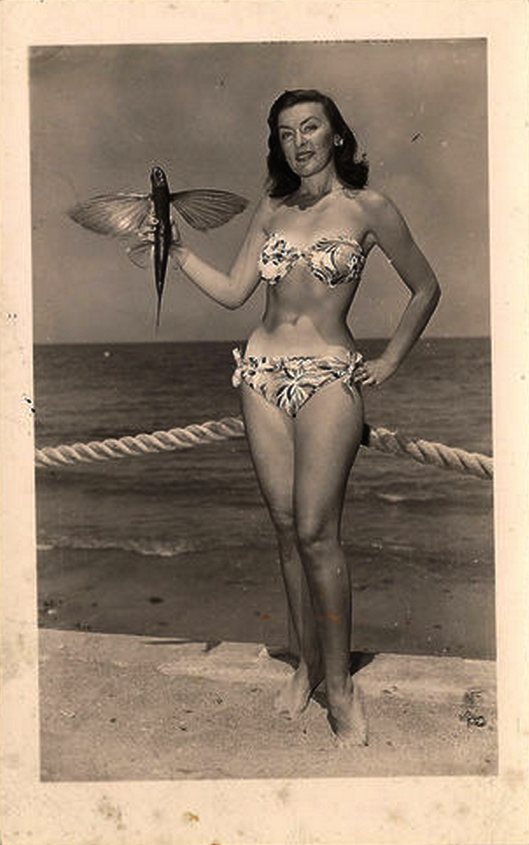
Here’s my aunt Filomena on vacation in Key Largo, I would guess around 1952 or ‘3. She’s got herself a flying fish. Not sure how exactly, but there it is. The guy who took the photo, Nick something or other, became so upset by her “haughty” attitude, owning that fish (which she soon threw back in the water), he left her stranded in the Keys, with 15 bucks but with a much clearer outlook on life.
So here’s a rule, be you man or woman, or landing someplace in between: If a potential date can’t deal with you on tiptoes, dressed in hibiscus, and proudly posing with a gorgeous force of nature, that person is not worth the trouble. And what happened to lovely Filomena? Well, she opened the most influential trinket shop in the Keys, stocked with sand dollars, fishing nets, dried seaweed, bug spray, and maps of Cuba. She was a charming delight and hosted many memorable parties for local fisherman, even creating her own signature drink, the Salty Miss, a blend of gin and sea water, garnished with an anchovy-stuffed olive. Several worthwhile lovers, bolder and smarter than that idiot Nick, took photos of her with various fish, including a giant squid ( all on display in her shop), up until the day she passed peacefully, from sun stroke, at age 68. Good show aunt Fil.
Posted in Skinny Guinea | 9 Comments »
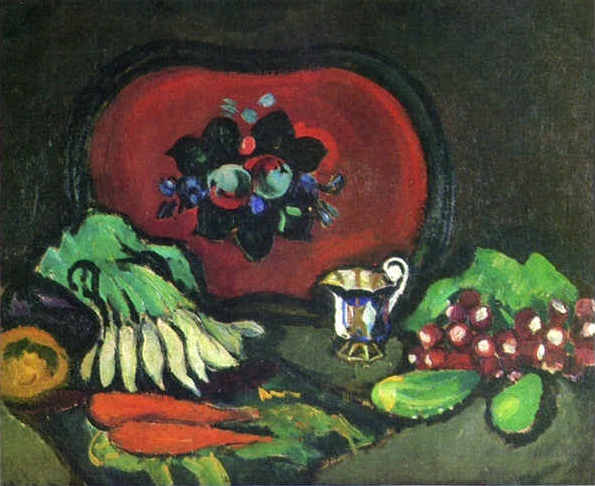
Tray with Vegetables, Pyotr Konchalovsky, 1910.
Recipes: Brussels Sprouts with Pancetta, Rosemary, and Fennel Pollen; Braised Carrots with Marsala and Sicilian Capers
I haven’t played with fennel pollen in a while. It was such a chef fad a few years back that since then I’ve had trouble getting the smell out of my nose. But recently, while on a mission to work more vegetables into my meals, I reintroduced myself to its beautiful aroma, one that goes very well with early fall vegetables, especially, to my taste, members of the brassica family—all the cabbages.
I’ve been cooking tons of vegetables, but do I want to eat them all? Yes, because another part of the assignment I’ve given myself is to come up with unexpected seasonings, not just going on automatic pilot—falling back on garlic and hot chilies with broccoli rabe, raisins and pine nuts with spinach, an approach that, at this point in my culinary life has no business in my head anyway. Now I’m keeping my herbs and spices rotating and revisiting flavors I might have neglected. So I find myself again with a little jar of fennel pollen, the fragrant bits collected from fennel’s firework-like cluster of tiny yellow blooms, which when dried take on an intense but sweet flavor. This stuff is more directly fennel than fennel seeds are, and it’s devoid of the bitter aftertaste that the seeds can have. If you haven’t used fennel pollen in a while or have never tried it, give it a shot. Last week I scattered a little into my broccoli rabe and sausage pasta. Transformational. And I think you’ll really like this new Brussels sprouts creation of mine. The fennel pollen lightens up what can often seem a too strongly flavored and dense vegetable.
Also, don’t forget your Sicilian salt-packed capers from Pantelleria or Lipari, the best capers in the world. They’re not just for fish. They’re gentle and sweet and have less acidity than vinegar-packed ones, so they don’t overpower most vegetables. Here I’ve paired them with carrots. The capers give them a little kick, cutting their sweetness and breaking through their sometimes soapy undertone. (Do you ever get that taste from carrots? And I’m not just talking supermarket carrots.)
Please let me know if there is a fall vegetable you’ve gotten into a rut with. That predictable butternut squash soup again? Another kale salad with dried cranberries? Whatever might be bogging you down, send it along. I’ll think it through for you.
Brussels Sprouts with Pancetta, Rosemary, and Fennel Pollen
(Serves 4 as a first course or side dish)
Extra-virgin olive oil
1 pound small Brussels sprouts, trimmed and cut in half
About ¼ cup chopped pancetta
2 small leeks, trimmed and cut into thin rounds
1 garlic clove, thinly sliced
½ teaspoon fennel pollen
3 small sprigs of rosemary, leaves chopped
Salt
Black pepper
A splash of dry vermouth
The zest from 1 lemon
Heat a tablespoon of olive oil in a large skillet over medium heat. When hot, add the Brussels sprouts, pancetta, and leeks. Sauté until the pancetta is crisp and the vegetables are lightly golden, about 5 minutes. Now add the garlic, the fennel pollen, and the rosemary, and season with salt and black pepper. Sauté a minute longer, and then add the vermouth, letting it boil away. Add a big splash of warm water, and cover the skillet. Turn the heat down to low, and cook until just tender, about another 3 or 4 minutes. You should have a little liquid left in the skillet. Add the lemon zest. Good hot or at room temperature.
* * *
Braised Carrots with Marsala and Sicilian Capers
(Serves 4 as a first course or side dish)
3 tablespoons unsalted butter
12 carrots, peeled and cut into 2-inch batons about ½ inch thick
1 teaspoon sugar
Salt
5 big scrapings of nutmeg
⅓ cup dry Marsala
A drizzle of extra-virgin olive oil
Freshly ground black pepper
A palmful of salt-packed capers, soaked and rinsed
A few large sprigs of tarragon, leaves lightly chopped
Choose a wide skillet, with a lid, that will more or less hold the carrots in one layer. Melt the butter over medium heat. Add the carrots, sugar, nutmeg, and salt. Sauté a minute or so to lightly caramelize the sugar. Add the Marsala, and let it bubble for a few seconds. Reduce the heat to medium-low, cover the skillet, and simmer until the carrots are just tender, 5 minutes or so.
When the carrots are about a minute away from done, uncover the skillet, and cook to let the liquid evaporate to a moist glaze. Add the capers and a drizzle of olive oil, and season with black pepper and a little more salt, if needed. Transfer to a serving dish, add the tarragon, and give it a quick toss. Serve hot.
Posted in 2013, Skinny Guinea | 9 Comments »
![IMG_5714[1]](https://ericademane.com/wp-content/uploads/2013/10/img_57141.jpg) Photo by Lisa Silvestri
Photo by Lisa Silvestri
Here’s my November column for Curves Fitness magazine. It’s a big, warm meal in a bowl, full of cannellini beans, escarole, shrimp, capers, garlic, oregano, all great Italian flavors. And it’s only 400 calories a serving. Can’t beat that. I hope you enjoy it.
Posted in Uncategorized | 8 Comments »


 Erica De Mane