Feeds:
Posts
Comments

Mosaic_in_Villa_Romana_del_Casale,_by_Jerzy_Strzelecki,_06.jpg
Ancient Roman grilling, in a fresco at Piazza Armerina, Sicily.

Recipe below: Grilled Peperoncino Chicken with Spice and Herb Yogurt Salsa

Grilled fat smells really good to me. Sizzle chicken skin over red-blue charcoal, and it will crisp up to form a coating that tastes fantastic, feels good going down, and protects the juicy meat it encloses. I think back on the barbecues of my childhood, in our little New York backyard, the sagging green awning over the grill catching all the smoke, our eyes burning (we could have moved the grill out from under, but no one ever did, because, who knows,  it could start to rain), a big wheel of luganega inevitably starting the show (a light appetizer, to my father’s way of thinking).

For years and years that theatrical sausage, held together with wooden skewers, and its aroma defined our family cookouts. But lately, messing around on my own grill. I’ve found that chicken brings back my most intense flavor memories. My father, the grill master of my childhood, is long gone, so now it’s up to me to keep that fire burning. Chicken, my father always said, is “a tricky son of a bitch.” You had to pay real attention to hit the perfect midpoint between “blackened to death,” as my mother called it, and raw. Each piece of chicken had to be repeatedly evaluated, more red wine consumed, a thigh moved around or turned, a drumstick taken off early, others left to cook longer, to avoid “bloody at the bone,” which nobody could tolerate. The worst was blackened to death and still bloody at the bone. We’ve probably all been there at some point. It’s complicated.

At my new upstate cottage, I’m getting myself reacquainted with the grill. I first cooked shrimp, a whole sea bass, steak, and lamb kebabs. All went smoothly. Last week I tried chicken, using only dark meat. (Breast meat is easy to dry out, which is one reason my father’s chicken got unnecessarily complicated, so I avoid it.) Even so, I felt his little grill dance begin in my head, working its way down to my tongs and spatula. I began moving pieces around. Some were darkening too fast, others looked flabby. At least my mother wasn’t around to supervise. So up to the warming rack some pieces went, while others got shoved to the side, away from the direct flame. The red wine flowed. Things started to come together. And, I have to report, my chicken eventually came out just about perfectcrisp, not too black, juicy inside, and spicy with fresh peperoncino, the way my father often seasoned it. Playing daddy is fun.

I’ve paired this diavolo chicken with something my father would never have thought to make, a North Africa-inspired spice and herb yogurt. I’m now growing dozens of herbs upstate, way more than I had room for on my city windowsills, and I try to come up with new ways to use them as often as I can. For this salsa I chose spearmint and lemon thyme; if you like cilantro,  use that in place of the thyme. Italian parsley or basil would be good, too.

(Serves 4)

For the yogurt salsa:

½ teaspoon cardamom seeds
½ teaspoon coriander seeds
½ teaspoon cumin seeds
1½ cups full-fat Greek yogurt
1 summer garlic clove, minced
2 tablespoons extra-virgin olive oil
Sea salt
12 big sprigs spearmint, the leaves well chopped
6 or so large sprigs lemon thyme, the leaves chopped, plus a palmful of small sprigs to garnish the chicken
A squeeze of fresh lemon juice

For the chicken:

6 whole chicken legs, cut into thighs and drumsticks
4 summer garlic cloves, peeled and lightly smashed
1 tablespoon za’atar spice mix
1 fresh red peperoncino, minced
1 teaspoon pimenton de la vera (Spanish paprika), or another medium-spicy smoked paprika
1 tablespoon extra-virgin olive oil
1 shot cognac or grappa
1 teaspoon warm, runny honey
Salt
4 chopped scallions, for garnish

Toast the cardamom, coriander, and cumin seeds over low flame just until their aroma rises up from the pan. They shouldn’t color. Stick them in a spice grinder or a mortar and pestle, and grind well. Put the yogurt in a small bowl. Add the garlic and the ground spices, and whisk in the olive oil. Add the spearmint and lemon thyme and some sea salt. Add enough lemon juice to give it all a light kick. Stir everything well. Now thin the sauce with a little warm water. (It should be liquid enough to run off a spoon into a thick puddle on your plate, but still thick.) Let sit while you prepare the chicken.

Put the chicken in a big bowl and add all the other “for the chicken” ingredients except the scallions. Toss well, and let sit at room temperature while you start up your grill.

I use charcoal, so I need about a half hour to get to glowing coals with no wicked flames. Whenever your grill is ready, place the chicken on it, presentation side up. If it flames up, cover the top until the flame dies down. Grill until the skin is well browned and crispy but not the dreaded black that drove my mother crazy. Give the pieces a turn, and crisp up their other side. Then move them to the edge of the grill, to let them cook through without taking on too much more color. This whole process should take about a half hour, and since you’re using all dark meat, the pieces should cook through evenly in about that time. If you find that the thighs need a little longer, move the drumsticks to the warming rack. Test for doneness by pressing on the thigh meat or the thickest part of the drum stick. It should be firm but still have a little spring to it.

Pile the chicken up on a big platter. Scatter on the scallions and the palmful of lemon thyme. I always add a little more sea salt after grilling, since a lot of it will have been grilled off, but that’s up to you.

Serve with the yogurt salsa.

manon+gauthier+via+carnet+imaginaire
Thyme, by Manon Gauthier.

Recipes below: Black Olive and Thyme Butter for Summer Radishes; Wild Fennel, Thai Basil, and Parsley Pesto, for Grilled Fish

Ever since I started growing my own herbs, first on my city window sills and in stoop pots, and now at a small upstate house I just purchased, they have had a strong pull on me. Last week I wrote about my need to consume rosemary. The urge hasn’t abated. I always liked rosemary, but only with certain things, like lamb, of course, and beans, and roasted winter vegetables, and stews, and a sweet rosemary polenta cake that I’ve been making for years. Now I think it goes with just about anything. I don’t often have particular food cravings. Usually I just want to eat whatever’s in front of me. I guess rosemary has become part of my physical and psychological evolution, which I hope isn’t a sign that something unpleasant is lurking inside my body in desperate need of herbal remedy.

Thyme is different. It has been a favorite herb of mine for a long time, but I’ve overused it, maybe even abused it. It’s my less harsh replacement for oregano in many classic Southern Italian dishes. I use it early in cooking, as I would a bay leaf, to add intensity. But thyme is too special to use indiscriminately. Adding an herb should be a dedicated decision. I’m now rethinking thyme, giving it more respect. Background noise no more. I’m putting it up front, using it as the wild, ancient flavor that it originally was and still is. And I want to taste it raw.

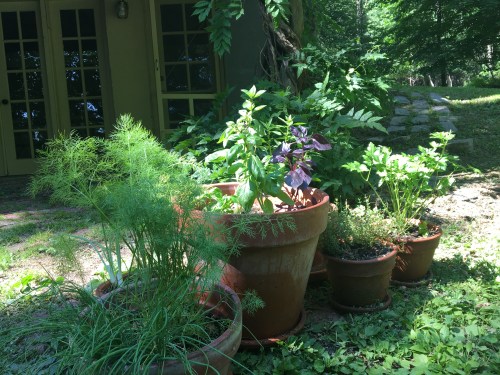
IMG_1282.JPGPart of my upstate herb garden. Here I’ve got epazote, mentuccia, thyme, opal and Thai basil, fennel, chives, and parsley.

Black Olive and Thyme Butter for Summer Radishes

I’ve used this and many other compound herb butters on many things. This one is especially good on grilled chicken or fish. Any that’s left over can be refrigerated and used cold on hot food. It will melt right in. I’ve found that after about 4 days it tends to lose some oomph, so I make it in small batches.

Note: I’ve tried a food processor for this butter, but I find that the color gets murky, losing some of its aesthetic charm. I prefer to chop all the ingredients separately, fold them into the softened butter, and then let the butter sit for about a half hour to meld all the flavors.

(Serves 4 as an appetizer)

1 stick unsalted butter, softened
6 black Niçoise olives, well dried, pitted, and minced
About 5 chives, minced
The grated zest from 1 lemon
6 large thyme sprigs, the leaves chopped, plus a little extra for garnish
Sea salt
A pinch of allspice
A big bunch of French breakfast radishes, or another seasonal radish, sliced in half lengthwise, leaving some of the tender green stem

Put the well-softened butter in a small serving bowl. Add the minced olives, chives, lemon zest, thyme leaves, a big pinch of sea salt, and the allspice. Mash everything together with a fork until it’s well blended. Wipe down the sides of the bowl, and let the butter sit for about a half hour.

When you’re ready to serve it, just spread a little of the butter on the cut side of your radishes. Garnish with extra thyme leaves. This is a good antipasto with a glass of rosé wine or prosecco.

Wild Fennel, Thai Basil, and Parsley Pesto, for Grilled Fish

I used this on grilled swordfish, and the next morning I spooned some over scrambled eggs. It was also good that afternoon, spread on a grilled fontina sandwich.

(Serves 6)

½ cup blanched, lightly toasted almonds
1 summer garlic clove
½ cup wild fennel fronds (or the tops from bulb fennel, plus a big pinch of fennel pollen)
½ cup Thai basil leaves
½ cup flat-leaf parsley leaves
½ cup good, fruity olive oil
Sea salt
The grated zest from 1 small lemon

Place the almonds and garlic in the bowl of a food processor, and pulse to a rough grind. Add all the rest of the ingredients, and pulse until you have a smooth, not too thick, bright green sauce. If it’s too tight, add a little more oil.

Women with Fish

2ED9AA7800000578-0-image-a-6_1449224685459

If you could see her through my eyes, she wouldn’t look fishy at all.

3Insects on a Sprig of Rosemary, by Jan van Kessler the Elder, 1653.

Recipe below: Strawberries with Rosemary Honey Syrup and Ricotta

I’ve been getting strong cravings for rosemary. Seems like a strange thing for my body to demand, but that is what’s been happening. And the desire is growing. The other night I ordered my routine takeout chicken, which is always decently seasoned, but I had to shower it with rosemary, and I did, lots of chopped sprigs until it veered toward the medicinal. But I wanted all that, and it tasted right to me. Also lately I’ve been flavoring many types of seafood with rosemary, where in the past I would have chosen a less woodsy herb, maybe basil or marjoram. I added rosemary to a white wine clam sauce. I’d never done that before, but it was just what the doctor ordered. I added pancetta and tomato that perfectly balanced all the piney notes, and those clams really hit the spot. I also made rosemary almond biscotti. And I bought rosemary gelato, which zeroed right in on my need, even though, oddly enough, I’m not generally an ice cream fan.

I was curious about what might be fueling this new craving, so I, of course, Googled it. Seems rosemary has always been thought to have healing properties. And most interestingly it turns out this resinous herb, with its woody stems and potent oil, has been used to help manage depression and anxiety for hundreds of years. Anxiety I’ve got by the truckload, so that might account for my wanting it so badly. Hey, it’s no Klonopin, but I do sense a slight lessening of my jitters.

Strawberries with rosemary whipped cream, custard, or goat cheese are all dishes I’ve heard of, mostly in the French kitchen. A touch of deep resin with sweet fruit makes so much culinary sense, especially lately. I’ve Italianized this recipe by including ricotta, which cushions the strong herb nicely. Try this for dessert or breakfast or as a midnight desperation dish with a glass or two of rosato. Your worries will start to slip away.

(Serves 2 to 3)

For the syrup:

3 tablespoons sugar
1 tablespoon wild flower honey (I used acacia)
3 big sprigs rosemary, lightly crushed with the side of the knife to release their oil, plus a few small sprigs for garnish
A small piece of vanilla bean, split
A long peel of lemon skin
1½ cup dry white wine

Plus:

1 pint small, local strawberries, left whole (Tristar are a good variety), or larger ones cut in halves or quarters
About 1½ cups high-quality whole milk ricotta
Freshly ground black pepper

Put all the ingredients for the syrup in a small saucepan, and simmer over medium heat until large bubbles appear on the surface, about 5 minutes (the bubbles will let you know that it has properly thickened). Let sit for about 5 minutes on the turned-off burner to further blend the flavors. Now strain into a small bowl (or just pick out the herbs and such). Stick the bowl in the refrigerator until cool.

Before using the syrup, bring it to room temperature.

Place the strawberries in a bowl. Pour the syrup over the top, and toss gently.

Portion out the ricotta in small bowls or big wine glasses. Spoon on the strawberries and then some of their syrup. Finish with a few grindings of black pepper, and garnish with rosemary sprigs.

field-of-thyme-eileen-digiacomo
Field of Thyme, by Eileen DiGiacomo.

Recipe below: Asparagus Tortino with Fontina and Thyme

I wasn’t sure what to call this improvisational baked thing I recently made using leftover asparagus vinaigrette. Because it had two Italian cheeses, Fontina and Parmigiano, I wanted to give it an Italian name. Maybe it was a sformata, a type of molded, dense soufflé, but when that preparation includes vegetables, they’re almost always puréed; here I left the asparagus in pieces. A sformata also is typically held together with béchamel, something I didn’t use, so that term was, as it turned out, not at all a match. My construction is more like a savory clafouti, the sweet French flan traditionally made with black cherries, but that’s, uh, not Italian. Torta is the classic Italian term for a baked sweet eggy dessert, with or without a crust. Tortino is the name often given to its savory sister, producing, among other mutations, something resembling a puffy, oven baked frittata. Close enough. I settled on that.

It’s sometimes hard to label dishes when you improvise as much as I do, but I  try. I want to make sure I don’t stray too much from the spirit of Italian cooking even when I invent. If I can find a solid category that fits my new creation, I know I’m not far from home.

I liked the texture of this tortino so much, I’m already imagining variations, perhaps with leftover sautéed greens such as escarole, Swiss chard, or spinach, especially if seasoned with summer garlic or young onion. Maybe I’d throw in toasted pine nuts or a little crisp pancetta. I used a good amount of fresh thyme in my asparagus version, which is a natural with cheesy custardy things. But parsley  could stand in, resulting in a fresher finish. I’m thinking I’ll try this dish again in July, when I can get perfect cherry tomatoes. Marjoram or basil would be good with those.

(Serves 4 as a brunch or light supper)

About a tablespoon or so of softened butter
½ cup grated Parmigiano cheese
A medium bunch of asparagus*, trimmed, blanched, and cut on an angle into approximately inch-long pieces (if the stalks still seem tough after trimming, give them a quick peel)
2 scallions, cut into thin rings, using just the leafy green part (save the bulb end for another use)
3 large eggs, at room temperature
¼ cup all-purpose flour
½ teaspoon baking powder
⅔ cup whole milk
2 tablespoons crème fraîche
½ teaspoon runny honey
⅓ cup grated fontina Val d’Aosta cheese (use the large holes of the grater for this)
About 6 large thyme sprigs, the leaves chopped, plus leaves from a few more sprigs for garnish
The grated zest from 1 lemon
A few big scrapings of nutmeg (about ⅛ teaspoon)
Salt
Black pepper.

*The asparagus I used were dressed with a light lemon vinaigrette, adding a little extra flavor to the dish. But freshly blanched nude asparagus will work just as well.

Preheat the oven to 375 degrees. Butter a baking dish, and then sprinkle in the Parmigiano, shaking it around to coat the bottom and up the sides, saving about a tablespoon or so to sprinkle on the top. (I used a 9-inch round dish with 3-inch sides, but an 8-by-8 square would be a fine alternative).

Scatter the asparagus pieces in the pan. Scatter on the chopped green scallion.

Put the eggs, flour, baking powder, milk, crème fraîche, and honey in the bowl of a food processor, and pulse briefly to blend. Add the fontina, thyme, lemon zest, and nutmeg, and season with salt and black pepper. Pulse a few more times to mix everything well. Pour this evenly over the asparagus, and sprinkle with the remaining Parmigiano.

Bake until lightly browned and puffy, about 35 minutes. Let sit for about 5 minutes to firm up a bit before serving. Garnish with the remaining thyme leaves. Serve with a green salad that has a touch of bitter from arugula, chicory, dandelion, escarole, or radicchio.


Tokarski_Still_life_with_peaPeas, by Mateusz Tokarski, 1795.

Recipe below: Snap Peas with Pepato, Lemon Zest, and Mint

I’ve always had a hard time fitting snap peas into my life. They aren’t as delicate as shell peas or as bittersweet as fava beans. They’re pea and pod in one, ideally to be eaten when young and tender. My father used to grow them in his cramped backyard garden. I thought they tasted like lawn clippings sprinkled with Splenda. I decided some time ago to add them to my list of overrated green things, which already included snow peas and fiddleheads. But since I’ve started treating snap peas with stronger seasonings, I’ve come around. My former method was butter, maybe a gentle herb, and that’s about it. I’d been told so often to let seasonal produce speak for itself that the message sank in too well. Sometimes reverence for local produce can be oppressive. These lumpy little pods can certainly take a little sharp and salt and strong pepper.

For this recipe I chose to add spearmint, a classic with shell peas, pecorino pepato, traditional with raw favas, and lemon zest, just because. You could go with basil and Parmigiano instead, for a gentler flavor. As far as cooking goes, for me snap peas are best when briefly sautéed over fairly high heat, with no liquid added, which should take 2 to 3 minutes tops.

Pepato is a semi-hard pecorino from Sicily that’s studded with whole black peppercorns (there’s also a younger, less assertive version, but for this dish you’ll want the aged kind). When  the cheese is shaved or grated, the peppercorns break up, falling into the dish and giving you strong bites of pepper here and there. I love those unpredictable hits of flavor. The cheese itself is sharp, but with touches of sweetness that blend in well with the strident greenness of snap peas. I’ve seen a lot of domestic pepato in my New York supermarkets. Do yourself a favor and avoid it. It’s acrid, with no depth of flavor whatever. Look for the good stuff, pepato pecorino Siciliana DOP.

(Serves 3 to 4)

Extra-virgin olive oil
1 large shallot, minced
¾ pound  young snap peas, the strings removed
A handful of pea shoots, if available (use only tender shoots)
The grated zest from 1 large lemon
Salt
About a dozen or so spearmint leaves, lightly chopped
A small chunk of Sicilian pepato cheese

Choose a large skillet that will hold the peas without crowding. Drizzle a tablespoon or so of oil into the skillet, and get it hot over medium-high heat. Add the shallot and the snap peas, and sauté, shaking the peas around, until they just start to soften, about 2 minutes. Add the pea shoots, if you’re using them, and the lemon zest, and sauté a minute longer. Season with salt. The peas should be shiny with oil and bright green, possibly with flecks of brown from the heat, and crisp tender to the bite. If you achieve that, you’re getting the best flavor out of the things.

Tilt the peas onto a large serving platter.  Drizzle with a thread of fresh olive oil, and scatter on the mint, tossing to incorporate it into the peas. Scrape about 10 shavings of pepato over the top. Serve hot.


11.jpgEscarole, by Todd Lynch.

Recipe below: Escarole Salad with Radishes, Ricotta Salata, and Garlic Croutons

There were certain foods that set an Italo-American family apart from other households in our New York neighborhood. Each family had its Italian staples. What ours always had on hand tells a historical tale straight from the Mezzogiorno. Eggplant, provolone, anchovies, broccoli rabe, and escarole were high up on the list of “foreign” foods we considered a normal part of life. They were always there, fitting effortlessly into all kinds of meals. Escarole salads came out at the end of dinner, sickeningly bitter and tough to outsiders, but eagerly awaited by us. So good after spaghetti with red clam sauce.

Things have been difficult around here the past few weeks. My mother, maker of the perfect escarole salad, is in the hospital again, all up and down and uncertain. When she gets sick, which has been often in the last few years, I find myself cooking what she taught me. But taught is not really the correct word. My mother never asked me into the kitchen to cook by her side. She was too irritable for that. She showed me, though, because I was watching. She believed that escarole with olive oil and lemon was the perfect digestivo and essential to good health. She brought it and other strongly flavored green things to the table, and she never questioned that we would eat them and like them and then anticipate their reappearance in the future.

I like escarole salad presented freely with just a swirl of oil and lemon or vinegar drizzled into the bowl, but I also like it with stuff added, as in the version I offer here, which has touches of springtime. Salty, crumbly ricotta salata goes exceptionally well with the crunch and bitter of escarole. So this salad’s for you, Mom. Feel better soon, and thanks for showing me how.

Note: In late spring I start seeing young escarole in my Greenmarket. I try to use it for salads, since the leaves are bright green and tender. The tougher supermarket stuff is best for sautéing with garlic, anchovies, and hot chili, as my family always made it. If you can only find older heads, just use their inner tender leaves for this salad.

(Serves four)

2 large, thick slices of day-old Italian bread, cut into 1-inch croutons, leaving the crust on (you’ll want about a cup or so of croutons)
Extra-virgin olive oil
1 garlic clove, minced
Salt
Black pepper
2 or 3 young heads of escarole, or an equivalent amount of inner leaves from older heads, torn into pieces
3 French breakfast radishes, thinly sliced on an angle, leaving on any tender green stems
1 small head of fennel, thinly sliced
2 scallions, thinly sliced, using some of the tender green part
About 1  1/2 teaspoons lemon juice
2 anchovy fillets, minced
A dozen or more large shavings of ricotta salata

Preheat the oven to 325 degrees.

Spread the croutons out on a sheet pan, and stick them in the oven until they’re crisp and fairly dry, probably in about 15 minutes.

Heat a little olive oil in a small skillet. When it’s hot, add the croutons, half the minced garlic, and a little salt and black pepper. Sauté until golden, about 2 or 3 minutes.

Put the escarole in a large salad bowl. Add the radish slices, fennel, and scallion.

In a small bowl, mix the lemon juice, minced anchovy, the rest of the garlic, and a touch of salt. Add about 2 tablespoons of olive oil, and whisk it in. Add more lemon juice if needed.

Grind a good amount of black pepper over the salad, and pour on the dressing. Toss lightly. Add the croutons, and toss again. Top with the ricotta salata shavings.

Legnari-Liguria-8by20-M
Spring in Liguria, by Ginette Callaway.

Recipe below: Pan Roasted Asparagus with Herbs, Butter, and Eggs

While working out this new asparagus recipe, I got to thinking about the ways I’ve passed on culinary knowledge to others. Every dedicated cook does it in his or her own fashion. Teaching formal classes is one way. I haven’t done full-on classes since I lost my cooking space a few years back (it was actually the music room of an Upper West Side bar that I transformed into an Italian trattoria each Wednesday). I’ve been trying to decide if I’ve missed teaching. I tell myself I have, but then I think maybe what I’ve felt is more of a sense of duty to be well-rounded. Writing about cooking is contemplative and solitary, and it’s always come more naturally to me than standing in front of a crowd. I’ve also wondered if most of the people who sign on for cooking classes really want to learn or just  want to be entertained. I suppose the popularity of the Food Network can partly answer that question. But the bigger question is, does it matter?

My trattoria classes were large, about 25 to 30 people, and demo-style. The students would occasionally get so loud and goofy, I resorted to ringing a bell when the chatting and laughing competed with my well thought-out presentation. Now this was partly my fault, since I offered good wine at low cost, the first glass free. I loved how everyone enjoyed themselves and enjoyed my take on improvisational Italian cooking, but keeping this fun, flirty group in line was exhausting, and after a while I got resentful. I tried a more studious, hands-on approach but soon realized that the only way to get the students to return was by letting them have a blast, and I needed the money. Most of them didn’t want hands-on. They wanted to watch me. Did it damage my ego to know all my hard work got boiled down to a few hours of cabaret? Not really. Did they learn? When I think of all the reasons I love to cook, that last question is answered for me. If I wanted to teach at the CIA I could have done so. I chose the bar for a reason. I love solitude in the kitchen, for sure, that’s how I teach myself. But I also love to entertain. I view every meal as a small celebration, or at least that’s my goal. And I’d like other people to get the same uplift from cooking that I usually do. Passing on enthusiasm is certainly part of teaching, even if the recipients are all too drunk to remember the recipe. Now that I’ve worked this out in my head, I want to stand up and teach again, the first glass free.

And speaking of teaching, I’ve been teaching myself about asparagus for a long time, learning what preparations work best. Sometimes I want contrast, sometimes I like my flavors to meld. For this recipe I didn’t want to add too much. I wanted to let the innate beauty of the fleeting vegetable dominate. Even though you’ll see a good number of ingredients, they’re mostly herbs that blend effortlessly into a lively green delicacy. Check it out.

(Serves 3)

About 3 tablespoons butter, unsalted
A drizzle of olive oil
1 big bunch medium thick asparagus, trimmed and the tough skin peeled
Salt
Pepper
A big pinch of ground coriander seed
A splash of Moscato or another sweet wine
The juice from about ½ lemon
About a dozen or so chives, chopped
A few big sprigs of mint, the leaves chopped
A few big dill sprigs, the leaves chopped
The yolk from 2 hard-boiled eggs

Choose a skillet large enough to hold the asparagus in one layer, more or less. It should have a lid. In it melt about 1½ tablespoons of butter, plus a drizzle of olive oil, over medium heat. Add the asparagus, turning it around in the oil to coat. Season with salt, black pepper, and the coriander seed, and sauté, turning the asparagus a few times until it just starts to soften and get a bit golden. Add the sweet wine, and cover the skillet. Cook, turning once or twice, until the asparagus is just tender, about 2 to 3 minutes. Check the skillet a few times to make sure the liquid hasn’t dried up, and add a little warm water if you need to.

Uncover the skillet, and transfer the asparagus to a serving platter. If the skillet liquid is watery, cook it down a bit. Otherwise just turn off the heat, leaving the skillet on the warm burner.

Add the lemon juice and a heaping tablespoon of butter to the skillet, stirring to melt it.

Crumble the egg yolks over the center of the asparagus. Then pour on the butter sauce, and scatter on the herbs. Serve right away.

Women with Fish

537318b4419e269565efce2f62c1855e

Lady, if you know what’s good for you, you’ll give it to the bear.

Mycenaecultfrescosegment1

Recipe below: Emmer Primavera with Asparagus, Peas, Radishes, and Mint

There’s absolutely nothing springlike going on at my New York Greenmarkets yet, not even those unappealing fiddleheads. So I’m off in dreamland, thinking about all the good stuff to come. And this has gotten me reflecting on peas. I mean shell peas, or English peas, as they’re sometimes called. It’s too early for local ones here, but frozen ones aren’t half bad, and they’re often even better than fresh, since they’re held in a cryogenic state at the peak of ripeness or somewhere close. Often when I get peas still in their pods at the Union Square Market in Manhattan, they’ve  already gone from eat-out-of-hand sweet to starchy and dull. That happens quickly with peas. I guess the drive down from Hudson is sometimes just too much for them.

I’m usually okay with frozen peas except for a couple of things. I find their uniformity upsetting. I understand they’re sorted by size, but why bother? And how are they so dark green? The seasonal peas at my market are various sizes and lighter in color. I guess Monsanto, or whoever is in charge of monotony in vegetables these days, has got that little soldier look down. Lately, instead of Birds Eye and the like, I’ve been buying frozen organic peas. They’re all the same size, too, but at least most that I’ve tried aren’t that disturbing dark green color.

I don’t have local asparagus or radishes yet either, but something was calling me to make this dish ahead of schedule. And it was good. I can’t wait to try it when I’ve got my hands on the real deal. Should be excellent.

I’ve used emmer for this dish, one of the three wheat grains that can be labeled farro (the two others are spelt and einkorn). At my Greenmarket I find straight, unpearled emmer, grown in upstate New York. It’s a rich tasting grain. Since it’s got the whole germ intact, it takes a little longer to cook than pearled farro, but it also has more nutrients, and it digests slower, something to keep in mind if you’ve got high blood sugar. If you can find local wheat berries near you, do yourself a favor and buy some, whatever the variety. The deep, wheat aroma that rose up from the pot while I was cooking this, with its undertones of sweet and bitter, was remarkable. Now I know what old-fashioned wheat is supposed to taste like.

Emmer Primavera with Asparagus, Peas, Radishes, and Mint

(Serves 4)

1½ cups emmer (or supermarket farro)
Salt
Extra-virgin olive oil
2 tablespoons unsalted butter
A big bunch of fairly thin asparagus, the tough ends trimmed, the stalks sliced on an angle into approximately 1-inch pieces
1 cup freshly shucked peas, or use frozen
4 French breakfast radishes, sliced thinly on an angle, leaving any radish leaves intact if possible
3 scallions, chopped, using much of the tender green part
¼ teaspoon ground nutmeg
½ teaspoon ground coriander seed
Black pepper
About 6 large thyme sprigs, the leaves chopped
A splash of dry Marsala
½ cup chicken broth or vegetable broth
A tiny drizzle of rice wine vinegar
A handful of spearmint sprigs, the leaves lightly chopped, plus about 6 nice-looking sprigs for garnish

Put the wheat in a saucepan, and cover it with water by about 4 inches. Add salt. Bring it to a boil, and then turn the heat down a touch, and let it cook at a lively bubble, uncovered, until the wheat is tender to the bite. My unpearled emmer took about 40 minutes. Supermarket farro, in my experience, goes faster. Just taste-test every so often.

While the wheat is cooking, set up a big pot of water, and bring it to a boil. Add the asparagus, and cook for about 30 seconds. Now add the peas, and cook about 30 seconds longer. Drain in a colander, and then cool under cold running water to bring up their green color. Drain well.

When the wheat is tender, drain it, and pour it into a nice-looking serving bowl. Drizzle on a little olive oil, and cover to keep warm.

In a large skillet, heat about 2 tablespoons of olive oil with a tablespoon of butter over medium-high flame. Add the scallions, the asparagus, and the peas. Season with salt, nutmeg, coriander seed, black pepper, and thyme. Sauté until everything is fragrant but still has a bit of bite to it. Add the radish slices, and just warm them through. Add the Marsala, and let it bubble for a minute. Add the chicken or vegetable stock and the rice wine vinegar, and let it all simmer for about a minute. Turn off the heat, and add a fresh lump of butter, stirring it in.

Pour the asparagus mix onto the wheat, add a drizzle of fresh olive oil and the chopped mint, and toss. Taste for seasoning, adding salt, black pepper, a little more vinegar, or a drizzle more broth if it needs moisture. Top with the mint sprigs, and serve warm.