Feeds:
Posts
Comments

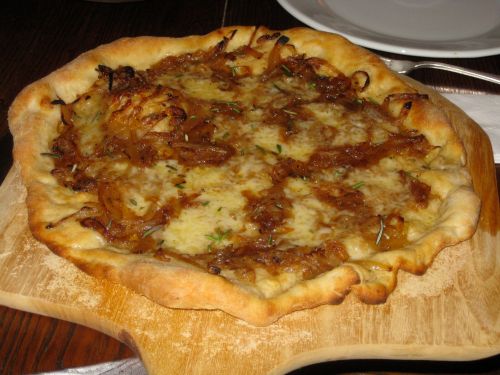
Winter Pizza

pizza

Recipe: Pizza with Rosemary Onions and Fontina Valle d’Aosta

I never used to like making pizza at home, mainly because it seemed so difficult. This, I’m happy to say, is no longer true. I’ve overcome my resistance, and I now turn out a fairly authentic, crusty, pully pizza that I’m proud of. But I’ve learned that you’ve got to start out with the right equipment. I’ve never been one for fancy kitchen utensils, but when it comes to pizza making, they’ll save you a lot of frustration.

For me the biggest technical challenge in producing an authentic and nice-looking pizza at home is having a large enough pizza stone, so that when you slip the pizza into the oven from your peel (the big spatula the pizza goes into the oven on—got to have one of those, too), it doesn’t go shooting over the undersized stone and into the back of the oven, folding up and dripping all over, making a big, smoky mess. That used to happen to me a lot, and it was very discouraging. I finally broke down and bought something big and sensible. Get a big stone. It will really help. A big rectangular one, not some measly round thing the same size as the pizza you’re making. And, second, don’t be stingy with the cornmeal. You’ve really got to coat your pizza peel with plenty of coarse cornmeal or semolina (although semolina burns faster), so that while you’re scattering on your anchovies, tomato, candy corn, what have you, the dough doesn’t start adhering to the peel, making a trouble-free slide to the stone virtually impossible. (I’ve tried using regular flour, but it soaks into the dough too quickly.) Without a dry base for your dough to slide on, you wind up using so much back-and-forth action trying to coax the stuck pizza off the peel that a disaster is inevitable. I hate when that happens, but it doesn’t have to.  Making pizza can really be fun. I promise you.

I like to come up with pizza toppings I can’t necessarily get at pizzerias, usually trying ones without tomato and without mozzarella, just for the hell of it, but there’s a fine line between improvisation and stupidity when it comes to creative cooking. I’m not a fusion girl. When I mix it up, I mix it up only with Italian flavors, maybe straying from regional tradition but not from what most Italians would recognize as  familiar tastes.

Winter is not the most exciting time for conjuring up newfangled pizza toppings, but, hey, we’ll always have cheese and onions ( I hope). With this thought in mind I’ve gone about making a tomatoless pizza with a rather Northern feel, perfect for the miserable New York weather I’m now experiencing. I’ve chosen Fontina, the nutty, sweet, easy-melting raw cow’s milk cheese from the Italian Alps. I caramelized the onions, but then I discovered that they together with the sweetish Fontina made my first version of this pizza a little too sweet. Second time around I added a drizzle of Spanish sherry vinegar to the onions. It made all the difference for the balance of flavors.  I hope you’ll enjoy it. And don’t forget to jack up your oven to the highest possible temperature, so you get those good slightly burned edges that are so delicious.

Pizza with Rosemary Onions and Fontina Valle d’Aosta

(Makes 2 approximately 10- to 11-inch pizzas)

For the dough:

1 packet active dry yeast
1 teaspoon honey
1 tablespoon extra-virgin olive oil, plus more for the bowls
3 cups all-purpose flour, plus a little more for kneading
1 teaspoon salt
About ½ cup coarse cornmeal or semolina flour

For the top:

2 tablespoons olive oil
2 Vidalia onions, very thinly sliced
Salt
Freshly ground black pepper
1 teaspoon sugar
3 whole allspice, ground to a powder
4 small sprigs fresh rosemary, the needles chopped, plus a little extra for garnish
½ cup dry Marsala
1 teaspoon Spanish sherry vinegar
½ pound Fontina Valle d’Aosta cheese, sliced

In a large bowl, dissolve the yeast in ½ cup of warm water. Add the honey and the tablespoon of olive oil, give it a stir, and then let sit until the yeast is foamy, about 8 minutes.

Add half of the flour and the salt, stirring it into the yeast. Add the remaining flour, and then gradually add about ¾ cup of tepid water, mixing until you have a soft, sticky, ragged ball of dough.

Flour a work surface, and turn the dough out onto it. Knead, adding little sprinklings of flour when necessary to prevent sticking, until the dough is smooth, about 8 minutes. Cut the dough in half. Pour a little olive oil into two large bowls, and drop a dough ball into each one, coating the dough lightly with the oil. Cover and let rise until the dough has doubled in size, about 2½ to 3 hours.

In a large skillet, heat the two tablespoons of olive oil over medium-low heat. Add the onions, salt, black pepper, the sugar, the allspice, and the rosemary. Sauté slowly until the onions start to turn golden, about 15 minutes. Now add the Marsala, and let it slowly boil away until the onions are moist but there’s no obvious liquid in the skillet. Add the vinegar and give it a good stir.

Put your pizza stone in the oven, and turn the heat up as high as it will go. Preheat for at least 15 minutes.

Flour a work surface, and turn out one of the dough balls onto it. Flatten it down with your hands to form a disk. Now roll it out into an approximately 10- or 11-inch round (it can be a little free-form, as in the photo above). Scatter an ample amount of corn meal or semolina on your pizza peel, and then transfer the dough over to the peel. Top with half of the onions, spreading them out to about an inch from the edge of the dough, and then place the Fontina on top. Scatter on a little of the fresh rosemary, and add a few grindings of fresh black pepper. The faster you do this, the less likely  your dough will start to stick. Gently slide the pizza onto the stone, ideally in one swift movement (when you get choppy and hesitant about it, you will run into trouble).

Bake until it’s lightly charred on the edges and bubbling in the center, about 12 to 15 minutes. Make another pizza in the same manner.


Family Meal

chicken-cacciatore

Recipe: Chicken alla Cacciatora with Black Olives, Crème Fraîche, and Thyme

After a string of holidays, I want nothing more than to dispense with the menu planning and just wing it, creating meals out of whatever is in the house, in true improvisational fashion. This type of cooking always reminds me of what it was like making “family meal”—i.e., the staff meal—when I worked in restaurants, where I was always told to use up what was on its way out anyway. Except that my family doesn’t consist of 20 Colombians all grumbling that my food is not cooked enough (they like their meat ‘hammered’) , or not spicy enough (they like their food incendiary). I’d watch these guys empty an entire bottle of Trappey’s hot sauce over my quickie coq au vin. It was wounding to my fledgling culinary self-esteem.  In any case, whether it’s appreciated or not, that kind of cooking is always liberating.

Last night I found I had a can of San Marzano tomatoes, a three-and-a-half-pound chicken, and various holiday leftovers in my refrigerator, such as several big containers of black olives, a mess of  dry, curling prosciutto (how did I let that happen?), some double- smoked cod, a couple of salami chunks, a  lump of pancetta, various dried-out herb branches, a couple of quarter bottles of dead wine, and a half-full tub of crème fraîche. Crème fraîche is an ingredient I almost never have on hand, but I had bought it to go with a little jar of caviar a friend was nice enough to bring to my Connie Francis theme tree-trimming party. I assessed all this food build-up and decided to cook up a chicken cacciatore, and to construct it in a newfangled way. My little group of diners declared the dish a hit (my family is, thankfully, much more accepting than most restaurant staff). Here I offer it to you, for your own family meal:

Chicken alla Cacciatora with Black Olives, Crème Fraîche, and Thyme

(Serves 4)

½ cup all-purpose flour
Salt
Freshly ground black pepper
4 allspice, ground to a powder
1 approximately 3½-pound chicken, cut into 8 pieces
Extra-virgin olive oil
1 tablespoon butter
1 ½-inch-thick slice of pancetta, cut into small dice
1 large shallot, minced
1 garlic clove, thinly sliced
1 small glass dry white wine
1 28-ounce can San Marzano plum tomatoes, well chopped and lightly drained
½ cup chicken broth
1 bay leaf
A branch of fresh thyme, the leaves chopped
A small handful of black olives, pitted and halved (I used Gaetas)
1 heaping tablespoon crème fraîche

Mix the flour, salt, black pepper, and ground allspice together on a large plate. Dredge the chicken pieces in it, shaking off any excess.

In a large sauté pan, heat a tablespoon of olive oil with the butter over medium heat. When hot, add the chicken pieces, and brown them well on both sides. Remove the chicken from the pan, and pour out the excess oil (not all of it, though; you want a little chicken grease in the dish). Add the pancetta, and sauté until crisp. Add the shallot, and sauté for a minute or so to soften it. Add the garlic, and sauté for a few seconds to release its flavor. Add the white wine, and let it boil away. Add the tomatoes and the chicken broth, and season with salt, black pepper, the bay leaf, and the thyme. Simmer, uncovered, at a lively bubble for 5 minutes. Return the chicken to the pan, and simmer, covered, at a low heat for about 12 minutes. Remove the white meat from the pan, and continue cooking, covered, until the legs and thighs are just tender, about 10 minutes longer.

Return the white meat to the pan, and add the olives and the crème fraîche, giving it a good stir. Turn off the heat, and let everything just sit there, uncovered, for about 15 minutes. This will allow all the flavors to continue mingling and let the sauce thicken a bit. It will also further cook the chicken in a very gentle way just in case there may still be a bit of pink at the bone.

To serve, gently reheat, uncovered, spooning the sauce over the chicken. Taste for seasoning, adding more salt or black pepper if needed.  Add a drizzle of fresh olive oil, and serve directly from the pan, accompanied by polenta, orzo, or rice, if you like.

deluise
Dom DeLuise, a keeper of the flame.

I’d like to propose a toast to every Italian-American home cook, chef, and gourmand who works hard each day keeping Italian cooking fresh and vibrant  in the U.S.A.  Keep creating the dishes and the amazing aromas that allow our beautiful culinary heritage to thrive here in such a relevant way. Here’s a negroni to you. Happy New Year.

blood-orange

Recipe: Blood Orange Salad with Prosecco Anise Syrup

I believe my father’s relationship to the family kitchen was typical for an Italian man. There seem to be three ways Italian men, and I include Italian-Americans, involve themselves in the creation of family meals: They take over the entire dinner preparation in a intense, chef-like manner, locking out the rest of the family; they assert a dictatorial attitude about all things that come out of the kitchen, without actually cooking anything themselves (this kind of man will often do some food shopping just to make sure his wife is cooking with top-notch stuff—a very Roman approach); or they completely take over one aspect of food preparation and make it exclusively theirs, such as grilling, or preparing coffee in a fetishy way.  My own father took the one aspect route. He put himself in charge of buying and preparing all the fruit that came into the house. How and why this came about, I can’t say, but he certainly picked up some of it from his father, who made a huge deal of squeezing and sniffing supermarket fruits, especially melons, and approving or rejecting their ripeness before allowing them into his home. It may also have been a vestige of the Southern Italian farming and foraging life endured by our near ancestors, in which no prickly pear was left unexamined.

For my father, fruit was a way of life, almost as central to his existence as his golf clubs. He was enamored of all tropical fruits—pineapples, guavas, mangoes, papayas, kumquats—and he fashioned them into elaborate, well-chilled fruit salads in big glass bowls. In summer he busied himself peeling and slicing peaches and dousing them with red wine or occasionally white wine, or sometimes a splash of grappa. Strawberries or blueberries got tossed with grappa and a little sugar and sprigs of mint. Pears and apples he always served with cheese, after dinner or sometimes at lunch. He’d set out wedges of cantaloupe wrapped in prosciutto to start a meal, or more often just cantaloupe sprinkled with salt, a trick he learned from his melon-crazed Puglian father. Cantaloupe also got cut in half and filled with vanilla ice cream, a perfect flavor combination, or, if we had it on hand, with sweet white wine, creating a kind of wine bowl. I absolutely loved that. Pineapple was his top all-time favorite fruit, and he’d slice it and drizzle it with sugar and rum. Bananas got a similar treatment, but he finished them with Kahlua. These were exotic and memorable desserts.

Another specialty of his was what we now call the smoothie. He usually made that with milk, ice cubes, sugar or honey, sometimes a little vanilla ice cream, and his fruit of choice, most often one of his beloved tropical fruits such as mango. Everything went into the blender, and it emerged as a fluffy pastel foam. I went through a nervous stomach era in my teenage years, and my father’s remedy for it was always one of his smoothies, often banana, which he insisted would soothe my perpetually churning gut. It helped more than the Maalox—I’ll have to give him that—but not as much as the Valium that I eventually got a prescription for.

He was a big believer in the health benefits of grapefruit, and he made a big deal about having grapefruit forks in their proper place in the cutlery drawer. (How many people even know what a grapefruit fork is anymore?) Oranges and nectarines he’d just slice up and present on a fancy platter, or work into a citrus fruit salad bowl. When he went to Florida for the winter he always sent me bags of sweet, nipple-topped Honeybell oranges in January. I really loved them, and now I miss them, since I have to order them myself and often forget. Their season is very short. It’s right now, in fact. I’m going to order some as soon as I post this blog.

After dinner in winter he’d bring tangerines to the table, along with whole nuts and a nutcracker and a bottle of Sambuca. That was a lovely cold weather ritual and a fun mess, with peels and shells all over the place. And to the astonishment of family and friends, he’d cut lemons in half and eat them like orange slices. I believe that’s a Southern Italian custom, having become one, I’m certain, only because their lemons are sweeter and more flavorful than ours. I think he used to sprinkle them with sugar. And then there was the juicing ritual. I can see him working in the kitchen at his hand-cranked citrus juicer with a crate’s worth of hollowed-out orange or grapefruit halves strewn all around him. I never saw him more content, almost Buddha-like.

In memory of my father, I’ve created this blood orange salad to celebrate the New Year. I’ve fashioned it in his style, with a little booze included. It’s something I know he would have loved.

Happy New Year’s to you.

A note about blood oranges: Moro and Tarocco blood oranges, both originally from Sicily, are now grown in California, Texas, and Arizona. I used to find imported Sicilian ones. They were very expensive but richly flavored. Since Sunkist started producing them here, I don’t see the imported ones much any more, but local blood oranges can be very good, and they’re the same varieties grown in Sicily, usually Moro and Tarocco. The Moro is acidic and can sometimes taste like baby aspirin, but in a good way. Tarocco is sweeter. The blood color of these oranges varies from fruit to fruit. Some are just barely tinged with red; others are startling dark, burgundy. If you can find Taroccos, use them for this salad.

Blood Orange Salad with Prosecco Anise Syrup

(Serves 4 as a dessert or as a palate cleanser between courses)

1½ cups  prosecco (you can use slightly flat leftover prosecco if you have it on hand)
1 tablespoon limoncello
2 whole star anise
½ cup sugar

6 blood oranges
A handful of nice-looking small basil leaves

Pour the prosecco and limoncello into a small saucepan. Add the star anise and the sugar, and give it a stir. Boil over medium-high heat until it’s reduced by half. You should see large bubbles forming on the surface when it’s just done, an indication that you’ve got a nice syrup. Place the pot in the refrigerator until well chilled and thickened. It should have the consistency of loose honey.

Peel and slice the oranges into thin rounds. Lay them out in a slightly overlapping circular pattern on a pretty serving platter (one that’s slightly banked at the edges is best, as it can catch the syrup). Drizzle the prosecco syrup over the top, and decorate with the basil leaves.

dino-xmas

Recipes:
Orange Flower Aperitivo
Orange Olivata Crostini

For me the aroma of orange has always been linked to Christmas. My father’s golf pro buddies would show up at my childhood home for holiday whisky sours, one of them inevitably bearing a little crate of highly waxed tangerines that, as the evening wore on, got opened up all over the house, their peels winding up on the floor, in the rug, their strong oils let loose by stomping feet. What a wonderful aroma. And then there were the big navel oranges my father always stuffed into the tip of our Christmas stockings, a dumbfounding gift when the refrigerator was crammed full of them, and when what I really wanted to find there was a $1.65 one-way ticket into Manhattan. Fast forward to me now, running my own little Christmas household. I always make a Sicilian orange salad as part of Christmas Eve dinner,  with red onions, black olives, mint, black pepper, and my best Sicilian olive oil (which would be Ravida). It is the most refreshing thing in the world to eat after our big traditional Southern Italian fish meal.

Another source of holiday orange is orange flower water, whose aroma drives me wild with desire. That gorgeous liquid is made from orange flower blossoms. It doesn’t smell much like orange, but its amazing floral scent can take your holiday-heavy mind away to far-off, exotic places. It’s the perfume in ricotta cheesecake, which is traditional in Southern Italy for Easter but shows up at just about every holiday of ours, and always at Christmas. I buy orange flower water from France that comes in little cobalt blue bottles. I buy that kind just because the packaging is so beautiful, but Italian and Middle Eastern versions are also easy to find. It’s good just to sniff in, but a few drops mixed into a bowl of honeyed ricotta make for me a truly perfect dessert. I love it drizzled over sliced oranges too. A few years ago I made a tangerine orange flower sorbetto for Christmas Eve that was a big hit with my stuffed, drunken guests. Another year the same flavor combo turned up in a Sicilian-inspired gelatina that I put together with too little gelatin. It was a bit of a sloppy mess, but the aroma was pure beauty. You can overdo it with this stuff. Like any kind of perfume, an excess can make you or your food seem whorish, and we don’t want that (do we?).

Lately I’ve been wondering how orange flower water would taste with alcohol. I always knew it was a key ingredient in the Ramos gin fizz, but I’ve never, believe it or not, had one of those drinks. I’ve discovered that a few drops added to a vodka martini are a lovely touch. I’ve also learned that adding orange flower water to gin and dry vermouth gives you what is called a Victorian martini, a real named drink. I haven’t tried that yet, but I’m sure it’s excellent. Yet what really lifted my spirits was when I added a little to cold white wine. I came up with the Christmas aperitivo of my dreams. I mixed dry white wine (a falanghina from Campania), a splash of Cointreau, and a sprinkling of orange flower water. This slightly haunting drink is, I think, a very nice way to open up a Christmas day meal. And since, in theory, you should always have a little something to eat along with your drink, here’s an orange-tinged olivata to go with it. Merry Christmas to you, and happy holiday cooking.

orange-flower-drink
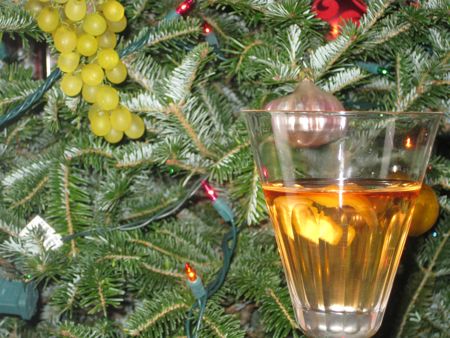
My orange flower aperitivo in the company of garlic and grape Christmas tree ornaments.

Orange Flower Aperitivo

Fill a chilled wine glass about three quarters full with very cold, dry white wine. Add a teaspoon of chilled Cointreau and about 4 or 5 drops of orange flower water. Garnish with a long orange peel. Also nice on the rocks.

__________

Orange Olivata

1 cup Gaeta olives, pitted
¼ cup extra-virgin olive oil
The grated zest from 1 large orange
2 anchovy fillets, roughly chopped
4 thyme sprigs, the leaves only
1 garlic clove, roughly chopped
1 teaspoon Dijon mustard
1 teaspoon Cointreau
Freshly ground black pepper

Place all the ingredients in the bowl of a food processor, and pulse until you have a rough paste. The texture should be a little chunky.  Spoon the olivata into a serving bowl. You can make it a day or two ahead and refrigerate it, but be sure to get it back to room temperature before serving. Serve on toasted baguette slices.

Lasagna for Christmas Eve

pesto-lasagna

Recipe: Lasagna with Basil Walnut Pesto and Besciamella

When I was a junior high school student on Long Island many centuries ago, there still existed a class called home ec, something all the girls had to take, a requirement that by then no one took very seriously. I believe I took it the last year it was offered before it gave way to a newer, hipper curriculum, like sensitivity training (I swear to you that was a real class at my school too). The white-haired black lady who ran home ec was truly serious about teaching us to create our own potholders and to cook some extremely foreign food. There were two dishes that I remember distinctly. They will be forever linked in my mind, not only for their nastiness but because we assembled and sampled them both on the same day. They were eggs à la goldenrod and chipped beef on toast.

Eggs à la goldenrod consisted of toasted Wonderbread slices scattered with crumbled hard-boiled egg whites and drizzled with a chalky white sauce before being finished with the chopped up egg yolks. Chipped beef on toast began with the same base of toasted Wonderbread, but then a jar of thin, round grayish-purple meat slices was opened. A load of them were piled on top of the toast before being covered with the same white sauce. It was hideous. The only thing it had going for it was that it was extremely salty. I remember asking my father about eggs à la goldenrod, and he said, “I don’t know what the hell you’re talking about.”  “What about chipped beef on toast?” I then asked. “Oh,” he said. “Shit on a shingle. Don’t you ever bring that into this house.” Don’t worry, Dad. I assumed he had been forced to eat this during his service in World War II, but it turned out his Puglian-born mother had prepared it once, in an attempt to Americanize their home. It evidently left an emotional scar. It’s curious to me that I was such a blasé home ec student but then went on to find the kitchen becoming such a big part of my life. It had everything to do with Italian food.

When my mother made a white sauce, it meant only one thing, lasagna. We called the sauce besciamella. Its aroma was beautiful, mingling butter and sweet, toasted flour, with hints of nutmeg and bay leaf and a whiff of dried red pepper. Miss home ec lady didn’t use any seasoning, not even salt. Her white sauce was like plaster of Paris.

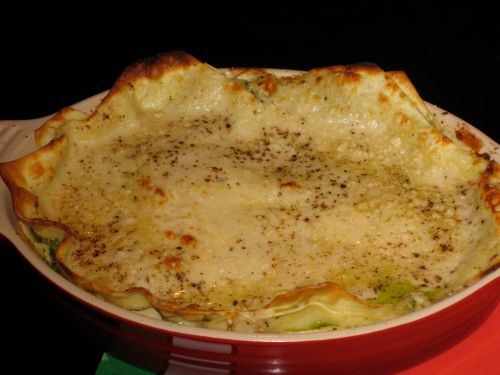
Lasagna was a special-occasion dish, made for New Year’s, Christmas, or birthdays. My mother prepared a great one, very typically Southern Italian, with layers of thick tomato-y ragu, the top covered with the fragrant besciamella. The huge dish was allowed to bubble and meld in a slow oven until a good crust formed on top. What a fabulous invention. The lasagna recipe I offer you here is based on a pasta dish I once ate in Genoa, the home of basil pesto. The original was a plate of pesto-slathered pasta squares haphazardly stacked up and left to spread out in a very free-form way. It was divine. I’ve derived a more formal baked lasagna from that, and I’ve included a nicely seasoned besciamella for lusciousness.

I really love the way it turned out. It’s a loose lasagna, so it doesn’t need to rest. I’d serve it right from the oven, so it can pool out a bit on the plate. It’s perfect, I think, for a meatless Christmas Eve dinner, a little something to work in amid your fish courses. The kitchen can be a beautiful place. Merry Christmas.

Note: Piave is a cow’s milk cheese from the Veneto. You can often find the aged version, Piave vecchio, in this country. It tastes something like Grana Padano, but it’s much sweeter, almost like caramel, which is why I found it a good match for the bitter herbiness of the basil. If you can’t find it, use Grana Padano or Parmigiano Reggiano.

Lasagna with Basil Walnut Pesto and Besciamella

(Serves 6 as a first course)

For the pesto:

½ cup extra-virgin olive oil
1 large garlic clove, roughly chopped
1 cup very fresh, lightly toasted walnut halves
2 cups basil leaves (packed down—about 2 good sized bunches)
4 large sprigs marjoram
1 cup grated Piave vecchio cheese, plus a little more for the top

For the besciamella:

3 tablespoons butter
3 tablespoons all-purpose flour
3 cups whole milk
⅛ teaspoon grated nutmeg
1 fresh bay leaf
Freshly ground black pepper
Salt
A pinch of sugar
⅛ teaspoon hot paprika (I used the Basque piment d’espelette)

1 pound very thinly rolled homemade egg pasta, cut for lasagna

To make the pesto: Place all the pesto ingredients in the bowl of a food processor, and pulse until you have a rough paste. If the pesto seems too tight, add a little more olive oil.

To make the besciamella: Melt the butter in a medium-size saucepan over medium heat. Add the flour, whisking it to blend it into the butter. Cook, while continuing to whisk, for about a minute, without letting the mix color. You’ll smell a sweet, lightly toasted flour aroma. Add all the milk, and continue whisking. Add all the seasonings, and continue cooking, whisking often, until the sauce has thickened. This will happen around the time it comes to a boil. When bubbles appear on the surface, turn the heat down a bit, and continue cooking for another minute or so or until the sauce is thick and very smooth.

Put up a large pot of pasta cooking water, and bring it to a boil. Season it with salt. Cook the pasta sheets, a few at a time, until tender (a minute for really fresh pasta, a little longer if it’s more dry). Run the pasta sheets under cool water after draining, and then lay them out on dish towels.

Preheat the oven to 425 degrees.

Coat an approximately 9-by-11-inch baking dish (or an equivalent oval dish) with olive oil. Make a layer of pasta, and spread it thickly with pesto. Make another layer of pasta, and spread it with besciamella. Continue altering pasta with layers of pesto and besciamella. You should finish with a layer of pasta spread with besciamella and then sprinkled generously with grated Piave vecchio. Bake, uncovered, until the edges have browned nicely and the whole dish is bubbling hot, about 20 minutes.

caravaggio
Red and green through the eyes of Caravaggio.

Recipe: String Bean Salad with Tomatoes, Savory, and Toasted Walnuts

During Christmas season I inevitably find myself making a lot of red and green foods. As farty as that sounds, I can’t help it. I like to color-coordinate dishes. I’ve made all-yellow meals in summer, and all-green ones in spring. It’s a way I organize my culinary thoughts, a path that’s not solely about flavor but just as much about physical beauty.

Christmas especially motivates me to cook in colors. I’ll throw pomegranate seeds and pistachios on roast pork, or finish a beet salad with a spoonful of mint pesto. This urge makes me feel a little like Miss Semi-Homemade with her color-coordinated cocktails, headbands, and napkin rings. I used to think she was crazy, but I don’t believe so anymore. She’s just hyper-orderly in an extremely dopey way. I understand. You want to create something that pleases you and lets you relax into your accomplishment.

So here’s a red and green string bean salad that may help you ease into Christmas. It’s delicious with roast duck or goose.

String Bean Salad with Tomatoes, Savory, and Toasted Walnuts

(Serves 4)

1 pound string beans, the ends trimmed
1 pint grape tomatoes, cut in half lengthwise
1 scallion, very thinly sliced, using some of the tender green part
A large handful of very fresh walnut halves, lightly toasted
Salt
Freshly ground black pepper
2 tablespoons extra-virgin olive oil
A 1/4-inch-thick round slice of pancetta, cut into small cubes
1 garlic clove, thinly sliced
2 whole allspice, ground to a powder
A few sprigs of winter savory, the leaves chopped
1 tablespoon Spanish sherry vinegar

Put up a medium-size pot of water and bring it to a boil. Drop in the string beans, and blanch for two minutes. Pour them into a strainer, and run cold water over them to bring up their green color. Let them drain well.

Place the string beans, the tomatoes,  the scallion, and the walnuts in a pretty serving bowl (something more wide than deep). Season with salt and black pepper.

Put a medium skillet on medium-high heat. Add the olive oil, and let it get warm. Add the pancetta, and sauté until it has rendered most of its fat and is nice and crisp. Add the garlic, the allspice, and the savory, and sauté a minute, just to release their flavors. Turn off the heat, and add the vinegar, letting it bubble for a few seconds in the skillet’s heat. Pour it all over the string beans, and toss well. Check for seasoning, adding more salt or black pepper, if needed.  Let it sit about 1/2 hour before serving.

Trout Saltimbocca

trout

Recipe: Trout with Prosciutto, Sage, and Lemon

I have to admit to myself that the road to weight control and good health is pretty obvious. For starters, cut down on refined carbs and saturated fats. That leaves vegetables and fish. I love seafood of all kinds, but if I fail to put a little creativity into the preparation, a fish fillet can be pretty boring. A squeeze of lemon? Forget it. You’ve got to mix it up. And that’s the culinary challenge.

I often analyze classic Italian meat dishes, steal their flavorings, and apply them to fish. It doesn’t always work, but when it does it can be a taste revelation. Here I’ve pulled out the ingredients for saltimbocca, the Roman veal dish. Take away the veal, and you’re basically left with prosciutto and sage. Saltimbocca is a very simple dish, but it has big flavor. The trick is to find the right fish.

First I tried salmon for the saltimbocca treatment. The result was cloying. I tried tilefish, but the prosciutto and sage overwhelmed the insipid meat. Then I used trout. Now it came out just right, rich the way rich is supposed to be, luscious and suave. It was the success I had hoped for, confirming my conviction that a little pork will improve just about anything. Sage is often a problem herb, musty and bitter, but just a few fresh leaves united the prosciutto with the trout in what I found to be a profound way.

The recipe is easily doubled or tripled.

Trout with Prosciutto, Sage, and Lemon

(Serves 2)

2 good-size trout fillets
1 shallot, very thinly sliced
1 tablespoon extra-virgin olive oil
The juice from ½ a lemon
A few big scrapings of nutmeg
Black pepper
Salt
6 beautiful fresh sage leaves
2 very thin slices prosciutto di Parma
2 tablespoons unsalted butter

Preheat the oven to 450 degrees.

In a small bowl, mix the lemon juice with a tablespoon of olive oil. Season it with the nutmeg, black pepper, and salt (go light on the salt, since the prosciutto is salty). Lay the trout fillets, skin side down, in a small baking dish. Pour the lemon oil over them. Scatter the shallot on top. Place 3 sage leaves on each fillet, and then cover the fillets with the prosciutto. Dot the top with butter, and bake until the prosciutto is lightly crisped and the trout is just tender (mine took about 6 minutes, but judge the time by the thickness of your fish). Serve right away.

meatballs

Recipe: Lamb and Ricotta Salata Meatballs on Tomato Arugula Soup

A few days after Thanksgiving I came down with a head-swelling cold. I expected it to keep me in bed for at least a day, but no, this cold made me fidgety and sick but still up and wandering the cold streets. It put me in a frustrating and confusing state of mind. I needed soothing food, but not from, say, a Chinese take-out. I wanted to make it myself—a spicy, steaming, healthy, Italian-tasting restorative. I didn’t want to knock myself out in the kitchen, but I did need to burn off some of the nervous energy the cold was inexplicably giving me. Cooking was the thing. I now recall that a thick, stuffy head has often made me restless. So I cook. This time my stuffy head told me to make meatballs.

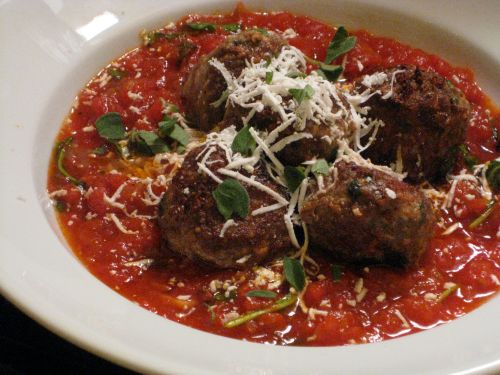
So here are spicy lamb meatballs blended with salty ricotta salata and served on a tomato arugula soup (really more of a loose sauce than a proper soup). This is a different meatball experience from your Sunday supper meatballs that simmer in sauce for hours. These are the meatballs you remember grabbing from the pan, hot, crisp, and greasy, before grandma lowered them into the steaming cauldron. Their outside is crunchy, their inside still a touch pink. This dish plus a few glasses of Dolcetto wine cured my cold. I know it is common knowledge that the histamines in red wine only clog you up more, but don’t believe it. This is the best remedy for a winter cold.

Lamb and Ricotta Salata Meatballs on Tomato Arugula Soup

(Serves 4)

For the meatballs:

1½ pounds ground lamb
2 tablespoons breadcrumbs, not too dry, not too finely ground
1 garlic clove, minced
⅛ teaspoon ground cinnamon
⅛ teaspoon ground nutmeg
½ teaspoon spicy paprika, plus a little more for garnish (I used Basque pimen d’espelette)
2 egg yolks
½ cup grated ricotta salata, plus extra for garnish
A handful of flat-leaf parsley leaves, well chopped
A few large sprigs of marjoram, the leaves chopped, plus a little more for garnish
Salt
Freshly ground black pepper
A generous drizzle of extra-virgin olive oil, plus more for sautéing.

For the tomato arugula soup:

Extra-virgin olive oil
1 large shallot, minced
1 garlic clove, thinly sliced
A pinch of ground cinnamon
A splash of dry Marsala or dry vermouth
1 28-ounce can and 1 15-ounce can Italian plum tomatoes, well chopped, with the juice
½ cup good quality chicken broth, possibly a little more
Salt
Freshly ground black pepper
A few drops Spanish sherry vinegar
A handful of wild or baby arugula, stemmed

To make the meatballs:

Place all the ingredients for the meatballs in a big bowl, and mix them well with your fingers. Try not to pack down the meat too much. The mixture should be well seasoned. Form it into medium-size meatballs, about 1½ inches across.

To make the soup:

In a large skillet, heat 2 tablespoons of olive oil over medium heat. Add the shallot, and sauté until softened. Add the garlic and the pinch of cinnamon, and sauté a minute longer. Add the Marsala or vermouth, and let it boil away. Add the tomatoes and the chicken broth, and cook at a lively bubble for about 8 minutes. Season with salt and black pepper. The soup should be just a little looser than a typical tomato sauce for pasta, so add more broth or water if needed. Turn off the heat, and add a few drops of the vinegar and the arugula. The heat from the sauce will gently wilt the arugula.

When you’re ready to serve the dish, pour about a half inch of olive oil into a large skillet over medium high heat. Add the meatballs, and brown them well on all sides, leaving their centers slightly pink. This should take about 5 minutes.

Ladle some tomato arugula soup into four bowls, about an inch or so of soup in each. Drain the meatballs on paper towels, and place four or five in each bowl, on top of the sauce. Sprinkle ricotta salata and a pinch of spicy paprika over each bowl. Scatter on the remaining marjoram, and finish each bowl with a drizzle of fresh olive oil. Serve hot.

A Thanksgiving Dance

Pier Paolo Pasolini and Anna Magnani step out.

Try working off those excess Thanksgiving calories with a celebratory dance.  (Whose shoe is that?  Gina Lollobrigida’s?)

Happy Thanksgiving to you from Skinny Guinea.