Feeds:
Posts
Comments

Sunny  Sicilian pleasures, compliments of Divorce Italian Style.

Recipe: Bucatini with Bottarga, Pistachios, and Mint

Do you need a little summer lightness in the midst of all this winter darkness? I do, and the easiest place for me to get it is in my kitchen. Stewed meat, as lovely as it can be, tends to eventually bring me down, making my brain feel cooked out, reduced to a very low simmer. In cold weather I like to play around with dishes that contain uncooked or flash-cooked elements. Grape and cherry tomatoes, usually pretty decent in winter months, can really lift a girl’s spirit. And I have to say that after all these years of seeing plastic packs of fresh herbs in my supermarket in January and February, I still can’t quite believe I can have them. It doesn’t seem that long ago I’d be hanging in my family kitchen watching my father go through his end-of-summer ritual of salting basil leaves from his garden, then wrapping them in plastic, then in aluminum foil, and then in more plastic (why?), and then stashing them in the freezer, hoping to prolong summer. Inevitably they’d be black when he defrosted them anyhow, but I suppose they did have a hint of fresh basil flavor, and in any case they were still better than dried ones for a winter tomato sauce.

I recently entered into a nuovo Siciliano cooking phase, probably to add some sunshine in my life. I’ve been putting energy into creating contemporary recipes using classic Sicilian ingredients like the bottarga, pistachios, and mint I incorporated in this pasta. I love Sicilian food, with its mix of Arab, Greek, Spanish, and haughty little touches of French, but I do get bored cooking the same classics. The food in Sicily is evolving, thanks mainly to a handful of innovative chefs but also in home kitchens. But you’d never know it from looking through most Sicilian or Southern Italian cookbooks written in this country. They tend to stay with the tried and true. Lately I just feel like playing around with sunny Sicilian flavors.

Buddy and Fumio check out a slab of Sardinian mullet bottarga.

Sicilian Bottarga is an interesting product, a salted, preserved roe from tuna. Think of using it where you might add uncooked anchovies but  you’re looking for a more sophisticated result (bottarga is shaved or grated and added to a dish at the last minute so it doesn’t cook and lose nuance). Classically it’s sliced thinly, drizzled with olive oil, and eaten as an antipasto. You can grate a little over a green salad; I’ve seen it done in Sicily. It can also be used as a condimento for pasta, the heat from the pasta just warming it slightly. True, bottarga is not something most people think of when they’re looking for sunny and light (if they think of it at all), but mixing it with the flash-cooked tomatoes and all the fresh herbs, I found that it along with the pistachios added a little depth to the dish, making it both rich and light—a good description generally of the Sicilian spirit.

In Sardinia, they make bottarga from mullet, and I kind of prefer the Sardinian to the Sicilian. It’s a little less straight-on salty, and it’s richer and moister. It’s also a bit more expensive, but since you use so little and it keeps, it’s really not such a splurge. Either kind will work really well in this recipe. You can purchase both Sicilian and Sardinian bottarga from buonitalia.com. Avoid the pre-ground powdered bottarga that comes in little plastic bags. That’s the dehydrated dredges of the dredges sold to tourists in overpriced food shops in Sicily (I’ve also seen it at the Buon Italia store at the Chelsea Market). That stuff is a complete waste of money.

I’ll be working on more revamped Sicilian-style dishes. The good ones I’ll pass on to you, hoping to lighten your winter load. Here is a good one.

Bucatini with Bottarga, Pistachios, and Mint

(Serves 4 as a main course or 6 a first course; I think it works best as a primo, because of its richness)

Salt
1 pound bucatini pasta
Extra-virgin olive oil
2 pints sweet grape tomatoes, halved
1 large garlic clove, very thinly sliced
A splash of sweet vermouth
A big palmful of shelled, unsalted pistachios
Freshly ground black pepper
The grated zest from 1 small lemon
About 2 ounces bottarga (you’ll want about 1/2 cup shaved)
A handful of flat-leaf parsley leaves, lightly chopped
A few large mint sprigs, the leaves lightly chopped

Put up a big pot of pasta cooking water, and bring it to a boil. Add a generous amount of salt, and drop in the bucatini.

In a large skillet, heat about 3 tablespoons of olive oil over high heat. Add the cherry tomatoes and the garlic, and cook quickly, just until the tomatoes start to soften and give off juice. Add a little salt. Now add the sweet vermouth, and let it bubble for a few seconds. Turn off the heat.

When the bucatini is al dente, drain it well. Pour it into a large pasta serving bowl, add the tomatoes with all the skillet juices, and toss gently. Shave the bottarga very thinly onto the pasta with a sharp vegetable peeler (or you could do this ahead of time and drizzle it with a litle olive oil). Add the pistachios, plenty of fresh black pepper, the lemon zest, and the parsley and mint. Add a drizzle of fresh olive oil. Toss again, lightly. Serve right away.

Too Much Salt

A shrine made from salt by the workers at the Trapani salt beds in Sicily.

I don’t eat out as much as a did when I wasn’t so tight with money, but I still do on occasion, especially when I want to check out a new Italian place in or around Manhattan that I’ve heard good things about. I feel okay shelling out for a place that is doing something new, or just doing something classic in a really fine way. I write restaurant recommendations on my blog from time to time, but I don’t write pans. I never wanted to be a restaurant critic; I don’t have the stomach for it. But a problem has arisen in, I’d say in the last ten years. It coincides with the growth of the “bam” seasoning mentality that has become such a problem with many newer chefs. They might not ever admit it, but I can taste it.

What bothers me, both as a diner and as a professional cook, is something that has become epidemic in Manhattan, and that is severe oversalting. I’m not talking about the French fries at Burger King or processed foods where you can’t control the salt content; I’m speaking of some upscale restaurants run by well-known chefs and owners.  There seems to be an unwritten assumption chefs have embraced that customers and critics won’t applaud your food unless it’s excessively salted. That is a bad assumption.

I recently ate at a very busy Italian place in my West Village neighborhood, lines out the door, people jammed together eating at the bar, noise level through the roof. Not my usual kind of atmosphere, but I’d heard good things about its Italian menu, and on paper it looked interesting. Every dish I ordered was outrageously oversalted. I thought it might just be an off night, so I went back about a week later, and I experienced the same thing. I couldn’t believe the salt level in the food, but I kept seeing the lines out the door, so I thought it only fair to try again. Same experience, especially in the appetizer department. The salt built up in the back of my throat. I started two nights with the same dish, a grilled octopus with chorizo and greens (I mean, really, how much salt do you need to add to a dish containing chorizo?). When on the second try I complained to the waiter about the salt, all he could come up with was “It’s one of our most popular dishes.” I don’t know if people are just too humiliated to complain about oversalting because they’re grateful they were able to obtain their 5:30 reservation in such a bastion of hipness, or possibly their palates have been shot to hell by chefs screaming “Attention must be paid” from their hot, steaming kitchens. I find this salt problem especially prevalent in wine bar food and appetizers, but not exclusively. I had a similar experience at one of the Batali restaurants about six months ago. Two dishes, a fritto misto and a pork ragu sauce, were not just salty but really salty. We sent the fritto misto back, but we were too embarrassed to complain about the other one as well. We should have.

I’m far from being a health freak or a saltophobe. I really like salt. I like my food well seasoned, but I’m talking here about the pleasure of taste as interpreted by trained chefs, and cooking with a fine-tuned palate, which to my palate doesn’t include being blasted with salt. (And furthermore, oversalted food makes some wines taste really bad, especially very tannic ones, so not only do these salt-happy chefs ruin your food, but they make it impossible for you to enjoy the wine you’ve paid an inflated price for too. Not fair any way you look at it.)

Please, don’t be shy. Speak out if you run into this problem. Tell your waiter. Tell the chef. These people should know when they’ve crossed the line from acceptably aggressive seasoning to flip impertinence. Or is it just a cry for help. ” Somebody get me out of this boiling, greasy kitchen”.

Recipe: Erica De Mane’s House Olives

I hardly ever have any real food in my refrigerator. I mean, I’ve got stuff like mustard, and I usually have a good stash of wine. You’d think being a food writer I’d have all sorts of delicious dishes wrapped up and ready to serve at any moment. Not so. First off, I’ve got no kids, so I don’t necessarily even stock dried pasta and canned tomatoes. I’m either cooking for Fred and me, shopping the day I cook, or I’m cooking for a big group, and shopping the day I cook. I usually send leftovers home with guests, because that’s easier than keeping them in my own refrigerator, plus I like giving friends food to go so they can think of me and my out-of-control generosity when they lunch on roast pork and cannellini beans the next day.

I like living like this. The stupid thing about it is that I often have nothing to offer friends when they stop by unannounced (I live in a street-level apartment, so they do often just show up, after looking in my window and seeing me milling around). I’ve always got booze, which is a good start, but it would be nice to offer them a little bread, cheese, salami. I  sometimes have those things, but usually just dried up odds and ends, not in a really presentable form.

If you live like me but would like to keep a few savory treats on hand, I suggest you try this: olives and taralli. Taralli, the great, dry, crumbly, savory Puglian biscotti made from semolina flour, olive oil, and white wine and often flavored with fennel seeds or rosemary, are the best way to go. They last for weeks and go extremely well with both red wine and gin. And olives, in my opinion, go with any type of booze your friends may request. They’re beautiful, they’re shiny, they’re classy and delicious, and they keep. They are grand dining at its most minimally acceptable.

I’ve now come up with what I consider our house olives. It’s a mix of the little brown Niçoise and the green Picholine varieties in about equal measure. I know it seems funny for an Italian food writer to serve French olives as her staple, but the sad truth is that even here in food-crazed Manhattan I can’t always find decent Italian ones. (The dark brown Taggiasche olives from Liguria and the green Sicilian Castelvetranos are my favorites. They’re sometimes available through buonitalia.com, or at Buon Italia’s store in the Chelsea Market, but not reliably.) I often wind up with these two French types, and they’re in no way a compromise. They’re just not Italian.

I mix them together and then grate on a bit of orange zest, a few sprigs of fresh thyme leaves, black pepper, and a drizzle of fresh olive oil, I give them a toss, and that’s it. There’s something about the orange, thyme, and black pepper trio that makes them perfect for me. I’ve tried other mixes, adding garlic, fennel seeds, hot chilies, rosemary, and various other additions, but this is the one I’ve grown to love. So if I’ve got my olives, my taralli, and my vino, I feel fully covered in the bare-bones hospitality department. At least I’m offering something. And if your friends are still hanging around after the olives are gone, you can always send out for a pizza.

Erica De Mane’s House Olives

1 cup brown Niçoise olives
1 cup green Picholine olives
The grated zest from 1 large orange
The leaves from about 8 sprigs of thyme
Freshly ground coarse black pepper
Extra-virgin olive oil

Drain the olives of whatever oil they were packed in (I find that it can sometimes be a little stale tasting). Place the olives in a nice-looking serving bowl. Grate on the orange zest, being careful not to lift up any of the white pith. Add the thyme leaves, and grind on a bit of really fresh coarsely ground black pepper. Give everything a drizzle of your best extra-virgin olive oil, and toss. They’ll last about two weeks refrigerated, but bring them back to room temperature before serving.

Recipe: Castelluccio Lentils with Leeks Vinaigrette

Lentils always used to be a dreary dish for me. The bowl of lentil soup my sister and I would order  because it was the only soup they had at a Midtown coffee shop was a winter tradition of ours when we were teenagers. That soup was, and still would be, mushy, gray, depressing, usually oversalted, and often studded with one choking-stiff bay leaf. It was our reward after a fine afternoon thinking of stealing but winding up paying for lipsticks at Macy’s. What usually saved the lunch was the extra-greasy grilled American cheese sandwich we’d order to share, alongside. If you’re a regular reader of my blog, you’ll probably know that I have a real aversion to mushy food. Mush aside, there’s not much flavor going on with run-of-the-mill lentils, unless you order a dish from an Indian place, where many, many spices mask the inelegance that lurks beneath.

But then one day years ago, while strolling the aisles of the old Balducci’s in the Village (boy, do I miss that store), I discovered a bag of lentils from Castelluccio, Italy. I bought them because they looked different, smaller, harder, smoother, multicolored, in shades of beige, light green and tan. They cooked up whole but tender and didn’t give off any sludgy brown film. They were pretty. I was so taken with them that I actually took a trip to that Umbrian village a few years later to watch the tiny things being harvested. (I put up an entire post about this trip a few years back, but for some reason it has temporarily vanished. When I find it I’ll let you know.) You can serve these glossy lentils for a fancy dinner and not feel you’re dishing up a mess of army rations. Castelluccio lentils are very much like the French Le Puy variety, which I discovered about a week later, also at Balducci’s, except that the French ones are dark green. Both are beautiful to cook with.

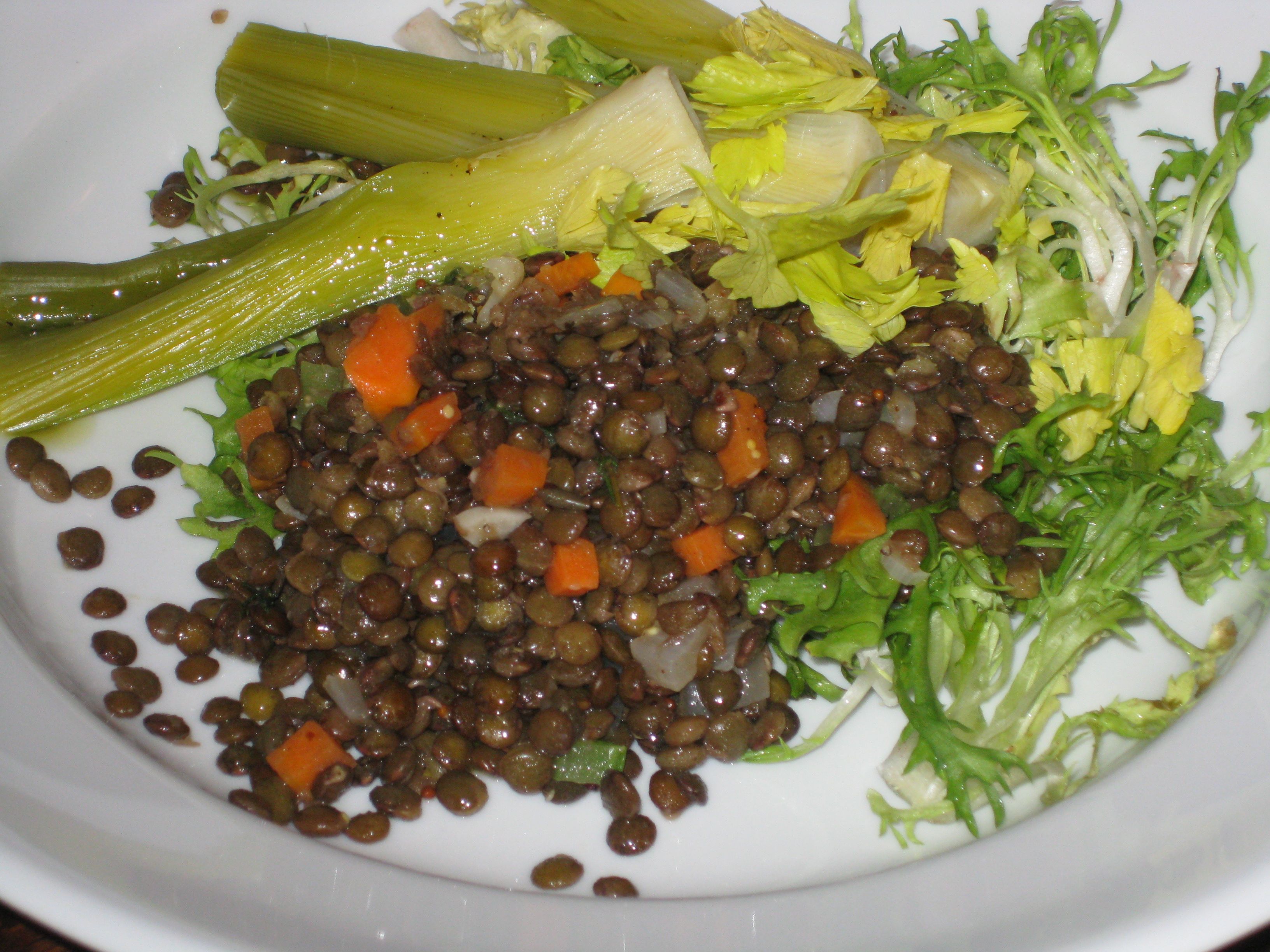
When I pick up a box of either the Castelluccio or the Le Puy lentils, what I like to do is make a salad, since cooking with lentils that stay intact is such a luxury. Here what I did was give them a brief boil (about 20 minutes) and then mix in a lightly sautéed soffritto before dressing them with a vinaigrette. I draped poached leeks over the top and wound up with what my pork-fat-loving palate found to be a vegetarian delight. (I had to restrain myself from adding pancetta. It would have been a good ingredient I’m sure, but I wanted this to be pure.)

Castelluccio Lentils with Leeks Vinaigrette

(Serves 4 as a main course)

2 cups Castelluccio or Le Puy lentils, picked over
1 fresh bay leaf
A generous pinch of sugar
Extra-virgin olive oil
Salt
1 large carrot, cut into small dice
1 large shallot, cut into small dice
1 celery stalk, cut into small dice, plus a handful of celery leaves, lightly chopped
¼ teaspoon ground allspice
Freshly ground black pepper
A few large thyme sprigs, the leaves lightly chopped, plus some extra for garnish

For the vinaigrette:

The juice and grated zest from 1  lemon
1 1/2 teaspoons Dijon mustard
Salt
A pinch of sugar
4 tablespoons extra-virgin olive oil
Freshly ground black pepper

Plus:

12 leeks, well trimmed and split down the middle, keeping the stem end intact
A big handful of mixed salad greens

Put the lentils, bay leaf, and sugar in a saucepan. Cover with cool water. Bring to a boil, lower the heat a bit, and cook at a low bubble, uncovered, until the lentils are tender but still holding their shape, about 20 minutes. Drain well, and place them in a bowl. Give them a drizzle of olive oil, and season them with a little salt.

In a small sauté pan, make a quick soffritto by sautéing the carrots, shallot, and celery in olive oil, leaving the vegetables a little crunchy. Add the vegetables to the lentils. Add the ground allspice, black pepper, and thyme . Mix, and let come to room temperature.

While you’re preparing the lentils, soak the leeks in a big pot of cold water, letting all the dirt fall to the bottom. Lift them from the water, making sure they’re very clean. Poach the leeks in boiling salted water until tender, about 20 minutes. Pull them from the pot, and lay them out on paper towels. Drizzle with a little olive oil. Season with a bit of salt.

When ready to serve,  divide the salad greens out onto four plates.  Whisk together all the ingredients for the vinaigrette, and pour about half of it over the lentils. Toss, and check for seasoning. Lay three leeks on each plate near or over the lentils (whichever looks prettiest). Drizzle the leeks with the remaining vinaigrette, and scatter on the thyme garnish and the celery leaves.

Women with Fish


Lady with a fish-bone tattoo.

Recipe: Baked Macaroni with Fontina and Montasio

The baked mac and cheese fad that’s been winding its way through Manhattan and Brooklyn restaurants for the last ten years or so shows no sign of slowing down. I really resented this trend when it first appeared, thinking it trashy (what a sin) or, as it evolved, ridiculously highbrow, with some upscale restaurants charging big for a gooey pile of cheap cheese. Today if you’re a low-end or high-end bistro-type place, you’ve got to have a giant locavore burger, and you’ve got to have mac and cheese. The versions that upset me most are the five-cheese one (how could any palate discern five distinct cheeses when melted into one big glue ball—that’s just a waste of cheese, in my opinion), or the all-time most sickening, the mac and cheese drizzled with that terrible chemical potion known as truffle oil. The smell of that stuff floating in the air in any restaurant gives me a gag response. It should be outlawed.

Now that I’ve given you my haughty and maybe slightly stupid assessment of this food trend, wouldn’t you know it that the other night I’d find myself craving the dish. It was a very cold night, and the aroma of hot melted cheese was what I wanted in my kitchen and in my mouth. But, as you would guess, it was going to have to be a very Italian mac and cheese, and one with the utmost integrity, because I am a food snob of the highest order. Fontina Valle d’Aosta, made from the milk of cows that roam the Italian Alps, is the ultimate velvety melting cheese, a cheese that when heated releases a gorgeous mix of sweet and stinky aromas. I knew it would be my starting point, so I went out and found myself a really good hunk. Despite my issues with combining cheeses for no effect, I did feel there needed to be a counterpoint to the fontina, a slightly stronger grating cheese that would balance out all the fontina’s richness. Parmigiano Reggiano would have been a good choice, as would grana Padano, but I went with an aged Montasio, a cow’s milk cheese from Friuli that’s assertive but still contains sweetness. You might want to avoid really sharp pecorinos or aged provolone. Both in my opinion are too sour. Their tastes would throw this mellow, rich dish into the low-class food department. I’m also not crazy about including gorgonzola, as much as I love that cheese. I’ve tried it, and not only does it make the dish quite pungent, it also adds a slight soapy taste, for some reason.

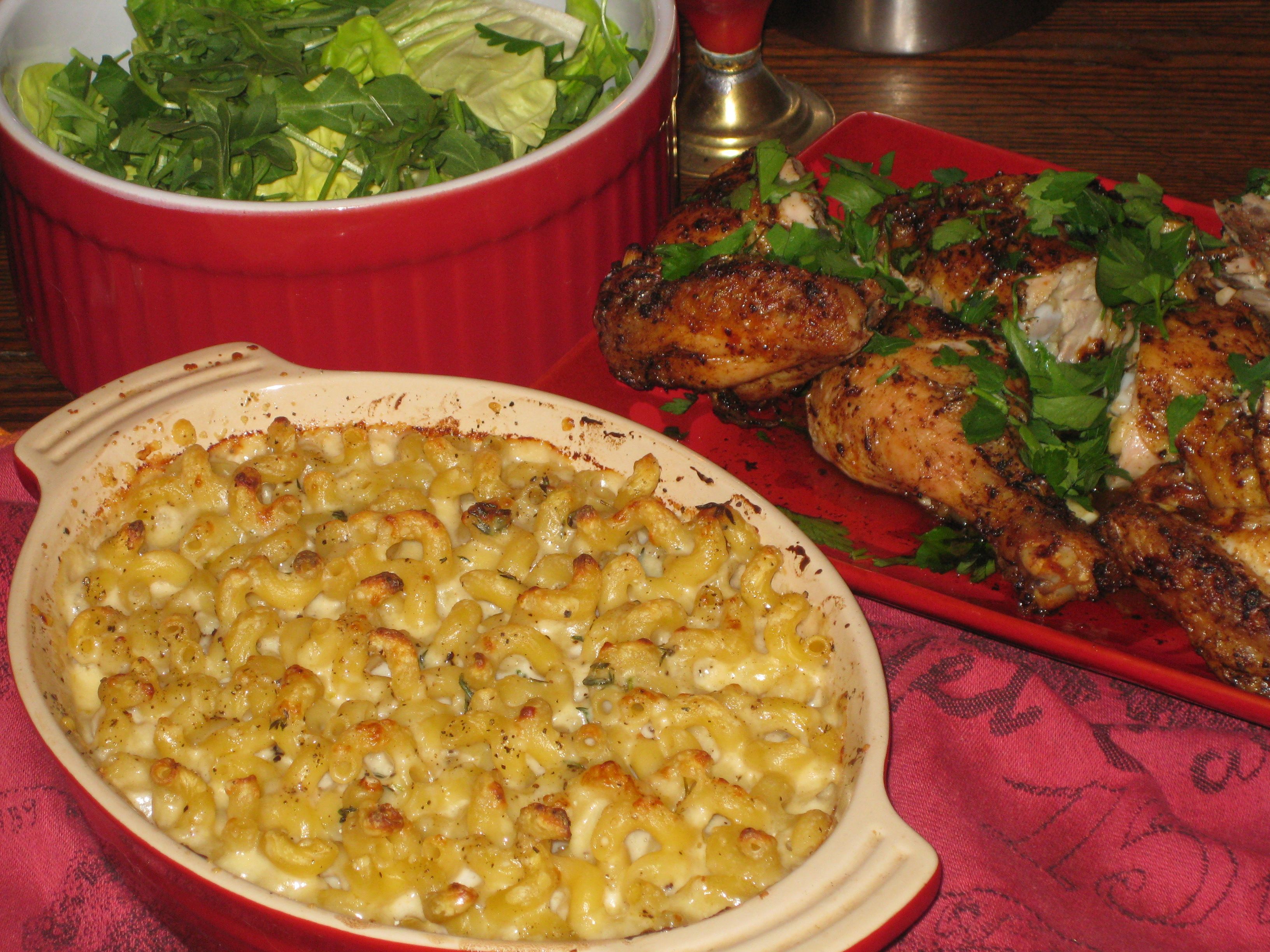
So here’s my Italian mac and cheese. I’m pretty happy with it. It’s a great thing to make after a day trudging around the freezing, dirty city, exhausted from expending a lot of energy getting nothing accomplished. It’s very easy to make—you just throw the cheeses into a food processor. I’ve glammed it up with fresh thyme, a dollop of crème fraîche, and a pinch of allspice. Cook it quickly in a hot oven for the best result, a rather loose inside with a crisp browned top.  Try  it with a green salad that includes a bitter element such as escarole or radicchio. I hope it makes you happy.

Baked Macaroni with Fontina and Montasio

(Serves 5 or 6)

1 pound cavatappi or fusilli pasta (or, my favorite shape for this, cellentani, a mini cavatappi made by Barilla)
Salt
A drizzle of extra-virgin olive oil
4 tablespoons unsalted butter, plus a bit more for the baking dish
3 tablespoons all-purpose flour
1 quart whole milk
½ teaspoon ground allspice
1 fresh bay leaf
A big pinch of hot paprika
1 garlic clove, peeled and lightly crushed
A few large thyme sprigs, the leaves lightly chopped, plus a little extra for garnish
2 tablespoons crème fraîche
1½ cups grated fontina Valle d’Aosta cheese
1 cup grated aged Montasio cheese
Freshly ground black pepper
½ cup dry breadcrumbs

Boil the pasta of your choice in well-salted water until al dente. Drain it, pour it into a bowl, and toss it with a drizzle of olive oil.

Preheat the oven to 425 degrees.

Melt the butter and flour in a saucepan. Whisk until it’s smooth and the raw flour smell is gone, about 3 minutes. Add the milk, whisking all the time. Add salt, allspice, the bay leaf, the hot paprika, the garlic, and the thyme. Whisk until it just comes to a boil and is smooth and thick, about 4 minutes or so. Remove the bay leaf, and try to smash up the garlic in the sauce. Pull the pan from the heat, and add the crème fraîche, the fontina, ¾ cup of the Montasio, and some freshly ground black pepper, and whisk until smooth. Taste to see if it needs more salt.

Butter a large gratin dish or casserole (wider and shallower is better than deep for optimum crust and quick cooking).  Pour about ¾ of the sauce on the pasta, and toss. Add the pasta to the gratin dish.  Pour the rest of the sauce on top. Mix the breadcrumbs with the remaining Montasio, adding a bit of salt and black pepper. Sprinkle over the top.

Bake, uncovered, until browned and bubbly, about 15 minutes or so. Garnish with the rest of the thyme leaves. Serve right away.


Dead Chicken, by Chaim Soutine.

Recipe: Chicken Liver Salad with Escarole, Capers and Sage Croutons

I was thrilled recently when I taught my students  to cook up a few chicken liver recipes and got good vibes from the group. I  heard comments like, “Oh, I just love chicken livers.” They were sincere, too, I discovered. When I had a few extra livers left in the sauté pan after the demo, some of the students rushed up to our little stage to fork them up, right out of the pan. Don’t underestimate the passion of middle-class Upper Westsiders, as I first learned during my octopus cleaning and cooking class. They get into it. Teaching can be a humbling experience.

Speaking of chicken livers, at the top of my list of favorite winter salads you’d find ones that include crisp, high-heat-sautéed chicken livers, left pink in the middle and finished with a dash of grappa or brandy. That wasn’t something in the recipes I recently did for my class, but it was something I wanted very badly for dinner last night.

The key to any composed salad is to keep it clean. Refrain from using too many flavors, and make the dressing simple (nothing creamy, for instance). If you’re adding hot ingredients, such as sausage, sautéed shrimp, or chicken livers, chose greens that won’t wilt under the heat (arugula, for one, melts with a drip of warm oil). Frisée and escarole are good choices.

For this salad I pulled some flavors from the classic Tuscan chicken liver pâté, a dish I did make for my class (you can find my recipe here). I included capers, sage, a splash of grappa, and coarse black pepper, which is very important for both flavor and texture.

It’s been very cold this week. Many people think of eating baked ziti or polenta when the weather gets rugged. Try this salad instead. You’ll discover what a comfort it can be.


Chicken livers sautéed with capers and grappa, salad-ready.

Chicken Liver Salad with Escarole, Capers, and Sage Croutons

(Serves 2)

1 small head escarole, torn into pieces
1 small shallot, very thinly sliced
2 slices day-old Italian bread, the crust left on, cut into 1-inch cubes
Unsalted butter
Salt
2 fresh sage leaves, chopped
A few big thyme sprigs, the leaves stemmed
1 teaspoon Spanish sherry vinegar
The grated zest from 1 small lemon
Extra-virgin olive oil
½ pound organic chicken livers, cleaned, cut into lobes, and well dried
A generous pinch of sugar
Coarsely ground black pepper
A small palmful of Sicilian salt-packed capers, soaked and rinsed and dried
A tiny splash of grappa

Put the escarole in a salad bowl, and scatter on the shallot.

In a small sauté pan, heat a tablespoon of butter over medium heat. Add the bread cubes, season with salt, and sauté until golden, about 3 minutes. Add the sage, and pull the pan from the heat.

In a small bowl, whisk together the vinegar, thyme, lemon zest, and about 2 tablespoons of olive oil, seasoning with salt.

In a medium sauté pan, heat a tablespoon of olive oil and a tablespoon of butter over medium-high heat. When the oils are hot, add the chicken livers, sprinkling them with the pinch of sugar and spreading them out in the pan. Let them brown without moving them around, about a minute or so. Turn them over with tongs, season them with salt and coarse black pepper, and brown them on the other side, about a minute or so longer. Be a little careful, as they can spit at you. When the livers are well browned but still pink at the center, add the grappa and the capers, and let bubble for a few seconds (the pan will probably flame up, so stand back so you don’t melt off your eye lashes). Add the chicken livers and all the pan juices to the salad bowl. Pour on the dressing, add a few grinds of coarse black pepper, and toss gently. Add the croutons, and toss very quickly. Serve right away.

Recipe: Shrimp and Roasted Cauliflower Bruschetta

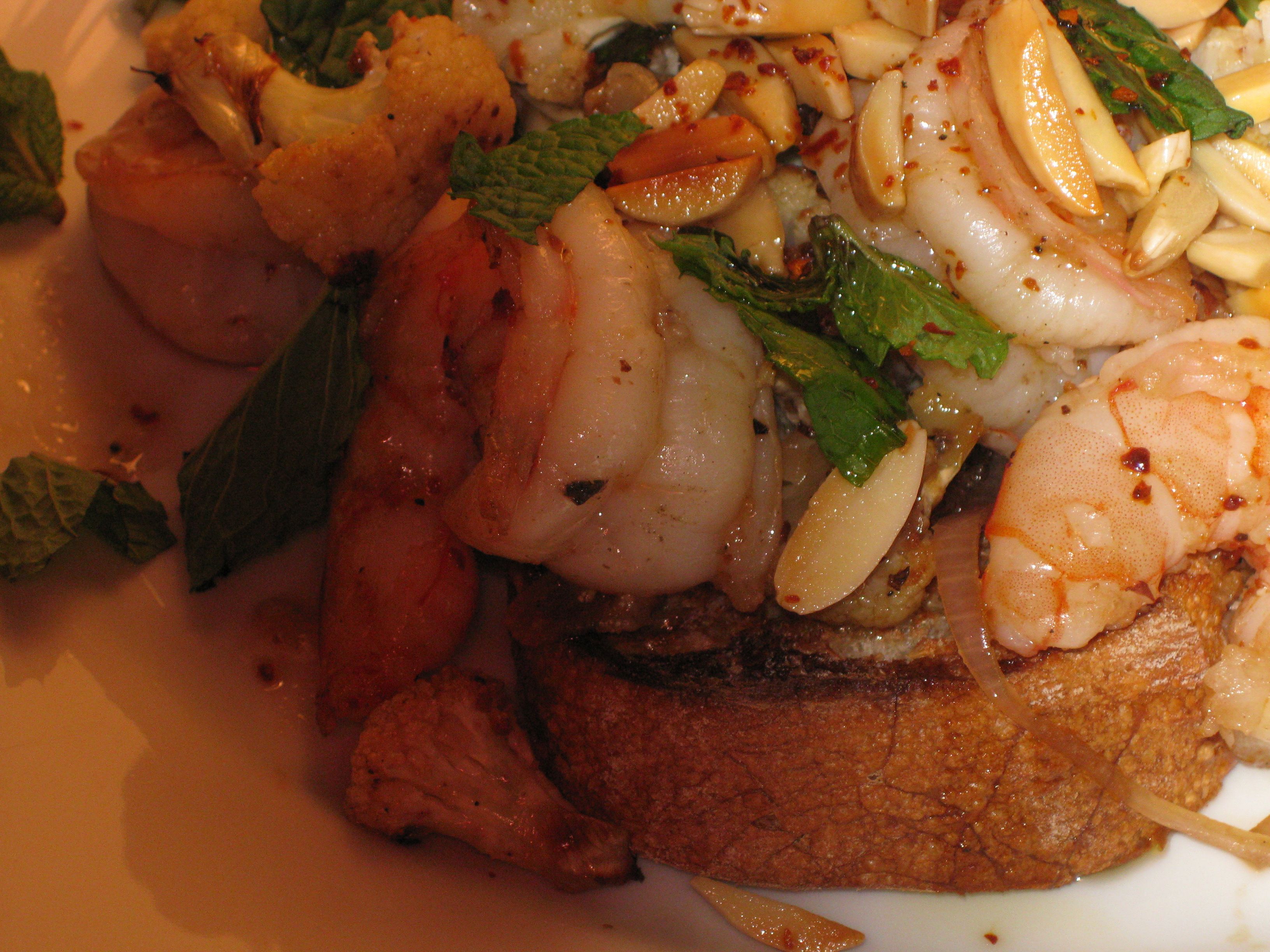
I don’t like the idea of Nine, the new movie based on Fellini’s and resurrected from the semi-bomb of a Broadway musical of the same name that opened in 1982 and hung around for about a year (my parents didn’t even see it). I think the musical starred Raul Julia, an actor I really loved on film. The movie, with its super-duper cast, including my favorite living actress, Penélope Cruz, seems to be, unfortunately, a huge embarrassment, featuring Nicole Kidman’s new fattened lips that make her look a little like Dr. Joyce Brothers. I saw the cast assembled on Larry King last night, in an apparently desperate attempt to drum up enthusiasm for what looks like a big movie heading to be a big bomb. They showed lots of clips, of course. One that especially caught my attention featured the usually excellent actor Daniel Day Lewis, speaking in an Italian-by-way-of-Montenegro accent. So strange. That pretty French woman who played Edith Piaf so exquisitely a few years back and won an Oscar for it looked lost in the lineup, trying to answer Mr. King’s questions about whether or not she actually liked working with all those other really big actors (questions from a man who recently let slip that he thought Michael Moore had possibly written the song “The Times They Are a-Changin'”). I’m not sure Fellini needs another whipped up homage, especially since in his later years he created a few overexcited and extremely expensive self-celebrations all by himself, such as Satyricon and, a few years later, Casanova. You don’t have to ignore those movies; Casanova is actually pretty funny. But do yourself a favor and watch I Vitelloni again (and then maybe a week later again), and let its beauty fill your heart. You’ll see that love needs little tribute to keep it alive—maybe just a taste of this shrimp and cauliflower bruschetta. Federico, this bruschetta’s for you.

Shrimp and Roasted Cauliflower Bruschetta

(Serves 4 as a substantial first course)

1 medium cauliflower, cut into small flowerettes
¼ teaspoon ground cumin
Salt
A pinch of sugar
Black pepper
Extra-virgin olive oil
1 shallot, thinly sliced
1½ pounds large shrimp, shelled and deveined
1 large garlic clove, very thinly sliced
Salt
A generous pinch of Aleppo pepper
A splash of dry white wine
½ cup chicken broth
A handful of lightly toasted almond slivers
4 large slices crusty Italian bread, about ¾ inch thick
1 lemon, cut into wedges
A handful of fresh mint leaves

Preheat the oven to 400 degrees. Place the cauliflower on a sheet pan. Season it with cumin, salt, a pinch of sugar, and black pepper. Drizzle it well with olive oil, and give it a toss with your fingers. Roast until fragrant, tender, and lightly browned, about 15 minutes. Add the shallots in the final few minutes of roasting. Pull the pan from the oven, and give it a good toss.

In a large sauté pan, heat 2 tablespoons of olive oil over high heat. When the pan is really hot, add the shrimp and the garlic. Season with salt and Aleppo, and sauté quickly, tossing the shrimp once or twice until they’re pink and just cooked through, about 3 minutes. Add the white wine, and let it bubble a few seconds. Add the chicken broth, and let it bubble a second or so. Add the cauliflower, and toss again. Add a generous drizzle of fresh olive oil, and add the almonds. Check the seasoning.

Toast the bread slices on both sides, and lay them out on plates. Drizzle them lightly with olive oil, and season them with salt.  Divide the shrimp mixture up onto each toast, letting it spill over onto the plate (this is a knife-and-fork bruschetta). Garnish with the mint leaves and the lemon wedges. Serve hot, along with a slightly bitter green salad, maybe escarole or arugula, simply dressed.

I have a great recipe to put up, something I made for Christmas Eve, but I’ve been a little frazzled and can’t yet get it into writing. It involves a combination of cauliflower and shrimp. I realize that doesn’t sound too promising, but I tell you it was excellent. I got the idea from an amazing dish I ate at a fancy restaurant in early December, for my birthday, that involved lobster and cauliflower. I didn’t think it would work, but I ordered it anyway. That was at Cafe Boulud, a place I’ve been to maybe twice in my middle-aged life. I loved the combination and decided to try it with more affordable shrimp. It was great. I’ll be posting it soon.

Buon capo d’anno to all my friends.

Erica

Orange Salad for Christmas Day


Sophia dressed as an orange salad.

Merry Christmas to lovers of Southern Italian cooking.

Orange, Fennel, Black Olive, and Mint Salad

(Serves 4 or 5)

4 oranges, peeled and cut into thin rounds (include 2 blood oranges if you can find them)
2 small fennel bulbs, trimmed and thinly sliced
½ red onion, cut into thin slices
A handful of black olives (I like the wrinkled Moroccan type for this salad)
Sea salt
Freshly ground black pepper
Your best extra-virgin olive oil
A handful of fresh mint leaves

Arrange the orange and fennel slices on a large, pretty serving platter. Scatter on the red onion and the black olives. You can cover and chill this until you’re ready to serve it.

Right before serving, season with sea salt and black pepper. Drizzle with a generous amount of olive oil, and garnish with the mint leaves. Serve right away.