Feeds:
Posts
Comments


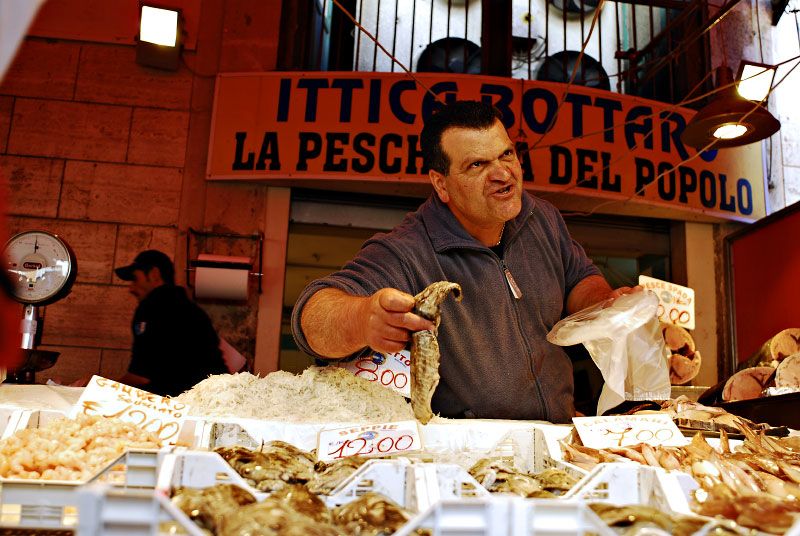
Sardines at the Santa Caterina market in Barcelona.

Recipe: My Pasta Colle Sarde

One of the Southern Italian dishes that most intrigue people, my readers for sure, is pasta colle sarde (pasta with sardines), that exotic, elegant dish from Sicily. The first time I tasted it was in Palermo, and all I can say is its flavor had no reference point for me. Nothing I recalled eating had tasted remotely like it. I fell in love. I was hooked.

When made in the classic manner, pasta colle sarde is a blend of cucina povera ingredients like wild fennel and the humble sardine, nice enough, but also raisins, pine nuts, and saffron, some of Sicily’s top-shelf ingredients. It is a dish of genius, a blending of Sicily’s poor and noble cooking, punctuated with Arab touches. Almost every time I’ve eaten it, in Sicily or here, it’s been made with bucatini. That is the classic pasta for it. Fresh sardines, not canned ones, are a given. They are what gives the sauce its distinct, vibrant taste. No garlic or tomatoes have ever been present in the classic versions I’ve sampled. And the pasta is always topped with toasted breadcrumbs. What a work of art.

I knew I had to make this pasta at home in New York, but when I set out on my first try, roadblocks kept popping up. There was no wild fennel in Manhattan. On the West Coast it grows freely along highways. I can now find it intermittently at the Greenmarket, but not reliably. There were no fresh sardines back then on my first attempt, which was about 15 years ago, I’d say. I tried using canned. That was a grave mistake. It made the dish taste fishy and oily and, well, just like canned sardines. No vibrancy there. A few years later I started seeing sardines imported from Portugal in my markets, so things changed. I could begin to capture the taste. Much better. Good even.

The use of wild fennel is something I’ve had a hard time getting comfortable with anyway. I’ve been served versions of pasta colle sarde in Sicily that seemed to incorporate cups and cups of boiled-down wild fennel, making the dish look like a soggy mass of lawn clippings. I don’t get that, but I’ve been served it that way on enough occasions that I guess it’s somewhat standard. When I find the wild stuff, I use much less, and that works for me. The version I offer for you here doesn’t use the wild. I know purists will say not to even attempt the dish without it, but I’ve found that if I blend ground fennel seeds, bulb fennel fronds, and a tiny, tiny amount of dill, I’ll get a flavor that feels right to me. The dill, although an herb almost unknown in Southern Italy, adds that slight bitterness you find in wild but not bulb fennel fronds.

Another challenge with this dish is that since it is made with very little real liquid and finished with breadcrumbs, it can wind up really dry. But don’t worry. I’m here with a solution to that and a few other problems you could run into when trying it yourself.

Most important, when you see really fresh sardines in your market, buy them, change course, and just know that tonight, whatever you had planned, you are instead making pasta colle sarde.

Here’s how I do it.

First, a word about how to prep the sardines for this dish. You can always ask your fish seller to do it for you, but I swear it’s surprisingly easy to do yourself. First, open the sardine up on the underside with a small knife and pull out its insides with your fingers. Cut off its head. Rinse the sardine under cool water while rubbing away all its scales (they slip off easily). Next, for this dish, you need to remove the backbone. To do so lay the fish open, skin side down, and flatten it with your fingers. You’ll be able to feel the backbone jutting out. Lift it out at the head end with your fingers. Most of the tiny side bones should come up with it (but it’s no big deal if a few remain; they’re tiny and full of calcium). Now pull the entire backbone up and toward the tail end. Snap it off at the tail. Separate the sardine with a small knife, along the backbone, into two fillets.

My Pasta Colle Sarde

(Serves 4 as a main course)

Extra-virgin olive oil
About ¾ cup homemade dry breadcrumbs, not too finely ground
Salt
½ teaspoon sugar
A few big scrapings of nutmeg
1 large spring onion, cut into small dice
4 anchovy fillets, minced
A small palm full of fennel seeds, ground to a powder
12 to 15 sardines (about  2 pounds), boned and filleted (see my advice above)
Freshly ground black pepper
½ cup raisins soaked in ½ cup dry Marsala
About 15 saffron threads, dried if moist and then ground to a powder and  put in ½ cup warm chicken broth (or a very light fish broth)
1 pound bucatini
½ cup all-purpose flour
½ cup pine nuts, lightly toasted
About ½ cup well-chopped bulb fennel fronds
6 large dill sprigs, chopped

In a medium skillet, heat a tablespoon of olive oil over a medium flame. Add the breadcrumbs, and sauté them, stirring them around, until they’re crisp and just turning golden, about 1 minute. Turn off the heat. Add a little salt, the sugar, and the nutmeg. Pour it all into a little bowl, and set aside.

Bring a large pot of pasta cooking water to a boil. Add a generous amount of salt.

In a large skillet, heat about 3 tablespoons of olive oil over medium flame. Add the onion, and let it soften for a minute. Add the anchovies, the ground fennel seeds, and all but about 6 of the sardine fillets. Sauté all these ingredients together while mashing up the sardines, until everything is soft and fragrant, about 3 minutes. Season with a little salt and a generous amount of black pepper. Add the raisins with their Marsala soaking liquid and the saffron-flavored chicken broth.

Drop the bucatini into the pot of boiling water.

Turn the heat under the sardine sauce down a bit, and let it simmer for about 2 or 3 minutes. Then turn off the heat.

In a small skillet, heat about 2 tablespoons of olive oil over medium high heat. Season the reserved sardine fillets in a little salt, and then dredge them in flour, shaking off any excess. When the oil is hot, add the fillets, and very quickly sauté them on one side. Give them a flip, and quickly sauté their other side. Take them from the skillet.

When the bucatini is al dente, drain it, saving about a cup of the cooking water, and put the bucatini in a large, warmed serving bowl. Add the sardine sauce, the pine nuts, the fennel fronds, and the dill. Add 1/4 cup  of fresh olive oil and a splash of the pasta cooking water. Give it all a good toss. Check for seasoning, and add more salt or black pepper if needed. Top with the sautéed sardine fillets and a sprinkling of the breadcrumbs. Serve right away, passing the remaining breadcrumbs at the table.

Quimet y Quimet, a tapas bar in Barcelona.

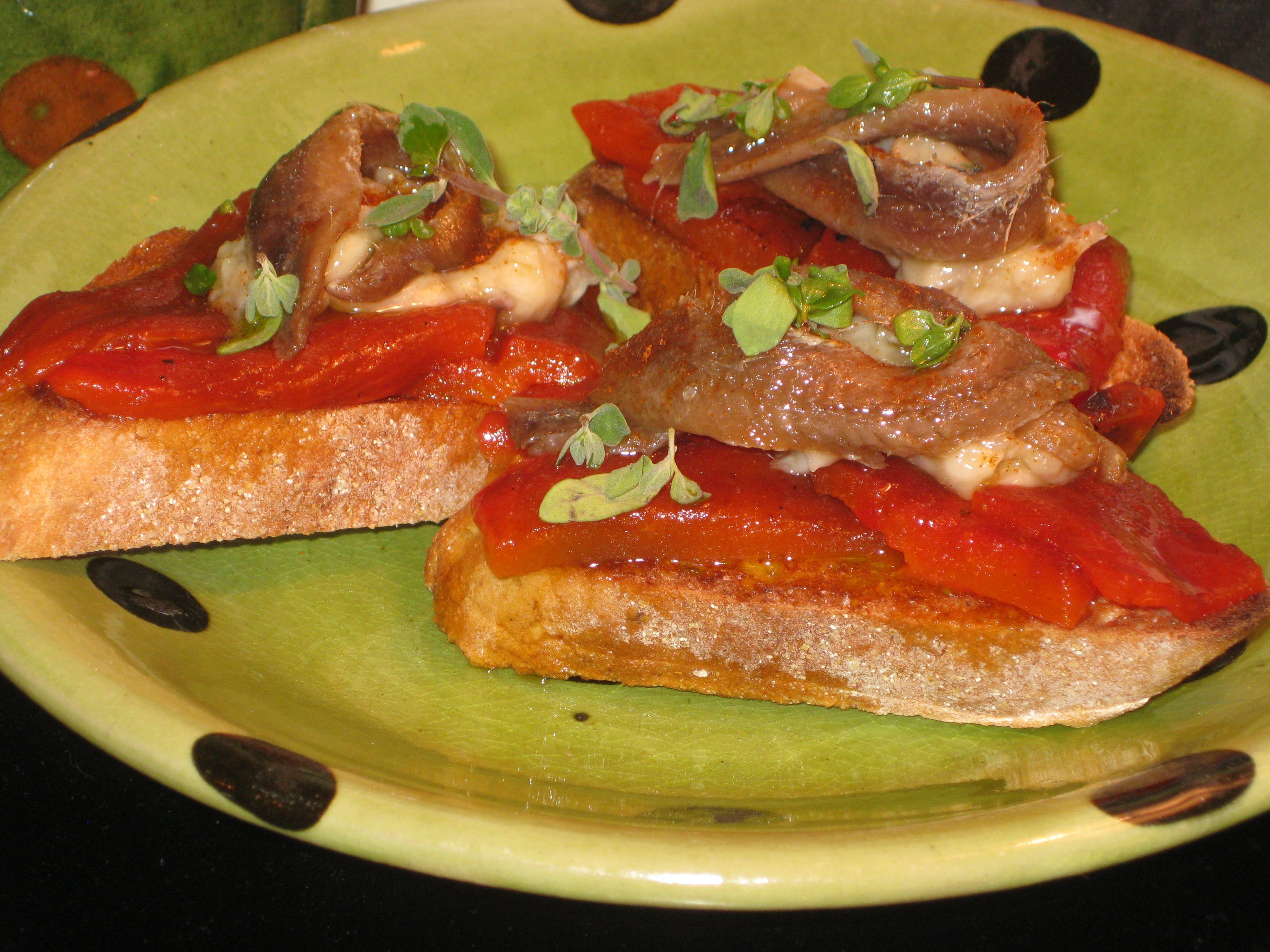
Recipe: Crostini with Anchovies, Butter, Roasted Peppers, and Marjoram

Sorry for my lack of postings in the last week or so, but I took a little vacation and couldn’t figure out how to put up photos or much else with the cranky old laptop I had with me. I went to Barcelona. Okay, it’s not Southern Italy, but even the most devoted little guinea must branch out at times, and it is, after all, on the Mediterranean. There are many similarities in its cuisine, because it is based on olive oil. In fact, many ingredients—olives, artichokes, sweet peppers, tomatoes, great wine, seafood including baccala (bacalla in Catalan and bacalao in Spanish)—play a huge part in both culinary worlds. That’s one of the reasons Barcelona is so fantastic and yet so familiar to an Italian food–focused individual. (Also the wine is really inexpensive and really good.)

As always when I travel, I headed straight to the markets, especially the fish markets. I was impressed by the quality of my favorite fish, sardines and anchovies, the silvery, oily, strong little fish I can never resist. Not only could I not take my eyes off of the little piles of them in the market, but I ordered them wherever I ate out. What is it about the taste of strong, oily fish that is so addictive? Well, maybe not everyone feels this way, but I don’t understand how anyone could fail to go nuts over a platter of deep-fried anchovies squirted with a little lemon, along with a glass or two of cava.

Now, in Barcelona they’ll say they’re not a tapas town, but it seems every old-time bar and every new hipster wine place serves amazing tapas, some traditional and some contemporary and sophisticated.  My husband and I went to a trendy and very tiny tapas bar called Quimet y Quimet in the Poble Sec neighborhood where we were staying. They specialize in tapas-type little dishes called montaditos,  built on hard round bread that looks like mini bagels. The little bagel things reminded me of the Southern Italian friselle of my childhood, but  much smaller and not quite so jaw breaking (you don’t have to soak them in hot water or soup to make them edible; a drizzle of olive oil softens them right up). There were all sorts of combinations piled on the crusty little bagels. I sampled one that combined smoked salmon, yogurt, roasted pepper, honey, and soy sauce. You wouldn’t think smoked salmon and honey would be particularly good together, but now I know that they are in fact very good. And of course I had to try the anchovy and tapenade montadito, also with yogurt (weird, this yogurt fixation) and roasted peppers. It was excellent primarily for the quality of its anchovies. Many tapas places serve boquerones, fresh anchovies spiked with a little vinegar and then laid out flat and covered with good olive oil. Quimet y Quimet used anchovies known as anchoas that have been salted and then packed in good olive oil. I like both types, but sometimes the fresh ones are too vinegary for me.

The bagel tapas appealed to me. When I got home I wanted to create some version of Quimet’s montadito using the oil-packed anchovies we can get here. I didn’t have the mini bagels, but since I understood them to be essentially Southern Italian crostini but with just a bit more art and complexity, I used good Italian bread as a starting point.

One thing I like to do with oil-packed anchovies, even really high-quality ones (and what others would you bother with?), is refresh them. I give them a gentle rinse in cool water and then lay them out in a low-sided dish. Then I drizzle them with a very good olive oil, my best oil, and let them sit and soak it all in. That gets rid of any overly fishy and less-than-great-quality olive oil they may have been sitting in.

So here’s a crostini piled a little higher than is usual in Italy. And by the way, all the montaditos are served at room temperature, not hot, so that’s what I’ve done here. Smart, actually. It makes all the flavors really pop.

Crostini with Anchovies, Butter, Roasted Peppers, and Marjoram

(Serves 4 as an antipasto)

A dozen oil-packed Spanish or Italian anchovies (I used Flott, a very good Sicilian brand)
Extra-virgin olive oil
4 tablespoons unsalted butter, at room temperature
2 red bell peppers, roasted until charred all over, peeled, seeded, and cut into pieces about the same size as the toasts
1 garlic clove, very thinly sliced
A pinch of sugar
8 slices baguette, cut on an angle
A sprinkling of smoked paprika, such Spanish pimenton de la vera
A few large sprigs of marjoram, stemmed, the leaves left whole

Place the anchovies in a strainer, being careful not to break them up, and gently run a little water over them. Pat them dry, and lay them out in one layer in a low-sided dish. Drizzle them with your best olive oil (I used Ravida, from Sicily), just enough to cover them lightly. Let them sit, unrefrigerated, to soak up the oil, for about an hour.

Take four anchovies from the dish, and put them in a mortar. Mash them well. Add the softened butter and blend it into the anchovies.

In a small bowl, combine the roasted pepper pieces, the garlic, and a pinch of sugar. Mix gently.

Toast the baguette slices on both sides, and let them cool for a moment. Place about two pieces of the roasted pepper on each toast. Then top the peppers with about a half teaspoon of anchovy butter, but don’t spread it out; just let it sit. Drape an anchovy over each little butter mound. Finish each crostini with a sprinkling of hot paprika and a few marjoram leaves.

A tarantella from Ischia sung by Pino De Vittorio.

Recipe: Little Mussels with Cherry Tomatoes, Chives, and Spring Herbs

Whenever my fish man at the Greenmarket has little mussels, I grab them. First off, any mussels from the Greenmarket are local, just caught, and as fresh as can be. But the little ones remind me of Southern Italy, in particular the ones I had many moons ago when I visited the island of Ischia, the beautiful sister island to Capri off the Bay of Napoli.

Mussels in general are something I usually can’t resist, but they’ve got to be totally fresh or they can turn on you (I’m sure you can recall one such experience). The ones I ate in Ischia so many years ago were pitch black, glistening, smooth, about a half inch to an inch long. Their beauty alone was enough, but then there was their taste, sweet, briny, cooked in white wine with those incredible Neapolitan cherry tomatoes that hang in clusters all over the place, and tons of herbs. Eating those little beauties in big glass bowls on an Ischia beach, the blaring sun and the fizzy white wine did something poetic to my distance vision. I watched, in a glazed-over fashion, as fishermen, pulling up in their turquoise boats (the brightest turquoise ever, at least to me, at that time and place), hauled in even more mussels. But even in the confines of my mini New York apartment, the Montauk mussels I purchased from the Greenmarket were out of this world.

Eating those mussels reminded me of something else, a singer I’ve just come to love very much, a man named Pino De Vittorio, from Puglia. He specializes in reviving Southern Italian folk music. His voice and movements are beautiful, sometimes hauntingly so (like Southern Italy in general). In the video above he sings a gentle (some aren’t so gentle) tarantella from the island of Ischia.

Little Mussels with Cherry Tomatoes, Chives, and Spring Herbs

(Serves 2)

Extra-virgin olive oil
1 shallot, thinly sliced
1 stalk young spring garlic, very thinly sliced, using all the tender green part too
1½ pints cherry tomatoes, stemmed
About 2 pounds small mussels, well washed and bearded if necessary
A big splash of dry white wine
1/2 cup homemade or good quality store-bought chicken broth
Freshly ground black pepper
Salt, if needed
A big handful of fresh herbs, very lightly chopped. A good mix is chives, Italian parsley, mint, fennel fronds, and tarragon
2 tablespoons unsalted butter

Heat about 2 tablespoons of olive oil in a large pot over medium flame. Add the shallot, and let it soften. Add the garlic, and sauté until it releases its aroma, about 30 seconds or so. Add the cherry tomatoes and the mussels, and stir everything around for a minute. Add the white wine, and let it bubble for a minute. Add the chicken broth, and cook, uncovered, stirring the mussels a few times, until they’ve opened, usually about 4 or 5 minutes. Add a good amount of black pepper and a little salt, if needed (that will depend on the saltiness of your mussels). Turn off the heat, and add all the herbs and the butter. Give everything a good stir. Serve right away. This is especially good with bruschetta rubbed with garlic and then brushed with olive oil.


The fish market in Siracusa, Sicily.

Recipe: Roasted Sea Bass with Tomato, Orange, and Chervil

When I travel to any place in Italy that’s near the sea, I want my first stop to be the fish market. Gotta go. The blend of beauty and  carnage is a huge draw (that happens for most people, in many areas of life). You don’t want to look, but you can’t turn away. The aroma of an outdoor market is best, since the fish aren’t cooped up (though being dead, they are stuck where they are, I suppose), and sea breezes, hopefully good ones, waft by. The Trapani market in southwestern Sicily is possibly my favorite. It’s small but startling. Politically incorrect 60-pound swordfish and tuna drip blood onto the stone street below. Colored plastic tarps hang above to cut the sun and keep out the rain. Sicily is full of all the big bad fish nobody’s supposed to touch anymore, but it’s also loaded with “good” fish too, the intense little oily ones, sardines, anchovies, so shiny, and piles of octopus, cuttlefish, squid, mussels, both big and minuscule. It’s been a few  years since I’ve experienced a Sicilian fish market in person, but I shop in Manhattan markets, not as raw and pagan an experience, nothing sending me down on my knees to soak up the puddles of blood, but still.

I like the fish shop at the Chelsea Market, The Lobster Place. It’s no Trapani or Siracusa, or Catania, but it smells right, and the selection and freshness are about the best one can do, outside of buying at the Greenmarket. The big slabs of sea bass looked particularly fresh the other day, so I brought one home and began thinking of ways to make it say spring to me. Chervil was what I wanted to taste with it.

Chervil is not a particularly Italian herb, but its gentle cross between anise and fennel is a very Italian taste. In the south of Italy wild fennel, a much stronger herb, grows rampant and is used in many fish dishes, most famously in pasta con le sarde. Chervil, so much gentler, so soft to the touch and lacy, is overlooked, I believe. I think we must as cooks think about it. Maybe the reason many people ignore it is that they don’t hear its message. What it’s telling you is that it’s best matched not with sardines but with more delicate fish.

Roasted Sea Bass with Tomato, Orange, and Chervil

(Serves 4)

2 approximately 1-pound sea bass fillets, skinned
Extra-virgin olive oil
¾ cup dry breadcrumbs, not too finely ground
Salt
A generous pinch of hot paprika
¼ teaspoon sugar
2 pints grape tomatoes
2 garlic cloves, very thinly sliced
A few large sprigs of thyme, the leaves lightly chopped
The juice and grated zest from 1 large orange
Freshly ground black pepper
A splash of Pernod or another pastis
A palmful of small capers, rinsed
A large handful of chervil, lightly stemmed, the sprigs left whole

Preheat the oven to 425 degrees.

Run your fingers over the top of the sea bass fillets. If you feel any bones, pull them out with tweezers. Choose a baking dish large enough to hold the fish fillets comfortably with no overlapping. Drizzle the bottom of the dish with a little olive oil. Lay the fish fillets in the dish.

Place the breadcrumbs in a small bowl. Drizzle with 2 tablespoons of olive oil, and season with salt, the hot paprika, and the sugar. Mix well. Pat this mixture over the tops of the fish fillets to coat them lightly all over. Give them an extra little drizzle of olive oil, and place them in the oven until just tender and beginning to flake, about 10 minutes.

While the fish is cooking, heat 2 tablespoons of olive oil in a large skillet over medium-high heat. When hot, add the grape tomatoes. You should hear a nice sizzle. Shake them around a bit so they cook evenly. After about a minute, add the garlic, and keep shaking the skillet. After another minute or so the tomatoes will start to burst and let off a little juice. Now add the thyme, orange juice, and zest, and season them with salt and black pepper. Let this bubble for about a minute or so, allowing the orange juice to reduce a bit. Add a splash of Pastis to the skillet, and let it bubble away for about 30 seconds. By this time the tomatoes should be bursting but still holding their shape. Add the capers.

When the fish is ready, take it from the oven. Set out four dinner plates. Divide up the fish onto the plates, and spoon some of the tomato sauce, with its pan juices, on top. Garnish with the chervil sprigs. Serve right away.


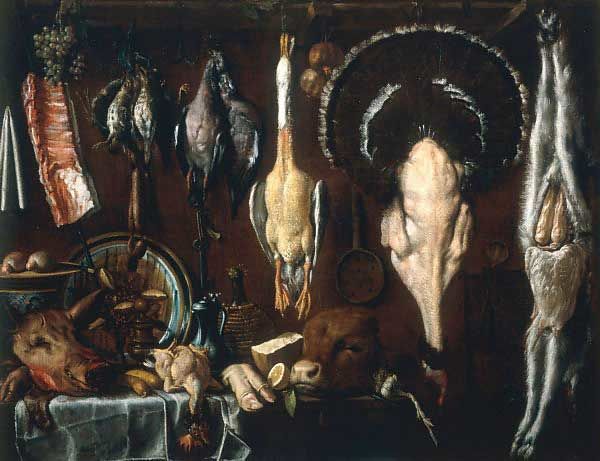
Dead ducks and such, painted by Jacopo da Emoli, 1551-1640.

Recipe: Seared Duck with Farro and Watercress Pesto

Have you tried buying a whole duck lately? I don’t know what’s going on, but the price is completely out of line. And I’m not talking Greenmarket, superorganic, locavore here, I’m speaking of the ducks I always used to pick up at a supermarket for, oh, a few  dollars more than I’d pay for a good chicken. Now I’ve discovered that I’d be paying $34 for a measly little fatty bird. I find this outrageous. Why should it be? I got really, I must say, really mad when I saw it. But since I don’t stay mad for long, especially for a Sicilian, my eyes glanced over to the pre-cut duck breasts and legs. Reasonable. I can by a cut-up duck for a lot less than a whole one (of course not the same thing, culinarily speaking, but still). So I picked up a whole antibiotic-free duck breast, went home, bolted myself into my little kitchen, and came up with what I feel is a nice spring recipe. I hadn’t experienced the seared rare duck breast of 1980s restaurant menus for a long time, so I thought I’d give it a whirl again. It’s easy to do at home. And you don’t need to make it so ridiculously blood rare you need saber-toothed tiger fangs to eat it. Rosy pink is what I like.

The trick to searing duck breast to pink perfection is to melt out the fat until the skin is crisp. Gently score the fatty side to help this process along. Then you’ll want to start the cooking with the duck breast fat side down, in a preheated skillet. You want to hear the sear. But watch what’s going on in the skillet, so the duck doesn’t burn before much of the fat has melted away. Just watch, and turn down the heat if necessary. It’s no big deal, but it’s essential.

Seared Duck with Farro and  Watercress Pesto

(Serves 2 as a main course)

2 duck breasts (one whole breast, split), of the Long Island type
¼ teaspoon ground allspice
¼ teaspoon ground fennel seed
¼ teaspoon ground coriander seed
¼ teaspoon ground black pepper
¼ teaspoon salt
1½ cups farro
Extra-virgin olive oil
2 bunches watercress, well stemmed
Salt
½ a garlic clove, roughly chopped
¼ teaspoon sugar
A small palmful of pine nuts
The juice from about ½ a lemon
1 carrot, cut into small dice
2 scallions, cut into thin rounds, using the tender green part
¾ cup freshly shucked spring peas
½ cup chicken broth, or possibly a little more

With a sharp knife, gently slice a few  cuts into the fatty side of the duck breasts, without cutting into the meat. Then mix all the spices together, including the salt, and rub them all over the duck, getting some into the slits. Let sit unrefrigerated while you get on with the rest of it.

Put the farro into a medium pot, and cover it with water by about 4 inches. Add a little salt, and bring it to a boil. Turn the heat down a bit, and let it bubble, uncovered, until the grains are just tender. Time can vary. The stuff I cooked up last night took only about 20 minutes, but I’ve had brands that have taken 30 minutes or longer, so just taste it from time to time. Add more hot water if it gets too low.  Drain the farro, and put it in a bowl. Drizzle a thread of olive oil over it, and give it a toss.

Put up a small pot of water, and bring it to a boil. Add one of the watercress bunches, and blanch it for about 30 seconds. Drain, and run under cold water to set its color. Then squeeze as much water out of it as you can.

Put the blanched watercress in a food processor. Add a little salt, the pine nuts, and the sugar. Pulse a few times until it’s well chopped. Add about ¼ cup of olive oil, and process until the sauce is fairly smooth. Add the lemon juice, and pulse again. If the sauce is too thick (it should have some weight but still be pourable), add a little more olive oil. Pour the pesto into a small bowl.

In a medium skillet, heat two tablespoons of olive oil over medium heat. Add the carrots, and let them soften. Add the scallions and the peas, and sauté a minute, adding salt and some black pepper. Add the chicken broth, and simmer, covered, until the peas are just tender, about 4 minutes. Add a bit more broth if it dries up (you should have a little liquid left in the skillet when the peas are tender). Add the farro and a generous drizzle of fresh olive oil, and mix well.

Put a heavy-bottomed skillet on medium heat, and let it get good and hot. Add the duck breasts, fat side down, and sear until the skin is very brown and much of the fat has been released. Lower the heat if they’re browning too quickly. This should take about 8 minutes. Turn the breasts, and sear the other side, about another 3 minutes for medium rare. Pull the duck from the skillet, and let it rest about 3 minutes.

Add about a tablespoon of the watercress pesto to the farro, and give it a stir. Check for seasoning.

Spoon a good helping of the farro onto two dinner plates. Slice the duck thinly on an angle, and fan it out around the farro. Decorate the plate with the fresh watercress, and spoon a generous amount of the watercress pesto near the duck. Serve right away.

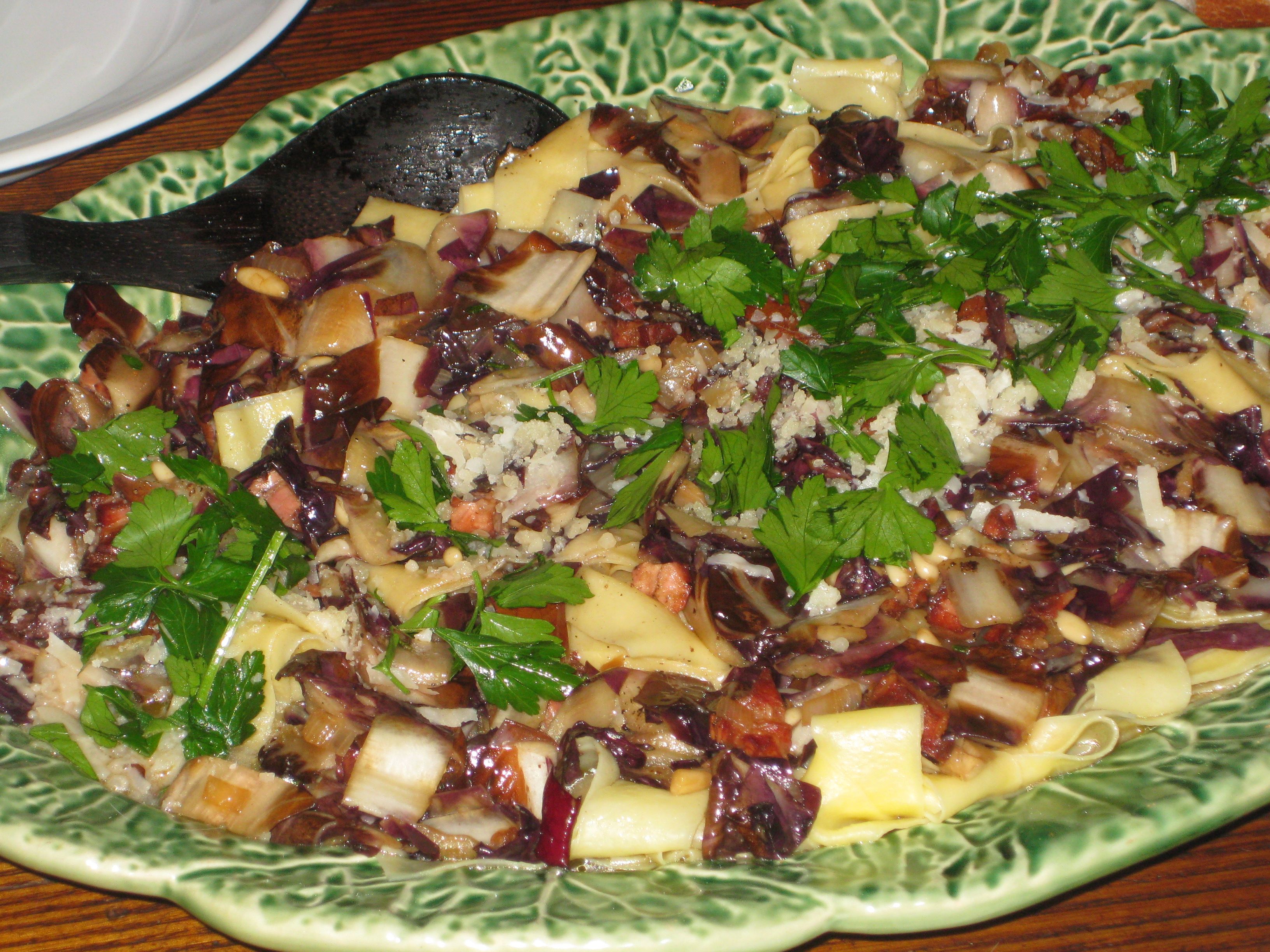
Recipe: Tagliatelle with Treviso Radicchio, Guanciale, and White Wine

Being a gal of Southern Italian spirit, I never quite know what to do with the very northern seeming Treviso radicchio I find in many food shops in winter and spring. Such a beautiful deep Venetian red, a red with pink undertones (for lipstick I prefer red with a hint of orange, better for olive skin, I think). Cooking this gorgeous vegetable is sad for me, as it darkens almost to black right before my eyes, a turnoff, to be honest, and a reality that has dampened my creative energy for this member of the chicory family, the beautiful bitters, as I like to call them. I like Treviso radicchio best when it’s cooked, but that’s when it goes all ugly on you.

Around the Venice area, where the most exquisite radicchio is traditionally grown, there are many types to choose from.  Here in Manhattan I can usually find the round Chioggia variety all year, and the Treviso, which in Venice is called Treviso Precoce, that I chose for this pasta dish, in season. It resembles a blowsy red endive.

I’ve tried cooking Treviso radicchio with pasta several times but have never been completely satisfied with how it ended up looking. Now I’ve given up on preserving its color and just concentrate on its flavor. Red happens to be my favorite color, so any red vegetable I’m bound to get hung up on. Can’t be helped.

I wanted a pasta that was bitter, unmistakably vegetable, but also just a little rich. My mind turned to lardo (actually my entire brain often feels like lardo). I was thinking pork fat, maybe not lardo per se; guanciale or pancetta would do the trick as well. I settled on guanciale, unctuous but not as fatty as pure lard, perfect to smooth out radicchio’s sharp edges and add suaveness.

I also found that adding the radicchio to a warm sauce base right as I turned off the heat, and letting it wilt, would retain a hint of its lovely red. That works if you happen to think the color of dried blood is lovely. I have to admit I do.

Tagliatelle with Treviso Radicchio, Guanciale, and White Wine

(Serves 2)

2 medium Treviso radicchios
Salt
Extra-virgin olive oil
A little less than ¼ pound guanciale, cut into small cubes (if you can’t find guanciale, use pancetta)
1 large shallot, minced
1 garlic clove, very thinly sliced
2 sprigs rosemary, the leaves well chopped
½ teaspoon sugar
About ¼ cup dry white wine
½ cup homemade or good quality prepared chicken broth
½ pound tagliatelle
A handful of lightly toasted pine nuts
A small chunk of Parmigiano Reggiano cheese
A handful of Italian parsley, lightly chopped

Cut the radicchio in half lengthwise, and core it. Slice it into half moon shapes.

Set up a pot of pasta cooking water, and bring it to a boil. Add a generous amount of salt.

In a large skillet, warm 2 tablespoons of olive oil over medium heat. Add the guanciale, and let it release its fat and crisp slightly. Add the shallot, and let that soften. Add the garlic, the rosemary, and the sugar, and let them heat just until everything gives off a nice aroma, about a minute.

Drop the tagliatalle into the water.

Add the white wine, and let it bubble for a few seconds. Add the chicken broth, and simmer for a minute or so. Turn off the heat.

Add the radicchio to the skillet, and stir it around for about a minute, just until it starts to wilt. Season with salt and black pepper.

When the tagliatelle is just tender, drain it, and pour it into a warmed serving bowl (I like a shallow and wide one for this pasta so it can spread out and stay loose). Add a generous drizzle of fresh olive oil. Add about a tablespoon of grated  Parmigiano and the pine nuts, and give everything a gentle toss. Pour on the radicchio sauce, and toss again. Top with a little sprinkling of Parmigiano, and garnish with the parsley. Serve right away. A Fiano di Avellino, a rich white from Campania with no oaky undertones, would be a good wine with this pasta.

Women with Fish


The Woman who loves fish,
series daydream 09, Laudator, 2011


Ravanello il candela di fuoco, from Southern Italy.

Recipe: Radish and Anchovy Antipasto

I’ve always liked radishes well enough, but when I discovered how great they taste smeared with soft butter, I started to love them. That isn’t an Italian flavor combination but a French one. It’s at its best in late spring, when I find long, red French breakfast radishes at the Greenmarket, or white ones, which are usually called icicle radishes. If I’ve got either of those and a block of lightly salted French butter, I’m in heaven. Both of those radish varieties are less bitter than the round red ones you see all over the place (even under my bed sometimes, since my cats love to play with them).

Enough French talk. Let’s get back to the entire point of my devotion to cooking, which obviously is cooking with an Italian spirit. With that in mind, I’d like to introduce you to an excellent flavor combination, radishes and anchovies. Maybe you already know about that, but it’s worth thinking about again if you haven’t for a while.

I believe my first encounter with this perfect match was at Aurora, a fine little Italian restaurant in Williamsburg, Brooklyn, when it first opened about seven years ago. I’m not sure how I had missed out on the little treat during all my trips to Italy. I mean, almost every time anything with anchovies appeared on a menu, I was on it.  But most of my traveling has been in the South, and I didn’t often come across ravanello, the radish’s Italian name. Even though Southern Italians love bitter anything, and even though cauliflower and broccoli, both related to the radish, are huge favorites all through the Mezzogiorno, radishes just don’t seem to have much of a presence. I have seen very long, skinny, red ones at a Palermo market, going by the name il candela di fuoco, which is exactly what they look like, but I don’t believe I ever ate one. I’ll have to ask my Greenmarket farmers if they’ve ever tried growing them. They look beautifully obscene.

In any case, mixing radishes with anchovies to produce something really delicious couldn’t be simpler. All you need to do is halve (or quarter if they’re huge) some decent looking radishes (the round reds ones are fine for this, but if you see long sweet radishes for sale, grab them and quarter them lengthwise); then mash a few oil-packed anchovies, very good quality of course (Flott are great, but so are Agostino Recca, both from Sicily) with a generous amount of fine extra-virgin olive oil, until you have a loose paste. I’ve made this with salt-packed and with oil-packed anchovies, and even though for uncooked dishes I usually prefer salt-packed, the oily ones seem to work better with the radishes, maybe since they’re richer, more like a condimento. Salt-cured anchovies, after soaking, can revert back to tasting like fresh fish. Now you’ve got a nice oily, fishy sauce. All you do is pour it over the radishes and give it a gentle toss. Simple. And that is exactly how they were served at Aurora. It’s kind of like bagna cauda, except it’s not hot. It’s just as messy, so have a pile of napkins nearby. It’s a nice change from a bowl of olives.

The recipe I’ve provided for you is my little spin on the theme, but I didn’t want to stray far from the pure treatment, so I’ve added only a couple of flourishes.

Radish and Anchovy Antipasto

(Serves 6 as an antipasto)

2 bunches of very crisp, round red radishes, washed, stemmed, and halved
5 oil-packed anchovies
½ a small garlic clove
About 4 tablespoons very fruity extra-virgin olive oil (preferably a Sicilian variety such as Ravida; Tuscan oil, I find, adds too much bitterness)
A handful of lightly toasted pine nuts
Freshly ground black pepper
A palmful of tender celery leaves, left whole

Place the radishes in a serving bowl.

With a mortar and pestle, grind the anchovies with the garlic, adding the olive oil a little at a time. You’ll want a fairly smooth consistency, but it’s okay if it still has some texture. Pour this over the radishes, add a few grindings of black pepper, add the pine nuts, and give it a toss. The sauce should be a little loose, so add a bit more oil if you think you need it. Right before serving, scatter on the celery leaves. Serve at room temperature.

161100125-romantic-picnic-with-lambrusco-cheese-baguette-and-ham-on-snow-traditional-italian-food-and-drink-ou

Recipe: My Pizza Rustica

My girlfriend Barbara told me that my last posting, the one about how Easter has become so unnecessary for me, was too depressing.  She was right. And I realized it’s not even true. It’s not unnecessary.  I might not be religious but I  rejoice in the rebirth of the earth and I honor it -a celebration for an almost green day.  And I bake pizza rustica, a traditional Southern Italian Easter torta.  This thing is a sweet-crusted pie filled with all sorts of savory Italian salumi and cheeses, an easily transportable creation many Italians take with them on picnics on La Pasquetta, the day after Easter. I was thinking of doing something like that myself. Not much picnic perfect sights in Manhattan, especially when it’s still Easter chilly.  Maybe I could take  one of those folding chairs into the middle of Times Square, along with a blanket, a slice of pizza rustica, and a double espresso, and watch all the Absolut vodka ads flash before my eyes. Better than nothing.  Fun even. Everything is coming back to life.

My Pizza Rustica

For the pastry:

1 cup all-purpose flour and 1 cup semolina
A generous pinch of salt
2 tablespoons  powdered sugar
A big pinch of ground nutmeg
1 large egg
1/3 cup dry white wine
1/4 cup extra-virgin olive oil

For the filling:

15 ounces whole milk ricotta
2 large eggs, lightly beaten
A 1/2 inch thick slice of capocollo, cut into small cubes
A 1/2 inch thick slice of prosciutto di Parma, cut into small cubes
1/2 cup chopped caciocavallo cheese
1/2 cup chopped gruyere
A handful of flat-leaf parsley leaves, chopped
A few marjoram sprigs, leaves chopped
¼ teaspoon freshly grated nutmeg
1/4 teaspoon ground allspice
Salt
Freshly ground black pepper
1 egg, beaten with a tablespoon of water, to brush over the top

To make the pastry, put the two flours in a large bowl, and stir in the salt, sugar, and cinnamon. In a small bowl, beat together the egg, white wine, and olive oil. Pour this over the flour, mixing it in with a fork until uniformly moist. Dump the dough out onto a lightly floured surface, and knead very briefly, pressing the dough together to form a ball. Cut it into two pieces, one slightly larger than the other. Wrap the pieces in plastic and let sit, unrefrigerated, for about an hour.

Preheat the oven to 375 degrees. In a large bowl, mix together all the ingredients for the filling.

Choose a standard  9-inch American-type pie plate (or a smooth sided tart pan with a removable bottom), and grease it lightly with olive oil. Roll out each dough ball, one into an approximately 11-inch round, the other about 9 inches. Fit the larger round into the pie plate and trim the edges so you have a more of less even 1/2 inch overhang all around. Pile in the filling, and smooth it out. Place the other dough round over the filling. Fold the overhang up over the top of the pie, making little pleats all around to seal it. Cut 3 short slashes into the top in a star pattern, and brush the top with the egg wash. Place the pie plate on a sheet pan, and bake for about 50 minutes or so, or until it’s golden and puffy (it’ll flatten down as it cools). Serve at room temperature with a cool glass of Falanghina.


Jesus Appearing to the  Magdalene, Fra Angelico, 1400-1455.

Recipe: Roasted Asparagus with Arugula Pesto and Parmigiano

Easter for those, like me, who have emptied themselves of Catholicism, can be a nonevent of the highest order. And here in Manhattan the weather is predictably cold, often overcast, which never adds much to the  pagan springtime renewal. My bonnet is usually a pilly black beret.  And my progressively more irritated family (I’m talking mainly about my mother) no longer gives a damn about Easter or any of the traditional preparations for it that seemed so carefully planned when we were kids. Big deal. I don’t really care either. I do love some of the classic Southern Italian Easter dishes, especially the ricotta-based ones—pizza rustica on the savory side, pastiera on the sweet. Those are gorgeous dishes. You can find a recipe of mine for pizza rustica on page 285 of The Flavors of Southern Italy, and one for pastiera here.

From some reason this Easter I’m thinking bitter—not thoughts (well maybe a little) but flavors. I’ve wanted to create a new asparagus dish, something warm but biting, so I’ve married the elegant spring vegetable with a loose arugula pesto. I didn’t mix cheese into the pesto but instead just shaved it over the top. Cleaner. And I used lots of lemon. Astringent. Really nice with a traditional Easter leg of lamb, if you happen to be going in that direction.

I’m usually quite sad when I see my Italian traditions drift away, but in this case it seems there’s not much I can do about it, so I’m moving on, possibly skipping Easter dinner altogether—I might even go out (horrors)—and having this lovely asparagus dish on Palm Sunday instead.

To all my loyal readers who still go the entire nine yards, light a few candles for me this Easter Sunday.

Roasted Asparagus with Arugula Pesto and Parmigiano

(Serves 6)

2 bunches of arugula, stemmed
1 small garlic clove, roughly chopped
Extra-virgin olive oil
Salt
2 bunches of asparagus, on the thin side, the ends well trimmed
Freshly ground black pepper
The juice from 1 small lemon
A small chunk of Parmigiano Reggiano cheese
A palmful of lightly toasted pine nuts

Blanch the arugula in a small pot of boiling water for 30 seconds. Scoop it from the pot with a large strainer, and run cold water over it. Drain very well.

In a food processor, add the arugula, garlic, about 1/4 cup  of olive oil, and a little salt. Pulse until you have a fairly smooth but loose paste.

Preheat the oven to 425 degrees.

Place the asparagus on a sheet pan. Toss it with olive oil, a little salt, and some black pepper, and then arrange it in one layer. Roast until it’s fragrant and browned at the edges, about 10 minutes (possibly longer, depending on the pieces’ thickness, so just keep an eye on it).

Transfer the asparagus to a warmed serving platter, and squeeze on a little lemon juice. Spoon the arugula sauce down the middle, and then shave some thin sheets of Parmigiano on top. Garnish with the pine nuts. Serve hot.