Feeds:
Posts
Comments

Me eating spaghetti with Patty Ianicelli’s (my father’s cousin) boys. Rye, New York,  around 1960.

Here’s the prologue from ‘The Making of an Italian Cook’, a work in progress. Hope you like it. The book is progressing well, a little shaky in parts, but I’ll iron that out in time.

The Making of an Italian Cook

Just like my aunt Eleanor and my grandmother, I now wake up in the morning thinking about what I want to cook. They lived food. Every winter our family would leave cold Greenvale, Long Island, and shack up in Hollywood, Florida, for a month or more (school? what’s school?), with Nanny, Pop, aunts and uncles, and a ton of cousins. Very cozy, considering there were only three bedrooms. Each morning my sister, Liti, and I would hear Nanny and my aunt discuss dinner around the breakfast table while they sectioned grapefruits.

“Mom, should we do the stuffed artichokes? What about the meatballs with string beans? Haven’t pulled that one out for a while.”

“How about sausage and peppers?”

“Pop always goes for the veal and peppers.”

“I prefer sausage and peppers.”

“Who cares what you prefer?”

“Nobody, I take it.”

This kind of talk embarrassed me, even scared me. Is that what I’ll become? One of those kitchen-to-bedroom Italian ladies, whisking plates from under your nose, replacing them with new plates, and then disappearing to change into bathrobe and slippers? Now I can’t believe this preoccupation with food is an urge I’m grateful for. It’s a place to be in this world. A relationship filled alternatively with elation and irritation, and hard work. Basically a long marriage.

Florida was a strange land to spend winters in, away from all my Long Island friends, and we got dragged down there every winter until I was, I believe, 17, and my sister Liti 14, when we then flatly refused. No problem. Arrangements were quickly made to leave us alone in the Long Island ranch house with a continuously farting housekeeper named Rose. Rose didn’t show up much, so this worked out fine.

One thing I can say for sure about my Florida winters—they brought me very close to the Puglian food Dick, my father, had grown up eating, since they shoved us into a small house with a lot of Southern Italians. Usually fifteen to twenty of our relatives showed up at some point during the long winter, sometimes all at the same time. Dinners down there were always massive and very high pitched. Everyone seemed perpetually angry. “Goddammit Gert, you made too much salad.” “What are we feeding an army?”  Almost. “Since when do braciole and artichokes go on the same plate?” “Will someone please bring me a goddamned salad plate?” “This wine is oxidized. Where the hell is the Fresca?” It was oppressive, but the food was great. Great, but heavy, especially for Florida, but no alterations were made to accommodate the subtropical weather. Nanny really loved to cook, and it was her show, so if she wanted braciole in red sauce on a 90 degree night, that was what we ate. It was pathetic when she got older and nobody trusted her anymore in the kitchen, they thought she’d skid on one of those pointless woven circular jute mats they threw all over the floor in there (unless the point was to make her fall). Take the mats up, why don’t you? Finally they did, but she was still banished from the kitchen. A little swelling of her ankles, a couple of left-on burners and other forgetfulnesses, and a longtime trust was dissolved. After that, Nanny’s stare often seemed vacant. Anybody home? Maybe not.

Gert, my father’s mom, keeper of the Hollywood table, with a rare, almost cheerful half smile.

Florida dinners, always at least fifteen at table, usually more, wore me down and made me feel there was something hovering over my head or around my head like an invisible vise (sometimes, I suppose, it was just a sunburn). Dining out was what I waited for, what everyone needed when cousins, aunts, uncles, Nanny, Pop, and my mother, Mo, had reached the point of implosion, the thin little house closing in, either way too hot or way to cold. No heat. No air conditioning. A thousand plates to clean. We’d from time to time bust loose.

Polynesian restaurants, the fantasy islands of my childhood, were where we’d escape to. So Florida, so 1960s. There was the giant place on the beach where Coconut Jerry hacked open coconuts and chubby half-naked women shook their thighs in grass skirts. My grandfather Nick was always escorted directly to the biggest wicker-backed chair and covered with leis, which he’d pull off in disgust. The drinks, prepared at one of their many torchlit Tiki bars, were served in hollowed-out pineapples, garnished, of course, with mini umbrellas or little plastic monkeys. We’d be served flaming skewers of the stickiest food I’ve ever eaten, flaming pork wrapped in ribbon candy, shrimp dipped in colored sugar, charcoal beef topped with burnt coconut. The only Italian thing that sweet that came to mind was the torrone my father always brought home around Christmas, but that was meant as a dessert.

Florida Polynesian was certainly unlike the solid and delicious Southern Italian dishes Nanny set out, and in retrospect it was a fairly sickening cuisine, but anything that came to the table on fire was pure joy, and this terrible food opened me to understanding eating as a form of glamour. Here was a place where food was served by people wearing bra tops, high heels, and strings of hibiscus. Food as celebration I already knew very well, from elaborate Christmas and Easter dinners. That was all pure Italian, but making food gorgeous and dramatic for no good reason was something I latched onto quickly. Food could be so many things. It could be exciting, oppressive, disgusting and hilarious. Food, I understood from a fairly young age, was a big deal.

Recipe: Sformata with Parsnips and Fontina

Sformata, hard to pronounce, even for a guinea girl like me. SSSSSSFFFFOOOOORRRR. Think of the makeup shop Sephora and you’ll get the idea, except you’ll want to elide the sound, not break it into two syllables. All it really means, in Italian culinary parlance, is something that’s molded, like a flan or a gratin type dish. But the primary issue here, I think, is the parsnip. Not many people eat them. Most people I know, even good cooks, aren’t sure what to do with them.

Parsnips are such a unique tasting vegetable. They look like pale carrots but have a starchier texture and an absolutely mesmerizing floral fragrance and taste. Don’t leave them out of your life. Unlike carrots, they tend to break up a bit if you just try to slice and sauté them.  They are good roasted, but if you want to try this, use smaller ones, as the big ones can get tough. To my taste, I think it’s better to mash them and then work them into something like a soufflé or a flan—a sformata, in fact.

Here I’ve added a little potato to give the dish body, but just a little. I didn’t want to dilute any of the beautiful parsnip flavor. Possibly this isn’t a true sformata, which really is more like a flan. Since I do add whipped egg whites, I suppose this is a morph between a flan and a soufflé, but it is molded, so I believe it qualifies as a sformata. I served it on New Year’s Day, along with a nice tender lump of roast beef.

And just in case you were curious, here is what Winter looks like in Sicily:

Sformata with Parsnips and Fontina

(Serves 5 as a side dish)

½ cup grated Fontina Val d’Aosta cheese (use the good stuff)
½ cup grated  grana Padano chese
¾ cup homemade dry breadcrumbs, not too finely ground and seasoned with a pinch of salt
3 tablespoons soft butter
Extra-virgin olive oil
About 8 medium parsnips (the really large ones can be tough), peeled and thickly sliced
2 medium baking potatoes, peeled and cut into medium dice
1 shallot, sliced
Salt
Freshly ground black pepper
About 10 big scrapings of nutmeg
6 fresh thyme sprigs, the leaves lightly chopped
3 egg yolks
6 egg whites

You’ll want an approximately 8-by-12-inch gratin dish (this is not a soufflé; it’s firmer; it will rise a bit while cooking but will fall just as quickly, which is what you want). Coat the inside of the dish with about half of the softened butter.

Mix the Fontina and the grana Padano together in a bowl. Sprinkle the dish with a handful of the cheese mixture and some of the breadcrumbs, and tap it around until the dish is lightly coated.

Preheat the oven to 400 degrees.

In a large pot, heat the remaining butter with about 2 tablespoons of olive oil over medium flame. Add the parsnips, potato, and shallot. Season with salt, black pepper, and the nutmeg, and sauté for about 2 or 3 minutes, just to coat the vegetables with flavor. Add about ½ cup of warm water to the pot, turn the heat down a touch, and cover it. Simmer, stirring everything around a few times, until the vegetables are tender when poked with a knife. If at any time it seems they might start to stick, add a little more warm water. Add the thyme. Now mash everything (I used a whisk) until you have a fairly smooth mush. Avoid the temptation to use a food processor; that might make it gluey. Let the mix cool for a few minutes, and then add the egg yolks, stirring them in well. Add the cheese, leaving about ¼ cup out to sprinkle on the top, and mix it in.

Whisk the egg whites, and gently fold them into the parsnip mixture. Pour everything into the baking dish. Scatter the remaining cheese and enough of the breadcrumbs to lightly cover the top. Drizzle with olive oil and bake, uncovered, until golden and puffy, about 30 minutes. You can serve this right away or let it fall a bit and serve it warm.

Tangerine Sorbetto

Recipe: Tangerine Sorbetto

Every year on Christmas Eve I serve some type of light citrus dessert. I can’t help it. It just seems the only way to go after a big fish dinner. Sometimes I’ll make a sweet blood orange salad with sugar and a touch of cinnamon, or one of those wobbly Sicilian gelatina molds (always a little tricky to turn out, unfortunately). This year I got out the ice cream maker, juiced up a bunch of tangerines, added vanilla, zest, and my most favorite Arab-Siculi flavor—orange flower water—and came up with something really nice, a keeper. The cream doesn’t really belong in a sorbetto, so it is optional, but it does add an alluring creamsicle taste.

I hope everyone had a great Christmas. Tell me what you cooked.

And here’s a Sicilian Christmas song to go with this Sicilian inspired dessert:

Tangerine Sorbetto

(Makes about 1½ pints)

¾ cup sugar
½ cup water
½ teaspoon vanilla
¼ teaspoon orange flower water
2 dozen or so tangerines
½ lemon
1 egg white
2 tablespoons heavy cream

Place the sugar in a saucepan. Add the water, vanilla, and orange flower water, and bring to a boil. Boil until the sugar has dissolved, about 4 minutes or so. Chill.

Zest two of the tangerines, and set the zest aside. Juice all of them and the lemon, making sure to remove all the pits. Let the juice chill for a few hours.

Place the tangerine and lemon juice and about ¾ of the sugar syrup in a food processor. Add the tangerine zest, egg white, and cream, and pulse a few times, just until well blended. Taste for sweetness, adding the rest of the sugar syrup if you need to (you can instead just mix everything in a big bowl, using a whisk).

Pour the mix into an ice cream maker, and churn until frozen and creamy.


Salt cod at the Boqueria market in Barcelona. Wow, pretty expensive this year.

Recipe: Baccalà Mantecato

In the last week or so several people have asked me about this salt cod dish, knowing I always make it for Christmas Eve. Baccalà mantecato (mantecare means to whip) is a Venetian dish, but it’s essentially the same as Provençale brandade. I’ve had versions of it in Naples too, but whipped-up, creamy salt cod is not as popular there as dishes where the salt cod is left in chunks and simply simmered with potatoes, tons of onion, white wine, and possibly tomatoes. It can include raisins, pine nuts, or capers, too, or all three.

I’ve always loved this creamy preparation, which by the way is made without cream; it gets its lovely texture from whipping poached salt cod with olive oil and sometimes a little cooked potato. You can do this with a whisk, a potato masher, your fist, or in a food processor, if you pulse quickly and gently (too much processing will make it overly smooth and possibly gummy, especially if you add a lot of potato). I’ve got the food processor thing down.

Salt cod is a unique taste, one that I crave, but to keep it special I save it for Christmas Eve, plus I don’t love soaking salt cod all that much, since it stinks up the kitchen. The cats do however love clawing and chewing at it while it soaks (I once found a huge piece pulled from the pot and dragged under the bathroom rug). They also like the finished dish. A beautiful white dish for two beautiful white cats. If you’ve got any old people or cats with no teeth to feed on Christmas Eve, this is the perfect thing.

And for your listening pleasure, here’s Louis Prima, doing what he did best, singing about baccalà:

Baccalà Mantecato

(Serves 5 or 6 as an antipasto)

1½ pounds salt cod (try to get the thicker middle section, which has fewer bones to deal with)
1 fresh bay leaf
½ cup dry white wine
1 baking potato, cooked soft, peeled, and roughly mashed
1 large garlic clove, minced
Extra-virgin olive oil
The grated zest from 1 small lemon
A few big gratings of nutmeg
5 or 6 thyme sprigs, the leaves lightly chopped
Freshly ground black pepper
A few tablespoons of milk
¾ cup homemade breadcrumbs, not too finely ground
A handful of black olives
Toasted crostini made from slices of baguette, brushed with a little olive oil

You’ll need to soak the salt cod in a big pot of cold water for about a day and a half, changing the water a bunch of times and putting the pot in the refrigerator overnight. Toward the end, taste a bit to see if a sufficient amount of salt has leeched out of it. If not, soak it a little longer. Then drain it.

Place the salt cod, cut into pieces if necessary, in a large skillet. Add the bay leaf, and pour on the white wine. Add enough cool water to just cover the cod. Bring to a boil, and then turn the heat down to very low. Cover the skillet, and gently simmer the cod until it just begins to flake. This should take only about 15 minutes, maybe even less, if you’ve got thin cuts. If it cooks any longer, it might become dry. Take the cod from the skillet, and when it’s cool enough to handle, pull off the bones and the skin.

Put the cod in a food processor, and give it a couple of pulses. Add the potato, the garlic, about ¼ cup of your best olive oil, and the lemon zest, thyme, nutmeg, and some black pepper. Give it a few more pulses. You want a texture that’s creamy but not completely smooth. Add about 2 tablespoons of milk, and pulse again. You shouldn’t need any salt.

Scrape the baccalà from the food processor, and spoon it into a shallow baking dish. Top with the breadcrumbs, and drizzle the top with olive oil.

When you’re ready to serve it, heat the oven to 425 degrees, and heat the baccalà through, about 10 minutes. If the breadcrumbs don’t turn golden, run the thing under a broiler for a minute. Scatter on the olives, and serve with the crostini.

Recipe: Polpettone with Ricotta, Pistachios, and Prosciutto

A friend recently told me that he had just made a meatloaf, an American-style one, and it had come out very well. I like a good American meatloaf, but I also love polpettone, Italy’s version of  a big old load of baked chopped meat. The one I came up with here contains no bread. Instead I’ve held it together with a few eggs and a good amount of ricotta, making it very moist, maybe a little harder to pat into shape, since the mixture is soft, but that’s not a terribly big deal. I wrap the entire thing in prosciutto, which not only holds it together but imparts a lovely flavor, making it taste something like a country pâté.

You can have fun playing around with my seasoning choices, replacing the pistachios with pine nuts, using a Parmigiano instead of a mild pecorino, incorporating a different herb. I chose marjoram, but I’ve also made versions of this using fresh sage (not too much) or thyme. Oh, also, in my opinion, the best polpettone are made from a mix of ground pork and beef chuck, since that gives you enough fat to keep it juicy.

And for all my friends of Puglian decent, here’s a little tune for you.

Polpettone with Ricotta, Pistachios and Prosciutto

(Serves 5)

1 pound ground pork
½ pound ground beef chuck
1 cup whole milk ricotta, drained if watery
2 large eggs, plus 1 egg white, lightly beaten
Extra-virgin olive oil
¾ cup grated young pecorino cheese (a pecorino Toscana is a good choice, or a young Manchego)
1 garlic clove, minced
A large handful of unsalted pistachios
A generous handful of flat-leaf parsley leaves, lightly chopped
3 or 4 large sprigs marjoram, the leaves chopped
5 or 6 scrapings of fresh nutmeg
Salt
Freshly ground black pepper
About 6 very thin slices prosciutto di Parma
1 wine glass dry white wine

Preheat the oven to 425 degrees.

Put all the ingredients for the polpettone, except for the prosciutto and the white wine, into a large bowl, and season with black pepper and salt (you will want to use a touch less salt than usual, since much of the salt from the prosciutto gets baked into the thing as it cooks). Mix everything around quickly with your fingers, trying not to pack it down too much. The mixture will be loose.

Choose a baking dish that will fit the polpettone fairly snugly with a little room to breath. Coat the bottom of the dish with olive oil. Shape the meat into a log, and set it in the dish. Drape the top with the prosciutto slices, tucking the ends underneath. The prosciutto should pretty much cover the entire meatloaf.

Pour the wine over the meatloaf, and drizzle it with olive oil. Bake, uncovered, for about 30 minutes. I like my polpettone with the slightest touch of pink at the center. That ensures that it will be nice and moist. Let the polpettone rest for about 10 minutes before slicing. You can serve it warm or at room temperature. I like mine served over a chicory salad, but you can, if you wish, make a simple tomato sauce and serve it with that and a vegetable (broccoli rabe?) and a starch (mashed potatoes, or polenta?), in a more Italian-American fashion.


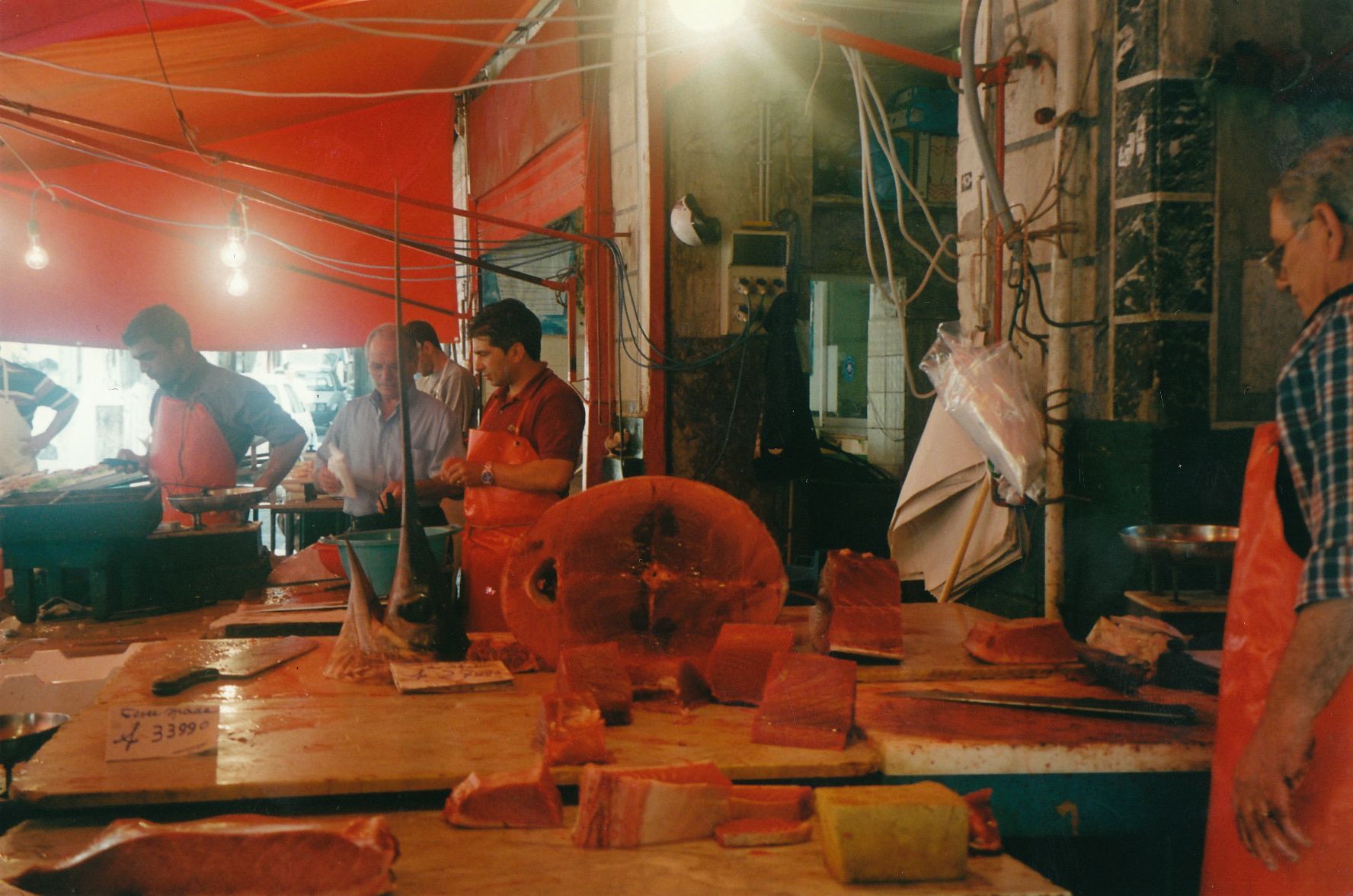
Very fresh tuna at the Trapani fish market. Dig the sword spire.

Recipe: Cavatelli with Fresh Tuna, Marsala, and Rosemary

I don’t know about you, but I find it extremely hard to keep up with the lists of endangered, semi-endangered, or just plain bad-for-your-health fish. I do consult the seafood selector set up by the Environmental Defense Fund, which tells you to stay away from bluefin tuna and imported shrimp. I find yellowfin tuna at my Greenmarket and grab it, but I also break down and buy small chunks of bluefin now and then. The best way to make a little go a long way is by including it in a pasta sauce.

I made this tuna pasta twice. The first go-round I quick-seared the tuna chunks, trying to keep them very pink in the middle, and added them to the sauce at the last minute. I liked the way it cooked up, but by the time I brought the dish to the table, the tuna had cooked through and was not as tender as I would have wanted, thanks to its initial high-heat treatment. Next time, I just dropped the tuna pieces into a very low-simmering sauce and let them gently cook through. That produced a more tender tuna and a nicer result, more like a fish ragu. I kind of missed the seared taste from the first try, but I concluded that all in all the gentle simmer is the way to go.

And for your listening pleasure:

Cavatelli with Fresh Tuna, Marsala, and Rosemary

(Serves 2)

Salt
Extra-virgin olive oil
2 garlic cloves, thinly sliced
1 small jalapeño pepper, minced, with the seeds
2 large sprigs rosemary, the leaves chopped
1 shotglass dry Marsala
½ pound cavatelli
1 28-ounce can plum tomatoes, chopped, with the juice
½ pound, or a little less, yellowfin or bluefin tuna steak, cut into approximately ½-inch cubes
A handful of toasted pine nuts
A smaller handful of Sicilian capers
A handful of flat-leaf parsley leaves, very lightly chopped

Put up a pot of pasta cooking water, and bring it to a boil. Add a generous amount of salt.

In a large skillet, heat about 2 tablespoons of olive oil over a medium flame. Add the garlic and the jalapeño, and sauté for a minute to release their flavors. Add the rosemary, and sauté for a few seconds to allow some of its oil to escape. Add the Marsala, and let it bubble until almost dry.

Drop the cavatelli into the water.

Add the tomatoes, seasoning with a little salt, and simmer at a lively boil for 5 minutes. Turn the heat to very low, and add the tuna, stirring the pieces around in the sauce for a few seconds. Turn off the heat, and take the skillet off the stove. The heat from the sauce will finish cooking the tuna. Add the pine nuts and capers. Taste for seasoning.

When the cavatelli is al dente, pour it into a warmed serving bowl. Drizzle it with fresh olive oil, and add the parsley. Give it a toss. Add the tuna sauce, and toss again. Serve right away.

Recipe: Polenta Lasagna with Brussels Sprouts and Fontina

In my ever-reaching quest to Italianize Thanksgiving, this year I came up with a lasagna loaded with good Italian ingredients like pancetta and fontina Valle d’Aosta. It actually, despite all my efforts, tasted very Thanksgivingy, and it went very well with turkey and all the other traditional American things other people brought (we had kind of a potluck affair this year, staged at my in-laws’ apartment).

As you know, I’m usually a purist and quite the snot about only using top-notch Italian ingredients, so you might wonder why I stooped so low as to use instant polenta for this dish. First off, I was in a hurry to get it put together and carried out of here, but most important, I found a brand of instant that I liked. Moretti, I just discovered, makes a very good precooked polenta, called Polenta Lampo. It’s got very rich corn flavor. I’ve always used their regular polenta and loved it, so I thought I’d give this one a try. Very decent for a shortcut. You can find it at www.buonitalia.com. Also, when I’m layering polenta into a baked dish I find the quick-cooking kind easier to work with. It doesn’t seem to seize up as fast as the real stuff, so I can pour it out onto sheet pans without its solidifying into a lump before it’s half way out of the pot. I did make sure I stayed on the up and up in the cheese department. I purchased the best Fontina Valle d’Aosta and parmigiano Reggiano I could find.

Polenta Lasagna with Brussels Sprouts and Fontina

(Serves 6)

For the polenta:

2 cups cold water
1 cup cold chicken broth
1 cup cold milk
2 cups instant quick-cooking polenta
1 bay leaf, preferably fresh
Salt
Freshly ground black pepper
2 tablespoons unsalted butter
Extra-virgin olive oil
½ cup grated parmigiano Reggiano cheese

For the Brussels sprouts:

Extra-virgin olive oil
1 ½-inch-thick round pancetta, cut into small dice
1 medium onion, cut into small dice
2 garlic cloves, thinly sliced
2 dozen Brussels sprouts, trimmed and thinly sliced
Salt
Freshly ground black pepper
4 allspice, ground to a powder
A few large sprigs each of rosemary and thyme
½ cup white wine
½ cup chicken broth
½ teaspoon of white wine vinegar
½ pound of Fontina Valle d’Aosta cheese, roughly grated
¾ cup grated parmigiano Reggiano cheese

Pour the water, chicken broth, and milk into a large saucepan. Add the polenta, and give it a good stir. Using cold liquid ensures that your polenta won’t clump up. Turn the heat to medium high, and bring the polenta to a low boil, stirring frequently. Turn the heat to low, and add the bay leaf and some salt and black pepper. Stir frequently until the polenta is thick and smooth. With instant polenta, this should only take about 7 minutes or so. Add the butter, a generous drizzle of olive oil, and the parmigiano, stirring well. If the polenta becomes too thick, add a little warm water and work it in. You want a pourable consistency. Check for seasoning, adding more salt or black pepper if needed.

Coat two sheet pans well with olive oil, and pour the polenta out onto them, smoothing it down. It should be about ½ inch thick (it won’t cover the entire sheet pans, but one seems too small). Stick the polenta in the refrigerator for about ½ hour, or a little longer if you have time, to firm it up (it should be cold).

To make the Brussels sprouts, in a large skillet, heat 2 tablespoons of olive oil over medium heat. Add the pancetta, and let it get good and crisp. Add the onion, and sauté until softened. Add the garlic and the Brussels sprouts, seasoning with salt, black pepper, allspice, and the herbs. Sauté about 2 minutes to coat the sprouts well with flavor. Now add the white wine, and let it bubble away. Add the chicken broth, and simmer, partially covered, until the Brussels sprouts are tender and most of the liquid has boiled off, about 6 or 7 minutes. Add the vinegar, and give it a stir. Taste for seasoning, adding salt or black pepper if needed.

Preheat the oven to 425 degrees.

Coat an approximately 8-by-12-inch baking dish that has 2- to 3-inch-high sides with olive oil. Cut the polenta into large pieces, and fit them into the dish, making one layer (which doesn’t have to look perfect). Heap on half of the Brussels sprouts mixture, and smooth it out. Scatter on half of the grated Fontina and a little of the parmigiano, and give that some salt and black pepper. Make another layer of polenta. Make another layer of Brussels sprouts, finishing them up. Add the rest of the Fontina and a sprinkling of parmigiano, reserving some for the top. Make a final layer of polenta, and sprinkle it with the remaining parmigiano. Drizzle it with some olive oil, and give it a few grindings of black pepper. Place the dish on a sheet pan, and bake, uncovered, until it’s bubbling hot and the top is golden, about 30 minutes. Let the polenta rest about 10 minutes before slicing.


Picasso drawing a fish.

Recipe: Whole Roasted Sea Bass with Rosemary Oil

The approach of Thanksgiving always gets me thinking about food that has nothing to do with Thanksgiving. It’s not my favorite food holiday. In fact, I’d have to say it’s my least favorite food holiday, except possibly for Halloween. I like the wines that go with turkey, but I don’t really love the turkey. I like the turkey skin. I’d honestly be happy with a few glasses of Nero d’Avola, crisp turkey skin on a salad, and then a big piece of pecan pie.

Since we’re just a few days from Thanksgiving and you’ve likely already got your menu down, I thought I’d give you a favorite Christmas Eve dish of mine, one for La Vigilia, the big Italian Christmas Eve dinner. I love rosemary with fish, and this dish is fragrant with it. I warm whole sprigs in olive oil, letting their essence release with the gentle heat, and I throw in a few more ingredients, such as garlic and orange zest, just to round out the flavor. Then I use this as a condimento for the fish.

Roasting is an easy way to cook a whole fish. I always use high heat, about 425 degrees, since it crisps up the skin, holding the juices in, and cooks the fish quickly, so it doesn’t dry out.

Whole Roasted Sea Bass with Rosemary Oil

(Serves 2)

1 approximately 2½ pound sea bass, gutted and scaled but with the head left on
Extra-virgin olive oil
Sea salt
Freshly ground black pepper
1 lemon, sliced into rounds
A big branch of rosemary
3 garlic cloves, peeled and smashed
½ cup dry white wine

For the rosemary oil:

½ cup extra-virgin olive oil
A large sprig of rosemary, the leaves finely chopped
1 garlic clove, very thinly sliced
1 fresh red medium hot peperoncino pepper, seeded and minced
The grated zest from 1 large orange
Sea salt

Preheat the oven to 425 degrees.

Cut three shallow diagonal slashes into each side of the fish. Rub it all over with olive oil, and then season it inside and out with sea salt and black pepper.

Lay the fish in a baking dish big enough to hold it with a little room all around. Stuff the inside of the fish with the lemon slices, rosemary, and garlic. Pour the white wine into the dish, and then give everything an extra drizzle of olive oil.

Bake until the fish is just tender, about 25 minutes. You can check by sticking a small sharp knife into it under the skin along the backbone. The flesh should release from the bone but still offer a little resistance, and it should be white and not gelatinous. What you don’t want is dry and very flaky, so check maybe once after about 20 minutes to see where it’s at.

While the fish is cooking, make the rosemary oil: Pour the olive oil into a small saucepan. Add all the other ingredients, and heat over a medium flame until the oil is quite warm to the touch but not boiling. Now turn off the flame, and let the mix sit there so it can continue to release its flavors.

When the fish is ready, scrape back its skin and fillet the top portion. I find this easiest to do using a chef’s knife and a spatula. Pull out the skeleton, and fillet the bottom half by lifting it out with a spatula. The skin will probably just stick to the dish. Plate both fillets. Gently reheat the rosemary oil if necessary, and spoon it over the fish. Serve right away.

Dreaming of Aglio e Olio

Recipe: Tagliolini with Oyster Mushrooms, Prosciutto Cotto, and Sage

I recently went hunting for oyster mushrooms in Dutchess County, New York, with my friend Toby. He finds them almost every year, growing shelf-like from half dead trees in the woods around his house. This year he had so many that after trying to peddle them off to a local restaurant (they were swamped, too), he asked me for a few recipes. I suggested making a simple bruschetta, just sautéing them in a bit of garlic, olive oil, thyme, and brandy, and then putting them on toast, which he did and served at a family dinner. His 93-year-old mother had the violent pukes for three days afterward. She has recovered, but I felt kind of guilty, although I’m sure it was the mushrooms, not my innocuous recipe.

The things do look a bit iffy. Sometimes they’re white or cream-colored, which seems pretty tame, but more often they’re a very light peach, which is what we found this year. Occasionally Toby has found bright butter yellow ones, looking like butterflies that have mated with a dreadful fungus. They look the most menacing, but they are delicious and quite harmless, I guess, unless you’re really old. You can get wild ones from mushroom sellers at farmers’ markets now, or buy cultivated oysters in supermarkets. Just make sure any you wind up with aren’t waterlogged. Those don’t sauté up well and can have a lightly mildewy odor. For that reason I try to avoid supermarket oysters that are packaged in plastic. I always buy loose ones.

As nice and sickening as that bruschetta was, here’s a recipe for something more involved, although by no means complicated. For this pasta you’ll want to purchase good prosciutto cotto di Parma , the cooked form of air-cured prosciutto, something I wouldn’t use in a cooked pasta sauce, since it’s delicate and when heated loses most of its charms, both in taste and in texture.


Oyster mushrooms in Toby’s woods.

Tagliolini with Oyster Mushrooms, Prosciutto Cotto, and Sage

(Serves 2 as a main course)

Extra-virgin olive oil
2 tablespoons unsalted butter
2 medium shallots, cut into small dice
Salt
½ pound tagliolini or spaghetti
¼ pound oyster mushrooms, roughly sliced, the thick stems cut away
A few big scrapings of fresh nutmeg
Freshly ground black pepper
A splash of dry vermouth
¼ cup homemade chicken broth
4 or 5 slices proscuitto cotto, cut into thin strips
1 heaping tablespoon crème fraiche
About 6 sage leaves, cut into thin strips
A handful of flat-leaf parsley leaves, lightly chopped
A chunk of grana Padano cheese

Set up a pot of pasta cooking water, and bring it to a boil.

Heat about a tablespoon of olive oil with the butter in a large skillet over medium heat. Add the shallots, and let them soften, about 2 minutes.

Add a generous amount of salt to the pasta water, and when it comes back to a boil drop in the tagliolini or spaghetti.

Add the oyster mushrooms to the skillet, and sauté until they’ve softened, about 3 minutes or so. Season with the nutmeg, a bit of salt, and freshly ground black pepper. Add the vermouth, and let it bubble away. Add the chicken broth and the prosciutto cotto, and warm through. Turn off the heat.

When the pasta is al dente, drain it and pour it into a warmed serving bowl.

Add the crème fraiche to the mushroom sauce, and stir it in. Pour the sauce over the pasta. Add the sage and parsley, and grate in about a tablespoon of grana Padano. Toss gently, adding a bit more salt or black pepper if needed. Serve right away, with extra grana Padano if you like.