Feeds:
Posts
Comments

201Still Life with Olives, Gerald Roling.

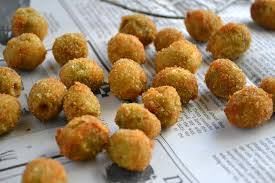
Fried olives are an intricate and exotic treat. They’re worth the bit of effort they take to prepare. I first came across them in Rome decades ago, made by a chef named Maria Romani at her fish restaurant, Il Pellicano. She was originally from the Le Marche region, where fried stuffed olives are a tradition, usually filled with pork. Signora Romani’s olives contained some type of seafood, shrimp maybe (it was a long time ago), and were breaded, fried, and served as one of the earlier courses in a multi-course meal. Everything was wonderful, but the olives were a mind blower. Such flavor, such labor. A strange feature of the restaurant was that dishes were brought out one after another, ten, twelve of them, until you told the waiter you couldn’t eat another bite. After you’d given the word, out would come a lemon sorbetto, and that was that. The restaurant hasn’t existed in years. I wonder what happened to Signora Romani? I’m going to give her an Internet search right now. . . . Well, I didn’t come up with anything. If anyone knows if she’s still cooking, or even still walks this earth, please tell me.

I love most fried foods, but olives have an agro-dolce-ness that plays extra well against the crispy, oiliness of a fried crust. Mild green olives, in my opinion, work the best. The Ascolana olives of Le Marche, which have a mild but bright flavor, are what inspired that region’s fried olive recipes, I believe. I can’t imagine frying a strong, wrinkled black Moroccan olive, no matter how much I love them. They don’t have enough juice or quiet acidity. Green Cerignolas from Puglia also have the right qualities for frying.

People worry that fried food is bad for you. Please don’t worry. Southern Italy perfected fried food, and the Mezzogiorno was included in the big 1960s Mediterranean diet study because it had an extremely healthy lifestyle. They fry things that are good for you, such as cauliflower, or sardines, not Milky Ways (well, zeppole, but just for le feste). Also the food is usually just dusted with a little flour or breadcrumbs, not a thick batter that becomes a grease-hogging encasement. Often they use olive oil and fry quickly so the oil doesn’t break down. And, maybe most important, fried food in Southern Italy is served as an antipasto, not a main course. Plus, you don’t need a gallon of oil. I fried these olives in about 2 inches of olive oil. That’s all they require. This is really a lovely salad. Give it a try.  And since I’ve included cheese and sausage in this salad, I didn’t bother to stuff them, so the prep is minimal. The olives are also good on their own, maybe served with some young pecorino, a few slices of prosciutto, and a glass of Grillo wine.
10407104_10152509212151880_5385312437885235276_n

Escarole Salad with Fried Olives, Capocollo, and Asiago

(Serves two)

For the salad:

2 big handfuls of young summer escarole or frisée (any green that is not a big wilter will work)
About 8 big shavings of aged Asiago
6 slices capocollo, cut into thin strips
2 very thin slices red onion
A small handful of tiny basil leaves
The leaves from a few large sprigs of marjoram
1 summer garlic clove, crushed
1 teaspoon Spanish sherry vinegar
A pinch of salt
Black pepper
About 1½ tablespoons extra-virgin olive oil

For the olives:

1 cup extra-virgin olive oil
10 Cerignola or Ascolana green olives, pitted (or any large green olive, as long as they’re not too salty. You can rinse ones that seem briny)
½ cup regular white flour
2 eggs, lightly beaten
¾ cup homemade dry breadcrumbs
6 or so large thyme sprigs, the leaves well chopped
¼ teaspoon ground allspice
¼ teaspoon ground fennel seed
1 tablespoon grated aged Asiago cheese
¼ teaspoon Aleppo pepper, or a pinch of cayenne
A few big grindings of black pepper

Place the lettuce in a nice looking salad bowl. Scatter on the Asiago, capocollo, onion, and the herbs.

Whisk the garlic, vinegar, salt, black pepper, and olive oil together, and set aside.

Pour the oil for the olives into a medium saucepan, and get it hot over high heat. You’ll want about 2 inches or so of oil.

While the oil is heating, place the breadcrumbs on a plate, and add the thyme, allspice, fennel, tablespoon of Asiago, Aleppo, and black pepper. Mix well.

Dry the olives, and coat them lightly in flour. Now dip them in the egg, shaking off excess.

Roll the olives in the breadcrumb mixture, coating them well all over. Stick them in the refrigerator while the oil is heating. This will help their coatings adhere.

When the oil is hot (test by flicking in a few drops of water; it should immediately sizzle), add the olives, and fry until golden all around (do this in two batches if they’re crowded). Lift them from the oil onto paper towels with a slotted spoon.

Toss the salad with the vinaigrette, and then scatter the hot olives on top. Serve right away.

IMG_7347Photo by Lisa Silvestri


The July issue of Curves magazine is out now, with my column on Steak Fajitas with a Cantaloupe Tomato Salsa. This, unfortunately, will be the final issue of this beautifully put together and informative magazine that has been so much help to women who are struggling to control their weight. It’s a shame, but the company needed to cut corners, so the magazine, they decided, had to go. Sad indeed.
http://viewer.zmags.com/publication/606c5222#/606c5222/29

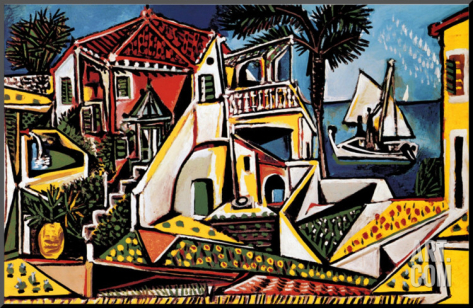
pablo-picasso-mediterranean-landscape_i-G-57-5702-E8BNG00ZMediterranean Landscape, Pablo Picasso.

The Mediterranean Diet?

I thought about my family’s ancestral cooking while gazing for the umpteenth time at the now familiar-to-most Mediterranean Diet Pyramid. The chart was assembled by the nonprofit Oldways and a few other groups in 1993 based on studies from the 1960s. Atop its tiny peak sit “meats and sweets,” to be eaten less than weekly; beneath that are poultry, eggs, cheese, and yogurt (daily to weekly), then fish and seafood (at least twice a week), and finally fruits, vegetables, beans, grains, olive oil and so on (the basis of every meal). The cooking I grew up with was imported from a little town on the Campania-Puglia border and from Sicily. Those areas, along with the rest of Southern Italy, plus Greece and Crete, made up the study. This time I really looked at this pyramid, and it didn’t look quite right. With all I know about Southern Italian food, it struck me as off. I found it lower in fat than I’ve experienced traveling through the region and on my own family’s table. I also saw a problem with its emphasis on whole grains.

OW_MedPyramid_612x792Olive oil is in the eat-every-day base of the pyramid, which is correct, but things like olives, anchovies, cured pork, cheese, and fatty end cuts of meats used for flavoring are not. Those are things Southern Italians actually do eat every day. The meals I shared with my grandmother’s cousin in Castelfranco in Miscano always began the same way: chunks of caciocavallo, slivers of salami, hard-as-hell taralli, salted anchovies, olives, and sharp, cloudy red wine (homemade, and I’m not sure you could buy anything tasting as weird). Then a very small portion of pasta (about a pound for six people) with a vegetable sauce (home-bottled tomatoes or broccoli rabe when I was there) often flavored with some odds and ends of fatty pork, olives, or anchovies, and finished with fresh olive oil and a hard caciocavallo. Next, if available, a slow-cooked meat made from a cheap cut, pounded, stretched, and filled with breadcrumbs, herbs, onion, nuts. Or, instead, a fresh sausage studded with fat, or sometimes a cooked vegetable, such as roasted peppers with tomatoes and anchovies or prosciutto end. Southern Italy was and still is a place that uses the whole hog. I also noticed big cans of sunflower oil in my relatives’ house. Olive oil is expensive, even in Italy, so you need a backup. I think they mixed the two for cooking. After the main course, my cousin Tony served raw fennel and celery, just the way my grandmother had in Port Chester, New York. He offered pears once. Almonds, too. No pastries. Those were reserved for holidays. Fried food, which is popular all over the South, is what you eat on the street or in restaurants, not in homes (and boy is it good).

And what’s with whole grains as something to eat every day? They’re supposed to make up a big percentage of the daily diet in those parts. I’ve never been offered a whole grain bread anywhere in Southern Italy, and believe me, I’ve been around. The bread is either ground durum wheat, the same used for dried pasta, or soft wheat, as in pizza flour. Sesame or fennel seeds are often scattered over the top, especially in Sicily. But dark, dense loaves studded with whole grains are not part of the culture. And in my experience you’re not expected to eat much bread. “Don’t fill up on bread” is a command I’ve heard from my family both here and in Italy. It’s considered bad manners.

There’s no whole wheat pasta either. Wheat berries show up in special occasion foods, like pastiera, the Easter ricotta cake, or cuccia, a porridge served for the feast of Saint Lucy. The wheat berries are included mostly for symbolic purposes, signifying the abundance of the earth.

What are part of the culture, for certain, are small portions of local seasonal food, whether a fresh orange just grabbed from a tree or a hot, oily arancini that oozes mozzarella, bought on a Palermo Street.

So let’s face it, Mediterranean is an excellent way to eatmaybe better than the pyramid suggests.

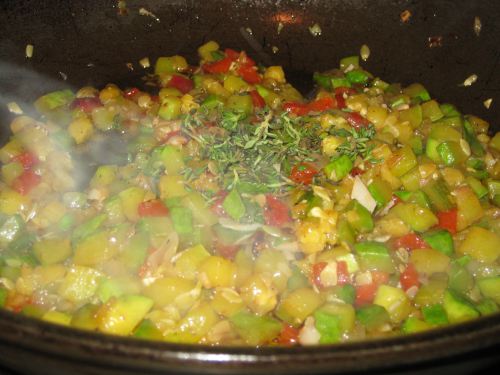
zucchini-pesto

Orecchiette with Baby Zucchini, Soppressata, and Mint

(Serves 4 as a first course)

Salt
¾ pound orecchiette pasta
Extra-virgin olive oil
6 or 7 tiny early summer zucchini, cut into small cubes
About 5 not-paper-thin slices soppressata, chopped (try to find one that’s not too dry)
1 large shallot, chopped
A few large thyme sprigs, the leaves chopped
2 fresh summer garlic cloves, thinly sliced
1 fresh red peperoncino, seeded and minced
A splash of dry vermouth
½ cup chicken broth
A small handful of fresh mint leaves, lightly chopped
A small handful of flat leaf parsley leaves, lightly chopped
A chunk of pecorino Toscana cheese for grating

Set up a pot of pasta cooking water, and bring it to a boil. Add a generous amount of salt, and drop in the orecchiette.

In a large sauté pan, heat 2 tablespoons of olive oil over medium flame. When the oil is hot, add the zucchini and the shallot. Add a little salt, and sauté until the zucchini is tender and just starting to turn golden, about 4 minutes or so. Now add the garlic and the soppressata, and sauté about 2 minutes longer. Add the vermouth, and let it boil away. Add the chicken broth, and turn off the heat.

When the orecchiette is al dente, drain it, and add it to the pan. Toss well over low heat until everything is well mixed, about a minute. Add a little more broth if it seems dry. Transfer to a warmed serving bowl, and add the thyme, the mint, the parsley, and a generous drizzle of fresh olive oil. Toss gently. Taste for seasoning. Serve with grated pecorino Toscana.

Women with Fish

dsc_0582

This out of control nun bought all the fish these guys had to sell. He had to close shop for the day after she finished with him. Must be a huge convent. Either that or, more likely, she had a side-line business going on. I don’t know, I’ve never really trusted nuns.

scallop shell  1

I’ve been making a Ligurian-style Swiss chard torta for probably around fifteen years. Everyone loves it. I’ve brought it to so many dinner parties, I’ve now got tart pans all around the city, most never to be seen again. I guess it’s become one of my signature dishes. The filling is mostly the chard, but it can also contain pine nuts, raisins, dates, almonds,  marjoram, Parmigiano, garlic, sometimes thyme or basil, and occasionally a few anchovies, all, of course, at the whim of the cook. I usually throw them all in. I find that more is strangely more in this preparation. It’s sort of the pasta con sarde of tortas, with seemingly colliding flavors creating a beautiful whole. I bake it in a flaky olive oil and white wine crust, which is incredibly easy to put together. An exotic treat for the vegetarians in my life.

In fact, the filling for this torta is so good I kept thinking about it recently while trying to come up with a diet-friendly main course to use up way too much Swiss chard I had bought. I deconstructed the torta. I got rid of the crust and used a modified version of my fillingno eggs,  no sweet aspects, very light on the cheeseas a bed for seared sea scallops, finishing it off with a lemony marjoram vinaigrette. Seasonal ingredients, thought through but simply put together.

One of my current diet goals is to present you with main courses that have so much flavor you don’t miss the usually unavoidable but gratuitous side of starch. This one really worked out well. I hope you enjoy it.

photo[1]

(Serves 2 as a main course)

For the lemon marjoram oil:

2 tablespoons extra-virgin olive oil
1 small summer garlic clove, minced
6 large marjoram sprigs, leaves chopped
The grated zest from 1 large lemon, plus about a tablespoon or so of its juice
Salt

For the rest:

Extra-virgin olive oil
1 tablespoon unsalted butter
1 shallot, minced
2 summer garlic cloves, sliced
1 very large or 2 smaller bunches Swiss chard, the thick white ribs removed, leaves chopped
Salt
Black pepper
A few large thyme sprigs, leaves chopped
A few large marjoram sprigs, leaves chopped
The zest from 1 lemon
A small chunk of Parmigiano Reggiano cheese
6 really large sea scallops, or 10 smaller ones
A big pinch of sugar

In a small bowl, mix all the ingredients for the lemon marjoram oil together. Let sit while you proceed with the recipe (allowing the flavors to blend).

Heat about a tablespoon or so of olive oil in a large skillet over medium flame. Add the shallot, and let it soften for a minute. Add the garlic, and sauté for a few seconds, just until it gives off an aroma. Add the chard, and sauté, stirring it around a few times, until it wilts down by about half. Season with salt, black pepper, and the thyme, marjoram, and lemon zest. If it has given off liquid, drain most of that off.

Season the scallops with the sugar, salt, and black pepper.

Heat a heavy-bottomed skillet over high flame. Add a big drizzle of olive oil and the butter. When they’re hot, add the scallops, and let them brown without moving them around. When they get crispy at the edges, turn the heat down a little, and let them continue to cook. Don’t flip them. When the top of the scallops feel warm, they’re done.

Add a few big gratings of Parmigiano to the chard, and give it a stir. Divide it up onto two plates. Place the scallops, browned side up, around the chard. Drizzle the scallops with the lemon marjoram oil, and grate on a little parmigiano. That’s it.

dscn0640
Alone on a warm evening in the not too distant past, I cooked myself a steak and opened a bottle of okay Sangiovese. Earlier that day I had picked up a bunch of purslane at the Greenmarket, and I decided to use it as a bed for my meager-looking skirt steak. What the hell. I wasn’t expecting much from the meal. But it turned out this was one of the best dinners of a year full of anxiety-packed, insoluble family issues. A solitary night, a chic but quickly assembled dinner, the swing of Gotan Project on my iPod. I started to feel pulled-together. It’s nice when that happens.

Skirt is a favorite cut of mine. It’s tender when cooked pink, has great flavor, and is easy to sear on a stove-top grill plate. I don’t eat a lot of steak, but I don’t have a problem with it. I’m also not overly concerned with saturated fat. Dietary thought on this subject is changing. The insulin assault on our bodies caused by sugar and carbs is possibly looking to be a bigger problem. My grandparents were brought up on olive oil and lard. That was the Southern Italian way. I’m sticking with it.

I’ve Italianized my steak dinner to the hilt, adding anchovies, capers, lemon, summer garlic, and fresh marjoram. Purslane, with its deep citrusy taste and moist texture, needs little dressing, so I left it in the nude, letting my steak juices and all the Italian flourishes trickle down, pulling the dish together.

But what exactly is purslane?

I love this strange, juicy, weed-like plant. It’s both lemony and peppery, best left raw or quickly sautéed to preserve its moisture. It’s actually a succulent, and you can find it growing on lawns and sometimes even up from cracks in sidewalks in the summer months. I treat it as an herb, throwing its stems into salads, scattering its leaves on a finished dish, or using it as an herby bed for meat or fish, as I’ve done here. It’s also full of Omega-3 fatty acids, the same healthful stuff you find in fatty fish, which makes it a good coupling with our supermarket grain-fed beef, which unfortunately has had most of its Omega-3 bred out of it.

 Skirt Steak on Purslane with a Lemon Anchovy Vinaigrette

 (Serves 2)

For the steak:

1 ¾- to 1-pound skirt steak, cut in two
½ teaspoon Aleppo pepper
Salt
Freshly ground black pepper
½ teaspoon sugar

For the vinaigrette:

1 large clove summer garlic, minced
1 teaspoon fresh lemon juice, or more to taste
4 oil-packed anchovies, minced
2 tablespoons extra-virgin olive oil
A few large sprigs of marjoram, the leaves lightly chopped
Freshly ground black pepper

Plus:

A big handful of purslane, some of the thicker stems removed
6 cherry tomatoes, halved
A palmful of salt-packed capers, soaked in several changes of cool water and then well rinsed.

Season the steaks on both sides with the Aleppo, some salt, black pepper, and the sugar.

Set up a stove-top grill plate over high heat. While the grill is heating, whisk together all the ingredients for the vinaigrette.

Divide the purslane up onto two dinner plates. Place the cherry tomatoes around it.

Grill the steaks (no need for oil here) until seared on one side, about 2 minutes or so, depending on their thickness. Give them a turn, and grill until rare or medium rare (you really don’t want to go further than this, as skirt steak can get tough if overcooked).

Pull the steaks from the grill and lay them over the purslane. Spoon the vinaigrette over the steaks, and garnish with the capers.

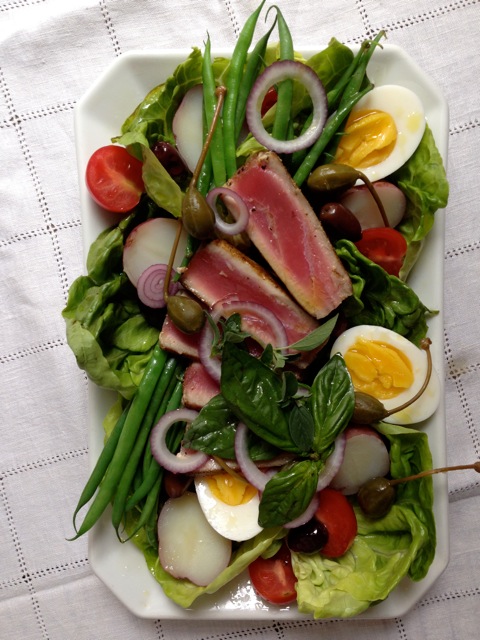
Salade Nicoise

IMG_6762Photo by Lisa Silvestri

My new column for the June issue of Curves magazine. It’s an elegant classic. Full of health, low in calories. I hope you like it.

tumblr_mlc3l1mEMn1qbhp9xo1_1280Still Life with Cat Stealing Squid from a Plate, Giuseppe Recco, seventeenth century.

Italian seafood salads are among my favorite dishes. I always hoped one would show up on my family’s patio table during a summer barbecue, and often it did, the first thing there. As a kid I was especially crazy about the versions that included scungilli, with its odd musky undertones and chewy texture. I realize many people don’t like scungilli, and you don’t see it around much anymore, even in old-school red sauce joints. Phil Karlin, my fish man at Union Square, carries it, caught right off the North Fork. I’m not sure who aside from me buys it. I also like cold mussel salads with lots of celery and fennel. I’m crazy for hot seared shrimp piled onto a bed of cool greens. And I like calamari salad anyway I can get it.

Classic Italian seafood salads fall into the category of things that are delicious to eat when you’re on a diet but that may have slipped your mind. When I think about it, I realize there exist many such dishes, mainly because much of the Mediterranean diet is intrinsically healthy and low-cal. No tinkering required.

I grew up eating these salads at home and in restaurants. Many of the restaurant versions were terrible, reflecting the worst of Italian-American cooking. Their chief faults, as I see them, were too much dried oregano, too much garlic, overcooked seafood, way too much vinegar, raw green bell peppers or chunks of red onion, all of which overtook the seafood’s delicate flavor. I still find recipes like that on the Internet. Very depressing. A potentially beautiful dish thrown overboard.

But I’m not going back in time, and neither are you. Try this warm version with calamari and chickpeas mixed with greens. I’ve suggested frisée, but any other sturdy early summer green, such as young curly chicory, will do. Arugula and watercress wilt on contact with warm oil, so save them for a different dish.

Happy healthy eating to you.

(Serves 4 as a main course)

Extra-virgin olive oil
1½ cups cooked chickpeas, drained and well-dried
2 long red peperoncino chilies, cut into thin rings
2 scallions, thinly sliced, using some of the tender green part
1 teaspoon za’atar Middle Eastern spice mix, plus a bit more for garnish
Salt
1½ pounds small calamari, cleaned and cut into rings, the tentacles left whole
2 fresh summer garlic cloves, thinly sliced
The grated zest from 1 lemon, plus about a teaspoon of its juice, or a little more to taste
6 large sprigs thyme, the leaves chopped
6 large marjoram sprigs, the leaves lightly chopped
1 medium head frisée lettuce, torn into pieces

Set out a large, nice looking salad bowl.

In a large skillet, heat about a tablespoon of olive oil over medium-high heat. When hot, add the chickpeas, the peperoncino, the scallions, the za’atar, and a little salt. Sauté quickly, just until the chili softens and gives off an aroma and the chickpeas take on a little crunch. Pour into the salad bowl.

Without cleaning out the skillet, add another tablespoon of olive oil, and turn the heat to high. When really hot, add the calamari, the garlic, the lemon zest, and a little salt. Sear the calamari quickly, just until it’s opaque and tender. Add the thyme, and stir it in. Add all this to the salad bowl.

Add the frisée and the marjoram to the salad.

Drizzle on about a tablespoon of fresh olive oil and the lemon juice. Season with a bit more salt, and toss. Sprinkle with a little extra za’atar. Serve right away.

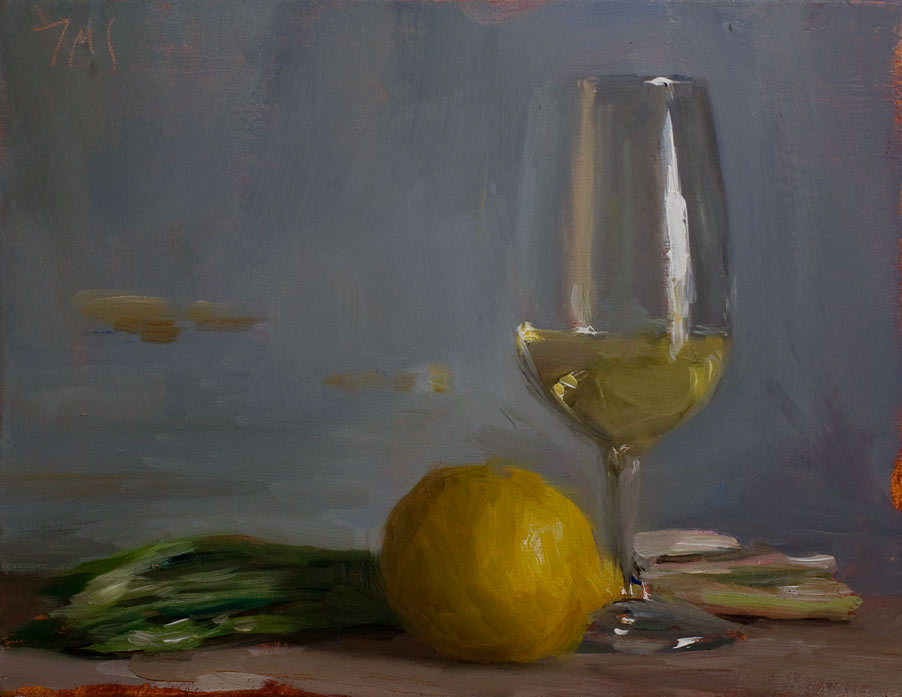
130310-lgeStill life by Julian Merrow-Smith.

Your Italian Diet

Recipe: Asparagus and Celery Soup with Celery Gremolata

Many readers have told me that they really like my monthly diet column for Curves magazine. I like it too. It’s been a stimulating but at times mind-boggling challenge, coming up with 400-calorie main course meals in a bowl. One thing I’ve certainly learned is how easy it is to eat too much. And after almost two years writing the Curves column, I feel I’ve now got the thing down.

So with you in mind, I’m going to extend my Curves forum to my blog, giving you all sorts of seasonal, low-calorie, mostly Italian recipes. They won’t be as strict as the ones for Curves, and I’m not listing numbers for calories, carbs, fats, or salt. That won’t be my style here, but I will assure you that any recipe I post will be healthy, low-calorie, and sensibly portioned (if a bit more generous than the ones for Curves).

The beautiful truth is that much of Southern Italian cooking falls naturally into this category. You just need to be careful about what you choose to cook. Which is where I can really help you. I’ll be posting some classics, but mostly, as is my way, giving you fresh, creative takes on Italian themes. I won’t be going near any diet ingredients, such as reduced fat cheeses or those awful cooking sprays. You’ll get real food, with recipes composed in a contemporary, natural, and I hope elegant style.

Cutting simple carbohydrates and sugar and upping vegetables is my goal. What about fat? I’m not as fat-phobic as some diet types are. I love fats of all kinds. They add flavor. I’ll be using, in addition to delicious, monounsaturated extra-virgin olive oil, things like pork fat, fatty fish, and cheese, but I’ll work them in so they flow into the dish without taking over (did you know that olive oil and just about all fats contain 120 calories a tablespoon? I used to pour oil over my food with abandon. Now I think about what I’m adding and why. Will more oil add more flavor, or just drown the dish in a greasy slick?)

What about pasta, you ask? I could live without pasta as easily as I could live without my red Gabrielle lipstick by Chanel. It’s not gonna happen, ever. But I will change up my pasta offerings. I’ll be suggesting that you eat pasta only as a first course, the way it’s traditionally served in Italy. I’m not sure how we got so far off track with pasta in this country. The portions are totally out of control. (I know people who eat an entire pound on their own. How do they even get it down?)

Which brings me to asparagus. I thought I’d implode waiting for it to show up in my markets. Spring in New York has been and still is damn cold. Every growing thing has been late. But now we’ve got the local stuff coming in, and I can relax a little. I’ve been especially eager to cook up some asparagus soup. Every spring I look for ways to make it a little differently.

This soup is in the crema style, which in Italian culinary terms means a purée but not one that necessarily contains cream. I don’t usually add many flavors to a spring vegetable soup, preferring to keep it simple and pure, but somehow I thought of celery this time around. Celery with asparagus. Yes, that sounded right. I tried it and really liked the way the two flavors married. I finished the soup with a spoonful of Parmigiano and a gremolata  made with parsley leaves, celery, and lemon. It came out really nice.

Please let me know if there are specific dishes you’d like to see here. I’m going to lay off the pizzas, paninis, and desserts for a while, since they really have no place in a weight-loss program, but anything else, just ask.

Asparagus and Celery Soup with Celery Gremolata

(Serves 5)

Extra-virgin olive oil
2 small spring onions, chopped, using some of the tender green stem
2 inner celery stalks, chopped, plus the leaves from about 5 stalks
2 pounds asparagus, the tough ends removed, blanched for about 1 minute and then plunged into ice water (this helps preserve the bright green color).
1 or 2 cloves spring garlic, sliced
1 large Yukon Gold potato, peeled and chopped
Salt
Freshly grated black pepper
About 5 large sprigs flat-leaf parsley
The grated zest from 1 lemon, plus a squeeze of its juice
1 heaping tablespoon grated Parmigiano Reggiano cheese

Drizzle about a tablespoon of olive oil into a large soup pot. Heat it over a medium flame. Add the onion and the celery (but not the celery leaves), and sauté for about a minute, just to release their flavors. Chop the asparagus into pieces, and add them to the pot, along with the garlic and potato. Give it all a good stir, and sauté for about 3 minutes. Now add enough water to just cover the vegetables

Bring the soup to a boil, and let it cook at a low bubble, uncovered, until everything is tender, about 15 to 20 minutes. Season with salt and black pepper.

While the soup is cooking, chop the parsley and celery leaves together. Mix in the lemon zest and a pinch of salt. That’s the gremolata.

Purée the soup in a food processor or with one of those wand things (I think the food processor does a better job with asparagus, which is so fibrous).

When you’re ready to serve, reheat the soup, and then check the seasoning. Add a tiny squeeze of lemon juice, the Parmigiano, and a drizzle of fresh olive oil, and give it all a stir. Ladle the soup into bowls, and top each bowl with a generous sprinkling of the gremolata.

salts_and_spices_pictures_3Spice of Life, by Kelly McCollam.

 Recipe: Lasagna with Spring Greens, Guanciale, and Spiced Besciamella

It’s been a cold spring in New York. Must be lasagna season. But not any lasagna, not the beloved Southern Italian lasagnas of my childhood, filled with ricotta, meatballs, sausage, tomatoes, mozzarella. One with a lighter style. I had to take a trip to the Genoa of my mind to decide my direction here. And there it was, a food memory of Liguria, its beautiful pesto lasagna, made by alternating layers of Genoese pesto and besciamella between sheets of pasta. As far as I’m concerned, it’s one of the genius dishes of Italian cooking. A streamlined concept that is surely worth improvising on. I figured I’d replace the pesto with a mess o’ young spring greens, make a thin, smooth besciamella, and that would do it. Then I started fiddling with spices.

The flavor of besciamella (Italian béchamel) is pretty much set. My usual is everyone’s usual, with nutmeg, a pinch of cayenne, and a bay leaf, producing a deep milky taste with a hint of spice. This time around I decided to go fragrant. I wanted a bit more spice, but I didn’t want the dish to scream curry. So I started adding a pinch of this, then tasting, then a pinch of that and another taste. I called it a day when the bubbling aroma turned warm and rich but hadn’t gone Asian on me. Where I stopped was at allspice, cardamom, coriander, and Aleppo pepper, while keeping the nutmeg and bay leaf. I think it worked well with the wilted greens and guanciale filling.

What I believe:

I believe lasagna should be loose and flowing. When I cut a piece and put it on a plate, it should breath. Not spread into a big, sloppy mess, but just relax. I don’t let lasagna “rest” when I take it from the oven. No need, the way I cook it. I construct it not so deep and cook it on high heat, uncovered, for a crisp top and a lighter interior. That way enough liquid evaporates without the thing overcooking into a compact block.

Lasagna with Spring Greens, Guanciale, and Spiced Besciamella

 (Serves 6)

For the spiced besciamella:

3 tablespoons unsalted butter
2 tablespoons all-purpose flour
3 cups whole milk
1 fresh bay leaf
A big pinch each (about ⅛ teaspoon) of Aleppo pepper, black pepper, allspice, cardamom, coriander, and nutmeg
Salt

For the rest:

Extra-virgin olive oil
¼ pound guanciale, cut into small cubes
2 shallots, chopped
2 garlic cloves, sliced
5 cups mixed greens, leaving a bit of water clinging to them: spinach, baby kale, arugula, mustard, the leafy part of broccoli rabe, and anything tender enough to collapse with a quick sauté
Salt
Black pepper
Aleppo pepper
1½ cups freshly grated grana Padano cheese
¾ pound fresh lasagna sheets, boiled, cooled, and laid out in the usual way, where ever you can find room (sometimes draped over the rim of my bathtub)

To make the besciamella: In a medium pot, melt the butter over medium heat. Add the flour, and whisk until it’s blended into the butter. Sauté a minute or so, without letting it brown, to get rid of the raw taste. Add all the milk, and whisk well to blend. Add all the spices and a decent amount of salt. Whisk a few times, and then let it slowly heat, whisking frequently. Keep whisking while keeping it at a low bubble, until the sauce becomes thick and smooth, about another 3 minutes. That should do it. Cover the surface with plastic wrap, so it doesn’t form a skin.

In a large, deep skillet, heat a few tablespoons of olive oil over medium flame. Add the guanciale, and let it render some of its fat. Add the shallot, and sauté until softened. Now add the garlic, and cook just until fragrant, a few seconds. Add as much of the greens as you can, turning them in the oil until they wilt enough for you to add the rest of them. Cook, uncovered, until they’re just tender, about 4 minutes (sprinkle with a little water if they’re dry). Season with salt, black pepper, and a little Aleppo.

Preheat the oven to 425 degree.

Choose an approximately 10-by-12-inch baking dish about 2 inches deep. Drizzle in a little olive oil to lightly cover the bottom of the dish, and put down a layer of pasta. Make a layer of greens, drizzle in a layer of besciamella, and sprinkle on some grana Padano. Repeat the process, ending with a layer of pasta. Now mix a tablespoon of olive oil with about 2 tablespoons of warm water, and pour it over the pasta. I like to do this when I’m not working with a liquidy sauce. A bit of moisture assurance. Finish with the remaining besciamella and a sprinkling of grana.

Bake uncovered until it’s hot and bubbling and the edges are browned, about 20 minutes or so. By the time it takes you to get it to the table, it’ll be ready to cut.