Feeds:
Posts
Comments

d33222c3bbcc5ef2a7b7620af833ab3f_rwh-competitions-in-schools-lanka-rain-water-harvesting-forum-rain-water-harvesting-images-for-drawing-competition_540-698

Recipe below: Rice Salad with Filetto di Pomodoro, Corn, Miso, and Basil

We had a dramatic rain in Manhattan last week. I got caught in it. I was walking down 14th Street, heading toward Seventh Avenue, when it suddenly came crashing down, unexpectedly, at least for me who hadn’t bothered with the weather report. Totally drenched, I made my way to a corner with leaky scaffolding and crammed in there, underneath the wood planks, with about thirty other soaking people. The thunder was the most raucous and crackling I can recall in a long time, and the rain came down almost horizontally.  A spotty dachshund cowered, but I felt free and good. Hard rain almost always lifts my spirits.

While waiting out the rain with my city mates, I thought of the backyard porch on Long Island where I grew up, which I loved especially when it rained hard. There I could be surrounded by rain but at the same time protected from it, just like on 14th Street. Our porch had a forest green canvas awning with white tassels, charmingly old-fashioned even back in the 1960s. During a hard rain I’d drag out my mother’s pasta pots and the bottom of our huge lobster cooker and set them up so they could collect rain water.  That was a hobby of mine. I’d sit on the cushioned love seat and listen to the thunder and watch the pots fill with water. Why? Was I trying to catch what might be needed for family well-being? We weren’t likely to face a life-threatening drought in Nassau County, twenty miles east of Manhattan. Maybe it was an element of housekeeping imprinted in my DNA, or some ancient Puglian relative guiding my survival instinct. Whatever provoked me, I collected rain water, a lot of it. And this wasn’t just an early childhood urge, like making mud pies. Water collecting lasted well into my late teens.

Unfortunately we eventually replaced our green canvas awning with an Italian-American update, a white aluminum roof that made machine gun sounds whenever it as much as drizzled, ruining the experience completely. Luckily, that wasn’t too many years before I moved into Manhattan and replaced the awning experience with city scaffolding.

Rain water harvesting is illegal in some states, because some arcane laws say rain doesn’t belong to you. It belongs to someone who may have laid claim to it far in the past—a wheat farmer or a cowboy, possibly—even if a cascade is pouring off your roof. New York doesn’t have that ridiculous law, or didn’t that I knew of at the time. I can’t say I harvested the water, exactly. It was more like hoarding it. I’d keep it for a few days and then, as I recall, pour it around my father’s tomato plants. He asked me to do that.

My father often talked about rain. He’d say, we could use some rain, or we really need a good rain. When I was very young I wasn’t sure what needing rain meant, growing up in a place that didn’t seem to need anything. I soon learned that he meant he wanted his tomatoes to be well provided for. Now that I grow my own tomatoes, rain has an added importance. I need it.
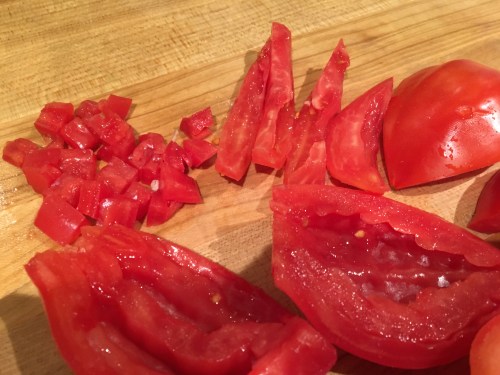
IMG_3047.JPGIn my opinion, tomatoes are nature’s greatest summer gift. A fine thing to do with them is to make an Italian-style rice salad, which is like a pasta salad but more authentically Italian. To cut down on excess wateriness in my rice salad, I slice the tomatoes into a filetto di pomodoro. That means I cut away all the seeds and watery gel from the inside of the tomatoes and then chop the remaining fillets. The deep red tomato bits look like a pile of rubies sitting on my counter (see the photo above). Don’t throw away those slippery seeds. You can take all that and throw it into a blender. Then you can easily strain it, making a thick tomato juice that’s great in a Bloody Mary, or for loosening up pastas or soups.

IMG_3053.JPG

Rice Salad with Filetto di Pomodoro, Corn, Miso, and Basil

(Serves 4 or 5)

3 medium-size summer tomatoes
2 cups cooked long- or medium-grain white rice
The kernels from 2 cooked ears of corn
1 small shallot, well chopped
A palmful of Niçoise black olives, pitted and lightly chopped
A palmful of toasted pine nuts
1 tablespoon white miso, at room temperature
1 tablespoon rice wine vinegar
A teaspoon of dry vermouth
1 small summer garlic clove, minced
Extra-virgin olive oil
Salt
Black pepper
A big pinch of pimento d’espelette
A handful of Thai basil leaves or regular basil (or a mix), roughly chopped

Quarter the tomatoes, and then cut out their insides, leaving the juicy, thick skin. Slice the skin into strips, and then cut the strips into little cubes (see the photo above). You’ve now got your filetto di pomodoro.  For suggestions on what to do with the tomatoes’ insides, see the essay above.

Place the rice in a nice-looking serving bowl; one more wide than deep is best. Add the filetto di pomodoro, the corn, the shallot, the olives, and the pine nuts. Give it all a toss.

Whisk the miso together with the rice vinegar, the vermouth, and the garlic. Whisk in 2 tablespoons of olive oil. Season the vinaigrette with salt, black pepper, and a little pimenton d’espelette. Pour this over the rice, adding the basil, and toss well. Let the rice sit for about a half hour so all the flavors can blend. Now give it another toss, correct the seasoning if necessary, and serve.

I find this especially good alongside grilled Italian sausages.


2861168-MLGMQQOJ-7.jpg

Still Life with Goat Skull and Beets, by Viktoria Kiss.

Recipe below: Beet and Goat Cheese Torta with Olives and Summer Savory

“Great cooking favors the prepared hands” —Jacques Pépin

That is a fairly well-known quotation from M. Pepin about creativity. Its truth has never been more apparent to me than in the last few months, when I’ve tried painting illustrations for my next cookbook. I’d had the idea before but never acted on it. This time I started painting. Oh, boy.  When things didn’t turn out instantly impressive, I got demoralized. What was I expecting? Instant greatness? My culinary skills, at this point, are pretty well rooted, allowing me to improvise freely.  After decades of cooking in restaurants, creating recipes, and writing cookbooks, I’ve got what M. Pépin calls prepared hands. Painting is another story.

Feeling like a beginner at this point in my life, felt, well, bad. I was a decent painter in high school (as in 40 years ago), and figured it would all come flowing back. I made the situation worse by choosing to paint in gouache, a medium I was completely unfamiliar with. I’m not sure why I went for that, except that possibly my love for Leonetto Cappiello’s posters drew me to his opaque matte finishes and bold shadows. I was hoping to turn out a first painting with a blue-gray sky and a scattering of stars under which a guy in a shiny suit, with Italian bags beneath his eyes, would float away with a handful of zucchini. Perfect cookbook material, no? So far, it hasn’t turned out as planned. But I haven’t given up.

This artistic frustration has led me, as many things do, to the Greenmarket, searching for color and all-around inspiration. High summer is definitely in bloom there. Lots of varieties of beets, a vegetable with a strong pull on me. Are you familiar with the Chioggia beet? It’s bright burgundy outside, which seems normal enough, but when you cut it open you reveal a spiral of fuchsia and white, a candy-stripe swirl. Amazing. But this is not some designer hybrid. It’s the real deal, a Northern Italian heirloom that became popular in the nineteenth century. Chioggia beets are very sweet and tender, and, another big plus, they don’t bleed all over the place.  When they’re cooked, their brilliant spiral design is replaced with an ombré effect, with colors moving from dark pink to orange and then to a creamy beige. Quite beautiful in its own right.

IMG_3021.JPGSo I made this beet and goat cheese torta. It’s a lot more beautiful and delicious than any painting I can turn out at the moment. I offer it to you as a high summer thought. You’ll notice that it has touches of sweetness, in the beets, of course, but also in the sweet pasta frolla, and the honey-vinegar drizzle I add right before baking. But to balance that out, I’ve added olives and a strong herb, making it suitable for an antipasto pass-around. Nice with a glass of rosé.
IMG_3032.JPG

Beet and Goat Cheese Torta with Olives and Summer Savory

(Serves 8 as an antipasto)

For the pasta frolla:

2½ cups regular flour, plus a little more for rolling
¼ teaspoon salt
¼ teaspoon baking powder
2 tablespoons powdered sugar
½ teaspoon ground allspice
The grated zest from 1 lemon
1½ sticks butter, cut into tiny cubes
2 large eggs, lightly whisked
About 2 tablespoons dry vermouth, maybe a little more

For the filling:

6 small beets, either Chioggia or another variety that doesn’t bleed too much
1 8-ounce log of fresh goat cheese
3 tablespoons heavy cream
1 small summer garlic clove, minced
1 large egg
Salt
Black pepper
About 10 black Niçoise olives, pitted and cut in half
About 6 large sprigs of summer savory or thyme (or a mix), the leaves lightly chopped
1 tablespoon extra-virgin olive oil
1 tablespoon runny honey
1 tablespoon rice wine vinegar

To make the pasta frolla, put the flour, salt, sugar, allspice, and lemon zest in a food processor. Pulse a few times to mix.  Add the butter, and pulse until it’s broken up into pea-size bits. Add the eggs and vermouth, and pulse again, quickly,  just until all the ingredients come together into a crumbly, moist mass (pinch a bit of dough; if it doesn’t hold together, add a touch more vermouth and pulse again). Tilt the dough out onto a lightly floured work surface, and knead briefly, maybe 3 or 4 strokes, until it comes together in a ball. Wrap it in plastic, and refrigerate for an hour or so.

Preheat the oven to 425 degrees. Wrap the beets in aluminum foil, stick them on a sheet pan, and roast them until fragrant and tender, about ½ hour (depending on the size of the beets they may need to go a little longer). Now let them cool until you can slip their skins off. Slice them into thin rounds.

Take the dough from the refrigerator, and let it warm up for about 15 minutes (this will make it easier to roll).

In the meantime, place the goat cheese, cream, egg, garlic, and a little salt and black pepper in a food processor. Pulse a few times to blend. Add the olives and the savory or thyme, and stir them in by hand (I don’t like pulsing the olives. It breaks them up too much).

Roll the dough out on a lightly floured surface and drape it into the tart pan, leaving overhang. Pour in the goat cheese cream. Now arrange the beet slices in a circular, slightly overlapping pattern. Trim the edges.

In a small saucepan, heat the honey with the olive oil and the vinegar, just until the honey is melted, about 30 seconds. Pour this over the beets. Season the top with a little salt.

Bake at 425 degrees until the inside is puffed and the crust is lightly browned, about 30 minutes. Let the tart sit about ½ hour before slicing, so it can firm up a bit.


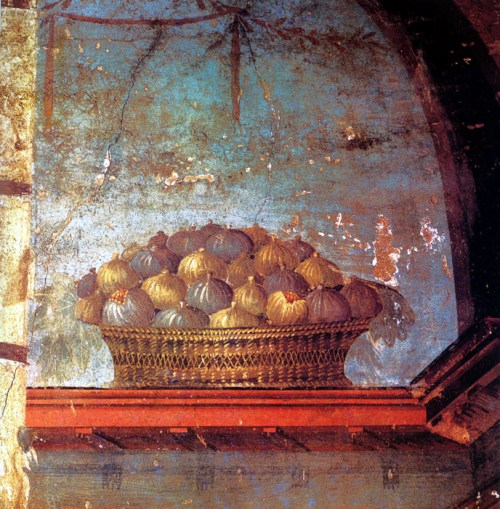
oplontis-fig-basket-villa-poppaea1.jpg

Fig Basket, Villa Poppaea, Oplontis


Figs

D.H. Lawrence


The proper way to eat a fig, in society,
Is to split it in four, holding it by the stump,
And open it, so that it is a glittering, rosy, moist, honied, heavy-petalled four-petalled flower.
Then you throw away the skin
Which is just like a four-sepalled calyx,
After you have taken off the blossom with your lips.
But the vulgar way
Is just to put your mouth to the crack, and take out the flesh in one bite.
Every fruit has its secret.
The fig is a very secretive fruit.
As you see it standing growing, you feel at once it is symbolic:
And it seems male.
But when you come to know it better, you agree with the Romans, it is female.
The Italians vulgarly say, it stands for the female part; the fig-fruit:
The fissure, the yoni,
The wonderful moist conductivity towards the centre.
Involved,
Inturned,
The flowering all inward and womb-fibrilled;
And but one orifice.
The fig, the horse-shoe, the squash-blossom.
Symbols.
There was a flower that flowered inward, womb-ward;
Now there is a fruit like a ripe womb.
It was always a secret.
That’s how it should be, the female should always be secret.
There never was any standing aloft and unfolded on a bough
Like other flowers, in a revelation of petals;
Silver-pink peach, venetian green glass of medlars and sorb-apples,
Shallow wine-cups on short, bulging stems
Openly pledging heaven:
Here’s to the thorn in flower! Here is to Utterance!
The brave, adventurous rosaceæ.
Folded upon itself, and secret unutterable,
And milky-sapped, sap that curdles milk and makes ricotta,
Sap that smells strange on your fingers, that even goats won’t taste it;
Folded upon itself, enclosed like any Mohammedan woman,
Its nakedness all within-walls, its flowering forever unseen,
One small way of access only, and this close-curtained from the light;
Fig, fruit of the female mystery, covert and inward,
Mediterranean fruit, with your covert nakedness,
Where everything happens invisible, flowering and fertilisation, and fruiting
In the inwardness of your you, that eye will never see
Till it’s finished, and you’re over-ripe, and you burst to give up your ghost.
Till the drop of ripeness exudes,
And the year is over.
And then the fig has kept her secret long enough.
So it explodes, and you see through the fissure the scarlet.
And the fig is finished, the year is over.
That’s how the fig dies, showing her crimson through the purple slit
Like a wound, the exposure of her secret, on the open day.
Like a prostitute, the bursten fig, making a show of her secret.
That’s how women die too.
The year is fallen over-ripe,
The year of our women.
The year of our women is fallen over-ripe.
The secret is laid bare.
And rottenness soon sets in.
The year of our women is fallen over-ripe.
When Eve once knew in her mind that she was naked
She quickly sewed fig-leaves, and sewed the same for the man.
She’d been naked all her days before,
But till then, till that apple of knowledge, she hadn’t had the fact on her mind.
She got the fact on her mind, and quickly sewed fig-leaves.
And women have been sewing ever since.
But now they stitch to adorn the bursten fig, not to cover it.
They have their nakedness more than ever on their mind,
And they won’t let us forget it.
Now, the secret
Becomes an affirmation through moist, scarlet lips
That laugh at the Lord’s indignation.
What then, good Lord! cry the women.
We have kept our secret long enough.
We are a ripe fig.
Let us burst into affirmation.
They forget, ripe figs won’t keep.
Ripe figs won’t keep.
Honey-white figs of the north, black figs with scarlet inside, of the south.
Ripe figs won’t keep, won’t keep in any clime.
What then, when women the world over have all bursten into self-assertion?
And bursten figs won’t keep?
fig-tart

Fig Tart with Limoncello and Thyme

(Serves 6 to 8)

For the crust:

5 tablespoons unsalted butter
2 tablespoons extra-virgin olive oil
4 tablespoons sugar
A pinch of salt
2 tablespoons Limoncello
1¾ cups all-purpose flour
4 thyme sprigs, the leaves lightly chopped

For the custard:

¾ cup non-ultrapasteurized heavy cream
1 large egg
2 tablespoons sugar
1 tablespoon Limoncello
The grated zest from 1 lemon
4 thyme sprigs, the leaves lightly chopped
1 teaspoon finely ground flour, such as Wondra

Plus:

15 or 16 fresh figs, either black or green, cut in half lengthwise
Extra sugar for the top

Preheat the oven to 375 degrees.

In a small saucepan, melt the butter. Add the olive oil to the butter, give it a stir, and then let the butter mixture cool completely. With a pastry brush, use about a tablespoon of the melted butter mixture to coat a 9-inch tart pan with a removable bottom.

To make the crust: In a medium bowl, combine the remaining butter mixture with the sugar, salt, Limoncello, and about a tablespoon of water. Stir to blend. Add the flour and the thyme, and mix briefly until you have a mass of moist, crumbly dough (don’t blend so much that it forms a ball). Tip the dough into the tart pan, and pat it down and out to the edges and all the way up the side to form a thin crust. Bake for about 15 minutes, until lightly colored and slightly puffy.

In a small bowl, combine all the ingredients for the custard, and whisk until they’re well blended.

Place the figs, cut side up, in the crust, in a slightly overlapping circular pattern. Pour the custard evenly over the figs, and sprinkle the top with sugar. Bake until the crust is golden and the custard is set, about 45 minutes. Let sit for about ½ hour before serving.

db9a0032602c3a5e076a55b94133d4fb

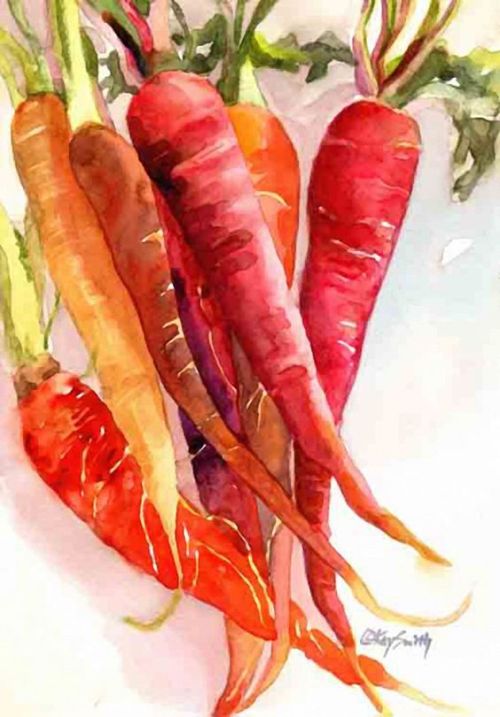
A Bunch of Carrots, by Kay Smith.

Recipes below: My Ras el Hanout; Carrots Roasted with Ras el Hanout and Summer Savory, Served with Crème Fraîche.

Growing up I didn’t have much contact with carrots. I’m trying to think if we ever even had them as a side dish when I was a kid. I don’t think so. They were for soffritto, little bits of orange that would float around in a ragù. My mother did put them out raw, along with celery and black olives, at cocktail parties, with blue cheese dip. I liked the dip.

What is the taste of a carrot?  It’s elusive. If I think too much about it I start to doubt my taste buds. Winter ones seem soapy. Early summer market carrots aren’t soapy. They’re sweeter, but, I don’t know, they just need something. Cooking helps, but even then, unless they come out somewhat spiced or candied, I’m not all that interested. Roasting is a very good way to concentrate their flavor, as are sweet and hot spices, too, or honey, salt, or, as I’ve just discovered, summer savory.

IMG_2893.JPG

My summer savory.

This is the first year I’ve grown that herb. The plant is already full and bushy. It tastes to me like a cross between thyme and oregano, so I’d give it a try anywhere I’d use those herbs, but it releases more strength than either of them, and it’s a little bitter, maybe closer in taste to a wild herb.

My Ras el Hanout

Toast cumin and coriander seeds, about a teaspoon of each. Then grind them together in a mortar and pestle, along with a small piece of Ceylon cinnamon stick. Add ground turmeric, sweet paprika, salt, dried ginger, and black pepper, about ½ teaspoon of each. Mix everything well. I like to leave the mix a little gritty, not too powdered. Close it up in a little jar. It will keep fragrant for about 2 months, providing you start out with fresh spices. I find it best to make in small batches, but feel free to double or triple this recipe if you think you’ll be using it up fast enough.

IMG_2977

My carrots, before roasting.

Carrots Roasted with Ras el Hanout and Summer Savory, Served with Crème Fraîche

(Serves 4)

2 bunches of thin summer carrots (multicolor will look especially pretty), scrubbed clean, leaving about ½ inch of their green stems (if your carrots are thick, as mine were, try cutting them lengthwise; see the photo above)
Extra-virgin olive oil
Salt
Aleppo pepper
1 teaspoon Ras el Hanout (see my recipe above or use a good store-bought brand)
1 scallion, cut into thin rounds, using some of the tender green part
1 tablespoon runny honey
A sprinkle of rice wine vinegar
10 large sprigs of summer savory, stemmed (if you don’t have it, use fresh thyme instead)
½ cup crème fraîche

Preheat the oven to 425 degrees.

Lay the carrots out on a sheet pan. Drizzle them with olive oil, and toss them well. They should be nice and coated. Sprinkle with salt and a little Aleppo, and toss again. Stick them in the oven, and roast them for about 5 minutes. Pull them out, and give them a gentle toss. Sprinkle on the ras el hanout, the scallion, and drizzle with honey. Toss to blend it all. Put the carrots back in the oven, and roast them until they’re golden, tender, and fragrant, about another 10 minutes, depending on how thick they are. Pull them from the oven, sprinkle on the rice vinegar (just a little sprinkle), and then scatter on the summer savory.

Pile the carrots up on a good looking platter.  Give each serving a dollop of crème fraîche.

982010-XADTJDAS-7

An Arrangement of Peas, by Mark Brooks.

Recipe below: Conchigliette with Shell Peas, Fennel, Prosciutto, and Basil

“Improvisation is the expression of the accumulated yearnings, dreams, and wisdom of the soul.” —Yehudi Menuhin

Can this quote, attributed to a great violinist, be applied to pasta cooking? I think so. There’s nothing more soulful and dreamed up than a bowl of good pasta. It’s the best thing an Italian cook can offer you. I make spur-of-the moment pasta a lot, but it doesn’t often find its way onto my blog. Not original enough? Not special enough? Too everyday? Yes, I guess all of those things. But don’t you love when a whim just hits, when flavors blend effortlessly, and the thing cooks along like in a nice dream? No snags, no thinking, all floating. The aroma is right from step one. In warm weather, when I’ve got such good produce to work with, these unrehearsed pastas can be memorable. I’d make this again.

wright-conchiglie


Conchigliette with Shell Peas, Fennel, Prosciutto, and Basil

(Makes 2 large servings)

Salt
4 thin slices prosciutto di Parma or San Daniele, the fat removed, chopped, and saved, and the rest cut into thin strips
Extra-virgin olive oil
1 fennel bulb, cored and thinly sliced, chopping and saving a few of the big feathery fronds
1 small summer onion, sliced, using some of the green stem
1 cup freshly shelled peas
2 allspice, ground to a powder
6 or so fennel seeds, ground
A splash of rosé wine
½ cup of chicken broth, possibly a little more
2 tablespoons unsalted butter
Black pepper
A few drops of rice wine vinegar
About a dozen basil leaves, cut into chiffonade
A small chunk of Parmigiano Reggiano cheese

Set up a pot of pasta cooking water. Add salt.

While that’s coming to a boil, get out a large sauté pan, and set it over medium heat. Add a generous drizzle of olive oil and the chopped prosciutto fat. When the fat starts to melt a bit, add the fennel and the onion, and sauté until softened, about 4 minutes.

Now add the peas, the allspice, and the fennel, and season with salt. Sauté for about a minute (this will bring out their flavor). Add the splash of rosé (or any crisp white wine), and let it boil away. Add the chicken broth, and simmer until the peas are just tender, about another 4 minutes or so.

Drop the conchigliette into the water, and cook until al dente.

Drain the pasta and add it to the sauté pan over a low heat. Add the butter, and season with black pepper and a few drops of the vinegar while tossing gently just until everything is mixed. Add a little more chicken broth, if it seems dry.

Pour the pasta into a serving bowl. Add the prosciutto and basil, and toss again. Serve with a generous grating of Parmigiano.

IMG_2850.JPG

Recipes below: Ricotta and Strawberry Torta with Anisette; Strawberries with Ricotta and Rosemary Syrup

Early morning anxiety is so predictable for me that I know exactly when I should reach out and find my colors. Staring hard at colors is an antidote, drawing me out, loosening the bad stuff. I’m now looking at my window box geraniums, reddish orange, light pink, peach. They’re catching the sun in spots. They look edible. Most things reddish or orangish look edible to me. Tomatoes. Strawberries.

Strawberries are just out. I picked up a few pints at the Greenmarket. I made a torta with one pint and an herby syrup for the others. Their colors, the more I look, should be simple to describe, but they’re actually hard. Deep red with tones of pink? Crimson? Sometimes they seem a little orange, depending on the type. That’s the thing about colors, they’re hard to tell someone about. I have these incredible geraniums, they’re orange verging on red, or red heading toward orange. I have strawberries that are red with under-hits of pinky blue. What that means to me it might not to you. Colors are personal. At times they seem empty but beautiful, but more often they’re confounding, especially the longer I look. When you really think about them they make you lose your words. Maybe that’s why color is salve for wasteful suffering. I can lose myself in color.

As a kid I was drawn to the tomatoes in my father’s small garden. I found red verging on orange, red verging on maroon, red verging on blue, depending. I loved slicing them to find out what went on inside (the same color as their skin?). I also loved watching their colors darken and their tastes change when they were heated. Tomato sauce is an amazing thing. It’ll be a while before we get good tomatoes around here.

tristars

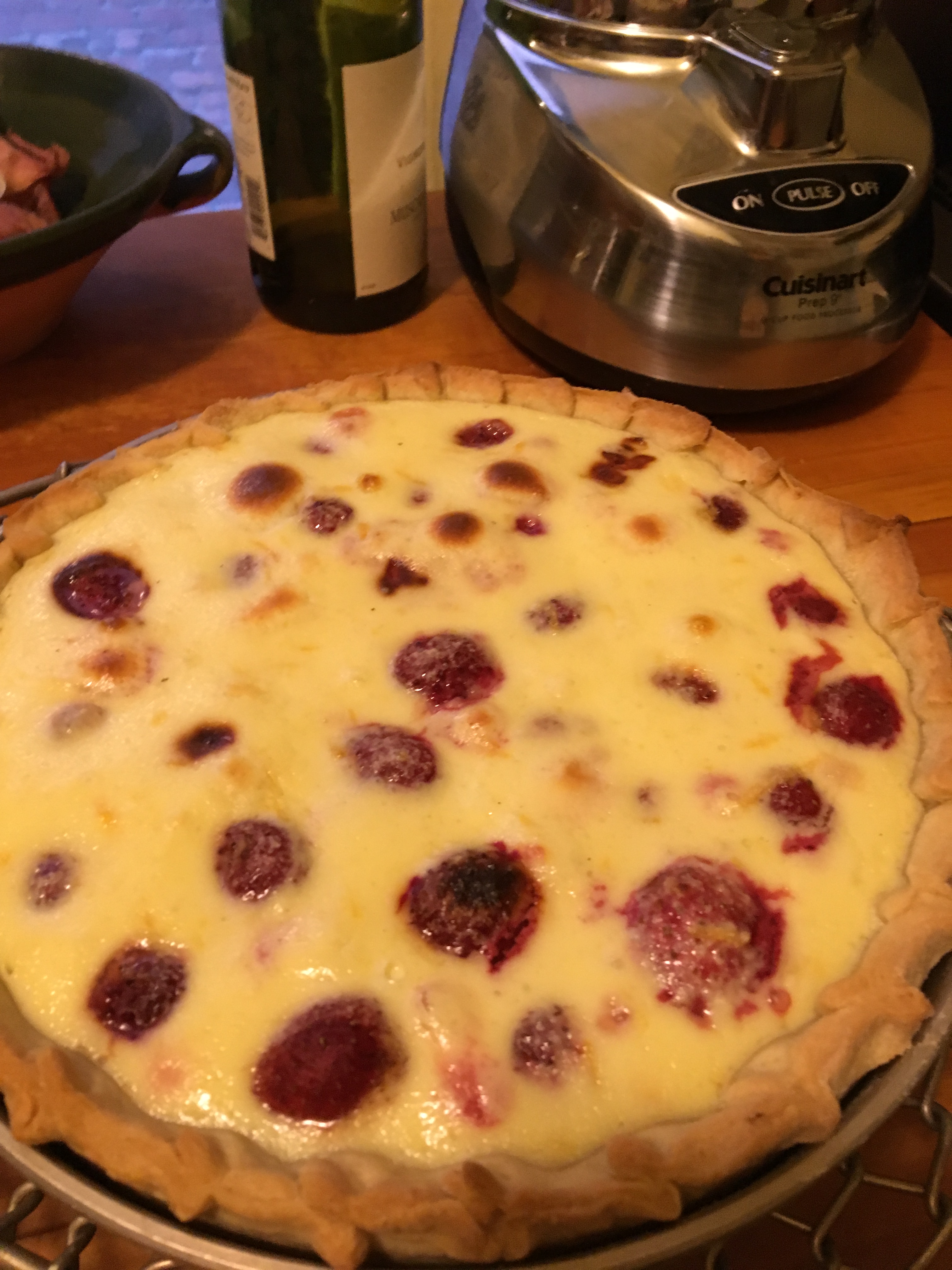
When I bought my pints of strawberries, I knew wanted to pair them with something light colored, like cream or cheese, so that their juices could mingle, creating another color. Dark pink was what I wanted. I got that when I came up with this strawberry and ricotta torta. I knew everything would run a little. Actually the color is more pinky orange, like an old debutante’s lipstick.

If you don’t want to go the pasta frolla (pastry dough) route, you can get a similar color seep, more quickly, by making a syrup for your strawberries and pouring that over ricotta. I love rosemary with strawberries. It sounds like a strange pairing, but taste it and you’ll see. And the colors are beautiful.

IMG_2864.JPG

Ricotta and Strawberry Torta with Anisette

This is for a 9-inch open-face torta. I used a straight-sided tart pan with a removable bottom, to get a rustic look. Nicer than fluted, I think.

For the pasta frolla

2½ cups regular flour, plus a little more for rolling
¼ teaspoon salt
¼ teaspoon baking powder
⅓ cup powdered sugar
The grated zest from 1 lemon
1½ sticks butter, cut into tiny cubes
2 large eggs, lightly whisked
About 2 tablespoons dry vermouth, maybe a little more

For the filling:

1 cup full-fat ricotta, well drained
⅓ cup powdered sugar
The grated zest from 1 lemon
1 tablespoon anisette or Sambuca
1 large egg
1 pint small spring strawberries, hulled but left whole (if you can find Tristar, they will be perfect)

To make the pasta frolla, put the flour, salt, baking powder, sugar, and lemon zest in the bowl of a food processor, and pulse a few times to blend everything. Add the butter, and give it a few good pulses, just until it is broken up into tiny bits. Add the eggs and vermouth, and pulse a few more times, until all the ingredients come together into a crumbly, moist mass. Tilt the dough out onto a floured work surface, and knead briefly, maybe with 3 or 4 strokes, until you’ve got a smooth ball. Wrap in plastic, and refrigerate for about an hour or so.

Take the dough out of the refrigerator about 15 minutes before you plan on rolling it.

Preheat the oven to 375 degrees.

Put all the ingredients for the filling, except for the strawberries, into a bowl, and mix well.

Grease the tart pan with a little butter. Roll out your dough, and drape it into the pan, leaving a little overhang. Place the strawberries, hulled sides down, in the pan (a nice circular pattern will look good). Pour on the filling. Now trim the edges of the dough, and go all around the pan making little folds.

Bake for about 35 minutes, or until the crust is golden and the insides look firm and a little puffed up. Let rest for about an hour before slicing.

Strawberries with Ricotta and Rosemary Syrup

Strawberries with rosemary whipped cream, or custard, or ice cream are all combinations I’ve heard of, mostly in the French kitchen A touch of rosemary’s deep resin flavor with sweet fruit makes so much culinary sense. I’ve Italianized my recipe by including ricotta, which cushions the strong herb nicely.

(Serves 2 to 3)

For the syrup:

3 tablespoons sugar
1 tablespoon wildflower honey (I used acacia)
3 big sprigs of rosemary, lightly crushed with the side of a knife to release their oil, plus a few small sprigs for garnish
A small piece of vanilla bean, split
A long peel of lemon skin
1½ cups of dry white wine

Plus:

1 pint small local strawberries, left whole (again, Tristar are a good), or larger ones cut in half or quarters
About 1½ cups high quality whole-milk ricotta
Freshly ground black pepper

Put all the ingredients for the syrup in a small sauce pan, and simmer over medium heat until large bubbles appear on the surface, about 5 minutes or so (the bubbles will let you know that it has properly thickened). Let sit for about 5 minutes on the turned-off burner to further blend the flavors. Now strain into a small bowl. Stick the bowl in the refrigerator until cool.

Before using the syrup, bring it to room temperature.

Place the strawberries in a bowl.  Pour the syrup over the top, and toss gently.

Divide up the ricotta into small bowls or big wine glasses. Spoon on the strawberries and then some of their syrup. Finish with a few grindings of black pepper, and garnish with rosemary sprigs.

The Wild Mint Patch

17rwtqftwg97tjpg

The Ancient Romans experimented with a number of wild herbs for birth control, with varying degrees of success.

Recipes below: Limoncello Collins with Lemon Bitters and Mint; Roasted Zucchini with Mozzarella and Mint Pesto; Penne with Zucchini, Anchovies, Mint, and Pecorino

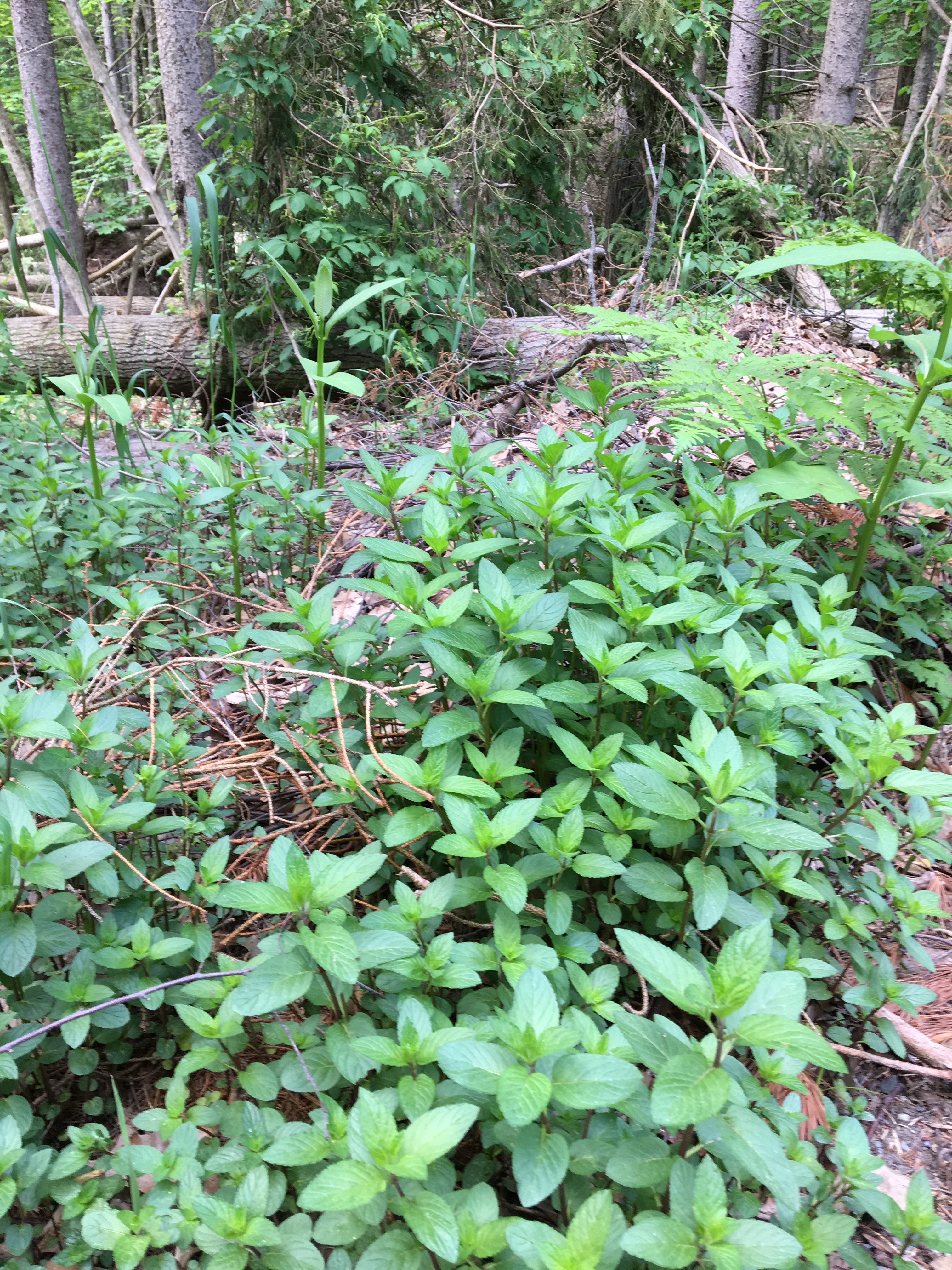
Down the road from my upstate house is an expanding patch of first-class wild mint growing amid downed trees, strawberries, and poison ivy. I first discovered it last spring. There are several spots of wild mint along the road, but this particular patch has the best flavor. It’s assertive, like all wild herbs, strongly spearmint but with a faint under hit of marjoram, giving it bitterness. Truly a beautiful thing.

A patch closer to my house, but only by about maybe ten yards, has an acrid flavor. I would never eat it. It seems to be biologically identical to the better one, but the difference in taste is dramatic. I didn’t understand that this could happen until I recently read Euell Gibbons’s Stalking the Healthful Herbs (a sequel to his more famous Stalking the Wild Asparagus). He says that the taste and aroma of any wild herb can differ dramatically depending on, well, I guess the word would be terroir. I was skeptical that the terroir from one end of my road to half way to the other end could vary so much. It’s the same slate-crammed soil in semi-shaded side-of-the-road situations. So what gives here? Maybe the plants nearby are different, and that affects the flavor? The inferior mint also seems to be growing on drier ground, maybe because it’s on a slightly hilly angle and the water flows away. I’m not sure I know what I’m talking about. Euell Gibbons would know, but unfortunately he’s now buried deep in his world of wild greens. I never imagined I’d be discussing Euell Gibbons, the Grape Nuts man from my childhood, in any context ever, but now he’s become a kind of hero to me. He was a great writer, funny too, and he really knew his wild plants. I’ll never make fun of Euell Gibbons again.

So this week I went about cooking with my good wild mint, adapting it to a few of my own classics. Mint with vegetables is a traditional Sicilian pairing, especially with first-of-the-season zucchini, which happens to be appearing right now. I made a simple pasta with zucchini and anchovies, something my mother used to cook, and it was elevated by the lovely but slightly in–your-face local spearmint. Then I made a pesto, which was also good, paired with zucchini as well.

I often get a caraway seed taste when I add spearmint to something hot, say the pasta with zucchini I tested for this post. Strange taste. I don’t get that when eating the leaves straight. I decided to do some research into this and was amazed to discover that mint and caraway both contain a molecule called carvone, which is what explains the odd flavor similarity, which must get released or at least amplified when heated. Has anyone else noticed this?

And about my cocktail. A few years back I was out for drinks with my Aunt Pat. She planned on ordering a regular old martini, but I knew she loved limoncello, so I suggested a martini made with that instead of vermouth. It was a hit (she may have had two). That drink is a little strong for me, so I came up with this fizzy version. I think the lemon bitters are essential, so maybe get yourself a bottle. They can really make so many drinks. I like Fee Brothers, because it doesn’t have a lot of Christmassy spices in it, like clove for instance, which many of the newer bitters contain. You really taste the lemon.

Just a final note on cooking with mint: All these recipes are created around spearmint. I hardly ever use peppermint in my dishes. It’s too sharp a taste to blend well with most ingredients. It makes a nice tea, though.

IMG_2832.JPG

The better mint patch.

Limoncello Collins with Lemon Bitters and Mint

(Serves 1)

1 tablespoon limoncello
A big shot of vodka
3 dashes lemon bitters
1 big mint sprig, plus 2 mint leaves, lightly chopped
Ice
2 ounces seltzer

Pour all the ingredients except the mint spring into a shaker, and give it a good shake. Pour it into a tall glass, and garnish with the mint sprig.

Roasted Zucchini with Mozzarella and Mint Pesto

(Serves 4)

4 or 5 small summer zucchini, cut, on an angle into ½-inch elongated rounds
Extra-virgin olive oil
Salt
Black pepper
A sprinking of Za’atar
A drizzle of lemon juice
1 big very fresh (ideally never refrigerated) mozzarella, sliced
A scattering of spearmint leaves

For the pesto:

About ½ cup spearmint leaves
2 sprigs marjoram, stemmed (in case you’d like to mimic the taste of my wild mint)
1 small summer garlic clove
A palmful of whole blanched almonds
Extra-virgin olive oil
Salt

To make the pesto, set up a medium-size pot of water, and bring it to a boil. Drop in the mint and marjoram leaves, and blanch them for about 30 seconds. Scoop the herbs from the water with a large strainer spoon, and place them in a colander. Run cool water over them to stop their cooking and preserve their green color. Squeeze out as much water as you can. This blanching will prevent oxidation so the pesto doesn’t darken quickly as it sits. Place the garlic and almonds in the bowl of a food processor, and pulse a few times until they’re roughly ground. Add the blanched herbs and enough olive oil to create a rich texture (about ⅓ cup). Season with a little salt, and pulse a few more times until everything is blended. Transfer the pesto to a small bowl. This is at its most vibrant when used right away, so I wouldn’t make it too much ahead.

Heat the oven to 425 degrees. Brush the zucchini rounds with olive oil on both sides, and lay them out on a sheet pan. Sprinkle them with salt and black pepper. Roast them until they’re golden and tender, about 15 minutes. Take them from the oven and sprinkle on a little za’atar (just a touch) and tiny bit of lemon juice.

Set out a large platter, and arrange the zucchini rounds and the mozzarella in a nice pattern. Season with a little salt and black pepper. Drizzle on some of the mint pesto, and garnish with mint leaves.

IMG_2825

Penne with Zucchini, Anchovies, Mint, and Pecorino

(Serves 2 generously)

Salt
Extra-virgin olive oil
4 or 5 tiny early summer zucchini, cut into not-too-thin coins
A sprinkle of sugar
1 small spring onion, chopped, including its tender green stem
2 small young garlic cloves, sliced
½ a fresh jalapeno, with its seeds, chopped
4 anchovy fillets, chopped
A splash of dry Marsala
½ pound penne
The grated zest from 1 small lemon
About 5 large sprigs of fresh spearmint, the leaves lightly chopped
A chunk of pecorino Toscano cheese

Set up a pot of pasta cooking water. Add salt, and get it boiling.

In the meantime, get out a big sauté pan, and set it over medium high heat. Drizzle in about 2 tablespoons of olive oil. When the oil is hot, add the zucchini and the sugar, and sauté, without moving the zucchini around too much, until it’s just starting to brown. Now add the scallion, garlic, anchovies, and jalapeno, and continue sautéing until the zucchini is just tender and the whole thing is fragrant. Add the Marsala, and let it bubble for a few seconds. Turn off the heat

Start cooking the penne. When it’s al dente, drain it, saving about ½ cup of the cooking water, and add it to the pan. Add the lemon zest, and sauté quickly over low heat to blend all the flavors.

Pour the pasta into a serving bowl. Add the mint, a drizzle of fresh olive oil, a little of the cooking water, and a few big gratings of the pecorino. Toss gently. Taste for salt (it might not need any, thanks to the anchovies). Serve hot or warm, bringing the rest of the cheese to the table.

Women with Fish

P1110743

I’m dressed for my club. It’s the monthly meeting, which is always black tie. This is my version of black tie. I wear the tie on my head, which is  perfectly acceptable. Is my fish on straight?

I take the minutes, and drink Montezuma gin cut with Hudson River water. That’s the official club drink. It comes in a fish shaped mug with the name of a deceased member engraved on it. My mug says Eddie Fisher. This club is not just for women.

bigBoccasilePasta-1

A pasta poster by Gino Boccasile, 1901-1952.

Recipe below: Thai Basil Fettuccine with Pine Nut Condimento

Flavoring fresh pasta with herbs seems to me a poetic task. Years ago, when I cooked at Le Madri, I learned to make fazzoletti (handkerchief pasta) with whole herbs pressed into them, usually sage or flat leaf parsley. I was so proud of myself for turning out those graceful things. We’d drape them over fish stew, and what an alluring dish. After I left the restaurant, I dreamed of the translucent pasta sheets. They were wonderful, but their herb taste wasn’t strong. I surmised that that was because the herbs weren’t chopped, so they couldn’t let off their essence properly. They were more of a visual presence than a flavor one. I’m now trying to create an herb pasta with a flavor presence. I think the key is the chop (rough, not minced) and also the choice of herbs. Thai basil immediately came to mind. It has a peppery perfume that barrels through even the hottest Thai chilies. And I’ve got a huge pot of it growing in my herb garden.

Silky, suave, delicate, romantic. Those are words that come to mind when I think of fresh egg pasta. But rolling pasta in my tiny Manhattan kitchen is such a pain in the ass that making it takes on a veil of frustration. For starters, I have no counter space. I have to use my dining room table. I have a problem with flour messes, and pasta making throws the stuff all over the place. It feels out of control, not the Zen experience I always imagine. And the cats attacking everything.

IMG_2747.JPG

However, I will report that after finally abandoning the traditional well method, I am now much happier making pasta. I resisted the change for years, out of duty to my ancient heritage, but now I mix the dough in a food processor and roll and cut it with my KitchenAid pasta attachment. Not particularly romantic, but it lets me ease into the process without getting all sweaty and miserable. In the right setting, it can now even be soothing.

Note: One thing I always have to remind myself of when I make pasta in a food processor is that I need to add less flour than I’d use for the traditional well method, since the food processor pulls it all in (no crumbly stuff remains on the side to discard). I’ve adjusted my usual recipe taking that into consideration.

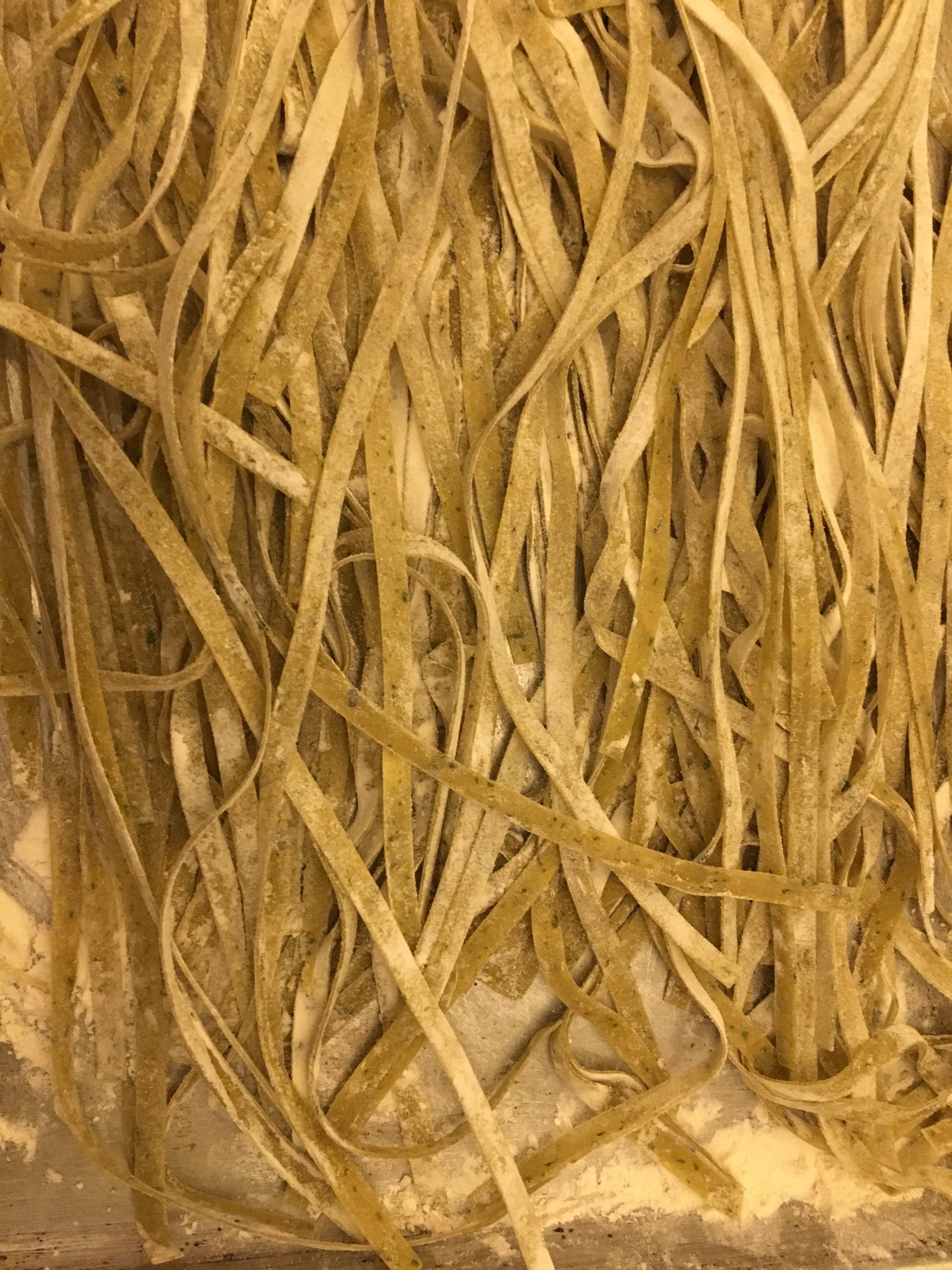
IMG_2755.JPG

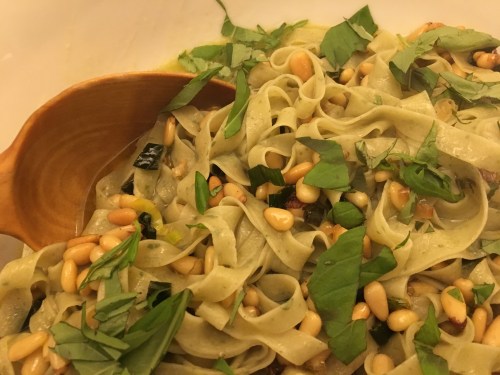
Thai Basil Fettuccine with Pine Nut Condimento

I don’t generally like using word deconstructed about food, but here it happens to be the perfect adjective. I’ve taken all the elements of a classic Ligurian pesto and pulled them apart, using some for the pasta and some for the sauce.

(Makes about 1 pound of pasta, enough for 4 generous first-course servings)

For the food processor pasta:

2½ cups all-purpose flour, plus extra for dusting
A big pinch of salt
A few grindings of black pepper
4 large eggs, lightly beaten
½ cup lightly chopped Thai basil

For the condimento:

Extra-virgin olive oil
Butter
Spring garlic
½ cup pine nuts
Salt
Black pepper
A big handful of very lightly chopped Thai basil
A chunk of grana Padano cheese

Put the flour, salt, and a little black pepper in the food processor bowl, and pulse a few times to blend everything. Add the eggs and the basil, and pulse until it all just forms a ball. If it’s not coming together, add a drizzle of water and pulse again.

Dump the pasta ball out onto a work surface, and knead it until the dough is smooth, about 5 minutes. It should be light green, flecked with green bits. I try not to use too much flour on the work surface, not wanting to add any more to the dough, as that can make it tough, but if your dough is sticky, you’ll definitely need a bit.

Cover the dough in plastic wrap, and let it rest, unrefrigerated, for about an hour. That will give the gluten time to relax, so it’s easier to roll out. Otherwise the dough can be too tight and fight back a little.

Roll it into sheets. I use the pasta attachment of my KitchenAid mixer, which works great, but use any method you like.

Now, and this I find to be a most important step, let your sheets dry for at least 10 minutes before cutting them into fettuccine or whatever ever you’re going to make of them. You want the sheets to be flexible but slightly leathery, not sticky. This can take, in my experience, anywhere up to an hour, depending on how wet your dough was to begin with and how much humidity you’ve got in the room. Drying is the only way I’ve been able to prevent pasta strands from sticking together, which is a most infuriating problem. This really takes care of it.

Then you can run the pasta through a fettuccine attachment or cut it by hand. Give everything a dusting of flour, and then lay it all out on sheet pans or a counter. It will be fine for several hours that way.

Put up a pot of pasta cooking water, add salt, and bring it to a boil.

In a large skillet, heat about 2 tablespoons of olive oil and 2 of butter. Get it warm over medium heat. Add the pine nuts, and let them color a bit. Add the garlic, and sauté a minute, just to release its flavor.

Drop in the fettuccine. It should take only a minute or so. When it is tender, drain it, saving about ½ cup of the cooking water.

Add the fettuccine to the skillet, and toss it quickly over low heat, seasoning it with salt and pepper. Pour it into a large serving bowl. Add a little of the cooking water to loosen the sauce. Add the basil and about 2 tablespoons of grana Padano. Toss gently, and serve right away.

Early Herbs

bronzino-agnolo_noli-me-tangere

Mary Magdalene mistakes Jesus for the gardener, painted by Agnolo Bronzino in 1561.

Recipes below: String Beans and Potatoes with Wild Arugula and Almond Pesto; Cucumber Salad with Burnet and Breakfast Radishes

I plant my herb garden in stages, to avoid gardening burnout. I used to love gardening burnout. I’d get so elatedly wasted. But as I’ve gotten older, I find it a little scary. Ticks, knee pain, sunstroke. I’ve had Lyme twice. But still I need my herbs, so I press on.

I do pot gardening, so, every spring it all starts from scratch. The reason for this is that the soil in upstate New York is about 95 percent rock. Backbreaking work even just dropping in seeds. One of these days I’ll construct a big raised bed, I guess. But for now I’ve got a good collection of big terra cotta pots. They smell wonderful when wet, and I think they’re beautiful.

My first plantings this year were from the greatest hits parade—thyme, rosemary, oregano, sage. It felt good to get those in, giving them time to grow large (I put in a lot of thyme, especially). Then I went ahead and planted a huge pot of wild arugula seeds. With luck they’ll sprout in a few weeks. I got the seeds from Seeds from Italy, an excellent source for Sicilian eggplant, cicoria rosa, Calabrian chilies, mentuccia, and more. Their arugula is the real deal, cultivated from wild and not like the big blousy bunches you find in the supermarkets or the prepackaged baby stuff. If it ever comes up it’ll be forte. My father grew a similar spiky, super bitter arugula in our backyard for 30 years. It was a gift from our neighbor who smuggled it back from Sorrento in the early sixties, and it was so intense that most of my friends wouldn’t touch my mother’s salads. Poison in a bowl, but, in my opinion, wonderful poison. Unfortunately, I haven’t had much luck growing my own. Maybe Long Island, where I grew up, is closer to Mediterranean than the Hudson Valley. I’m trying again. I’ll let you know how it goes.

I’ve also planted salad burnet, which I’ve been curious about for some time but hadn’t previously seen at any of my usual herb buying haunts. It’s originally a Mediterranean plant, a member of the rose family. Evidently it grows wild in upstate New York, but I haven’t found any (and I’ve been looking). Luckily this year I spotted small pots of it at Northern Dutchess Botanical Gardens, a big place in Milan (pronounced MY-lan), New York, with an extensive selection including some oddball stuff. If you’re ever up near Rhinebeck, check them out. My burnet seems to be taking well to its big pot. At the moment, it tastes faintly of sweet cucumber, but I’ve read that in really hot weather it will take on a watermelon taste. Can’t wait for that, if actually true.

This week I’ll move on to the leafier herbs.

salad burnet with pixie leaves unfolding.jpeg

Salad burnet.

String Beans and Potatoes with Wild Arugula and Almond Pesto

I got the idea for this from the traditional Genoese pasta with pesto, which also often contains little diced potatoes and string beans. I just left out the pasta and changed up the pesto.

(Serves 4)

About a cup of small, spikey arugula
1 small clove of spring garlic, smashed
⅓ cup very fresh blanched almonds
Extra-virgin olive oil (about ¼ cup)
¼ cup grated grana Padano cheese
Sea salt
½ pound string beans, trimmed and cut in half if really long
1 pound of really tiny Yukon Gold potatoes, left whole (if you can only find bigger ones, cut them in half)

Put up a small pot of water, and bring it to a boil. Add the arugula, and blanch it for about 30 seconds. Drain it, and then plunge it into a bowl of cold water to stop the cooking. This will set its deep green color. Now drain it well, and squeeze it out.

Put the garlic and the almonds in a food processor, and pulse them until well ground. Add the arugula and about ¼ cup of good olive oil. Pulse until blended. Add the grana Padano and a little salt, and pulse again, until the mix is quite smooth. Add a little more olive oil if it seems dry. The pesto is best made shortly before you want to serve it.

Put up a medium-size pot of water, add a little salt, and bring it to a boil. Drop in the string beans, and blanch until crisp-tender, about 2 minutes. Scoop them from the water with a big strainer spoon, and run them under cold water to bring up their green color.

Add the potatoes to the string bean cooking water, and boil until just tender.  Drain them, saving about ½ cup of the cooking water.

Put the string beans and the warm potatoes into a nice looking serving bowl. Add the pesto, and toss, adding enough cooking water to make a creamy coating (probably only a tablespoon or so). Serve right away.

Cucumber Salad with Burnet and Breakfast Radishes

(Serves 4)

1½ English cucumbers (the Persian variety is also good for this, if you can find it), stripe-peeled and cut into thin rounds
3 French breakfast radishes, sliced on an angle
1 red scallion, thinly sliced
2 teaspoons rice wine vinegar
1 teaspoon light soy sauce
1½ tablespoons extra-virgin olive oil
Salt
Black pepper
A pinch of sugar
A pinch of piment d’espelette
A handful of salad burnet leaves, stemmed (A few big sprigs of tarragon are also nice here instead, even though their flavor is completely different, or you can use both, a good mix)

Combine the cucumber, radishes, and scallions in a wide serving bowl. Mix the rice wine vinegar, soy, and olive oil together, seasoning with salt, black pepper, a pinch of sugar, and a little espelette. Pour the mixture over the salad, and toss. Scatter on the burnet leaves, and toss gently. Serve now or a little later.