Recipe below: Impanata di Pesce Spada
There was a time when the teenage me and my slightly younger sister were in Rome with my mother. A strange trip for many reasons, but mainly because we went without my father, which was highly unusual. I’m not sure how it came about, but there we were having breakfast at the Bernini Bristol, our clean and ugly hotel, when I made the mistake of ordering soft-boiled eggs. Evidently Italians didn’t eat eggs for breakfast, ever. It was offered on the tourist menu, but it mortified my mother to the point where, looking nervously around the dining room, she acted like she didn’t even know me. She was humiliated, steaming mad. It was hilarious, on some level, but also upsetting. Was she going to bitch me out for the entire trip? I also learned at that time: no cappuccino after 11 a.m. And then there was one other important matter, a point I had had drilled into my head from childhood but that was underlined again on our trip: no grated cheese on fish. That was serious, a sin in most parts of Italy. But not, as I’ve since discovered, in Sicily.
When I was researching my book The Flavors of Southern Italy, fish and cheese dishes kept popping up around me—almost all of them Sicilian. They were all highly interesting. Mozzarella or Ragusano with anchovies (a great pairing), swordfish involtini with caciocavallo, sarde beccafico (sardines stuffed with raisins, pine nuts, breadcrumbs, and often a mild pecorino). When I first tasted a baked pasta con le sarde in Palermo, it had a little cheese mixed in, holding it together. I found a recipe for gamberi con la conza in the excellent Sicily book put out by the Silver Spoon Kitchen, where breadcrumbs, almonds, and Parmigiano are sprinkled over baked shrimp. Sounds good, a little like Greece’s shrimp Santorini, although that uses feta. Pane cunzato, a warm panino with anchovies, primo sale, oregano, and tomatoes, is another Sicilian dish that blends cheese and fish deliciously. Here’s my recipe for it.
And then there’s impanata di pesce spada, an elaborate, enclosed torta that contains pine nuts, raisins, capers, caciocavallo, orange, and swordfish. It’s a specialty of Messina. When I came across that masterpiece, I knew I needed to include it in my book. It’s still one of my favorite Sicilian creations. There’s a tuna version from Agrigento that also contains cheese, usually primo sale. Sicilians understand that sometimes a little cheese, usually a fairly mild one, can up the flavor of seafood, not mask it. I wish the rest of the country could lighten up.
Here I’ve updated my recipe for that Sicilian fish torta, streamlining it a bit so it’s easier to put together.
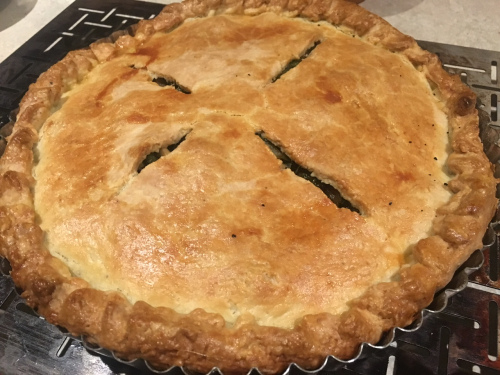
Impanata di Pesce Spada
(Serves 8 as an antipasto or a first course)
You’ll want a standard 9-inch pie pan for this torta.
For the crust:
2½ cups all-purpose flour
The grated zest of 1 large orange
2 tablespoons of sugar
A big pinch of salt
1½ sticks cold, unsalted butter, cut into little bits, plus a little extra for buttering the pan
About 4 tablespoons cold white wine
For the filling:
Extra-virgin olive oil
1 small onion, finely diced
1 tender inner celery stalk, with the leaves, finely diced
A big handful of pine nuts
1 15-ounce can plum tomatoes, chopped and drained
Salt
Black pepper
A big pinch of ground cinnamon
A handful of golden raisins, soaked in about ¼ cup dry Marsala
A palmful of salt packed capers, soaked and drained
1 pound swordfish, skinned and cut into ½ cubes
A handful of flat-leaf parsley, lightly chopped
A few sprigs of wild fennel or dill
1 cup grated caciocavallo cheese
1 egg lightly beaten, plus an egg yolk whisked with a little water to brush over the top
To make the crust: In a food processor, combine the flour, orange zest, salt, and sugar. Pulse a few times to blend. Add the butter, and pulse once or twice until the butter is about the size of lentils. Add the Marsala, and pulse a few more times to get a crumbly, moist-looking texture. Don’t let it work itself into a ball. Dump the dough out onto a work surface, and squeeze it into a ball. Knead briefly a few times to make sure it holds together. Cut the dough into two pieces, one a little larger than the other, wrap them in plastic, and refrigerate them for about an hour.
Preheat the oven to 375 degrees.
Take the dough from the refrigerator so it can warm up for a bit for easier rolling.
To make the filling: In a large skillet, heat about 2 tablespoons of olive oil over medium flame. Add the onion and celery and celery leaves, and sauté until soft and fragrant, about 4 minutes. Add the pine nuts, and sauté until lightly golden, about a minute or so longer. Add the tomatoes, and season with salt, black pepper, and a little cinnamon. Let cook for about 5 minutes. Add the raisins, with their Marsala, and the capers. Simmer another minute or so. The sauce should be fairly dry. Let it cool for a few minutes, and then stir in the egg.
Butter your pie pan.
Flour a work surface, and roll out each ball of dough into a round, making the large piece about 11 inches across and the smaller one about 9 inches. Fit the larger piece into the pie pan, letting its edges hang over the rim. Spread the swordfish out on top of the dough. Season it with a little salt and black pepper, and give it a drizzle of olive oil. Scatter on the parsley and the wild fennel or dill, and then the grated caciocavallo. Pour on the tomato sauce, spreading it evenly. Place the other dough round on top, and pull up the edges of the bottom dough to form a border, folding and pinching together the dough all around. Make a few slits in the dough to let air escape, and brush the entire top with the egg wash.
Bake until the torta is nicely browned, about 50 minutes. Let it sit for about ½ hour before serving. That will make it easier to cut.