Feeds:
Posts
Comments
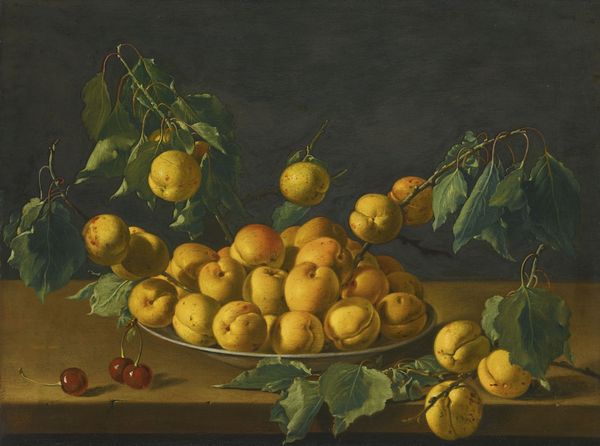
Still Life with Apricots, Luis Melendez, Naples, 1716–1780.

Recipe below: Apricot Tart with Almonds and Thyme

Growing up in New York I’ve almost never had a decent apricot. Seems we don’t know how to grow them here. Even in season at farmers’ markets they’re usually sour or, even worse, mealy and tasteless. I asked the people at Migliorelli Farm in Tivoli about this and was told that apricots are “temperamental” and have a “short period of perfect ripeness.” My brother, who lives north of L.A., says the local apricots out there are much better than we get. I was upset to hear that.

Cooking helps immensely. The ones I found recently were pretty sour but also juicy and  just so pretty I had to buy them. The ones Migliorelli grows are a deep orange with splotches of pinky red. They smelled good, sort of like apricots should, so I thought heat and sugar would wake them up. And they did.

This tart was inspired by a Patricia Wells recipe I learned about many years ago. The technique is so easy compared with pâte brisée–based tarts. What you do is basically make a cookie dough and press it into a tart pan. You don’t even have to roll it out. And forget about the annoying blind-baking bean-and-aluminum-foil procedure. You just stick it in the oven to firm it up a bit before filling it. Cut the apricots in half (small plums also work well), stick them cut side up in the pan, and pour a cream and egg mix over the top. I flavored my custard with almonds and a drizzle of orzata syrup, which I love and which is less obnoxious than that crappy, ultra strong almond extract, the ruin of so many Italian American pastry shops.

The mix of apricots and almonds can’t be beat, and, as I’ve just discovered, adding fresh thyme brings the whole thing together with a weird hit of savoriness.

You’ll want a 9-inch tart pan with a removable bottom.

Apricot Tart with Almonds and Thyme

For the crust:

1 stick unsalted butter, melted and then cooled to room temperature, plus a little extra butter to grease the pan
⅓ cup sugar
1 tablespoon orzata syrup
½ teaspoon vanilla extract
The grated zest from 1 small lemon
1½ cups regular flour
A pinch of salt
1 tablespoon finely ground almonds

For the custard:

1 heaping tablespoon crème fraîche
½ cup heavy cream
1 large egg
1 teaspoon regular flour
1 tablespoon orzata syrup
½ teaspoon vanilla extract
2 tablespoons runny wildflower honey
About 6 sprigs thyme, the leaves lightly chopped, plus of few nice looking sprigs for garnish

Plus:

About 1½ pounds ripe local apricots, pitted and halved (a bit sour is better than mealy), cut in half and pitted

Preheat the oven to 375 degrees.

Put all the ingredients for the crust except for the ground almonds in a bowl, and mix them together until you have a crumbly, moist mass. Coat the tart pan with a little butter, and then dump the crust into the center of the pan, pressing it all around until you have a nice, relatively even crust all around. Build the sides up a touch to allow for shrinkage. Poke the bottom lightly with a fork in several places.

Stick the tart pan in the oven until the crust is very lightly golden at the edges and puffs a bit in the center, about 12 minutes or so.

Take the tart pan out of the oven and sprinkle the almonds more or less evenly over the floor of the crust.

Put all the ingredients for the custard in a bowl, and whisk until smooth.

Arrange the apricots, cut side up, in the tart pan. Pour the custard mix over them, being careful not to get any over the rim.

Bake until the crust is golden and the custard looks set, about 35 minutes. Garnish with the thyme sprigs. Serve warm or at room temperature.
Pink and Sage Green, by Jennifer Hornyak.

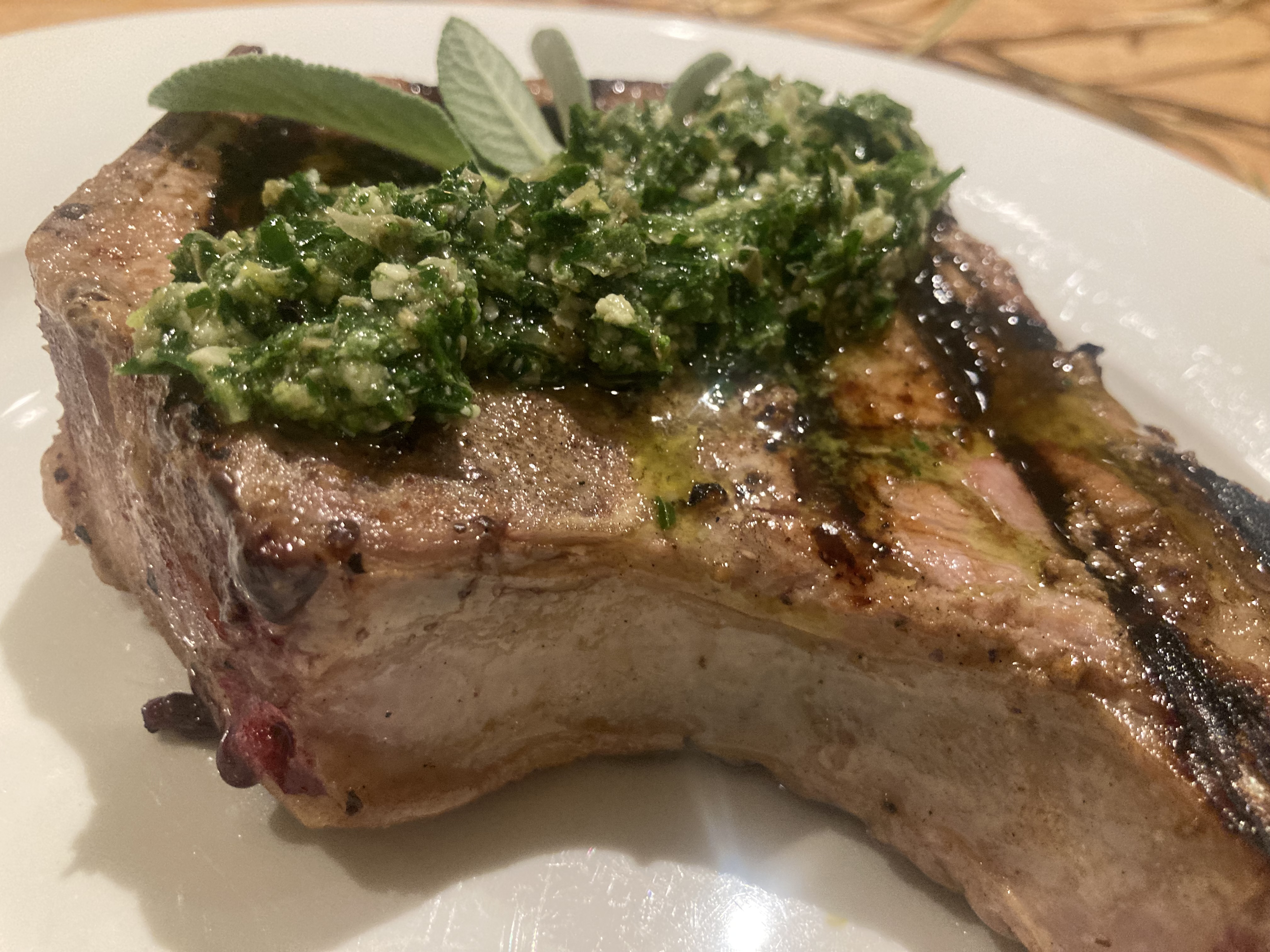
Recipe below: Grilled Pork Chops with Caper Sage Salsa

I love a grilled pork chop. When it’s properly done the fat gets all crispy and there’s a slight pink at the bone. My nostalgia for grilled pork grows partly from childhood memories of my father’s boozy summer grill nights, when everything and everybody was amply toasted and things were not often properly done. It’s a mixed bag of recall, but it gives me mostly a good feeling.

Dick would start his grill nights with a “mart,” meaning a good-size glass of vodka on the rocks with a twist. He’d have a few of those and then move on to the big bottle of mouth-puckering Chianti. The pork went on a fire that never was given a chance to die down to suitable-for-cooking orange coal. Flames shot up, and the meat almost always emerged burnt on the outside and still cold in the middle. My mother would scream that everything was “completely blackened. Disgusting. And raw.” There was a lingering fear of trichinosis back in the late sixties and early seventies, so the “raw” question stirred panic in Italian American moms (maybe in all moms, but it seems the Italian ones were always especially prone to medical scares). We ate all the blackened raw pork anyway and sort of loved it. The few pork chops that were actually overcooked in addition to being blackened (no trichinosis there), were coveted. I actually preferred the rare ones. They were more like steak. I also thought I knew that trichinosis was a thing of the past. All the pork chops, in whatever stage, got topped with fire-roasted onions and peppers, and that was a good touch. I suppose our grill nights might possibly have been just as unruly without the booze, but I guess we’ll never know.

I still love grilled pork chops, especially soaked in a simple marinade. Here I prepare a marinade with a hint of the sea. When I “man” the grill now, I try to not get too bombed and actually pay attention to what I’m doing, which in a way seems like less fun than when my father was at the grill, but I guess it’s a tradeoff. I like my pork cooked juicy, with that little touch of pink. I try for that and usually more or less succeed.

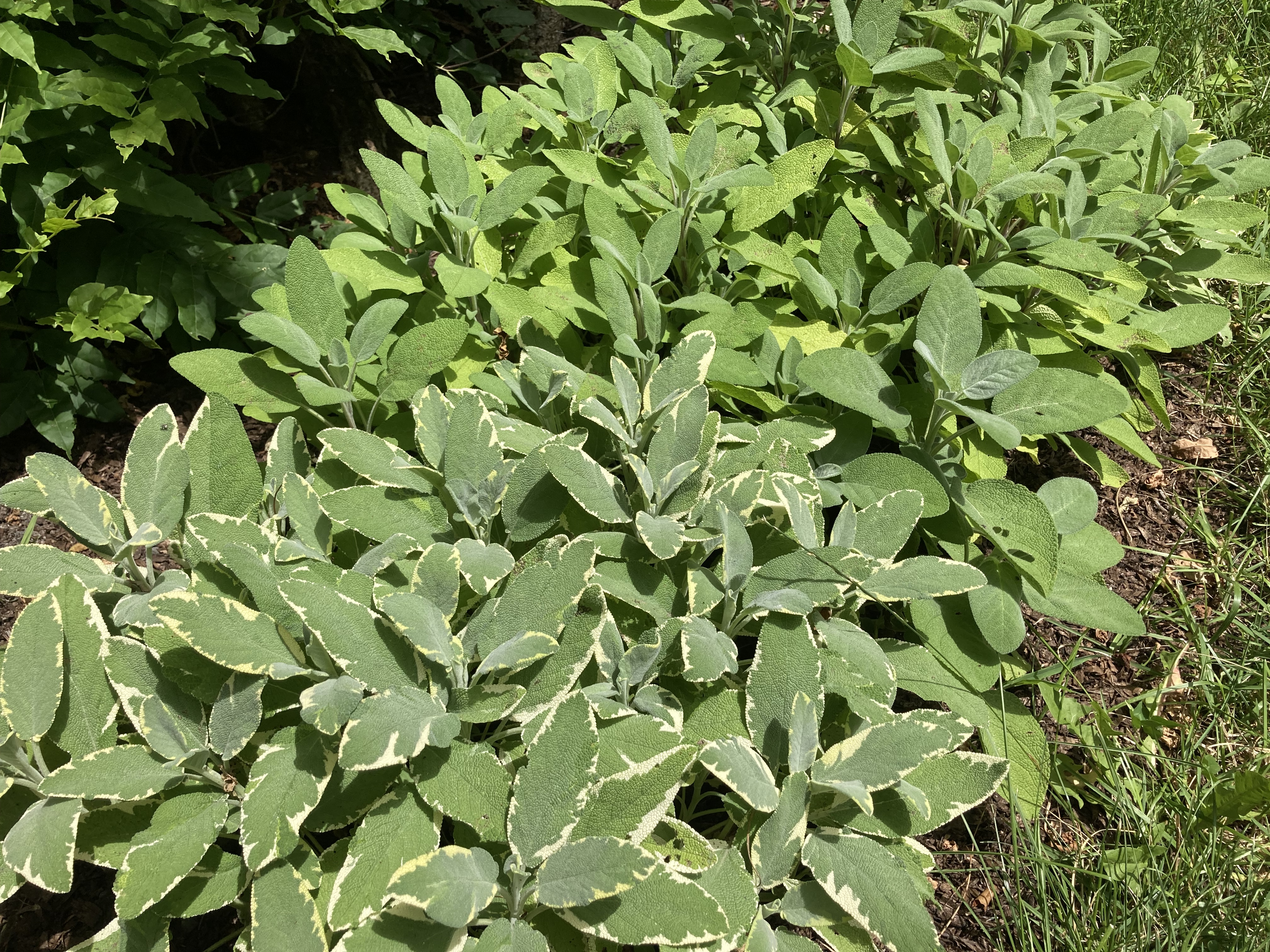
Sage is a strange-smelling herb. I like it, but sometimes it stumps me. I search for new ways to use it, especially since I’ve got so much of it in a patch that comes back bigger every year. This sage and caper salsa was a surprise. I was expecting it to be kind of harsh, but the good olive oil, the capers, and the pine nuts seemed to bring out the sweetness in the herb. Sage is lovely on pork, classic, but also, I have discovered, on whole grilled trout. And try it on thick slices of roasted pumpkin or butternut squash, as the summer moves toward its end.

Happy summer grilling to you.

Grilled Pork Chops with Caper Sage Salsa

4 large bone-in pork loin chops

For the marinade:

2 teaspoons Thai fish sauce or Italian colatura
2 tablespoons extra-virgin olive oil
2 summer garlic cloves, crushed
Black pepper
1 tablespoon sweet vermouth
1 tablespoon rice wine vinegar
A little salt

For the salsa (makes about 1 ½ cups, probably a bit more than you’ll need, but it’ll keep for a day or two without losing too much flavor):

¾ cup fresh sage leaves
½ cup flat-leaf parsley leaves
½ cup Sicilian capers, soaked for about 20 minutes, rinsed, and drained
½ cup really good extra-virgin olive oil (I used Olio Verde, a Sicilian brand)
A palmful of pine nuts (about 1½ tablespoons)
1 small fresh, summer garlic clove, lightly crushed
The grated zest from 1 small lemon, plus a squeeze of its juice
Salt
Black pepper

Dry off the pork chops and lay them out in a shallow pan. Mix all the ingredients for the marinade together and pour it over the meat, turning them over a few times so everything is nicely distributed. Let marinate in the refrigerator for about 2 hours.

To make the salsa: Set up a small pot of water and bring it to a boil. Add the sage and parsley leaves. Blanch them for a minute, and then pour them into a colander and let cold water run over them to set their good green color. Squeeze out as much water as possible.

Put the blanched herbs and all the other salsa ingredients in a food processor, and pulse about 6 times or so, until the mix has a loose but rough green pesto-like consistency. Don’t let it pulse so much that you wind up with a smooth purée. Scrape the salsa out into a small bowl.

Take the pork chops out of the refrigerator about a half hour before you want to cook them. While they’re coming to room temperature, set up your charcoal grill and let it burn down to orange coals (not my father’s impatient flame fire).

Rub oil on the grill surface. Take the pork chops from the marinade, letting excess marinade drip off, and place them on the grill. If it starts to flame up, lower its cover. Let the meat cook until you’ve got good grill marks and the chops move easily when you give them a nudge, about 4 minutes. Flip them, and grill their other side. If your fire is really hot you might want to move them slightly off to the side so they can cook without browning too much. Another 4 minutes is about right for cooked but with a touch of pink at the bone, but that really depends on your fire and the thickness of the meat, so it’s a personal judgment call.

When your chops are done, give them a final sprinkling of salt, and plate them. Top each serving with a big dollop of the salsa, and serve right away.

If find that these chops go really well with ratatouille and grilled country bread rubbed with summer garlic and brushed with good olive oil.

These peaceful fish and lady are happy to be underwater, where they hear a lot of rumbling. This painting is by Sergio Fiorentino. This is a portrait of me.

Still Life with Peaches, by Paul Gaugin.

Recipe below: Crostata with Summer Peaches and Rosemary

Fruit and herbs. I’m always looking for good new combinations of fruit with fresh herbs. And in my culinary travels this summer I’ve discovered I love rosemary with stone fruit. Not too much rosemary; just a small amount will perfume the fruit with a gentle evergreen aroma. Too much and you might wind up with harsh medicine. So follow me here, and I’ll show you how nice it can be.

I first tried this flavor combo last week with small yellow plums, called lemon plums, that I found at the Union Square market, making a rosemary-scented syrup that I poured hot over the stoned fruit, letting it soak in. It was piney and sweet. Then I moved on to peaches, which had just become available at Migliorelli, my farm stand in Rhinebeck. They had both yellow and white peaches. I chose the white ones for this, but I left their mottled red skins on for color and richness of taste. Before I went about putting this crostata together, I sliced a peach, placed a few rosemary needles on it, and ate it. The taste was a mix of sweet, pine, lemon, and, I thought, also a hint of black pepper. That was what I was hoping for.

Heat both mellows and deepens flavor, depending on what you’re working with. For instance here the peaches became less acidic, more just melting sweet with a hit of citrus. The rosemary lost its harsh edge, but also spread its flavor throughout the crostata in a softened way. All good.

When apricots show up at my markets, in the next week or so, I’m going to try using rosemary on them, maybe in a sorbetto. I’m not sure, but stay tuned.

And happy summer herb cooking at all my friends.

Crostata with Summer Peaches and Rosemary

For the pastry:

2 1/4 cups regular flour
1 tablespoon sugar, plus a little more for sprinkling on the crust
A pinch of salt
2 small sprigs rosemary, the leaves well chopped (about 1 teaspoon chopped)
1½ sticks cold unsalted butter, cut into small dice, plus a little more for greasing the sheet pan
¼ cup cold white wine
1 egg yolk, for brushing on the crust

For the filling:

4 large or 5 medium-size summer peaches, unpeeled and sliced
¼ cup sugar
2 small sprigs rosemary, the leaves well chopped (about 1 teaspoon chopped)
A tiny pinch of salt
A pinch of ground allspice
A tiny splash of Kirsch or grappa (about 1 teaspoon)
A big squeeze of fresh lemon juice

To make the pastry, put the flour in a food processor. Add the sugar, salt, and rosemary, and give it a few pulses to blend everything. Add the butter, and give it a few quick pulses to break up the butter into tiny bits. Add the white wine, and pulse a few more times, just until you have a crumbly, moist mass. Don’t pulse so much that it works into a ball.

Turn the dough out onto a work surface, and press it into a ball. Cover it with plastic, and stick it in the refrigerator for at least 2 hours (you can also leave it overnight, if you like).

About a half hour before you plan on cooking the crostata, put the sliced peaches in a large bowl. Add the sugar, rosemary, salt, and allspice. Add the Kirsch and the lemon juice, and give everything a toss.

Preheat the oven to 400 degrees, and rub a large sheet pan with butter.

Take the pastry from the refrigerator, and let it warm up for about 15 minutes.

Flour a work surface, and roll the pastry out into a 12- or 13-inch round, trimming the edges to make it even. Place it on a large, standard-size sheet pan, which is 13 inches wide, so it should fit perfectly.

Lift the peaches out of the bowl with a slotted spoon so most of the liquid gets left behind (you don’t want the crostata to get too soggy), and place them in the center of the pastry, pressing them down a bit so the fruit comes to about 1½ inches from the rim. Pull up the edge of the pastry, and fold it back toward the center, pressing it all around so it makes a pretty tight package (see my photo above for what it should look like).

Put the egg yolk in a glass with a splash of water, and whisk it around. Brush the crust with the egg wash, and then sprinkle it with a little sugar.

Bake the crostata until it’s golden and fragrant, about 30 to 35 minutes. Then let it rest for about ½ hour before cutting.

I like to serve it with sweetened ricotta or crème fraîche or whipped cream—or with nothing. A glass of Beaujolais is a wonderful accompaniment, reminding me of the bowls of peaches in red wine my father used to bring out for summer cookouts.

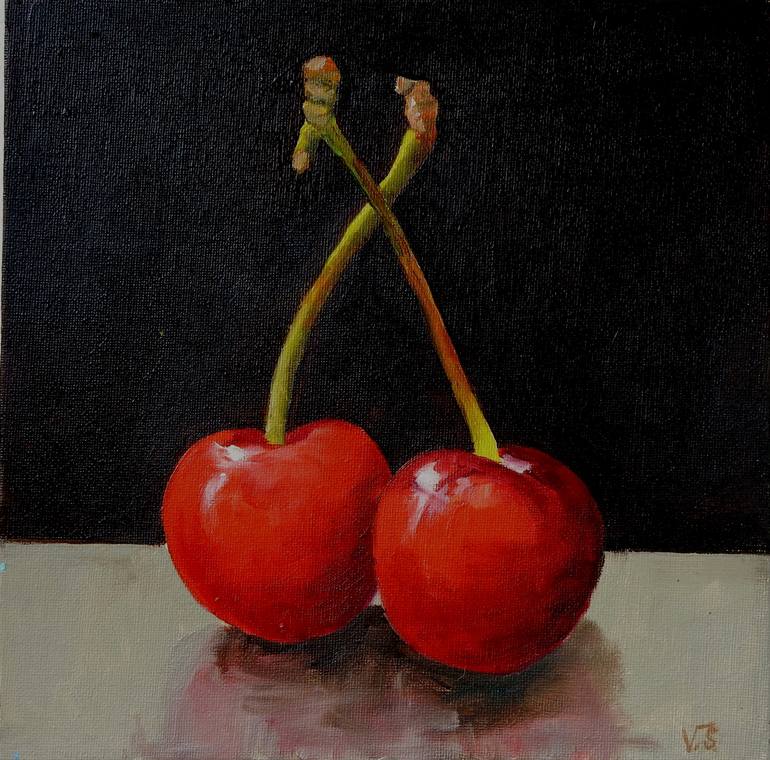
First Cherries of the Season, by Vita Schager.

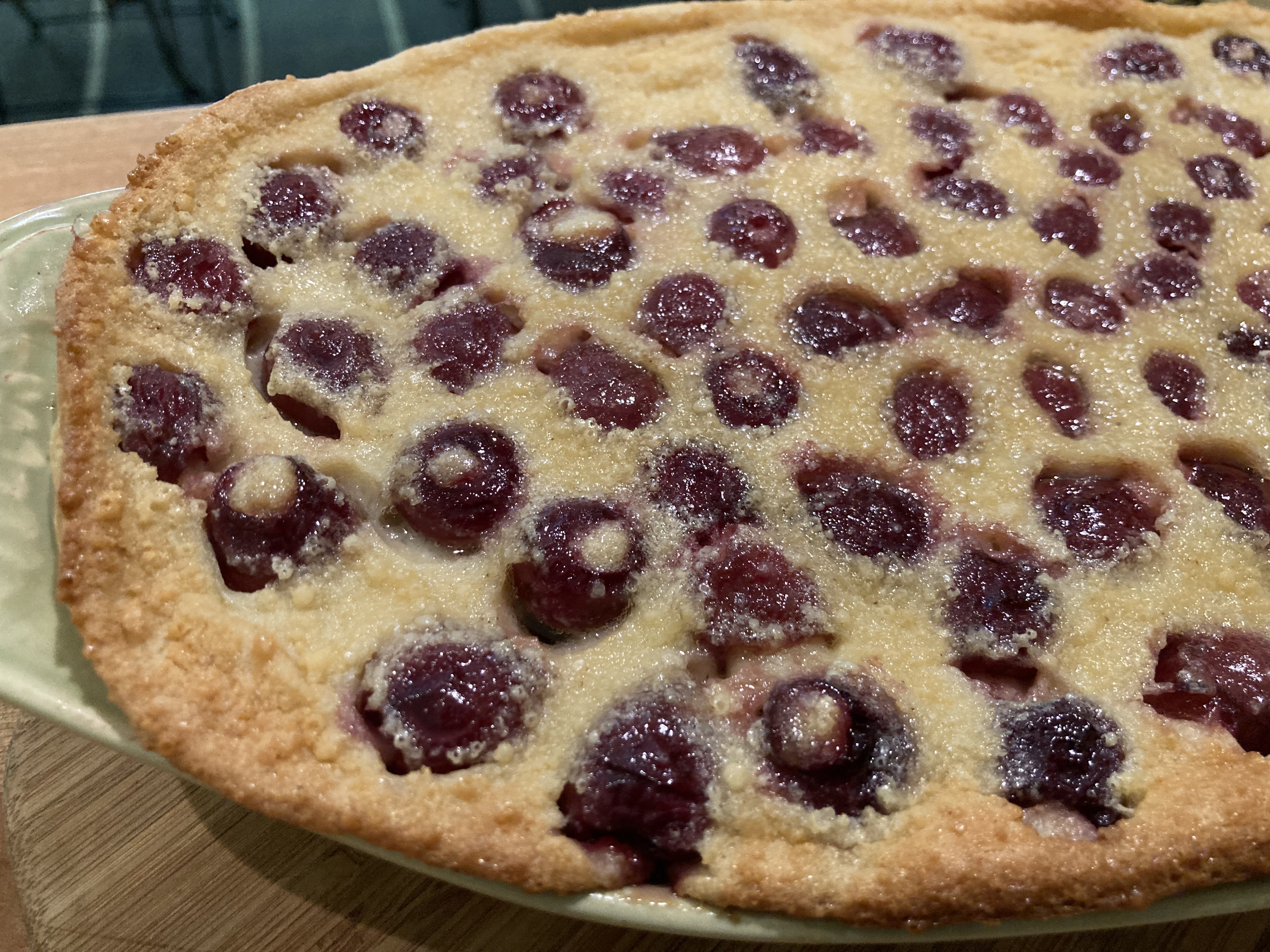
Recipe below: Cherry Clafoutis with Bay and Lemon Thyme

Cherry clafoutis as traditionally made in the Limousin region of France uses whole, unpitted cherries.  I never wanted to serve it that way, for fear of choking someone, especially when my swallowing-compromised mother was still alive. So every summer I’d consider making a cherry clafoutis and ultimately decide to forget it, even though the thought drove me crazy with culinary romance. Also I wanted to pit the cherries, but I stupidly couldn’t figure out how. Why it took me so long to break down and buy a cherry pitter I’m not sure, but I think I had it in my head that there was no way a simple little gadget that cost nine dollars could get the pit out while leaving the cherry more or less whole. I was dead wrong. The things work. Buy one. I only use it in June and July, when cherries are in season, but it has contributed to my life in a big way.

After I got through with the pitting, which took all of five minutes, I needed to think about herbs, as I wanted to add some sort of herb flavoring to the batter. The usual additions are kirsch and vanilla, which I love and did add, but since dairy, especially cream, accepts flavors so readily, I decided to also add fresh bay leaves and sprigs of lemon thyme to the standard milk-and-cream mix and give that a quick heat-and-steep. You’ll want only fresh bay leaves here. Dried would impart a musty flavor, which would really not be good at all. If you don’t have lemon thyme, regular thyme and a piece of lemon peel will work beautifully. Lemon verbena is also a nice way to go.

I love the bay leaf and lemon thyme combination so much, I’m already thinking about other ways to use it, both sweet and savory. Stay tuned.

I used a shallow 11-by-8-inch oval baking dish for the clafoutis, but any more-or-less equivalent-size round or rectangular dish will work fine.

Cherry Clafoutis with Bay and Lemon Thyme

1/2 cup whole milk
3/4 cup heavy cream
2 fresh bay leaves, ripped in half
5 sprigs lemon thyme
A pinch of salt
1 teaspoon vanilla extract
1½ pints sweet summer cherries, pitted
1 tablespoon sugar, plus ⅓ cup for the batter
1 tablespoon kirsch liqueur
2 tablespoons unsalted butter, plus a little more for greasing the baking dish
2 large eggs
⅓ cup all-purpose flour

Put the milk and cream in a saucepan. Add the bay leaves, the lemon thyme, a pinch of salt, and the vanilla, and bring to a boil. Turn off the heat, and let it steep for about an hour to develop flavor.

While the cream mixture is steeping, put the pitted cherries in a bowl, and add the tablespoon of sugar and the kirsch. Give them a quick toss, and let them sit to soak in the sugar and cherry flavors.

Preheat the oven to 350 degrees. Coat the baking dish lightly with butter.

When the cream mixture has steeped for an hour, put the 2 tablespoons of butter in a small saucepan, and cook over medium heat until it turns golden brown, about 4 minutes.

Put the ⅓ cup of sugar and the eggs in a mixing bowl, and whisk them together. Add the flour, whisking it in. Pull the herbs from the cream mixture (or strain it), discarding them, and add the herb cream to the bowl. Add the browned butter, and mix everything well. Add the cherries, with any juices they’ve given off.

Pour it all into the baking dish, and bake until it has puffed up and is lightly browned, about 35 minutes. If the center hasn’t puffed and still looks wobbly, cook a few minutes longer.

Let the clafoutis sit for about 15 minutes so it can firm up. It’ll deflate as it cools, but that’s the way it goes. Serve slightly warm.

When I first moved to Manhattan from my Long Island childhood home, in the late 1970s, Downtown was an enticingly raw place. My studio apartment near Union Square got broken into a lot, once two days in a row. I started growing pots of basil on the roof, because I missed my father’s backyard garden. Soon one of the old women on my floor, who we referred to as Miss Alabama, a big butch in men’s boxers with a Southern drawl, told me if I continued to go up there to garden, someone would come along and slit my privates from end to end. Men were waiting, she repeatedly warned me. I was more worried about being assaulted by Miss Alabama than by a stranger on the roof—and those pots of basil brought me great joy. They opened a world of fresh sweet aroma and flavor and green wonder for me. Not only did I ignore Miss Alabama’s warnings, I went bigger, adding parsley, thyme, fennel, oregano, rosemary, and wild arugula.

I’ve since grown herbs in city stoop pots, on windowsills, under grow lamps in winter, in a garden in upstate New York, and on the roof of God’s Love We Deliver—they have a big, gorgeous herb garden up there which for a while I helped tend.

I have found herb gardening in Manhattan extremely rewarding, an endless hit of aroma and freshness, Not that it doesn’t have its drawbacks. People steal my plants. All the time. Who thinks it’s the height of accomplishment and city fun to get shitfaced and rip out marjoram at three in the morning? That’s upsetting, but it has never deterred me. I just keep planting. The joy of going out to my stoop while cooking dinner and scissoring a few sprigs of rosemary or basil is just too great.

When I was a child my father kept a tidy Italian man’s garden, growing tomatoes, peppers, and eggplants, the triumvirate of Southern Italian soul cooking, and he always had basil, flat-leaf parsley, oregano, sage, rosemary, and spikey arugula (from cuttings our next door neighbor had smuggled back from Sorrento). Fresh herbs feel like home to me. At my wedding I carried a bouquet of them, heavy on the rosemary and thyme. I wish it had been bigger, much bigger. If I had my wedding to do over now, I’d wear a headdress of herbs as well, and give each guest a small bouquet to take home. And I should have had an herb-themed wedding dinner and a cake decorated with basil and mint. But that’s okay. I’m making up for it now.

I’m extremely lucky to now have, in addition to my city stoop pots, my own herb garden upstate. I stare at it and fuss with it dozens of times a day. Herbs are my friends. Truly. They are great company. I talk to them. I plant kinds that complement each other next to each other, like basil and marjoram, or fennel and parsley, so they’ll have something is common when they chat among themselves. Maybe it’s my imagination, but I’m pretty sure this year my bronze fennel, parsley, and lemon verbena are leaning in together, not just toward the sun. I must have made the correct arrangement.

My ancestors in Southern Italy, going back hundreds of years, cooked with the same herbs I grow and use today, and knowing that connects me to them, though otherwise they are somewhat of a mystery to me. The wild fennel liqueur I make in August, a Neapolitan specialty, is probably close in flavor to the liqueur my great grandfather made. I bake rosemary-flavored taralli, little, round crackers, that taste like the ones my family would have eaten in their poor little town in Campania. I’m sure of this because I have gone there and tasted them at the source, eating ones made by my grandmother’s cousin Tony, who grew all his herbs in his dusty little backyard garden, the same way his grandfather had.

So it’s early summer again and my upstate garden is just starting to fill in. This year I planted some companion flowers, nasturtium and marigolds mostly, to deter bugs and disease. So far it all looks pretty good. At this stage when some of my plants such as basil are still small, I’ll wait to start using them lavishly so they have a chance to grow bushy. July and August are when I really let loose and go wild with herbs. Stay tuned.

Red Scallop, by Mary Hubley.

Recipe below: Riso Nero Venere with Scallops, Saffron, Pastis, and Basil

A good way to expand your cooking knowledge is by buying an ingredient you don’t use and making yourself cook with it. Sounds obvious, but I think we all know how easy it is to recycle the same things over and over (penne with tomato sauce again?). I recently bought a bag of riso nero, Italian black rice, just because I hadn’t cooked any in years.

Riso venere, or Venus rice, as they call it, is mostly grown in the Lombardy and Piedmont areas. As I said, it had been a while, so I wasn’t expecting its color to change with cooking, from black to a very dark, sultry, gorgeous purple. A lovely thing to witness. I’m thinking that tells me it’s got a lot of the same antioxidant properties as other purple and red foods such as berries and grapes. When I looked it up, I found that it is in fact rich in fiber and in minerals like calcium, manganese, selenium, magnesium, phosphorous, zinc, and iron, which all make it much more nutritious than the denatured white rice you probably, like me, eat a lot of. It certainly tastes and smells richer. Some people say it smells like freshly baked bread. I get that. I’ve also heard sandalwood. That I don’t pick up.

Italian black rice is a hybrid of emperor’s rice, from China, also known as forbidden rice (meaning forbidden for anyone other than the emperor; seems he didn’t want his people to be healthy, and he also thought it an aphrodisiac that, if released to the public, could leave the masses out of control). The original Chinese version grows best in warmer climates. This variety was created to grow in cooler places such as Northern Italy.

For my recipe I pulled up some classic Marseille flavors, saffron, pastis, basil, and thyme. The dish itself is elaborate and feels very special-occasion to me. I found great-looking scallops at my farmers’ market, so I decided to make this for my husband’s birthday. He loved it. Seafood goes beautifully with this rice. You can use shrimp or calamari or clams instead of scallops. Or, if you prefer, you can leave out the seafood entirely and just serve the saffron pastis black riso alone, or as a side dish. The rice is so intrinsically flavorful, you might at times want to serve it very simply, maybe just tossed with soft herbs (basil, parsley, tarragon, chives, fennel), pine nuts, and good olive oil. It also makes a nice summer rice salad with seasonal vegetables such as zucchini with summer garlic and mint. And it looks beautiful on a picnic table.

I chose a riso nero from Pacifico Crespi, a producer in Piemonte. It’s imported by Gustiamo. You can also get a riso nero from a company called Marhaba at Kalustyan, and you can find several other producers on Amazon, but I like the Gustiamo one the best.

If you give this rice a try, let me know how it turns out.

Riso Nero Venere with Scallops, Saffron, Pastis, and Basil

12 or so large sea scallops, the side muscles removed (if your scallops are really large, like mine were, three per person should be plenty, but see what you come up with and judge for yourself if you think you’ll need more or you’re big eaters)
The grated zest from 1 lemon
½ teaspoon runny honey
Calabrian chili paste, just a touch for the scallops and another little touch for the tomatoes
Salt
Extra-virgin olive oil
1½ cups riso nero venere
1 large shallot, cut into small dice
A few large thyme sprigs, the leaves chopped
1½ pints sweet grape tomatoes
A big splash of dry vermouth
1 tablespoon white miso, plus a big pinch of dry ground saffron threads, both dissolved in ½ cup warm water
2 tablespoons unsalted butter
A splash of pastis, such as Pernod
A handful of torn basil leaves

Put the scallops in a large bowl. Add the lemon zest, the honey, a touch of Calabrian chili paste, a bit of salt, and a drizzle of olive oil. Toss it all around, and stick it in the fridge until you’re ready to cook the scallops (you can refrigerate them for a few hours, but for optimal freshness I wouldn’t leave them overnight).

Fill a medium saucepan about halfway with water. Add salt, and bring it to a boil. Add the rice, and give it a stir. Turn the heat down so it cooks at a low bubble, partially cover the pan, and cook until just tender. Because black rice still contains its bran, it takes longer than white rice, more like cooking brown rice, so figure about 30 minutes. I cook black rice more like pasta, in lots of water. When it’s al dente tender, drain it, and toss it with a drizzle of olive oil.

Set out a large sauté pan over medium high heat. Add a big drizzle of olive oil. Add the shallot, the thyme, the tomatoes, and a little salt, and cook, shaking the pan around a few times, until the tomatoes start to burst and give off some juice, about 5 minutes or so. Add the vermouth, and let it bubble for a few seconds. Add the miso saffron water, stirring it in and letting it simmer for about a minute. Add a touch of the Calabrian chili paste.

Add the rice to the tomatoes, stirring everything well. Taste for seasoning. Keep it warm over a low flame.

In another large skillet, heat the butter and a drizzle of olive oil over high heat. When the pan is hot, add the scallops, spacing them out so they’re not crowded. Let them brown, without moving them around at all, for about 2 minutes. Give them a flip, and quickly brown their other side for about a minute or so longer. Add the pastis, and let it bubble away.

Add half the basil to the rice, and pour it onto a large serving platter. Arrange the scallops on top. Pour any pan sauces you might have over the top. Scatter on the remaining basil. Serve right away.