Sophia Loren in the film Boy on a Dolphin, 1957
Archive for the ‘Uncategorized’ Category
Women with Fish
Posted in Uncategorized on March 16, 2012| 5 Comments »
Women with Fish
Posted in Uncategorized on March 1, 2012| 9 Comments »

Seated Woman with Fish, Pablo Picasso, 1942.
Women with Fish
Posted in Uncategorized on February 2, 2012| 6 Comments »
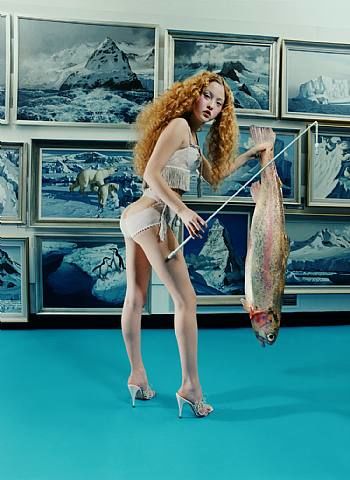 Fish Stick: Devon Aoki in agent provocateur, 1998
Cinnamon, Nutmeg, and Orange Flower Water
Posted in Uncategorized on January 12, 2012| 8 Comments »
 Mo, my mother, around 1952. She sure could cook.
Cinnamon, Nutmeg, and Orange Flower Water
Here’s another excerpt from ‘The Making of an Italian Cook’, a memoir I’ve been working on.
“We’re completely out of pepper flakes?,” Dick, my father, would say, to no one in particular, while shaking an empty little plastic jar. Shit, no more anchovies, I’d notice, knowing quite well I ate the last of them the night before. Well, this calls for yet another trip to Razzano’s. I was starting to live at that store. I was becoming just like Dick, focused on Italian condiments. Anchovies and hot red pepper flakes were the two big flavors I took to heart when I first became interested in cooking. Their importance on our family table couldn’t be overestimated. My father shook pepper flakes on almost everything, even on fettuccine Alfredo. I think being a Southerner, he didn’t quite grasp the nuance of that dish. And I could down a tin of anchovies, straight, in one sitting (I’d also done the same with jars of cocktail onions, but that’s possibly an issue separate from my world of Italian food). However, when I began digging deeper, three other flavors, less strident ones, came forth as foundations of our Italian kitchen: cinnamon, nutmeg, and orange flower water.
Nutmeg was, back then, and still is an aroma that drives me wild. From the time I was a little kid to right this minute I associate it with ricotta, a big Easter and Christmas ingredient for Southern Italian families. Ricotta-scented nutmeg is a voluptuous combination and one of the Italian tastes that, although subtle seeming, can just flood your mouth with flavor. Two ingredients that are sweet without being sugary. There’s something mysterious about that, almost in the line of trickery. And there is just about nothing more enticing, food-wise, for me, than shoving a big spoon of lasagna filling into my mouth, right from the bowl. (The way my mother, and just about every Southern Italian mother I knew, made this was by combining ricotta, parmigiano, parsley, and a whiff of nutmeg. Truly sublime.)
When I first began exploring Italian ingredients on my own, I felt smart and haughty buying nutmegs whole at Razzano’s, the big Italian grocery in Glen Cove, Long Island, a place I now knew intimately thanks to my escalating involvement with the Italian kitchen. Our neighbor Gloria told me whole nutmeg was best, and I was quite surprised to discover it actually began life as a round brown lump and not just a jar of beige powder. Scraping at a whole nutmeg with a clumsy box grater was an intimate experience (we never had an actual nutmeg grater, I suppose because my parents always bought the pre-ground stuff). The dark hard thing, which kind of resembled wood, didn’t release its charm until you got it irritated with a quick little exfoliation. Once I starting paying attention to this beautiful spice, I realized that Mo was using nutmeg in other preparations as well, in béchamel sauce, for instance (usually along with a bay leaf and a pinch of paprika), to layer into her “Northern” lasagna (the Southern ones, of course, always got ricotta, usually flavored with nutmeg). She also added a discernible amount to her Bolognese sauce, another “Northern” dish that intrigued me as a kid (milk in a meat sauce? What the hell?). These dishes were added to her repertoire by way of the many restaurant dinners my parents consumed during the ’60s and ’70s, when generic-style Northern cooking was huge.
Cinnamon is a spice I associate with Mo’s Sicilian side, her father’s family. She not only used it in eggplant parmigiano, but her family occasionally flavored ricotta with cinnamon, not nutmeg, to use as a filling for giant ravioli, something evidently very radical and gossiped about in her mostly Neapolitan neighborhood when she was growing up in Rye, New York. Being a glamorous working mom, she didn’t have time for elaborate pasta making and never cooked this dish for us, but she told me about it during one of the many arguments I’ve started over how she never told me about her family’s Sicilian dishes (it turns out she told me about quite a few of them, but I always, neurotically perhaps, felt she was holding out). I worked up a version of these ravioli from her description and she said they were more or less right on, except that they didn’t have the tomato paste–laden sauce that her grandmother napped them with. I dismissed that as too thick and sour and settled on a lighter, looser tomato sauce that I flavored only with basil. I included this excellent ravioli recipe in my book The Flavors of Southern Italy, if you’d like to give it a whirl. It’s got an unexpected sweetness, since the filling also contains more than a pinch of sugar, an addition I later discovered was common to many savory Sicilian dishes.
I now know that there are two popular varieties of cinnamon, each distinct. The kind most American’s know, the powder that comes in jars and gets sprinkled on rice pudding, is Cassia cinnamon, an Indian variety. It’s sweet and strong, its bark hard and dark brown. This is the only cinnamon I was familiar with until maybe the late ’70s, when I moved into the city and began shopping at Kalustyan’s Middle Eastern market in “Curry Hill” in the East 20s and discovered the lighter and more fragile-barked Ceylon variety (native to Sir Lanka), which is what cooks use in Mexico (if you’ve ever had Mexican hot chocolate, you know its taste). A more complex spice, still sweet but with a touch of bitter that hits right on the tip of your tongue, Ceylon is considered the true cinnamon. Evidently the Cassia type began as just another bark that tasted somewhat like Ceylon cinnamon and so eventually got added to the spice rack. Ceylon is what I now prefer for savory cooking, although it makes some of the dishes I grew up with, such as lamb ragu and baked eggplant, taste quite different from what I remember. I’ve gotten used to this new taste, but still, with almost anything I make that includes ricotta, savory or sweet, I continue to go for the Cassia. For instance in ricotta cheese cake. I just can’t get myself to tamper with my flavor memories there.
Orange flower water has to have been the most exotic of my teenage flavor discoveries. It happened one Easter, when I was on our yearly trip to Rocco’s Bakery in Glen Cove with Dick to pick up the ricotta cheesecake, a Pastiera, the type that includes whole wheat berries and is made only for Easter (or at least was when I was a kid). I had always found the pastiera’s flavor exotic but never really thought about it. Now, entrenched in my new found love of Italian cooking and with my jacked-up taste buds, I asked Mo what made the thing taste so wild, so unlike anything else except possibly a gently scented soap from a Miami hotel. She didn’t know. She’d never made one. I was incensed. How could she not know? I got the feeling my constant cooking- related questions were starting to seriously annoy her. Her parents had both died very young, so stirring up memories must have been painful. I suppose I was insensitive to this at the time, but I really needed an answer. Could it be she really didn’t know what went into ricotta cheesecake? So, brilliantly, I got the idea to go over to Rocco’s and ask. Orange flower water was the answer. Orange what? So then I marched myself over to Razzano’s, and there it was sitting on the shelf, gorgeous little cobalt blue bottles, imported from France, of all places. (Now I know that this lovely liquid is produced all around the Mediterranean and used in Middle Eastern, Sicilian, and Provençal cooking. At the time I thought is was exclusive to Easter cheese cake.)
So there were many secrets lurking behind the red sauce world of Southern Italian cooking. I could only guess what magic I would go on to discover (and of course there turned out to be much more than I imagined). I went right ahead and made a few ricotta cheese cakes, finding an interesting recipe in The Talisman Italian Cookbook, by Ada Boni, an excellent little volume my mother had hanging around the house that I unfortunately didn’t get to know better until I moved it into the city with me several years later. Ida Boni’s recipe didn’t contain wheat berries, but that was fine with me. At the time they scared me, reminding me of my earlier forays into that dreadful health food cooking. It didn’t contain orange flower water either, just orange zest and cinnamon, and that was not fine with me at all, so I just dumped some in. As it turned out, I dumped quite a lot in, and the cakes did taste like soap, inedible actually. I knew as they were cooking that something was terribly wrong. There was a dry perfume slick in the air that triggered a slight gag response in me. But since I’m not easily deterred, I tried it again. This time I added just a few drops. and what do you know, that was all it took to achieve that delicate taste that had been so damned intriguing. Not until some years later did I learn that this glorious liquid was one of the culinary legacies of the Arab influence on Naples and Sicily, but I certainly knew right then, on the North Shore of Long Island, that it was something I’d be needing in my life for a long time to come. I drizzled it over fruit, which was a beautiful experience, especially, as you’d imagine, with actual oranges (which I later found out made a pretty standard North African and Sicilian dessert). And, off the culinary track for a moment, if you add a small capfull to a cup of safflower or olive oil, you’ll have an amazing body oil. I use it all the time, and my elbows are quite smooth and fragrant.
And then I made a huge olfactory connection. That I didn’t think of it right away made me feel extremely stupid, but orange blossom perfume, in little orange shaped bottles, was an aroma I had known intimately my entire life, as part of my winters in Hollywood Florida. The bottles were sold at Anthony’s Grove, in their gift shop, where we’d drive several times a week to purchase grapefruits, tangerines, and various hybrid citrus and watch a drunken sad old Seminole Indian guy stick his head in an alligator’s mouth. That was always a side attraction, and it made my sister Liti and me uncomfortable. Not that the worn-out alligator posed any threat, but this man’s miserable predicament made us feel guilty.
The shop reeked of orange blossom perfume, a truly unique aroma. Could it be that, inexplicably, I didn’t understand blossom and flower to mean the same thing (is that possible?), or was it the French or Tunisian packaging and New York setting, as against the southern Florida, that threw me off? I suppose it is just that one of them you wore and the other you cooked with. I guess, but really, in retrospect, that was pretty lame.
These three flavors came to form a group in my mind, for I was learning that one, two, or sometimes all three would show up in various Southern Italian dishes. Before my father poured red or white wine over summer peach slices, I’d grate on a good amount of nutmeg. I’m not sure where I picked up that habit, but it seemed to impress him. “You made this up?,” he’d ask. Nutmeg, I later discovered, when, a few years later, I started cooking my own La Vigilia, the Christmas Eve fish feast, is a great mellower of baccala, rounding out the residual saltiness and adding warmth. I like rubbing nutmeg-scented butter over a chicken before roasting it. The aroma while it’s cooking is beautiful, and the taste is subtle but opulent, especially if you make a little pan sauce out of the drippings (a splash of dry Marsala for deglazing is the neat little trick there). A half a cinnamon stick simmered in a simple tomato sauce is lovely, even better when the sauce contains squid. Cinnamon and lamb are a great match, a Sicilian flavor combination my mother made good use of and one I encountered years later when I began visiting that gorgeous island on my own. The next time you’re braising lamb shanks (and I know you will be), throw a cinnamon stick into the liquid, and see what an exotic result you get.
My mother told me about a baked rice pudding her Sicilian father used to make that contained orange flower water, nutmeg, and cinnamon and I certainly got on that case quickly. Its flavor is very much like a ricotta cheese cake, except that it contains no ricotta.The rice and spicing provide depth and sweetness (and also the sugar, of course.) This, and a bunch more new recipes, will be published in my book.
Italian cooking doesn’t layer on spices like, say, Indian or Moroccan. Generally speaking, Italians, both north and south, dispensed with most spices a few hundred years ago and ever since have preferred the freshness of herbs. But these three ingredients (I still think of them as exotic gifts) continue to make an appearance, and I’m happy to create with them, knowing that I’m in no way compromising the spirit of the Southern Italian palate.
Women with Fish
Posted in Uncategorized on November 10, 2011| 1 Comment »
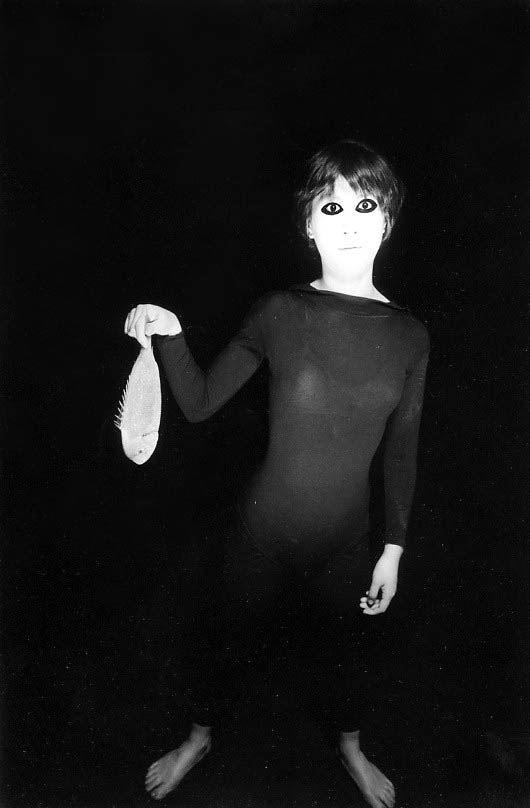
Italian Food Poem
Posted in Uncategorized on October 7, 2011| 2 Comments »
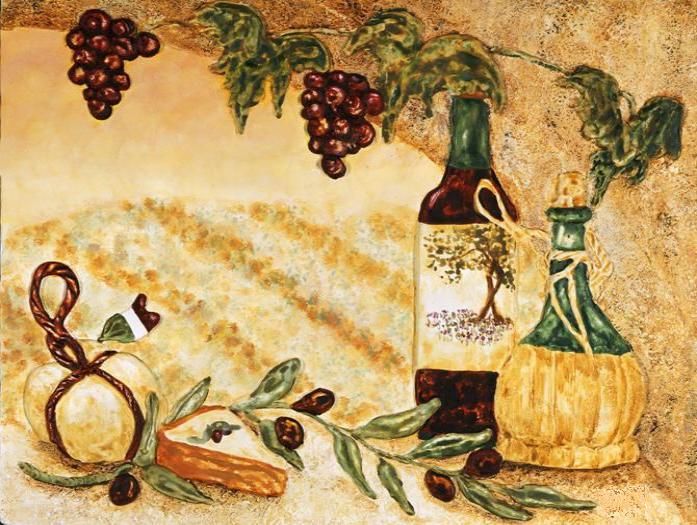
Italian Food
A poem by Shel Silverstein
Oh, how I love Italian food.
I eat it all the time,
Not just ’cause how good it tastes
But ’cause how good it rhymes.
Minestrone, cannelloni,
Macaroni, rigatoni,
Spaghettini, scallopini,
Escarole, braciole,
Insalata, cremolata, manicotti,
Marinara, carbonara,
Shrimp francese, Bolognese,
Ravioli, mostaccioli,
Mozzarella, tagliatelle,
Fried zucchini, rollatini,
Fettuccine, green linguine,
Tortellini, Tetrazzini,
Oops—I think I split my jeani.
© 2011 Evil Eye, LLC
Women with Fish
Posted in Uncategorized on August 8, 2011| 2 Comments »
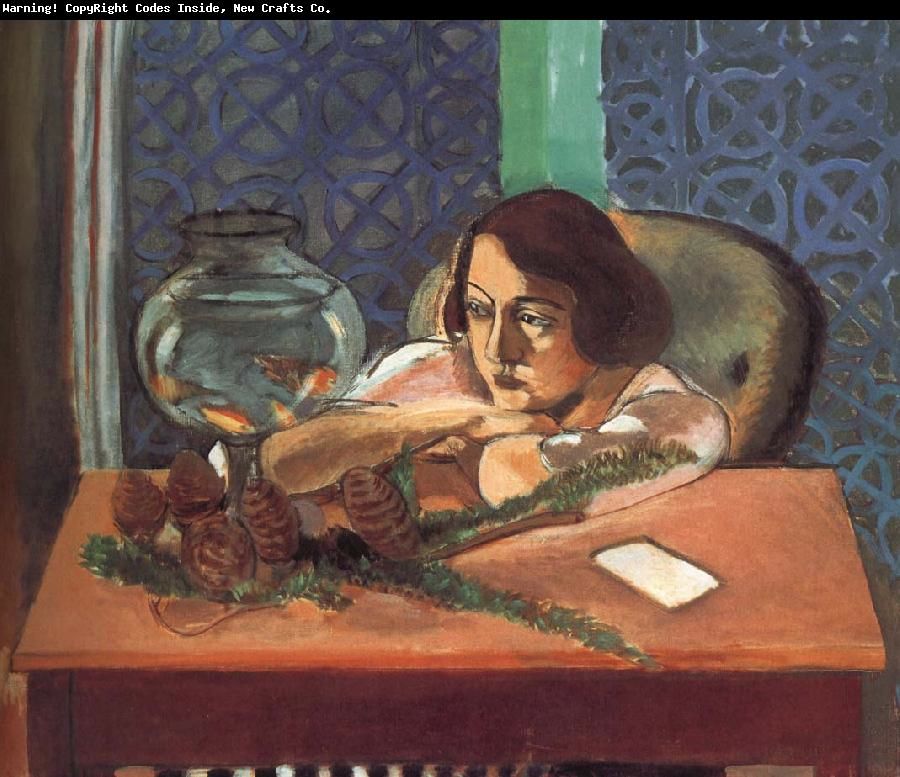
The Making of an Italian Cook
Posted in Uncategorized on May 4, 2011| 12 Comments »
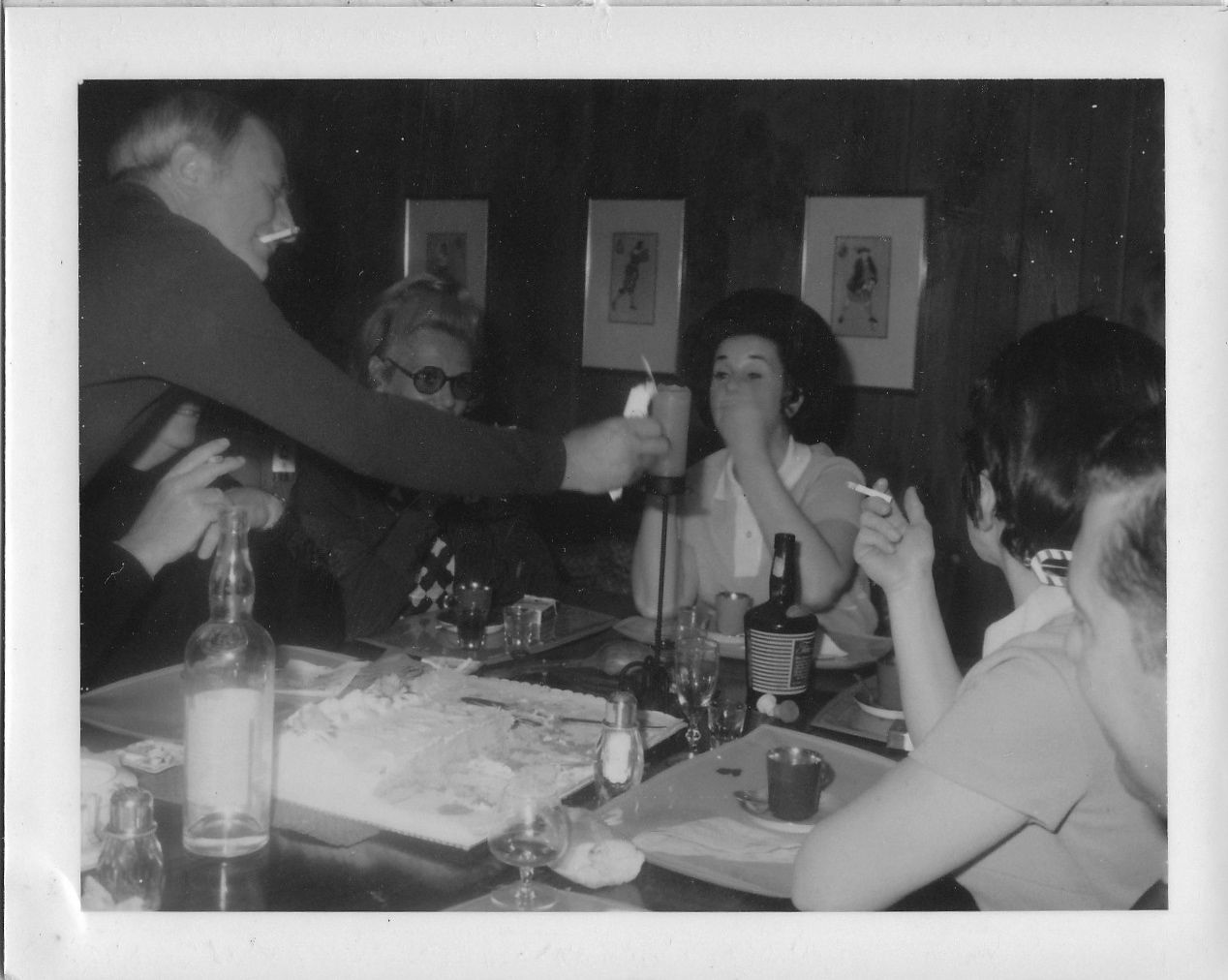
Mo, center, with neighbors, having a smoke and Strega Festa
Here’s another little section from ‘The Making of an Italian Cook’, a book of essays I’ve been working on for a few months. I’ve already posted two other short sections. They’re all still a little rough, but I just thought I’d run pieces of this by you to see what you think.
Dinner in Greenvale, Long Island
This was a night when Dick, my father and golf pro supreme, came home late from a poker game in the Grill Room, a private cubby hole at the country club where he worked that was off limits to women, even in 1972, and that for all I know still is. Mo, my mother, was in the kitchen when she heard the Caddy door slam. She was pissed off of course, but not as enraged as she could be on these boys’ nights out. I think she was tired from peddling Izods all day. Running the club’s pro shop meant long days for her, having to smile morning to night, everyone wanting things shorter and tighter when all the members were just getting older and fatter. My good friend Scott was sitting on my bed making sketches of stiletto pumps with weapon toes and ostrich plumes jutting from the heels. My sister Liti was in the den watching Gunsmoke. Dick went straight for the Trini Lopez recording of”La Bamba,” and it mingled nicely with Gunsmoke in our den, formerly our garage, now the wood-paneled all purpose fun and fight (and flight) room that housed my father’s well-stocked bar, a yellowy brown, naugahyde sofa pit, a series of ye olde Scottish golfer prints, men teeing off wearing knickers and knee socks, a humongous painting, done by a neighbor, of a guy trying to chip his way out of what looks like an eighty-foot-deep sand trap (not the greatest sense of perspective). The den was decorated in shades of brown and that particular 1970s burnt orange that was fashioned into a lot of the leather jackets of the time; in the den it expressed itself most dramatically in the form of a stained -glass faux medieval chandelier hanging from thick iron rings. Our four year old baby brother, Richie, was screaming from his high chair. It was June, not too hot, and yet the air-conditioning was turned to what Liti and I knew as the deep freeze. Dick liked it that way, since he spent much of his afternoons teaching golf in the broiling sun and, in the process, creating black moles all over his head that from time to time needed gouging. I wore a navy blue wool cardigan over a black leotard and pink seam-up-the-back stirrup foot tights, having just come back from my Martha Graham class, something I’d been studying for years with not much enthusiasm. It was a good way to burn off energy.
Mo began to fry veal cutlets, one of the most exquisite food smells that ever came out of our kitchen. She usually served them just with lemon. I also liked the parmigiano treatment, but that softened up the crispy, greasy, just lifted from the pan allure that was so enticing. Mo had a certain finesse with food. Her cooking was lighter than Dick’s mother’s, less tomatoes, more lemon, more herbs. That was her style. It was partly a health and diet issue, but that wasn’t the entire story. Mostly she just cooked what I’d call contemporary Southern Italian. Not a lot of steam came out of her kitchen. She didn’t usually have time for Sunday sauce (although on occasion she’d make one and it was great). Lots of grilling went on, raw vegetables with creamy dips lifted from magazines. Flounder fillets with crunchy crumbs and garlic. Linguine with clams and white wine. Roasted local blue fish with capers and olives. She made a lot of salads.
Mo put out a tray of raw celery, fennel, olives, and chunks of a focaccia I’d recently been trying to perfect, this one topped with capers and anchovies (really couldn’t pry myself away from those anchovies). Everyone gathered around our wine-barrel-motif table, whose top could be flipped over to reveal a green felt crap game table. Chianti came out, along with diet raspberry soda, diet cream soda, and regular old Coke. The hot and bubbling fried veal cutlets, crisp and greasy, with lemon wedges and parsley, came out next. Mo now brought out a platter of broccoli rabe sauteed with garlic.
Trini Lopez morphed into Al Martino, and then into some ancient Italian opera’s greatest hits album that was dug into and hissing beyond belief, a sort of winder downer. The music was loud, always. The TV was still on. Nobody watching, nobody bothering to turn it off.
Then Mo brought out a chicory salad that was so bitter that Scott, who decided to stay for dinner (for a change), tried to act as if it didn’t exist. I loved it. I loved Mo’s salads, often with hits of wild arugula thrown in from our neighbor Lou Mastellone’s garden. Her dressings were simple, pure Italian in spirit, just olive oil, salt, and vinegar or sometimes lemon, occasionally with a bit of garlic. I love bitter, so these salads were what I craved.
Lou Mastellone dropped by to talk tomatoes. Of course, Lou also had a backyard garden, and the tomato rivalry, despite Lou and Dick’s close friendship, was strong. Lou’s were higher this June, and it was a cold June. Dick was perplexed. They both grew beefsteaks, plums, cherries. Cigarettes came out. Strega and Sambuca came out. A lot of talk about proper staking and tying and sun angles. It was interesting to me up to a point, and then it just started to seem like work I would never want any part of.
Dick came out with a big tray of very sour, weird Abruzzi Christmas cookies I had made the day before (it wasn’t any where near Christmas, and maybe that’s why they were so awful). They were like mini calzones but filled with dried figs, mashed up chickpeas, chocolate, sweetened with honey (not enough, or maybe too much; hard to say). Probably these things had a reason for being, but at the time I didn’t get the concept. Seemed like something more out of the dreaded New York Times Health food cookbook I now despised, although I believe I got the recipe from the Calabrian lady next door. I now know that those cookies are called cavicinetti, a perfectly respectable classic, and when properly made a delicious baked thingy, but back then they eluded me, although I baked about eighty of them that time.
Mo, my mother was not an Italian-American apron Mamma, like my father’s mother, but a chic New York gal, a former Seventh Avenue showroom model married to a golf pro and living in Nassau County, Long Island. She ran the golf shop at my father’s club, stocking it with Ralph Lauren and cashmere argyle sweaters. She cooked Southern Italian food very well, not making a big deal out of it and not heartbroken when she and Dick decided to go out instead, which was often, but in her cooking and in her personal style there was a sure hand with nuance and detail.
Women with Fish
Posted in Uncategorized on February 19, 2011| 3 Comments »

Woman Fish, by Oleksiy Fedorenko (2002).
It’s been a while, and I was missing “Women with Fish,” so here you go.
A New Feature: The Italian Recipe Exchange
Posted in Uncategorized on January 27, 2011| 1 Comment »

Hello fellow Italian food fanatics, I have a new feature on my blog. It’s called ‘The Italian Recipe Exchange’. If you’ve ever wanted your own favorite Italian recipe posted and up for the world to see, you might want to click ‘The Italian Recipe Exchange’ button on my home page and read all about it.
-
Welcome to Ericademane.com

I am a chef, food writer, and herb lover who specializes in improvisational Italian cooking. I am the author of The Flavors of Southern Italy and Pasta Improvvisata, as well as Williams-Sonoma Pasta, which is available at Williams-Sonoma stores. A member of the Association of Culinary Professionals, The New York Women's Culinary Alliance, The New York Culinary Historians, The Herb Society of America, and the Italian-based International Slow Food Movement, I live in New York City.
For more about me, see About Erica De Mane.

Buy a copy of The Flavors of Southern Italy.

Buy a copy of Pasta Improvvisata.

Buy a copy of Williams-Sonoma Pasta.Buy a copy of my ebook, Pasta Improv


