I’m constantly revising my list of animals I won’t eat. I have the luxury of doing so because I can pay for alternate sources of protein. I used to eat frog legs with butter and garlic and herbs, and they were delicious, but now I can’t. I’ve held frogs many times and felt their skin, thick, green, and rubbery. I know their skin is removed before cooking, but I can’t help remember it was once there. I think about chewing it and choking it down. Completely irrational. I used to eat rabbit too, but when I began working in restaurants and had to skin their soft fur from their dead bodies over and over and over, I decided I couldn’t do that anymore. (Now rabbit usually comes into a restaurant already skinned, but back in the day scalping it was a sad job.) This turnaround is unfortunate for me, because Italian rabbit recipes are very good (coniglio agrodolce, for instance, with green olives, pine nuts, vinegar, honey, and mint). Also, I do understand that frogs and rabbits have very low greenhouse gas issues compared with cows, which are off-the-charts problematic, but I seem to have no problem eating cows. I’m working on changing my thinking about rabbit.
I have never had any problem with any type of poultry, especially duck. I’ve known some ducks personally, but still I can eat them. I could even kill them if I had to, although I’ve never had to.
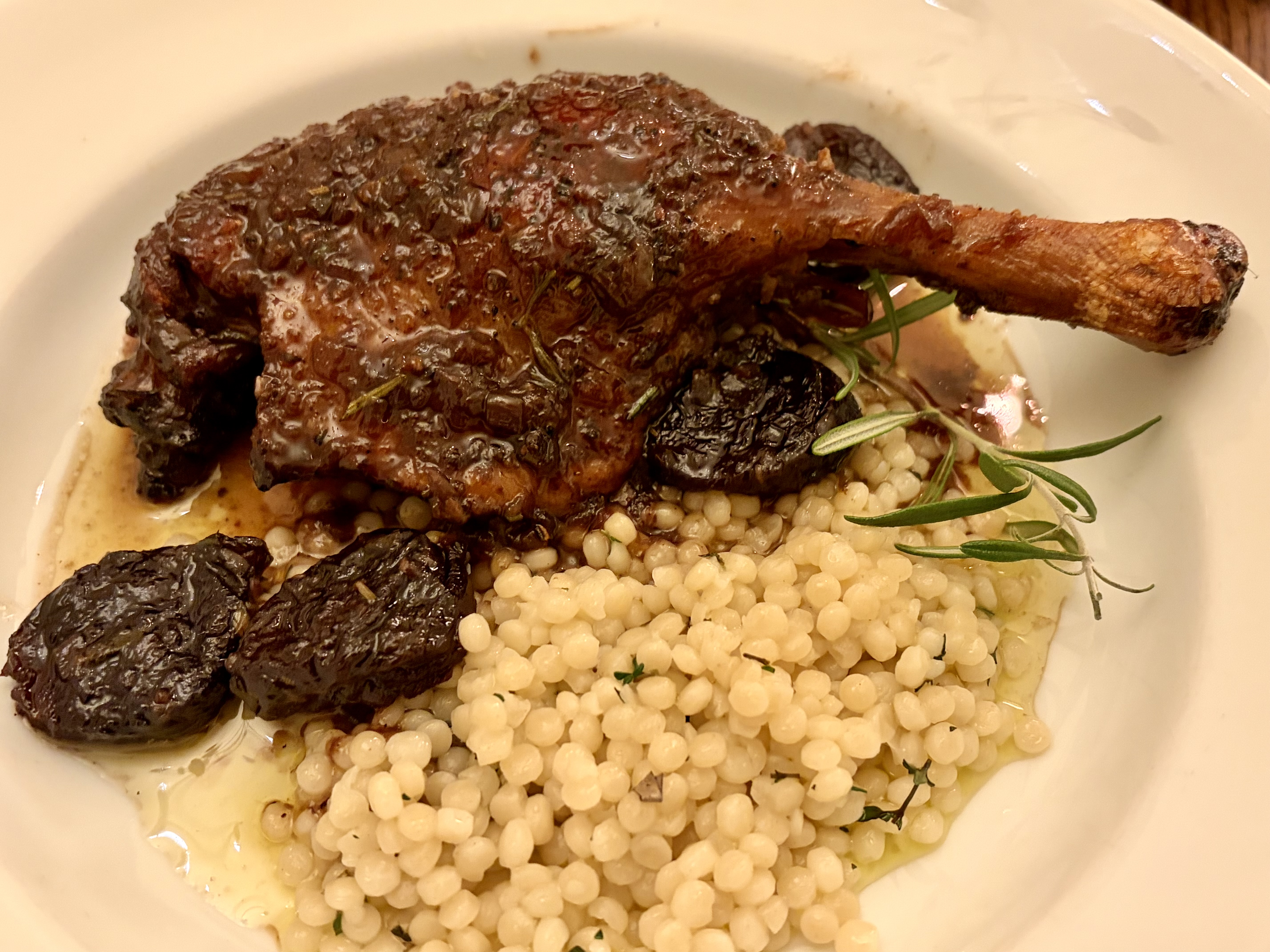
I like cooking duck legs. Once I’ve seared and melted off most of their fat (ducks carry an astonishing amount of fat), I put them into a low oven to braise until tender, a long time, but then there’s no further work for me. The kitchen starts to smell wonderful, especially if red wine is involved in the braise. And their color when they’re tender, a deep burnished red-brown, is just like the few leaves that are now left on the trees outside my apartment window.
For the braised duck I used D’Artagnan whole duck legs on my first try. These are Rohan ducks, a hybrid that includes both the mallard and Pekin breeds. For my next go-round I tried Hudson Valley Foie Gras Moulard duck legs. Both brands were good and took about two hours to become tender, but the Hudson Valley duck had much more fat, which I trimmed a bit. It also had more meat. Both cooked up tender with excellent flavor.
4 whole duck legs Salt Black pepper Extra-virgin olive oil 1 large shallot, finely diced 1 carrot, finely diced About ½ teaspoon allspice 5 large sprigs rosemary, the leaves well chopped A big splash of grappa (if you don’t have any grappa, use cognac or brandy) ½ bottle red wine (I used a Barbera) 2 cups homemade chicken broth, possibly a little more 12 pitted prunes
Preheat the oven to 350 degrees.
If it looks like you’ve got a ton of fat on your duck legs, carefully trim a little off (I used scissors for this). Get out a big skillet or sauté pan that will fit the duck legs comfortably (if you have cast iron, I’d use it). Set it over medium heat. Season the legs generously on both sides with salt and black pepper. Drizzle a little olive oil into the pan. Add the duck legs, skin side down, and let them sit there, not moving them around, until they’re well browned. This will take about 8 minutes. You want to cook out much of the fat. If the legs are browning too fast, turn the heat down a little. Give them a flip, and sear the other side for about 2 minutes. Remove the duck from the pan.
Pour off most of the duck fat (keep it for sautéing potatoes or something), leaving about a tablespoon. Set the pan over medium heat again, and add the shallot, carrot, allspice, and about half of the chopped rosemary. Let the mix sauté until softened, about 3 minutes. Add a big splash of grappa (or cognac), and let it bubble up for about 30 seconds. Add the red wine, and let it reduce by about half.
Put the duck back in the pan, skin side up. Add enough chicken broth to come up a little more than halfway, to just under the edge of the skin. Sprinkle the rest of the rosemary over the duck. Bring the liquid to a gentle boil, and then stick the pan in the oven and braise it there uncovered (which will help keep the skin crisp), for about 2 hours. Add the prunes after 1½ hours. Check once in a while to make sure the liquid isn’t getting too low, and add a little more broth or even water if needed. I didn’t have this problem, but you never know.
Remove the duck to a plate, skin side up. Spoon off excess fat from the pan, and then reduce the sauce if necessary (you want a little thickness in it). Check for seasoning. Plate the duck, and pour some sauce and prunes over each serving.
The first time I made this I served it over a celery root purée and that, I thought, was a good accompaniment. The second time I made Israeli couscous, also good but more neutral, maybe better in a way better for soaking up all the wine and prune sauce.
I also love duck legs slow braised and shredded into a ragù for pasta. If you’d like to try that, here’s recipe I did for it a few years back, using black olives, orange, and basil.
Recipes below: Ziti with Cannellini Beans, Mussels, and Rosemary; Baked Mussels with ’Nduja Breadcrumbs and Marjoram; Spaghetti with Mussels, ’Nduja, and Tomatoes (in text)
Does anyone cook ziti anymore? When I was a kid that was almost all we cooked, except when we made spaghetti. We ate a lot of baked ziti, in various forms. It was a thing. Baked ziti with eggplant, tomato, and mozzarella was my favorite (we called it Sicilian-style), but just plain tomato sauce and some type of good cheese was and is also excellent if done right.
Ziti is smooth, hollow, not too large, and not cut on an angle. Solid, no ridges. In my opinion it’s more charming than rigatoni or penne for most pasta needs, unless you require spaghetti or tiny soup pasta like acini di pepe. I used to use ziti to make garlands to drape around the Christmas tree—a good tight fit—spray painting them gold until I became a teenager and began painting them black.
Package designed by Dolce & Gabbana.
Ziti is a primarily Campanian pasta shape, which is why it has always been popular with so many Italian-Americans. I like the Gragnano-based Pastificio di Martino brand, so I was curious to know if the company had anything to say about the shape’s origin. Here’s what I found on their site:
“Short, smooth, tube-shaped pasta. Originally Ziti are a long type of pasta, usually hand broken before cooking and traditionally served on Sundays or important occasions. . . . Can be combined with a classic sauce of the Neapolitan tradition or with more creative versions, perfect to bake in the oven. The name Ziti came from zita who were the unmarried girls that stayed at home on Sundays to break the pasta with their own hands instead of going to mass. Today this practice is now performed in the homes of many Neapolitans and represents a real ritual performed by family members before cooking the dish.” Wow. I would always rather have stayed home breaking pasta than gone to church. I never knew it was an option.
When I was young, maybe under 13, baked ziti was a special-occasion dish, on Sundays and birthdays, and always with ragù or chunks of sausage, but as time went by it started to show up more often as a quick anytime dinner, with leftover tomato sauce, mozzarella, provolone maybe, ricotta sometimes, meat almost never, thrown in the oven. And occasionally there was that eggplant version, which drove me wild.
I start making pasta with various types of beans when the weather goes cool. Probably you do the same. Ditalini is the standard fazool pasta shape, but when I recently picked up a bag of mussels at the Greenmarket and decided to include them in my latest fazool, that changed the pasta sauce ratio in my head. Ditalini too small with mussels. Ziti perfect.
And while I’ve got mussels in the house, why not make stuffed mussels with ’nduja? I made a version of that last year for a friend’s birthday. It was really good, but then I overdid it with ’nduja for a few months and needed to lay off. After a half year cool-down, I’m fresh on ’nduja again. This dish is truly a simple one, but the payback is big. You’ll see that it contains only three main ingredients, ’nduja, panko, and an herb of your choice (I used marjoram, but Italian oregano or thyme would also be good, or for a more mellow result try Italian parsley). I hope you’ll consider making it. It’s excellent for a big group with its prepare-ahead-and-then-heat-on-command technique.
You’re probably asking, can I make this with clams? In my opinion, that doesn’t work as well. Their brininess clashes with the spicy fattiness of ’nduja. Two strong flavors collide. But what about the classic Spanish dish of chorizo and clams, you ask? That works, I believe, because it’s a looser concoction, usually brothy, where everything has room to mellow. That combo also comes up in paella, where there’s plenty of rice to separate the two strong ingredients. With these baked mussels, the flavors are literally right on top of each other, but mussels are gentle, not briny, smoothing the way for a spicy, fatty top coat.
The best time for mussels is during the colder months, October through February. Right now they are at peak flavor, less watery, plumper, sweeter. I almost always get my mussels from PE & DD Seafood at the Union Square Market. They fish early in the morning off Long Island and get it all into the city by the time the market opens. So fresh. They also sometimes offer their housemade smoked mussels. Also excellent.
1 2-pound bag mussels (about 30 mussels), cleaned 1 glass dry white wine Extra-virgin olive oil Salt 1 pound ziti 1 ¼-inch-thick round of pancetta, cut into small dice ½ a sweet onion (such as Vidalia), cut into small dice 3 tender inner celery stalks, cut into small dice, plus their leaves, chopped A big pinch of allspice About 1½ cups cooked cannellini beans, with a little of their cooking liquid. (A tip: For this dish it is good to cook them with a few fresh bay leaves, a whole garlic clove, and a few sprigs of rosemary, and add salt toward the end.) I used Rancho Gordo’s Marcella beans, which are named for Marcella Hazan. 5 or 6 sprigs fresh rosemary, the leaves chopped Aleppo pepper to taste Grana Padano cheese, if you like
Put the mussels in a large pot. Pour on the white wine. Turn the heat to medium-high, and cover the pot. When the wine starts to boil, uncover the pot, and stir the mussels around. Cook them until they open. With a strainer spoon, lift them from the pot into a large bowl. Strain the cooking liquid into a small bowl. I had about ¾ cup. When the mussels are cool enough to handle, remove them from their shells, and put them into a small bowl. Pour on the mussel cooking broth, and give them a drizzle of olive oil.
Set up a pot of pasta cooking water, and bring it to a boil. Add salt and the ziti.
Get out a large sauté pan, and set it over medium heat. Drizzle in about a tablespoon of olive oil, and add the pancetta. Sauté until the pancetta is crisp and has given up much of its fat, about 4 minutes. Add the onion and the celery, holding the celery leaves back for garnish. Sauté until softened, about another 3 minutes. Add the allspice, the cannellini beans, a little salt, and the rosemary. Sauté for another 3 or 4 minutes to blend all the flavors.
Now add the mussels with all their liquid, and gently reheat the sauce for no longer than a minute (you don’t want the mussels to overcook).
When the ziti is al dente, pour it into a large serving bowl, saving about ½ cup of the cooking water. Drizzle with about 2 tablespoons of fresh olive oil (you can use a really good one here), and give it a toss. Add the sauce. Sprinkle on Aleppo to taste, and give it another toss, adding a little of the cooking water if needed to loosen the sauce. Taste for seasoning. Scatter on the celery leaves. Serve hot. I like this without cheese, leaning more toward a heavier dose of Aleppo, but it’s not bad with a little grana Padano sprinkled on top. That’s up to you.
Baked Mussels with ’Nduja Breadcrumbs and Marjoram
1 2-pound bag mussels, (about 30 or so), well-rinsed ½ cup dry vermouth Extra-virgin olive oil 1 approximately ¼-pound chunk ’nduja (you’ll need about 3 tablespoons for this recipe, so use the rest for my bonus pasta recipe below or for anything else that strikes you as a good idea) 1 cup panko breadcrumbs About 5 or 6 big sprigs marjoram, the leaves chopped Salt if needed.
Put the mussels in a large pot. Pour on the vermouth, and turn the heat to medium high. Cover the pot, and let the mussels heat up. When the wine is steaming, uncover the pot and stir the mussels around. Cook them until they open.
Using a strainer spoon, lift the mussels from the pot and into a bowl. Strain their cooking liquid into a small bowl. When the mussels are cool enough to touch, pull off the top shell from each one, detach the mussel from the bottom shell, and then place the mussel back in the bottom shell.
Preheat the oven to 425 degrees.
Get out a medium sauté pan, and set it over medium heat. Add about a tablespoon of olive oil and the ’nduja, and let the ’nduja melt, about 3 minutes. Add the panko, stirring it around until it blends with the ’nduja and becomes crisp, about a minute or so. Add 2 tablespoons of the mussel cooking liquid, stirring it in. Turn off the heat, and add half of the marjoram. Pack each mussel with about a teaspoon of the ’nduja mix, and place the mussels shell side down in a baking dish. Give them a drizzle of olive oil. Stick the dish in the oven, and roast until hot and crispy, about 4 minutes. Garnish with the remaining marjoram. Serve hot or warm.
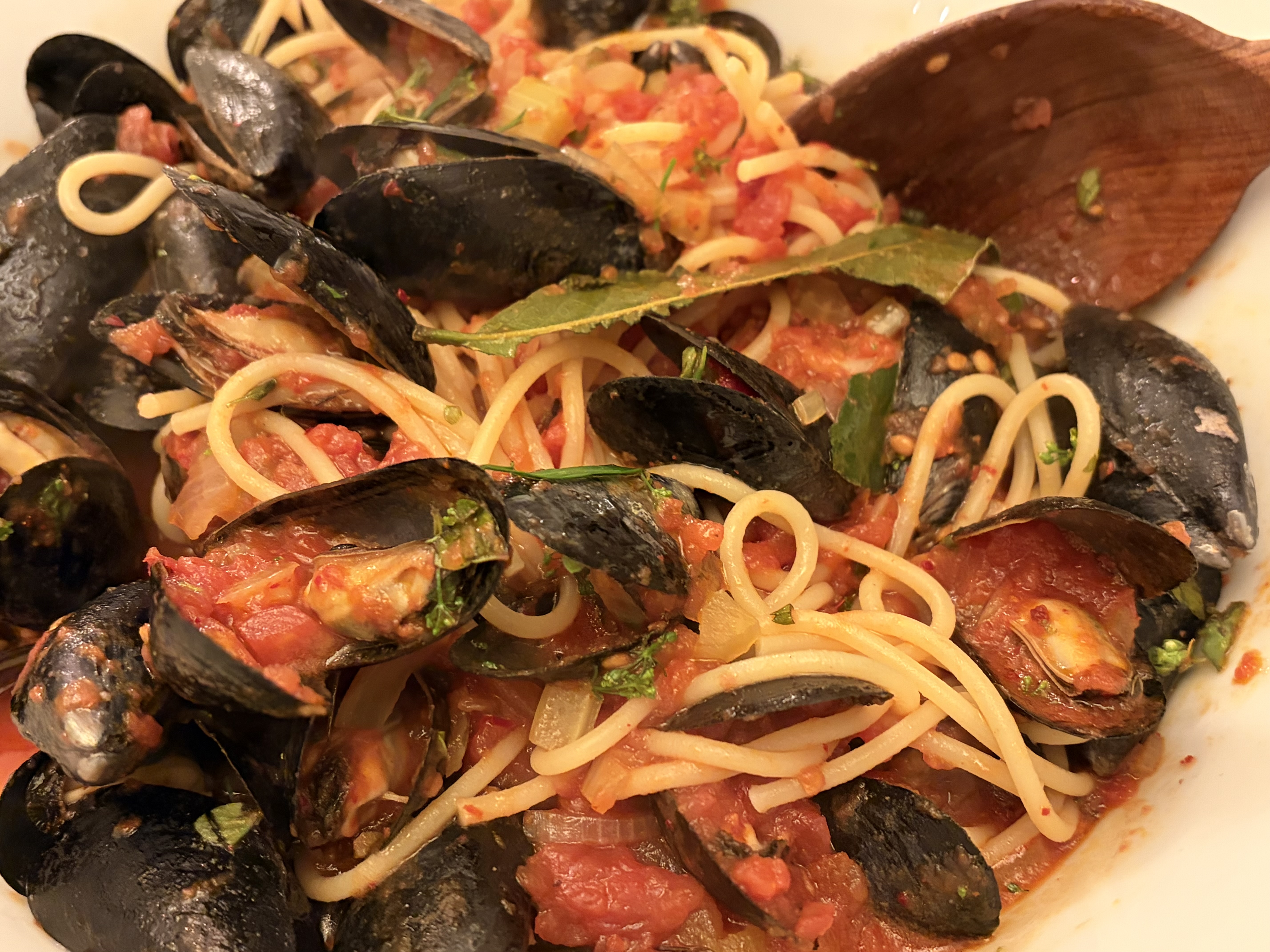
Bonus Recipe: After I retested my baked mussels with ’nduja recipe, I had mussels and ’nduja left over, so I made this Spaghetti with Mussels, ’Nduja, and Tomatoes, which serves 2.
Put 20 or so mussels into a saucepan, and pour on a big splash of white wine. Turn the heat the medium high, and cook the mussels, stirring them around occasionally, until they open. Turn off the heat.
Drizzle about 2 tablespoons of olive oil into a large sauté pan. Add about 2 big tablespoons of ’nduja, half a chopped onion, a chopped celery stick, a few fresh bay leaves, and a peeled and lightly crushed whole garlic clove. Sauté until everything is fragrant and softened, about 3 minutes. Add a splash of white wine, and let it bubble away.
Add a small can of Italian plum tomatoes, chopped, including the juice, and sauté for about 5 minutes.
Cook about ½ pound of spaghetti al dente, drain it, and pour it into a serving bowl. Drizzle on some fresh olive oil.
Lift the mussels out of the pot with a strainer spoon, and add them to the tomato sauce. Gently heat them through on low heat, no longer than about half a minute. Strain the mussel cooking liquid, and add it to the pan.
Pour the sauce over the spaghetti. Scatter on a generous amount of fresh herbs. I used marjoram, Italian parsley, and a few lovage leaves. Toss gently. Taste to see if you might need salt. Serve hot.
Recipes below: Orecchiette with Sausage, Cauliflower, Saffron and Celery Leaf; Pumpkin Soup with Anise Seed, Saffron and Celery Leaf
I haven’t posted in the past three weeks because I’ve been busy with two other writing projects, one of which, a food-related fiction idea, has been giving me sweaty pangs of embarrassment. I hope to burn past that (if all goes well, you’ll be hearing more about it at some later date). In the meantime I want to give you an update on my fall herb garden. Bittersweet is the word to describe what is going on now in my little garden. I’ve got a plot full of bitter and crusty, but it still gives hints of what those beautiful plants once were. Seems like only yesterday.
Some robust herbs hang on until the ground is almost frozen. Lovage and fennel do, and so does a variety of celery that’s grown primarily for its leaves and is called leaf, Chinese, or cutting celery in this country. I first planted that two springs ago, and it came back this year. In upstate New York you never know what’s going to return. I’m hoping it will become a solid perennial. Its stalks are skinny and hollow, without any of the stringiness of normal celery stalks, but they can be tough, so I make sure to chop them fine if I’ll be using them in a soffrito, for instance. The leaves, though, are the main attraction, dark green, a little shiny, and abundant. I love the taste of celery, so for me leaf celery is a must-have. I use its leaves both cooked and as a straight-on herb, scattered at the last minute. It’s deep stuff.
I still have it coming up in my garden, and I’m grateful. It’s what inspired these two recipes. If you don’t have leaf celery, both dishes will still be really good with stalk celery. You’ll just need the leaves from almost entire head for each recipe (or you can use half celery leaves and half Italian parsley, if your celery leaves are sparse). I like to include celery leaf in dishes that have a semi-sweet element, like the pumpkin and the pork here. Its savory bitterness balances things out nicely.
I’m assuming that these will be the last recipes I post this year with herbs from my garden. People ask me if I dry my herbs. I don’t. I like herbs fresh, so during cold months I resort to those plastic supermarket packages. They’re not bad, but they definitely lack romance. One thing I do do with end-of-season herbs is make liqueurs. This year I cut down all my gone-to-seed fennel for finocchietto. It has been sitting in Everclear for only about three weeks so far, but it already smells sweet and intense. I’m hoping its deep green color will last until Christmas, when the liquor will be ready.
Orecchiette with Cauliflower, Sausage, Saffron, and Celery Leaf
1 large cauliflower (any color or variety), cut into small florets about the size of orecchiette Extra-virgin olive oil Salt ¾ cup homemade chicken broth ¼ teaspoon saffron threads, lightly dried and then crushed in a mortar and pestle 3 or 4 sweet Italian sausages (about ¾ pound), skinned and pulled into little bits 1 large shallot, cut in small dice 3 tender inner celery stalks, cut into small dice, plus, separately, the leaves from the whole bunch (if you happen to have leaf celery, use 3 of those stalks, well chopped, and a good handful of their dark green leaves) 4 or 5 sprigs rosemary, the leaves chopped A big splash of dry white wine 1 pound orecchiette Aleppo pepper to taste A chunk of aged Manchego cheese
Heat the oven to 425 degrees, and get out a large sheet pan. Spread the cauliflower out on the pan in more or less one layer. Drizzle it with a good amount of olive oil, and season it with salt. Roast until golden and tender, about 10 minutes. Take the pan from the oven, and let it sit while you get on with the recipe.
In a small saucepan, heat the chicken broth to warm it, and add the saffron, giving it a stir. The broth should turn a lovely orange.
Set up a pot of pasta cooking water, and bring it to a boil. Add a generous amount of salt.
While the water is coming to a boil, get out a large sauté pan, and set it over medium-high heat. Drizzle in a film of olive oil, and add the sausage, letting it brown lightly, about 3 to 4 minutes. Add the shallot, the celery stalk, the rosemary, and a little salt, and sauté until it’s all fragrant and softened. Add the cauliflower, and give it a stir. Add the white wine, and let it bubble away.
Drop the orecchiette into the boiling water.
Add the saffron chicken broth to the pan, turn down the heat, and simmer for about 3 or 4 minutes. Sprinkle in some Aleppo.
When the orecchiette is al dente, drain it, and set aside about a cup of its cooking water. Put the orecchiette in a large, wide serving bowl, drizzle on a little fresh olive oil, and give it a quick toss. Add the sausage sauce, a few gratings of Manchego, and about half of the celery leaves. Toss again, adding some cooking water if you need it to loosen the sauce. Scatter the rest of the celery leaves on top. Bring the rest of the Manchego to the table.
Pumpkin Soup with Anise Seed, Saffron, and Celery Leaf
Extra-virgin olive oil 1 medium-size onion, chopped 2 tender inner celery stalks, chopped, plus, separately, about ½ cup celery leaves, lightly chopped (if you have leaf celery, use 2 small stalks, well chopped, and ½ cup leaves) 1 pound skinned, cubed fresh pumpkin (I used cheese pumpkin for this, as I think it has the best flavor, but you can substitute butternut squash, if you like; it’s easier to peel, a bit sweeter, and less deeply flavored) Salt 2 fresh bay leaves A big pinch of allspice 1 teaspoon ground anise seed A big splash of dry vermouth 4 cups vegetable broth, or half chicken broth and half water A big pinch of lightly dried saffron, crushed in a mortar and pestle and dissolved in a few tablespoons of hot water ¼ cup heavy cream, or a little less if you prefer Green peppercorns
Get out a large soup pot, and drizzle into it 2 tablespoons of olive oil. Turn on the heat to medium, and add the onion, celery stalks, and pumpkin. Season with a little salt, and add the bay leaves, allspice, and anise seed. Sauté until everything is fragrant and just starting to soften, about 4 minutes. Add the vermouth, and let it bubble away. Add the vegetable or chicken broth, and bring everything to a boil. Lower the heat, and cook partially covered at a low bubble until the pumpkin is very tender, about 20 minutes. Add the saffron water.
Remove the bay leaves, and purée the soup in a food processor until it’s smooth. Return the soup to the pot (wipe out the pot first). Gently reheat it, and add the cream, stirring it in. If the soup is too thick, add a little water or more broth (I like it the consistency of thick cream). Add a few grindings of green peppercorns, and check the seasoning. Add about half of the celery leaves. Serve hot, garnishing each bowl with the remaining celery leaves.
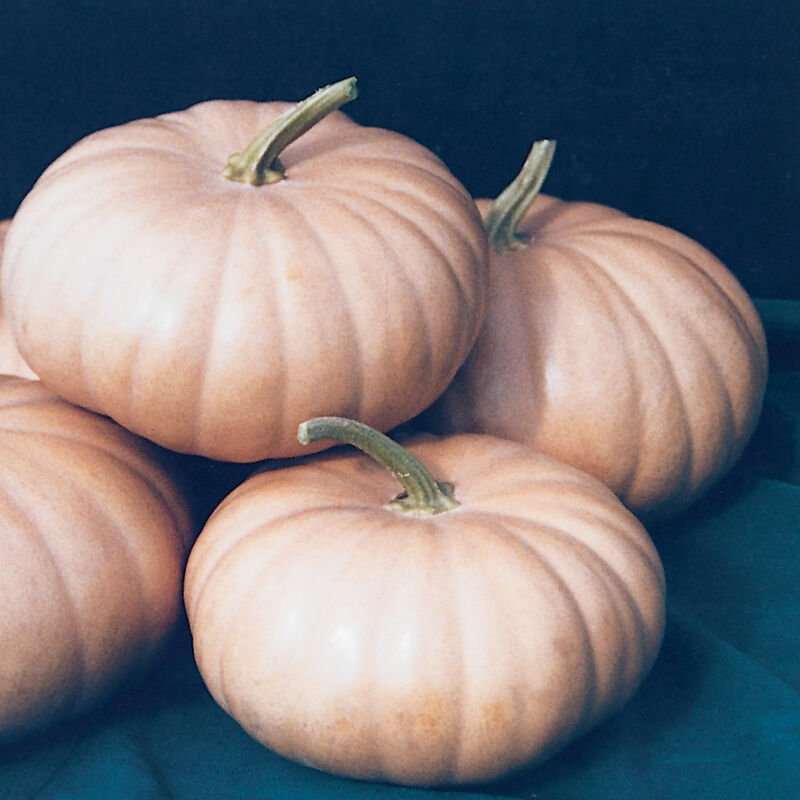
Here’s what cheese pumpkins look like. They also make great pie.
Recipe below: Shrimp Tagine with Tomato, Ginger, and Fennel
Mums are out, the ugliest flower in the Northeast (and they smell bad, too). They are the first sign that summer is closing down. (Pumpkins are next.)
Mums and Pumpkins, by Yulia Nikonova.
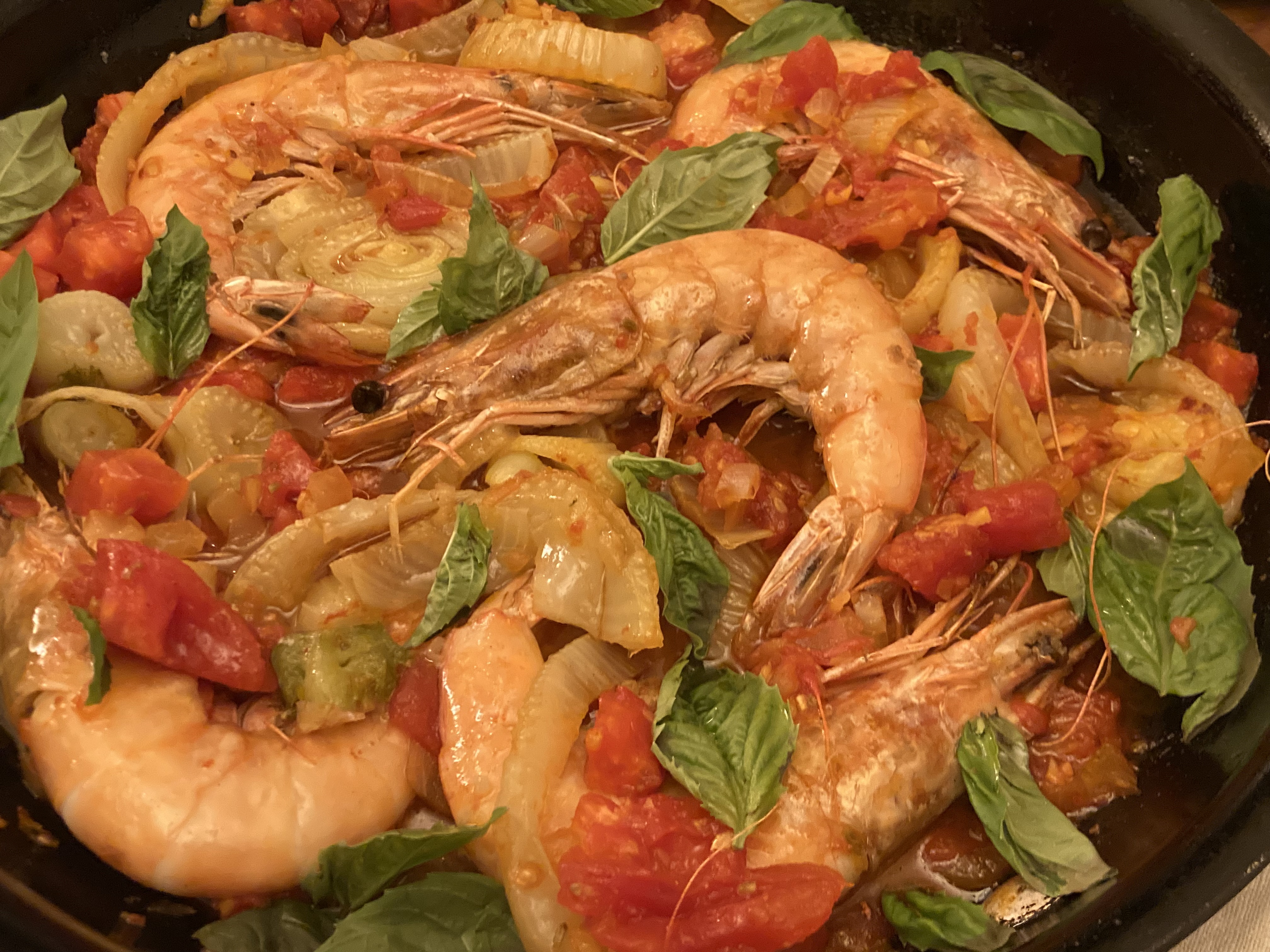
But the weather is still fine, 83 today and not too humid. You can see the first signs of leaves going burnt orange, and some of my herbs are getting crispy around the edges, the basil just developing that late season cat-piss smell that makes me nervous. My fennel has gone to seed, but that’s a good sign. I like to dry the seeds and use them fresh-dried. Much better than most of the dead stuff you get at a supermarket. The aroma of my newly plucked seeds brings back a memory of a shrimp-and-fennel tagine recipe I found many years ago in Flavors of Morocco, by Ghillie Basan. I’ve made her version several times, and it’s lovely, incorporating many of my own favorite flavors like saffron, fennel, and smoked paprika. This time around I’ve, of course, fiddled with it. Not too much. Just enough to own it.
This dish is a cross between a Moroccan tagine and what I’d call an Andalusian cazuela de pescado. From Tarifa, in Southern Spain, Tangier is just a one-hour ferry ride across the water, as I learned a few years back when I took that route myself. Spanish culture infiltrated Tangier during an occupation that lasted from the nineteenth century to the mid-twentieth. Many people in Tangier speak Spanish, and I saw churros being sold on the streets. Bisteeya, the Moroccan pastry filled with pigeon, almond, and warm spice, has Andalusian origins. So a dish like this tagine is a natural.
I’ve removed the cilantro from the original recipe, because I find cilantro revolting. I love Moroccan food, but not its use of cilantro. They put it in almost everything. I’ve gotten around it by substituting mint or basil, or parsley, or a mix of oregano and parsley, depending on the recipe. Here I’ve replaced it with Thai basil, which is still growing well on my deck and hasn’t gone to cat piss like the Genoa variety.
The end of summer is a bittersweet time for most cooks. I try not to let it slip through my fingers. Here in New York we’ll have tomatoes and fresh fennel and garlic until probably early October, and many of my herbs will hold on until it gets solidly cold. They’re mostly rugged Mediterranean creatures.
3 fennel bulbs, trimmed and thickly sliced lengthwise Extra-virgin olive oil Salt 1 medium sweet onion, diced 2 summer garlic cloves, sliced 1 1-inch chunk fresh ginger, minced 1 teaspoon ground fennel seed ½ teaspoon sweet pimentón de La Vera (sweet smoked Spanish paprika) 3 large summer tomatoes, peeled, chopped, and lightly drained (hold on to the drained water) ½ teaspoon dried saffron threads, ground to a powder and dissolved in a few tablespoons of warm water 1 tablespoon honey 12 extra-large shell-on shrimp, three per serving (if you can find head on, that’s best, and it’s what I used) A splash of dry sherry 15 Thai basil leaves, lightly chopped
Preheat the oven to 375 degrees.
Place the fennel slices on a lightly oiled baking dish or sheet pan. Sprinkle on a little water, drizzle with olive oil, and season with salt. Cover with aluminum foil, and roast until tender, about 30 minutes. Give one slice a poke with a sharp knife to make sure they’re done. Take them from the oven and pull off the aluminum foil.
Get out a large sauté pan, and drizzle in some olive oil. Turn the heat to medium, and add the onion. Let it soften for a minute or so. Add the garlic, ginger, fennel seed, and pimentón de La Vera. Add the fennel slices, and sauté for everything a minute or so, turning the fennel slices over once to coat them with seasoning. Add the tomatoes, the saffron water, and the honey, season with salt, and simmer at a low bubble for about 5 minutes.
Get out another large sauté pan, and set it over high heat. Season the shrimp with a little salt. Drizzle some olive oil into the pan, and add the shrimp, searing them quickly on one side, about 2 minutes. Turn them over with tongs, and sear the other side for another minute or so. Add the splash of sherry, and let it bubble away. Lift the shrimp into the fennel tomato sauce, along with any pan juices. Give everything a gentle stir, and warm it through on low heat for about another minute. If it seems too tight, add a little of the tomato water. Add the Thai basil (or regular basil, if you prefer). Serve hot.
I must add that I find it extremely important to support food distribution in Gaza any way I can right now. World Central Kitchen is trying hard to increase its food production to reach as many people as possible. If you’d like to help them out, either as a volunteer or with financial support, here is their link.
Dates, Pomegranate, and Persimmon with Silver Cup, by Julian Merrow-Smith.
Here we are in full-blown New York summer. I love the solid heat, the exciting thunderstorms, the rainbows, and, most of all, the produce the wild weather unleashes. Which means it’s ciambotta time.
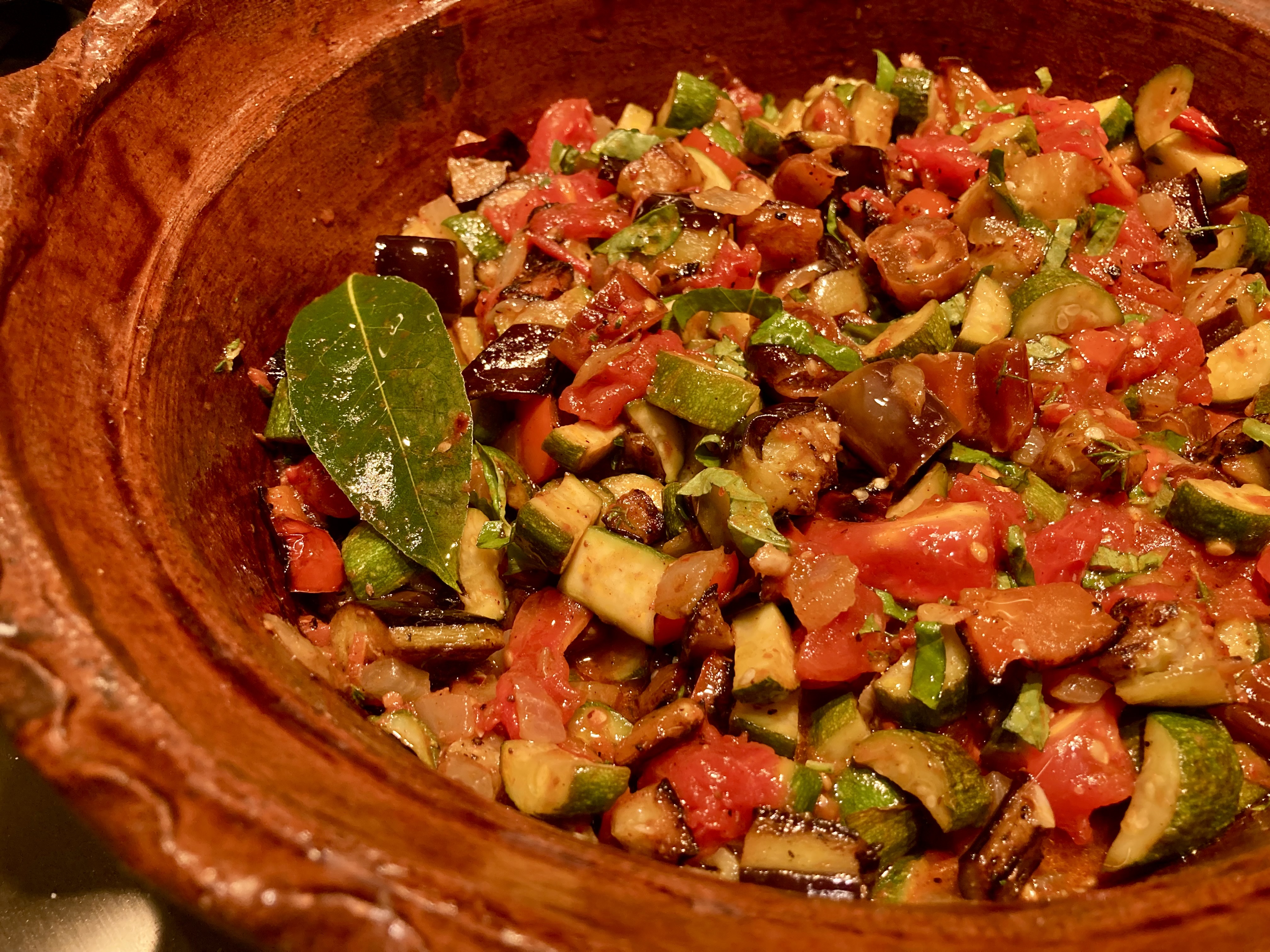
Ciambotta is Southern Italy’s version of ratatouille. It was a late summer ritual in my family, often using vegetables from my father’s backyard garden. Now it’s my responsibility to carry that on. Ciambotta translates to something like a big mixup or a mess, and the word is often used when someone has created a big emotional mess in their life, as in, “Richie made a real jambot outta his marriage.” (That’s how my family, and most Southern Italian Americans, pronounce the word.) The dish almost always contains the summer quartet of eggplant, sweet pepper, zucchini, and tomato, just like ratatouille, but the Italian version tends to be more freewheeling. Often potatoes or celery, and sometimes chunks of sausage or pancetta, are mixed in, making it a piatto unico, a one-course dish. One thing not to my knowledge ever added to it is dates. But this year they’ve made their way into my version, and I was very happy with how that turned out, the sweet dates playing again the bitterness of eggplant and the acidity of the tomatoes. A success.
I believe I got the idea of adding dates and North African spices to eggplant dishes from one of my Moroccan cookbooks, but I can’t figure out which one (I’ve got a lot of them). I’m thinking it was in a Ghillie Basan book. (If you don’t know her, maybe pick up Flavors of Morocco as a starter. Beautiful recipes, photos, and stories.) Wherever I got the idea from, I just went with it. As you’ve probably noticed, I often add North African touches to my southern Italian food. For me, that’s a natural, flowing from Naples and Sicily’s long-ago history. Much of the Arab influence in Southern Italy has diminished, but I’m here to bring some of it back.
Dates have always fascinated me. How can anything be as sweet as candy and yet be natural? When I was a kid I assumed dates were soaked in sugar, given a sort of candied-cherry treatment. I was amazed to find out they’re just dried. But what excited me more was discovering that those sticky brown dates actually start out as a fresh fruit. I first saw them at Kalustyan’s, the amazing Middle Eastern spice shop in Little India in Manhattan. They were plump, smooth, golden, hanging off of stems in clusters, like bloated grapes. The checkout lady gave me one to taste, and it exploded in my mouth in a sweet gush. Revelation. I try to make it back to Kalustyan’s each year in fresh date season, which happens to start right now and last through September. If you’re interested in tasting a fresh date, make your way over (maybe call first to make sure they’re in stock). However, you’ll want traditional dried dates for this recipe.
Also, if you’d like to read more about ciambotta and consider other approaches to putting this dish together, check out three of may earlier blog posts on the subject here, here, and here.
Extra-virgin olive oil 1 big summer onion, diced 1 red bell pepper, diced ½ a fresh peperoncino, minced 2 summer garlic cloves, thinly sliced 1 teaspoon ras el hanout spice mix (if you want to make your own, you might want to try my version) 1 large eggplant, stripe-peeled and cut into small cubes 2 fresh bay leaves A few large sprigs summer savory or thyme Salt 2 medium zucchini, cut into small cubes 3 medium-size summer tomatoes, peeled, seeded, and chopped, lightly salted, and left to drain in a colander for about 15 minutes (save the tomato water, as you might want it to loosen the dish at the end) A big splash of dry Marsala 10 to 12 pitted dates, cut into quarters A few drops of rice wine vinegar A handful of basil leaves, lightly chopped
Get out a large sauté pan, and set it over medium heat. Add a tablespoon or so of olive oil. Add the onion, bell pepper, peperoncino, half of the garlic, and half of the ras el hanout. Let sauté until everything is fragrant and starting to soften, about 2 minutes. Add the eggplant, one of the bay leaves, and the savory or thyme. Give it a drizzle of olive oil and some salt, and sauté until the eggplant is tender, about 6 minutes. Turn off the heat.
Get out another sauté pan, turn the heat to medium, and add a big drizzle of olive oil, the rest of the garlic, the remaining ras el hanout, and the other bay leaf. Sauté a few seconds, and then add the zucchini, sautéing until it’s tender, about 3 or 4 minutes. Add the tomatoes and a little more salt, and cook for about another 3 minutes. Add the Marsala, and let it bubble away.
Add this to the eggplant mixture. Add the dates, and mix well. Let everything sit for about 5 minutes. The waning heat from the vegetables will soften the dates but not enough to turn them into mush. Taste for seasoning, adding more salt plus possibly a few drops of rice wine vinegar, to bring up the acidity. Add a little of the tomato water if the ciambotta seems too tight. Add the basil.
Serve hot or warm, or even at room temperature. I love this served with scrambled eggs, but it’s really good with lots of things, such as lamb kebabs, or just as is, with Sicilian-style sesame seed bread, for instance.
Cooking a fish whole can be emotionally fraught. Not because it’s a difficult job. It’s not at all. But because you have to look into those swollen, glassy eyes and say, you’re dead and I’m still alive. You’d think I’d be used to that, cooking as long as I’ve cooked. But it’s always a new death staring back at me. However, it’s good to be reminded, when we want to eat fish or meat, that we or someone has to kill it. It’s a big ugly food chain out there. I’ll eat just about anything, and I’m glad about that. I’m also glad I didn’t grow up on a farm. That would have demolished my open-mindedness. I know that people say the closer your connection to food, the more respect you have for it. True up to a point, but unless I was literally starving to death, I could never personally kill a baby goat (I might be able to kill an old goat—not sure). I need to keep a certain distance to stay free. A coward’s way out. Although I know I can kill an oyster.
Now that we’ve discussed that, I’d like to tell you why you should cook a fish whole anyway. First off, the presentation is beautiful. If you want to impress someone, this is a nice way to do it. But the most important reason is flavor. It will be the best tasting fish of your life. The skin and bones add moisture and body and a certain lovely stickiness that you miss out on when you cook fillets. It’s that gelatinous quality that lures me every time.
To roast a whole fish what you’ll want to do is stick it in the oven. I’m not being condescending here, but that’s really it. From my experience, a 2½-to-3-pound whole fish, the size I used for this recipe, will take about 20 to 25 minutes at 425 degrees. Once you know that, the rest is style.
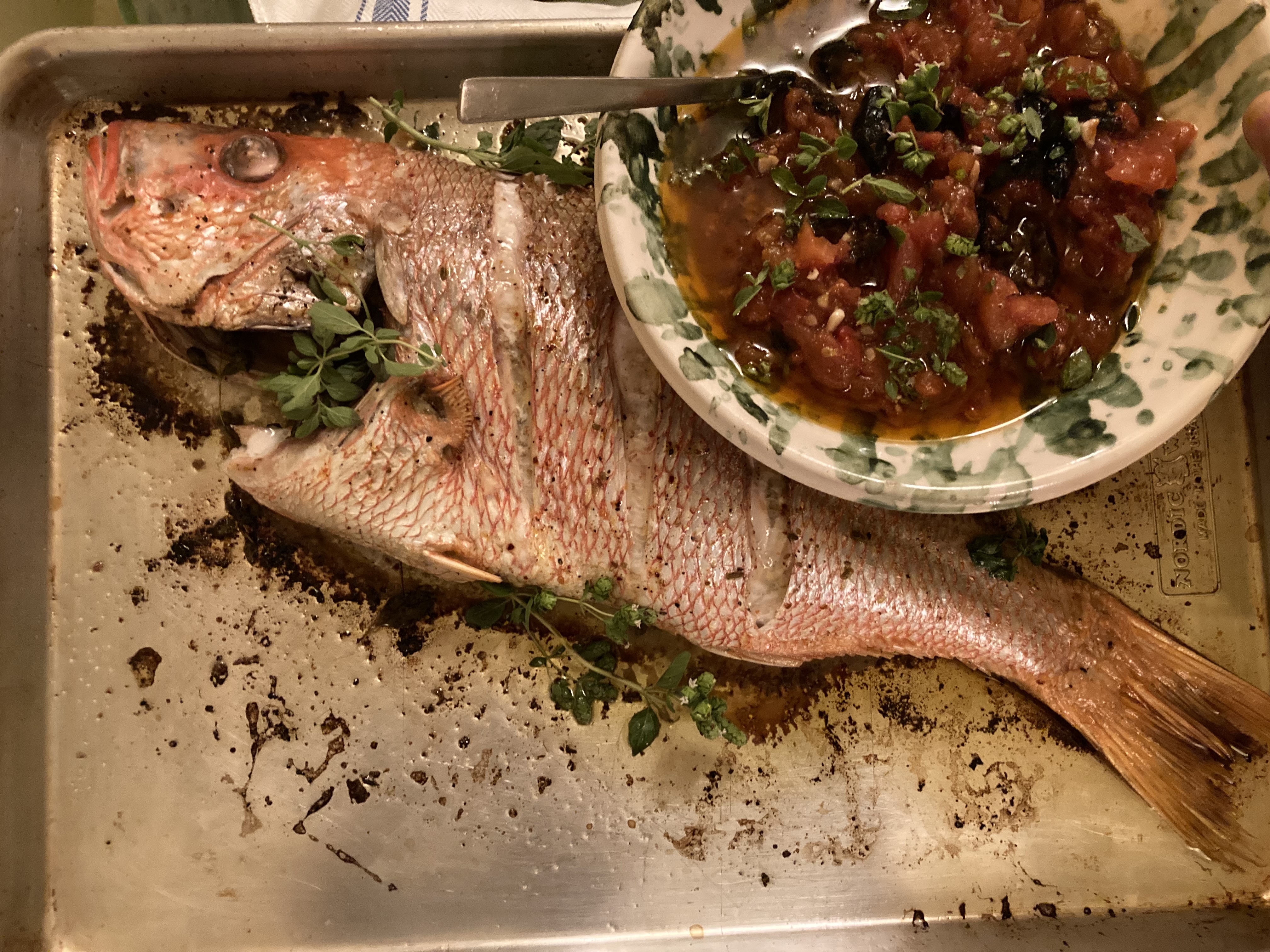
This time around I made a vibrant vinaigrette with lemon, good olive oil, and fennel seeds, and rubbed it all over the fish, inside and out, and then stuffed the inside with Italian oregano. That’s a favorite oregano of mine, not too harsh like the Greek variety. It’s actually a cross between Greek oregano and marjoram, so it’s more floral and less biting. It’s good for a mild fish like red snapper.
I also wanted to make a sauce with our peak-season New York tomatoes, cooking them quickly so not to drain any of their glory. Italian oregano came back as an element of the sauce. I also added those oily, wrinkled Moroccan olives, because I love them.
In the past, my problem with serving whole fish (aside from having to look it in the eyes), has been not how to cook it but how to fillet it when it’s done so my people don’t wind up with a mouthful of bones. Here’s a good video that shows you how to do that. The spoon he uses is a great idea. Long ago I used to try to lift the fillets off with a spatula, but that scraped up a ton of bones along with the fish. The spoon lets you move gently, feeling as you go.
Roasted Red Snapper with Tomatoes, Cumin, Moroccan Olives, and Italian Oregano
1 approximately 2½-to-3-pound red snapper, cleaned and scaled, the head left on The juice and zest from 2 lemons ½ cup extra-virgin olive oil, plus a little more for serving 1 tablespoon freshly ground fennel seeds Salt Black pepper 6 or so long Italian oregano sprigs
For the sauce:
Extra-virgin olive oil 2 summer garlic cloves, thinly sliced 1 fresh red chili, minced (and seeded if you like less heat) 1 teaspoon freshly ground cumin seed 3 anchovy fillets, chopped A splash of white wine 3 large red, round summer tomatoes, peeled, chopped, and lightly drained Salt A handful of oil-cured, wrinkled black Moroccan olives, pitted and halved 5 sprigs Italian oregano, the leaves lightly chopped
Preheat the oven to 425 degrees.
Get out a sheet pan, and place the fish on it. Make three shallow slashes through the body of the fish on both sides (this will help it cook evenly and also work seasoning into the flesh). Mix the lemon juice and zest, olive oil, fennel seeds, salt, and black pepper together in a bowl. Pour it over the fish, working it into the inside and into the slashes. Make sure both sides of the fish are covered.
Stick the oregano sprigs inside the fish, and put the pan in the oven.
While the fish is cooking, make the sauce. Get out a sauté pan, and set it over medium-high heat. Drizzle in a little olive oil. When the oil is hot, add the garlic, chili, cumin, and anchovies, and sauté until fragrant, about a minute or so. Add a splash of white wine, and let it bubble away. Add the tomatoes, seasoning with a little salt, and sauté about 3 or 4 minutes. Turn off the heat, and add the olives and the chopped oregano. Add a drizzle of fresh olive oil.
Take a look at the fish after 20 minutes. Check for doneness by sticking a thin knife into it along the backbone. If the flesh pulls away with just a little touch of pull, it’s done. And remember that it’ll cook further as it sits. Depending on the size and thickness of your fish, it may take a little longer.
When the fish is done, you can transfer it to a big platter, if you want to get fancy, but I just left it on the sheet pan with all the roasted herbs and juices spilling out. I thought it looked beautiful.
Fillet the fish (reviewing the video if necessary). Drizzle the fillets with fresh olive oil and a sprinkling of salt. Top each serving with some of the sauce.
Cooking a whole fish. That’s what I’m working on now. If you’re interesting in learning how to do this, stay tuned. A few thoughts, and they just might involve tomatoes. August cooking in New York. Nothing better.
Still Life with Aubergines, by Henri Matisse, 1911.
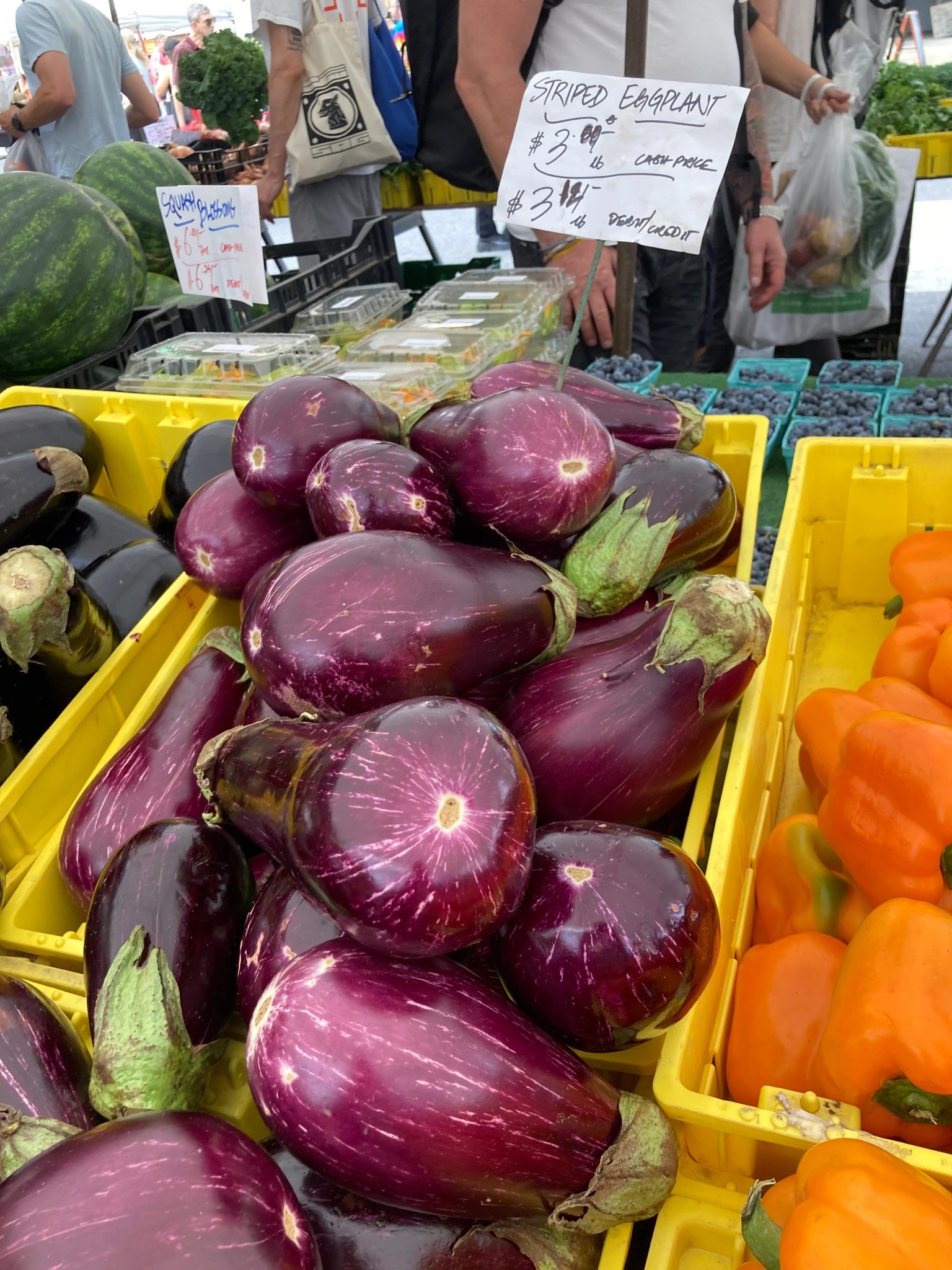
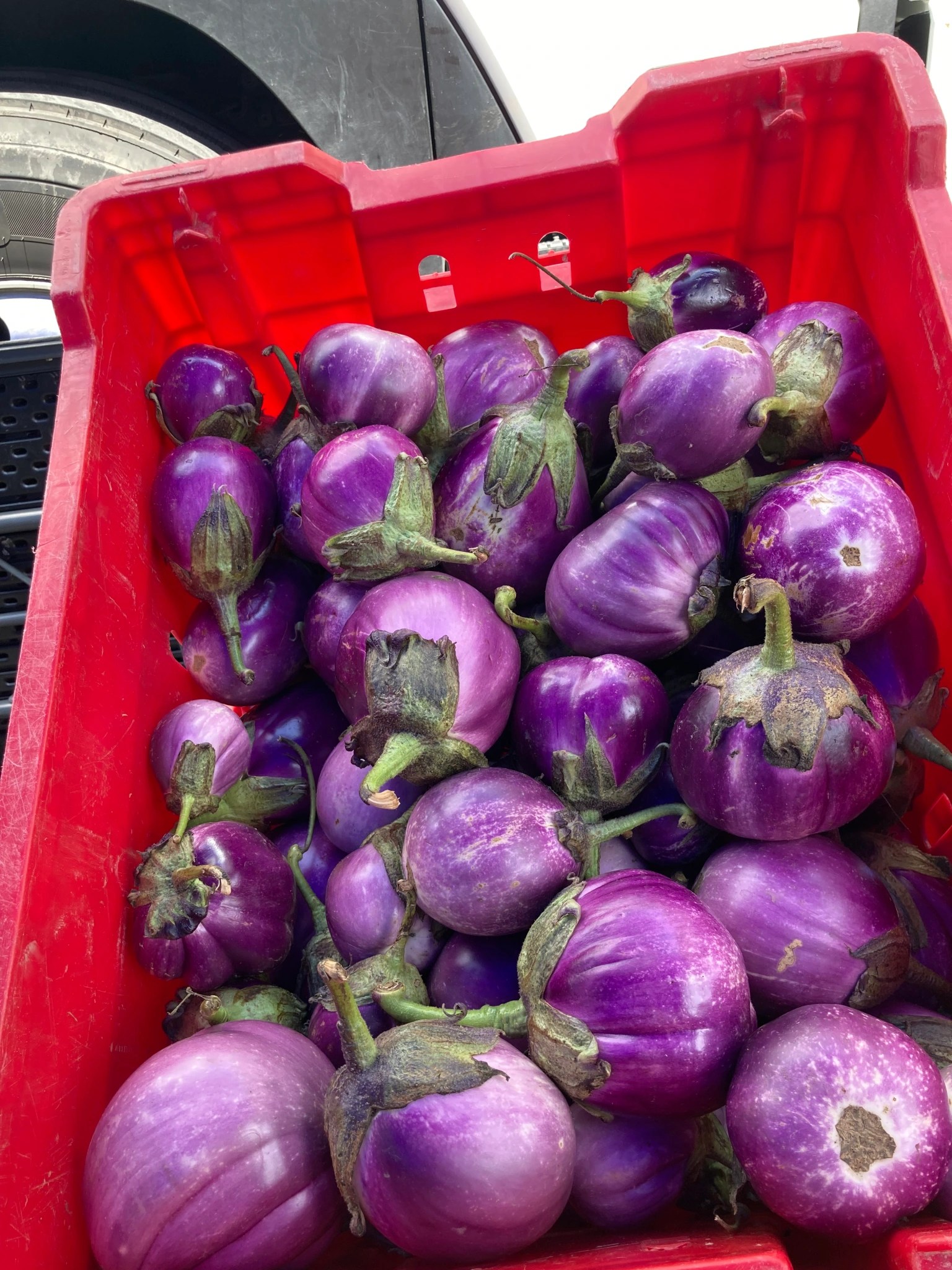
Eggplant is a vegetable of my childhood. It cemented my upbringing in Italian-American land. I grew up wanting it. All these years later I still want it, partly now for the various colors of its skin: deep purple verging on black, violet, clear purple, streaky purple, pure white, all shiny. Magnificent. I’m involved in the colors of food more than I used to be. They help me plan, not just my recipes but also my day. Color theme days. I have them, not every day but some days.
A type of graffiti eggplant, purple pink with streaks of white.
Unfortunately eggplant is not so beautiful when it’s cooked. It’s gray-beige, but its taste is rich. It soaks up herbs, garlic, olive oil, and wine better than most things. It’s a flavor trap.
Barbarella, a type of globe eggplant, blue-purple with hits of white.
Here’s a baked eggplant without tomato, a drift away from Parmigiano. It gets its togetherness from goat cheese and crème fraîche. I think it came out really well. I hope you like it.
I served it with grilled lamb chops marinated in rosemary, fennel seed, and garlic and a radicchio salad dressed with lemon, salt, and good olive oil.
It’s almost August. Tomato recipes will be coming soon. I’m working on a few that should be unexpected. Stay tuned.
Plus: Emergency. Happening now. Starvation in Gaza. I know we can feel angry and helpless in a terrible situation like this, thinking there’s nothing we can do, but there is something. We can support World Central Kitchen, either by donating our time or our money. Please help, if you can. Here’s their link.
Gray-beige but beautiful.
Eggplant Gratin with Goat Cheese, Honey, and Thyme
Extra-virgin olive oil 2 medium eggplants, stripe-peeled and cut into ½-inch-thick rounds Salt Black pepper 1 fresh summer garlic clove, minced 1 large egg 1 4-ounce-or-so log soft goat cheese, at room temperature (I used Président brand) ¾ cup crème fraîche ¼ cup whole milk 6 or 7 large thyme sprigs, the leaves lightly chopped ¼ teaspoon allspice 1 tablespoon runny honey (I used an acacia honey) ¼ cup grated Parmigiano Reggiano cheese ¼ cup panko breadcrumbs
Heat the oven to 400 degrees. Lightly coat 2 sheet pans with olive oil. Lay out the eggplant slices on them in a single layer. Drizzle the slices with olive oil, and season them with salt and black pepper. Bake until the eggplant is tender and lightly browned, about 20 to 25 minutes. Take the pans from the oven, and sprinkle the minced garlic over the slices.
Put the egg, goat cheese, crème fraîche, milk, half of the chopped thyme, the allspice, and the honey into a food processor. Add a little salt and black pepper, and pulse a times to blend everything well. It should be thick but pourable.
Turn the oven down to 375.
Coat a baking dish lightly with olive oil (I used an 8-by-12-inch, 2-inch-deep oval). Lay down a layer of eggplant slices (a little overlap is okay). Drizzle on about ¼ of the goat cheese mixture. Make another layer of eggplant, using it all up. Pour on the rest of the goat cheese mix.
In a small bowl, mix the Parmigiano with the panko and the rest of the thyme. Add a little salt and black pepper and a drizzle of olive oil. Mix it with your fingers, and then scatter it fairly evenly over the top of the gratin.
Bake at 375 until it looks firm and the top is lightly browned, about 30 minutes. Serve hot or warm.
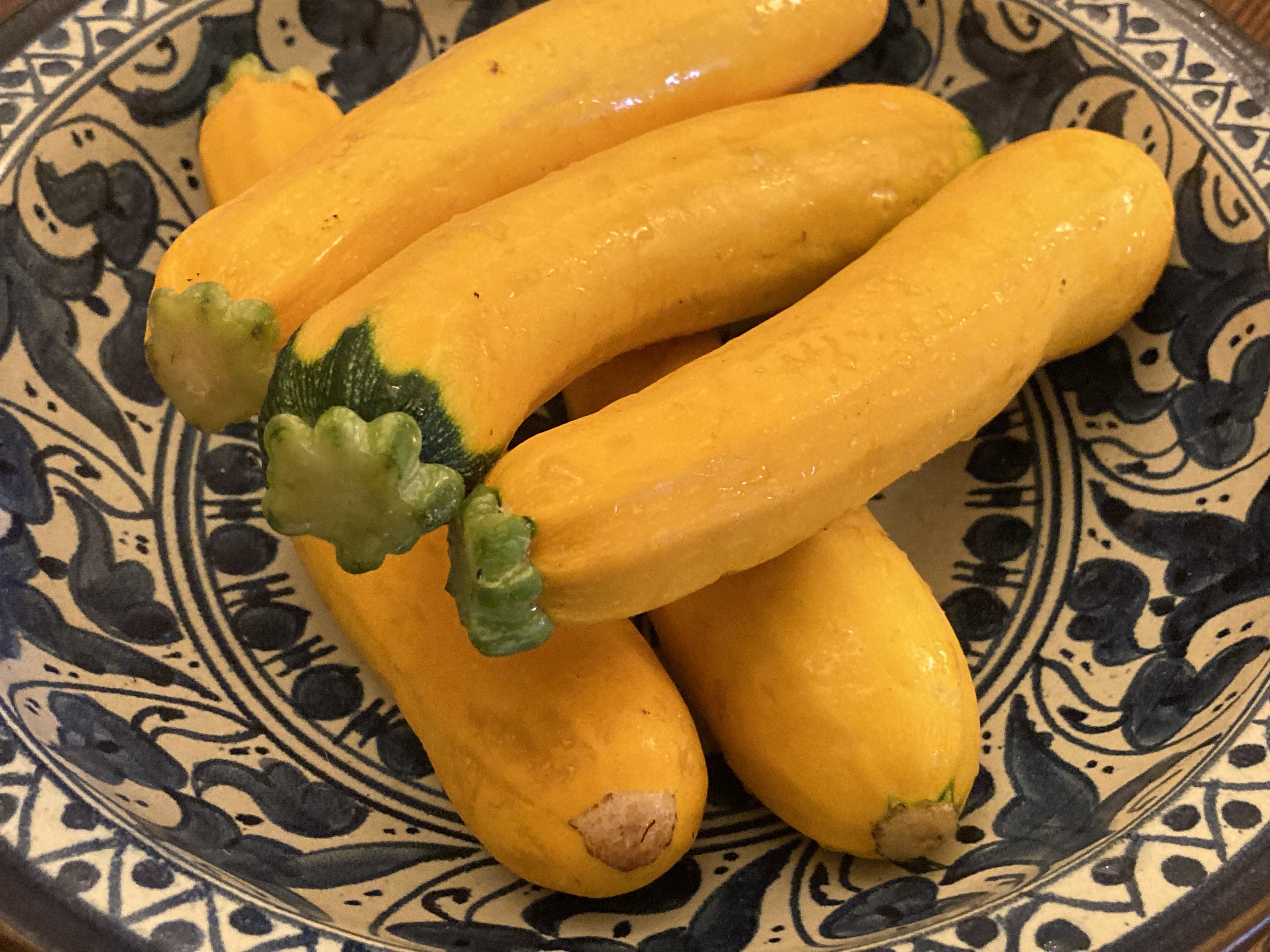
I bought deep yellow zucchini at Story Farms, in Catskill, New York, the other day. You can see in my photo that they have dark green tips near their stems. The things are gorgeous. Their yellow is thick, verging on orange. Of my Winsor & Newton watercolor tubes this would be their Cadmium Yellow.
Not only is this zucchini cultivar beautiful, it’s also a little sweeter than the green ones. Less green-leafy, more soil-earthy in taste. There are a bunch of varieties of yellow zucchini. The one I found at Story is called Golden Delight. Its color alone makes me grab some every summer. It’s a prompt. A call to action.
This time around, out came a soup. A cold soup. Topped with herbs, like everything I cook in the summer. Lately I love a simple herb oil garnish—just herbs, good olive oil, and a little salt, whizzed up to almost a purée. There’s nothing like it for herbal essence (remember that shampoo?). This time I used Genoa basil, set to bright green by quick blanching. I thought it looked wonderful against the yellow of the soup. You might instead go with spearmint if you prefer.
There’s no cream or butter in this soup, and that’s good when you serve it cold, letting the texture flow smooth and loose. The soup gets its depth of flavor from good olive oil, so use your best, both in the soup and in the herb oil. I chose Benza BuonOlio, made from 100% Ligurian Taggiasca olives. It’s rich and mellow with not much of a bite. Gustiamo.comcarries it. It’s a new favorite of mine.
I hope everyone is doing some creative summer cooking. We’re deep into it now.
Golden Zucchini Soup with Saffron, Basil Oil, and Pine Nuts
Extra-virgin olive oil (4 tablespoons for the soup, plus ⅓ cup for the basil oil) 1 large summer onion, diced 1 medium carrot, peeled and diced 5 or 6 medium-size golden zucchini, chopped 1 large Yukon Gold potato, peeled and chopped ½ teaspoon fennel pollen or ground fennel seed ½ teaspoon turmeric Salt A splash of dry vermouth 1 quart light chicken broth (or vegetable broth) A big pinch of saffron, crushed and dissolved in about ¼ cup hot water A big pinch of ground green peppercorn About 15 basil leaves A few drops of rice wine vinegar A palmful of pine nuts, lightly toasted
Get out a soup pot, and set it over medium heat. Add 2 tablespoons of olive oil, and let it warm. Add the onion and carrot, and sauté until both are fragrant and starting to soften, about 3 minutes. Add the zucchini and the potato, the fennel pollen or seed, and the turmeric, and season with a little salt. Sauté for another few minutes to open up all these flavors. Add the vermouth, and let it bubble away. Add the chicken or vegetable broth and enough water to cover the vegetables. Bring to a boil, and then cook at a steady bubble, uncovered, until the potato and zucchini are tender when poked, about 20 minutes. Add the saffron water, the green peppercorn, and 2 more tablespoons of olive oil.
While the soup is cooking, make the basil oil. Set up a small saucepan, and fill it halfway with water. Bring it to a boil, and add some salt. Drop in the basil leaves, and blanch for about 30 seconds. Drain them, and run cold water over them to set their color. Squeeze out as much water as you can, and put the basil in a food processor. Add ⅓ cup of olive oil and a big pinch of salt. Pulse a few times. You want a slightly chunky purée. Pour it into a small bowl.
Purée the soup in a food processor, and then chill it. When the soup is cold, check its consistency, adding a little cold water if it needs loosening. And check its seasoning, too, adding a few drops of rice wine vinegar for brightness if needed.
Top each serving with a spiral drizzle of basil oil and a scattering of pine nuts.
And here’s a little video from another of my favorite farm stands, Montgomery Place Orchards, in Red Hook, New York.
I’ve never done this in any organized way before, but I just now decided it would be a nice thing to rank my favorite herbs by how much I love them. I wanted to write it out for myself, and then I thought possibly you’d be interested in it, too.
I find good uses for every herb except cilantro, which makes me gag. I love summer savory with beans and braised beef and pork dishes, and in minestrone, but it’s not my favorite smell straight on. Thyme is an herb I use in many dishes, often as an anchoring flavor in the early stages of cooking. It’s amazing in a compound butter to melt over a thick pork chop, or as a starting point for chicken alla cacciatore, but cutting a few sprigs and bringing them up to my nose, why do I sometimes smell toothpaste? Strange. Oregano has a bite I expect to accompany certain grilled vegetables, eggplant and sweet peppers, for instance, and meats, sausages especially. It takes me back to my Italian American childhood. Yet a clean chomp on an oregano sprig doesn’t make me so happy. I love these herbs as tools for cooking, but for all-out beauty of aroma and taste, there are herbs that fall into a different category, ones of pure intoxication. Here are the herbs that are knocking me out right now, in early summer, best, then next best, then down to almost best.
This ranking will likely change as the season progressives. But this is my up-to-the-minute report.
Thai basil
Thai basil’s deep anise aroma is for me an exotic joy, but the herb’s taste is different from its smell, more like licorice. It’s really bold, but somehow I never tire of it. The herb still surprises me, even after years of cooking with it. And its strength doesn’t fade out with heat, unlike other basils. That’s a bonus. Siam Queen is the type I plant. It’s the standard Thai variety that’s easiest to find and grow in the Northeast. So different from Italian basil varieties. (Actually no basil is originally Italian. Their origins lie in India, Southeast Asia, and parts of Africa, but Liguria and all of Southern Italy have made basil their own.) Every spring when I plant my Siam Queen (it’s an annual), I feel like I’m giving myself a huge gift. Braised calamari with cannellini beans and Thai basil is an exception thing.
Marjoram
If it weren’t for my current love affair with Thai basil, marjoram would be number one. I consider it a perfume, meaning something I’d personally love to smell like. I use it so much in my cooking, I guess I do often smell like it. Even though it’s closely related to oregano, to me they are so different. Marjoram is sweet and floral, with none of the camphor tones of oregano. I do pick up a gentle pine taste, but there’s so much sweetness, too, that nothing registers as sharp. I even made a sweet marjoram sorbetto last summer, and you wouldn’t believe how desserty it was. (I tend to like desserts than could pass as appetizers.) Marjoram is my current favorite flavoring for shellfish. I recently used it in place of Italian parsley in a linguine with clam sauce, I thought with good results.
Genoa basil
Genoese basil is what Genoese pesto is all about. It’s a beautiful clean basil, without a profound hit of anise. For me, it’s a perfect blend of sweet and savory. My father always grew it in his backyard garden. Each leaf was precious. At the end of the season he’d salt what was left, wrap it in plastic and then in aluminum foil, and stick his little packages in the freezer, only to pull them out in December, the leaves now black as could be, to add to our Christmas Eve zuppa di pesce. Floating black strips in a sea of mussels and shrimp. That memory now makes me sad, I guess because we can now buy fresh basil at the supermarket year-round. He worked so hard on his basil. But there’s nothing like summer basil, picked from the garden and immediately ground down into a pesto. That ritual is reserved for high summer.
Rosemary
I’m crazy about rosemary, but I think I overdid it with it last year. I used it in places where I should have chosen something less obvious. I also added it many sweet things, like sugar cookies and polenta cake. It started to wear on me. But its pure pine aroma is such a draw, I reach for it sometimes when I’m feeling disgusted or agitated, knowing it will likely lift me up. However, it offers no sweetness. When I crush a needle in my fingers I capture fresh eucalyptus. I think the beauty of rosemary comes through best when you let heat open it up and diffuse its oils. Rosemary-and-garlic lamb spiedini, and rosemary-and-lemon roast chicken come to mind. Classics.
Fennel
Fennel is a natural flavor for me, maybe because I grew up smelling and tasting all the Italian fennel or anise liqueurs that appeared on our table after dinner. Sweet and bitter are stamps of many Italian childhoods. I grow a cultivated variety of wild fennel in my garden, mainly for its fronds. It has become a perennial there, in upstate New York. Not sure why. Maybe global warming? It grows tall and bushy and attracts Eastern swallowtail caterpillars, which is one of the reasons I plant it. Its fluffy fronds are excellent raw in salads and are a main component of pasta con le sarde, which I make at least once every summer. But the big event is when it goes to seed in the early fall. I cut off its umbrella-like flower stalks, which contain its seeds, and plunge them into Everclear to make my bright green finocchietto, a liqueur stronger and way less sweet than the sticky ones I grew up with. My finocchietto clears the head, and it’s also great worked into a big bowl of mussels with crème fraîche and tarragon.
Spearmint
A few years back I planted Berries and Cream mint, a spearmint cultivar. It jumped pot and is now taking over part of my garden. That’s a good thing. I use a lot of spearmint, especially since I began cooking Sicilian food years ago. Zucchini with anchovies, summer garlic, and fresh mint I make as soon as I see the first zucchini show up at the local farm stands. I just cooked up a pot the other day. Blood oranges, spearmint, a little red onion, salt. It is a dish I wait for every winter.
Spearmint is soft and sweet, good to just stick your nose into, which I often do. A strange thing happens when you heat spearmint. A caraway taste is released. That’s because both plants carry a molecule called carvone. I like its flavor, but I don’t want it in the forefront, so to preserve a clean mint taste I don’t let the herb stew in a dish. I add it at the last minute instead. And on a sweaty summer day I love grabbing a handful and sticking it into a pitcher of cold water, a glass pitcher so I can admire the herb’s beauty.
Lemon verbena
Its aroma is phenomenal, like pure, clear lemon zest without any of the bitter. But since lemon verbena’s brilliant aroma fades with heat, it’s a waste to add the leaves to a stew or a braise. I’ve learned that the best way to harness its beauty is to mince it raw into a semi-damp cluster. Then you can scatter it over cooked dishes or work it into an ice cream mix. I make a gremolata substituting lemon verbena for the lemon zest, mixing it with Italian parsley, maybe some sage, and fresh garlic. Grilled swordfish with that is a wonderful thing.
Bay leaf
If I tear a fresh bay leaf in half and bring it up to my nose and sniff it in, I sense a softness of atmosphere, a gentle mix of pine and thyme. Some people say bay leaves have no flavor. That’s just crazy. Maybe those dried-out things you buy in jars don’t offer much, but since now you can find fresh bay leaves year-round at many supermarkets, there’s no excuse for those. I like to use a few bay leaves to perfume a chicken broth that will go into risotto, and I often add the leaves to a winter tomato sauce. A dish I learned years ago from Giuliano Bugialli and still make often is baked ricotta lined with bay leaves, a lot of bay leaves. Their perfume penetrates the entire cheese. I love it drizzled with honey and served warm. Make sure you deal with true bay, with the fatter, more rounded leaves. The long, tapered California bay leaves can be harsh.
Italian parsley
After traditional Genoese pesto, my second favorite pesto is made with all Italian parsley, almonds, a little grana Padano, and fresh summer garlic. I love Italian parsley’s clean, slightly black pepper taste. I use it so often with seafood that I sometimes taste a fishy undertone when I bite a leaf, but I don’t think that actually exists. It’s just a brain jump. Have you ever tried making a salad of all Italian parsley? I eat that alone, dressed with good olive oil and a few drops of sherry wine vinegar. It tastes surprisingly deep to me. It also makes a great bed for roasted chicken.
And now for the recipe . . .
As you can see above I happened to buy one very large skate wing, which I knew would be difficult the cook and flip without breaking. I had a lucky flip, and it stayed in one piece. I’d suggest that for this recipe you get two smaller wings to make your life easier.
Salt ¾ cup marjoram leaves ⅓ cup extra-virgin olive oil (a good one—I used Benza Taggiasca oil from Liguria, which Gustiamo carries) A palmful of Sicilian salt-packed capers, soaked for about 10 minutes, changing the water a few times, and then drained The grated zest from a large lemon
For the fish:
2 cartilage-free skate wings, about ½ pound apiece Salt Black pepper Extra-virgin olive oil 2 tablespoons unsalted butter About ½ cup fine semolina (I used Bob’s Red Mill) The juice from 1 large lemon
To make the salsa verde, set up a pot of water, add salt, and bring it to a boil. Drop in the marjoram leaves, and blanch them for about 30 seconds. Drain them, and run cold water over them to stop the cooking and set their color. Give them a squeeze to remove excess water. Give them a rough chop. Mix the marjoram with ⅓ cup of your best olive oil, the capers, a little salt, and the zest from a large lemon. That’s your salsa.
Pat your skate wings dry with paper towels, and season them well, on both sides, with salt and black pepper.
Get out a sauté pan large enough to hold the fish without overlapping (you might need to use two pans). Set it over high heat, and add a few tablespoons of olive oil and the butter.
Pour the semolina out on a plate, and coat the skate on both sides, shaking off excess.
When the oil is hot, add the skate, and let it brown, about 3 minutes or so. Gently give the pieces a flip with a large spatula, and brown them on the other side, about another 3 minutes. When the skate pulls apart easily when poked with a knife, it’s done. Squeeze the lemon juice on the skate, and plate it.
Spoon a generous amount of the salsa verde down the middle of the fish. Serve right away.
I am a chef, food writer, and herb lover who specializes in improvisational Italian cooking. I am the author of The Flavors of Southern Italy and Pasta Improvvisata, as well as Williams-Sonoma Pasta, which is available at Williams-Sonoma stores. A member of the Association of Culinary Professionals, The New York Women's Culinary Alliance, The New York Culinary Historians, The Herb Society of America, and the Italian-based International Slow Food Movement, I live in New York City.














 Erica De Mane