
Recipe below: Rigatoni with Oxtail Ragù
I love a good coda alla vaccinara, a Roman-inspired oxtail, either served in bony hunks or worked into a ragù tossed with a solid pasta. I enjoy cooking the thing. It looks exactly like you’d expect, moveable joints in an ox’s tail (or nowadays more likely a cow’s tail). Oxtails need a long low braise, a cooking method that still amazes me with its transformative power. And the aroma of the cut is sweet as it loosens up and gives off its abundant collagen, producing a sauce with lots of body, a little like beef osso buco but even more unctuous. Roman-style oxtail is traditionally flavored with red wine (sometimes white), clove, guanciale, often lots of celery, sometimes marjoram, a hit of dark chocolate, and pecorino if made into a pasta sauce. I’ve had versions with raisins and pine nuts, but I consider that too rich for the cut.
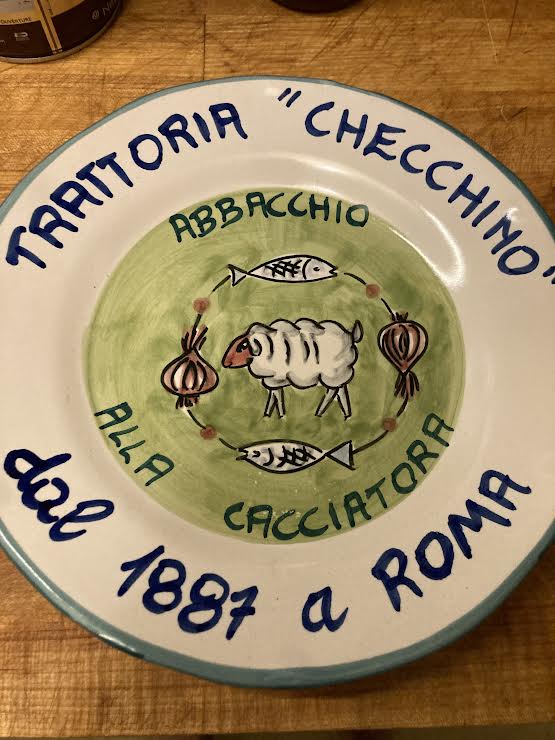
The first time I ate oxtail was many years ago, in Rome, at the famous Testaccio restaurant Checchino dal 1887, which is still going strong and run by the same family as always. Checchino continues to serve all the quinto quarto (offal) dishes from the neighborhood’s slaughterhouse days—oxtail in a stew or with pasta, rigatoni con la pajata (stuffed lamb intestines, one of my other favorites), insalata di zampe (a trotter salad) among them. I know a lot of you have eaten at this wonderful place on the Testaccio Hill, such a spooky Romantic walk up there, in the dark, especially in winter, when I most want to eat these dishes. On one visit I even bought one of their Buon Ricordo restaurant plates, corny but so nice to have now hanging on my kitchen wall.
I’m hoping to get back to Checchino soon, but in the meantime if I want to eat oxtail at a place closer to home (besides my own kitchen), there’s still Lupa, on Thompson Street, one of Mario Batali’s old trattorias, now run solely by his former Bastianich partners, and still, in my opinion, a good place to eat classic and improvisational Roman food. I loved the place when it first opened, in 1999, and soon after when Mark Ladner was the chef. Its coda alla vaccinara served over Roman-style gnocchi, big, round disks made with semolina, was excellent. I went back recently to taste Lupa’s oxtail again. It was good but had a heightened agro dolce taste that for me was just a bit too much, overshadowing the sweet richness of the meat. I was looking for that oxtail signature mellowness. Too much chef’s tinkering, I thought.
When I want to cook oxtail at home, and I often want to, I pick a long, cold day and get myself set up. For this version I decided on a boneless ragù with pasta, but if you wanted you could leave the meat on the bone and serve it with all its dark sauce over Roman gnocchi or polenta. I love it both ways. Here I went a bit untraditional, replacing the clove with the more rounded taste of allspice, ditching the chocolate and the marjoram and instead going with rosemary and fresh bay leaf, a flavor combination I’m wild for, especially in the fall. I still have rosemary in my garden (although it will die off soon, as it doesn’t winter over in my New York climate), and I just brought my bay laurel bush in for the season. It has been doing well indoors, thriving even, for five winters now. I put in against a big window where it gets good sun, and I water it sparingly.
In New York you find oxtails not only at Italian places but, more often, at Jamaican restaurants, where they’re traditionally stewed with butter beans, Scotch Bonnet peppers, allspice, and brown sugar. A great rendition. And I’ve started to see oxtail pizza around town, made mostly at places that are more hipster and less strictly Italian. I haven’t tried an oxtail slice yet, but I’ve seen that Cuts & Slices makes four different types of oxtail pizza, one with curry, another that includes hot chilies, which sounds good to me, and one that’s somewhat teriyaki, which doesn’t sound good to me at all.
Since the weather is changing fast, I hope you’ll give my improvisational Roman dish a try.

Rigatoni with Oxtail Ragù
Extra-virgin olive oil
About 3 pounds oxtails (try to get the wider, meatier middle cut, not the tiny tail ends)
Salt
Black pepper
A big pinch of sugar
An approximately ¼-inch-thick round of pancetta, cut into small cubes
1 big onion, cut into small dice
2 carrots, cut into small dice
2 inner celery stalks, cut into small dice, plus the leaves, lightly chopped
1 teaspoon freshly ground allspice
2 fresh bay leaves
4 good-size rosemary sprigs, the leaves chopped
1 glass dry white wine
1 glass sweet red vermouth
1 cup homemade chicken broth
1 28-ounce can Italian plum tomatoes, chopped
A splash of balsamic vinegar
1 pound rigatoni (lately I’ve been using Sfoglini, an artisanal brand made in the Hudson Valley using American wheat)
A chunk of pecorino Toscano (you’d think I’d use pecorino Romano, but most of the brands I find here are too sharp for my taste).
Preheat the oven to 325 degrees.
Get out a large casserole that will hold the meat in more or less one layer. Turn the heat to medium high, and drizzle in a tablespoon or so of olive oil. Season the oxtails with salt, black pepper, and sugar, and brown them on all sides. Add the pancetta, and let it get a little crisp. Add the onion, carrots, and the celery with its leaves. Add the allspice, bay leaves, and rosemary, and sauté until everything is fragrant, about 3 or 4 minutes. Add the white wine and the red vermouth, and let it bubble away for about a minute. Add the broth and the tomatoes. Season with a little more salt and black pepper. The meat should be almost completely covered with liquid; if not, add a little water, or more broth if you have it. Bring it to a boil. Cover the casserole and stick it in the oven. Let it simmer there until the meat is tender, about 2½ to 3 hours. Check once or twice during that time to make sure the liquid hasn’t cooked down too much.
When the meat is good and tender, take it out of its liquid and let it cool off a bit. Skim most of the fat from the liquid. Oxtails throw off a lot of fat.
Next get in there with your fingers and pull the meat from the bones, discarding any really fatty or gnarly bits. Chop the meat well, and put it back in the pot. Simmer, uncovered, over a low flame, for about a half hour. Oxtails are collagen-rich, so the sauce should have good body with a slight shimmer on the surface and be thick enough to cling well to pasta.
Taste, and correct the seasoning. Oxtails tend to be a little sweet, so I sometimes find a drizzle of balsamic vinegar is good to add acidity. It’s a judgment call.
Toss with al dente rigatoni, adding a little of the pasta cooking water if needed to loosen the sauce. Pass the pecorino Toscano around the table for grating.


 Erica De Mane
For years, my favoured way of preparing oxtail has been the classic French braise, Queue de bœuf aux pruneaux. The meat is sweet and has great depth of flavour, brought out by the long, slow cooking. So your dish caught my eye, straight away, as an appealing alternative and I’ll be trying it very soon.
As you say, these type of dishes are ideal once the seasons change and colder weather is with us. We had a big storm blow though the UK only last night: strong winds and heavy rain, so today would be a perfect day for oxtail. I expect there’ll ne none to be found at any of the local food shops – but such is life.
Hi Clive, I’ve never made the French braise oxtail, but I’m going to try it soon. When I cooked at Florent many moons ago, we made a Normandy style oxtail with cider and served it over celery root puree. You got me thinking about that. Happy cooking to you. Erica
There’s a reliable recipe for the French braise in my blog.
I was able to buy oxtail, today, and it will be ready in about an hour. I’ll just have time to strain off the liquid, chill it and then lift off the solidified fat before recombining the elements as I reheat them for tonight’s supper. I am lucky to have guanciale (my own), so I have no need to substitute pancetta, but I have substituted a light red wine as I have no Vermouth in the house and didn’t want to get a bottle especially. Romano will have to do instead of pecorino Toscano, but I’ll tone it down by blending it with a little grana padano. My imported Italian bronze die rigatoni will be perfect, and we’ll drink the rest of the bottle opened for the sauce.
I love Italian food – thank you for the recipe.
Erica. Thank you for another fine post. Always good to see ingredients like oxtail being championed. Your ragu looks fantastic! Any suggestions for an oxtail substitute? Household tradition reserves that increasingly harder-to-find cut for Rabo de Toro. As it so happens, my desire to get through the rest of this life behooves being a compliant cook.
Hi Craig, I’m so glad you like my post. As for a substitute, you could try short ribs or beef osso buco cut. Just adjust the cooking time. Oxtails take a little longer. Happy cooking to you. Erica
OMG you’ve got me…I adore oxtails! And surprise, surprise not only are we in Rome but have our usual visit to Testaccio planned for next week! The weather here has not been co-operating at all with oxtail weather but I’m simply going to have to have some regardless. Thanks for the reminder about Dal Cecchino and fingers crossed those plates are available…I only have one from Del Dalfina in Artimino and I’m desperate to find another one here…for all the years of Rome adventures.
Phyllis, I haven’t been to Rome since before Covid. I wish I could come with you. Have a great trip, and get some oxtails, for sure.