Feeds:
Posts
Comments


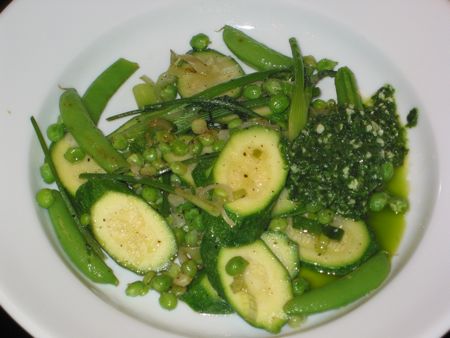
You can serve this pretty spring dish either hot or at room temperature.

Recipe: Spring Vegetables with Mixed Herb Pesto

The more you crowd your plate with beautiful vegetables, the less room you have for bad fats and refined carbs. A little bad fat and carb is desirable, but I’ve found that an excellent way to avoid overdoing it is by learning to be a fabulous vegetable cook. That’s not so hard, especially this time of year, when good things are bursting forth from our still somewhat productive earth, beckoning to be cooked and eaten.

I like going to the market and simply selecting vegetables by color, and then coming up with a way to present them, all together, in a palate of visual and savory pleasure. This week I picked up snap peas, shell peas, little baby fennel, and first-of-the-season zucchini, all in varying shades of green that really caught my eye. And I grabbed basil, parsley, and tarragon because there they were there. I decided to do a little sauté of pretty green things and make a pesto of green to go with it. Now I had a plan. Continue Reading »


Gelato in brioche, a bad Sicilian idea of breakfast.

Recipe: Uova in Purgatorio (Eggs in Purgatory)

Every diet I’ve ever heard of instructs you to eat a good breakfast. It will supposedly set you up for the day. I for one am not hungry in the morning. Am I supposed to eat anyway just to get set up? What I’ve always wanted in the morning is nothing but coffee, a big cappuccino. Maybe if I started getting shaky and deranged, a sign of a blood sugar dip, I’d want breakfast, but I never feel that way, unless I overdo it with the coffee.

If I’m coerced into eating breakfast, I get just as hungry for lunch, and at the same time as if I hadn’t eaten breakfast at all. Eating in the morning jump starts my eating cycle, depriving me of several peaceful hours where I feel no need to stuff my face. As I see it, there’s very little point in ignoring the individual quirks of your own body and mind, no matter what the diet experts say.

I’ve been reading a book called Eat, Drink, and Weigh Less, drawn to it initially because it had the word drink in the title. This book, written by Mollie Katzen, of Moosewood Cookbook fame, and Walter Willett, M.D., a nutritionist, is in many ways a fine, reasonable book, aside from some very unreasonable, non-Italian, health-foodie recipes, heavy on the tempeh and cumin. What this book says about breakfast makes perfect sense: “When it comes to smoothing out the peaks and troughs of hunger all day long, a good breakfast starts things off on exactly the right track. Skip breakfast . . . and it’s easy to set off a chain of overeating that lasts till bedtime.”

Every diet book says this, so it must be true, but it’s not true for me. Eating breakfast makes me gain weight. Eating breakfast just adds another meal when I don’t even want it. This book emphasizes setting your blood sugar at a good level by eating whole grains and some protein. That sounds perfectly and scientifically sensible, but don’t let it scare you into eating when you don’t feel like it. After reading tons of diet books and blogs, you’re led to believe skipping breakfast turns you into a savage, food-starved beast, grabbing at any edible thing in your path and stuffing your face endlessly until you finally pass out at night in a bloated haze. For me, I’ve found the opposite to be true. Do you still have to eat breakfast? Dr. De Mane says no, unless you want to. Continue Reading »


Benito Mussolini stands on a wheat threshing machine in Aprilia, Italy, to inaugurate the harvest of 1938 (I love the no-smoking sign).

Recipe: Warm Wheat Berries with Shrimp, Peas, and Spring Onion

A culinary trilogy has been running through my head all spring: dishes made from a seafood, a green vegetable, and some form of whole wheat. My recent posting of a recipe for Mussels with Whole Wheat Linguine, Swiss Chard, and Smoked Chili came from this mindset, and I’ve got more brewing in my little Italian-American head.

I really love whole wheat berries. I love the pure wheat aroma that fills my kitchen while they simmer. Their texture and taste is really special to me. I believe I first encountered their taste as a kid when we ate pastiera, the Southern Italian Easter cake filled with wheat berries and ricotta. In Southern Italy, wheat berries are used in all sorts of salads and soups. both hot and cold. Sicily has a filling dish called cuccia in which wheat berries are served warm, mixed with ricotta and usually something sweet like honey or grape must (possibly not a great diet choice). You traditionally eat this on St. Lucy’s feast day, December 13. I often buy big bags of wheat berries for no particular reason, just because I want to have them in my kitchen. I always find something to do with them.

Since spring pod peas have just arrived at my New York Greenmarket, I know I have to cook with them right away. Despite what people always tell me about the virtues of frozen peas, I’m sorry, but they’re just not as fine as fresh, and all the work involved in shucking and blanching just makes the latter more special for me. Continue Reading »


Ultra-fresh mussels from the Union Square Greenmarket.

Recipe: Mussels with Whole Wheat Linguine, Swiss Chard, and Smoked Chili

This past weekend I bought the most beautiful mussels from Phil Karlin, the number-one fish man at the New York Greenmarkets. They were tiny, glistening black, all shut tight, and they cooked up amazingly sweet and creamy. I’ve been getting local Long Island fish from Mr. Karlin for many years, and his seasonal catch has spoiled me. Nothing else seems fresh enough. His calamari? It’s slippery, firm, and caught that morning. His whole fish (I’ll take whatever he has on any given day) is a pleasure to clean—even the guts are pristine (he sells some pre-cleaned fish, but I actually enjoy the grisly labor).

I had these gorgeous little mussels in my kitchen, and I knew I wanted to show them off. Not only are mussels incredibly delicious, but they’re a low-calorie, low-fat, high-protein food, just about perfect. I love pasta with any type of shellfish, but since I’ve been trying to limit my intake of refined carbohydrates, I’ve switched more often than not to whole wheat pasta. Sound dreary? Not at all, as it turns out. You just have to rethink your sauces a little, making them piu forte. My solution for the mussels was to add bitter greens and a hint of spicy smoke, both flavors able to stand up to the whole wheat taste and texture, balancing the dish nicely. Continue Reading »


Nasturtiums at the Union Square Greenmarket in Manhattan.

And if you’d like to eat flowers, try some of these. They’re gorgeous and delicious. Here’s a recipe:

Arugula Salad with Nasturtium Blossoms, Spring Onion, and Black Olives

(Serves 2)

1 large bunch arugula, stemmed
1 small spring onion, very thinly sliced, using some of the tender green part
1 1/2 tablespoons extra-virgin olive oil
1 teaspoon Spanish sherry vinegar
A few scrapings of fresh nutmeg
A pinch of salt
Freshly ground black pepper
A small handful of black Niçoise olives
About a dozen nasturtium blossoms

Put the arugula and onion in a salad bowl. Whisk the olive oil with the vinegar, and season it with the nutmeg, salt, and black pepper. Pour the dressing over the salad and toss gently. Scatter and olives and nasturtium blossoms on top. Serve right away.


Skate with Neapolitan flavorings, and a side of cheesy broccoli.

Recipes:
Sautéed Skate with Puttanesca Sauce
Broccoli with Spring Garlic, Vermouth, and Pecorino

Many people get nervous at the thought of cooking skate, a devilish ray from a voyage to the deep. There is really no need to worry. Skate is one of the easier seafoods to prepare. It stays moist even if slightly overdone, a rare quality for any seafood. It’s forgiving. It tastes like lobster. It’s absolutely delicious. Many of my friends will order it on a menu but not have the courage to bring it into their home. Bring it in. I’ll show you what to do.

Skate has no bony, fish-like skeleton, but instead is held together by cartilage, much like what keeps the tip of our nose jutting out from our face. You can cook it with the cartilage intact, but it’s easier to consume when filleted. Since the fillet is a little tricky to work off the cartilage in one piece, have your fish seller do it. Most places sell it already cleaned anyway.

My favorite way to cook skate is a quick pan sauté in a slick of olive oil, much the way I treat any number of fairly firm, white fish fillets, such as catfish or sole. I do a light dusting of flour, salt, and pepper, get the skillet really hot, and brown the skate well on both sides for a crisp crust and delicate insides. When cooked, a skate wing separates naturally into juicy, very tender cords that resemble crab meat (and that do, I swear, taste like lobster).

Skate is rich. It needs acidity. A standard French bistro treatment is a pan sauté with a finish of capers, lemon, and brown butter. They got that one right. Puttanesca, as all you Italian food lovers out there know, is a pasta preparation from Naples. The components, all strong flavors, usually capers, olives, anchovies, tomato, garlic, and herbs, go great with rich seafood, so I’ve decided on a Puttanesca-like sauce to top my skate. Continue Reading »


Marcello snacking in bed? How un-Italian of him.

This is a problem. I never was much of a dessert person, but if I ate early and had time to kill, hanging around reading or watching TV, I’d start craving another glass of wine—totally bloating and unnecessary. And after finishing off the dregs of the bottle, I’d sometimes go back for round two and finish off that last piece of lasagne, or stuff in a few more meatballs. It’s just the same for you who crave sweets. The more time you’ve got to digest your food before bed, the more attractive that tub of gelato, hunk of salami, or extra vino is. Solution: Eat late. As late as you can. When you eat at six o’clock, unless you’re a farmer who has to rise before dawn, what are you going to do all night? Watch TV and raid the refrigerator is probably the answer. So drag it out, eat at nine, as they do in Italy and Spain. I love stuffing myself and then lying down with a book—usually a cookbook, wouldn’t you know it—and a couple of cats on my chest. All of a sudden it’s midnight, and I’m still full from dinner and ready for sleep (and I sometimes even wake up in the morning feeling full).

I’ve always heard that you shouldn’t go to bed on a full stomach. It’s bad for acid reflux, and calories eaten before bed are somehow super calories, harder to burn off and quickly turning to fat. The calorie part is simply not true, according to recent studies, including one from Oregon Health & Science University. Our bodies don’t stop working and burning calories when we sleep, so there’s no special time when we store fat. The same meal eaten at six or at nine will cost the same number of calories and be processed by our bodies the same way. The problem, insofar as there is one, is that late evening is a notorious time for binge eating. But that’s why a healthy, low-calorie late-evening dinner, with no snacking, has worked for me (and if you go out to eat, it’s easier to get a reservation at a late hour).

Now that I know calories are calories whenever consumed, any trick that stops me from squeezing in an extra little meal is worth it. When I was a kid my family would often have those huge Italian Sunday suppers at five or six, with the “big” sauce loaded with meatballs, sausage, braciole, and hunks of pork. I’d feel stupefied afterward, but then around ten or ten-thirty, my father and I would be hovering around the refrigerator digging for leftover meatballs and sausages to make huge hero sandwiches with. We’d have dinner all over again. Even as a kid, I felt that there was something wrong here, and as I watched my father’s gut expand to beach-ball dimensions, I became convinced of it. No one over the age of two needs four meals a day. So get a grip. Dispense of your American or Italian-American eating habits. Eat like a real Italian. I’m sure Marcello would have never eaten in bed; this was just for the movies.


My light-as-air soufflé, just about ready to pull from the oven.

Recipes:
Fontina and Piave Cheese Souffle
Baby Spinach Salad with Radishes and Chive Vinaigrette

A soufflé is for me the ultimate diet food. You might find that strange, but think about it. It’s light and fluffy, gorgeous, romantic, and smells amazing while cooking. Okay, it’s full of eggs, but mostly the whites. It’s low-carb, so it fits into my diet philosophy nicely. And I serve it as a main course, not a side. But is a soufflé Italian? The word, which comes from the French verb souffler, meaning to blow, obviously isn’t. The technique, as far as I can determine, is traditionally French, but the true lineage of many French and Italian dishes can be a sore subject, since many Italians believe that everything culinarily worthwhile was originally Italian. Italians certainly use the term on menus, and chefs there make some fine soufflés using, for instance, porcini, Parmigiano, ricotta, and zucca. How beautiful is the idea of a soufflé made with Italian flavors?

Sformato is a word you’ll find on Italian menus as well. It means a delicate, eggy, baked mold, firmer than a traditional soufflé, more a custard than a puff. A sformato is always set with eggs, but it may or may not have beaten egg whites folded in at the end. I love a sformata, but it’s not particularly diet-friendly. I make one with cauliflower that has the texture of a tender custard. I’ve also made a chicken liver sformata that’s firm, with a rich flavor heightened by sage and Parmigiano. Neither is meant to rise very much, and both contain cream, making them dense and rich, packing a lot of calories into a very small lump of food (and they’re generally thought of as first courses, so they’re just the start of the meal). Continue Reading »

Don’t let this happen to you.


A dieter’s delight.

Recipe: Pork Tenderloin with Roasted Pepper and Fennel Sauce

Pork tenderloin is a dieter’s delight. It’s got just about no fat—which is why I almost completely avoided it for years. Not only was I skeptical of fatless pork, but the few times I prepared the cut, it was dry and boring. In retrospect I think that was because I was still under the influence of the old-fashioned hammered-to-death pork cookery of my childhood. Now I’m enlightened. I’ve cooked up a few tenderloins lately, and I’ve discovered that they cook amazingly quickly. You should leave them pink at the center. That makes them a most delicious cut of pork, not as porky maybe as a big fatty, bone-in chop, but elegant, simple to slice, and open to all sorts of flavorings. So you can get really creative. I’ve chosen to emphasize fennel here. Pork with fennel is a classic Italian combination. I marinate the tenderloin for about an hour in fennel seed and a splash of pastis, among other things, and also include a touch of fennel in my roasted sweet pepper sauce.

One of the best ways to cook a whole pork tenderloin (a cut of meat that looks remarkably like a horse’s thingy, I must say), is by browning it well on the stove and then putting it in the oven to finish cooking (grilling is my second favorite method, and I’ll provide a recipe for that as we head into summer). You just want to get the meat’s temperature up to 140 degrees. That will make for a touch of pink and a lot of juiciness. Many books, even recently published ones, tell you to cook pork tenderloin to 150 to 155 degrees, and they claim that that will give you pink. Don’t do it. The result will be dry and gray. This small, tender cut, much like a chicken breast, keeps cooking after you take it out of the oven, more than does any larger, fattier cut, so if anything, you want to take it out a little sooner. The last one I made, I pulled at 138 degrees, and after I let it rest for about 5 minutes, it sliced into gentle pinky-beige perfection. It’s what I made for my mother on Mother’s Day. She loved it, and she’s not even on a diet. Continue Reading »