Feeds:
Posts
Comments


Orange cauliflowers at the Union Square Greenmarket.

Recipe: Orecchiette with Orange Cauliflower, Raisins, Pine Nuts, and Saffron

I stand in my kitchen holding an orange cauliflower, and I think, this has to be one of the most beautiful vegetables I’ve seen in a long time. It looks like a cauliflower drenched in creamy cheddar cheese. In fact it is sometimes called cheddar cauliflower. I was told by the upstate farmer I purchased it from that the orange color remains after cooking. I was skeptical, since I’ve cooked up bright green and deep purple cauliflowers, and they both faded to pale beige-gray when blanched.

I knew this cauliflower was destined for a pasta sauce. I love cauliflower with pasta, especially when I prepare it in Sicilian fashion, with noble additions such as pine nuts, almonds or pistachios, raisins, saffron, bay leaf, and sometimes wild fennel or anchovies, sometimes capers. I thought about all these opulent Sicilian possibilities and picked quite a few for this dish. And, more important, I can report that the orange color remained after cooking, even becoming more orange. The taste is about the same as that of the more standard white varieties, but when the little orange florets are tossed with pasta, they don’t blend into one big bowl of off-white the way traditional cauliflower does. The orange prettily pops out at you. It’s a happy look. We get a little free beauty in our bowl, which is fine with me. I’ll take beauty wherever I can get it.

Cauliflower with pasta is a very delicious and very healthy dish, as anyone who reads this blog knows, but too much pasta is still too much pasta. I’m really trying to get into the habit of eating pasta as a first course, in true Italian fashion. The Italians have got the thing worked out, and they know that pasta won’t make you fat if you do as they say: Make every pasta dish beautiful and delicious, and savor every bite. Then take it away and move on to something lean and something green. I’ve come up with a few excellent dishes, mostly meat or fish preparations, that I put together while I’m preparing a pasta and serve just warm or at room temperature, along with a green salad. A small bowl of perfect pasta, a small protein course, and a gorgeous green salad—that’s my idea of a great meal, and one that won’t have you running back and forth into the kitchen all night when you should be relaxing and enjoying your dinner with friends or family. I’ll be posting recipes for some of these post-pasta dishes soon. In the meantime, enjoy your pasta.

Orecchiette with Orange Cauliflower, Raisins, Pine Nuts, and Saffron

(Serves 6 as a first course)

1 small orange cauliflower or ½ a larger one (or use a white, green, or purple one), cut into small florets
Extra-virgin olive oil
1 large Vidalia onion, thinly sliced
4 anchovy fillets, chopped
1 fresh bay leaf
Salt
Freshly ground black pepper
1 pound orecchiette
½ cup pine nuts, lightly toasted
½ cup black raisins, soaked in ¼ cup dry white wine
A generous pinch of saffron threads, dried, ground to a powder, and soaked in a few tablespoons of warm water
6 large thyme sprigs, the leaves chopped
A handful of Italian parsley leaves, lightly chopped
A chunk of Moliterno or another aged pecorino cheese for grating

Set up a big pot of pasta cooking water, and bring it to a boil. Season generously with salt, and drop in the cauliflower. Blanch for about 3 minutes. Scoop the cauliflower from the pot into a colander with a large strainer spoon. Run cold water over it to stop the cooking and to set its beautiful orange color. Let it drain.

Choose a large skillet, and get it hot over medium flame. Add two tablespoons of olive oil and the onion, the anchovy, and the bay leaf.

Bring the water back to a boil, and drop in the orecchiette.

Sauté the onion until it’s soft and fragrant, about 5 or 6 minutes. Add the cauliflower, and season with salt and black pepper. Sauté until the cauliflower is just tender, about 3 or 4 minutes longer. Add the raisins and wine, the pine nuts, the saffron water, and the thyme, and let everything simmer for a minute or so.

When the orecchiette is al dente, drain well, saving about a cup of the pasta cooking water. Pour the pasta into a large, warmed serving bowl. Add the parsley, a few more turns of black pepper, and a generous drizzle of fresh olive oil, and give it a toss. Pour on the cauliflower sauce, and toss again, adding a little of the pasta cooking water if needed to loosen the sauce. Serve hot.
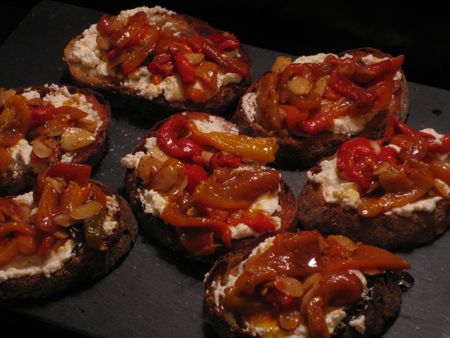
Peperonata at Its Best

Recipe: Peperonata with Almonds, Thyme, and Pimentón, Served on Ricotta Bruschetta

Peperonata, the roasted sweet pepper dish so popular throughout Southern Italy, is one of my favorite things to eat, and early fall is the best time to make it, when the sweet peppers are warm and ripe and piled high at the Greenmarket. So of course here I am making it now, as every year at this time. Like most dishes I cook a lot, it has evolved through the years to reflect my ever-changing culinary outlook.

When I first started making peperonata I used a lot of sharp and salty flavors, such as capers, anchovies, and olives. That was how I’d often had it served to me in Southern Italy, and it was how my family usually cooked up a batch. Over the years I’ve found I prefer mellower and richer ingredients in it. The peppers themselves provide enough sharpness. In my newest incarnation, I include toasted almonds, fresh thyme, and just a hint of the smoked Spanish chili called pimentón, which adds sweetness and smoke but not much heat. Pimentón comes in both sweet and hot versions. Use the sweet one for this.

Peperonata makes a lovely pasta sauce—I sometimes add it to a simple tomato sauce and toss it with spaghetti—but my favorite way to eat it is on grilled bread, with a  smear of ricotta serving as a gentle, luscious base, a flavor juxtaposition that for me encapsulates Southern Italy’s culinary style at its most brilliant.

Try these bruschetta with a glass of Cerasuolo di Vittoria, a bright red, pleasantly acidic wine made from a mix of Sicily’s frappato and Nero d’Avola grapes. Valle dell’Acate is a very good producer to look for.

Peperonata with Almonds, Thyme, and Pimentón, Served on Ricotta Bruschetta

(Serves 6 as an appetizer)

5 bell peppers (a mix of red, orange, and yellow will look pretty, but all red will give you the deepest flavor)
Extra-virgin olive oil
A handful of sliced almonds
1 garlic clove, thinly sliced
Salt
A pinch of sugar
A larger pinch of Spanish pimentón de la Vera, preferably the sweet variety
A few drops of Spanish sherry vinegar
5 large sprigs of thyme, the leaves chopped

Plus:

1 1/2 cups ricotta (for link to my homemade ricotta recipe, clicca qui)
12 thin bread slices from a long Italian loaf

Preheat the broiler. Place the peppers on a sheet pan, and broil them about 4 inches from the heat source, turning them as they blacken until they’re well charred all around. Let the peppers cool for a few minutes, and then peel and seed them and cut them into slices.

In a medium skillet, heat a tablespoon of olive oil over medium heat. When hot, add the pepper slices, almonds, garlic, sugar, and pimentón, and season with salt. Sauté until everything is fragrant and the almonds are lightly golden, about 4 minutes. Turn off the heat. Add a few drops of the vinegar, the thyme, and a drizzle of fresh olive oil, stirring it all to blend well. Transfer the peperonata to a small bowl. Serve it warm or at room temperature. It’ll keep about 3 days refrigerated, but bring it back to room temperature before serving.

To make the bruschetta:

Toast or grill the bread slices on both sides. Spoon on a heaping spoonful of the ricotta, and top with a spoonful of the peperonata. Serve right away.

Olive Oil for Weight Loss?


Italian olive oil for sale in Manhattan around 1930.

I just read an article that says that the good fat found in olive oil may provide one of the keys to appetite control and weight loss. Could it be true, fattening old olive oil?

Could be. It seems that oleic acid, a kind of monosaturated fat that olive oil has in abundance, suppresses hunger pangs and so can help prevent snacking between meals, according to researchers at the University of California, Irvine.

In a study involving lab mice (who else?), the researchers found that when oleic acid reaches the small intestine, it’s converted into a hormone called oleoylethanolamide. The hormone sends hunger-dampening signals to the brain, which means you feel full sooner and can go longer without eating. The findings were published in a journal called Cell Metabolism.

Truly? Somehow it feels true. Just think how satiated you feel after a big bowl of spaghetti aglio e olio. Maybe olive oil and red wine, my two favorite foods, have all along been the keys to the Mediterranean diet. It’s gotta be.


. . . As you can see in this photograph.

Recipe: Penne with Butternut Squash, Speck, and Leeks

Every year around this time, when the New York weather changes seemingly overnight, my sister Liti starts to crave pasta with butternut squash or pumpkin, and I always oblige her by making it for her, doing a slightly different version each time. In my book The Flavors of Southern Italy I have a recipe for pasta with pumpkin, tomatoes, and basil. I remember being surprised to discover that tomato blended so well with pumpkin as I stretched my imagination to come up with interesting things to do with the big squash. What really made them fit together was the addition of a mild pecorino, which miraculously brought all the sharp flavors into harmony. Usually I don’t add tomato but just let the squash stand more or less alone—more or less except for the pancetta or guanciale or Italian sausage I can never resist slipping in. Pork fat and fall squash make a heavenly combination, though usually not a lean dish by any stretch of the imagination.

I’ve been trying to cut down on my intake of saturated fat, sadly, especially pork fat, which is something I can eat, to my horror, in fairly large quantities. But sometimes pork fat seems to be just the thing, and no substitute is truly appropriate. Speck is a perfect product to reach for when you need some pork but just can’t bring yourself to surrender again to that fatty salami or fresh sausage quite yet. Speck is a cured and smoked boneless prosciutto from the Alto Adige region of Italy. It has about the same ratio of lean to fat as regular prosciutto, but its delicate smoky taste, with an underlying hint of juniper and bay leaf, makes it a great element in a hearty fall pasta.

In Southern Italy pumpkin pasta often includes garlic. I don’t love the combination, preferring shallot or the leeks I use in my most recent incarnation of the dish. I also include Marsala wine and sage, two flavors that always crop up in my culinary head when the weather turns cold.

Try to serve this as a first course. It’s rich and filling, so a small amount is really perfect. Afterward, a few slices of cold roast chicken sliced and serves over a green salad, maybe with a caper vinaigrette, would be great, in which case you wouldn’t need to run back to the kitchen to finish cooking anything (a big problem when you serve pasta as a first course, but not an insurmountable one).

Penne with Butternut Squash, Speck, and Leeks

(Serves 6 as a first course)

Extra-virgin olive oil
2 medium leeks, well cleaned and cut into thin slices, using only the white and tenderest green parts
1 small butternut squash, peeled, seeded, and cut into small dice
Salt
Freshly ground black pepper
2 whole allspice, ground
2 juniper berries, ground
1 pound penne
½ cup dry Marsala
½ cup chicken broth
6 or 7 slices speck, cut into thin strips, with any excess fat removed
10 sage leaves, cut into thin strips
A chunk of Montasio cheese for grating

Set up a large pot of pasta cooking water over high heat.

In a large skillet, heat 2 tablespoons of olive oil over medium heat. Add the leeks and the butternut squash at the same time. Season with salt, black pepper, and the ground allspice and juniper berries, and sauté until the vegetables are well coated with flavor and are just starting to soften, about 4 minutes.

When the water comes to a boil, add a generous amount of salt, and drop in the penne.

Add the Marsala to the skillet, and let it boil out for a few minutes. Add the chicken broth, cover the skillet, and continue cooking until the squash pieces are just tender when poked with a knife, about another 5 minutes (you want them soft but still holding their shape). Turn off the heat, and uncover the skillet. You should still have a little liquid in the skillet. Add the speck and the sage, a generous drizzle of fresh olive oil, and a few more grindings of black pepper.

When the penne is al dente, drain it into a serving bowl, saving about ½ cup of the pasta cooking liquid. Pour the squash sauce onto it, and toss gently, adding a little of the cooking water if it seems dry. Serve right away with a little Montasio grated over the top of each portion.

Beautiful Beets


Pink beets, roasted and peeled, smooth and shiny.

Recipes:

Roasted Beet Salad with Pistachios and Basil Vinaigrette
Roasted Beets with Black Olives, Orange, and Anchovy

Just about every recipe for beets I’ve run across in the last ten years has paired them with goat cheese. There’s nothing wrong with that—in fact it’s a fine combination—but I’m sick of the taste, and the combination of textures isn’t the greatest. I’ve especially had it with the stacked beet and goat cheese “lasagna” appetizer thing that so many restaurants have kept on their menus for years. It’s weird when such a chef creation takes off and spreads around the food world, running amok.

I do love beets, with their sweet but curiously bitter undertone, which, for me, prevents them from ever being boring, and of course they’re outrageously beautiful in shades of pink, purple, yellow, orange, red and white stripes, and pink and white stripes. I saw all these colors at the Union Square market a few days ago. I closed my eyes and grabbed a bunch, and they turned out, after roasting and peeling, to be that amazing shade of pinkish reddish orange that Matisse often used for wallpaper.

What should you do with beets? Roast them, for starters. Their sugars concentrate and fill your kitchen with a strange, unique sweetness, like no other sweetness, since it’s tinged with a root-vegetable aroma (maybe a little like a roasted sweet potato, but deeper and more complex). Roasting contains juices, so the colors and flavors of your beets aren’t lost to a big pot of hot water. In markets in Italy you can buy preroasted beets. Isn’t that something? Nobody would think of doing that here. If you want to try the things, you’ll have to cook them yourself.

What should you do with roasted beets? Bathe them in Italian flavors is my answer. Anchovies, just a touch of them, are an amazing match, believe it or not. I borrowed an odd Sicilian combination of anchovies and orange to flavor one of these two beet salads, It’s something I first encountered years ago in an artichoke dish I ate in Palermo. For the other salad I relied on basil, which is pretty much the perfect beet herb, much better than the more typical and more strident choice dill. Pancetta, capers, and olives, all salty, are good bets too. (I find you don’t often go wrong pairing salty and sweet. Think of salted caramels.) You also can add nuts of all types with confidence. Pine nuts, walnuts, almonds, or the pistachios I’ve chosen for one of these recipes add rich flavor and protein, and their textures seem right against the slipperiness of the beets. So as I rummaged through my head for appropriate Italian flavors to add to my two beet salads, I found myself using quite a few.

Here are beets, beautiful and delicious, for your viewing and eating pleasure.

(Both salads serve 4 as a first course or light lunch)

Roasted Beet Salad with Pistachios and Basil Vinaigrette

4 medium beets
Salt
2 small bunches watercress, well stemmed
A handful of unsalted, shelled pistachios
1 shallot, thinly sliced
A small chunk of Parmigiano Reggiano cheese

For the vinaigrette:

1 cup basil leaves
1 small garlic clove, roughly chopped
1/4 cup extra-virgin olive oil
1 teaspoon lemon juice (or a little more to taste)
Salt
Freshly ground black pepper

Preheat the oven to 400 degrees. Place the beets on a big sheet of aluminum foil. Sprinkle them with a little water, and close up the foil tightly around them. Place the package on a sheet pan, and roast for about 40 to 45 minutes, or until the beets are tender and fragrant. You’ll smell their sweetness, an indication that they’re getting there, but if you’re unsure, poke one with a thin knife. It should pierce through with little effort. When they’re done, run the beets briefly under cool water, just to cool them. Peel them and cut them into small cubes (they’ll look like big rubies (don’t you wish)), and place them in a bowl, seasoning them with a little salt.

Blanch the basil leaves in a small pot of boiling water for one minute. Drain the basil, and run it under cold water to stop the cooking and to bring up its green color. Squeeze out all the water. Place the basil in the bowl of a food processor. Add the garlic, olive oil, and lemon juice. Season with salt and black pepper, and pulse several times, until the mixture is smooth.

Place the watercress in a salad bowl. Add the beets, pistachios, and shallot, and pour on the vinaigrette (you may have a little extra, so just eyeball it). Toss gently. Divide the salad out onto four plates, and shave a few sheets of Parmigiano Reggiano onto each one. Serve right away.

Roasted Beets with Black Olives, Orange, and Anchovy

4 medium beets
1 medium head frisée lettuce, torn into pieces
1/2 a small red onion, very thinly sliced
A handful of black Nicoise olives
A handful of flat-leaf parsley leaves

For the vinaigrette:

1 anchovy, minced
The grated zest from 1 small orange
1 garlic clove, smashed with the side of a knife
3 tablespoons extra-virgin olive oil
1 teaspoon Spanish sherry vinegar
1 teaspoon Dijon mustard
Salt
Freshly ground black pepper

Preheat the oven to 400 degrees. Place the beets on a big sheet of aluminum foil. Sprinkle them with a little water, and close up the foil tightly around them. Place the package on a sheet pan, and roast for about 40 to 45 minutes, or until the they are tender and fragrant. You’ll smell their sweetness, an indication that they’re getting there, but if you’re unsure poke one with a thin knife. It should pierce through with little effort. When they’re done, run the beets briefly under cool water, just to cool them. Peel them, and cut them into not-too-thin rounds, thick enough that they don’t break apart too easily.

Whisk all the ingredients for the vinaigrette together in a small bowl.

Place the frisée in a salad bowl, and drizzle it with a little olive oil and season it with a bit of salt. Toss it, and divide it out onto four salad plates.

Add the beets to the salad bowl. Add the olives, red onion, and parsley. Pour on the vinaigrette, and toss gently. Divide the beets out onto the frisée. Serve right away.

How Much Pasta Is Too Much?


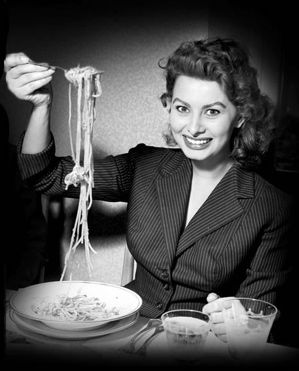
Sophia and the stuff she’s made of (although what is that lumpy mess hanging in the middle?).

I had an extremely enlightening conversation with a friend  while we were preparing dinner together a few nights ago. The subject was pasta, and what he matter-of-factly said shocked me—me the pasta queen, who really thought I knew pasta and the habits of pasta eaters inside and out. He said that when he makes pasta for himself and his boyfriend, one pound easily and almost always serves two. Okay, these are two fairly big guys, but that is a huge amount of pasta, and with all the sauce and bread to sop it up, that is a tremendous amount of calories. I’ve never heard of eating so much pasta. Then I started asking around, and it seems other people do this too, and not just men. Pasta happens to be one of the good carbohydrates, one that digests relatively slowly, not like potatoes or rice, but if you eat enough of any good carb it will turn into a bad carb from the act of gluttony alone. I don’t mean to embarrass anyone, and coming from someone who can down an entire bottle of Chianti in about 15 minutes, I’m not one to judge.

I guess what I want to say here is more of a reminder than a reprimand. One pound of pasta traditionally serves six as a first course, in true Italian style. If you want to serve pasta as a main course, a pound should  serve four, or sometimes  five if you have a protein-rich sauce, such as a ragù. I understand Sophia supposedly said that everything you see she can attribute to pasta, but she couldn’t possibly be eating that much. I mean, she does still have a waistline.

BuonItalia


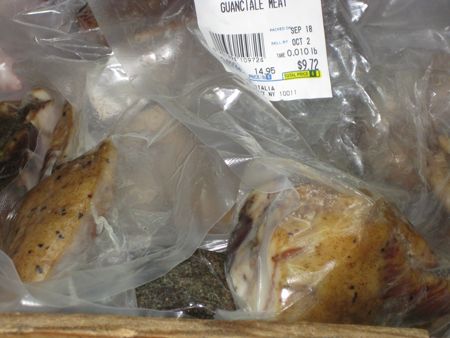
Guanciale at BuonItalia in Chelsea Market.

I lament the demise of the old-fashioned provolone-stinking Italian grocery store of my childhood. Such places certainly still exist on Arthur Avenue in the Bronx, but as far as Manhattan goes, I don’t know. I can’t think of one. Faicco’s on Bleecker Street? DiPalo? Those are great shops, but not the all-encompassing, one-stop stink-bomb places my father used to bring us to for his “cold cuts,” where the sausages hung heavy and low and dripped on your head as you tried to wait patiently for someone to wait on you. Those where the days. There’s a place in Glen Cove, near where I grew up, called Razzano’s that’s still properly stinking, with tons of soppressata and caciocavallo hanging from the ceiling, the kind of place where you can pick up a board of rank salt cod and a jar of salty, rubbery lupini beans and walk out the door with a freshly made salami hero soaked with vinegar peppers.

BuonItalia, in the Chelsea Market, is a store I go to often. It is in many ways a great Italian food shop, though it’s one where much of the stuff is shrink-wrapped and thus odorless. It’s a strange sensation, seeing all that guanciale, bottarga, and pepato cheese and not being able to smell it. It’s not particularly romantic. In fact, the place can remind me of a medical supply house. But in their defense, they do carry a lot of hard-to-find items, stuff you’d never in a million years see at Razzano’s.

For starters they stock Setaro pasta from Naples (after Latini, my favorite), and they’re the only place I know that does. You can buy bright green pistachios di Bronte from Sicily, butter made with Parmigiano milk (amazingly rich), almond flour, chestnut flour, semolina flour, chickpea flour for making Sicilian panelle, Strega-filled chocolates, fish shaped-marzipan, orange-flower tea, Black Umbrian truffles, vincotto from Puglia, mostardo from Cremona, guanciale (the cured pork cheek indispensable for traditional pasta carbonara), bottarga di muggine (made from mullet roe), colatura di Alici (a pungent anchovy syrup from Campania), menaica anchovies, braised eel, porchetta, lardo flavored with rosemary, fresh Italian yeast, buffalo-milk ricotta from Naples and fresh stracciatella (both very fresh the three times I’ve bought them), Miscela d’Oro coffee, much cheaper than Illy and in my opinion every bit as good. They’ve got shrink-wrapped Italian dried beans galore with names such as verdolino, tuvalgiedda marrone, tabacchio, San Michele, panzaredda, nassieddu viola, ciuto, munachedda, and marucchedda. What the hell are all these beans? All that in addition to the expected olive oils, canned tomatoes, and vinegars.

Okay, the place may not smell like Razzano’s, but I have to admit it’s pretty amazing.

Bottarga di Muggine at BuonItalia

BuonItalia
75 Ninth Avenue (in the Chelsea Market)
New York, New York 10011
(212) 633-9090
www.buonitalia.com


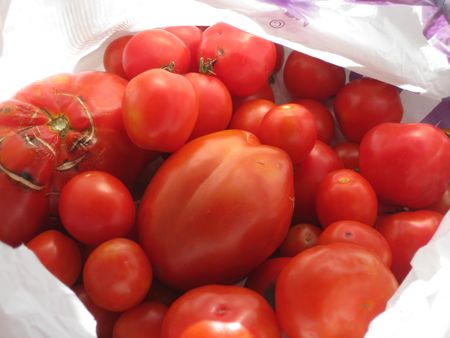
The finished product and the raw ingredients.

Recipe: Tomato Tart with Pecorino and Rosemary

My friend Barbara, of Patron Saints and Holy Cards fame, has a house with a vegetable garden in Delaware County, New York. She grows gigantic, lumpy deep red tomatoes, and also really delicious grape and cherry tomatoes, all from Italian seeds she gets from www.growitalian.com. In mid-September she has a ton of tomatoes. They are a lovely gift. Just when you start feeling sad about summer’s end, out pop all these gorgeous summer tomatoes. She dropped a big bag of them off at my apartment a few days ago. They made me extremely happy. The big ones are varieties called Red Pear and San Marzano Redorta. I’m not sure what the cherries are, but I believe they’re Puglian. Growitalian.com has a slew of Italian tomato varieties and has seeds for every imaginable Italian vegetable and herb. If you’re a garderner and love Italian food, that website is for you.

When I get a bunch of warm-from-the-garden cherry tomatoes, I usually do one of two things. Either I make a burst-cherry tomato sauce for pasta or I make a tomato tart. This time I had enough tomatoes to make both. I love the completeness and tidiness of a savory tart, and it’s always a special offering for friends, since it looks like you put some thought into it—which you did. Cherry tomato tarts can look especially beautiful, with the little globes arranged in rows or circles, all red and glistening. I published a cherry tomato tart recipe in my book The Flavors of Southern Italy; it is really good but really rich, written before my health and diet kick kicked in. It has a sweet buttery crust, cream, ricotta, and lots of cheese. Sounds good, right? I’m trying to forget about it now.

For my new healthier but I hope no less alluring version, I use a classic Italian olive oil crust, which really is perfect for tomatoes, better than butter, I’m now convinced. I marinate the tomatoes briefly in garlic, mustard, and rosemary to enrich their flavor, and I lighten up considerably on the cheese and cream. The flavor is much more tomatoey than my original recipe, deeper, less custardy. I seriously like this one much better. You can serve it as an appetizer, with a glass of Dolcetto. Or serve it as a lunch or light dinner, alongside an arugula salad.

If you’d like to make a pasta with burst tomato sauce, all you need to do is get a large sauté pan really hot over high heat, add a generous amount of olive oil and the cherry tomatoes (about 2 ½-3 pints for a pound of pasta), and sear them, shaking the pan around a fair amount, until they just start to burst and brown slightly, about 5 minutes or so. Once they’ve begun to burst and let off some juice, you can add garlic, salt, hot chilies, whatever you like (a few chopped anchovies are good). Add a hit of white wine to loosen up all the caramelized tomato on the bottom of the pan, and finish with a handful of fresh herbs and a drizzle of fresh olive oil. Toss with pasta. That’s it.

For the tart, you’ll want to have on hand a nine-inch tart pan with a removable bottom, ideally a pan with smooth, not fluted, sides. Or you can use a tart ring.

Tomato Tart with Pecorino and Rosemary

(Serves 4 as a lunch or light dinner, or 8 as an appetizer)

For the crust:

2 cups all-purpose flour
2 sprigs rosemary, the leaves well chopped
Salt
¼ cup extra-virgin olive oil
¼ cup water
1 large egg

For the filling:

About 20-25 cherry tomatoes, cut in half
1 tablespoon Dijon mustard
1 large garlic clove, peeled and smashed with the side of a knife
2 tablespoons extra-virgin olive oil
2 sprigs rosemary, the leaves well chopped
1 teaspoon sugar
Salt
Freshly ground black pepper
½ cup grated young Pecorino Toscano cheese
¼ cup heavy cream
1 large egg

In a large bowl, mix the flour with the rosemary and a little salt. In a small bowl, stir the egg, olive oil, and water together, and pour the mixture over the flour. Stir to blend everything, and then dump the resulting dough out onto a work surface. Knead it very briefly, just until it holds together in a more or less smooth ball. Wrap the dough in plastic wrap, and let it rest, unrefrigerated, for about an hour.

Place the tomatoes in a bowl. Add the mustard, olive oil, garlic, rosemary, and sugar. Season with salt and black pepper, and toss well. Let the tomatoes sit at room temperature, tossing them around a few times, while the dough is resting.

Preheat the oven to 375 degrees. Coat your tart pan with a little olive oil. Roll out the dough, and drape it into the tart pan, cutting off any overhang. Sprinkle half the cheese into the tart shell. Line the tart with the tomatoes, in slightly overlapping circles. Save the juice left from the tomato marinade. Sprinkle the tomatoes with a little extra salt and black pepper.

Whisk together the remaining cheese, cream, egg, and about a tablespoon of the tomato marinade liquid. Season with a little salt and black pepper, and pour evenly over the tomatoes. Bake until browned and set, about 35 to 40 minutes.

854939

Recipe: Fig and Celery Salad with Walnut Pesto Crostini

Walnut pesto is a lovely thing, but it’s quite a load in the calorie department when used for its intended purpose, being tossed with pasta. I’ve found a new way to enjoy the rich paste in small doses where it can still make a big impact: on warm crostini (which work really well with whole-grain bread, if you’re so inclined).

Walnuts and fresh figs are an exquisite combination, and now is the time for figs. Not local New York figs; such things don’t exist unless you’re an old Italian-American living in Bay Ridge and stubbornly trying to keep a fig tree alive through the winter by wrapping it in swaddling clothes. The figs in the markets now are flown in from California and arrive in pretty good shape. Corner fruit vendors are now selling pints of black-skinned figs. I actually prefer green-skinned ones, but I take what I can get, and if you make sure they’re perfectly ripe, the black-skinned kind can be delicious, especially tossed in a salad. My only gripe with them is that sometimes their skins are thick and taste bitter. But if they’re really ripe, that isn’t usually a problem.

A simple vinaigrette really compliments the funky sweetness of figs, especially one well seasoned with salt and fresh black pepper. I tossed a few ripe figs with Boston lettuce (which is very underrated, in my opinion) and a handful of thin-sliced celery and a few celery leaves (also underrated, and a great flavor boost when added to a soffrito, for instance). Then I made my walnut pesto crostini and plopped them around the salad. I really liked the way the flavors came together. There is nothing really sweet about the salad, even though it contains fruit. Somehow the celery, shallots, and walnuts take it forcefully in the direction of savory. It is practically an entire meal (though I did make a roast chicken with garlic and fennel to go with it).

Buying walnuts can be a problem. I don’t know about you, but I often find that the shelled walnuts I get at most food shops are stale and bitter. This is really a drag, especially since they come in those little sealed-up plastic containers, so you can’t exactly taste-test them. I think you do better buying them in Italy or France, where they’re considered a luxury item, not just some dusty thing you throw into a trail mix. I’ve found ones that are usually very good at Buonitalia at the Chelsea Market (whose website is buonitalia.com). They are imported, shelled Italian walnuts, and they’re vacuum-packed. Buonitalia sells all its nuts this way, and it keeps them very fresh.

If you can get your hands on some very fresh walnuts and a few figs, this is a good early fall salad to throw together.

Fig and Celery Salad with Walnut Pesto Crostini

(Serves 4)

For the pesto:

1 cup very fresh shelled walnuts
1 garlic clove, roughly chopped
2 tablespoons grated Grana Padano cheese
3 tablespoons extra-virgin olive oil
A handful of flat-leaf parsley, the leaves chopped
Salt
Freshly ground black pepper
1 baguette, whole-grain if you like, cut into 2 thin slices per serving

For the salad:

1 large head Boston lettuce
A handful of watercress
2 tender inner celery stalks, thinly sliced, plus leaves from about four stalks
1 small shallot, very thinly sliced
12 ripe, black skinned figs, cut in half lengthwise
Freshly ground black pepper
1 1/2 tablespoons extra-virgin olive oil
1 tablespoon walnut oil
1/2 tablespoon red wine vinegar
Salt

To make the pesto, place the walnuts and garlic in the bowl of a food processor, and pulse until you have a rough chop. Add the Grana Padano, olive oil, parsley, a little salt, and a few grindings of black pepper. Pulse a few more times, just until you have a fairly rough but amalgamated texture. Scrape the pesto into a little bowl.

Put the Boston lettuce and watercress in a salad bowl. Add the celery and leaves, shallot, and figs. Season the salad with a generous amount of fresh black pepper. In a small bowl, whisk together the olive and walnut oils and the vinegar. Season with a little salt.

Toast the baguette slices on both sides, and spread them lightly with the pesto.

Toss the salad with the dressing, and serve it onto four salad plates. Place two crostini on each plate. Serve right away.

San Gennaro and Chickpeas


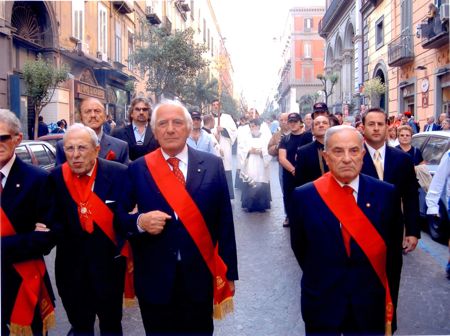
The San Gennaro festival procession in Naples.

Recipe: Roasted Chickpeas with Garlic and Rosemary

I think we have to face a fact: The San Gennaro feast in Little Italy is a crashing bore. When Johnny Boy proclaimed in Mean Streets, ”I hate this feast with a passion,” I could feel his pain. I’m sure at some point, maybe back in 1966 when it first started, the feast was fun (unless, of course, you lived upstairs from it). Even back when I first attended, in the 1970s, we could at least win the “basket of cheer,” full of cheap Chianti and lupini beans—and they didn’t mind if teenagers opened the straw-basket bottles and drank on the streets. Those were the days. And then the neighborhood holy men, all boozed up, would drag out the metallic San Gennaro statue, green-face from wear, and start their dinky procession, accompanied by a four-piece Little Italy band that sounded like it was playing kazoos and tin cans when in fact it was holding real instruments like trumpets and drums. This was mesmerizing. There was the arancini lady, who set up a folding chair and sold rice balls, at the corner of Hester and Mulberry. I even saw Frankie Valli perform there once, perched up on a little wooden platform, right next to the arancini lady. All this is certainly better than the generic New York street fair the feast has morphed into. I understand that not many Italians still live in the neighborhood, and they say that’s the main reason the charm has drained away. It’s sad really. It makes me long for old Napoli, where the feast has its Catholic origins.

San Gennaro (Saint Januarius in English) is the patron saint of Naples, and the city celebrates his feast day on September 19 (and just on that one day, not on the eleven frigging days they drag it out over here). There are elaborate religious processions through the streets, but the real focus, as far as I’m concerned, is the celebration of the city’s beautiful street food. Not great diet food (and we always have to consider these things, here at Skinny Guinea), but fabulous nontheless.

If you like things fried, as I do, Naples does them better than anywhere else. At the feast you can get batter-fried zucchini flowers, calamari, artichokes, eggplant, even fried cow’s brains. Or a slice of Naples’s famous pizza margherita. Or you might require calzone stuffed with escarole or ricotta, or pizza fritta (basically a deep-fried calzone), crocche (potato croquettes), zeppole, or a sweet, flaky sfogliatelle. While the kids eat spumoni, the old men walk the streets munching on roasted chickpeas from little bags and drinking red wine out of plastic cups. That ritual seems very austere compared with everything else going on at the feast, which makes it very appealing and romantic. You can still get roasted chickpeas at the Little Italy feast in New York, but they are as hard as pebbles and, in my opinion, almost too dangerous to eat. Like most things, if you really want them right you’ve got to make them yourself. So here is my recipe for roasted chickpeas. They’re crisp and brown outside, but with a creamy center. Not only are they delicious and crunchy, but they’re almost fat-free, and they’re a great carb choice, low on the glycemic index. With all the red wine you’ll need to ease them down, they are a health meal made in Naples. For the wine, try a glass of Campanian red, such as a Lacryma Christi Del Vesuvio. Terredora is a good producer.

Roasted Chickpeas with Rosemary and Garlic

2 cups home-cooked chickpeas, drained (use good-quality canned ones if you prefer, but rinse them)
2 tablespoons extra-virgin olive oil
5 garlic cloves, unskinned and crushed with the side of a knife
Sea salt
A generous pinch of ground hot red pepper
A pinch of sugar
3 sprigs rosemary, the leaves well chopped

Preheat the oven to 450 degrees. Lay the chickpeas out on a sheet pan. Drizzle them with the olive oil. Scatter on the garlic cloves, and season everything with salt and the ground hot pepper. Toss the chickpeas with your fingers so they’re well coated with the seasoning. Spread them out again in one layer.

Roast the chickpeas until they’re fragrant and starting to brown, about 20 minutes. Pull the sheet pan from the oven, and scatter on the rosemary, and sprinkle on the pinch of sugar. Toss quickly, and put back in the oven for another 5 minutes or until the chickpeas are browned and crunchy-skinned but still have soft centers. Let them cool on the sheet pan. Serve warm or at room temperature.