Feeds:
Posts
Comments

garzoni-pears
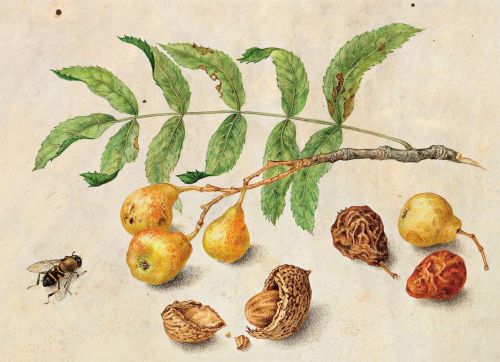
Still Life with Pears, an Almond, and a Bee, by Giovanna Garzoni.

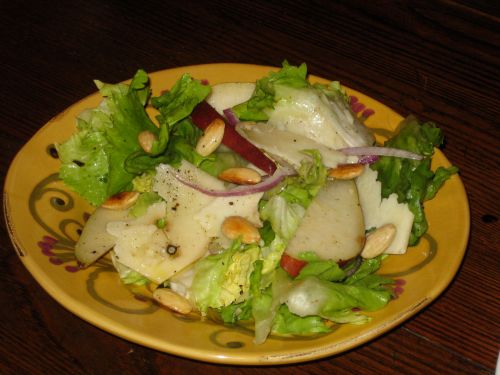
Recipe: Escarole Salad with Pears, Rosemary Almonds, and Pepato

The fruit still-life paintings of Giovanna Garzoni are riveting. Ever since I first discovered them about twenty five years ago in Elizabeth David’s book Italian Cooking (no longer available in the original hardcover with the illustrations, unless you search in a used-books resource like abebooks), I haven’t been able to keep my eyes off them for very long. When I lose my determination, I stare at one of them until I become so focused I  get a little paranoid. When I’m hungover, they bring me hope. If I’m in a  frivolous mood, they force me to dig deeper and just be quiet.

A lady painter in the mid 1600s must have had some particular hurdles to overcome, but this girl from Ascoli, in Le Marche, seems to have been a tireless worker despite any obstacles her sex may have caused her. She produced a lot in her seventy years, and she was rewarded with royal patrons, including Renaissance dukes, duchesses, and princes, among them many Medicis. She won them over with her meticulous, gorgeous tempera-on-vellum miniatures (minatures meaning not tiny paintings but rather paintings done in minute detail). She painted portraits, she painted flowers, but it’s the fruit work that draws me in, with its withered leaves, wormholes, and strategically placed voles and flies. These realistic, slightly spooky interpretations were a fashion at the time, but Garzoni’s were more so than most, more detailed and hence more surreal. This was decorative design at its scientific and artistic best.

I’ve created this salad in tribute to Ms. Garzoni, being inspired specifically by her Still Life with Pears and Almonds (the name it usually goes by, not acknowledging the bee in the title, as I did in my caption above). It seemed the thing to make while waiting for the first spring fruit to arrive (wait till you see Garzoni’s cherries).

garzoni-small
A portrait of Giovanna Garzoni, painted the year she died, by Giuseppe Ghezzi. She seems to be holding a sketch for one of her royal portraits.

If you’d like to experience some of Garzoni’s fruit still lifes, check out either of two cookbooks. I already mentioned Italian Food, by Elizabeth David, originally published in England in 1954 and now hard to find in hardcover, with the illustrations. This was a groundbreaking book in its day, one that really woke up the clunky British palate. Its beautiful illustrations include many of Garzoni’s best fruit paintings. Florentines: A Tuscan Feast, by Lorenza De Medici, put out in 1992 and also now out of print, is another good place to go. This little book is filled with fruit-inspired Tuscan recipes and contains paintings exclusively by Garzoni.
salad-pears

Escarole Salad with Pears, Rosemary Almonds, and Pepato

(Serves 4)

For the almonds:

1 tablespoon extra-virgin olive oil
¾ cup blanched whole almonds
Freshly ground black pepper
Salt
A generous pinch of sugar
2 small sprigs rosemary, the leaves finely chopped

For the rest of the salad:

1 large head escarole, torn into small pieces
2 red d’Anjou pears, cut into slices
½ small red onion, very thinly sliced
¼ pound pepato cheese, shaved or cut into thin, wide slices
1½ tablespoons Spanish sherry vinegar
½ teaspoon light soy sauce
1 garlic clove, peeled and crushed
4 tablespoons extra-virgin olive oil
Salt
Freshly ground black pepper

To make the rosemary almonds, heat the olive oil in a small skillet over medium-low heat. Add the almonds, and sauté, stirring them around frequently, until they just start to turn very lightly golden, about 2 minutes.  Season with black pepper, salt, the sugar, and the rosemary, and continue sautéing until the almonds are golden and very fragrant, about another minute or so. Turn them out onto a large plate or a work space, separating them a little so they don’t stick together, and let them cool for a minute.

In a large salad bowl, combine the escarole, pear slices, red onion, pepato, and almonds.

In a small bowl, whisk together the Spanish sherry vinegar, soy sauce, garlic, and olive oil. Season with a pinch of salt (remember that soy sauce is salty) and black pepper. Pour the dressing over the salad, and give it a good toss. Some of the peppercorns from the pepato will inevitably fall from the cheese into the salad. I love when you bite into a whole black peppercorn (and these have been softened by the cheese-curing process, so they’re tempered). The pepper goes so well with the sweetness of the pears.

Serve right away.

balsamic-risotto

Recipe: Risotto with Butternut Squash, Leeks, Parmigiano, and Aged Balsamic Vinegar

In my many years as a devotee of Italian cooking, I’ve several times bought bottles of long-aged, very expensive balsamic vinegar, usually on trips to Italy. I wanted them so badly, with their medieval-looking red wax consortium seal of approval. They’re beautiful, packaged like perfume—so beautiful, in fact, that at times I’ve been scared to use them. Is this the right dish? Is it worthy? Will I be wasting this precious syrup? I’m talking about the real artisanally made balsamico, not the supermarket balsamic that’s mostly red wine vinegar with a little caramel added (although there’s really nothing wrong with that product—it’s fine for dressing salads or adding to marinades—it’s just not real aceto balsamico).

At some point I finally got over my fear of wasting aged balsamico and got on with using it the way they do in Italy, drizzled on cantaloupe or on a chunk of Parmigiano Reggiano, or on grilled scallops or lamb chops, or over braised cannellini beans, or on fresh figs or vanilla ice cream. I’ve tried sipping some  as a fine after dinner drink, the way they do in Modena, but I wasn’t crazy about it. Maybe my bottle wasn’t good enough. Maybe it’s an acquired taste, like drinking Amaro, the bitter herb liqueur, which I now love but at first sipping thought tasted like poison.

Balsamic vinegar originated in Emilia Romagna, in the provinces of Modena and Reggio. It’s been made there for almost a thousand years. Artisanal aceto balsamico must be aged for at least 12 years, and the really special stuff is usually aged longer, getting richer and mellower with time. Real balsamic vinegar should contain no wine vinegar or caramel. It’s made primarily from the juice of Trebbiano grapes, a white wine grape, which is cooked so that it caramelizes ( unlike wine vinegar, which is made by turning alcohol into acid, balsamic vinegar is made by turning sugar into acid). It’s then aged in a progression of casks made from different types of wood until it reaches a mahogany-colored, sweet-tart, wood-kissed, syrupy consistency. A great one tastes to me like a tangy port.

I recently heard very good things about a balsamic vinegar made in New Mexico, of all places. Aceto Balsamico of Monticello is a company started in 1998 by a group of organic farmers who took it upon themselves to start producing balsamic vinegar in true Northern Italian style. This is a huge undertaking. Not only does producing artisanal balsamico take years, but there’s the mystique, history, and peculiarly Italian austere glamor surrounding its production that almost makes it sacrilegious to try. But I guess they figured what the hell and gave it a whirl.

Aceto Balsamico of Monticello makes its vinegar the way it’s made by artisans in Emilia Romagna, using organically grown Trebbiano grapes and wood casks from a master cask maker, Francesco Renzi of Modena. The vinegar is aged 12 years, as required by Italian code, so the company is just coming out with its first batches now. They even feel that Monticello, New Mexico, has an advantage over Modena, because its low humidity allows for a quicker evaporation, concentrating the flavors of the grapes. I suppose this speeds up the aging process slightly, making the vinegar more viscous faster. You can check out their website, www.organicbalsamic.com, for more details on how and why they do what they do.

I ordered a bottle of Aceto Balsamico of Monticello, and I’m glad I did. To me this New Mexico balsamic tastes as lovely as much of the good stuff I’ve brought back from Italy. It’s got that woody port flavor and deep, blackish red color, very much like the best bottles I’ve carried back with me. And I can only imagine that if they can keep it up their vinegar will get even richer and deeper as the years go on.

To show off my new balsamico, I created a simple risotto with leeks, Parmigiano, and butternut squash, three ingredients that to my palate really show off an aged balsamic vinegar’s lush beauty.

Oh, and by the way, that strange spoon with the hole in the center in the photo at top is an actual risotto cooking spoon. It was given to me by my cookbook editor Maria Guarnaschelli when I was working on my first book. The idea is that as you keep stirring the rice, the hole allows the liquid in the pan to stay at a steady flow, with no drag,  so the rice cooks evenly . It really works. She bought it in Vicenza, I believe. I’ve never seen it in a cookware shop here.

risotto-plated

Risotto with Butternut Squash, Leeks, Parmigiano, and Aged Balsamic Vinegar

(Serves 4 as a first course)

5 cups light chicken broth (or half broth, half water)
Extra-virgin olive oil
2 tablespoons butter
2 fat leeks, cut into small dice, using the white and only the tender light green part
1 small butternut squash, peeled, seeded, and cut into small dice (you’ll want about 3 cups of dice)
A few large scrapings of nutmeg
Salt
Freshly ground black pepper
2 cups carnaroli rice
¼ cup sweet red vermouth
¾ cup freshly grated Parmigiano Reggiano cheese
2 teaspoons aged balsamic vinegar

Pour the chicken broth into a saucepan, and bring it to a boil. Turn the heat to very low, to keep it at a low simmer.

Choose a wide, low-sided pan to cook the rice in. This will allow fast evaporation of the liquid, which is exactly what you want for a creamy risotto with a good bite.

Heat 2 tablespoons of olive oil and 1 of butter over medium high heat. Add the leeks, and sauté until they’re softened, about 2 minutes. Add the squash, seasoning it with nutmeg, salt, and black pepper, and sauté a minute or so to coat it well with oil. Add the rice, and sauté for another minute. This puts a light seal on the rice, so it will cook up firm and glossy. Add the red vermouth, and let it bubble for a few seconds.

Add a ladle of broth, and start stirring the rice. The rice should cook at a lively bubble. Turn the heat up a touch if you need to. When the broth is almost dry (not completely, though), add another ladle, and keep stirring. Keep adding broth when it gets low until the rice and the squash are both tender but still retain a slight bite. In my experience this takes 16 to 17 minutes. If you run out of broth, just add a little hot water. As soon as the rice is perfectly cooked, add the remaining butter and the Parmigiano, and give it a stir. Take the pan from the heat, and add a little more broth to ensure a slightly loose consistency. Check for seasoning, adding more salt and black pepper if you think you need it.

Ladle the risotto out into shallow serving bowls, and drizzle about a half teaspoon of the aged balsamic vinegar over each serving. Serve right away.

Sardines Now

emmaus_large
Christ with Sardines, by  Giovanni Bellini.

Recipe: Grilled Sardines with Hot Pine Nut Vinaigrette

If you’ve never tasted a really fresh sardine, you have an obligation as an Italian food fanatic to do so. They’re rich and delicious and will open up your taste buds and wash away the remnants of all those boneless, skinless chicken breasts that have been too much a part of our lives for too long. I’ve found that fast high-heat grilling shows off their charms the best. When I can find impeccably fresh sardines, I grill them at home. “But, oh, I can’t cook sardines in my kitchen. They’ll stink up the place for days.” Not if you buy really fresh ones.

And therein lies the problem. Sardines are often past their prime at the fish counter. “Are they fresh?” you may think to ask the seller. “Yes, they just came in today.” Well, if so, then they arrived half rotten. Even at Citarella, where the quality is generally so high, I’ve at times been disappointed by the sardines. Sardines and other oily fish go off really fast, and when they do they get that heavy, fishy, rank oil smell that can turn you off to this amazing fish for years. That is not how it should be, and it makes me sad. Eating a really fresh sardine is something every fish lover should experience.

How can you tell if a sardine is super fresh? Usually I can tell by looking. They should be shiny silver and not floppy.  But I always ask to smell. Fish sellers really hate that, since it looks bad to the other customers. I really don’t give a damn. I’ve been burned by bad fish too many times. Just get up your courage and do it.

Where do I go to find fresh sardines in this big city? Nowadays I go to the Chelsea Market. The Lobster Place at the Chelsea Market (at Ninth Avenue and 15th Street in Manhattan) has expanded, and with that expansion has come a big commitment to quality and freshness. It has always been a pretty good fish shop, but its selection used to be smaller. Now they carry everything, tons of whole fish, all sorts of oysters, and lobsters of course, from alive and crawling to chunks of perfectly steamed tail meat to throw into a salad. And very fresh sardines, flown in from Portugal. European sardines have been showing up in New York markets for years, but I  stopped buying them, not trusting anyone. Now I’m into them again. These are the freshest I’ve seen in a long time.

To celebrate finding these beauties, I revamped a recipe from my book The Flavors of Southern Italy, making it a little more chic and streamlined. It’s a variation on my most loved sardines-over-salad concept. Don’t be afraid to grill sardines at home. If they’re really fresh, they’ll fill your kitchen with the aroma of the Italian Riviera. Portofino anyone?

sardines1
Sardines at the Lobster Company.

Grilled Sardines with Hot Pine Nut Vinaigrette

(Serves 4 as a first course)

For the Vinaigrette:

1 cup very fresh pine nuts
¾ cup extra-virgin olive oil (use your best oil for this)
Sea salt
Freshly ground black pepper
A generous pinch of sugar
The grated zest and juice from 2 lemons
A splash of dry white wine

For the sardines:

1 head frisée lettuce, torn into small pieces
1 large endive, separated into leaves and then sliced into thick strips
12 fresh sardines, gutted and scaled but with the heads left on
Extra-virgin olive oil
Sea salt
Freshly ground black pepper
The juice of 1 lemon
A handful of marjoram sprigs, the leaves left whole

To make the vinaigrette, toast the pine nuts over low heat in a medium skillet, stirring them around, until they’re golden. Add the olive oil, salt, pepper, sugar, lemon zest and juice, and let it all warm through for about 30 seconds. Add the wine, and let it bubble for a few seconds. Turn off the heat, but leave the skillet on the burner (to keep it warm).

Divide the frisée and endive up onto four salad plates.

Set up a stove-top grill pan over high heat. Coat the sardines lightly with olive oil, and sprinkle them inside and out with salt, pepper, and lemon juice. Grill the sardines until good char marks appear, about 2 minutes per side. Grab the sardines from the grill, and place three on each plate. Scatter the marjoram on them.

Reheat the vinaigrette gently, if you need to, and then spoon some over each salad. Serve right away, with good Italian bread and a glass of Italian rosé (try the Vino Rosato Sangiovese produced by Guido Gualandi).

monet_red_mullet2
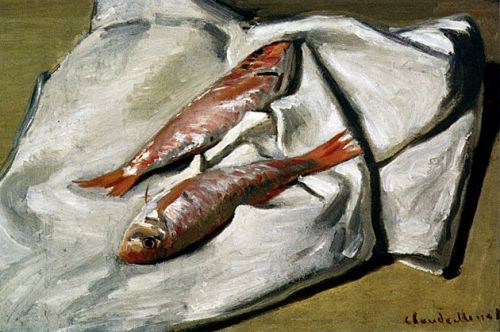
Red mullets as seen by Claude Monet.

Recipe: Pan-Fried Red Mullet with Almond Mint Fregola and Olio Santo

Last night I had another of my torturous dreams where I’m braising some type of meat in the oven, usually lamb or pork, and the thing becomes a whole living creature while cooking, not the shoulder roast or whatever I started out with. And it’s still alive, groggily trying to escape the engulfing heat. I keep trying to push the thing back in, turning up the temperature to try to decrease its suffering, but the animal stays half dead, half alive forever, and my feelings of misery and remorse grow so strong I can’t bear them. Pleasant, isn’t it? Is this the cook’s dilemma?

It’s trendy now in the food world to get to know the meat you cook in an intimate way and to master high-powered butchering. Cookbooks are filled with bloody photos of tattooed chefs burying cleavers into whole hogs, animals the chefs have watched grow up. I could never work on a farm and become friends with goats or lambs and then slaughter them. I’d be terrified of what I’d take back with me to bed at night. Fish, no problem. I’ve gutted and filleted fish that were still wiggling.

Who can sort it all out?

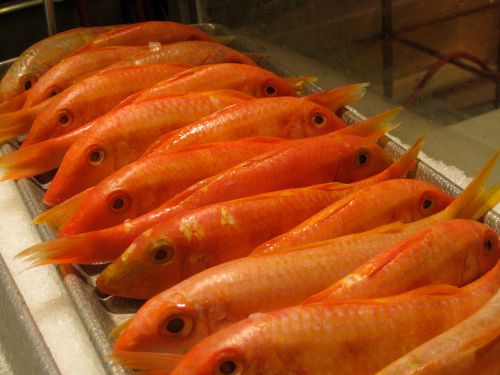
Maybe love of flavor overrides all. I’ve never met a sea creature I didn’t want to eat and wouldn’t mind harpooning, from the shimmering yellow pompano to the hideously appealing octopus. But I have to say that, lately at least, red mullet has been my favorite fish. It’s popular in the South of France, all along the Mediterranean, and down to Greece. The first time I tasted it was not in Europe, but in a Greek restaurant in Astoria, Queens, one of the many places there that serve plain grilled fish, Greek salad, retsina, and that’s about it. I ordered the red mullet because I wanted to be transported to Nice, but mainly because there the fish were, lined up on ice, a beautiful pinkish orange, a color frequently used by the designer Christian Lacroix to accent his amazing gowns. They were too lovely not to devour.

raw-mullet
Red mullets for sale at Chelsea Market.

Red mullet looks firm, not floppy, and when you pick one up you’ll see that it doesn’t just look that way. Its texture after cooking is sturdy, not tender, and full of irritating little bones; its taste is shrimp-like and iodiny, a flavor that for me is addictive. After my first experience with red mullet (called rouget in French and triglie in Italian), I thought a lot about the fish. I wanted to taste it again. I wanted to cook it myself, for certain. Years ago I had a hard time finding it in fish shops, but now I see it often, since it’s caught and shipped up from the Gulf Coast of Florida (these fish really get around).

When in Italy I’ve ordered red mullet whenever I could. In Southern Italy it’s usually served simply grilled or fried, with a side of lemon, but I had it once in Venice worked into a pasta sauce. (I’ll see if I can remember that dish more vividly and write up a recipe. It included cherry tomatoes—I remember that distinctly.) In Spain it’s often matched with roasted peppers. For my version, I’ve just done an easy pan fry, pairing the crisp fish with fregola, the Sardinian toasted couscous, and a spiced-up olive oil. I hope you’ll like it.

The oil is not a traditional olio santo, the hot pepper oil used in Southern Italy, where the chilies are steeped in oil and then strained out. Rather I’ve minced everything together to serve more as a spicy relish.

cooked-mullet
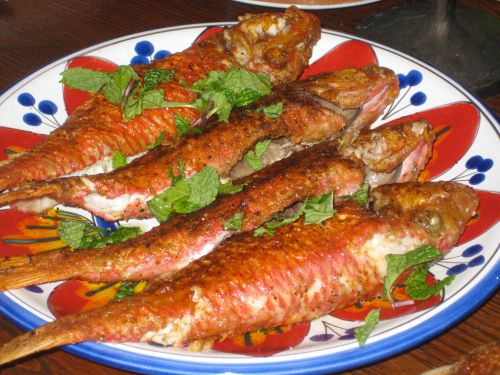
My pan-fried red mullet.

Pan-Fried Red Mullet with Almond Mint Fregola and Olio Santo

(Serves 2)

For the olio santo:

⅓ cup extra-virgin olive oil
2 long, red fresh peperoncini, seeded and roughly chopped
1 garlic clove, chopped
1 tablespoon red wine vinegar
Salt
1 teaspoon  sugar

For the fregola:

1½ cups large fregola (it comes in two sizes, small pellets, more like a traditional couscous, and a larger version; I prefer the texture of the larger kind)
Salt
1 bay leaf
Extra-virgin olive oil
1 tablespoon unsalted butter
1 large shallot, finely chopped
A large handful of whole blanched almonds
A generous pinch of ground cumin
A generous pinch of ground cinnamon
Freshly ground black pepper
A splash of white wine
¼ cup chicken broth
A few large mint sprigs, the leaves lightly chopped, plus a few extra sprigs, left whole, to garnish the fish.
A few large basil sprigs, the leaves lightly chopped

4 whole red mullets (usually 2 per person is about right; if you find bigger ones, 1 may do), cleaned and scaled but with the heads left on
Salt
Freshly ground black pepper
A pinch of ground cumin
A pinch of powdered, lightly smoked chili, such as Pimenton de la Vera
¼ cup all-purpose flour
Extra-virgin olive oil

To make the olio santo: Put all the ingredients into the bowl of a food processor, and pulse until you have a rough but uniform chop. Transfer to a small bowl.

Set up a pot of water, and bring it to a boil. Add a generous amount of salt and the bay leaf. Add the fregola, and cook until tender, about 8 to 10 minutes for the bigger type but check the package for specific cooking instructions. Drain well, and place in a large serving bowl. Drizzle on a little olive oil, and give a quick toss.

In a small skillet, heat a tablespoon of olive oil with the butter over medium heat. Add the shallot and the almonds, and season with the cumin, cinnamon, black pepper, and a little salt. Sauté until the almonds are lightly golden. Add the white wine, and let it boil away. Add the chicken broth, and turn off the heat. Pour this over the fregola, and toss gently. Add the mint and the basil, and toss one more time.

To cook the red mullets: Season the fish with salt, black pepper, cumin, and a touch of smoked chili. Then coat them with flour, shaking off any excess. Pour about an inch of olive oil into a large skillet, and get it hot over medium-high heat. Add the mullets, and sauté them on one side until crisp and browned, about 4 minutes. Flip them, and sauté on the other side about 3 or 4 minutes longer. Removed the fish from the skillet, and place on paper towels for a moment to blot excess oil. Transfer to a serving platter, and garnish with mint sprigs. Serve right away with the fregola, drizzling a little olio santo over the fish.

Aparagus, Ricotta, Pasta

pasta-eaters
A scene from Miseria e Nobiltà, starring the legendary Totò.

Recipe: Casarecci with Asparagus, Ricotta, Anchovy, and Basil

Since making my asparagus and ricotta tart last week, I can’t get its just about perfect flavor combination out of my mind. It reminds me of one of the dishes I used to make at my first apartment, on University Place, several centuries ago, a studio near New York University, where I was supposed to be attending journalism school. It was the time of my blossoming love affair with Italian food, but I didn’t yet really know what I was doing in the kitchen, and I had next to no money. And to make things even more confused, more often than not there were various people, usually some actual friends, who hung around my small place, passed out on the floor, stuffed into my twin bed, rifled through my meager closet looking for something to wear for a night of clubbing. Someone always seemed to have locked themselves in the bathroom, doing God knows what. Well I certainly had to feed them. Pasta was the most reasonable choice.

Penne with frozen peas, cream, and Boar’s Head salami was a standby. Sometimes I’d substitute Boar’s Head prosciutto, if I had a few extra bucks. This dish wasn’t really very good, but it was filling. I did many variations on pasta puttanesca, usually either with canned tomatoes, capers, and anchovies, or with canned tuna, olives, dried oregano, and way too much garlic (it takes practice to develop a nuanced approach to garlic). These improvisations were generally more successful than my cream-based ones, so puttanesca became my signature dish, and it was demanded by my transient group. I’d cook up several pounds at a time, toss the whole thing in a restaurant bus bucket, and serve it trough-style, so anyone who happened to be hanging around could just dig in. I did, I think, own several dishes, but I could never find them when I needed them. Everyone seemed to wind up at my house after a night of doing whatever. They knew I’d have food. It felt like a transgender commune, or the St. Vincent’s triage center, depending on the group. Whatever it was, these people were always hungry.

At some point after I officially dropped out of college I hosted an unruly Italian language class at my apartment, usually about eight people at a time (a friend of mine who spoke decent Italian offered to teach this because she craved attention and loved to boss people around). After class I made pasta. People brought Gallo Hearty Burgundy, Champale (I swear), Harvey’s Bristol Cream, Gorilla brand Anisette (maybe the foulest liqueur ever produced). We’d play Louis Prima and John Cale, and I’d cook up a big bucket of some pasta concoction (I think I may have even gotten plates together by that time). Penne with broccoli rabe and canned sardines was definitely a low point.

As I honed my skills, my pasta dishes became a bit more sophisticated. One dish I started improvising with was pasta with ricotta (something my mother used to make and I always loved), with various add-ons. Pasta with ricotta and asparagus was one of the creations that came out of this time period, and it was heaven. I haven’t made it in a while, but I cooked up a version last night, and I’m glad I did.

Of course now I use homemade (or good Italian shop–made) ricotta and fancy olive oil. Being a snob makes such a difference in the quality of your finished dish. I’ve added lemon zest and a splash of white wine to wake things up. Garlic and anchovy add backbone. I’ve found that lots of freshly ground black pepper is essential to elevate the ricotta base to support a sophisticated whole. This is still, even with all my haughty flourishes, a simple, inexpensive meal, but it’s one with great taste, both creamy and fresh at the same time. It’s the essence of springtime, and it’s still great for an impromptu get-together.

casarecci1

Casarecci with Asparagus, Ricotta, Anchovy, and Basil

I’ve chosen casarecci, a thin, rolled tube-shaped pasta from Puglia, for this recipe. I like the way the ricotta gets caught up in its grooves. Benedetto Cavalieri, an artisanal pastamaker from Puglia, makes an excellent one. You can substitute other short twisted or rolled shapes, such as cavatelli or gemelli, if you like.

(Serves 6 as a first course)

1 large bunch medium thick asparagus (about 2 dozen), peeled and cut on an angle into sections
1 cup whole milk ricotta
¼ cup whole milk, warm if possible
4 anchovy fillets, minced
The grated zest from 1 small lemon zest
⅛ teaspoon grated nutmeg
Salt
Freshly ground black pepper
Grated pecorino Toscana cheese
1 pound casarecci pasta
Extra-virgin olive oil
2 garlic cloves, thinly sliced
¼ cup dry white wine
A handful of basil, cut into chiffonade

Set up a large pot of pasta cooking water, and bring it to a boil. Add the asparagus, and blanch for 2 minutes. Scoop it from the water with a large strainer spoon, and run it under cold water to stop the cooking and set its green color. Drain well.

Choose a large, nice-looking pasta serving bowl, and keep it warm. Add the ricotta, anchovies, milk, lemon zest, nutmeg, salt, freshly ground black pepper, about 3 tablespoons of the grated Pecorino Toscana, and a generous drizzle of olive oil. Mix well.

Bring the pasta water back to a boil, and add a generous amount of salt. Drop in the casarecci.

In a large skillet, heat 2 tablespoons of olive oil over medium heat. Add the garlic, and let it sauté for about 30 seconds. Add the blanched asparagus, season with salt and black pepper, and sauté about a minute or so. Add the white wine, and let it bubble for a few seconds. Don’t bubble it dry, though. You should have some liquid left in the skillet.

When the pasta is al dente, drain it, saving about a cup of the cooking water. Pour the pasta into the serving bowl, and toss well to cover it with the ricotta mixture. Add the asparagus, with all the skillet juices. Scatter on the basil, and toss gently. The texture should be creamy. If it seems too dry, add a little pasta cooking water. Taste for seasoning, and add more salt and black pepper if needed. Serve right away, with more pecorino Toscana brought to the table if desired.

asparagus-tart-2

Recipe: Asparagus and Ricotta Tart with Thyme

I’ve been preparing myself for the drabness of March, my least favorite month of the year, by making myself miserable so I don’t have to compete with the weather. This is generally a very dull month in forgotten old Manhattan, a time where the city is littered with clumps of dirty snow, cold winds blow, and scaffolding provides dark shelters to the forlorn. But to my surprise I woke up this morning and it was beautiful, sunny, almost 70 degrees, and crocuses were coming up on West 13th Street. How about that? And what about the misery I’d been honing so successfully? I decided to break out of it by doing a little spring-like baking.

Ricotta and asparagus are for Italians two symbols of the earth’s springtime renewal, and both of these fine ingredients figure prominently in Italian Easter recipes. I actually really dislike Easter, mainly because it’s so damned religious but also because it’s still usually too cold around here to get done up in pastels and strut around town. But I do start to crave asparagus. It is still months away at our local Greenmarkets, but sunny California’s got tons of it right now, so I went out to good old Balducci’s and bought a bunch, along with a container of very sweet-smelling store-made ricotta. A few hours later I had a good-looking asparagus and ricotta tart cooling off on my kitchen counter. I felt almost cheerful. I’m sure the crappy March weather will return, but at least I had something good to eat on this fine day.

Asparagus and Ricotta Tart with Thyme

You’ll need a 9-inch tart pan with a removable bottom

For the crust:

2 cups all-purpose flour
Salt
1 tablespoon sugar
1 teaspoon chopped fresh thyme
4 tablespoons cold, unsalted butter
3 tablespoons extra-virgin olive oil, chilled
4 or 5 tablespoons cold white wine,or  possibly a little more

For the filling:

1 big bunch medium-thick asparagus, trimmed and peeled (if you can find only really skinny ones, don’t bother peeling them)
Extra-virgin olive oil
1 shallot, thinly sliced
Salt
Freshly ground black pepper
1½ cups whole-milk ricotta
2 large eggs
3 tablespoons whole milk
½ cup grated Parmigiano Reggiano cheese, plus a little extra for the top
1 garlic clove, thinly sliced
⅛ teaspoon grated nutmeg
The grated zest from 1 small lemon
A few large thyme sprigs, the leaves chopped

To make the pastry: Put the flour in the bowl of a food processor. Add the salt, sugar, and thyme. Give it a few pulses to blend the ingredients. Add the butter and the olive oil, and pulse 2 or 3 times to break up the butter into bits. Add the white wine, and pulse once or twice more or until you have a mass of moist clumps (the dough should hold together when you pinch a bit of it). If it still seems too dry, add a tiny bit more wine and pulse again. Dump the dough out onto a work surface, and press it into a ball. Give it one or two quick kneads, and then wrap it in plastic wrap. Let the dough rest in the refrigerator at least 3 hours, or overnight.

Set up a large pot of water, and bring it to a boil. Add the asparagus, and blanch for about 3 minutes. Drain it, and run it under cold water to stop the cooking and to bring up its green color. Cut the stems into disks, leaving the tips with about an inch of stalk attached.

In a small sauté pan, heat a tablespoon of olive oil over medium heat. Add the shallot and the asparagus rounds (not the tips), and season with salt and black pepper. Sauté until the shallot has softened, about 2 minutes. Let cool.

Preheat the oven to 400 degrees.

Coat the tart pan with a little olive oil. Roll out the pastry dough on a lightly floured surface, and drape it into the pan, trimming off any overhang.

Stick the tart pan in the refrigerator while you’re preparing the filling. Mix all the remaining ingredients for the filling together in a bowl, and season well with salt and black pepper. Add the sautéed asparagus disks and shallot, and mix everything well.

Pour the filling mixture into the tart shell. Arrange the asparagus spears on top in a star pattern. Scatter a sprinkling of Parmigiano over the top, and drizzle on a little fresh olive oil.

Bake until the crust is golden and the filling is set, about 40 minutes.

norica
One of Norcia’s elaborate salumerie.

Recipe: Celery, Pistachio, and Parmigiano Salad, Served with Salami

I think I’m a salami addict. When I’m offered a platter of good salami, the same feeling comes over me as when I’m offered a great (or even not so great) glass of red wine. I get happy but a little agitated, worrying that there won’t be an endless supply. Salami, salted, air-dried sausages, mainly of pork, are served in Italy as an antipasto. They’re not a main course because they’re so rich and, I should add, fattening. As the proper Italian gal I try to be, I do make an effort to control myself, but it’s a struggle, especially if the salami is really good.

What makes me very unhappy is bad salami, the kind that’s so loaded up with nitrites it chokes you at the back of the throat and has a terrible sour aftertaste. It’s hard to find excellent salami here like the often wonderful stuff made in Italy, the local, hand-tended, funky-shaped, moldy,  gorgeous big shlongs you see hanging from pork shop ceilings. I once tasted a soppressata in Lecce, Puglia, a salami so mellow and suave it brought tears to my eyes.

Pork and tears seem to go together in my family. On a trip to Umbria with my husband and sister some years ago we settled for a few days in Norcia, a town famous for its pork butchers. We entered one of their many salumerie for sandwiches to take on a short journey up to Castelluccio, where I was dying to watch the local ladies harvest their famed lentils. We ordered slabs of salami and pecorino on rolls, and that was it. As we sat by the side of the road eating our sandwiches and sipping Oranginas, I saw a watery-eyed look on my husband’s face. The look said, essentially, this is one of the best things I’ve ever eaten, and I’m overwhelmed with emotion. And it truly was. Norcia has unfortunately become a little full of itself lately, loaded with tour buses and some hastily made salami. I’m sure you can still find excellent salami there, but it has become something of a racket. The best Italian salami I’ve eaten recently has been in Puglia and in Basilicata, where you can taste everything from the most nuanced nutmeg- and wine-scented soppressata to big fat salami loaded with garlic, hot chilies and fennel.

For years I’ve been hearing very good things about Fra’ Mani, a California company that makes handcrafted salami, but for some reason I wasn’t able to find any of their stuff in Manhattan until just recently. Fra’ Mani was started in 2006 by Paul Bertolli, a former chef at Chez Panisse, and Oliveto, in Oakland. Fra’ Mani is an Italian abbreviation for fratelli mani, meaning brothers’ hands, and the name sets the mood for this pig-friendly company (as pig-friendly as a company can be that’s in the business of butchering pigs). Mr. Bertolli set out to create the kind of salami he and I have tasted in Italy (I actually ran into him at an agroturismo place in Ostuni, Puglia, in 2004 where he and his buddies were hanging around talking about, of all things, salami—small world). Well, he has really done his homework.

I’ve finally found Fra’Mani salami at Balducci’s in Manhattan (Fra’Mani has always had a website where you can order online, www.framani.com, but somehow I never got around to using it). I was happy to see that Balducci’s carries three types of their salami. I first tried the Gentile, which is suave and subtly seasoned but with a pronounced porky flavor that I really loved. It’s based on an eighteenth-century Parma recipe. I went back later the same day (wouldn’t you know) and purchased a big chunk of their Salame Nostrano, a fatter one, more coarsely ground, and a bit gentler in flavor. I imagine it would go really well with fresh figs—or just sliced thin and piled up in an Italian-American-style hero, for that matter. Those are two of his milder offerings. Fra’ Mani also makes salami seasoned with garlic, wine, and pimenton de la Vera, the smoky Spanish pimento. And a salami called sopressa, Vicenza-style, seasoned with cloves.

Their pork is antibiotic- and hormone-free and fed on grains and natural feed, and it’s made without nitrites. This it seems is possible because Fra’ Mani closely monitors the salami during the fermentation stage, a period when lactic acid bacteria cause protein breakdown and the release of water. That is when salami starts to develop its tangy, gamy aromas. All the salami is packed in natural casings, and all is hand-tied, making it look as artisanal as it in fact is. Low temperatures are used during fermentation to encourage beneficial mold and a good nuanced flavor, a quality you’ll notice when you cut into one, even before you take a bite. Temperature, humidity, and airflow are tightly controlled during the next phase, the drying period, so that the texture turns out just right, not too mushy, not too hard. Then the salami is left to age, and soon after that you can eat it.

Since I do have a problem controlling myself when faced with great salami (and just for the record, why is it that lately everything I eat seems to want to turn directly into thigh fat?), I’m always looking for a refreshing, salady dish to serve with my salami, something that will both complement the meat and also, as a side benefit, prevent me from focusing single-mindedly on the salami and eating way too much. Here’s the cool and crunchy little something I created to accompany Fra’ Mani’s Gentile salami. It’s a mix of thin sliced celery, fennel, and scallions, with a handful of pistachios and slivers of Parmigiano tossed in. I dressed it with good olive oil and lots of lemon to balance the salami’s richness. It and the salami make a nice combination.

Celery, Pistachio, and Parmigiano Salad, Served with Salami

(Serves 4 as a first course)

1 large fennel bulb, very thinly sliced
3 celery stalks, very thinly sliced, plus a handful of celery leaves
2 scallions, cut into thin rounds, using some of the tender green part
A handful of unsalted, shelled pistachios
About a dozen big shavings of Parmigiano Reggiano cheese
The juice from 1 small lemon
2 tablespoons extra-virgin olive oil, possibly a little more
Salt
Freshly ground black pepper
A few big grating of nutmeg

Place the fennel, celery and leaves, and scallions in a shallow serving bowl. Scatter on the pistachios and the Parmigiano. In a small bowl whisk together the lemon juice and olive oil, seasoning with salt, black pepper, and the nutmeg. Pour this over the salad, and toss gently with your fingers, adding a bit more olive oil if needed to coat everything lightly. Serve right away, accompanied by a platter of really good thinly sliced salami.

8-half_saraghina

Recipe: Calamari and Shrimp Salad with Celery and Fennel

La Saraghina haunts my dreams, Fellini’s wild mistress of the Adriatic, tormentor of young boys, clumsy enticing dancer. I see her pumping that Tasmanian devil body on the sand, her dark smudged eyes rolling around in her flat face, black hair matted and sticking up straight in the hazy sun. Barefooted Saraghina, the sardine lady, so named because she traded her favors for sardines. Wilma Flintstone stole her wardrobe. I hear the music she dances to so clearly. She’s not a lady of many words (she’s actually of no words in ), but recently, I suppose because I had been thinking about her so hard, she spoke to me. Just a husky muttering, but the voice was unmistakable. She said, “I miss the sea. I want to taste the sea.”

I feel for Saraghina, long gone, even lonelier than she was in her outcast life, lived in an abandoned concrete gun casemate on the beach, where the smallest distraction, a flock of seagulls, a group of little boys throwing coins, provoked her to sway to the music. I would say she made the best of a bad situation, and because of that I loved her. I’ve always wanted to repay her for being such a positive influence on my younger life.

When I first watched , back in high school, I think at the old Elgin Theater at Eighth Avenue and 19th Street (bums admitted free in the afternoon), every minute riveted me, but when Saraghina came on the screen her ugliness was a shock, and her shimmy was self-righteous. She made me want to dance boldly. And I did, quite frequently. My mother called it “showing off.”

Years went by, and at times it’s been hard to conjure that same spirit of unbridled fun. So it makes me happy now to close my eyes and summon up an image of Saraghina, until I can see her fat form clearly. And on the occasions she speaks (this has happened only a few times), I do what she says. Saraghina, this recipe’s for you.

calamari-salad

Calamari and Shrimp Salad with Celery and Fennel

(Serves 4 or 5 as a first course)

1 fresh bay leaf
Sea salt
1 small fennel bulb, cut into small cubes
2 tender inner celery stalks, thinly sliced, plus a handful of celery leaves
1 pound large shrimp, peeled and deveined
1½ pounds small calamari, cleaned and cut into rings, the tentacles left whole
2 scallions, thinly sliced, using some of the tender green part
5 sprigs of thyme, the leaves chopped
A small handful of chervil sprigs
1 garlic clove, very thinly sliced
The juice from 1 small lemon
Extra-virgin olive oil, the best you’ve got
A few drops of Sambuca
Freshly ground black pepper

Set up a large pot of water. Add the bay leaf and a generous amount of salt. Bring to a boil, and throw in the fennel and celery. Blanch for a minute, and then scoop the vegetables out with a strainer spoon into a colander (this not only softens them but also seasons the water for the seafood to come). Run cold water over the fennel and celery to stop their cooking and to bring up their green color. Drain, and then spread  them onto paper towels.

Add the shrimp to the pot, and boil just until pink and tender, about 2 to 3 minutes. Scoop them from the water, and lay them out on  paper towels to soak up any remaining water.

Add the calamari, and boil for about a minute. Scoop the calamari from the water, and lay it out on paper towels.

When the vegetables and seafood are all more or less at room temperature, place them in a shallow serving bowl. Add the scallion, the thyme, the chervil, and the celery leaves.

In a small bowl whisk together the garlic, lemon juice, about 2 tablespoons of olive oil (or a little more), and the Sambuca (very little, a few drops only for good flavor; too much will make the dish bitter). Season with salt and black pepper. Pour the dressing over the salad, and toss gently with your fingers. Taste for seasoning, adding more black pepper or a bit more olive oil if needed, to coat everything with a good glisten. Serve right away.

ricotta-eaters-2
The Ricotta Eaters, by Vincenzo Campi, 1585 (the guy on the left looks a little ill).

Recipe: Crespelle with Ricotta and Walnut Pesto

At some point during my teenage years, my mother began making manicotti using crespelle, the Italian version of crepes, instead of the more traditional pasta sheets. I took an immediate love to this new dish, which was inspired, I believe, by her fascination with Julia Child’s TV shows. It was so light and elegant. I loved the aroma of the crespelle as they colored lightly in the pan. So I decided to cook up a batch of our new improved manicotti to bring to my grandmother, a woman who had always been somewhat remote and ornery. When I close my eyes to envision her now, I can only remember a short, big-breasted woman lying on a couch with a wet towel over her forehead. I guess I hoped the crespelle would cheer her up. I kept everything else in the dish exactly the way she would have made it—the ricotta filling, the tomato sauce, the béchamel. I worked all day on it, and it came out, I thought, very impressive.

I placed the big, bubbling-hot baking dish on my grandmother’s dinner table and served the group, which also including my remote and ornery aunt (takes one to know one) and her goofy, handsome, but hot-tempered husband, my uncle Pat. They tasted, and there was a weird silence. Then my grandmother said, “These taste different.” More silence. Then my aunt said, “They look different.” There was another nerve-racking pause, and then uncle Pat, actually shouting, said, “These ARE different.”  The rest of the evening was awkward to say the least, and, frankly, terrible for me. I sat gulping down my grandmother’s Riunite in a futile attempt to transport myself to some gentler time and place. My mother felt very sorry for me.

It’s incredible how rigid Southern Italians can be about their food. Now that I look back on it, though, the whole thing pisses me off. I wish I had had the temerity to just say, this is it. This is what you’re eating. It’s new. It’s delicious. Deal with it. Although if I had, my grandmother probably would have whacked me in the head.

That was the last time I cooked for my grandmother, but the experience obviously didn’t dissuade me from cooking altogether. In fact it turned out perversely enough to be one of the catalysts for my career in Italian food. Since then my crespelle has evolved further, to something that would be completely unrecognizable to my headachy and now deceased grandmother. I’m no longer interesting in imitating manicotti. I leave off the béchamel and the tomato sauce, a combination that I’ve grown to feel overwhelms delicate crepes. I’ve also added a thin layer of walnut pesto, which blends really well with ricotta. I made this for my mother the other night. She loved it. And it did taste different.

crespelle-best

Crespelle with Ricotta and Walnut Pesto

(Serves 4 or 5—makes about 12 7-inch crespelle)

For the crespelle:

1 cup all-purpose flour
4 large eggs
A generous pinch of salt
1 tablespoon sugar
3 tablespoons olive oil, plus extra for cooking
1 cup whole milk, possibly a little more
1 tablespoon grappa or brandy

For the ricotta:

2 cups whole-milk ricotta
1 large egg
½ cup grated Grana Padano cheese
A few big scrapings of nutmeg (about ⅛ teaspoon)
Salt
Freshly ground black pepper
A handful of basil leaves, lightly chopped

For the pesto:

1½ cups very fresh walnut halves
1 small garlic clove, roughly chopped
¼ cup extra-virgin olive oil
¼ cup grated Grana Padano cheese
Salt

For the top:

3 pints grape tomatoes
1 large garlic clove, thinly sliced
Salt
Freshly ground black pepper
A big splash of white wine
½ cup grated Grana Padano cheese
About a dozen basil leaves, lightly chopped

For the crespelle batter: Put all the crespelle ingredients into the bowl of a food processor, and pulse until very smooth. The result should be the consistency of thick cream. If it’s too thick, add a little more milk. Pour the batter into a bowl, and let it sit about 45 minutes before using (this will relax the gluten a bit, so you get a nice tender crepe).

To cook the crespelle: I used a 7-inch omelet pan, but if you’ve got a proper crepe pan, a little bigger or smaller, use that. Any small sauté pan will do the trick. With these olive oil crespelle, I never find sticking a problem, so you don’t need a non-stick pan. Put the pan over a medium flame, and let it heat up. Pour in enough olive oil to just coat the pan. Pull the pan from the heat, and ladle in a bit less than a quarter cup of batter, tilting the pan quickly in a circular movement to spread the batter. (You’ll get the hang of it. The first one usually doesn’t come out too well. Once the heat is regulated and you get the feel of it, trust me, you’ll find it fairly easy.) Let the crespelle cook just until you notice it coloring lightly at the edge. Now shake the pan, moving the crespelle away from you, and slip a spatula underneath. Give it a fast, confident flip. If it folds up a bit, just straighten it out with your fingers (these things are a lot sturdier than you would think). Cook on the other side for about 30 seconds, and then slide onto a big plate.

Make the rest of the crespelle the same way, adding a drizzle of olive oil to the pan each time. Stack the crespelle up on top of one another (they won’t stick, I swear). You can refrigerate them until you want to assemble the dish, if you like.

Mix the ingredients for the ricotta filling together in a big bowl.

Put all the ingredients for the pesto in the bowl of a food processor, and pulse until you have a rough paste.

Preheat the oven to 425 degrees.

Chose a very large shallow-sided baking dish (one that you’d use for a big lasagna is perfect). If you don’t have a big one, use two smaller ones. You want the crespelle to fit fairly snuggly. Coat the dish or dishes lightly with olive oil.

Lay out a crepe on a work surface, and coat one side lightly with the walnut pesto. Now add about 3 tablespoons of the ricotta mixture, and smear it around as best you can (it doesn’t have to be perfectly distributed). Now roll up the crepe, and place it in the baking dish. Repeat this with all the crespelle.

In a large skillet, heat about 2 tablespoons of olive oil over medium-high heat. When the oil is hot, add the grape tomatoes, and sear until they start to burst, shaking the skillet often so they cook evenly. Add the garlic, and season with salt and black pepper. Sauté a minute longer, just until they start to give off a little liquid. Add the white wine, and let it bubble for about a minute, not letting the liquid evaporate too much. Pour the tomatoes, with their liquid, over the crespelle. Sprinkle on the Grana Padano, and bake until bubbling and lightly browned at the edges, about 15 minutes. Garnish with the basil.

Serve hot. No need to let this rest. They’re quite firm. I like them served with a simple winter salad of mixed chicory-type lettuces, such as frisée and endive.

Veal and Peppers Revisited

dickalpaty-21
Dick De Mane (center) and his buddies, out on the town.

Recipe: Braised Veal with Sweet Peppers and Capers

One of my father’s favorite dishes was veal and peppers, a Neapolitan-American plate of slow simmered veal with bell peppers, tomatoes, a little wine, a sprinkling of hot pepper flakes, a handful of parsley. That’s about it, but those few ingredients produced a rich, tender stew with big flavor. Most Italian-run pizza shops made it to serve in heroes, and just about every Italian-American household, including ours, cooked up a version. Homemade was far superior, at least when prepared by my mother. And you got to enjoy the aromas while it cooked.

The dish brings back a specific patch of time, the mid-sixties, when I was right in the middle of pure childhood, with no adolescent yearnings. I remember the clothes my parents wore, my mother’s clean Jackie looks, my father’s deep ocher V-neck pullovers and sleek sport coats. Those are the clothes I prefer today for myself (a V-neck and pointy high heels will never let you down). We ate a lot of veal and peppers in those days. But then into the seventies, when my mother’s little Jackie suits turned to jeans and tees and my father started wearing turquoise, veal and peppers went away. We started eating grilled steaks. Maybe my mother still made veal and peppers every once in awhile, but I recall it from an earlier time, one I have preserved in the sweet spot in my brain.

The photo above of my father flanked by his two buddies Al Feminelli and Patty Iannicelli brings back the veal and peppers era vividly. It was a time when everyone was strong, and cigarettes, booze, and sun weren’t against the law. I don’t know where this restaurant was. It could have been in Hollywood, Florida, near the dog track, or possibly Port Chester, New York, or maybe in midtown Manhattan. Hard to say.

I know my mother thinks I have a nostalgia problem. I guess she’s right. So be it. It’s fueled my love for Italian cooking, so I can only view it as a bonus.

Here’s my new recipe for veal and peppers. It’s not my mother’s recipe; it’s just me fiddling around. I added a little sweet mix of spices I happen to like with veal, and a bit of rosemary, some Marsala, lemon zest, and capers. Despite my updated flourishes, it tastes quite the same as I remember it. Maybe the dish is so strong, so powerful, that it can’t be altered even if you try. Or if I can remember my catechism correctly, it’s incorruptible, as they say.

Braised Veal with Sweet Peppers and Capers

(Serves 4 or 5)

3 pounds boneless veal shoulder, cut into approximately 1½-inch chunks
1 tablespoon sugar
Salt
Freshly ground black pepper
2 tablespoons Wondra flour
Extra-virgin olive oil
2 tablespoons butter
½ cup chopped pancetta
3 leeks, cut into thin rounds, using the white and only tenderest green parts
3 garlic cloves, thinly sliced
⅛ teaspoon ground nutmeg
⅛ teaspoon ground cinnamon
A pinch of clove
½ teaspoon Aleppo pepper (or another medium spicy dried chili)
1 cup dry Marsala
3 sprigs rosemary, the leaves well chopped
1 28-ounce can plum tomatoes, chopped, with the juice
½ cup chicken broth, possibly a little more
3 sweet red bell peppers, roasted until charred, peeled, seeded, and cut into thick slices
The grated zest from 1 small lemon
A handful of salt-packed Sicilian capers, soaked in cool water for 20 minutes, rinsed, and drained

Dry the veal chunks well. Sprinkle them with the sugar, salt, and black pepper.

Set a large casserole fitted with a lid over a medium-high flame. Add about a tablespoon of olive oil and the butter. Sprinkle the flour over the veal chunks, and toss to coat them lightly. When the olive oil and butter are hot, add the veal, and brown lightly all over (do this in batches if you need to). Take the veal from the casserole, and put it in a bowl or on a plate (something that will catch juices).

Add the pancetta to the casserole, and sauté until crisp. Add the leeks, and sauté until soft, about 4 minutes. Add the garlic, the nutmeg, cinnamon, clove, and Aleppo or other medium-hot chili, and sauté a minute to release all their flavors. Return the veal to the casserole, along with any juices it may have given off. Add the rosemary and the Marsala, and let it bubble for a minute or so. Add the tomatoes, with their juice, and the chicken broth, and bring to a boil (the liquid should just cover the meat; if not, add more broth or a little water). Add a bit more salt and black pepper. Turn the heat to low, cover the casserole, and simmer for an hour and a half. Then add the roasted peppers, and simmer, covered, for about another half hour, or until the veal is very tender.

Skim the surface of the stew well, and then add the lemon zest and the capers. Let it all sit for about a half hour (this will help all the flavors meld). Reheat gently. Serve hot. I think this goes especially well with rice, which is how my mother usually served it, but a small pasta such as ditalini will also be a good choice.