Feeds:
Posts
Comments

4407-17354

Dom DeLuise was a person I became infatuated with at an early age. I loved his ability to give himself up to the free form, Italian style humor that was so creepy, but so familiar to all Italian-Americans, and I loved his attachment to Southern Italian cooking. That was his heritage, as it was  mine.  I loved the movie Fatso. He wasn’t even all that fat then. I wish he could have grown up in a time when he  could have been more free with his sexuality, but so be it (maybe it would have ruined his comic timing. Who knows).  He made my family happy, and he was a great cook. This recipe is dedicated to you, Mr. De Luise.

Duck Pizzaiola with Sweet Vermouth, Marjoram, and Black Olives

Pizzaiola is a sauce of tomatoes, oregano, garlic, and olive oil designed to taste like Neapolitan pizza sauce. I’ve been working on updating the heavy, garlicky pizzaiola dishes of my Long Island childhood, and I’ve come up with ways to make the sauce (and the meats it goes on) fresher, juicier, and less cooked-down. I’ve omitted  the traditional musty dried oregano and replaced it not with fresh oregano, which can be harsh, but with  its cousin fresh marjoram, with its bold but sweet floral taste.

(Makes 4 main-course servings)

2 split duck breasts (Long Island variety), with the skin
½ cup sweet red vermouth
1 bay leaf, fresh if possible
2 tablespoons of extra-virgin olive oil
2 garlic cloves, thinly sliced
1 28-ounce can chopped Italian plum tomatoes, lightly drained (San Marzano are ideal)
About ½ cup pitted black Niçoise olives, cut in half
4 large sprigs fresh marjoram, the leaves chopped, plus a few whole sprigs for garnish
Salt
Freshly ground black pepper
A generous pinch of ground, dried red chilies (such as Aleppo)

Using a sharp knife, score the duck breasts  lightly through the skin in a crisscross pattern. Place them  in a shallow bowl, and add the bay leaf, and pour on the sweet vermouth. Let marinate, unrefrigerated, for about ½ hour.

Remove the duck from the marinade, and pat dry with paper towels. Reserve the marinade. Season the breasts liberally with salt, black pepper, and a dried chili.

In a large, heavy-bottomed skillet, heat the  olive oil over medium-high flame. When it’s almost smoking, add the duck breasts, skin side down. Sear without moving them until they are just starting to brown around the edges. Turn the heat  to medium, and continue cooking until the skin is well-browned  and crisp and much of the fat has cooked out, about 6 minutes.  Turn the breasts, and brown the other side, about 3 or 4 minutes longer. Remove the duck from the skillet, and set aside on a plate to rest. Cover them with aluminum foil. Pour all but about 2 tablespoons of the fat from the skillet.

Turn the heat to medium low, add the garlic,  and sauté until it just starts to turn very lightly golden, about a minute. Turn the heat to medium high, and add the  marinade, and let it boil down to a few tablespoons. Add the  tomatoes, and season with salt,  black pepper, and a pinch more red chili. Cook, uncovered, over a lively heat for about 3 or 4 minutes, just until the sauce thickens. Add the chopped marjoram and the olives. Taste for seasoning. Cut the duck on an angle into thin, wide slices (it should be medium rare). Arrange it on a warmed serving plate and pour on the sauce. Garnish with marjoram sprigs. Serve hot. This dish is excellent with a side of polenta.

piacentinu-salad

Recipe: Fennel and Fava Salad with Piacentinu Cheese

You know how you can discover a new food and it fascinates you even before you taste it? Bresaola was one of those foods for me. Cardoons were another. Piacentinu is a third.

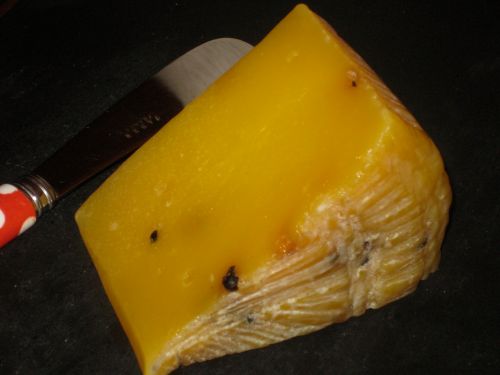
Piacentinu is a cheese I discovered during my first trip to Sicily, about 12 years ago. It’s a very old and unusual-tasting cheese, dating probably back to medieval times. It’s a Sicilian pecorino from the inland area around Enna. Much like the island’s pepato, Piacentinu is studded with black peppercorns, but unlike pepato it’s infused with saffron, which gives it a beautiful golden color and a taste that might be what you’d call acquired. I’ve now acquired it. At first I wasn’t so sure. I was fascinated with its color, so I tasted it.  This may have been in the fabulous city of Trapani. I was overwhelmed by its beauty—both the cheese and the city’s—and when I got home I tracked down Piancentinu in Manhattan, bought a hunk, and tasted it again. I found it strange, almost medicinal, but I couldn’t let it go. I wanted to taste it again, to keep tasting it. I’m not sure why, exactly. Something was telling me I loved this cheese but just didn’t know it yet.

Saffron is a spice I really had to learn to cook with. It has an alluring bitter edge, which can become less alluring when heated too long, or if you use too much, but in good hands (the hands I now have) it produces an exotic, bittersweet perfume. I believe Piacentinu cheese came into being at a time when saffron, like black pepper, was a sign of wealth and so was an extravagance. The fact that the cheese held on as most heavily spiced foods fell from favor in Sicily is a testament to what I now find to be its lovely flavor. That flavor, like other slightly bitter tastes that punctuate some Southern Italian foods, such as that of Amaro, is something I’ve worked to love. Now I even crave it.

It took me a while to come up with good flavor pairings for Piacentinu, but I finally found them. When I started thinking Arab, it all came together. Piacentinu, I discovered, tastes incredibly good with dates. It’s also wonderful with a glass of good dry Marsala. It marries well with sweet or slightly bitter fruits such as figs or pears, but maybe not so well with acidic ones like green grapes. To my palate it’s a little too rich to match with salumi products like soppressata. When I was looking for ways to incorporate it into a fully composed dish, I thought about some of the classic Sicilian cooking that includes saffron, and I finally hit on what I think is a right-on match for this unusual cheese: fennel. Saffron and fennel are often paired in Western Sicilian dishes, as they are in neighboring North Africa. Think of pasta con le sarde, with its mix of fennel, saffron, raisins, and pine nuts, and Sicily’s version of couscous, usually a fish concoction scented with fennel, bay leaf, and saffron.

I decided to include Piacentinu in a raw fennel salad, and I was extremely happy with the opulent results. I added pine nuts because Sicilians love pine nuts. And since it’s springtime, I threw in a handful of fresh fava beans and a little watercress. I hope you’ll like the salad, too. It is, I think, I  nice way to coax your palate into spring, and a good way to make your acquaintance with Piacentinu.

You can order Piacentinu from Dipalo’s or Buonitalia.

piacentinu
Sicilian Piacentinu, flavored with saffron and black pepper.

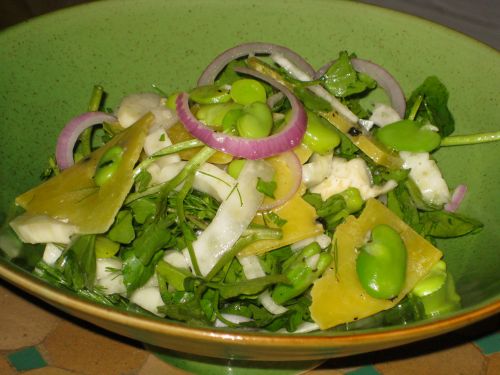
Fennel and Fava  Salad with Piacentinu

(Serves 2)

1 pound fava beans, in their pods
1 small fennel bulb, very thinly sliced, plus a few fronds reserved for garnish
About ¼ a red onion, very thinly sliced
A small bunch of watercress, the thick stems trimmed
A palmful of pine nuts, lightly toasted
About 10 big shavings of Piacentinu cheese
The juice from ½ a small lemon
2 tablespoons extra-virgin olive oil
Salt
Freshly ground black pepper

Shell the fava beans. Set up a small pot of water, and bring it to a boil. Drop in the fava beans, and blanch them for two minutes. Drain them, and then run cold water over them to stop the cooking. Now pierce the skin of each bean with your nail, and pop the bean out. The skins should slip off easily. Now you’ll have a nice pile of tender, smooth bright green fava beans.

In a small salad bowl combine the fava beans, fennel, red onion, watercress, pine nuts, and Piacentinu. Mix the lemon juice with the olive oil, and season it with salt and black pepper. Pour this over the salad, and toss gently. Garnish with the fennel fronds. Serve right away.

Women with Fish

lulu-2
Lulu Peyraud, a Provençal cook, with traditional cork fish paniers, 1968.

cook1
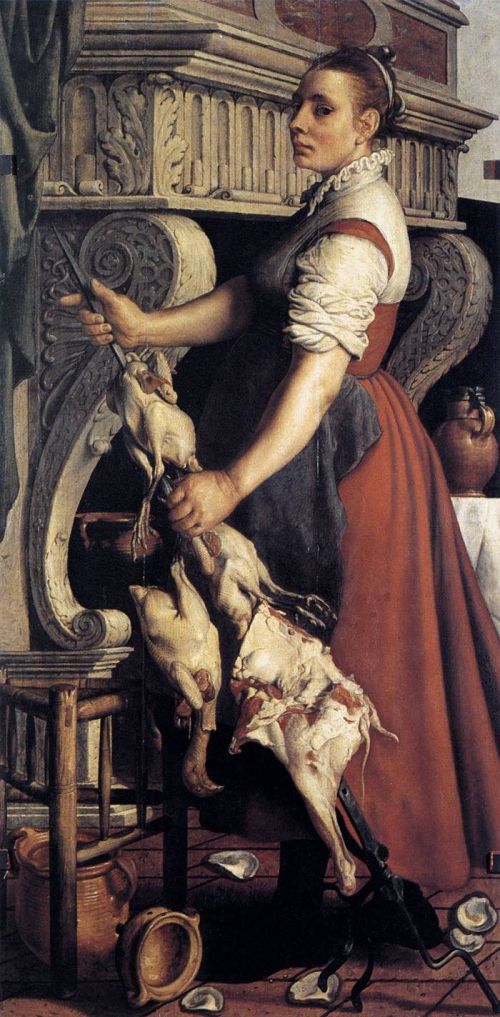
The Cook, by Pieter  Aertsen (1508-1575).

Recipe: Roast Chicken with Leeks, Thyme, and Black Olives

I never had roast chicken when I was a kid. We had chicken alla cacciatora, chicken with lemon and garlic, or we barbecued chicken, lots of it, all summer. The idea of the perfect still-life whole roast chicken came later for me, when I started reading French cookbooks. Jacques Pépin’s cookbooks introduced me to roast chicken, and I love him for it. I love him for a lot of things. His big technique books were the guidance I turned to first when I decided to get serious about cooking. I also love the fact that he slaughters and sautés frogs he catches in a pond on his Connecticut property. I somehow find that incredibly alluring.

From Mr. Pépin I learned to roast chicken on high heat, but he also always recommended turning the thing around a bunch of times during the cooking. I used to do that, and the results were very good. I don’t know what happened, but somewhere along the way I completely lost patience with the technique and just stopped doing it. But then a curious thing occurred. I started producing really good roast chicken by just sticking the thing in the oven and letting it sit there. Sorry Jacques. I still love you.

What I do now is put the chicken in legs first, so the dark meat, which cooks slowest, is in the hottest part of the oven. That gives me tender dark meat and moist breast meat without having to keep moving the bird. And I’ve found that an even 400 degrees is a good roasting temperature for the entire stint. A 3½-pound chicken takes about 1 hour and 20 to 25 minutes at this temperature (with a read of about 165 degrees at the upper thigh joint, next to the bone, when perfectly cooked). I start the chicken on convection, which helps boost browning, but then I turn it off after about a half hour so the skin doesn’t get too dark too early.

A roast chicken is something you can really play around with. I’ve done the million-cloves-of garlic thing, I’ve gone Sicilian with anchovies and orange, I’ve tried the tarragon-and-vinegar approach. Oh, I’ve been all around Europe with my roast chickens. I love the flavor combo of fresh thyme with black olives, and I reach for it when I want something easy but lush. So this time I started with those flavors and then added leeks and Marsala to the roasting pan. They become central components of a rich pan sauce that basically made itself. I hope you like it.

roast-chicken

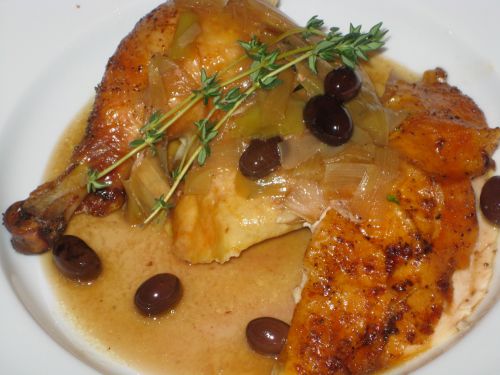
Roast Chicken with Leeks, Thyme, and Black Olives

Extra-virgin olive oil
2 tablespoons melted butter, slightly cooled
Salt
Freshly ground black pepper
¼ teaspoon ground nutmeg
½ teaspoon sugar
An approximately 3½-pound free-range chicken
A small bunch of fresh thyme branches
3 garlic cloves, peeled and lightly smashed
2 large leeks, trimmed, split lengthwise, and cleaned
4 carrots, peeled and cut lengthwise in two
A big wine glass of dry Marsala
2 cups chicken broth
A tiny splash of Spanish sherry vinegar
A handful of black olives, such as Niçoise
A tiny splash of Spanish sherry vinegar

Preheat the oven to 400 degrees.

In a small bowl, mix the butter with 2 tablespoons of olive oil. Season well with salt, black pepper, the nutmeg, and the sugar. Rub the chicken all over with this seasoned oil. Shove the garlic cloves and the thyme in the chicken’s cavity. I don’t bother to truss the thing, but I do fold the wings under so they’re neatly tucked in.

Choose a roasting pan that will hold the chicken with a little room to breathe. Place the leeks and carrots in the pan, making a flat bed. Place the chicken on the vegetable bed, breast side up. Pour the Marsala and about ½ cup of the chicken broth into the pan. Give the chicken an extra little sprinkle of salt, and put it in the oven, legs toward the back.

Roast for about 1 hour and 20 to 25 minutes, adding more chicken broth from time to time when the liquid gets low. I use convection for the first half hour, which cuts the cooking time by about 5 minutes or so. You can test the upper thigh joint with a thermometer. It should be perfectly done when it reads between 160 and 170.

When the chicken is done, take it from the oven. Pour any juices that run from the cavity into the roasting pan. Place the chicken on a serving platter. Take the garlic and the thyme out, and add them to the pan juices. Take out the leeks and carrots. Place the carrots around the chicken, and cover everything lightly with aluminum foil.

Skim off as much fat from the pan juices as you can. Chop the leeks into small dice, and return them to the roasting pan. Heat the pan juices over a medium flame until bubbling. Add the olives. Add enough chicken broth or water to create a thin sauce. Boil for about a minute or so. Remove the thyme. Add a tiny splash of Spanish sherry vinegar, just to bring up the flavor. Taste for seasoning, adding more salt or black pepper if needed. Pour the sauce into a gravy bowl.

Cut the chicken into pieces ,and pour a generous amount of the sauce onto each serving.

scampi

Recipe: Scampi with Almonds, Mint, and Lemon

I went out to dinner a lot as a child, mostly to Italian places in Nassau County, Long Island, and in Manhattan (the City, as we called it). My father was a golf pro, which meant he had erratic hours, especially in warm weather, so dinner at home was hit or miss. He also loved to party, and taking everyone out to dinner was very much a part of his ring-a-ding life. I’m grateful for it. The flavors of the 1960s Italian-American food on all those usually fun restaurant evenings are permanently embedded in my palate memory. Shrimp scampi, as it was always called then, was something I ordered constantly. I became quite the snotty little expert on the scampis served in the greater New York area. Scampi then meant lots of garlic (sometimes burnt black and acrid), lots of olive oil, and lots of lemon. It also more than occasionally meant horrendously overcooked shrimp, which was a big disappointment. This glamorous dish, I discovered, could be amazingly delicious or disgusting, depending on the time and place. But I was always up for the confrontation.

Going home with the garlic burps after a night out with my father, my clothes stained with  olive oil, red wine, and Shirley Temples and reeking of cigarette smoke, was a recurring experience of my childhood. It was also the beginning of my culinary education. What I learned back them was that a good scampi was gentle on the garlic and not hammered to death.

In Italy real scampi look like beautiful mini lobsters, but with a thinner shell (or maybe a better description is that they look like big shrimps with claws). They’re most often served just cracked down the middle and sautéed or grilled with a simple mix of olive oil, herbs, garlic, and breadcrumbs. I don’t often see real scampi here, but Citarella almost always stocks jumbo shrimp. They’re excellent for what I suppose should be called shrimp scampi-style (or gamberi (the Italian word for actual shrimp) scampi-style). I make variations on this dish often. This time I decided I wanted a springtime feel to it. I added ground almonds, which lighten it up, since they don’t soak up oil the way the straight breadcrumbs do. I added fresh mint instead of parsley. I also decided to serve the shrimp on a bed of watercress. It came out pretty springlike, I think.

real-scampi
True Italian scampi.

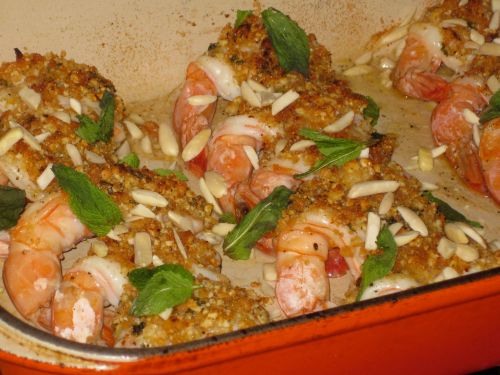
Scampi with Almonds, Mint, and Lemon

(Serves 4)

12 jumbo shrimp
Extra-virgin olive oil
The juice and grated zest from 1 small lemon, plus lemon wedges for garnish
¼ cup dry white wine
2 garlic cloves, very thinly sliced
Salt
Freshly ground black pepper
⅓ cup homemade dry breadcrumbs, not too finely ground
½ cup whole lightly toasted almonds, half finely ground, the rest roughly chopped
1 heaping tablespoon grated Grana Padano cheese
A handful of fresh mint leaves, half chopped, the rest left whole for garnish
2 bunches watercress

Peel the shrimp, leaving the tails on. Then make a deep slice into the back of each shrimp, removing the vein. You’ll want to go about halfway in, just far enough so the shrimp will open up and lay flat in the baking dish. Put the shrimp in a large bowl.

In a small bowl, mix together the lemon juice, about ¼ cup olive oil, the white wine, and the garlic. Season with salt and black pepper. Pour this over the shrimp, giving them a good toss.

Preheat your broiler.

Place the shrimp in a shallow sided baking dish, cut side up, curling their tales to the side so they can lay flat. Pour any remaining marinade over the shrimp.

In another small bowl mix together the breadcrumbs, ground almonds, Grana Padano, lemon zest and chopped mint. Season well with salt and black pepper. Add about 2 tablespoons olive oil, and mix well.

Place the watercress in a salad bowl.

Broil the shrimp about 4 inches from the heat source for about 4 minutes. Pull the dish from the broiler, and scatter the breadcrumb mixture over the shrimp. Return the dish to the broiler, and cook until the breadcrumbs are a nice golden brown, about another 4 minutes. Pull the dish from the broiler, and garnish the shrimp with the chopped almonds and the mint sprigs.

Dress the watercress with a little olive oil and lemon juice, and serve alongside the shrimp. You can drizzle any juices left in the dish over the shrimp if you like. Serve with lemon wedges.

eat-sicily
Eat Smart in Sicily, by Joan Peterson and Marcella Croce, published by Ginkgo Press in 2008.

Recipe: Penette con Pesto di Pistacchio e Mandorle

Considering the size of my apartment, I have to say my collection of Italian cookbooks is almost out of control. But whenever I try thinning it out, I find there’s a fine and true reason to keep every one of them. They’re a family, and I can’t break them up. These books comfort me when my sense of identity slacks off. They remind me of things I need to remember, of specific dishes I love and want to cook again, and of flavor combinations I shouldn’t forget to play with. Most of all they bring back to me all my trips to Italy that can sometimes feel so far in the past. I especially treasure the little regional Southern Italian cookbooks and pamphlets I’ve collected from various excursions into Sicily, Campania, Puglia, Basilicata, and Calabria. Those are my people, that is my food, and now these are my books. They are where I find recipes for the home cooking in little corners of the world, for traditional dishes that may be fading out of people’s lives. These little paperbacks, often sold in the town hall or visitor center of a village (a room in a church), written by local cooks or historians, their covers decorated with illustrations of elaborate pastries or coiled sausages, or people picking olives, or a photo of a lady in a ridiculous regional outfit, complete with wacky headgear, taken during some sagra, make me cook with heart. When I cook from one of these books, I travel back to a place no big chef’s book can take me to.

Recently I entered “Sicily” in the Barnes & Noble search window, as I do from time to time, just to make sure there isn’t something new needed on my shelves, and up came Eat Smart in Sicily, part of an Eat Smart travel series published by Ginkgo Press. With its generic-looking travel-guide cover, I imagined it would be the opposite of the pinpointed, regional ones I love. But since I have to keep nurturing my big collection, I ordered it anyway.

In format the book turned out to be what I expected , but its content was much more involved than I’d imagined, more homey and intimate, with no slick edges. In fact it was like my beloved little regional books. The dishes and the names of the dishes, often presented in Sicilian dialect—a kind of Arab-looking and -sounding form of Italian—were truly foreign and distinct, drawing me right in with their poetry.

The book begins, as it should, with a rundown of Sicily’s checkered past, with all its Greek, Roman, Arab, French, and Spanish invaders, and how each contributed to what Sicilians eat and why. Interesting, but I’ve been there before. Once I got past that, and the authors started talking about the food, I was knocked out by its richness.

The next chapter is called, plainly enough, “Local Sicilian Food.” Just  scanning through it, picking out words on the pages, got me really tasting true Sicilian food. Some of the words that popped out at me: sesame seeds, swordfish, tuna, capers, fichi d’india, citrons, pine nuts, tomatoes, artichokes, sheep’s milk ricotta, olives, eggplants, cipolle, zucchina lunga, tenerumi, peperoncini, ceci, fiori di zucca, lumache, mint, parsley, wild fennel, saffron, maiali, agnello, capretti, horse meat, gamberi, calamari, seppie, polpo, fava, ricci (I love sea urchin), sarde, lenticchie, blood oranges, limone, aceto, chestnuts, caciocavallo, tuma, primosale, pecorino, honey, vino, acqua minerale, espresso, wild asparagus, almonds, figs, pistachios. What a glorious jumble.

Which leads to what in my opinion is the best part of the book, its “menu guide.” This is an extensive alphabetical list of Sicilian dishes that reads like a great nonfiction book (at least to me). Here’s a sampling of the names of some of the amazing dishes that it covers (for a description of what these things actually are and how they’re made, you’ll have to look at the book itself). I love the sound of ammogghiu, babaluci con aglio e prezzemelo, cappidduzzi (my favorite), ericini, filetto di suino, frascatole in brodo di pesce e gamberi, gelo di melone, impanatigghi, latte di mandorla, minne di vergini, olivette di Sant’Agata, pane e panelle, quaresimali, rosolio, salame di cinghiale, tagliancozzi, uva al liquore, vurrania bollita, zucca all’agrodolce, and zuppa di crastuna, to name a few.

And just to hep you up further, and get you wondering why you’re not booking a trip to Sicily right now, the authors include a handful of recipes, both traditional home-cooking types and contemporary restaurant dishes. I’ve always been fascinated by Sicilian nut pestos, the classic one being a mix of almonds, tomato, garlic, mint, and basil. But evidently the pure nut pestos like the one I made from this book, which contain almost nothing but ground pistachios and almonds, are more contemporary (you’d think it would be the other way around, since tomatoes came along relatively late in Italian history, but that’s evidently not the case).

Pennette with pistachio and almond pesto, the recipe I chose, turned out to be a great dish, but I do have a few things to say about making this opulent pasta outside of Sicily. As with all pestos, this one is best when prepared no more than about an hour before serving, so that it stays fresh and brightly colored (and it’s really quick to make, just a few ingredients thrown into a food processor). I did, however, have to make several changes to the original recipe, because the nuts I find here at not all that flavorful. I can sometimes track down Sicilian Bronte pistachios and decent almonds, if I run all over town, but I usually have to make do with nuts from a health food shop, which seem to have more flavor than supermarket ones. At any rate, I found I needed to toast them a little to bring up their taste. Even with the toasting, I found I needed to add a little garlic, which is not present in the original recipe. I didn’t cave in and add cheese or black pepper, though, two ingredients most Americans seem to think belong in every Italian dish.

I have to say, this pesto was delicious. If you find the freshest, best nuts you can, and use good Sicilian olive oil (I would suggest Ravida), you’ll get excellent results. Maybe not quite as wonderful as you could get in Sicily; for that, you’ll just have to book a trip.

nut-pesto

Penette con Pesto di Pistacchio e Mandorle

This recipe is my adaptation of one in Eat Smart in Sicily. The authors got it from Giovanni Farruggio, chef at the Ristorante La Pigna in the Hotel Villa Paradiso dell’Etna, in San Giovanni La Punta in the province of Catania.

(Serves 4 as a first course)

½ cup unsalted, shelled pistachios, lightly toasted
½ cup blanched almonds, lightly toasted
1 small garlic clove, roughly chopped
Extra-virgin olive oil, preferably an estate-bottled Sicilian oil such as Ravida
Salt
About 20 basil leaves
¾ pound pennette (small penne)
A handful of chopped fennel fronds for garnish (if you can find wild fennel that will be best, but I used the fronds from bulb fennel, which weren’t bad)

Put up a pot of pasta cooking water and bring it to a boil. Add a generous amount of salt.

Put the pistachios and the almonds in the bowl of a food processor. Add the garlic, and give it a few quick pulses. Add about a third of a cup of olive oil and some salt, and pulse a few times more. You want to chop the nuts into little pieces, but you don’t want to create a paste. When the nuts are fairly uniformly chopped, add the basil, and pulse once or twice more, just to break it up. The texture should be pebbly.

Cook the pennette al dente, and drain, saving about a cup of the pasta cooking water.

Pour the pennette into a warmed serving bowl. Add the nut pesto and a few tablespoons of the cooking water. Toss well. Add a drizzle of extra olive oil if needed for texture. Taste for salt. Garnish with the fennel fronds. Serve.

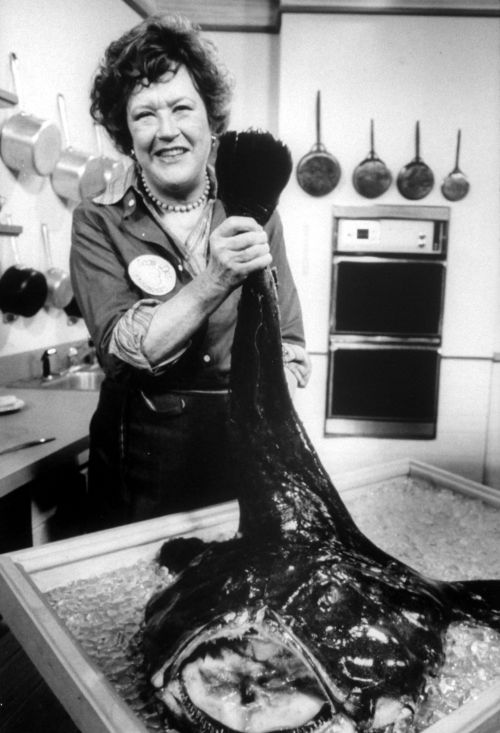
Women with Fish

julia_child_imageJulia Child and a very large monkfish.
Here’s a new feature on Skinny Guinea: “Women with Fish.” It will be an ongoing series of photos of anything that can be considered “Women with Fish.”  We will see how it develops as time goes by. If you have any photo you’d like to see in it, please feel free to send it along to me, at edemane@earthlink.net.

sea-f-000185-0000the-old-man-of-artimino-palatine-gallery-florence-posters2
A picnic from your wildest dreams, by Giovanna Garzoni.

Recipe: Roast Lamb Sandwich with Ricotta and Caper Pesto

Pasquetta sounds wonderful to me. That’s Easter Monday, when Italians pack up a picnic lunch and head to the countryside to spread it all out under the Italian sun. We generally don’t have the weather for a Pasquetta picnic in New York, where I live, so this nice little celebration is out. Plus we don’t get the day off, so we’re doubly out of luck here.

Come to think of it, Americans generally don’t have picnics. We do barbecues, don’t we? I certainly didn’t grow up having any picnics on Long Island, but we had plenty of barbecues. Picnics are European. You can bring pâté to a picnic, and wine. There was, though, that William Inge play Picnic, which was made into a movie with William Holden as the handsome but creepy drifter who slips into town to cause trouble on Labor Day. Maybe in Kansas they have picnics.

If I lived in Italy and were packing up a big basket for Pasquetta, this is what I’d include (you’ve got to do something with all the leftover lamb). By the way,  the painting above by Giovanna Garzoni is my idea of a great picnic. How can you go wrong with a spread that contains a scary dog,  a dead bird, and a bunch of cardoons?

Happy Pasquetta to you.

Roast Lamb Sandwich with Ricotta and Caper Pesto

(Serves 2)

¼ cup salt-packed capers, soaked for 20 minutes and then rinsed
1 small garlic clove, peeled and roughly chopped
A small handful of flat-leaf parsley leaves
⅓ cup extra-virgin olive oil
Freshly ground black pepper
½ a large baguette, sliced horizontally
6 good-size slices of roasted leg of lamb, not too rare, at room temperature
Salt
½ cup whole-milk ricotta (sheep’s milk, if you can find it)
A handful of baby arugula

Place the capers, garlic, parsley, olive oil, and a few grindings of black pepper in the bowl of a small food processor, and pulse to a rough paste.

Smear the insides of the baguette with a thin layer of caper pesto. Lay the lamb on the flat sides of the bread, and make a layer of ricotta on the rounded sides. Season the lamb with salt and black pepper, and top with the arugula. Close up the sandwiches, and wrap them in aluminum foil. Grab a cold bottle of Frascati and a pint of strawberries, and head for the warm sun.

Roman Easter Bread

pasolinijesus92
Pier Paolo Pasolini relaxes with Jesus between takes while filming The Gospel According to St. Matthew.

Recipe: Torta Salata Pasquale

The earthquake in the Abruzzo on Monday made me terribly sad. It is a beautiful region. Many friends of mine have family ties to the area, east of Rome.

When I was working on my book The Flavors of Southern Italy, I stopped in the Abruzzo while making my way from Rome to the Gargano, in northern Puglia. My husband and I decided to spend a few nights in Sulmona, a lovely little city in the province of L’Aquila. The town called L’Aquila, which is the capital of the province, is where Monday’s earthquake hit hardest. I haven’t heard of any destruction in Sulmona from the quake, but in 1706 that city was nearly razed to the ground by a devastating one. Abruzzo is and always has been earthquake country. Some Medieval structures survived Sulmona’s big quake, but most of the city was rebuilt in eighteenth-century Baroque style, which gives it a sort of fairy tale glow that I  love. Of course, what I recall most vividly about Sulmona is its food.

On our first night in Sulmona we made our way into an informal-looking little place for a late dinner, one of the only restaurants open on Sundays. I can’t remember its name, but it was owned by a very old, skinny lady, who seemed to be hostess, waitress, and chef. At first I felt guilty watching her run around on her bony legs, but then I realized she was really enjoying herself, chatting up all the dark-haired men in their slick business suits, refilling their wine glasses, grilling up pork chops. I realized she was doing just fine, and I relaxed into the scene.

The flavors of Abruzzo are big and direct. I ordered sautéed caciocavallo, which was huge and served as a main course. It was a big slab of easy-melting, salty cheese, pan sautéed until crisp outside and soft and oozing within and then seasoned with red wine vinegar, black pepper, and fresh marjoram, like an Abruzzese fondue. My husband had fat pork sausages served with onions and chickpeas. The Montepulciano d’Abruzzo red wine was outstanding—deeply colored, mellow, rich, low in tannin. It was a happy meal all around.

We followed our main courses with a plate of broccoli rabe seasoned with garlic and fennel seeds. I love the robust quality of this food, and when it’s cooked brilliantly, as it was in Sulmona, a simple meal can be most elegant. Just in case we didn’t drink enough wine (and we did), we ordered Sulmona’s specialty, cent’erbe, an herbal digestivo that I had tasted before elsewhere but never quite like this. Cent’erbe, as interpreted in Sulmona, is so high in alcohol it evaporates on your tongue (it hovers around 150 proof). I’ve never experienced anything else like it. I brought a bottle home with me, of course, and nobody I’ve served it to could believe its shocking power. Even if I can barely get it down, it’s sort of great to know a drink like it exists.

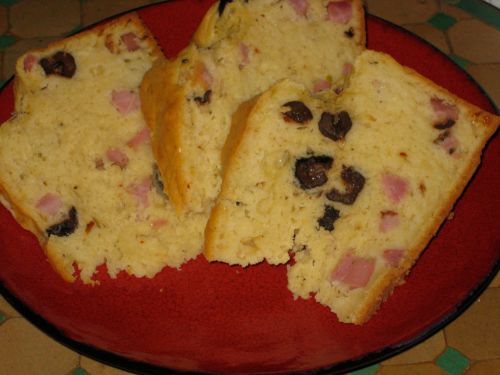
One of my favorite Easter recipes comes from Rome, the Abruzzo, and the areas of central Italy. There are many versions of torta salata Pasquale. The Roman version is more of a bread; in Abruzzo it can be constructed as a two-crusted tart. It always has a filling of prosciutto or salami, often olives, and pecorino or caciocavallo cheese. It’s eaten on Easter morning or Pasquetta, the day after Easter, when Italians pack up a picnic and head outdoors. This year I made mine breadlike, more Roman than not, and I included prosciutto cotto, mortadella, black olives, pecorino , and a hefty dose of white wine. Sounds like it would be a real load, but for an eggy bread it’s in fact surprisingly light.

You’ll need a ten-inch springform pan, lightly greased with olive oil.

A note about the ingredients for this torta: You’d think for authenticity I would have chosen Gaeta olives and a pecorino Romano, but the truth is I can’t usually find decent enough versions of those products here. Both come too salty, and Gaeta olives often have a harsh lye taste. Pecorino Toscano is more reliable, and little black Niçoise olives have a nice mellow flavor, so I’ve gone with those instead. Also, try to find real imported prosciutto cotto and mortadella. They will make a big difference.

torta-psqua1

Torta Salata Pasquale

(Serves 10)

3¾ cups all-purpose flour
A generous pinch of salt
1 tablespoon sugar
A pinch of cayenne
Freshly ground black pepper
A few big scrapings of nutmeg
1½ tablespoons  baking powder
¾ cup fruity extra-virgin olive oil
1 cup Frascati or another dry white wine
6 large eggs
¾ cup small-diced prosciutto cotto
¾ cup small-diced mortadella
¾ cup  pitted and roughly chopped black olives, such as Niçoise
¾ cup grated pecorino Toscano cheese

Preheat the oven to 350 degrees.

Pour the flour into a large bowl. Add the salt, sugar, cayenne, black pepper, nutmeg, and baking powder. Stir everything around well to blend.

Mix the olive oil, wine, and a cup of water together in a small bowl, and then pour it over the flour. Stir well with a wooden spoon to blend. The dough will be quite stiff at this point.

In another small bowl, whisk the eggs lightly, and slowly pour them into the flour mixture, mixing as you do, until they’re well incorporated (use an electric mixer if you like).

Add the prosciutto cotto, mortadella, olives, and pecorino, and mix briefly.

Pour the batter into the pan, and bake for about an hour, or until the bread puffs and the top is dark golden and springy. Let cool, and then loosen the springform. Serve at room temperature. In my experience this bread loses texture when refrigerated. Just cover it with plastic wrap to keep it moist. It will stay fresh for about five days.

A Roman Easter

elsamartinellib06
Elsa Martinelli, il Colosseo, and a fluffy white kitty.

Recipe: Easter Eggs with Asparagus, Guanciale, and Pecorino

Easter in Rome—what a lovely fantasy. It sounds grand and enveloping, old-world Catholic, except that if you’re a tourist and don’t have anyone to freeload off of, you’ll discover that most of the restaurants are closed, and you’ll wind up eating leaden fettuccine Alfredo with a bunch of Japanese in an overpriced hotel dining room. And the Vatican will be a mob scene. Oh, well. Another glamorous bubble burst. I guess I’ll stay put in slick and godless Manhattan, hanging out with the cats and my freshly laid-off friends to cook up some solid Roman food.

Roman Easter food has always had a big allure for me. It’s creative, seasonal Italian cooking at its best. Lamb, ricotta, eggs, artichokes, asparagus, shell peas, favas, and wheat all play a part in the Roman Easter feast and springtime celebrations. These are rich tastes, but their freshness and greenness make them renewing to the spirit, which is just what I need this time of year (doesn’t everybody?).

Here’s a Roman dish that I absolutely love. It highlights the beauty of spring asparagus, and I can’t imagine Easter without asparagus. (It’s not quite in season here yet, but what comes from California is pretty decent.) Here you bring together a few simple ingredients—asparagus, eggs, pecorino, guanciale, a handful of herbs—to create a truly opulent dish. Since you leave the egg yolks soft, they run all over the asparagus and the guanciale, creating a cheesy, eggy sauce. Really nice. I think this makes a great first course before another classic Roman Easter dish, braised lamb with fresh green peas. Here’s my recipe for that, if you’d like to give it a try.

And I’ve got more Roman Easter recipes on the way.

roma-eggs1

Easter Eggs with Asparagus, Guanciale, and Pecorino

(Serves 4 as a first course)

1 large bunch medium-thick asparagus, trimmed and peeled
Extra-virgin olive oil
⅓ cup well-chopped guanciale (or use pancetta instead)
2 garlic cloves, peeled and lightly crushed
Salt
Freshly ground black pepper
The juice from ½ a large lemon
4 extra large eggs
½ cup grated Pecorino Romano cheese (the best you can find, and not too salty)
A few chives, chopped
A few large sprigs of fresh mint, the leaves left whole

Set up a pot of water, and bring it to a boil. Drop in the asparagus, and blanch for about 4 minutes. Drain the asparagus in a colander, and then run it under cold water to stop the cooking and to set its green color. Drain well.

Lay the asparagus out in a shallow baking dish.

In a large skillet, heat a tablespoon of olive oil over medium heat. Add the guanciale, and let it get crisp and give up its fat. Add the garlic, and sauté a minute longer, just to release its flavor.

Remove the crisp guanciale bits from the skillet with a slotted spoon, and scatter them over the asparagus. Discard the garlic. Season the asparagus with salt, black pepper, and the lemon juice. Reserve the guanciale cooking fat.

Poach the eggs in just-simmering lightly salted water until the whites are set but the yolks are still runny (you can do this two at time, or one at a time, whatever you’re comfortable with). Scoop them from the water with a slotted spoon, resting them on paper towels for a moment to blot excess water, and arrange them on the asparagus. Spoon a little of the guanciale cooking fat over the eggs, and a little over the asparagus if you have extra, and season the eggs with salt and black pepper.

Sprinkle on the pecorino, and heat the dish under a broiler until the cheese just starts to melt, about a minute or so. Garnish with the chives and the mint. Serve right away.