Feeds:
Posts
Comments


A very deep yellow.

Recipe: Yellow Squash Soup with Saffron and Farro

Color can hold great power for the cook. It’s important to me. I find it can sway me in a culinary direction I didn’t intend to go in, especially in the summer, when so many brightly colored vegetables are there at my Greenmarket, seemingly just to shock me. Here’s a soup that’s bright yellow. If you love the color yellow as I do, it should be a pleasing soup to cook and bring to your table. It also tastes good. It gets its color from those amazing yellow zucchini I’m finding at my Greenmarket right now. (Get them now before they grow too big.) I can’t believe how incredibly yellow yellow zucchini actually are. They’re yellow just verging on orange, sort of like the color of Meyer lemons—in fact almost exactly that color. I’ve added saffron to this soup to underscore the yellow, and it also adds lovely flavor. I paired the saffron with thyme, since over the years I’ve found that to be an enticing combination. The saffron also turns the potatoes a bit yellow. The only thing that isn’t yellow is the farro, which of course is deep brown. If you would rather have uninterrupted yellow, you could substitute orzo pasta for the farro. That would give you a much lighter tasting soup, but it would be extremely yellow.

Yellow zucchini is a bit bland, a little starchier than the green variety, I find. To balance it I added some lemon zest. You could also “correct” this soup, as they say in restaurant kitchens, with a few drops of lemon juice or a gentle vinegar such as one of the Spanish sherry type, adding it after cooking, when you evaluate the soup’s flavor.

Yellow Squash Soup with Saffron and Farro

(Serves 6)

¾ cup farro
Extra-virgin olive oil
Salt
2 ¼-inch rounds pancetta, cut into small dice
1 medium summer onion, cut into small dice
2 fresh garlic cloves, very thinly sliced
3 baby Yukon gold potatoes, skinned and cut into small cubes
About 8 thyme sprigs, the leaves chopped
3 cups light chicken broth
5 small yellow zucchini, cut into small cubes
Freshly ground black pepper
About 20 saffron threads, dried if moist and ground to a powder
The grated zest from about ½ lemon
A chunk of Montasio cheese (a delicate cow’s milk cheese from Fruili; grana Padano is a fine substitute—you want something sweet that won’t overpower the delicate flavors of the soup)

Place the farro in a saucepan, and cover it with at least 4 inches of cool water. Bring to a boil. Turn the heat down a bit, and let bubble until just tender, usually about 15 minutes but taste it from time to time (I’ve found that some farro cooks faster). Drain the farro, and pour it into a small bowl. Give it a drizzle of olive oil and a little salt, and mix. Set it aside.

In a medium soup pot, heat about 2 tablespoons of olive oil over medium flame. Add the pancetta, and sauté it until most of its fat has melted out. Add the onion, the garlic, and the potatoes, and sauté for about 2 minutes, just to release their flavors. Add the zucchini, the thyme, and a little salt, and sauté for a minute to coat the zucchini with a little flavor. Add the chicken broth and about a cup of water, and bring everything to a boil. Turn the heat down a touch, and cook, uncovered, at a lively bubble until the potatoes and zucchini are just tender but still holding their shape, about 12 minutes or so. Add the farro, the saffron, a good amount of black pepper, and the lemon zest, and let the soup simmer for a few minutes to release the saffron into the broth.  Add more water or broth if it get’s too thick after adding the farro. Taste for seasoning.

Garnish each bowl with a drizzle of fresh olive oil and a grating of Montasio cheese.

Laura Nyro and Red Wine

Recipe: Summer Cherries with Red Wine, Vanilla, and Cassis

As a teenager in the 1970s I didn’t have many hip Italian-American gal role models to turn to. I mean, I did love Connie Francis, her voice moved me, but she was not an inspiration for what I wanted to be, for the Catholic-free, Guido-free life I wanted to lead. When I discovered Laura Nyro it was love at first hearing and sight, even though she was in truth only half Italian. Everything about her was what I was looking for (except when she screeched her way up to some of those high notes; I have to admit I found that a little irritating).

I think my first taste of Laura Nyro’s music coincided, fittingly, with the blossoming of my adoration of red wine. Not my discovery of red wine—I’d been drinking it since I was a child—but my new very deep interest in it. That seemed right. She was an Italian art girl, so there was the non–Connie Francis order right there, and she sang about red wine (well, she sang about wine; she didn’t say it was red, but you knew it had to be). I could be an Italian art girl and drink a lot, and since it was red wine I fell in love with, nobody was too alarmed. That was what I was supposed to be drinking. Red wine wasn’t booze, it was nourishment.

I loved red wine and drank plenty of it, the good, the bad, and the ugly. Chianti in straw bottles, heavy Spanish wine with weekday meals, red wine that had screw tops and handles, but also serious wine, the bottles of Barolo and Amarone that Lou Mastellone, the liquor salesman who lived across the street, would bring to our house.

It was a turning point for me. Lots of possibilities, I knew, would grow out of the union of good music and good wine.

“Let’s go down by the grapevine, drink my Daddy’s wine, get happy.
Down by the grapevine, drink my Daddy’s wine, get happy, happy.
Oh, sweet blindness, a little magic, a little kindness.
Oh, sweet blindness, all over me.”

Laura, this recipe’s for you.

Summer Cherries with Red Wine, Vanilla, and Cassis

(Serves 6)

1 bottle fruity red wine, such as a non-oaky Sangiovese
¾ cup Cassis
¾ cup sugar
1 vanilla bean, split
2 strips lemon peel
2 pints sweet summer cherries, the stems left on
A handful of small basil sprigs for garnish

Place the red wine, Cassis, sugar, vanilla bean, and lemon peel in a saucepan. Bring to a boil over high heat. Turn the heat down a touch, and let the mixture bubble until reduced by about ¾ (that should leave about a cup or a cup and a half of liquid). Let cool completely. When cooled it should have a the consistency of a loose syrup.

Put the cherries in a large bowl, and pour the red wine syrup over them. Give them a stir, and let sit for about ½ hour. When ready to serve, spoon the cherries with some of the wine syrup out into small bowls or wineglasses. Garnish with the basil sprigs.

Recipe: Orecchiette with Baby Zucchini, Saucisson a l’Ail, and Mint

The only great zucchini is really young zucchini, the kind I’m finding right now at the Greenmarket. They’re small, skinny, and firm, like we’d all love to be forever and ever. As you all know, zucchini can rage out of control, becoming huge and inedible toward summer’s end, so grab them now, before you’re forced into making one (or maybe even fifty) of those horrible old hippie zucchini breads.

Saucisson a l’ail, French garlic sausage, is wonderful with pasta, because it’s soft, not firm like most Italian dried salumi, such as soppressata, which can be a little rugged to bite down on in a bowl of pasta. D’Artagnan makes a good garlic sausage that I often find at many slightly more upscale supermarkets.

I like cutting the sausage and the zucchini into little cubes, about the size of the indentation in the orecchiette, so that they nestle in nicely and give the dish a pretty look.

Happy start of the summer to you.

Orecchiette with Baby Zucchini, Saucisson a l’Ail, and Mint

(Serves 2 as a main course)

Salt
½ pound orecchiette
Extra-virgin olive oil
5 or 6 very small summer zucchini, cut into small cubes
About 3 thick slices French garlic sausage, cut the same size as the zucchini
1 large shallot, very thinly sliced
1 jalapeño pepper, seeded and minced
A splash of dry vermouth
¼ cup chicken broth
About 8 large thyme sprigs, stemmed
A small handful of fresh mint leaves, lightly chopped
A chunk of pecorino Toscana cheese for grating

Set up a pot of pasta cooking water, and bring it to a boil. Add a generous amount of salt, and drop in the orecchiette.

In a large sauté pan, heat 2 tablespoons of olive oil over medium flame. When the oil is hot, add the zucchini, garlic sausage, shallot, and jalapeño, all at once. Add a little salt, and sauté until the zucchini is tender and just starting to turn golden, about 4 minutes or so. Add the vermouth, and let it boil away. Add the chicken broth, and turn off the heat.

When the orecchiette is al dente, drain it, saving a little of the cooking water, and add it to the pan. Toss well over low heat until everything is well mixed, about a minute. Add a little of the cooking water (or more broth, if you have it) if it seems dry. Transfer to a warmed serving bowl, and add the thyme and the mint and a drizzle of fresh olive oil. Toss gently. Taste for seasoning. Serve with grated pecorino Toscana.

Recipe: Farfalle with Morels, Asparagus, Shallots, and Chervil

No doubt about it, pasta with morels and asparagus is a springtime classic. The little touches you give it are what make it your own. My way (at least my way last night) is to include shallots, fresh garlic, thyme, white wine, crème fraîche and chervil. This is a gentle dish, no sharp edges, no hits of salt or hot spice. It’s what I would call soothing. It’s got to be gentle, because I don’t want to mask the tastes of my two very special main ingredients.

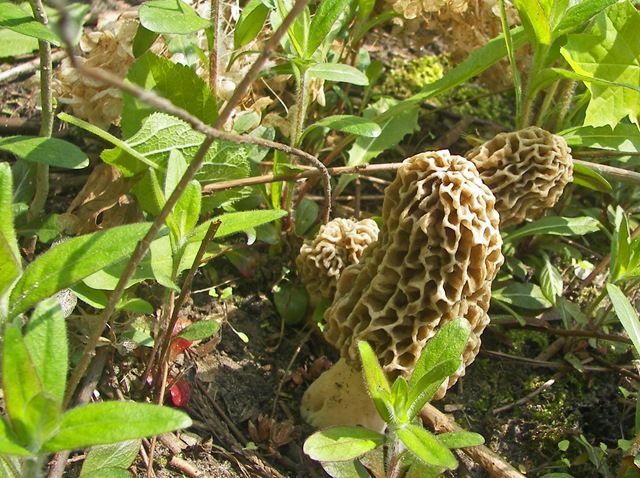
Morels have a unique flavor. At their best I’d say they’re earthy and deep, but if they’re waterlogged, they can taste like mold and have a slimy texture, so if you’re buying them from a shop, make sure they’re neither dead dry nor soaked. Springy is a word that comes to mind. Smell them, too. If they smell like a lovely mushroom, they’ll cook up tasting the same. I once found what I thought was a little cluster of morels on my friend Tobias’s property in upstate New York. They tend to pop up in the spring in moist areas and usually under dying elm trees (that’s so morbidly romantic). The ones I saw looked just like morels, but to be sure I checked my little pocket mushroom book and learned there is such a thing as a false morel, a mushroom you don’t want to be eating. Since I didn’t feel like finding out what I was dealing with by cooking them up and actually swallowing them, I decided to let them be. Just as well, I guess.

I don’t often cook farfalle (Italian for “butterfly”). That pasta shape always seems gimmicky to me, like those terrible wagon wheels my mother always cooked when we were kids. Farfalle is pretty, but a plate of it tossed with sauce can easily look like a cluttered mess. The way around this, to maintain farfalle’s loveliness, is to cut all the sauce ingredients in long slivers, so you don’t get clunky chunks competing with the decoratively shaped pasta.

It also can be a little tricky to cook correctly. It’s very important to buy a good artisanal brand of farfalle. Mass-produced ones like Buitoni are tight, compact, and force-dried, so their pinched-closed center tends to stay hard while the wings, I suppose you could call them, go beyond al dente toward flabby. You want a pasta that breathes, one that’s made with care. I chose Benedetto Cavalieri, an old, artisanal company from Puglia that still does it right. Another good choice with this sauce would be a fresh egg pasta such as tagliatelle.

Farfalle with Morels, Asparagus, Shallots, and Chervil

(Serves 2 as a main course)

Salt
12 thick asparagus stalks, trimmed
½ pound farfalle pasta
Extra-virgin olive oil
1 large shallot, very thinly sliced
1 large fresh garlic clove, thinly sliced
About 10 thyme sprigs, the leaves lightly chopped
About 10 to 15 morels (depending on their size), cut into slices lengthwise
Freshly ground black pepper
A splash of dry white wine
¼ cup chicken broth
1 heaping tablespoon crème fraîche
A handful of chervil, lightly stemmed
Grana Padano cheese for grating

Bring a pot of pasta cooking water to a boil. Add a generous amount of salt. Add the asparagus, and blanch it for a minute. Lift it from the water with a large strainer into a colander. Run it under cold water to bring up its color. Dry it well, and slice the stalks thinly on an angle.

Drop the farfalle into the boiling water, and give it a stir.

In a large skillet, heat two tablespoons of olive oil over medium heat. When hot, add the shallot, and sauté for about a minute. Then add the garlic, thyme, morels, and asparagus. Season with salt and black pepper, and sauté until the morels are just tender, about 4 minutes. Add the splash of white wine, and let it boil away. Add the chicken broth, and let simmer for a few seconds.

When the farfalle is al dente, drain it, and add it to the skillet. Toss gently over low heat for about 30 seconds. Turn off the heat, and add the crème fraîche, tossing gently. Taste for seasoning.

Divide the pasta up into two bowls. Garnish with a little grated grana Padano and then the chervil, bringing the remaining cheese to the table if you’d like a little more.


A still life with pork fat and dead birds by
Giacomo Nani (1698–1770).

Recipe: Warm Potato Salad with Pancetta, Mustard, and Pistachios

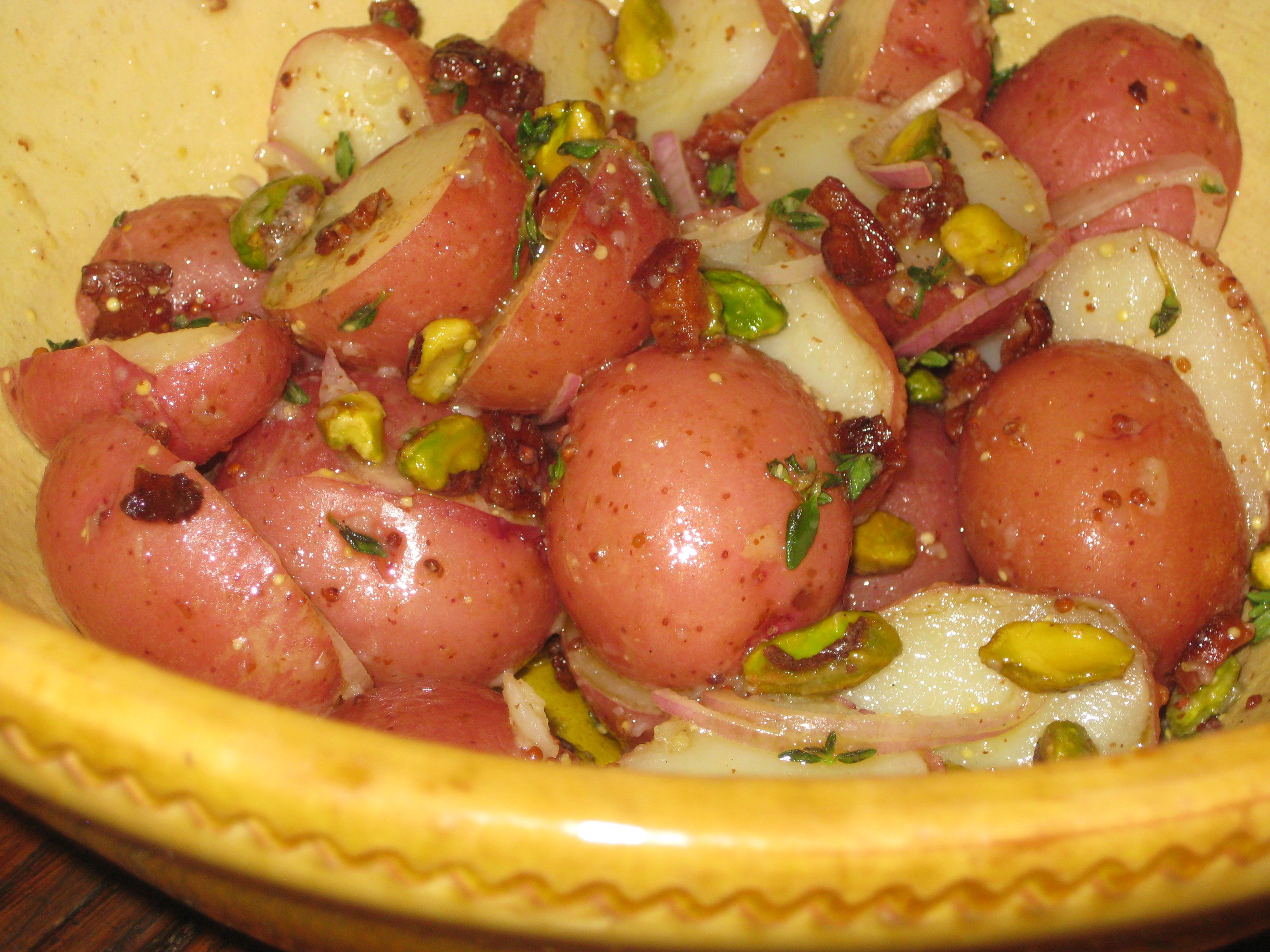
Improvvisata. In terms of Italian cooking, this can mean a number of things, from the highest creative impulse to just using up what you’ve got in your pantry to its best advantage. In the case of this potato salad, I mean the later. I had pistachios left over from my last blog, which featured a Sicilian nut pesto. Little red potatoes were sitting there in their mesh bag. And I ask you, what goyl can go a day without knowing she’s got a nice lump of pork fat in the frig, so I always have pancetta. I gathered a few stems of fresh herbs from the depths of my vegetable bin, considered the rosemary, scrapped it, and settled on thyme instead. A little mustard, some good olive oil. I had a lemon and a small shallot.

Try this sometime, or your own version of it. It’s got lots of flavor. I served it with orange roughy fillets fried in olive oil and served with lemon. But with barbecued chicken? Could be even better.

Warm Potato Salad with Pancetta, Mustard, and Pistachios

(Serves 4 as a side dish)

About 15 baby red-skin potatoes
Salt
2 tablespoons dry white wine
1 heaping teaspoon coarse-grain mustard
The juice of 1 small lemon (maybe a little less)
¼ cup extra-virgin olive oil, plus a little extra for sautéing
Freshly ground black pepper
About 10 thyme sprigs, the leaves lightly chopped
1 small shallot, very thinly sliced
A handful of unsalted, shelled pistachios
1 approximately ¼-inch-thick piece of pancetta, cut into small cubes

Place the potatoes in a pot of cool water, covering them with about 3 inches of water. Add salt, and turn on the heat to high. Simmer until just tender, about 8 minutes or so. Drain, and cut them in half.

Place the potatoes in a large shallow serving bowl. In a small bowl, mix together the white wine, mustard, lemon, and olive oil. Season with a little salt and a generous amount of black pepper. Pour this over the hot potatoes, and toss gently with your fingers (which will prevent breaking up the potatoes). Add the thyme, shallot, and pistachios, and toss again, very gently.

Pour about a tablespoon of olive oil onto a medium skillet, and put it on medium heat. When hot, add the pancetta, and let it get nice and crisp. Scoop the pancetta out with a slotted spoon, and add it to the potatoes. Spoon on about a teaspoon of the pancetta cooking fat, and toss. Serve warm.


Sicilian pistachios just before the harvest.

Recipe: Mussels with Sicilian Nut Pesto.

Now, I would imagine you feel the same way about this. What good cook wouldn’t? I go a little ballistic when I purchase nuts only to bring them home and find that they’re rancid.

It’s such a common problem in this country. It’s terrible. And nuts are expensive, especially pine nuts. The nuts I use most often as a Southern Italian cook are pine nuts, almonds, pistachios, and walnuts. Walnuts are almost always somewhat stale when I buy them at a regular supermarket. I think Italians respect nuts more than we do (although I also think we respect people who are nuts more than Italians do). In any case, Italian cooks demand high quality in their food, as we all know. Possibly the problem in the U.S. of A is that most people eat nuts mainly as a snack, where they’re so highly salted you can’t even detect their staleness. Nuts are rich in oils that go off quickly. Their antioxidant qualities, which are fairly high in most kinds of nuts, are lost when they go rancid. In fact, eating stale nuts is bad for you, because they’re now oxidized and releasing free radicals (I think that’s the way it works). So it’s not just a matter of taste. Although taste is very, very important.

Most mid-price supermarkets—I’m talking decent places but not high end—routinely sell rancid nuts, usually packaged in plastic takeout-type containers. I bought pine nuts from West Side Market the other day and they were bitter and inedible—and expensive. And it’s hard to tell from looking. Since the containers are sealed, you can’t exactly sample the product. Walnuts are almost always bitter and rancid at supermarkets.

At Buon Italia, in the Chelsea Market (and at buonitalia.com), the nuts are shrink-wrapped and extremely fresh. Most of them come from Italy. In my experience, and I’ve been shopping there for years, they’re always in great condition. Kalustyan’s keeps most of its nuts in covered bins, but the turnover must be very high, for I’ve never purchased rancid nuts from them either, plus you can sneak a taste to know for sure. They also carry the very special Sicilian pistachios that are still grown around Mount Etna, in the Bronte area. If you can get your hands on some of those, you’re in for a treat.

I guess the only solution to this nut problem is to shop at great places. Use any nuts you buy quickly, and store them in the refrigerator to somewhat slow down their spoilage. Also, I buy small quantities, just to make sure they don’t hang around too long unused.

Sicilian nut pesto is classically used to dress pasta, but I’ve found that I absolutely love it with shellfish. There’s something about the blend of the mollusks’ brininess and the creamy richness of all the nuts. It’s a really wonderful combination in both taste and texture.

Mussels with Sicilian Nut Pesto

(Serves 4 as an antipasto)

For the pesto:

¼ cup shelled unsalted pistachios
¼ cup pine nuts
¼ cup blanched almonds
1  small clove fresh garlic, roughly chopped
¼ cup extra-virgin olive oil, preferably an estate-bottled Sicilian one such as Ravida
Salt
The grated zest from 1 lemon

For the mussels:

1½ pounds very fresh mussels, washed and, if necessary, debearded
½ cup dry white wine
½ cup freshly grated grana Padana cheese
A drizzle of extra virgin olive oil
A handful of flat-leaf parsley leaves

Put all the nuts and the garlic in the bowl of a food processor. Pulse a few times to give them a rough chop. Add about 1/4 cup of olive oil, salt, and the lemon zest, and pulse a few more times, just until you have a very rough paste (you want to keep some texture).

Place the mussels in a large pot with the white wine, and turn the heat to medium high. Cook, stirring them frequently, until they open, about 4 minutes. With a big strainer or slotted spoon, lift the mussels out of the pot and transfer them to a bowl. Let them cool a bit. Strain the mussel cooking liquid into a small bowl.

When the mussels are cool enough to handle, remove them from their shells. Then choose the nicest looking shells, and place one mussel in each. Add about 2 tablespoons of the mussel cooking broth to the pesto, and give it a stir. Top each mussel with about a teaspoon of the nut pesto and then with a little of the grana Padano. Place them all on a sheet pan or in a shallow baking dish, and drizzle them with a little fresh olive oil.

Run the mussels under the broiler, about six inches from the heat source, just until the cheese starts to turn golden (you don’t want to burn the nuts), probably about 2 or 3 minutes. Arrange them on a serving platter (or keep them in the baking dish), and garnish with the parsley leaves. Serve hot.

Spring Garlic Maionese

Recipe: Maionese all’Aglio

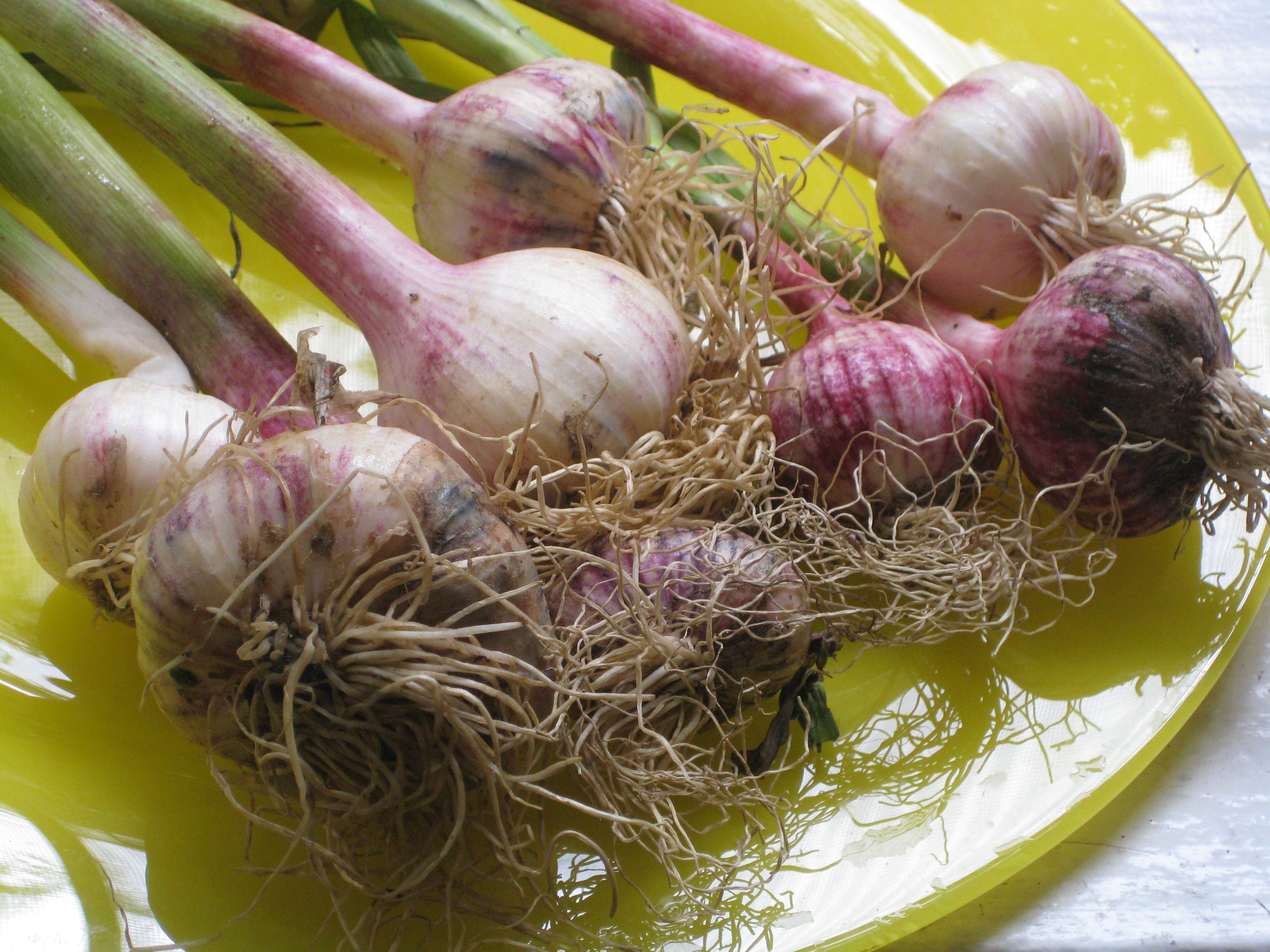
I find that there gets to be something frantic in the air around mid-May. For some it may be the approach of hurricane season, or plain spring fever; for me it is vegetables. They are so ephemeral. The best produce is here today and gone tomorrow, like fresh spring garlic, garlic that is so nascent it hasn’t even formed its cloves yet. You slice it like a scallion, and it releases a strong aroma, but its taste is sweet, without a trace of bitterness. If you miss it, you don’t have another chance at it for an entire year. I find it at the Greenmarket the first, second week of May. This year I seem to have missed the really young stuff (not quite sure how that happened).  The bunches I found were not those skinniest bulbless stalks but ones just a bit more mature, beginning to form cloves but not yet with any skin over the cloves, so I could slice them straight through into thin rounds. Actually, I’ve found that those are when young garlic at its best and juiciest.

When fresh garlic is in season, I crave garlic mayonnaise. Aioli is its name in French. The Italians call it maionese all’aglio. You can get fresh garlic in New York throughout the summer. It matures and forms cloves as the season progresses, but it stays wonderful. It is hard-necked, recognizable by a firm stalk that runs up through its center. It doesn’t dry well, so you can’t store it like the papery and often bitter soft-neck varieties you find in grocery stores year round. If you try to dry it, it just rots. So you’ll only be eating it fresh. It does take on a stronger flavor as it matures, developing full cloves and a thicker skin, but it continues to be heaven. I look for the purple-tinged Italian rocambole variety. It’s lovely and has a good kick.

When I make my maionese all’aglio, I don’t add a huge amount of garlic. You’ll find Provençal recipes that include an entire head or more of mature garlic. I’m not really sure how anyone can really eat that. I’d guess you need to be a boules-playing, pastis-slugging 80-year-old to get it down. Gauge the maturity of the fresh garlic you’ve got to determine how much you want to use. If it’s really young and looks like scallions, chopping up two (including some of the tender stalk) will give you good flavor. If you’ve got small heads, like I had, with cloves just starting to form, you might want to use an entire small head. If the cloves are fully formed, you’ll need to peel them, and you’ll probably do well by using two big cloves. But of course it’s a matter of taste. I like my mayo somewhat mild. If you prefer otherwise, go for it. Also I like a mix of fruity olive oil and a more neutral vegetable oil, as opposed to the more Mediterranean approach, which uses all olive oil. I find that a little strong.

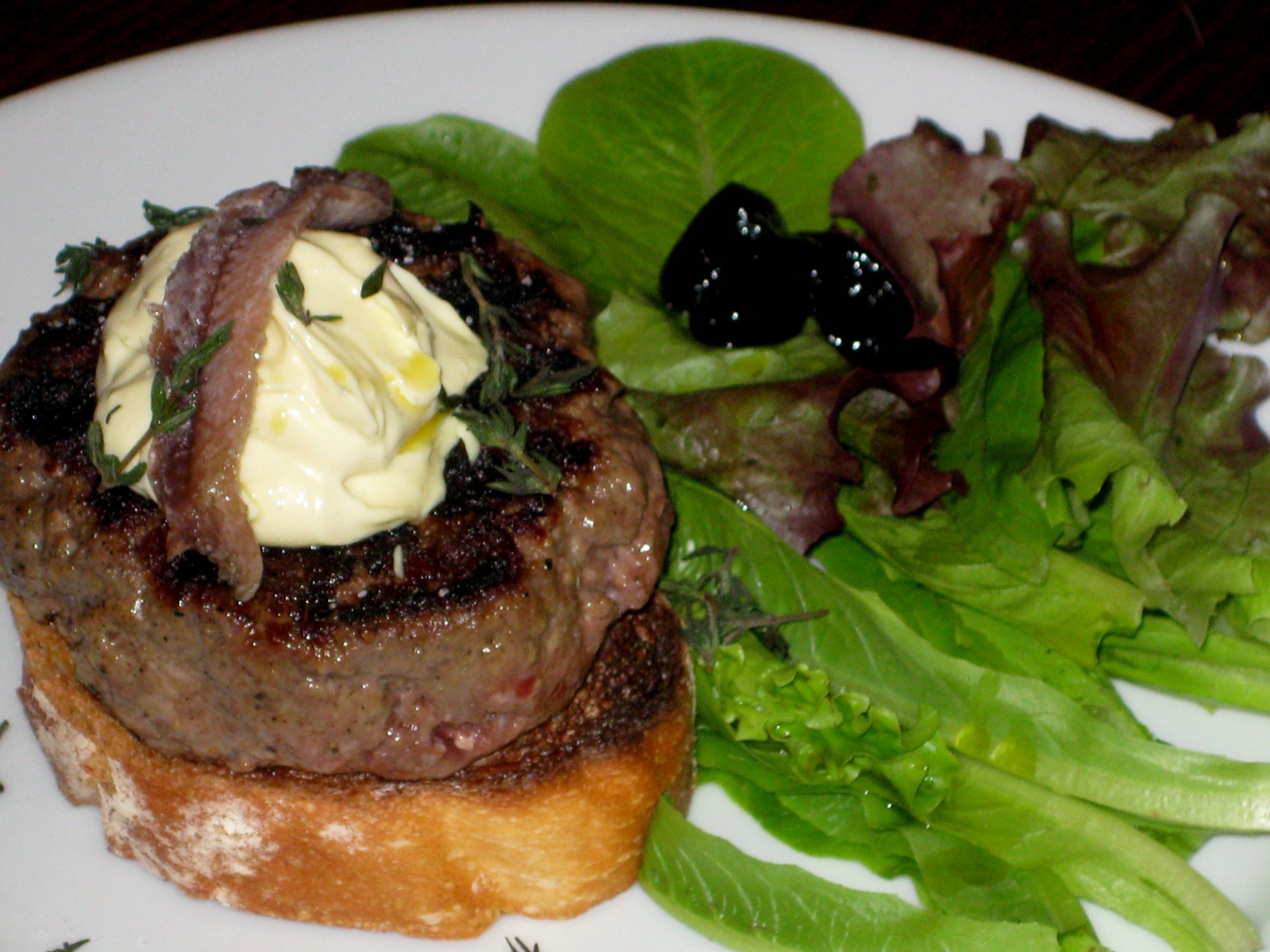
This sweet but powerful mayo is excellent on blanched asparagus, grilled eggplant, roasted peppers, grilled sardines, and lots of other things. Last night I tried it on a rare burger, and I have to tell you, that really makes a great combination. Resist the temptation to add cheese to your burger. The mayo stands alone. And it seemed somehow more appropriate to do an open burger, on a toasted piece of Italian bread brushed with olive oil—a knife and fork experience. I draped an anchovy over the mayo for an added kick.

Maionese all’Aglio

Spring garlic, well chopped (see my remarks above about how much you might want to use)
A generous pinch of sea salt
2 extra large egg yolks
¼ cup extra-virgin olive oil (something light and fruity)
½ cup neutral vegetable oil
The juice from about ½ a lemon

Put the garlic and the salt in the bowl of a medium-size food processor. Pulse until well chopped. Add the egg yolks. Process until the yolks are light in color and the garlic is well blended. Start adding the oil through the top funnel in a very slow stream. If you add too much at first, the maionese may break on you. You want the egg yolks to absorb the oil, and that will only happen if you have a slow hand. Keep adding the oil slowly. After a minute or so you’ll notice that it will have started to catch, and the mayo will thicken. You can now add oil a little faster, but still you should do so in a steady stream. Add a tiny squeeze of lemon juice from time to time if the mayo gets very thick and starts bumping the machine. When you’ve used up all your oil, you should have a nice thick but fluffy consistency. Try not to add too much lemon juice, or you’ll risk making it too thin.

You can use the mayo right away or keep it refrigerated for about a day, but I find that after a day it starts losing some flavor.


Sardines at the Santa Caterina market in Barcelona.

Recipe: My Pasta Colle Sarde

One of the Southern Italian dishes that most intrigue people, my readers for sure, is pasta colle sarde (pasta with sardines), that exotic, elegant dish from Sicily. The first time I tasted it was in Palermo, and all I can say is its flavor had no reference point for me. Nothing I recalled eating had tasted remotely like it. I fell in love. I was hooked.

When made in the classic manner, pasta colle sarde is a blend of cucina povera ingredients like wild fennel and the humble sardine, nice enough, but also raisins, pine nuts, and saffron, some of Sicily’s top-shelf ingredients. It is a dish of genius, a blending of Sicily’s poor and noble cooking, punctuated with Arab touches. Almost every time I’ve eaten it, in Sicily or here, it’s been made with bucatini. That is the classic pasta for it. Fresh sardines, not canned ones, are a given. They are what gives the sauce its distinct, vibrant taste. No garlic or tomatoes have ever been present in the classic versions I’ve sampled. And the pasta is always topped with toasted breadcrumbs. What a work of art.

I knew I had to make this pasta at home in New York, but when I set out on my first try, roadblocks kept popping up. There was no wild fennel in Manhattan. On the West Coast it grows freely along highways. I can now find it intermittently at the Greenmarket, but not reliably. There were no fresh sardines back then on my first attempt, which was about 15 years ago, I’d say. I tried using canned. That was a grave mistake. It made the dish taste fishy and oily and, well, just like canned sardines. No vibrancy there. A few years later I started seeing sardines imported from Portugal in my markets, so things changed. I could begin to capture the taste. Much better. Good even.

The use of wild fennel is something I’ve had a hard time getting comfortable with anyway. I’ve been served versions of pasta colle sarde in Sicily that seemed to incorporate cups and cups of boiled-down wild fennel, making the dish look like a soggy mass of lawn clippings. I don’t get that, but I’ve been served it that way on enough occasions that I guess it’s somewhat standard. When I find the wild stuff, I use much less, and that works for me. The version I offer for you here doesn’t use the wild. I know purists will say not to even attempt the dish without it, but I’ve found that if I blend ground fennel seeds, bulb fennel fronds, and a tiny, tiny amount of dill, I’ll get a flavor that feels right to me. The dill, although an herb almost unknown in Southern Italy, adds that slight bitterness you find in wild but not bulb fennel fronds.

Another challenge with this dish is that since it is made with very little real liquid and finished with breadcrumbs, it can wind up really dry. But don’t worry. I’m here with a solution to that and a few other problems you could run into when trying it yourself.

Most important, when you see really fresh sardines in your market, buy them, change course, and just know that tonight, whatever you had planned, you are instead making pasta colle sarde.

Here’s how I do it.

First, a word about how to prep the sardines for this dish. You can always ask your fish seller to do it for you, but I swear it’s surprisingly easy to do yourself. First, open the sardine up on the underside with a small knife and pull out its insides with your fingers. Cut off its head. Rinse the sardine under cool water while rubbing away all its scales (they slip off easily). Next, for this dish, you need to remove the backbone. To do so lay the fish open, skin side down, and flatten it with your fingers. You’ll be able to feel the backbone jutting out. Lift it out at the head end with your fingers. Most of the tiny side bones should come up with it (but it’s no big deal if a few remain; they’re tiny and full of calcium). Now pull the entire backbone up and toward the tail end. Snap it off at the tail. Separate the sardine with a small knife, along the backbone, into two fillets.

My Pasta Colle Sarde

(Serves 4 as a main course)

Extra-virgin olive oil
About ¾ cup homemade dry breadcrumbs, not too finely ground
Salt
½ teaspoon sugar
A few big scrapings of nutmeg
1 large spring onion, cut into small dice
4 anchovy fillets, minced
A small palm full of fennel seeds, ground to a powder
12 to 15 sardines (about  2 pounds), boned and filleted (see my advice above)
Freshly ground black pepper
½ cup raisins soaked in ½ cup dry Marsala
About 15 saffron threads, dried if moist and then ground to a powder and  put in ½ cup warm chicken broth (or a very light fish broth)
1 pound bucatini
½ cup all-purpose flour
½ cup pine nuts, lightly toasted
About ½ cup well-chopped bulb fennel fronds
6 large dill sprigs, chopped

In a medium skillet, heat a tablespoon of olive oil over a medium flame. Add the breadcrumbs, and sauté them, stirring them around, until they’re crisp and just turning golden, about 1 minute. Turn off the heat. Add a little salt, the sugar, and the nutmeg. Pour it all into a little bowl, and set aside.

Bring a large pot of pasta cooking water to a boil. Add a generous amount of salt.

In a large skillet, heat about 3 tablespoons of olive oil over medium flame. Add the onion, and let it soften for a minute. Add the anchovies, the ground fennel seeds, and all but about 6 of the sardine fillets. Sauté all these ingredients together while mashing up the sardines, until everything is soft and fragrant, about 3 minutes. Season with a little salt and a generous amount of black pepper. Add the raisins with their Marsala soaking liquid and the saffron-flavored chicken broth.

Drop the bucatini into the pot of boiling water.

Turn the heat under the sardine sauce down a bit, and let it simmer for about 2 or 3 minutes. Then turn off the heat.

In a small skillet, heat about 2 tablespoons of olive oil over medium high heat. Season the reserved sardine fillets in a little salt, and then dredge them in flour, shaking off any excess. When the oil is hot, add the fillets, and very quickly sauté them on one side. Give them a flip, and quickly sauté their other side. Take them from the skillet.

When the bucatini is al dente, drain it, saving about a cup of the cooking water, and put the bucatini in a large, warmed serving bowl. Add the sardine sauce, the pine nuts, the fennel fronds, and the dill. Add 1/4 cup  of fresh olive oil and a splash of the pasta cooking water. Give it all a good toss. Check for seasoning, and add more salt or black pepper if needed. Top with the sautéed sardine fillets and a sprinkling of the breadcrumbs. Serve right away, passing the remaining breadcrumbs at the table.


Quimet y Quimet, a tapas bar in Barcelona.

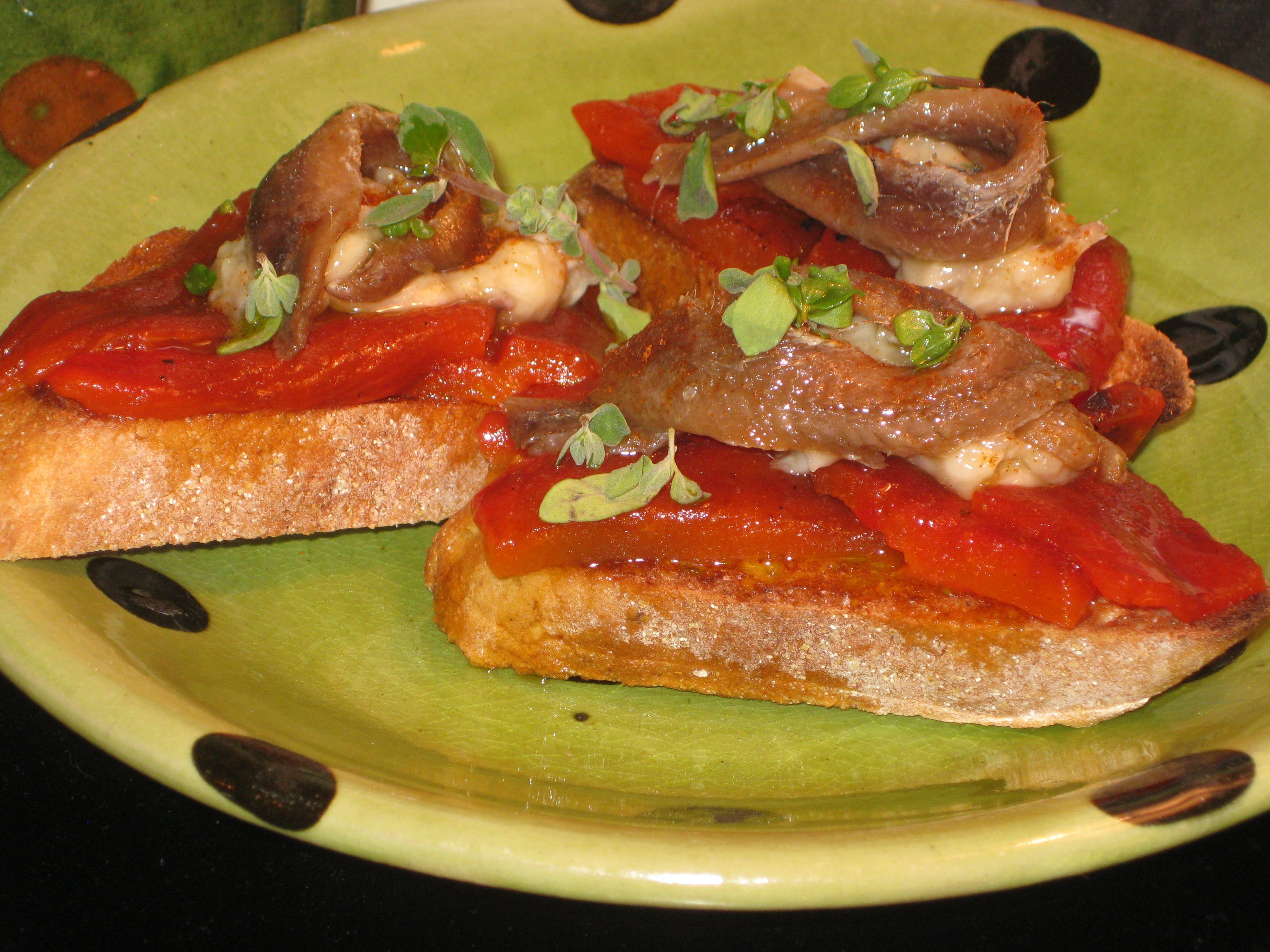
Recipe: Crostini with Anchovies, Butter, Roasted Peppers, and Marjoram

Sorry for my lack of postings in the last week or so, but I took a little vacation and couldn’t figure out how to put up photos or much else with the cranky old laptop I had with me. I went to Barcelona. Okay, it’s not Southern Italy, but even the most devoted little guinea must branch out at times, and it is, after all, on the Mediterranean. There are many similarities in its cuisine, because it is based on olive oil. In fact, many ingredients—olives, artichokes, sweet peppers, tomatoes, great wine, seafood including baccala (bacalla in Catalan and bacalao in Spanish)—play a huge part in both culinary worlds. That’s one of the reasons Barcelona is so fantastic and yet so familiar to an Italian food–focused individual. (Also the wine is really inexpensive and really good.)

As always when I travel, I headed straight to the markets, especially the fish markets. I was impressed by the quality of my favorite fish, sardines and anchovies, the silvery, oily, strong little fish I can never resist. Not only could I not take my eyes off of the little piles of them in the market, but I ordered them wherever I ate out. What is it about the taste of strong, oily fish that is so addictive? Well, maybe not everyone feels this way, but I don’t understand how anyone could fail to go nuts over a platter of deep-fried anchovies squirted with a little lemon, along with a glass or two of cava.

Now, in Barcelona they’ll say they’re not a tapas town, but it seems every old-time bar and every new hipster wine place serves amazing tapas, some traditional and some contemporary and sophisticated.  My husband and I went to a trendy and very tiny tapas bar called Quimet y Quimet in the Poble Sec neighborhood where we were staying. They specialize in tapas-type little dishes called montaditos,  built on hard round bread that looks like mini bagels. The little bagel things reminded me of the Southern Italian friselle of my childhood, but  much smaller and not quite so jaw breaking (you don’t have to soak them in hot water or soup to make them edible; a drizzle of olive oil softens them right up). There were all sorts of combinations piled on the crusty little bagels. I sampled one that combined smoked salmon, yogurt, roasted pepper, honey, and soy sauce. You wouldn’t think smoked salmon and honey would be particularly good together, but now I know that they are in fact very good. And of course I had to try the anchovy and tapenade montadito, also with yogurt (weird, this yogurt fixation) and roasted peppers. It was excellent primarily for the quality of its anchovies. Many tapas places serve boquerones, fresh anchovies spiked with a little vinegar and then laid out flat and covered with good olive oil. Quimet y Quimet used anchovies known as anchoas that have been salted and then packed in good olive oil. I like both types, but sometimes the fresh ones are too vinegary for me.

The bagel tapas appealed to me. When I got home I wanted to create some version of Quimet’s montadito using the oil-packed anchovies we can get here. I didn’t have the mini bagels, but since I understood them to be essentially Southern Italian crostini but with just a bit more art and complexity, I used good Italian bread as a starting point.

One thing I like to do with oil-packed anchovies, even really high-quality ones (and what others would you bother with?), is refresh them. I give them a gentle rinse in cool water and then lay them out in a low-sided dish. Then I drizzle them with a very good olive oil, my best oil, and let them sit and soak it all in. That gets rid of any overly fishy and less-than-great-quality olive oil they may have been sitting in.

So here’s a crostini piled a little higher than is usual in Italy. And by the way, all the montaditos are served at room temperature, not hot, so that’s what I’ve done here. Smart, actually. It makes all the flavors really pop.

Crostini with Anchovies, Butter, Roasted Peppers, and Marjoram

(Serves 4 as an antipasto)

A dozen oil-packed Spanish or Italian anchovies (I used Flott, a very good Sicilian brand)
Extra-virgin olive oil
4 tablespoons unsalted butter, at room temperature
2 red bell peppers, roasted until charred all over, peeled, seeded, and cut into pieces about the same size as the toasts
1 garlic clove, very thinly sliced
A pinch of sugar
8 slices baguette, cut on an angle
A sprinkling of smoked paprika, such Spanish pimenton de la vera
A few large sprigs of marjoram, stemmed, the leaves left whole

Place the anchovies in a strainer, being careful not to break them up, and gently run a little water over them. Pat them dry, and lay them out in one layer in a low-sided dish. Drizzle them with your best olive oil (I used Ravida, from Sicily), just enough to cover them lightly. Let them sit, unrefrigerated, to soak up the oil, for about an hour.

Take four anchovies from the dish, and put them in a mortar. Mash them well. Add the softened butter and blend it into the anchovies.

In a small bowl, combine the roasted pepper pieces, the garlic, and a pinch of sugar. Mix gently.

Toast the baguette slices on both sides, and let them cool for a moment. Place about two pieces of the roasted pepper on each toast. Then top the peppers with about a half teaspoon of anchovy butter, but don’t spread it out; just let it sit. Drape an anchovy over each little butter mound. Finish each crostini with a sprinkling of hot paprika and a few marjoram leaves.

A tarantella from Ischia sung by Pino De Vittorio.

Recipe: Little Mussels with Cherry Tomatoes, Chives, and Spring Herbs

Whenever my fish man at the Greenmarket has little mussels, I grab them. First off, any mussels from the Greenmarket are local, just caught, and as fresh as can be. But the little ones remind me of Southern Italy, in particular the ones I had many moons ago when I visited the island of Ischia, the beautiful sister island to Capri off the Bay of Napoli.

Mussels in general are something I usually can’t resist, but they’ve got to be totally fresh or they can turn on you (I’m sure you can recall one such experience). The ones I ate in Ischia so many years ago were pitch black, glistening, smooth, about a half inch to an inch long. Their beauty alone was enough, but then there was their taste, sweet, briny, cooked in white wine with those incredible Neapolitan cherry tomatoes that hang in clusters all over the place, and tons of herbs. Eating those little beauties in big glass bowls on an Ischia beach, the blaring sun and the fizzy white wine did something poetic to my distance vision. I watched, in a glazed-over fashion, as fishermen, pulling up in their turquoise boats (the brightest turquoise ever, at least to me, at that time and place), hauled in even more mussels. But even in the confines of my mini New York apartment, the Montauk mussels I purchased from the Greenmarket were out of this world.

Eating those mussels reminded me of something else, a singer I’ve just come to love very much, a man named Pino De Vittorio, from Puglia. He specializes in reviving Southern Italian folk music. His voice and movements are beautiful, sometimes hauntingly so (like Southern Italy in general). In the video above he sings a gentle (some aren’t so gentle) tarantella from the island of Ischia.

Little Mussels with Cherry Tomatoes, Chives, and Spring Herbs

(Serves 2)

Extra-virgin olive oil
1 shallot, thinly sliced
1 stalk young spring garlic, very thinly sliced, using all the tender green part too
1½ pints cherry tomatoes, stemmed
About 2 pounds small mussels, well washed and bearded if necessary
A big splash of dry white wine
1/2 cup homemade or good quality store-bought chicken broth
Freshly ground black pepper
Salt, if needed
A big handful of fresh herbs, very lightly chopped. A good mix is chives, Italian parsley, mint, fennel fronds, and tarragon
2 tablespoons unsalted butter

Heat about 2 tablespoons of olive oil in a large pot over medium flame. Add the shallot, and let it soften. Add the garlic, and sauté until it releases its aroma, about 30 seconds or so. Add the cherry tomatoes and the mussels, and stir everything around for a minute. Add the white wine, and let it bubble for a minute. Add the chicken broth, and cook, uncovered, stirring the mussels a few times, until they’ve opened, usually about 4 or 5 minutes. Add a good amount of black pepper and a little salt, if needed (that will depend on the saltiness of your mussels). Turn off the heat, and add all the herbs and the butter. Give everything a good stir. Serve right away. This is especially good with bruschetta rubbed with garlic and then brushed with olive oil.