Here’s what the Covid 50 looks like. It didn’t happen by eating just fish, I can tell you that. The pasta and pizza diet I’ve been on since April is catching up with me. Pasta with seafood, pizza with seafood, those are two of my most favorite things. During the lockdown I decided to go with it, all cooked at home, with love. I made pizza with clams and tomatoes, pizza with clams and no tomatoes, pizza with anchovies and mozzarella, orecchiette with clams and escarole, penne with shrimp and escarole, cavatelli with braised squid and peas, penne with seared squid and peas, busiate with swordfish and eggplant, busiate with swordfish and almonds, rigatoni with fresh tuna and pistachios, pappardelle with quinine and crab, ziti with canned tuna, capers, and olives, bucatini with sardines and wild fennel, spaghetti moscardini with a red wine reduction, spaghetti with bottarga and butter, spaghetti with sea urchin and orange, spaghetti with colatura and orange, penne puttanesca with monkfish and grief, gemelli with grilled shrimp and radicchio, fettuccine with piss, vinegar, and scallops, ravioli filled with shrimp, ravioli filled with branzino, ravioli filled with tears, lasagnette with artichokes and octopus, pizza with artichokes and eel, pizza with mussels still in their shells, fusilli with mussels out of their shells. I also cooked a bunch of things with salt cod. And I could go on.
My signature striped boatneck doesn’t have the same boho impact when pulled over all this fat. So now I’ve decided to go on the famous Keats diet, prescribed by his doctor to treat his tuberculosis. It consisted of one anchovy a day and never leaving his apartment overlooking the Spanish Steps. The never leaving the apartment part I’ve got down, although I’m pretty sure he had a better view.
A smaller Thanksgiving for sure. That seems okay to me. Too many relatives was never okay. It wasn’t a bad time, but I never loved thanksgiving food. I remember turkey and cigarettes and sambuca. Not terrible. I also remember the stuffed artichokes and braised fennel my grandmother made to Italianize the day. Aside from those lovely dishes, all the mushy stuff, mashed sweet potatoes, stuffing, mashed potatoes, I could do without. What I love is to pull a piece of crusty leg skin off the turkey, wrap it around some broccoli rabe, and then pour on some gravy. This was good, way better than the dried out breast meat that seemed so dreary.
I also love to make marinated olives, something my Nanny always offered, along with raw fennel and celery ( very Puglian).
So all you really need to do here is buy good olives. I used cerignolo green and Moroccan black. A nice mix, I think. Then I sprinkled the olives with fresh chopped rosemary, fennel pollen (or fennel seed), a few crushed garlic cloves (make sure they’re fresh), and coarse ground black pepper. I also added the chopped fronds from a fennel bulb. If you don’t have this, you can use parsley or a little chervil or even a bit of tarragon, but not too much.
Happy thanksgiving to all my friends. It’s a weird one, but we’ll all pull through.
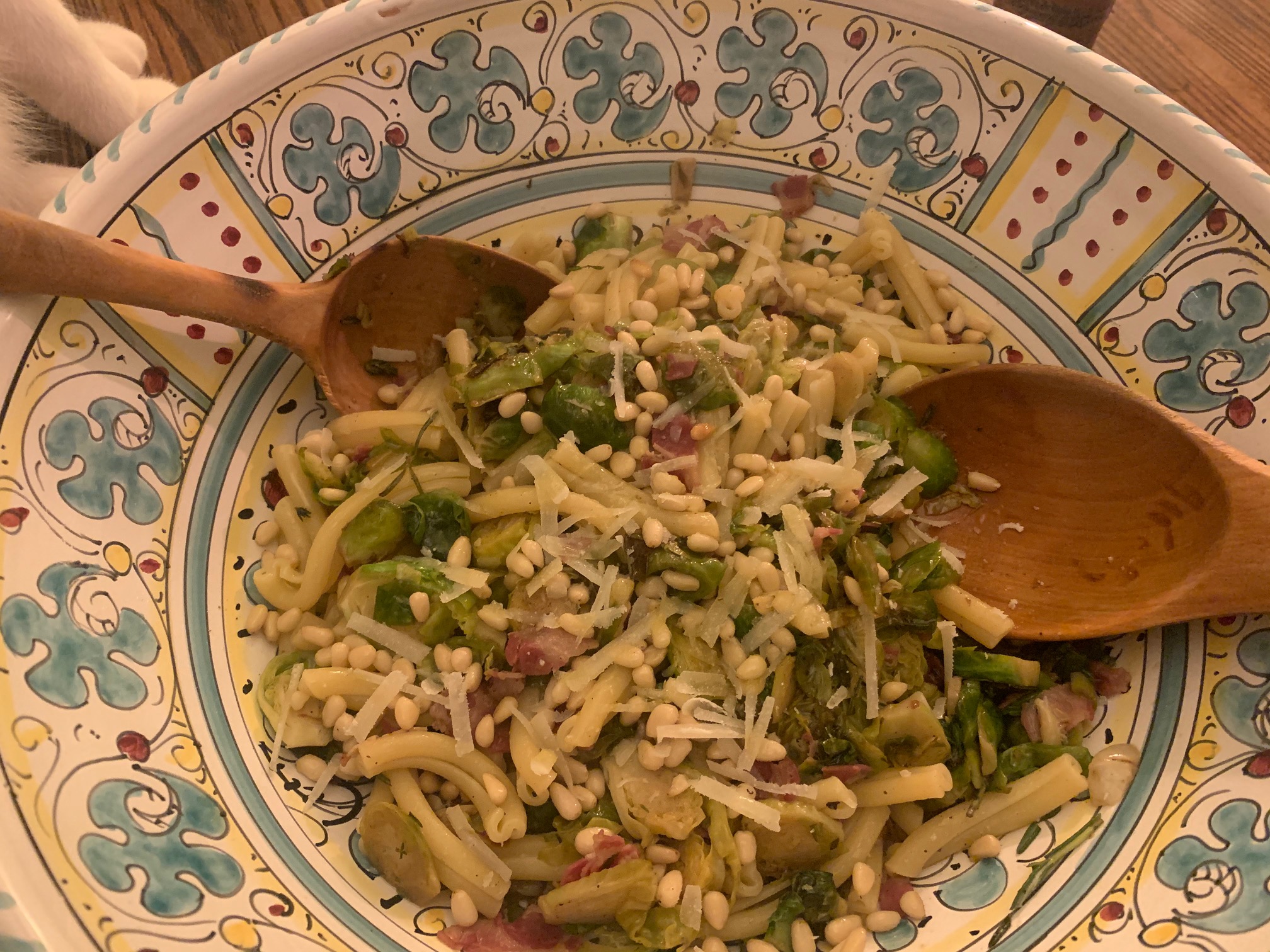
Recipe below: Casarecce Pasta with Capicola and Brussels Sprouts
Since moving back to the city in October, after a seven-month stay in upstate New York, I’ve been hyper aware of the sounds inside and outside my apartment. There’s an intermittent buzzing noise in the wall next to my stove. In all the 35 years I’ve been in this place, I never heard it before. Something new, I guess. Early mornings I hear a low rumbling outside my bedroom window. I hear it every morning, usually starting at about 3 a.m. It sounds as if the entire city might be rumbling, but it’s most intense right by my window. It’s also new, I think. Maybe I’m just more sensitive to sounds after spending so much time in the woods. I’m not sure.
Around 4 a.m. last night I heard a kid screaming, a young boy it seemed. I’m not sure what he was screaming. At first I thought it was “Help,” but then I realized it wasn’t. More like “Heyyyyy” repeatedly, and than banging, like banging on a door. He might have been locked out of his apartment, I guessed. I looked out my front windows and tried to see down the block. The sound seemed to be coming from the far end, not from my building in the middle of the block. I expected to hear sirens, but I never did. When I picked up my phone to call 911, the “heyyyyy” stopped. I guess someone returned home from their Covid party and let him in. I don’t know what it was all about, and nobody else in my building that I’ve spoken to heard it. At 5 a.m. the banging of our tenement heating system kicked in. After not hearing that all year, I found it jarring, too, but in a more comforting way.
All the strange noises aside, I’m glad to be back cooking in my city kitchen. It’s a long, narrow galley kitchen, I guess typical of the apartment’s railroad setup. The building, built in 1900, was originally lit by gas, so it’s definitely on the quaint side. On the downside, the entire structure is crumbling, inside and out. But I do love my kitchen. It’s sort of a restaurant arrangement, everything lined up, nowhere to turn. I don’t consider it a relaxed space. It’s a place to get things done. There’s an urgency built in that I like, although I’m not sure if it’s built into the kitchen or into me.
One of my big kicks is going to the Greenmarket, buying lots of vegetables, and spreading them out on my long butcher block, contemplating what to do with them. I did this the other night with a big mess of Brussels sprouts. I knew I was heading in the direction of pasta. The rest of the ingredients were odds and ends pulled from the fridge. It was a New York City success.
Casarecce Pasta with Capicola and Brussels Sprouts
(Serves 4)
Extra-virgin olive oil 1 small fresh serrano pepper, sliced into thin rounds 3 scallions, sliced into thin rounds, using a lot of the tender green part Salt ½ pound Brussels sprouts, the ends trimmed, sliced thin ½ teaspoon allspice 1 big sprig rosemary, the leaves chopped 4 or 5 sprigs thyme, the leaves chopped Black pepper, coarsely ground 5 slices sweet capicola A splash of white wine ½ cup chicken broth 1 pound casarecce or gemelli or penne pasta A few drops of rice wine vinegar A chunk of pecorino Toscano cheese A big handful of pine nuts, lightly toasted
This pasta comes together fairly quickly, so set up your pasta pot at the start, salting the water and setting it over high heat.
Get out a large sauté pan, and get it hot over medium heat. Add a big drizzle of olive oil. Add the serrano, scallions, Brussels sprouts, allspice, rosemary, and thyme, season with salt and black pepper, and sauté until everything is fragrant, about 3 or 4 minutes. Next add the capocolla and stir everything around.
Start cooking the pasta.
Add the white wine and the chicken broth to the sauté pan, and simmer, uncovered, until the Brussels sprouts are just tender but still a bit firm. This will take anywhere from 5 to 8 minutes, depending on how thick you sliced the sprouts. Taste for seasoning, adding a few drops of the rice vinegar to bring up the flavors and a little more salt if needed.
When the pasta is al dente, drain it, leaving a little water clinging to it, and pour it into a large serving bowl. Add the Brussels sprouts sauce. Add a drizzle of fresh olive oil and some more black pepper. Grate on about a tablespoon of so of the pecorino, and toss. Scatter on the pine nuts. Serve hot or warm, bringing the rest of the cheese to the table.
Recipe below: Eggplant Lasagna with Almonds, Mint, and Ricotta Salata
I know this may sound odd, but I occasionally think of eggplant as candy. When I was a kid, I’d grab a few breaded and just fried eggplant slices before my mother had the chance to layer them into the Parmigiano pan. I’d grab them off the oil-soaked paper towels, hot, and sprinkle them with powdered sugar. They were like zeppole, sweet, greasy, a little salty. If you’ve never tried this, you’re in for a treat.
I am the eggplant queen, or maybe the eggplant fiend. If you know me, you know I love the vegetable. Southern Italy and its eggplants are in me for good. Recently an incredible artist I know found himself painting an eggplant and somehow understood I needed to have the painting. So he made it for me. I am honored. Greg Decker created gorgeous eggplant art. He paints a lot more than eggplants, too. If you’re not familiar with his work, you might want to take a look at his website.
And speaking of eggplant art, a couple of months back I cooked up an eggplant lasagna with sweet spices, cinnamon, allspice, and ginger. I called it Eggplant Lasagna with a Hint of Moussaka. Its sweet savory edge reminded me of the faux zeppole I fashioned for myself as a child. I thought it was a success. And now, with the surprise gift of the eggplant painting, I’ve been inspired to think up another eggplant lasagna, with similar spicing but no béchamel this time; instead I’ve added two Southern Italian layers of ricotta seasoned with cinnamon and nutmeg. I’ve also added mint, almonds, and basil. It’s a less formal lasagna than the béchamel version, a bit tighter. It calls to mind food smells I remember from my visits to Sicily. Ricotta, eggplant, and cinnamon are my new culinary triumvirate.
Eggplant Lasagna with Almonds, Mint, and Ricotta Salata
(Serves 5 or 6)
For the eggplant:
2 large, firm eggplants, stripe-peeled and cut into ½-inch-thick rounds Extra-virgin olive oil Salt 2 teaspoons ras el hanout Aleppo pepper to taste
For the tomato sauce:
Extra-virgin olive oil 3 tablespoons unsalted butter 2 large shallots, chopped 2 garlic cloves, sliced 1 teaspoon ras el hanout 1 teaspoon allspice 2 fresh bay leaves 5 or so sprigs thyme, the leaves chopped A big splash of sweet Marsala Salt Aleppo pepper 2 28-ounce cans Italian plum tomatoes, chopped, with juice
For the ricotta:
32 ounces (1 large tub) whole milk ricotta 1½ tablespoons sugar A big pinch of salt Black pepper 1 teaspoon ground cinnamon 1 teaspoon ground nutmeg
Plus:
1 ¾-pound chunk of ricotta salata, grated A bunch of basil, the leaves chopped A smaller bunch of mint, the leaves chopped A big handful of whole blanched almonds, lightly toasted and chopped 1 pound homemade or thin, fresh store-bought lasagna sheets, parboiled.
Preheat the oven to 400 degrees. Grease a couple of sheet pans with olive oil. Lay on the eggplant slices, brushing their tops with oil. Season lightly with salt, ras el hanout, and Aleppo, and stick them in the oven until golden and tender, about 20 minutes. You don’t need to turn them. Let them cool a bit on the sheet pans.
To make the tomato sauce: Get out a good-size saucepan, and drizzle in a tablespoon or so of olive oil over medium heat. Add the butter and the shallots, and sauté until soft, about 4 minutes. Add the garlic, the ras el hanout, the allspice, the bay leaf, and the thyme, and sauté until everything is fragrant, about another 2 minutes. Add the splash of Marsala, and let it bubble for a minute. Season with salt and Aleppo, and add the tomatoes. Cook at a lively bubble, uncovered, for 10 minutes. Turn off the heat, and let the sauce rest.
Mix together all the ingredients for the ricotta in a bowl.
Get out a 10-by-14-inch rectangular baking dish, or one more or less equivalent. Drizzle a little olive oil in the bottom, and smear it around. Add a little of the tomato sauce, and put down a layer of lasagna sheets. Top with a layer of the ricotta. Sprinkle the top with ricotta salata and some of the mint and basil. Add another layer of lasagna sheets. Lay all the eggplant slices on top, topping them with more tomato sauce. Sprinkle with a little more ricotta salata, and scatter on the almonds. Put down another layer of lasagna sheets, and add the remaining ricotta, sprinkling again with ricotta salata and a bit more of the mint and basil. Add a final layer of lasagna sheets. Add the remaining tomato sauce, and sprinkle on the rest of the herbs and the remaining ricotta salata. Drizzle a bit of fresh olive oil over the top, and bake, uncovered, until golden and bubbling, about 35 minutes.
Let the lasagna rest for about 10 minutes before serving.
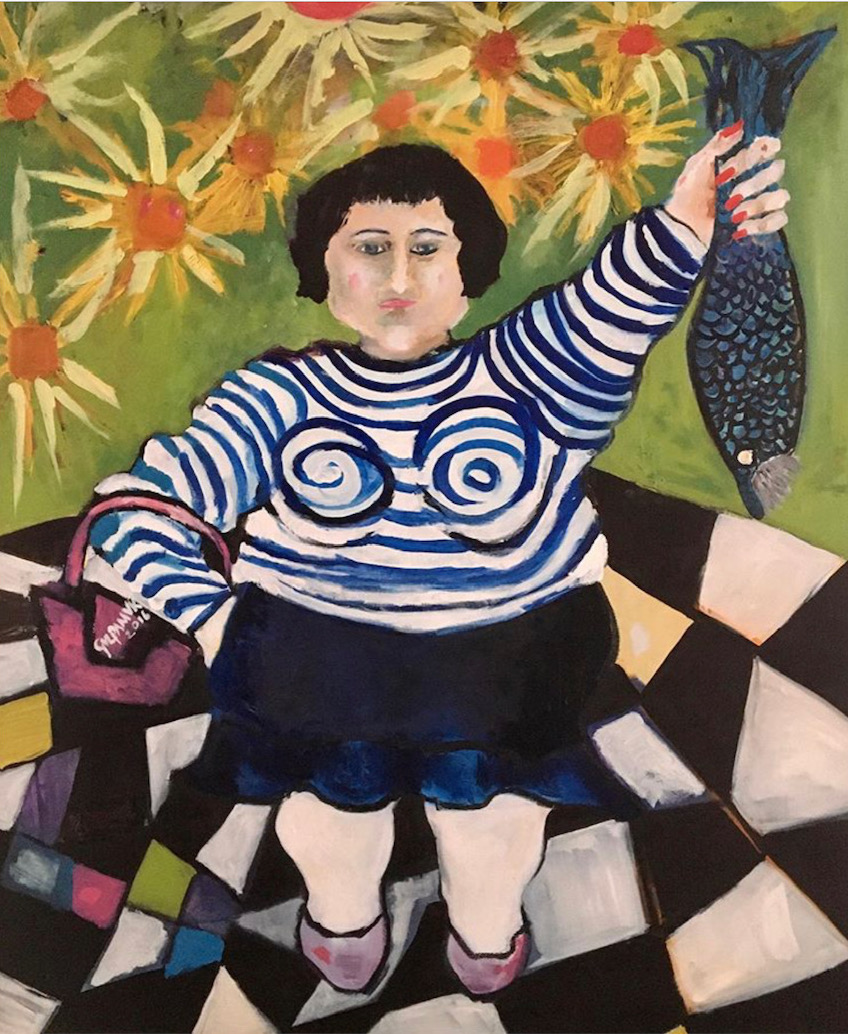
This 17-year-old Filipino woman is carrying a fish baby. She’s holding photos of the father. I can’t wait to see what the kid looks like. A beautiful union.
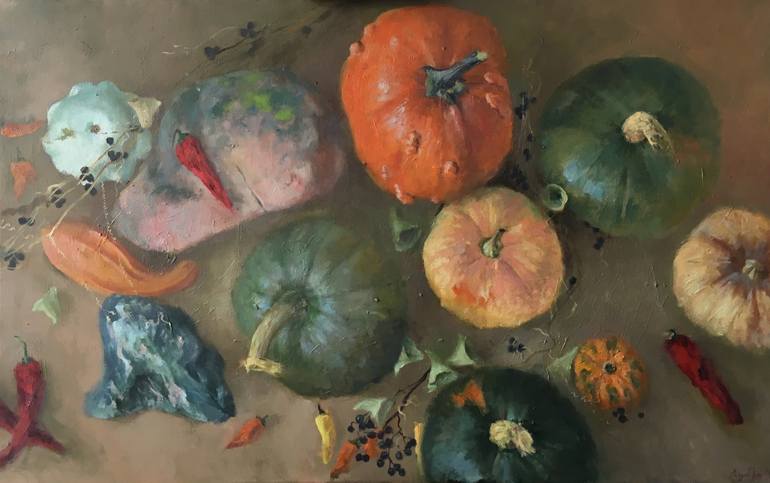
Recipe below: Minestra with Pumpkin, Farro, and Rosemary Gremolata
What a year. In June I contracted tick-borne malaria. Then my husband, who had recently had Lyme, came down with a mysterious attack of amnesia. And last week my sister suddenly needed brain surgery to remove a benign tumor. Now she can’t see out of her right eye, and her thoughts are drifting. This, her doctors say, will clear up in time, but she doesn’t believe it. All this with the Covid lockdown as a backdrop. I can’t say I’m feeling lighthearted. Summer is gone, and Tuesday is the election. Red wine helps. I love red wine, especially Beaujolais, but just about any decent red that’s not oaky is fine with me. Why do producers put all that oak in wine? Some of the Chianti and Rioja I used to love I now find undrinkable. I guess it started with winemakers thinking that Americans and Britons like oak because they have unsubtle palates. I hope the trend will come to an end.
And I love soup. Not thick a-spoon-stands-up-in-it soup but brothy soup with lots of good bits floating around. Also I feel that any type of minestrone or minestra (a lighter soup) must be kept under control. I’m not a fan of the kitchen-sink approach to soup. Even when I’m using up stuff in my fridge for an essentially cucina povera dish such as this minestra, I prefer to choose just a few seasonal vegetables, so each one stands out. There’s reason and elegance in this approach, I think. This soup is an orange-tinted one, by design. I thought of adding zucchini, but I decided against it, because I didn’t want to mess up the color scheme.
I hope you enjoy this cozy fall soup. And don’t forget to vote.
A note on gremolata: A gremolata is a fresh-chopped mix usually sprinkled on osso buco before serving. Parsley, lemon zest, and garlic are its most typical ingredients. Sometimes sage is added. Here I’ve included a little rosemary to pick up on the flavoring in the soup.
A note on farro: I cooked the farro separately in lightly salted boiling water until just tender and added it late in the preparation of the soup. That way it retained its individuality. The farro will swell up a little as it sits in the soup.
Minestra with Pumpkin, Farro, and Rosemary Gremolata
(Serves 5)
1 ½-inch round of pancetta, cut into small dice Extra-virgin olive oil 1 sweet onion, chopped 2 celery stalks, cut into medium dice 3 orange carrots, cut into medium dice 2 cups pumpkin or butternut squash, cut into medium dice 2 yellow squashes, cut into medium dice 1 teaspoon ras el hanout spice mix 2 fresh bay leaves Black pepper Salt A big splash of sweet vermouth About 6 canned plum tomatoes, chopped A few large sprigs of thyme, the leaves chopped 2 or 3 large sprigs of rosemary, the leaves chopped 1 quart light homemade chicken broth 2 cups cooked farro (see note above) A few drops of rice wine vinegar
For the gremolata:
The leaves from a large sprig of rosemary A handful of flat-leaf parsley leaves 1 small garlic clove, peeled A pinch of salt The grated zest from 1 lemon
Get out a big soup pot, and drizzle a little olive oil into it. Add the pancetta, and cook over medium heat until it’s browned but not completely crisp. Add the onion, carrot, and celery, and sauté until it’s all just starting to soften, about 5 minutes. Add the pumpkin, yellow squash, ras el hanout, and bay leaf. Add some black pepper and a little salt, and sauté a minute or so to coat the vegetables with flavor. Add the vermouth, and let it bubble for a few seconds. Add the tomatoes, the broth, and the rosemary and thyme. Bring everything to a boil.
Turn the heat down a notch, and cook at a low boil, uncovered, until all the vegetables are tender but still holding their shapes, about 20 minutes, adding hot water, if needed, to keep it brothy.
Turn off the heat, and add the farro. Let the soup sit on the turned off burner for about 10 minutes. The farro will absorb flavor from the broth and swell up a little. Add more water if the soup becomes too thick. Taste for seasoning, adding more salt and black pepper, if needed, and a few drops of rice wine vinegar to bring up all the flavors.
While the soup is cooking, make the gremolata. Simply pile the herbs and the garlic up in a little mound, sprinkle on some salt, and chop it up finely. Add the lemon zest, mixing it in.
When you’re ready to serve the soup, reheat it if necessary. Ladle it out into big bowls, and sprinkle each serving with some of the gremolata. The soup will be at its best served with freshly grilled or toasted bruschetta brushed with olive oil and a little garlic.
I’ve been eating a lot of beef lately—in stews, steaks, meatballs, hamburgers (lots of hamburgers). Maybe because of the new cool weather, or maybe it just fell that way. I actually feel kind of gross, pissed off too, loaded up with meat and sick of wanting all that meat. So to lighten up my head, I’ve decided to focus on mushrooms.
Sometimes mushrooms are just the thing. They’re like nothing else we put in our mouths. A vegetable-like food with no chlorophyll. I mean, asparagus and carrots are more alike than are mushrooms and potatoes. Mushrooms and truffles are similar, but only a select few of us get to eat truffles with any regularity.
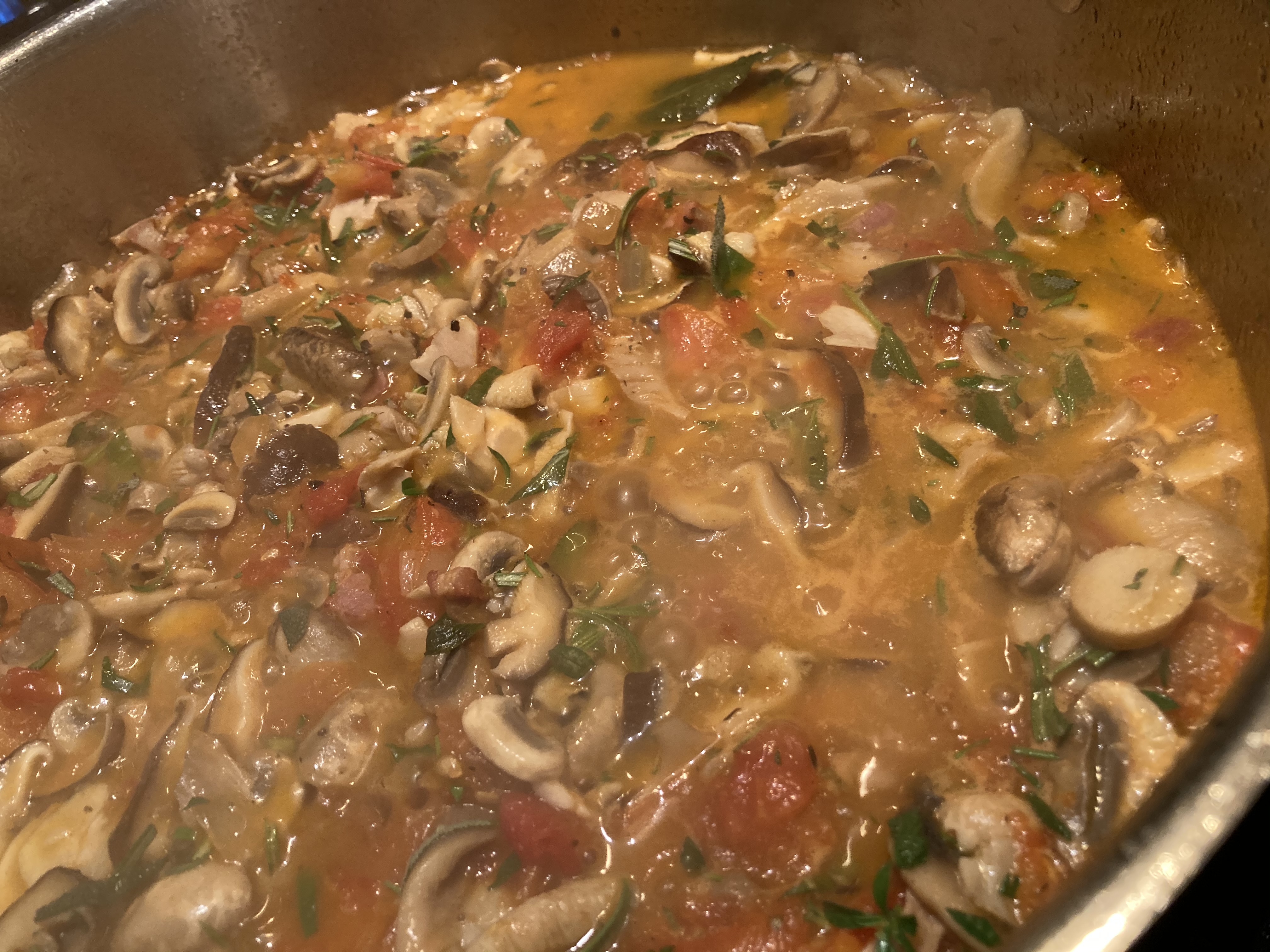
A ragù is an especially good thing to make with a pile of assorted mushrooms. Some cooks make one with dried mushrooms, or partly with dried. I like that, and I do that, but this time of year, when I can get local oysters and hens of the woods, I use all fresh, usually selecting small amounts of those two special ones and then adding bulk with creminis or whatever ones look decent at the supermarket. They all have good flavor, and when united in the same pot, they give you a fragrant sauce that’s good on pasta, polenta, scrambled eggs, or ladled out in a bowl, with bruschetta for dunking. The sauce also makes an excellent lasagna, if you smother the top with béchamel and use a good amount of Parmigiano between the layers.
My herb garden is edging toward its weather-beaten stage, but its woody stuff, rosemary, savory, sage, thyme, still stands erect. Mushrooms can take a lot of herbage, so I used a little of all of the above.
Please feel free to use this recipe as an outline for cooking with your own favorite mushrooms. The more diverse your assortment, the better the ragù will be. So hunt around and go for the best. Happy fall cooking to you.
Mushroom Ragù with Woody Herbs
(Makes enough to go with a pound of pasta or 4 servings of polenta)
Extra-virgin olive oil 1 ¼-inch-thick round of pancetta, chopped 2 medium shallots, chopped 1 celery stalk, chopped 4 pints mushrooms, a mix of wild and cultivated (I used oyster mushrooms, shiitakes, creminis, and one small hen of the woods), cleaned and sliced Salt Black pepper ½ teaspoon ground allspice 1 small wine glass dry Marsala 1 cup chicken broth, or possibly a little more 6 canned plum tomatoes, chopped 3 tablespoons unsalted butter A few large sprigs of rosemary, thyme, and savory, the leaves chopped A few small sage leaves, chopped A chunk of Parmigiano or grana Padano cheese for grating.
Take out a large sauté pan, and get it hot over medium heat. Add the pancetta and a drizzle of olive oil. Let the pancetta brown, and then add the shallot and celery, sautéing until it’s all softened.
Add all the mushrooms. Turn the heat up a notch, and sauté them, seasoning with salt, black pepper, and allspice, until they start to soften and give off some liquid, about 5 minutes or so.
Add the marsala, and let it bubble for a moment. Add 1 cup of chicken broth, the tomatoes, and all the herbs. Bring to a boil, and then turn the heat down to low, and cook at a gentle bubble, uncovered, until some of the liquid is cooked down and you get a rich mushroom aroma, about 10 minutes. Now add the butter, stirring it in. The sauce should stay fairly loose, so add a bit more chicken broth if it gets too cooked down.
Turn off the heat, and let the sauce settle for about 10 minutes. Taste for seasoning.
However you decide to use your mushroom ragù, I’d top it with a big grating of Parmigiano.
Recipe below: Big White Beans with Leek and Fennel
Back in March I hoarded beans. Many of us did. I still have most of them. It turned out my La Bohème all-bean diet wasn’t necessary. I could still purchase ribeye steaks and scallops. Oddly, though, I think of beans not as an economy food but as a luxury, like ribeyes and scallops. Beans are the gorgeous flavor trappers in a cassoulet, soaking up all the wine, garlic, and various meat juices you add to the pot. And I’ve always thought of the cannellini-heavy pasta fazool of my childhood as exotic—chic even. It seemed like one of my family’s little secrets, with its fresh sage and hot chili flecks dotting an otherwise white dish. But of course, fazool is commonplace cucina povera, so I’m not sure why I felt that way. Cecis have also been a longtime favorite. Dried, they seem so dead and hard that nothing could ever wake them up. But they do come to life after a few hours of slow cooking, bursting into vibrancy especially when tossed with good olive oil and a little sea salt. I imagine they were one of the things my ancestors lived on in pre-tomato Southern Italy.
Lately I’m into big beans, like the Greek gigantes ones, or a similar type called corona (not named for the virus,). I buy a variety called Royal Corona from Rancho Gordo. When I want the big, fat Greek ones, I usually find them at Kalustyans. Those are both excellent, but I especially like the corona, because their skins don’t slip off during cooking, which I find extremely annoying as it looks messy. They cook up clean and firm but with a creamy center.
This dish, flavored with just leeks, fennel, and a bit of sage, is streamlined and I think quite beautiful. I like eating it as a main event, with a few glasses of fiano di Avellino and a stubby candle providing the only light.
Big White Beans with Leek and Fennel
(Serves 4 or 5)
1 1-pound bag corona or Greek Gigantes beans About 2 cups chicken broth Water A splash of soy sauce Extra-virgin olive oil 1 fresh bay leaf ½ teaspoon ground allspice 1 garlic clove, lightly smashed 3 thin, young leeks, trimmed and cut into rounds 1 large fennel bulb, trimmed and cut into small cubes, saving and chopping a palmful of the fronds A big pinch of fennel pollen or ground fennel seed Salt Black pepper A splash of dry vermouth About 5 small sage leaves, cut into chiffonade A drizzle of rice wine vinegar
I don’t usually soak beans unless they’re really dry. If yours are really dry, soak them overnight and drain them just before cooking them. Otherwise just put them in a big pot. Add the chicken broth, and then add water to cover the beans by about three inches. Add a drizzle of soy sauce, a drizzle of olive oil, the allspice, the bay leaf, and the garlic. Turn the heat to high, and bring the liquid to a boil. Turn the heat down low, and wait until you’ve got a gentle simmer. Partially cover the pot, and wait a few more minutes to see if you need to turn down the heat further to keep the liquid just simmering.
Check on the beans from time to time to make sure the water hasn’t boiled down too much and they’re still at a gentle simmer. The Rancho Gordo Royal Corona beans I cooked took about an hour. Older beans, like the ones you typically buy at the supermarket, will be harder and may take a fair amount longer, even an hour or more longer, so just taste as you go. When the beans are firm but creamy throughout, drain them, saving about a cup of the cooking liquid. Drizzle them with a little fresh olive oil, and give them a bit of salt.
Pull out a skillet large enough to hold all the beans. Get it hot over medium heat. Add a big drizzle of olive oil. Add the leeks and the fennel (but not the fronds). Sauté until everything is fragrant but still has a crunch to it, about 3 or 4 minutes. Add the fennel pollen or ground fennel seed.
Now add the beans, seasoning with a little more salt and black pepper. Stir for a minute or so. Add the vermouth, and let it bubble away. Add about ¼ cup or so of the bean cooking liquid, just enough to moisten the beans but not make them soupy. If you forgot to save some cooking liquid, use chicken stock or water.
Turn off the heat, and add the sage and fennel fronds. Taste for seasoning, adding a tiny bit of rice wine vinegar to bring up the flavor if necessary. I like to give them a final drizzle of my best olive oil right before serving. Serve hot, warm, or at room temperature.
I am a chef, food writer, and herb lover who specializes in improvisational Italian cooking. I am the author of The Flavors of Southern Italy and Pasta Improvvisata, as well as Williams-Sonoma Pasta, which is available at Williams-Sonoma stores. A member of the Association of Culinary Professionals, The New York Women's Culinary Alliance, The New York Culinary Historians, The Herb Society of America, and the Italian-based International Slow Food Movement, I live in New York City.








 Erica De Mane