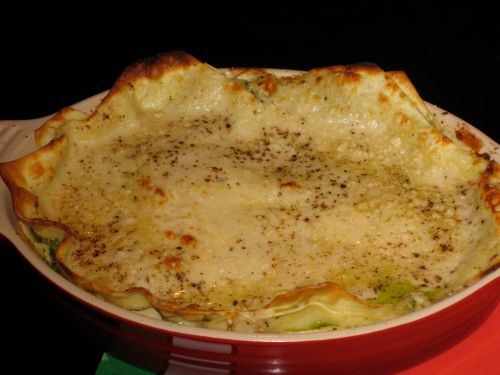
Recipe: Lasagna with Basil Walnut Pesto and Besciamella
When I was a junior high school student on Long Island many centuries ago, there still existed a class called home ec, something all the girls had to take, a requirement that by then no one took very seriously. I believe I took it the last year it was offered before it gave way to a newer, hipper curriculum, like sensitivity training (I swear to you that was a real class at my school too). The white-haired black lady who ran home ec was truly serious about teaching us to create our own potholders and to cook some extremely foreign food. There were two dishes that I remember distinctly. They will be forever linked in my mind, not only for their nastiness but because we assembled and sampled them both on the same day. They were eggs à la goldenrod and chipped beef on toast.
Eggs à la goldenrod consisted of toasted Wonderbread slices scattered with crumbled hard-boiled egg whites and drizzled with a chalky white sauce before being finished with the chopped up egg yolks. Chipped beef on toast began with the same base of toasted Wonderbread, but then a jar of thin, round grayish-purple meat slices was opened. A load of them were piled on top of the toast before being covered with the same white sauce. It was hideous. The only thing it had going for it was that it was extremely salty. I remember asking my father about eggs à la goldenrod, and he said, “I don’t know what the hell you’re talking about.” “What about chipped beef on toast?” I then asked. “Oh,” he said. “Shit on a shingle. Don’t you ever bring that into this house.” Don’t worry, Dad. I assumed he had been forced to eat this during his service in World War II, but it turned out his Puglian-born mother had prepared it once, in an attempt to Americanize their home. It evidently left an emotional scar. It’s curious to me that I was such a blasé home ec student but then went on to find the kitchen becoming such a big part of my life. It had everything to do with Italian food.
When my mother made a white sauce, it meant only one thing, lasagna. We called the sauce besciamella. Its aroma was beautiful, mingling butter and sweet, toasted flour, with hints of nutmeg and bay leaf and a whiff of dried red pepper. Miss home ec lady didn’t use any seasoning, not even salt. Her white sauce was like plaster of Paris.
Lasagna was a special-occasion dish, made for New Year’s, Christmas, or birthdays. My mother prepared a great one, very typically Southern Italian, with layers of thick tomato-y ragu, the top covered with the fragrant besciamella. The huge dish was allowed to bubble and meld in a slow oven until a good crust formed on top. What a fabulous invention. The lasagna recipe I offer you here is based on a pasta dish I once ate in Genoa, the home of basil pesto. The original was a plate of pesto-slathered pasta squares haphazardly stacked up and left to spread out in a very free-form way. It was divine. I’ve derived a more formal baked lasagna from that, and I’ve included a nicely seasoned besciamella for lusciousness.
I really love the way it turned out. It’s a loose lasagna, so it doesn’t need to rest. I’d serve it right from the oven, so it can pool out a bit on the plate. It’s perfect, I think, for a meatless Christmas Eve dinner, a little something to work in amid your fish courses. The kitchen can be a beautiful place. Merry Christmas.
Note: Piave is a cow’s milk cheese from the Veneto. You can often find the aged version, Piave vecchio, in this country. It tastes something like Grana Padano, but it’s much sweeter, almost like caramel, which is why I found it a good match for the bitter herbiness of the basil. If you can’t find it, use Grana Padano or Parmigiano Reggiano.
Lasagna with Basil Walnut Pesto and Besciamella
(Serves 6 as a first course)
For the pesto:
½ cup extra-virgin olive oil
1 large garlic clove, roughly chopped
1 cup very fresh, lightly toasted walnut halves
2 cups basil leaves (packed down—about 2 good sized bunches)
4 large sprigs marjoram
1 cup grated Piave vecchio cheese, plus a little more for the top
For the besciamella:
3 tablespoons butter
3 tablespoons all-purpose flour
3 cups whole milk
⅛ teaspoon grated nutmeg
1 fresh bay leaf
Freshly ground black pepper
Salt
A pinch of sugar
⅛ teaspoon hot paprika (I used the Basque piment d’espelette)
1 pound very thinly rolled homemade egg pasta, cut for lasagna
To make the pesto: Place all the pesto ingredients in the bowl of a food processor, and pulse until you have a rough paste. If the pesto seems too tight, add a little more olive oil.
To make the besciamella: Melt the butter in a medium-size saucepan over medium heat. Add the flour, whisking it to blend it into the butter. Cook, while continuing to whisk, for about a minute, without letting the mix color. You’ll smell a sweet, lightly toasted flour aroma. Add all the milk, and continue whisking. Add all the seasonings, and continue cooking, whisking often, until the sauce has thickened. This will happen around the time it comes to a boil. When bubbles appear on the surface, turn the heat down a bit, and continue cooking for another minute or so or until the sauce is thick and very smooth.
Put up a large pot of pasta cooking water, and bring it to a boil. Season it with salt. Cook the pasta sheets, a few at a time, until tender (a minute for really fresh pasta, a little longer if it’s more dry). Run the pasta sheets under cool water after draining, and then lay them out on dish towels.
Preheat the oven to 425 degrees.
Coat an approximately 9-by-11-inch baking dish (or an equivalent oval dish) with olive oil. Make a layer of pasta, and spread it thickly with pesto. Make another layer of pasta, and spread it with besciamella. Continue altering pasta with layers of pesto and besciamella. You should finish with a layer of pasta spread with besciamella and then sprinkled generously with grated Piave vecchio. Bake, uncovered, until the edges have browned nicely and the whole dish is bubbling hot, about 20 minutes.
Read Full Post »




 Erica De Mane