This cauldron I’m holding is not for cooking fish. It’s for returning fish to the sea. It’s actually a chute that goes through that table directly into the Atlantic Ocean. I understand that most of these fish are already dead, but some are pregnant and, once returned to the sea, will be able to give birth to live babies. I didn’t catch these fish, but I collected them, stole them actually, from fishermen while they were staring off into the sunset. I steal fish, then I dress in blue and send the fish home. The sea is now full of dead fish. I was under the impression that this was a good thing. But now I’m not so sure. I just can’t stop myself.
Archive for the ‘Uncategorized’ Category
Women with Fish
Posted in Uncategorized on August 19, 2014| 7 Comments »
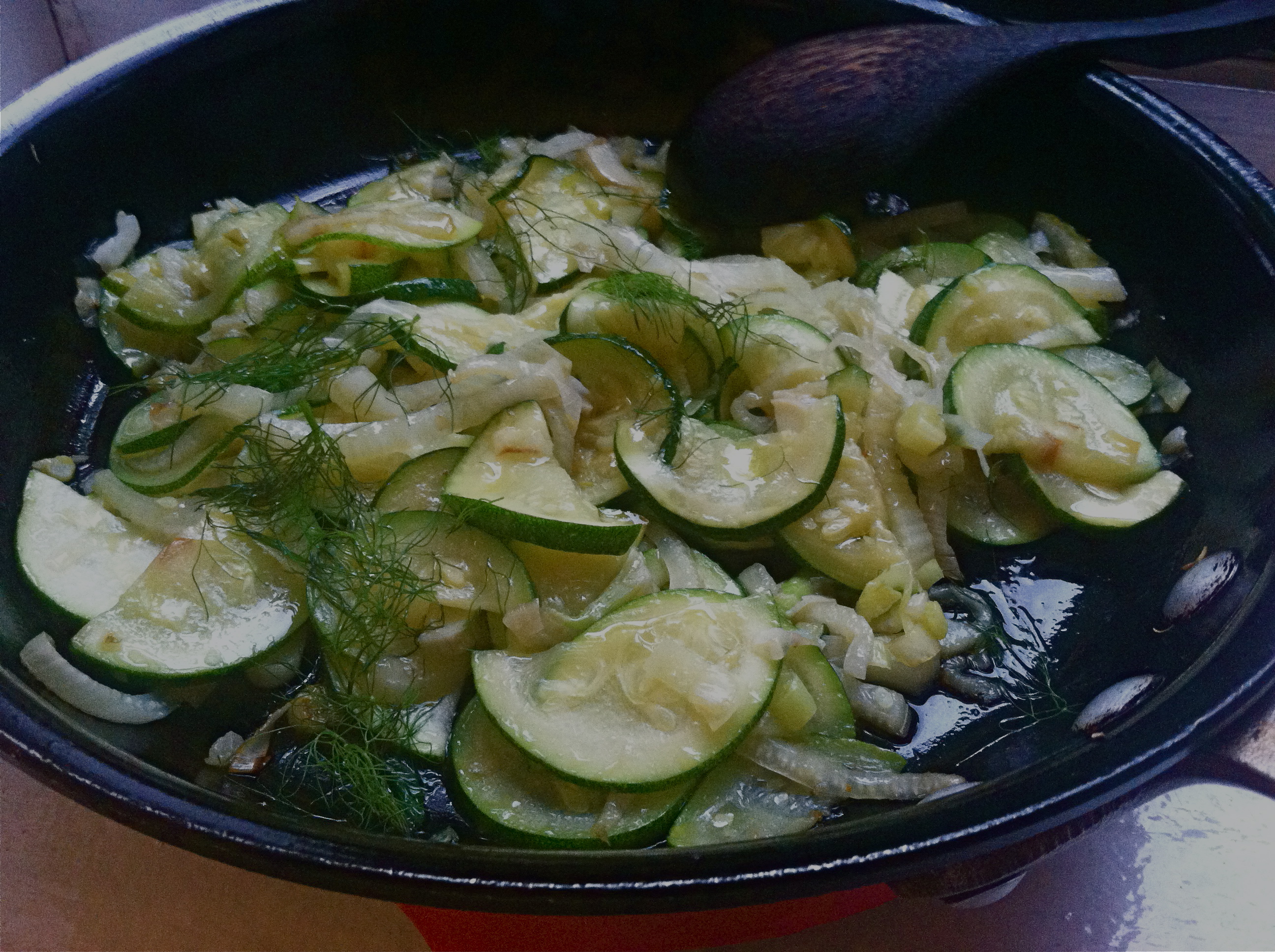
Grilled Shrimp Spiedini with Rosemary Salsa, Zucchini, Leeks, and Fennel
Posted in Uncategorized on August 13, 2014| 11 Comments »
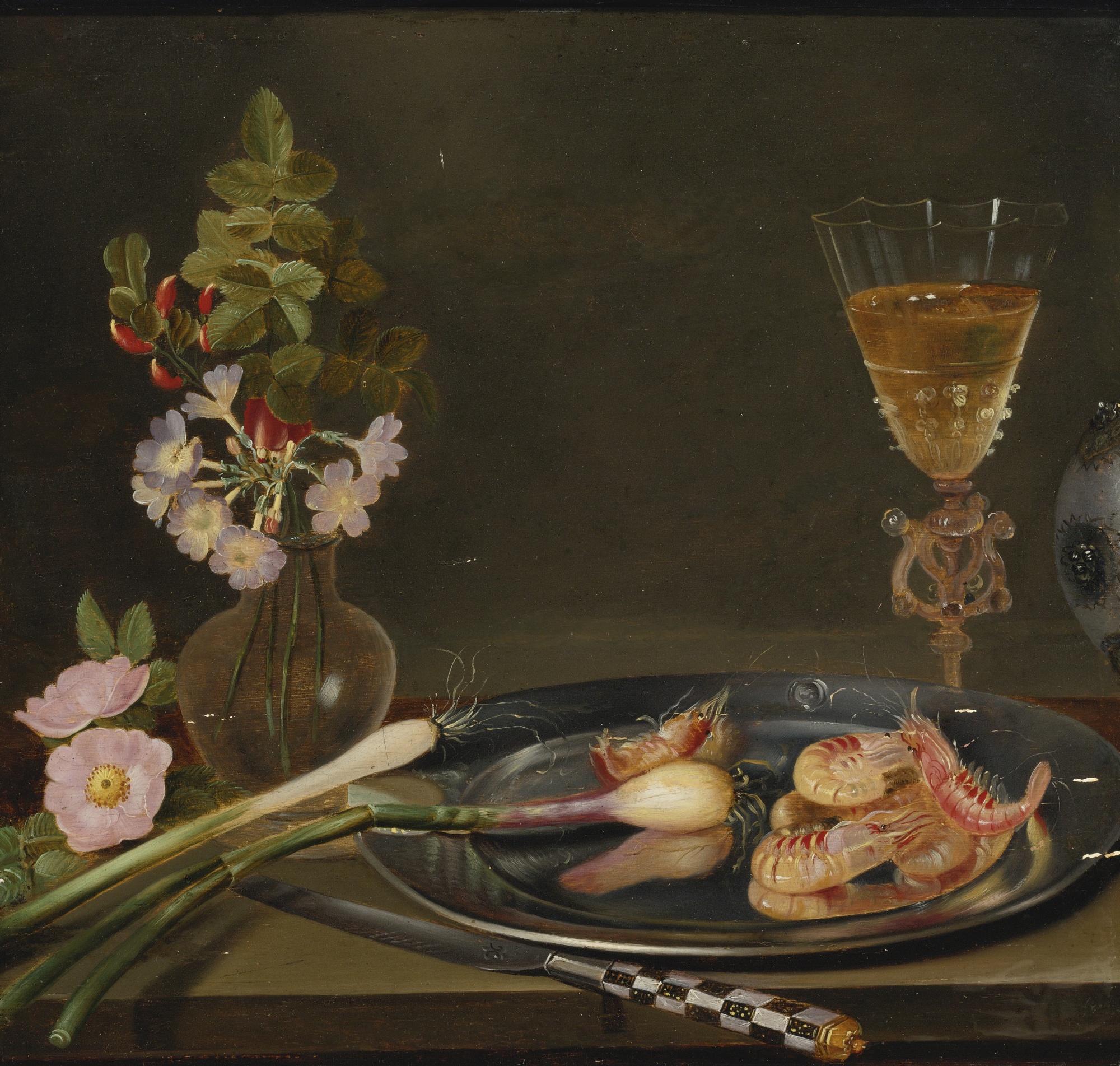
Still Life with Shrimp, Ramps, Flowers, and a Glass, Franz Ykens, 1601-1693.
When I was a kid, shrimp was special. Not as special as lobster, but up there. Spaghettini with shrimp was for Christmas Eve, period. So was shrimp “scampi,” made with breadcrumbs, herbs, garlic, white wine, and, inexplicably, butter. Shrimp scampi was too good for olive oil. And my family sometimes found it with the heads still intact, usually on Arthur Avenue, in the Bronx. That was just too much excitement. Now shrimp is all over the place. Sometime soon I’m expecting to see it at Dunkin’ Donuts, worked into an ice cream topping, maybe.
I’m bringing this up because I’m confused by the abundance of shrimp. I figured wild shrimp would be better than farmed, but after some research, now I see that that’s not so clear. The wild shrimp I most often find are from Colombia, and they and many other foreign wild shrimp are caught with trawl nets that take up all sorts of other sea life with them, such as endangered sea turtles.
Farmed shrimp from Asia and South America are, for the most part, not sustainable. They threaten wetlands and are given hormones and, because of their bacteria-laden environments, antibiotics. Shrimp farms are now cropping up in the U.S., and I hope we can look to them to provide a healthier, better regulated alternative. I’d ideally like to eat fresh East Coast shrimp, but those seem hard to locate even in season. I’d pay more for them and eat them less often.
If we don’t want to eat garbage and damage our already fragile earth, we cooks need to keep on top of this. At the moment, what places are the worst offenders? China? Venezuela? When I’m in doubt, I check at http://www.seafoodwatch.org, where I obtained much of the info for this post. I’m still perplexed when I go to my fish shop and see eight kinds of shrimp, all from different countries, some farmed, some wild. It’s a shame. Shrimp is a delicious low-carb food that has served as the base for some of my best culinary whims. I want to eat it, and I love it, so you can be sure I’ll be keeping up on this issue and passing along to you what I learn.
Back to the fine low-carb beauty of this recipe. While probing my culinary bean for a side dish to go with these shrimp, I immediately thought of faro or wheat berries, but since those aren’t on my low-carb program, I had to search deeper. Zucchini is a vegetable I reach for when I want something rich but not a potato. It has a solid presence, a gentle taste, and soaks up sauce well. And in summer you’ve got tons of it.
You’ll need two short metal skewers for this recipe.
Grilled Shrimp Spiedini with Rosemary Salsa, Zucchini, Leeks, and Fennel
(Serves 2)
For the rosemary salsa:
3 large sprigs rosemary, the leaves well chopped
4 large sprigs flat leaf parsley, the leaves well chopped
1 summer garlic clove, minced
Salt
A pinch of sugar
The grated zest from 1 lemon
The grated zest from 1 orange
1 tablespoon lemon juice
About 3 tablespoons extra-virgin olive oil
For everything else:
6 to 8 jumbo shrimp (3 to 4 per person, depending on desire), peeled and deveined but with the tails left on
1 tablespoon ground fennel seed
Salt
Piment d’espelette dried red pepper
A pinch of sugar
Extra-virgin olive oil
3 medium summer zucchini, cut into thin rounds
1 large fennel bulb, trimmed and cut into thin rounds
2 young summer leeks, cleaned, the white part cut into thin rounds
2 anchovy fillets, minced
Salt
Black pepper
A squeeze of lemon juice
In a small bowl, mix all the ingredients for the salsa together. Let sit at room temperature while you proceed with the recipe.
Put 3 or 4 shrimp on each skewer. Season them all over with the fennel, salt, a decent sized pinch of pimenton, depending on how spicy you like it, and the sugar, pressing the spices into the shrimp. Stick the shrimp back in the refrigerator.
In a large skillet, heat a little olive oil over medium flame. Add the zucchini, fennel, and leeks, all at the same time. Add the anchovy, and season with a little salt and more generously with black pepper. Sauté quickly until the vegetables have a golden edge but are still holding their shape, about 5 minutes. Give them a tiny squeeze of lemon juice.
Put a stove-top grill pan over high heat (or use an outdoor grill).
Drizzle the shrimp with just a touch of olive oil. When the grill is hot, lay the skewers on it, and grill quickly until the shrimp is just browned, about 2 minutes on each side. That’s for real jumbos. For smaller ones, you’ll want to cut down the time. Keep them juicy.
Set out two plates. Spoon some of the zucchini onto each plate. Place a skewer next to the zucchini. Drizzle some of the rosemary salsa on top.
Hamburgers with Thyme Peperonata and Caper Berries
Posted in Uncategorized on August 5, 2014| 8 Comments »
Meat, Pepper, and Eggs, Felix Vallotton, 1918.
I want hamburgers often, and I want them rare. Lately I’ve liked them better than a steak. There’s something about the tenderness of a good burger, a perfect package, that when you bite into it it always seems like a little surprise (although not so good a surprise if you’ve overcooked it). Burgers are one of those foods that are both pedestrian and celebratory. I love shaping them, something you really can’t do with a steak unless for some reason you’re compelled to cut heart patterns or stars, which I’ve never seen even at any of the more far-reaching catering places I worked for.
If the idea of supermarket ground meat grosses you out, as it now does me, you can easily grind it yourself. I buy a hunk of beef chuck, the best cut for burgers, since it has more fat than sirloin. If you want you can purchase grass-fed beef, which is higher in omega-3 (or you could buy ground meat at a farmers’ market, which for me is a tad expensive, but every once in a while I go for it). When grinding it myself, I cut my beef hunk into smaller pieces and then throw a few at a time into my food processor and pulse quickly. It works really well. The more you try it, the more you’ll come to feel when you’ve got a perfect, uniform chop. That way you’ll be sure your chopmeat came from one cow, not some grab bag of corporate animal sludge. Of course, you can use a meat grinder, but mine, which belonged to my sausage-obsessed grandmother, is so old and rusty at this point that the food processor works much better. Just to make it more luscious, I add a drizzle of olive oil into the mix before forming the patties.
You’ve probably noticed that lately I’ve been focusing on low-carb Italian and Mediterranean, so no bun here. Of course you can have one, but cutting the carbs really does help you lose weight. That’s what many of my readers have been asking for, so I decided to oblige. I’m getting used to this way of eating. It’s extremely creative. I’m trying to present combination dishes, such as this one, that make a full meal without a carb side. They really force you to you work your vegetables.
I’d round out this burger dinner with a summer tomato salad and a lightly chilled Sangiovese. At the end of the meal you can add a few peach slices to your wine, a beautiful Southern Italian touch.
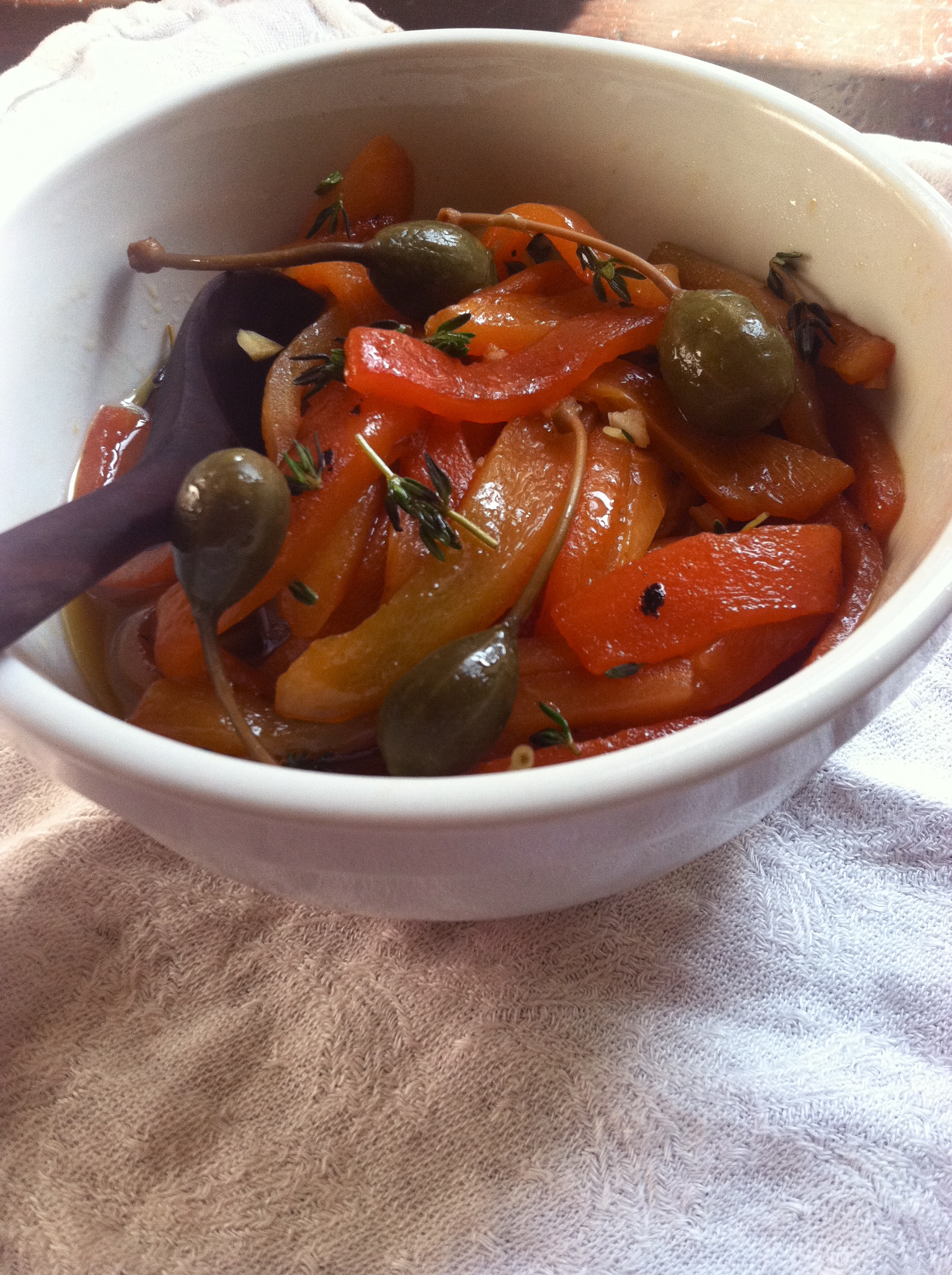
Hamburgers with Thyme Peperonata and Caper Berries
(Serves 4)
For the peperonata:
4 red summer bell peppers
Extra-virgin olive oil
2 summer garlic cloves, sliced
Salt
2 anchovy fillets, minced
A splash of sweet vermouth
About 6 thyme sprigs, the leaves chopped, plus 4 large sprigs for garnish
1 teaspoon Dijon mustard
A dozen caper berries
For the burgers:
1¾ pounds ground chuck
Salt
Black pepper
Extra-virgin olive oil
8 or so leaves Bibb lettuce
To make the peperonata, place the peppers on a sheet pan, and coat them with a little olive oil. Turn on the broiler, and broil them about 6 inches from the heat source, turning them often, until they’re charred all over. I like this method better than grilling outside or over a gas flame because it takes away the inner rawness that can leave the peppers bitter.
Cover the peppers with a towel or throw them in a paper bag, and let them steam in their own heat for about 10 minutes. Now peel and seed them, and cut them into strips.
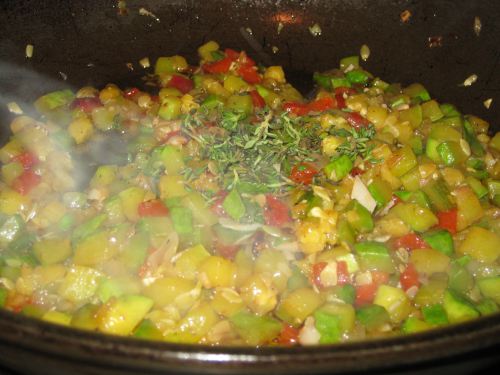
In a medium skillet, heat a tablespoon of olive oil over medium flame. Add the pepper strips, garlic, and salt, and sauté until the garlic gives off its aroma, about a minute. Now add the sweet vermouth, and let it bubble away. Add the thyme and the mustard, mixing them in. Cook about a minute longer. Now turn off the heat, and let the peperonata sit in the skillet. This will help it develop flavor. After about 5 minutes, transfer it to a bowl, and give it a drizzle of fresh olive oil.
Place the ground meat in a bowl. Add about a tablespoon of olive oil, and season with salt and black pepper. Mix gently. Shape the meat into four thick patties.
Cook the patties on either an outside grill or a stove-top grill plate. I like mine very rare, but anything from almost raw to medium-rare, in my opinion, is acceptable. If you’re going to hammer them, I really don’t see the point of wasting good meat. So give them the touch test. Soft in the center is rare. Heading toward medium rare you’ll feel a bit of springiness.
While your burgers are cooking, set out 4 plates, and place a few leaves of the Bibb lettuce on each. Place a hamburger on each. Top with the peperonata (which I think is best slightly warm or at room temperature). Garnish with caper berries and thyme sprigs.
Swordfish with Salmoriglio and a Tomato, Mozzarella, and Celery Leaf Salad
Posted in Uncategorized on July 28, 2014| 10 Comments »
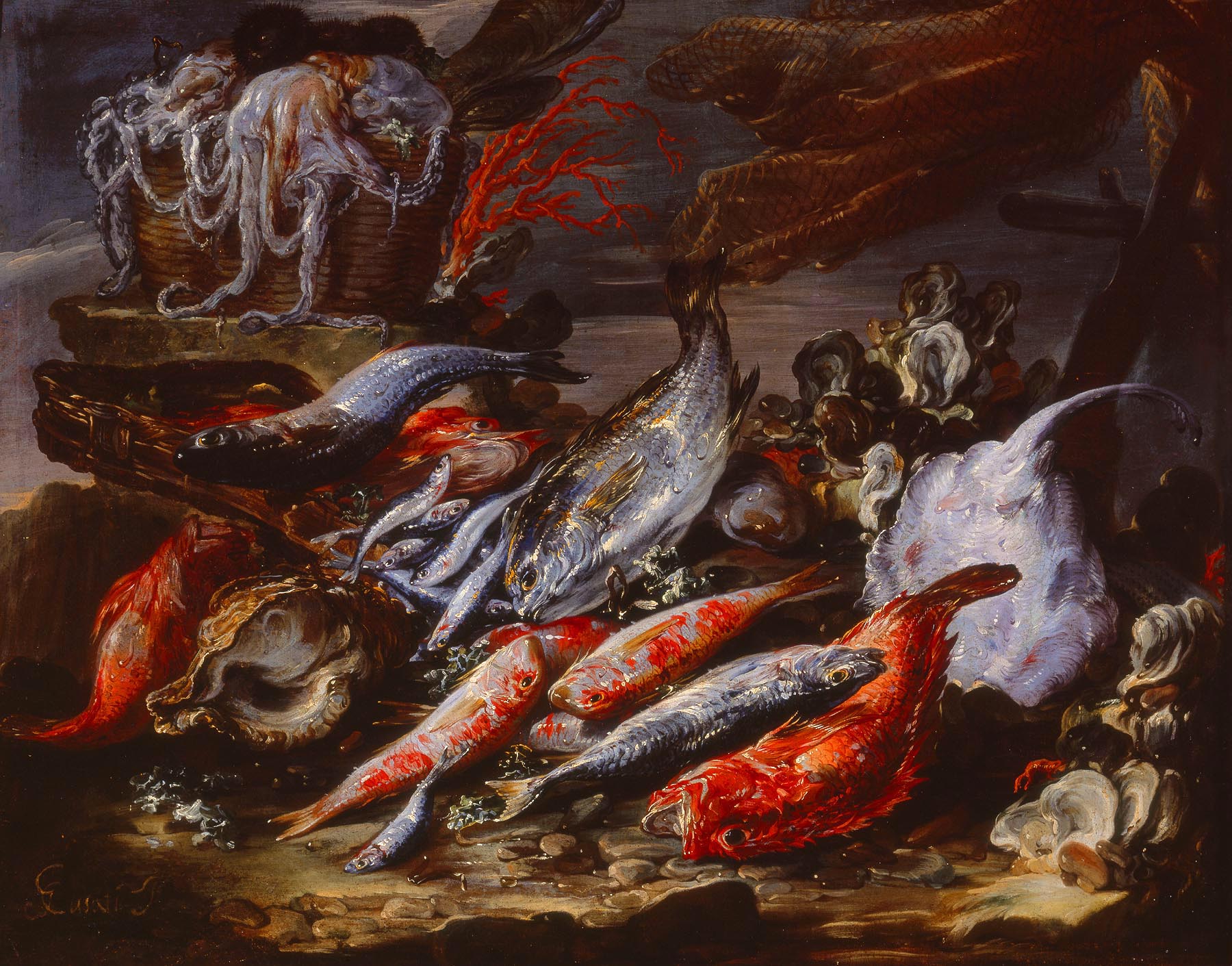
Still life with fish, Gaetano Cusati, circa 1700.
Mozzarella with tomatoes. You’d have to be brain-dead to say no to that. But mozzarella with swordfish? One of the big shocks of my Italian culinary life was visiting Sicily and seeing how often they pair fish with cheese, something I was brought up to consider bad manners. I discovered in Palermo that a sprinkling of pecorino on baked tuna is a wonderful thing. Spaghetti with shrimp and tomatoes and a little aged caciocavallo, that tasted just fine, too. I also noticed that cheese, along with bread crumbs, herbs, and maybe pine nuts and raisins, makes a wonderful filling for stuffed sardines.
Somehow I was thinking recently that the meatiness of swordfish, a popular fish in Sicily, and the plushness of mozzarella would produce a pleasant match. And they did. I tell you, it was really good.
Swordfish with salmoriglio sauce is a Palermo classic. The sauce is so simple yet has such intense flavor, you won’t believe it. Just herbs, your best olive oil, lemon, and a touch of garlic. There are cooked and uncooked versions. For summer, I like it cool and fresh. It’s used on meat and fish, but it’s also great on mozzarella, so I suppose that’s how the connection found its way into my head. This is a piatto unico, a meal on a plate. You’ll want the salmoriglio to spill off the fish so a little works its way onto the salad. All the flavors should blend. Since these flavors are distinct, the blend will be a vibrant one. Sicilian food is like that, even when improvised.
So here’s another low-carb Mediterranean offering for you pleasure-seeking dieters. Ditch the bread, but go for a glass of good Italian rosato.
Happy summer.
Seared Swordfish with Salmoriglio and a Tomato, Mozzarella, and Celery Leaf Salad
(Serves two)
For the salmoriglio:
½ cup extra-virgin olive oil
The juice from half a large lemon
Salt
1 summer garlic clove, minced
About 6 sprigs each fresh marjoram and oregano, the leaves chopped
For the salad:
8 summer cherry tomatoes, cut in half and drained for about ½ hour
½ pound not-too-soft mozzarella, cut into medium cubes
½ cup celery leaves, left whole
A few thin slices red shallot
3 sprigs marjoram, the leaves left whole
Salt
Extra-virgin olive oil
A drizzle of lemon juice
A palmful of baby arugula
2 thick slices, about ½ pound each, swordfish steak
Salt
Black pepper
A drizzle of extra-virgin olive oil
In a small bowl, mix all the ingredients for the salmoriglio together. Set aside. This should be made about ½ hour before serving, but not much longer or the herbs will lose their freshness.
In a large bowl, combine all the ingredients for the salad except the arugula, and give them a toss.
Put a heavy-bottomed skillet (cast iron will work well) over medium-high flame. Season the swordfish with salt and black pepper, and coat each side with a little olive oil.
When the skillet is hot, add the swordfish and sear, without moving the pieces around, until the bottoms are nicely browned and the fish moves easily in the skillet. Give them a flip, and brown the other side. The entire cooking time shouldn’t be more than about 4 to 5 minutes, depending on the thickness of the fish. You’ll want to keep the center a bit underdone, since swordfish can easily become dry.
Place the fish on two dinner plates. Put a little mound of arugula next to the fish. Divide the salad up onto the arugula. Drizzle the salmoriglio over the fish. Serve right away.
Woman with Fish
Posted in Uncategorized on July 27, 2014| 4 Comments »
One of my fashion icons holding a hollow fish. Have I been led astray into a land of emptiness? I must find a way back while retaining high boho style. Help.
Escarole Salad with Fried Olives, Capocollo, and Asiago
Posted in Uncategorized on July 16, 2014| 3 Comments »
Still Life with Olives, Gerald Roling.
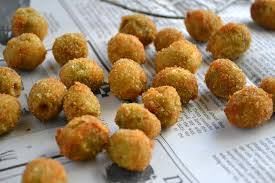
Fried olives are an intricate and exotic treat. They’re worth the bit of effort they take to prepare. I first came across them in Rome decades ago, made by a chef named Maria Romani at her fish restaurant, Il Pellicano. She was originally from the Le Marche region, where fried stuffed olives are a tradition, usually filled with pork. Signora Romani’s olives contained some type of seafood, shrimp maybe (it was a long time ago), and were breaded, fried, and served as one of the earlier courses in a multi-course meal. Everything was wonderful, but the olives were a mind blower. Such flavor, such labor. A strange feature of the restaurant was that dishes were brought out one after another, ten, twelve of them, until you told the waiter you couldn’t eat another bite. After you’d given the word, out would come a lemon sorbetto, and that was that. The restaurant hasn’t existed in years. I wonder what happened to Signora Romani? I’m going to give her an Internet search right now. . . . Well, I didn’t come up with anything. If anyone knows if she’s still cooking, or even still walks this earth, please tell me.
I love most fried foods, but olives have an agro-dolce-ness that plays extra well against the crispy, oiliness of a fried crust. Mild green olives, in my opinion, work the best. The Ascolana olives of Le Marche, which have a mild but bright flavor, are what inspired that region’s fried olive recipes, I believe. I can’t imagine frying a strong, wrinkled black Moroccan olive, no matter how much I love them. They don’t have enough juice or quiet acidity. Green Cerignolas from Puglia also have the right qualities for frying.
People worry that fried food is bad for you. Please don’t worry. Southern Italy perfected fried food, and the Mezzogiorno was included in the big 1960s Mediterranean diet study because it had an extremely healthy lifestyle. They fry things that are good for you, such as cauliflower, or sardines, not Milky Ways (well, zeppole, but just for le feste). Also the food is usually just dusted with a little flour or breadcrumbs, not a thick batter that becomes a grease-hogging encasement. Often they use olive oil and fry quickly so the oil doesn’t break down. And, maybe most important, fried food in Southern Italy is served as an antipasto, not a main course. Plus, you don’t need a gallon of oil. I fried these olives in about 2 inches of olive oil. That’s all they require. This is really a lovely salad. Give it a try. And since I’ve included cheese and sausage in this salad, I didn’t bother to stuff them, so the prep is minimal. The olives are also good on their own, maybe served with some young pecorino, a few slices of prosciutto, and a glass of Grillo wine.
Escarole Salad with Fried Olives, Capocollo, and Asiago
(Serves two)
For the salad:
2 big handfuls of young summer escarole or frisée (any green that is not a big wilter will work)
About 8 big shavings of aged Asiago
6 slices capocollo, cut into thin strips
2 very thin slices red onion
A small handful of tiny basil leaves
The leaves from a few large sprigs of marjoram
1 summer garlic clove, crushed
1 teaspoon Spanish sherry vinegar
A pinch of salt
Black pepper
About 1½ tablespoons extra-virgin olive oil
For the olives:
1 cup extra-virgin olive oil
10 Cerignola or Ascolana green olives, pitted (or any large green olive, as long as they’re not too salty. You can rinse ones that seem briny)
½ cup regular white flour
2 eggs, lightly beaten
¾ cup homemade dry breadcrumbs
6 or so large thyme sprigs, the leaves well chopped
¼ teaspoon ground allspice
¼ teaspoon ground fennel seed
1 tablespoon grated aged Asiago cheese
¼ teaspoon Aleppo pepper, or a pinch of cayenne
A few big grindings of black pepper
Place the lettuce in a nice looking salad bowl. Scatter on the Asiago, capocollo, onion, and the herbs.
Whisk the garlic, vinegar, salt, black pepper, and olive oil together, and set aside.
Pour the oil for the olives into a medium saucepan, and get it hot over high heat. You’ll want about 2 inches or so of oil.
While the oil is heating, place the breadcrumbs on a plate, and add the thyme, allspice, fennel, tablespoon of Asiago, Aleppo, and black pepper. Mix well.
Dry the olives, and coat them lightly in flour. Now dip them in the egg, shaking off excess.
Roll the olives in the breadcrumb mixture, coating them well all over. Stick them in the refrigerator while the oil is heating. This will help their coatings adhere.
When the oil is hot (test by flicking in a few drops of water; it should immediately sizzle), add the olives, and fry until golden all around (do this in two batches if they’re crowded). Lift them from the oil onto paper towels with a slotted spoon.
Toss the salad with the vinaigrette, and then scatter the hot olives on top. Serve right away.
The Last Issue of Curves Magazine
Posted in Uncategorized on July 8, 2014| Leave a Comment »
The July issue of Curves magazine is out now, with my column on Steak Fajitas with a Cantaloupe Tomato Salsa. This, unfortunately, will be the final issue of this beautifully put together and informative magazine that has been so much help to women who are struggling to control their weight. It’s a shame, but the company needed to cut corners, so the magazine, they decided, had to go. Sad indeed.
http://viewer.zmags.com/publication/606c5222#/606c5222/29
The Real Mediterranean Diet
Posted in Uncategorized on June 28, 2014| 3 Comments »
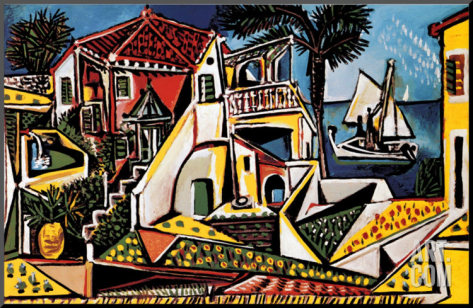
Mediterranean Landscape, Pablo Picasso.
The Mediterranean Diet?
I thought about my family’s ancestral cooking while gazing for the umpteenth time at the now familiar-to-most Mediterranean Diet Pyramid. The chart was assembled by the nonprofit Oldways and a few other groups in 1993 based on studies from the 1960s. Atop its tiny peak sit “meats and sweets,” to be eaten less than weekly; beneath that are poultry, eggs, cheese, and yogurt (daily to weekly), then fish and seafood (at least twice a week), and finally fruits, vegetables, beans, grains, olive oil and so on (the basis of every meal). The cooking I grew up with was imported from a little town on the Campania-Puglia border and from Sicily. Those areas, along with the rest of Southern Italy, plus Greece and Crete, made up the study. This time I really looked at this pyramid, and it didn’t look quite right. With all I know about Southern Italian food, it struck me as off. I found it lower in fat than I’ve experienced traveling through the region and on my own family’s table. I also saw a problem with its emphasis on whole grains.
Olive oil is in the eat-every-day base of the pyramid, which is correct, but things like olives, anchovies, cured pork, cheese, and fatty end cuts of meats used for flavoring are not. Those are things Southern Italians actually do eat every day. The meals I shared with my grandmother’s cousin in Castelfranco in Miscano always began the same way: chunks of caciocavallo, slivers of salami, hard-as-hell taralli, salted anchovies, olives, and sharp, cloudy red wine (homemade, and I’m not sure you could buy anything tasting as weird). Then a very small portion of pasta (about a pound for six people) with a vegetable sauce (home-bottled tomatoes or broccoli rabe when I was there) often flavored with some odds and ends of fatty pork, olives, or anchovies, and finished with fresh olive oil and a hard caciocavallo. Next, if available, a slow-cooked meat made from a cheap cut, pounded, stretched, and filled with breadcrumbs, herbs, onion, nuts. Or, instead, a fresh sausage studded with fat, or sometimes a cooked vegetable, such as roasted peppers with tomatoes and anchovies or prosciutto end. Southern Italy was and still is a place that uses the whole hog. I also noticed big cans of sunflower oil in my relatives’ house. Olive oil is expensive, even in Italy, so you need a backup. I think they mixed the two for cooking. After the main course, my cousin Tony served raw fennel and celery, just the way my grandmother had in Port Chester, New York. He offered pears once. Almonds, too. No pastries. Those were reserved for holidays. Fried food, which is popular all over the South, is what you eat on the street or in restaurants, not in homes (and boy is it good).
And what’s with whole grains as something to eat every day? They’re supposed to make up a big percentage of the daily diet in those parts. I’ve never been offered a whole grain bread anywhere in Southern Italy, and believe me, I’ve been around. The bread is either ground durum wheat, the same used for dried pasta, or soft wheat, as in pizza flour. Sesame or fennel seeds are often scattered over the top, especially in Sicily. But dark, dense loaves studded with whole grains are not part of the culture. And in my experience you’re not expected to eat much bread. “Don’t fill up on bread” is a command I’ve heard from my family both here and in Italy. It’s considered bad manners.
There’s no whole wheat pasta either. Wheat berries show up in special occasion foods, like pastiera, the Easter ricotta cake, or cuccia, a porridge served for the feast of Saint Lucy. The wheat berries are included mostly for symbolic purposes, signifying the abundance of the earth.
What are part of the culture, for certain, are small portions of local seasonal food, whether a fresh orange just grabbed from a tree or a hot, oily arancini that oozes mozzarella, bought on a Palermo Street.
So let’s face it, Mediterranean is an excellent way to eat—maybe better than the pyramid suggests.
Orecchiette with Baby Zucchini, Soppressata, and Mint
(Serves 4 as a first course)
Salt
¾ pound orecchiette pasta
Extra-virgin olive oil
6 or 7 tiny early summer zucchini, cut into small cubes
About 5 not-paper-thin slices soppressata, chopped (try to find one that’s not too dry)
1 large shallot, chopped
A few large thyme sprigs, the leaves chopped
2 fresh summer garlic cloves, thinly sliced
1 fresh red peperoncino, seeded and minced
A splash of dry vermouth
½ cup chicken broth
A small handful of fresh mint leaves, lightly chopped
A small handful of flat leaf parsley leaves, lightly chopped
A chunk of pecorino Toscana cheese for grating
Set up a pot of pasta cooking water, and bring it to a boil. Add a generous amount of salt, and drop in the orecchiette.
In a large sauté pan, heat 2 tablespoons of olive oil over medium flame. When the oil is hot, add the zucchini and the shallot. Add a little salt, and sauté until the zucchini is tender and just starting to turn golden, about 4 minutes or so. Now add the garlic and the soppressata, and sauté about 2 minutes longer. Add the vermouth, and let it boil away. Add the chicken broth, and turn off the heat.
When the orecchiette is al dente, drain it, and add it to the pan. Toss well over low heat until everything is well mixed, about a minute. Add a little more broth if it seems dry. Transfer to a warmed serving bowl, and add the thyme, the mint, the parsley, and a generous drizzle of fresh olive oil. Toss gently. Taste for seasoning. Serve with grated pecorino Toscana.
Women with Fish
Posted in Uncategorized on June 18, 2014| 13 Comments »
This out of control nun bought all the fish these guys had to sell. He had to close shop for the day after she finished with him. Must be a huge convent. Either that or, more likely, she had a side-line business going on. I don’t know, I’ve never really trusted nuns.
Swiss Chard with Scallops, Pine Nuts, and Lemon Marjoram Oil
Posted in Uncategorized on June 15, 2014| 2 Comments »
I’ve been making a Ligurian-style Swiss chard torta for probably around fifteen years. Everyone loves it. I’ve brought it to so many dinner parties, I’ve now got tart pans all around the city, most never to be seen again. I guess it’s become one of my signature dishes. The filling is mostly the chard, but it can also contain pine nuts, raisins, dates, almonds, marjoram, Parmigiano, garlic, sometimes thyme or basil, and occasionally a few anchovies, all, of course, at the whim of the cook. I usually throw them all in. I find that more is strangely more in this preparation. It’s sort of the pasta con sarde of tortas, with seemingly colliding flavors creating a beautiful whole. I bake it in a flaky olive oil and white wine crust, which is incredibly easy to put together. An exotic treat for the vegetarians in my life.
In fact, the filling for this torta is so good I kept thinking about it recently while trying to come up with a diet-friendly main course to use up way too much Swiss chard I had bought. I deconstructed the torta. I got rid of the crust and used a modified version of my filling—no eggs, no sweet aspects, very light on the cheese—as a bed for seared sea scallops, finishing it off with a lemony marjoram vinaigrette. Seasonal ingredients, thought through but simply put together.
One of my current diet goals is to present you with main courses that have so much flavor you don’t miss the usually unavoidable but gratuitous side of starch. This one really worked out well. I hope you enjoy it.
(Serves 2 as a main course)
For the lemon marjoram oil:
2 tablespoons extra-virgin olive oil
1 small summer garlic clove, minced
6 large marjoram sprigs, leaves chopped
The grated zest from 1 large lemon, plus about a tablespoon or so of its juice
Salt
For the rest:
Extra-virgin olive oil
1 tablespoon unsalted butter
1 shallot, minced
2 summer garlic cloves, sliced
1 very large or 2 smaller bunches Swiss chard, the thick white ribs removed, leaves chopped
Salt
Black pepper
A few large thyme sprigs, leaves chopped
A few large marjoram sprigs, leaves chopped
The zest from 1 lemon
A small chunk of Parmigiano Reggiano cheese
6 really large sea scallops, or 10 smaller ones
A big pinch of sugar
In a small bowl, mix all the ingredients for the lemon marjoram oil together. Let sit while you proceed with the recipe (allowing the flavors to blend).
Heat about a tablespoon or so of olive oil in a large skillet over medium flame. Add the shallot, and let it soften for a minute. Add the garlic, and sauté for a few seconds, just until it gives off an aroma. Add the chard, and sauté, stirring it around a few times, until it wilts down by about half. Season with salt, black pepper, and the thyme, marjoram, and lemon zest. If it has given off liquid, drain most of that off.
Season the scallops with the sugar, salt, and black pepper.
Heat a heavy-bottomed skillet over high flame. Add a big drizzle of olive oil and the butter. When they’re hot, add the scallops, and let them brown without moving them around. When they get crispy at the edges, turn the heat down a little, and let them continue to cook. Don’t flip them. When the top of the scallops feel warm, they’re done.
Add a few big gratings of Parmigiano to the chard, and give it a stir. Divide it up onto two plates. Place the scallops, browned side up, around the chard. Drizzle the scallops with the lemon marjoram oil, and grate on a little parmigiano. That’s it.


![photo[1]](https://ericademane.com/wp-content/uploads/2014/06/photo1.jpg?w=500&h=375)