Feeds:
Posts
Comments

Archive for the ‘Uncategorized’ Category

maxresdefault.jpg

Recipe below: Baked Ricotta with Deep Summer Herbs

Early summer every year I get a feeling of urgency. I can’t wait to start using all my newly planted herbs in everything, food, drinks, on my face. This year I’m especially worked up, because I have my first raised bed. Before now I always jammed thirty or so big herb pots up onto my deck and watched them grow into a dense mass. A voluptuous jungle, but ultimately suffocating, for the herbs and for me. Some herbs, tarragon for instance, hate being crowded, so they never thrived up there. Same for marjoram, which usually started out promising but soon shriveled into a crusty stump. This year, with my new setup, those are both thriving. I’ve also planted salad burnet, which has a fresh cucumber taste, summer savory, bronze fennel, borage, lovage, five types of basil, Aleppo and Espelette chilies. Can’t wait to see what the deer decide to eat.

IMG_3664

My raised bed.

What I like to do early in the season is cook dishes that will taste good with small amounts of herbs. That way I get to enjoy my plants’ unique flavors without completely scalping them. I decided to make this baked ricotta with that in mind, and I went with a few tiny sprigs of some of the sturdier, more deeply flavored herbs, rosemary, savory, thyme, and marjoram. The mix turned out quite beautiful on the tongue. The entire thing took about five minutes to throw together and a half hour to bake. Instant homemade antipasto. All you need with it is good bread and a bottle of Fiano di Avellino.

Happy early summer cooking to you.

IMG_3688

Baked Ricotta with Deep Summer Herbs

I used a 2-cup soufflé dish for this, but any equivalent, not too shallow baking dish will work fine.

15 ounces whole-milk ricotta, well drained
1 tablespoon heavy cream
1 large egg
1 tablespoon extra-virgin olive oil, plus a little more for the dish
½ teaspoon ground nutmeg
1 teaspoon powdered sugar
1 heaping tablespoon grated grana Padano cheese
2 sprigs each of rosemary, marjoram, savory, and thyme, the leaves all lightly chopped (or whatever you have that would fit with this theme, such as a little Italian oregano or even some spearmint)
Salt

Preheat the oven to 400. Oil your baking dish.

Mix all the ingredients together in a medium bowl. Make sure they’re well blended.

Pour this all into the baking dish, and bake until just set in the middle and lightly golden around the edges, about 30 to 35 minutes.

Let sit about 10 minutes before serving, just so it can firm up a bit. Serve warm or at room temperature.

I love to serve this with crostini, toasted, rubbed with garlic, and brushed with olive oil. You also might want to present it alongside summer ratatouille or caponata, or a tomato salad. And good olives or gently pickled vegetables would also make a nice counterpoint to the deep creaminess of the ricotta.

Read Full Post »

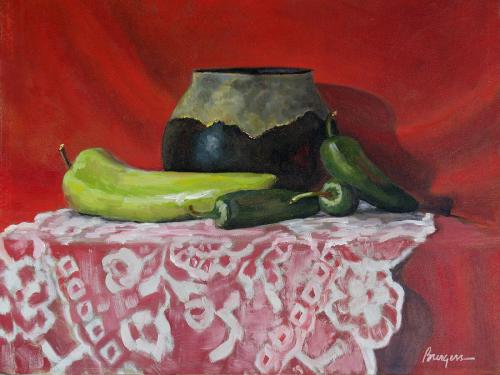
121124-lge

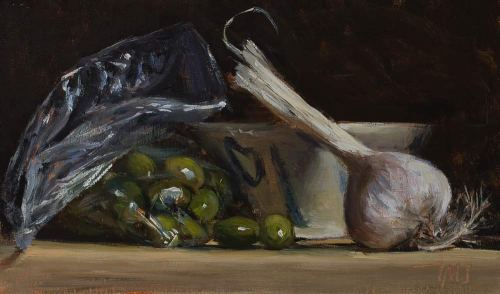
Olives, Cup, and Garlic, by Julian Merrow-Smith

Recipe below: Taggiasca Olive Cake with Summer Herbs

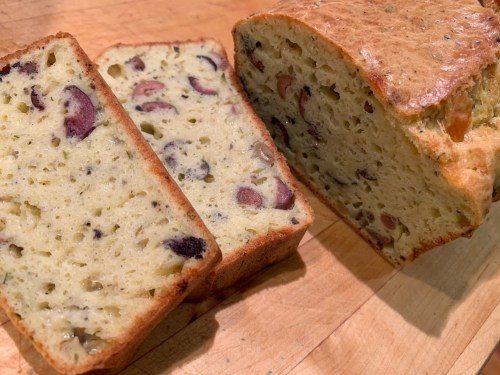
You know how sometimes you hear about a dish or see a dish and immediately know it’s for you, sometimes even before tasting it? It just hits the spot. For me it happened with French olive cake. First off, the name drew me. Olive and cake. Then there was the taste memory, from childhood Easters, of pizza rustica, a torta with cheese, salumi, and often olives, made with a slightly sweet crust, the sweetness possibly undetectable unless you baked it yourself and knew you had put a little sugar in there. Sweet and savory. I tend to like such things. I saw a French olive cake in the window of a bar, alongside other aperitif-type offerings, during my one and only trip (so far) to Marseille, and I remember thinking, this looks good. I walked past several times, zeroing in on the slices of yellowy cake-bread thing filled with olives. Finally I went in and ordered a piece. It was compact yet slightly custardy, filled with olives and Gruyère and herbs and bits of ham, as I remember. I held it in my hand while wandering around the bar, spying on what everyone else was eating and wearing.

Immediate attraction, hard to explain, like the seemingly perfect boyfriend, the one you zero in on from across the street, looking disheveled and distracted into his own bad head. So alluring, yet somehow so familiar. I can’t go after every person on the street who looks appealing, but with food I can love whatever I want. It’s liberating.

When I got home from Marseille I started looking into the olive “cake” and learned that it was something that French cooks all knew about, a classic hors d’oeuvre. The recipes varied greatly in their proportions, some almost all egg and olives, with only a few tablespoons of flour, claufoutis-like, others denser, with baking powder for lift. Gruyère was almost always the cheese, but the olives varied. One thing I knew when I went about figuring out my own recipe was that I’d almost subconsciously steer it away from being pure French, and so I did. I couldn’t help it. My experiment in Italianization started with the olives. They would have to be the perfect olives or what was the point? Sweet and gentle, not the lye-soaked things at West Side Market. I ordered Taggiasca olives from Gustiamo. They’re grown in Liguria, and they’re basically the same as Niçoise, just over the border in France, so they’re not a radical Italian departure. I love them mostly for their gentle flavor, but also for their varying colors, from green to brown-streaked to almost black.

Most of the recipes I saw used butter, or a mix of butter and olive oil. I went with all olive oil. It make so much sense with the olives. And for the cheese for this, Gruyère is perfect. I did, however, happen to have a chunk of Bitto, a cow’s milk cheese from Lombardi, on hand. When moderately aged, it tastes a bit like Gruyère to me, so I went with it. I imagine Fontina Val d’Aosta would be another good choice.

The herbs contribute a lot here. My summer savory was doing well ,so I picked some. It’s a pungent herb. You just want a little. I mixed it with rosemary, which took the edge off it, yielding a warmer flavor. If you don’t have savory, use thyme. I left out the ham and decided instead to serve the cake with a side of soppressata. A nice Italian solution. I have found that the cake is best eaten right after it’s made, while maybe still a little warm. It’s also good the next morning for breakfast. After that it gets a bit gooey.

IMG_6957

Taggiasca Olive Cake with Summer Herbs

1½ cups flour
2 teaspoons baking powder
Sea salt
Black pepper
4 large eggs
½ cup extra-virgin olive oil
½ cup dry vermouth
2 tablespoons sugar
A few sprigs each of rosemary and summer savory (or thyme)
¾ cup grated Bitto, Gruyère, or Fontina Val d’Aosta cheese
A big handful of Taggiasca, or Niçoise olives, pitted and pulled in half

Preheat the oven to 400 degrees. Oil up a loaf pan.

In a medium bowl, mix the flour with the baking powder, salt, and black pepper.

In a standing mixer, beat the eggs until foamy. Add the olive oil, the vermouth, and the sugar, and briefly mix everything together. Now gradually add the flour mixture to the eggs, just until everything is blending. Add the herbs, cheese, and the olives, and briefly mix.

Pour the batter into the loaf pan, and bake until the top is golden and the cake is springy to the touch, about 40 minutes. Let it cool for about 15 minutes before cutting.

It will go well with an arugula salad and a few slices of prosciutto, or, possibly even better, with soppressata. Or have it with a summer tomato and sweet onion salad, or just plain, with a glass of rosato.

Read Full Post »

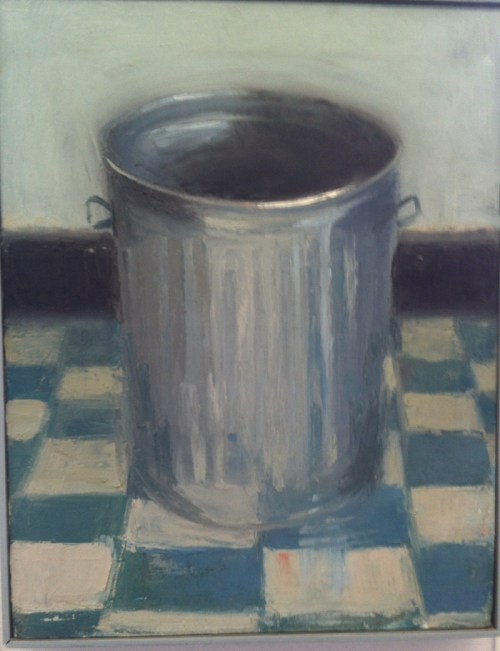
imgallery-19MyGarbageCan

My Garbage Can, by Ed Stitt, 1985.

Recipe below: Salmon Cakes with Basil and Capers

As I’ve gotten older, I’ve become preoccupied with waste. Waste of time, opportunity forfeited, out of laziness or, more likely, fear. Waste coupled with worrying about waste. As a cook, I find food waste a huge concern, now more than ever. Maybe I think about it too much. What happened to the lighthearted me? I mentioned my dearth of gaiety to a friend recently, and she said, “Oh come on. You were never lighthearted.” Okay. Good to know.

Anyone who has ever cooked in a restaurant or written a cookbook, spending years at recipe testing or frenetic food service, can become sickeningly immune to all the good food that gets thrown away, victim of either shortage of time to deal with it or lack of creativity about repurposing.  I remember when, ages ago, during one of my restaurant stints, I decided to make a soup from potato peels and onion skins. I felt extremely virtuous until the chef came by and told me to stop fucking around. And that was right after he gave the staff an oppressive speech about bringing food costs down. The soup was good, served hot, garnished with thyme blossoms. It was essentially vichyssoise. But maybe making vichyssoise from scraps was going too far.

Waste in a place of plenty is particularly nasty. So here I am now, decades later, always worrying about what’s rotting in my fridge. Should I have thrown that out? Did it have another day to it? Is there some way I could have used it?

I recently played a stupid dance with a slab of salmon fillet. I bought more than I wound up needing for dinner, and the rest went into the freezer. The next day I took it out, thinking I’d use it right away, but I got sidetracked while it sat defrosting on my counter. Then I stuck in in the fridge. I’d think about it tomorrow. Tomorrow I ended up having a dinner date. The salmon remained in the refrigerator, deteriorating by the minute. I was reluctant to refreeze it, but I knew I wasn’t going to cook it that night. I wound up sticking it back in the freezer. Then I worried that the refreezing would ruin it, destroying its texture and freshness. I took it out of the freezer again and defrosted it. I’m not sure why I did that. I knew that if it was messed up beyond usefulness it was my fault, and that would ruin my week. So the next morning, with much trepidation, I smelled it, expecting the worst. It was okay, even sweetly fresh, and bouncy to a press of the finger, so at 8:30 a.m. I threw it in the oven, with no plan beyond stopping the cycle of decay and neurotic worry.

After some thought I came up with a Sicilian-influenced recipe for salmon cakes. And they were delicious. Problem solved. Disaster averted, until next time.

Happy cooking to all my anxious food friends.

2617357-RPPJIHEQ-8

Salmon Patties, by Jan Jahnke.

Salmon Cakes with Basil and Capers

(Makes 4 to 5 good-size salmon cakes)

1 ¾-pound salmon fillet, with or without its skin
Extra-virgin olive oil
Salt
Black pepper
Aleppo pepper
2 scallions, cut into thin rounds, using most of the green part
2 inner celery stalks, with their leaves, chopped
1 teaspoon rice wine vinegar
12 basil leaves, roughly chopped
A few large thyme sprigs, with their leaves, chopped
The grated zest from 1 lemon
¼ cup salt-packed capers, soaked and rinsed
2 teaspoons Dijon mustard
¼ teaspoon ground allspice
2 eggs, lightly whisked
½ cup good quality breadcrumbs, not too finely ground
3 tablespoons butter
Lemon wedges for serving

Set the oven to 400 degrees.

Drizzle some olive oil onto a sheet pan, and lay the salmon on top. Drizzle a little oil over the salmon, and season with salt, black pepper, and a sprinkling of Aleppo. Roast until just tender, about 15 minutes. Take it from the oven and let it cool.

In a medium sauté pan, heat about a tablespoon of olive oil over medium flame. Add the scallion and celery, including the leaves, and sauté until they’re just softened, about 2 minutes. Add the rice wine vinegar, and turn off the heat. Let cool for a few minutes.

In a large bowl, break the salmon up into small pieces with your fingers. Add the scallion mix, with all its cooking liquid. Add all the other ingredients except for the butter and the lemon wedges. Season with a little more salt, black pepper, and Aleppo, and mix everything well. Shape into four to five cakes, and refrigerate them for about an hour.

When you’re ready to serve, heat about 2 tablespoons of olive oil and the butter in a large skillet over medium-high flame. When it’s hot, add the salmon cakes, browning them well on one side and then flipping them to brown the other side. This will take about 5 minutes. Do them in 2 batches if you need to.

Serve them really hot with a big squeeze of lemon juice.  I served mine with a lentil salad, a very good match.

Read Full Post »

istockphoto-936452716-612x612

Recipe below: Mozzarella with Asparagus, Mint, and Warm Lemon Vinaigrette

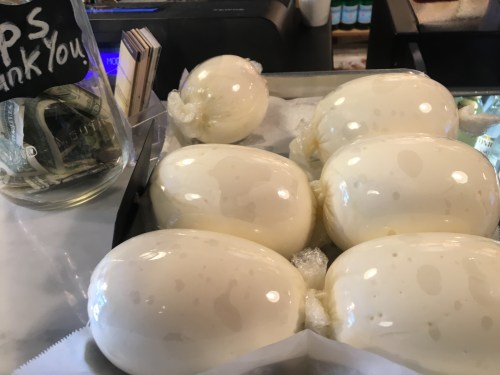
I’m fascinated by good mozzarella. It’s pully but soft, dense but puffy, and when it’s freshly made it’s so milky you wonder how it holds together. But it does. And it’s shiny, too. Mozzarella comes together fast with stirring, heating, and stretchingthe pasta filata method. Mozza, Neapolitan dialect for ‘cut’, is what happens last. Cutting the tender cheese and shaping it into balls, or sometimes  braiding it for treccia,

The first mozzarella I ever knew was like rubber. The New York supermarket lump. My family and every Italian-American I knew used it for cooking, and it performed decently in my mother’s lasagna, especially with nothing to compare it to. I never remember eating it by itself. That would have been pointless with that slab of just about tasteless, compact stuff that didn’t resemble anything organic. I didn’t know that a version quite glorious existed, in the old country or anywhere. That changed when Razzano’s, our local Italian deli, started making their own. Then we began to have Caprese salads and antipasto with oozing cow’s milk fior di latte, black olives, and gently vinegared red peppers. A palate opener.

Now, decades later, in downtown Manhattan, when I want a nice warm blob of just made fior di latte mozzarella, I often go to either Murray’s Cheese on Bleecker or DiPalo on Grand. Both are top-notch New York food experiences. But DiPalo’s is in Little Italy, far from where I live, and usually has a long line. If I have three hours to kill just for buying mozzarella, I’ll go there, but that doesn’t usually happen. You’d think New York City would have fabulous mozzarella on every corner.

IMG_3623.JPG


The truth is there aren’t many charming and highly useful little Italian shops around anymore. The few that remain, in the East Village for instance, are now heading toward reliquary status, with second-rate Italian-American fare. But at least now there’s Sergimmo Salumeria, a branch of a Hell’s Kitchen shop only a few blocks from my West Village home. Their mozzarella is superbsoft, warm, a little liquidy, smelling of milk, held together by quick handiwork. They turn it out several times a day in their little back kitchen. The arrival of Sergimmo has changed my life in a small but not insignificant way: I almost never walk past without buying at least one. God I hope they can stay in business, despite the sinful rents in this part of town.

So I’ve been eating a lot of mozzarella lately. And I’ve been combining it with spring vegetables. Asparagus with warm mozzarella is a delicious thing, and pretty too. When I have ingredients that immediate, I tend toward straightforward compositions, with not much melding. And the vinaigrette is mild. I don’t want anything too astringent pushing up against my milky cheese.

Happy spring cooking.

IMG_6907.jpeg

Mozzarella with Asparagus, Mint, and Warm Lemon Vinaigrette

(Serves 4 as a first course)

A big ball, ½ pound or so, of soft, never-refrigerated cow’s milk mozzarella
Your best olive oil
Salt
Black pepper
The grated zest from 1 big lemon
1 teaspoon rice wine vinegar, maybe a little more
A few big scrapings of nutmeg
½ teaspoon mild honey
20 medium-thick asparagus stalks (5 for each serving), the ends well trimmed
A small palmful of crushed pink peppercorns
The green part from 2 scallions, thinly sliced
A handful of spearmint leaves, lightly chopped

Slice the mozzarella, and divide it up onto 4 plates. Or, if you prefer, just lay it out on  one big serving platter, family style.

Preheat the oven to 450 degrees.

Place the asparagus on a sheet pan. Drizzle it with olive oil, and season it with salt and black pepper. Roast until just tender and starting to brown a bit at the tips, about 10 minutes, but the roasting time will depend entirely on how thick your asparagus is, so keep an eye on it.

While the asparagus is roasting, pour about ¼ cup of olive oil into a small saucepan, and heat it gently over a low flame, just until warm. Turn off the heat, and add the lemon zest, rice wine vinegar, honey, nutmeg, and a little salt. Stir everything around. You don’t want it so acidic it competes with the mozzarella, so I’ve kept the vinegar down to a minimum, but add a little extra if you like.

Pull the asparagus from the oven, and place 5 stalks on each portion of mozzarella (or all of them on the mozzarella on the serving platter). Drizzle with the warm vinaigrette, and grind on fresh black pepper and a sprinkling of pink peppercorns. Garnish with the scallion and the mint leaves. Serve right away.

Read Full Post »

My YouTube Channel

Here’s the link to my new cooking videos on YouTube. I’ll be adding new ones often. I hope you enjoy them. Happy cooking.

Read Full Post »

Here’s a new video showing you how to work with stinging nettles, a springtime green that’s absolutely delicious, worth getting past the sting so you can be comfortable cooking with it.   Happy spring to all my friends.

Read Full Post »

Women with Fish

165cdb162c9262a0b4794f9a78ba14d7

I’ve always been a decorator. Even as a kid, I’d make things look better with fish. Fish are streamlined, and most are shiny, and they work in any room, with a little imagination. The kitchen obviously, mackerel, sardines are beyond lovely, and my favorite to eat. Ephemeral décor. But then there’s fabric pulled tight to create sleekness. Or glass, blown glass maybe, of varying colors, like the body of a real fish only human realized. I’ve always said, if you like pink, yellow, and turquoise, work with fish. If you like to stuff things tight, work with fish. If you like things fresh, work with fish, but work fast, unless you’re working in plastic or metallic paper. The only medium that doesn’t work with fish, in my opinion, is wool. Wool is anti-fish. A knitted fish is a thing of horror to a decorator like me. I think most people would agree with this.

Read Full Post »


2469616-QTAERUYC-8.jpg

Storm Break, Venice Fish Market, by Phong Trinh.

Recipe below: Sautéed Red Snapper with Orange Zest and Fennel

I don’t have fond memories of baked fish. The Fashion Institute of Technology cafeteria served hotel pans full of baked cod every night, its sour steam permeating the air, hitting me the minute I walked in the door. The fillets were beige and dry, despite all the murky juices they exuded. Other specialties at the otherwise wonderful trade school included boiled cauliflower topped with salad cream, something I’d never heard of, and stiff squares of what were labeled scrambled eggs, served with a side of acidic salsa. Coming from my parents’ Italian-American kitchen, I found it all a shock. You’d think a fashion school could come up with something a little more fashionable. After a few months I could no longer stand the smell of the place, especially its stinking cod, and I started holding spaghetti puttanesca parties in my dorm. An improvement.

What is it about baking that brings out the worst in a white, boneless slab of seafood, sometimes giving it the smell of a public bathroom? Okay, maybe I’m slightly inflating the problem,  but other people, especially cooks with good noses, must agree to some extent. Even if the fish is super fresh, baking it, especially at low heat, seems to accentuate its innate fishiness. I guess topping it with crumbs and herbs helps, but, still, it wouldn’t be my first choice. If I’ve got a nice fillet of red snapper or sea bass, or salmon, I’m most likely going to sauté it.

Sautéing seals in the juices and coats the fillet in flavorful butter or olive oil, or, as I love most, a mix of both. More often than not I keep the skin on (unless it will cook up flabby, as with mackerel, for instance). The skin will hold it together, making it easier to flip, but more important it will add crunch, a lovely contrast with the soft flesh beneath.

There are a several good ways to sauté fish fillets. The method I like best for skin-on fish is the one I show you here. It’s easy high-heat cooking that will make you feel in control. I hope you enjoy it.

IMG_6836[1].jpg

Sautéed Red Snapper with Orange Zest and Fennel

(Serves 2)

2 Red snapper or sea bass fillets, about 8 ounces each, with their skin on
Salt
Black pepper
½ teaspoon fennel pollen or ground fennel seed
½ teaspoon sugar
Extra-virgin olive oil
3 tablespoons unsalted butter
The grated zest and juice from 1 orange and 1 lemon, plus the juice from the lemon and the juice from half of the orange
About 10 basil leaves, cut into chiffonade

Pat the fillets dry with a paper towel. Then score them lightly through the skin in two or three places, depending on how long they are. That will help them cook evenly and prevent them from curling up during cooking (it also will aid in crisping up their skin, most important for flavor and texture). Season the fish with salt, black pepper, the sugar (this will help it brown), and the fennel pollen, getting some into the slits in the skin.

Pull out a large sauté pan, and get it hot over high heat. Add a tablespoon of butter and a tablespoon or a little more of olive oil, and let that heat through. When it’s bubbling and hot, place the red snapper in the pan, skin side down. Let it cook without moving it around at all. You want the skin to really brown up. This can take a few minutes, so try not to get too impatient. When the edges of the fillets look nicely browned and they start smelling sweet and good and move easily when you shake the pan, give them a gentle flip, and let them cook on the other side until just tender, a minute or so longer, depending, again, on their thickness. This stage of the cooking will go faster than you’d think, so maybe don’t walk away. You may poke a thin knife into one of the scored areas if you’re not sure about its doneness. If it goes in easily and doesn’t feel tight and resilient, it’s done.

Take the fish from the skillet and plate it, skin side up, on two warm dinner plates.

Now, I usually like to make a quick pan sauce. Unfortunately high heat fish cooking doesn’t leave the most delicious pan juices. Often they’re a bit burnt and oily. So discard all that, and take out a fresh small sauté pan. Turn the heat to medium high. Drizzle in a thread of olive oil, and add the orange and lemon zests, shaking the pan around until everything is fragrant, only about 30 seconds. Pour in the lemon and orange juice, letting it boil for about 30 seconds longer, and add a pinch of salt. Pull the pan from the heat, and whisk in the remaining 2 tablespoons of butter. Pour the liquid over the fish, and scatter on the basil. Serve right away.

I like to serve crisp skin-on fish with Israeli couscous or rice simply tossed with butter and fresh herbs, and maybe a scattering of small chopped tomatoes.

Read Full Post »

Women with Fish


vincenzo-calli-painting-woman-on-horseback-with-basket-of-fish-1636843-en-max

A basket of fish, a horse, and a good pair of shoes. A more than fine day.

Read Full Post »

image-20151210-7422-7i8rdd.jpg

Recipe below: Calamari Filled with Swiss Chard and Pine Nuts and Braised in Vermouth

When I moved into the city, in the mid-seventies, I often ate at a cheap Italian place in the West Village whose entrance was charmingly down a few steps from street level. It was a soothing hideaway that  got me away from the complicated street life of the time. Why can’t I remember it’s name? I’m thinking Mariella’s or Angelina’s, but that’s not quite right. It may have been on West 4th Street. I Googled it but came up with nothing familiar. I guess it was too long ago. The small space was close and candlelit, and it had the slightly sour smell of cooked tomato paste typical of many Italian American restaurants back then. The food was pretty much what you’d expect, except that they did have a few weird things on the menu. First off, they served a meatball the size of a bocce ball. That was odd enough. I mean, I’ve seen some big Italian-American meatballs in my day, but that was outrageous. Another eccentric dish was their stuffed calamari.

One over-filled, torpedo-size (they were into big) squid was plopped on top of tomato-sauced bucatini, which sounds normal enough, except that the calamari stuffing was pure mozzarella. No filler, breadcrumbs, chopped tentacles, herbs, nothing. And it was hard to cut. The thing kept slipping out from under your knife. Then once you got into it, the stringy mozzarella poured out onto the pasta, leaving a big, empty cephalopod on top. It was like eating Italian food in a funhouse. It did, however, taste pretty good, so I’d order it just about every time I went, always surprised anew when I cut into the bloated thing and the hot white cheese came spilling out.

I’ve never been tempted to duplicate that dish at home. It was purely a thing of its setting. I do think about it almost every time I make stuffed squid, though, and I still occasionally wonder who came up with the unworkable but nonetheless alluring dish.

I offer that little memory as an introduction to my newest stuffed calamari creation. This one is more traditional, except that instead of being breadcrumb-heavy, it’s greens-heavy. I recently made another of my Swiss chard torte (they have become a fixation), and it occurred to me that the stuffing, with a few adjustments, would probably work well in calamari. I added ground taralli as a binder and then just jacked up the flavors all around. I wanted to do without the more usual tomato sauce braise, so I made a mix of vermouth and chicken stock. The resulting sauce, after straining, was quite elegant and rich.

I served the calamari with warm ceci, because I had a big pot of them in the refrigerator, already cooked. Rice or fregola might have been even nicer, since they would have soaked up the loose broth better. And, by the way, I’ve found that the best way to stuff calamari is with your fingers.

IMG_6816.jpeg

Calamari Filled with Swiss Chard and Pine Nuts and Braised in Vermouth

(Serves 3)

1 bunch Swiss chard, the leaves chopped, the thick parts of the stalks removed
8 medium squid (about 4 inches long), cleaned, with a few tentacles
Extra-virgin olive oil
1 shallot, minced
1 garlic clove, thinly sliced, plus 1 peeled and left whole for braising
2 oil-packed anchovies, well chopped
3 taralli, ground to a not-too-fine crumb
A palmful of toasted pine nuts, plus a bit more for garnish
The grated zest from 1 lemon
4 large sprigs marjoram, plus 2 more for garnish
¼ cup grated grana Padano cheese
Salt
Black pepper
1 egg, lightly whisked
1 tablespoon  butter
1 sprig rosemary
¼ cup dry vermouth
½ cup chicken broth

Set up a medium pot of water, and bring it to a boil. Add the chard, and blanch it for a minute. Drain it, and then run cold water over it, to bring up the green color and stop the cooking. Squeeze as much liquid out of it as you can, and then give it a few extra chops.

Chop the squid tentacles well. You’ll want only about ½ cup, so if you have more, give it to your kitty.

In a medium sauté pan, heat about 2 tablespoons of olive oil over medium flame.  Add the shallot, and sauté until soft, about a minute or so. Now add the garlic and the tentacles, and cook until the squid bits are translucent, only about 30 seconds. Turn off the heat, and add the chard, anchovies, taralli, pine nuts, lemon zest, marjoram, and grana Padano. Season with salt and black pepper, and stir everything around. Add the egg, and stir it in. The mixture should be moist. If not, add a drizzle of olive oil.

Fill the calamari about ¾ way with the chard mixture, and close up the open ends with toothpicks (the calamari will shrink when cooked, so you don’t want to overfill them or they might explode).

Choose a sauté pan large enough to hold all the filled calamari in one layer with a little wiggle room. Put the pan over medium-high heat, and drizzle on a tablespoon or so of olive oil and the butter. When hot, add the calamari. Season with salt and black pepper, and slip in the garlic clove and the rosemary sprig. Turn the calamari  in the pan once or twice so the pieces brown lightly on both sides.

Next add the vermouth and the chicken broth. Let bubble for a few seconds, and then turn the heat to low, cover the pan, and let the calamari braise until tender, turning it once or twice. This should take about 30 minutes.

Remove it to a warmed serving dish. Strain the braising liquid into a small cup. Cut the calamari into thick slices, on an angle, and arrange it on plates. Spoon a good amount of the vermouth sauce over it, and garnish  with the pine nuts and the remaining marjoram.

Read Full Post »

« Newer Posts - Older Posts »