Feeds:
Posts
Comments

Archive for the ‘Skinny Guinea’ Category

Rosemary’s

Lots of healthy basil on Rosemary’s roof garden.

Rosemary’s
18 Greenwich Avenue (at 10th Street)
New York, NY 10011
(212) 647-1818

On July 4, Oliver, my 90-year-old father-in-law, decided he was strong enough to go out to dinner for the first time after having heart surgery seven weeks earlier. I chose to take him to Rosemary’s, a new Italian place a few blocks from my apartment in the West Village, because he loves to try new places, and because I had applied for a job there, sort of.

My initial interaction with Rosemary’s took place a few weeks before it opened. I saw a write-up in The New York Times dining section mentioning that the new restaurant was thinking about giving cooking classes for kids. Rosemary’s has a rooftop garden where they’re growing herbs, lettuces, and vegetables to use in the restaurant, and the classes are to center on showing local kids how vegetables grow and then teaching them to cook with them. (Considering that most of these local West Village kids also have lovely country homes, I’m not sure how groundbreaking these vegetable demos will be for them, but no matter.) The idea appealed to me, so I walked in while they were still hammering the place together and asked for the e-mail address of Wade Moises, the former chef de cuisine at Eataly and now in charge of Rosemary’s kitchen. I wanted to offer up my considerable teaching expertise. Weeks went by, the place opened, my father-in-law had heart surgery, and I haven’t heard from Mr. Moises. Oh well, you never know. I still might.

So here are some preliminary thoughts about Rosemary’s, based on a pre-opening go see and one dinner since. Not enough for a standard restaurant review, but I never write true critiques. What I do is focus on one special aspect of a place. In the case of Rosemary’s that would be its local produce (very local, since much of it comes from the roof) and its house-made items.

The place is big and airy, with lots of faux rustico touches that are really quite pretty if you don’t examine them too closely. It isn’t the Disneyland of Italian food that Eataly can feel like. My first mission, after procuring a glass of sparkling rosato, was to check out the upstairs garden. It was lush and thriving. It certainly wasn’t big enough to carry the produce load for a large place like this, but it did contain a ton of beautiful basil, and also tomatoes and zucchini blossoms, lots of baby arugula, and herbs, many of which made appearances in our dinner dishes. Everything looked well tended. I’m eager to see how the garden comes together in the future.

There is a flavor of Southern Italy at Rosemary’s. It doesn’t advertise itself as Southern Italian, but its hits of raisins, pine nuts, hot chilies, almonds, anchovies, basil, and lots of lemon are the brash hallmarks of Southern Italian cooking. And there are dishes like caponata, and several labeled as Sicilian.

The menu is broken down into small dishes, salads, pastas, main courses, cheeses, and salumi. I loved the spaghetti with preserved lemon and pickled chilies that Deborah, my mother-in-law, ordered. A touch of parmigiano blended with good olive oil rounded out the stronger flavors for a really nice plate of pasta. I often make something similar that I learned in Palermo years ago, with a flavor that is predominantly fresh lemon. Rosemary’s is more forte. Orecchietti with sausage and broccoli rabe is something we’ve all tasted often. It appears on plenty of Italian menus in this city. But taking the trouble to make both the orecchietti and the sausage on the premises makes a huge difference. The sausage had serious depth of flavor.

Oliver ordered cavatelli with peas, asparagus, and ricotta, and the pasta and ricotta were both homemade, so the result was a chewy pasta with a rich, creamy slick of ricotta—and not too much ricotta, either, so the texture stayed light, not clunky. Deborah started with a chopped salad that was loaded with cubes of ricotta salata and olives, escarole, and capers, another very Southern dish. I love escarole used as a salad green—my mother often served it—so this was a fine combination, as far as I was concerned. I ordered a small dish of cabbage with almonds, raisins, hot chilies, and a little pecorino. It was delicious, and its intense flavor made its small size  right. My husband had a celery root and celery salad tossed with anchovy dressing, what they call a celery Caesar. I love anchovy with celery. It’s a combination I often use in my own cooking, but a little goes a long way, and this salad was big. Next time I’d split it.

I followed with two small fish dishes. The first was olive-oil-poached tuna tossed with capers, fried chickpeas, olives, and parsley. The tuna was soft and lovely against the bracing capers and olives, and it was rightly served in a small portion. An octopus salami, called that I imagine because the octopus was sliced really thin, was topped with a sharp sauce of preserved lemon and tomato that to my palate was a little overpowering and salty. We also ordered a house-made capacolla that was very gentle in flavor except for its spicy red dried chili coating. I found it off balance. They also make their own testa, which I’m eager to sample.

On this first try here I found all the dishes well prepared, extremely flavorful, and assembled with high-quality ingredients such as fine olive oil, excellent anchovies and capers, and Maldon sea salt. My only complaint, and it’s not an insubstantial one, is that across the board I found every dish a little too salty. At first I thought it was just the place’s emphasis on salty ingredients, but the three pastas, none containing anything innately salty, were each too salty for me (I think my father-in-law’s taste buds aren’t what they used to be, so he had no problem). This is a common trick used in restaurants to allow flavors to jump out at you and to ensure that the food makes a lasting impression (hopefully a good one). I’m not fond of the trick. I’m trusting, though that at Rosemary’s it’s just a kink that the kitchen will work out as the place settles in. The place hasn’t been open for even a month yet.

Read Full Post »

Women with Fish

Woman with Fish Hat (and kitty), John Bellany, 1987.

Read Full Post »

Zucchini Troop, Isabel Bannerman, 2012.

Recipe: Zucchini Sautéed with Fennel, Anchovies, and Mint

I went all Arabo-Siculi on myself this week after finding tiny-as-can-be zucchini and fennel at the Union Square Greenmarket. It’s baby vegetable time again, still pre-tomato, so all is still in shades of green, from pale to profoundly deep.

I came up with a quick sauté with surprisingly complex flavor, using toasted fennel seed and cumin, anchovies, fresh hot green chili, and mint. Toasting and then grinding fennel and cumin seeds together produces a deep, sensual aroma, the whole being, in my culinary opinion, greater than the sum of the parts. And then if you go ahead and layer on anchovy and mint, well, then you’re really cooking with Sicilian benzina. I hope you enjoy this. It’s great served along side a boned-out grilled leg of lamb (perhaps marinated in garlic, rosemary, and red wine).

Zucchini Sautéed with Fennel, Anchovies, and Mint

(Serves 5 or 6)

Extra-virgin olive oil
1 large spring bulb onion, chopped, using much of the tender green stem
2 very tiny fennel bulbs, cut into small dice
1 fresh medium hot green chili (jalapeño is a good choice), thinly sliced
About 10 baby zucchini, cut into small cubes
¼ teaspoon each, fennel and cumin seeds, lightly toasted and then ground in a mortar and pestle.
4 oil-packed anchovy fillets, minced
Salt
A squeeze of fresh lemon juice
A small handful of fresh spearmint leaves, cut into chiffonade.

In a very large, shallow sauté pan, heat about 4 tablespoons of olive oil over medium-high flame. Add the onion, fennel bulb, green chili, and zucchini, and sauté everything together until it’s just starting to brown. Add the spices and the anchovy and a sprinkling of salt, and continue sautéing just until the vegetables are tender and fragrant, about 3 minutes.  Add a squeeze of lemon juice, and pour everything into a serving bowl. Add the mint and a drizzle of fresh olive oil, and toss gently. Serve hot or at room temperature.

Read Full Post »

Cannellini beans cooking with olive oil and allspice. Beautifully spooky.

Recipe: Cannellini Salad with Sage, Celery Leaves, and Red Shallot

Making cannellini bean salad was one of my tasks while working at Le Madri restaurant in Chelsea many moons ago. It was a pleasant job. I like the way beans smell when they’re simmering, and more important I learned how to cook them so they didn’t get all mushy and explode. This is important esthetically, since you ideally want a neat presentation. They should look like big freshwater pearls, or at least they shouldn’t be a mess of cracked shells and broken, half dissolved beans floating in a pot of sludge.

One way to achieve this, or at least to have a better shot at reaching this goal, is by soaking the beans overnight. I don’t always soak beans, especially if they’ll wind up in a purée, but I find that soaking does plump them up so they can then simmer without having their outsides overcook while their insides remain hard. And it also cuts down on cooking time. Soaking is especially important if you’re using run-of-the-mill supermarket beans, which are what I often wind up with. Usually they’re quite old, dry and brittle, not the previous season harvest you get from small bean growers like Rancho Gordo or Phipps. On the rare occasions when I get my act together, I order from those two (www.ranchogordo.com and www.phippscountry.com). They also have heirloom varieties you won’t ever see on your supermarket shelves, which can make bean cooking a little more romantic.

But I’ve got to say that as lovely as some of these fancy beans can be, I’ve gotten great results using, for instance, Goya, as long as I treat them with dignity. And while I’m on the subject of bean etiquette, I was taught that you never, never add salt or acidy stuff, such as vinegar or lemon, while the beans are cooking. That toughens the skins and can evidently prolong cooking time. I have, however, seen many chefs and home cooks season beans while rock hard with all those things and they’ve come out perfectly tender, so it’s really hard for me to give you a solid opinion on this issue. I never used to add salt, but now I add a little at the beginning of cooking, plus a big drizzle of olive oil and sometimes small shots of herbs or spices. That has a big effect on the taste. When the beans are just tender, I add more salt, turn off the heat, and let them sit in their warm cooking liquid to become really tender and infused with flavor.

The cannellini salad I made at Le Madri was always the same. I’d toss the cooked beans with Tuscan olive oil, celery leaves, sage, red onion, and black pepper. That is still one of my favorite warm weather salads. The mix of celery and sage produces a deep musky flavor. But of course, once you get your beans cooked to perfection, you can flavor them in any number of ways. The only advice I have for you on this subject is not to add a whole bunch of things. You want to taste the beans and the good olive oil.

This recipe is a beauty, but other good bean salads I’ve made have included rings of tender calamari and flat-leaf parsley, or a few chopped anchovies, a handful of capers, and a little fresh marjoram. I also like a mix of black olives, chopped raw summer tomatoes, and basil. Roasted sweet red peppers and fresh rosemary make another great flavoring.

Cannellini Salad with Sage, Celery Leaves, and Red Shallot

(Serves 6 as part of an antipasto offering)

2 cups dried cannellini beans, soaked overnight in lots of cool water
Salt
Extra-virgin olive oil ( I used Ravida, an estate bottled Sicilian oil, for this)
About 5 whole allspice
2 tender inner celery stalks, chopped, plus ½ cup celery leaves, lightly chopped
1 small red shallot, finely chopped
A dozen sage leaves, lightly chopped
The grated zest from 1 large lemon
Freshly ground black pepper

Drain the beans, and put them in a big pot with enough fresh water to cover them by at least 4 inches. Pour on about 3 tablespoons of olive oil, and sprinkle on a little salt. Add the allspice, and bring the water to a boil over high heat. Turn the heat to low, partially cover the top, and simmer, very gently, until the beans are tender. If the water gets low at any point, just add some extra hot water to the pot. The cooking time can vary wildly, depending on how hard your beans were to begin with, but start testing after about 40 minutes. You’ll want to test a few beans, since they can cook up a bit unevenly. When you’ve tasted 4 or 5 beans and they’ve all seemed tender, you’re good. Now, turn off the heat, add a bit more salt, and let the beans sit for about 20 minutes to soak in the salt and to become even more tender. Then drain them well, and see if you can find and remove the allspice. No big deal if you can’t. I like biting into one. It’s a pleasant jolt of flavor.

Drizzle the beans with about 4 tablespoons of really good olive oil. Add all the other ingredients, seasoning well with black pepper. Toss gently. I use my fingers, which work much better than a spoon for minimizing breakage. Taste to see if the beans need more salt.

These beans are wonderful served with a platter of prosciutto and good Italian bread to soak up all the herby olive oil.

Read Full Post »

Strawberries, Elizabeth Wilson, 2010.

Recipe: Strawberries with White Wine, Vanilla, Basil, and Orange Flower Syrup

Strawberries are my favorite fruit. I find it amazing that I can say a particular fruit is my absolute favorite, since in my opinion all fruits are unique and delicious, but the strawberry, with its aroma, taste, its crimson color, feels custom made for me. Just about everything I love about life is embodied in a ripe strawberry (except possibly some of life’s alluring darker aspects). Its beauty inspires me, but ultimately I find I don’t, culinarily speaking, do much with it. I prefer strawberries raw. Local ones, the ones I’m finding now at the Greenmarket, are best that way, and organic ones are worth seeking out. I don’t want to contribute to the bad deeds of the mega California strawberry growers who pump the soil with an excess of chemicals instead of rotating their fields.

When I’m not eating strawberries nudo, I like to hull them, pile them in a big bowl, and then make a syrup, usually with some kind of wine as its base. I pour it over the berries right before serving. It’s a nice way to do something to them without doing much. I chill the syrup before dousing them so they stay perfectly uncooked.

I’ve played with different flavorings for my syrups. Red, white, and rosé wines all reduce nicely with sugar to become glossy and thick, with an attractive  acidic edge. Vanilla is an especially nice addition because it’s not intrusive the way, say, cinnamon might be. Mint is a good thing to add at the end, but lately I’ve found I like basil much better.

I look for small strawberries and leave them whole. In the spring and even throughout the summer you may find very tiny ones at your farmers’ market that go by the name of Tristar. They’re a cultivated variety bred from wild stock, and they’re  generally quite sweet , with the subtle perfume that wild strawberries tend to have. They’re a special treat in this recipe, but any local strawberry, as long as it’s juicy and ripe, will be excellent.

Strawberries with White Wine, Vanilla, Basil, and Orange Flower Syrup

(Serves 4 or 5)

½ bottle dry, non-oaky white wine
⅔ cup sugar
½ a moist vanilla bean, split lengthwise
½ teaspoon orange flower water
2 long strips orange peel
2 pints small strawberries, hulled but left whole
A handful of small basil leaves, left whole (or larger ones ripped in two)

Place the wine, sugar, vanilla bean, orange flower water, and orange peel in a saucepan. Bring to a boil over high heat. Turn the heat down a touch, and let the mixture bubble, uncovered, until reduced by about half (which should leave about a cup or so of liquid). Let cool completely. When cooled it should have the consistency of a loose syrup.

When you’re ready to serve, put the strawberries in a serving bowl, add the basil leaves, and pour the wine syrup over the berries, giving them a gentle stir. Spoon the strawberries, with some of their syrup, into wine or parfait glasses.

Read Full Post »

Il Buco Alimentari & Vineria
53 Great Jones Street (near Bowery)
New York, NY 10012
(212) 837-2622

Recipe: Bruschetta with Il Buco Lardo and Sautéed Escarole

The cliché about ingredients being the key to good Italian cooking is, like most clichés, partly true. Contemporary Italian has few hiding places (it’s been several hundred years since dishes there were last smothered with spices). When I cook I always try to buy the best I can afford. I need to work with quality. But when I’m eating Italian food out, it’s hard to know in advance what I’ll be getting and if it will be worth it. At Il Buco Alimentari e Vineria it’s worth it, whether you buy there or eat there.

The point of the pretty little place, which is part restaurant and part food shop, is the high quality of its ingredients. Many products are made on premises. The house-made salumi and breads are the best I’ve had in New York. Seriously. The space is chic and somewhat trendy looking, but it’s got the feel of many of the food stores I’ve been to in Italian cities, places where shopping and eating are intimately mingled. Il Buco is the anti-Eatly approach to Italian food, a place to purchase excellent salumi, breads, cheeses, olive oil, dried beans, sea salt, and pasta, among other things, without getting pushed around by celeb-chef-crazed tourists. But it’s also a place, thanks to its chef, Justin Smillie, to sit down and eat simple but creatively prepared dishes made from those lovely ingredients, morning, noon, and night.

When I walked in for lunch the other day I noticed the air actually smelled of bread. In Manhattan this isn’t common even in bakeries (why, I wonder—food should be seen and not smelled?). The bread is intensely flavored, primarily, I discovered, because of the very slow fermentation of the dough with wild yeast. This is the patient work of Kamel Saci, Il Buco’s master baker. You get a basket of sliced breads when you sit at a table, or you can buy a loaf to go. After taking in the baking fumes, I knew that for lunch I wanted a panini, so that’s what my friend and I ordered. I chose porchetta, which they make with pork from local East Coast farms. My friend had a brandade panini, fashioned from house-cured salt cod (wow, that’s kind of special—who bothers to preserve their own cod?). The brandade sandwich also included roasted red peppers and arugula and was finished with really good olive oil. The bread on both sandwiches wasn’t grilled or pressed but just left as is, crusty on the outside and slightly soft within, so it soaked up all the juices from the cod and the tender herby pork very nicely, just what I always crave in a sandwich but seldom get, a melding of bread and filling so the sum is greater than the parts. The panini were highly flavored, and the chef understood that a side of giardiniera, that vinegar-cured Southern Italian vegetable medley, was the perfect accompaniment. That day the giardiniera was a mix of cipollini, baby parsnips, and cauliflower. And it wasn’t mouth-puckering sharp like the stuff my family used to buy in jars from Progresso (or the jars my uncle Tony used to put up in his garage—boy was that ever rugged). It provided a fabulous tingle that lifted the fragrant oils on my palate just when they needed lifting.

I came back a few days later just to do some shopping. I had been thinking about the house-cured lardo I’d seen on the takeout counter on my first visit and wanted to get my hands on some, and maybe some culatello too. They cure and age all their pork products in the basement, with state-of-the-art knowhow. Pancetta, capocollo, finocchiona, and guanciale are other options, either to buy or to fashion into your own custom-made plate to eat there. These amazing salumi, the work of butcher Bernardo Flores and longtime salumi maker Christopher Lee, have the aroma and texture of some of the best stuff I’ve sampled in Puglia and Umbria, smooth, warm, no sharp edges. While browsing the takeout area I noticed they also carried Fra Mani cured meats, a great artisanal product made by Paul Bertolli, former chef at Chez Panisse and Olivera. His excellent salumi has been hard to find in New York since the 14th Street Balducci’s folded. It was nice to see again.

They sell and cook with Gentile pasta, a company from Gragnano, near Naples, that’s been in business more than 100 years and makes dried pasta the right way, with high quality durum wheat, old-fashioned bronze dies, and a slow, natural drying process to heighten flavor. Also it’s packaged in lovely deep blue and gold bags, which I find glamorous. I bought rigatoni and gemelli to take home.

After shopping I was really hungry,  so I ordered a glass of prosecco and a plate of spaghetti with bottarga di muggine, the salted, press mullet roe that’s a specialty of Sardinia. For me, good durum pasta with a salty fishy sauce is about as good as pasta gets, and this was sensational. Again, it’s all about the ingredients, and this dish contained three: great pasta, great olive oil, and great bottarga. They also make a bucatini alla gricia with their own guanciale. I’ll be going back for that. Oh and I almost forgot to mention their home-made ricotta, which I also sampled on this visit. Aside from my own, it’s the best I’ve had in this fine, Italian food obsessed city (I wonder if they make it with buttermilk like I do?).

I haven’t yet been for dinner. I hear it gets a little hectic, and in any case I really see Il Buco as more of a lunch and shopping spot. The noise level at lunch, even though the place was completely packed, was not overly loud. I do, however, have one big gripe. The wines by the glass are over-priced across the board. I’m not sure what they think they’re doing with that. Many places in town are now lowering their glass prices, which got completely out of hand about eight years ago during the wine bar boom. I’d knock a dollar off each glass.

Note: Il Buco Alimentari & Vineria has a sister place called Il Buco, a real restaurant, on Bond Street. It’s a wonderful, more formal place that’s been in business for many years. Just so you don’t get them confused.

Here’s what I made with Il Buco’s house cured lardo:

Bruschetta with Il Buco Lardo and Sautéed Escarole

(Makes 4 large bruschette)

1 medium head escarole, cleaned and chopped
Salt
Extra-virgin olive oil
1 stalk spring garlic, thinly sliced, using all the tender green part
The grated zest from 1 small lemon
About a dozen fennel seeds
Freshly ground black pepper
4 large slices good Italian bread (a ciabatta works well), cut about ½ inch thick
4 very thin slices lardo (large enough to almost cover the bread; if needed, use two slices)

Set up a medium pot of water, and bring it to a boil. Add a little salt, and drop in the escarole, blanching it for about a minute.  Pull it from the water, and put it in an ice bath to cool. Drain the escarole, and squeeze as much water out of it as possible. Then give it an extra few chops.

In a sauté pan, heat about 2 tablespoons of olive oil over medium high heat.  Add the escarole, garlic, lemon zest, and fennel seeds. Season with salt and black pepper, and sauté until the escarole is tender and well infused with flavor, about 2 minutes.

Grill the bread slices on both sides, and then brush them lightly with olive oil on one side. Lay the lardo slices on the oil-brushed side of the toasts. Then divide the escarole up on top of the lardo. Serve hot. This is best eaten with a knife and fork.

Read Full Post »

A table set at the American Academy in Rome.

Recipe: Chicken Soup with Farro, Fennel, and Escarole

About two years ago I wrote a letter to Mona Talbott, the chef then presiding over the American Academy in Rome’s newly revamped kitchen. The Rome Sustainable Food Program, as this revitalization is called, was conceived by Alice Waters in 2007. Miss Waters placed Mona Talbott, a Chez Panisse alumna, in charge, trusting she would be the right person to completely overhaul what evidently had been a lackluster, disconnected cafeteria. Under Miss Talbott’s care an elegant kitchen based on La Cucina Romana, both traditional and creative, emerged. Organic vegetable gardens were planted on the grounds of the academy, and meats and cheeses where purchased locally from some of the best purveyors in Rome. I soon began hearing very good things about this big kitchen, a kitchen that must feed all the artistic and academic fellows who visit the American Academy each year, along with the organization’s large staff.

So with my industrious little mind churning, I thought, what these people now need is a fancy new cookbook to go with their spruced-up kitchen, and I’m just the gal to write it. So off went my letter to Miss Talbott, suggesting just that. Uh, well, she wrote me back, “I’m now working on the American Academy in Rome cookbooks.” Duh, of course she was. She was, after all, the chef. Boy did I ever feel stupid (my usual motto is “It never hurts to ask,” but it can occasionally have embarrassing ramifications).

The American Academy in Rome cookbooks are now just coming out, issued as small single-subject books. Last week I went to a gathering at the Academy’s New York office introducing the second in the series, all published by the Little Bookroom. Miss Talbott’s first was Biscotti. This new one is Zuppe. Now, a book on soup recipes is something I never thought I’d really need, soups being so improvisational by nature, but this little collection is different. It has soul, partly because it’s inspired by Rome, giving it a unified feel, but also because all the soups look really good.

At the event we sampled two soups from the book, one with farro and pumpkin, the other a lentil and spinach soup with hot chili oil (the grains and legumes, by the way, were provided by www.gustiamo.com, the best Italian food importer in the country, so obviously Miss Talbott doesn’t kid around, even when on American soil). Both were excellent, perfect winter-into-spring transitional dishes.

The farro soup got me remembering how much I really love farro soup. That might seem a weird thing to say, but if you’re like me and cook a lot, juggling myriad ingredients every day, you’ve probably had the overwhelming feeling that there are so many foodstuffs (at least in this country) and ways to put them together that sometimes great ingredients fall from your repertoire for a while until coaxed back by, for instance, a new cookbook. I hadn’t cooked with farro in almost a year.

But it wasn’t just farro that jarred my culinary recall. When I got Zuppe home and started paging through it, I was repeatedly reminded of soups my family had made when I was a kid, especially my father’s Puglian mother’s soups (she was the inspired cook in the household). Not that they were the exact same ones, but Miss Talbott’s recipes, chiefly through their ingredients, captured the essence of soups from my childhood, with escarole, dandelions, baby meatballs, pumpkin, zucchini, chickpeas, green peas, grilled bread, chicken broth, pecorino, tomatoes, cannellini beans, rosemary, prosciutto ends, bay leaves, nutmeg, anellini, pastina, and stellini, to name a bunch of things. When was the last time I cooked anything that contained tiny stars?

For me the best way to use this beautiful collection of recipes is by concentrating on the ingredients Miss Talbott has chosen, giving them a gentle shake in my head and then just seeing where they land. An improvvisata. If you prefer, you can, of course, make any of these great soups just straight, but for me they beckoned to be meditated on.

I happened to have a package of Gustiamo farro in my pantry, so as soon as I tasted Miss Talbott’s soup at the signing I decided I really need to cook up a pot of farro right away, maybe even in a soup. Here is my resulting tribute to the soups of the American Academy in Rome.

Chicken Soup with Farro, Fennel, and Escarole

(Serves 4 or 5)

1 cup farro
Extra-virgin olive oil
Salt
A small chunk of fatty end-cut prosciutto, well chopped
1 medium onion, cut into small dice
2 carrots, cut into small dice
1 large fennel bulb, cut into small dice
3 whole chicken legs, with the skin
Freshly ground black pepper
A few big scrapings of nutmeg
A few large sprigs of rosemary, the leaves chopped
A small palmful of fennel seeds, lightly toasted and ground
¼ cup dry Marsala
1 quart homemade chicken broth
1 medium head escarole, washed, dried, and well chopped
1 cup grated grana Padano cheese

Bring a medium pot of water to a boil over high heat, and drop in the farro. Cook at a low bubble until the farro is just tender, but still has a bit of a bite, about 18 minutes (taste a piece after about 15 minutes to check where it’s at). When it’s cooked, drain it well and tilt it into a bowl. Toss with a drizzle of olive oil and some salt.

Choose a large casserole or heavy-bottomed soup pot fitted with a lid. In it heat a few tablespoons of olive oil over medium flame. When hot, add the prosciutto, onion, carrots, and fennel, and sauté a few minutes to soften. Add the chicken, seasoning it with salt, pepper, nutmeg, rosemary, and the ground fennel, and brown it lightly all over, about 10 minutes. Add the garlic, and sauté a minute or so, just to release its flavor. Add the Marsala, and let it reduce by half. Add the chicken broth and enough water to just cover the chicken, if needed. Turn the heat to low, cover the casserole, and simmer, turning the chicken occasionally, until it is very tender, about ½ hour.

Remove the chicken from the broth. Skim most of the fat from the surface. When the chicken is cool enough to handle, pull the meat off it and cut it into chunks. Discard the skin and bones. Add the chicken meat to the casserole, along with the farro and the escarole. Simmer on low heat about 2 or 3 minutes, just to blend the flavors and wilt the escarole. Taste for seasoning, adding a bit more salt and black pepper, if needed. Add a drizzle of fresh olive oil. Serve hot or warm, topped with a sprinkling of grana Padano if you like.

Read Full Post »

John’s Vegan Italian

When I first moved to the Village, in the late 1970s, it was very different from now. Union Square, a block away from my apartment, was a creep-infested hellhole you wouldn’t set foot in even in daylight. The now famous Greenmarket was just starting, a few truckloads of old hippies selling sprouts and cat grass. My apartment was burglarized four times in one year, the streets smelled like marinating garbage. It was a ton of fun. CBGB and the Mudd Club were in full bloom, and I certainly took advantage of that.

My buddies and I spent a lot of time roaming the streets looking for cheap restaurants. John’s Italian on 12th Street was one we’d go to a lot. Allen Ginsberg lived across the street from it, and he was always milling around. That was a plus. The place opened in 1908, and the inside remains unchanged even today, with beautiful multicolor tiled floors and murals of Tuscan cypresses and Mediterranean villas. The food at John’s was never great, pretty standard red sauce stuff, but we’d go for the romance and the funk of it. They had big Chianti bottles overflowing with wax from the candles stuck in them. They were a bit disgusting and dirty but sort of fabulous, too (and they’re still there, though reined in and tidied up). If back then I ordered an eggplant parmigiano with a side of spaghetti and a glass of red house swill, I was safe and happy. John’s was one of the only affordable Italian games in town. Now you can’t walk a block in the East Village without coming across three good to great Italian places, all with more contemporary food and prices just as reasonable as John’s. But John’s endured. I went in about a dozen years ago just for old time’s sake. The food was exactly the same (not so good), the décor the same (good), but the place was almost empty. I couldn’t blame my neighbors for going instead to the cute Sicilian brick oven place around the corner that had house-made mozzarella, freshly grilled sardines with orange salad, and great nero d’Avola for six bucks a glass. That one last visit got me over the need ever to eat at John’s again. Or so I thought.

I happened to walk past good old John’s the other night and noticed a change. The gorgeous red neon sign was still lit and spectacular as ever, but the awning lettering had changed. What had for years said simply “Italian Restaurant”now read “Traditional & Vegan Italian Restaurant.” Vegan Italian? What is going on here? I marched in. No apparent change in the atmosphere, thank God, but I grabbed a menu and there it was, the insert, an addition to their usual, a complete Italian vegan listing, including seitan Parmigiano, ravioli with vegan Alfredo, and chocolate soy cannolis. Oh, what are you guys thinking? I supposed their business had become so precarious they were taking a tip from Angelica, the always packed vegetarian place next door. A last-ditch attempt to stay afloat. Wow, how sad, was all I could think.

I’m not vegan, but I eat a lot of vegetables, and I have a high regard for vegetarian cooking. Vegan really only works well when you tailor it to a basically nondairy cuisine, as they do at Angelica’s, where most of the stuff has an Asian feel. There they don’t need to substitute that much. The food can just be. But Italian? Parmigiano, mozzarella? What could possibly replace those classic tastes? The perversity of it all captivated me. I had to try it. So I grabbed my sister, the only person I knew who might be game, to eat vegan Italian at John’s.

The place was fairly busy, but a quick glance at the tables told me that almost everyone was ordering off the traditional menu. Plates of veal Marsala, chicken parm, and spaghetti with meatballs were everywhere and looked just as they had in the seventies. Then two twenty-something girls came in, sat next to us, and grabbed the vegan menus. They were excited. I asked how the vegan food was. “Excellent. I eat here all the time. The ravioli is to die for.” Really? Both of them ordered the vegan Alfredo ravioli, big green lumps, as it turned out, covered with a creamy whitish sauce. One of them let me taste a bit of the sauce. It tasted like soy milk (something I had sampled exactly once). A shaker of vegan parmigiano was brought to their table, which I also tasted. The flavor was not remotely cheese-like, more like a mix of wood chips and MSG. It was truly odd. I couldn’t imagine wanting to put it in my mouth, but the girls were in heaven, oohing and ahing. They ate really fast. Then their chocolate tofu cannoli came out, and they screamed with joy. It looked liked a dried-out doggy doodie. I don’t know whether is was the three rum-and-cokes they each consumed or what, but this food was the living end for them. To each her own, I suppose, but Southern Italian cooking is my passion, and it really pained me to see it messed with that way.


Seitan Marsala with a shaker of vegan Parmagiano.

But on to our meal. There was a vegan Caesar salad I wanted to try, but it scared my sister. She assumed it would be loaded with garlic and the same vegan Alfredo sauce that covered the ravioli (and what’s a Caesar without anchovies?), so we scratched that idea and started with the stuffed mushrooms instead. For a main, my sister ordered seitan Marsala only after I promised to pay for her entire meal (this dish we couldn’t help calling Satan’s marsala). It had an odd bitter sweetness that hit you at the back of the throat, almost as if it contained a sugar substitute, and it seemed to completely lack salt or pepper (as did the girls’ ravioli). Its liquidy brown sauce didn’t taste like Marsala, but I was told it contained it. And the seitan slab was covered with extremely soggy mushrooms. Soggy seems to be the prevailing texture with the vegan menu. There was traditional food that looked like it had been properly roasted, but all the vegan stuff seemed to be steamed. Like the eggplant parmigiano I ordered, a heavily breaded dish so mushy and gummy it dissolved in my mouth in an unpleasant way (I mean, it wasn’t supposed to be a soufflé). That was especially disappointing because the dish looked relatively normal, with its stringy melted “cheese” topping. I discovered  that the “cheese” was made by Daiya, a Canadian company. It melted well, but it had no flavor at all. I don’t mean no particular flavor; I mean literally no flavor. I looked up the company, and all they make is vegan cheese substitutes. They’ve actually won awards. Well, I suppose if you’re desperate for a cheese substitute. Wikipedia tells me that the main ingredients in the Daiya product used on my eggplant are arrowroot, cassava powder, and titanium dioxide (yes, the same white stuff that’s in your sunblock, but a version of it used as a food dye—how vegan).

Our stuffed mushrooms were filled with breadcrumbs and I think some of that Daiya cheese, but they had the same mushy consistency as the eggplant dish. The traditional eggplant parm and stuffed  mushrooms I saw on other people’s plates didn’t look steamed. They were browned and seemed to have some texture. They had obviously been baked. Just because a dish is vegan, does that mean it can’t have texture or seasoning? Vegans, to my knowledge, aren’t opposed to ovens. They just don’t like to eat animals and their byproducts.

As I see it, the moral of this story is, if you insist on eating vegan, don’t make it Italian. Go with a cuisine that lends itself more naturally to vegan, like veggie Japanese. Or if you somehow must have Italian, pick dishes that are naturally vegan, such as orecchietti with broccoli rabe, garlic, chilies and pine nuts, and forget about the cheese, or make yourself grilled eggplant with a salsa verde using great olive oil and Sicilian capers and fresh mint.

If Allen Ginsberg were alive today and still living across the street, I can’t imagine he’d eat that stuff, and he actually was a vegan (or was he macrobiotic?). I think he’d head over to Angelica’s instead, and try to preserve his dignity.

Read Full Post »


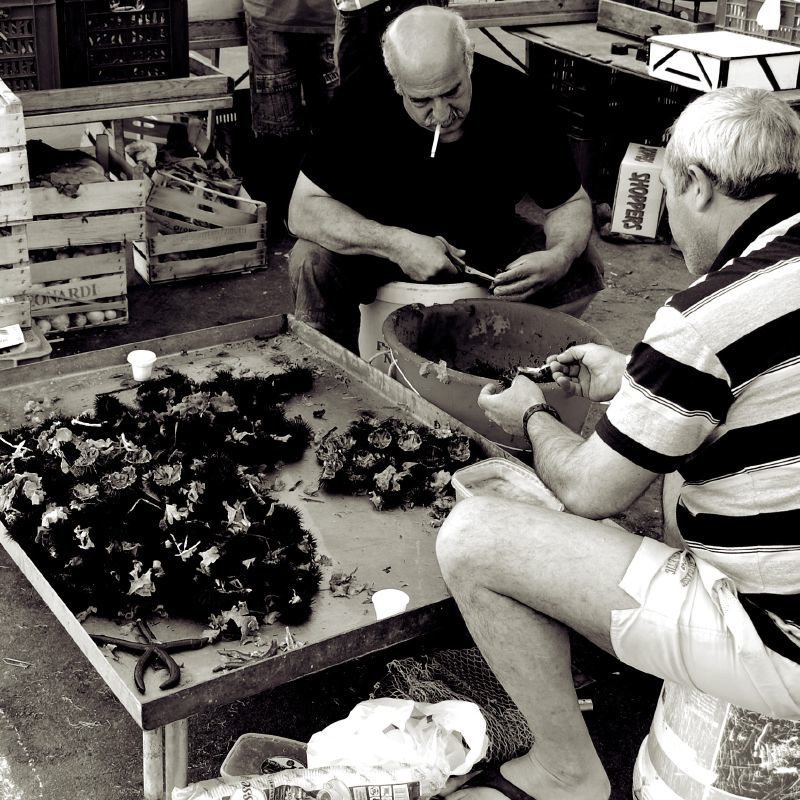
Cleaning ricci in Sicily.

Recipe: Spaghetti with Sea Urchins, Hot Chilies, and White Whine

Maybe you’ve noticed, or maybe not, but it’s sea urchin season again, at least at Citarella (actually has been for more than a month now). They’ve got piles of these beautiful spiky things, trucked down all the way from Maine to Manhattan. I find it quite exciting.

I first tasted ricci, sea urchins, years ago on Mondello beach, a middle-class seaside resort just outside of Palermo, Sicily (where people pronounce the word reetzee). Mondello is full of simple waterside restaurants that serve almost nothing but ricci, mostly raw, where locals  and the occasional tourist get down  into huge platters of the round, spiky creatures, picking out the orange roe with little forks and letting them slither down their throats, often followed with a glass of limoncello. Ricci means hedgehog in Italian, hence hedgehogs of the sea, with their spiny shells.

At most of these places you can also order ricci lightly cooked and tossed with pasta. I love them that way. Just a quick sauté with a few standard Sicilian ingredients produces a miraculous dish. The freshly plucked ricci roe is usually flash-seared in a skillet with olive oil, garlic, white wine, a touch of tomato (or not), and hot chili flakes, and then tossed with very al dente spaghetti. The sweet but slightly bitter taste of the sea urchin, raw or cooked, seems perfect to my taste buds.

The whole fresh ricci I buy from Citarella’s fish counter, covered with two-inch-long dark-green spines, are fished wild in Maine, but sea urchins live in every ocean around the world. California is another big harvester; I’ve seen sea urchins from there with dark red spines. In Palermo the spines were a glistening black, but elsewhere they can be ivory-colored or even a gorgeous lavender, sometimes as long as a porcupine’s quills.

I’ve sampled ricci with pasta several times in Manhattan. The best version so far was served to me at Esca. The ricci was made into a raw, puréed sauce, creamy and rich, that enveloped the bucatini beautifully. For a little crunch and contrast, the dish was topped with a scattering of slivered scallions. Very nice. That was a few years back, so I can’t say if this exact dish is still on the menu, but I’m sure the chef is doing something with sea urchins right now. But forget  about restaurant cooking for a moment. Let’s take a walk on the wild side.

When you bring whole ricci into your kitchen (and I know you will), you’ll need to extract the lovely orange roe by cutting a slice off the urchin’s underside with a sharp knife or kitchen shears (which seem to work better for me), holding the thing with a thick rag or something so you don’t stab yourself.  Once the roe is exposed, you gently lift the pieces out with a small fork. It’s not the hardest thing to do. Pour yourself a glass of wine to get in the mood, and then just have at it.  You’ll realize it’s worth it when you taste this pasta, plus these are absolutely fascinating things to look at, so there’s another bonus in bringing them home.

Spaghetti with Sea Urchins, Hot Chilies, and White Wine

(Serves 2)

Salt
1/3 pound spaghetti
Extra-virgin olive oil
2 garlic cloves, very thinly sliced
About ½ a fresh red peperoncino, minced, with seeds
The tongues (that’s what the pieces of roe are called)  from 8 sea urchins (see above for how to extract them)
A splash of dry white wine
6 canned plum tomatoes, lightly drained and very well chopped
A few sprigs of marjoram, the leaves lightly chopped
A handful of flat leaf parsley leaves, very lightly chopped

Put up a pot of pasta cooking water, and bring it to a boil. Add a generous amount of salt, and then drop in the spaghetti.

In a large skillet, heat about ¼ cup of olive oil over medium high heat. Add the garlic, the peperoncino, and the sea urchin pieces. Sauté for not more than a minute. Season with a little salt, and then add the white wine, letting it bubble for a few seconds. Now add the tomatoes, and sauté for about a minute.

When the spaghetti is al dente, drain it, and add it to the skillet, saving about ½ cup of the pasta cooking water. Sauté quickly, tossing everything around until well mixed. Add a little of the cooking water if it seems dry, and then add a generous drizzle of fresh olive oil and the marjoram and parsley. Correct the seasoning with a little more salt, if needed, and give it another gentle toss. Divide it up into two pasta bowls, and eat it right away.

Read Full Post »

Sarde in Agrodolce

Sardines at the Campo de’ Fiori Market, Madeline Sorel, 1980.

Recipe: Sarde in Agrodolce

I love whole fried fish, especially very little ones, like sardines. They’re excellent pan fried in breadcrumbs and served hot with fresh lemon, or dredged in flour and deep fried. But I also love some of the more elaborate takes on little fried fish. Sicily’s got a few great ones.

If you’ve been following my recipe posts, you’ll know I’ve been on a Sicilian raisin and pine nut roll. It has not abated. While gazing at lovely silver-skinned sardines fresh from Rhode Island at Citarella the other day, I recalled how much I love them made agrodolce, a Sicilian preparation that, wouldn’t you know it, includes raisins and pine nuts.

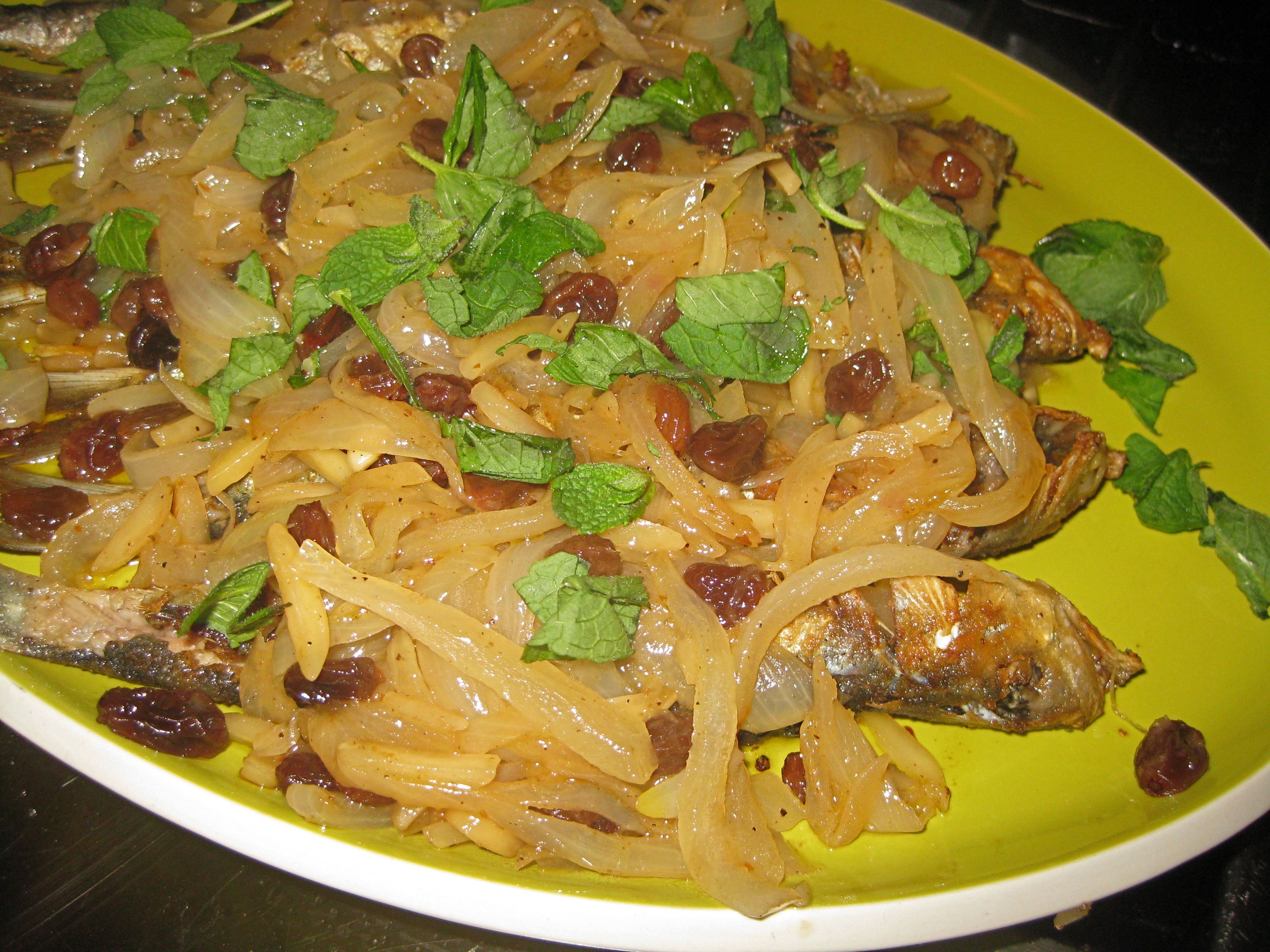
Agrodolce, sweet and sour, mostly means very old, pre-tomato dishes down there. Caponata, made with eggplant, is the one the most people are familiar with. When you make agrodolce with sardines, you sauté a copious amount of onion until sweet and melting. Then you mix it with raisins, pine nuts, wine, a splash of vinegar, fresh herbs, a little honey or sugar, and sometimes capers, too. You pour this rich sauce over the just-fried little fish and then, traditionally, leave it all to marinate for about a day before serving it at room temperature. Marinating makes the dish pungent, the vinegar and the sardines coming to the forefront. I like this intense version. It’s great for an antipasto offering along with maybe a glass of Falanghina, a nice, fresh white from Campania that I’m liking a lot lately. But I’ve come to prefer eating the fish hot, right after cooking, so there’s a more unified balance of sweet and sour, the fish gentle and the onion rather pronounced.

For an herb I’ve chosen spearmint, but basil would work well too. The cumin and allspice are my additions, adding a touch of Renaissance flavor to a dish that probably once had it anyway, since many sweet savory Sicilian foods were laced with spices back then.

You’ll notice that I use Japanese rice vinegar, which is obviously not an Italian product. The reason is that I don’t like a very sharp vinegar taste here. The sharper the vinegar, the more it brings out the strong oils in the sardines, making them fishier. This slightly sweet vinegar blends seamlessly with all the other ingredients, resulting, at least to my palate, in a perfect balance of flavors.

Sarde in Agrodolce

(Serves 2)

Extra virgin olive oil
1 Vidalia onion, thinly sliced
1 tablespoon sugar
½ teaspoon ground cumin
½ teaspoon ground allspice
2 tablespoons Japanese rice vinegar
¼ cup dry white wine
Salt
Freshly ground black pepper
⅓ cup raisins
⅓ cup pine nuts, lightly toasted
½ cup all-purpose flour
6 sardines, scaled and gutted but with the heads and tails left on
A handful of mint leaves, lightly chopped, plus a few whole sprigs for garnish

In a medium skillet, heat 2 tablespoons of olive oil over medium heat. Add the onion, and sauté until it’s starting to soften, about 6 minutes. Add the sugar, cumin, and allspice, and sauté a minute to release their flavors. Add the vinegar, and let it bubble for a few seconds. Add the wine and the raisins, season with a little salt and black pepper, and let simmer until the onion is quite soft and the sauce has a pleasant agrodolce flavor, about another 5 minutes (it shouldn’t be too sweet, so adjust it with a few extra drops of vinegar if necessary; also make sure some liquid, just a few tablespoons, remains throughout the cooking, and if you see the skillet getting dry at any time, just add a little warm water). Turn off the heat, add the pine nuts, and let the sauce sit in the skillet.

Dry the sardines with paper towels. Pour the flour out on a plate, and season it with salt and black pepper.

In a large skillet, heat about 5 tablespoons of olive oil over high heat.

Dredge the sardines in the flour. When the oil is hot, add the sardines to the skillet, and brown well on one side. Flip them over, lower the heat a bit, and brown them on the other side. Depending on their thickness, the cooking should take about 4 minutes.

Reheat the agrodolce sauce, adding the chopped mint.

Lift the fish from the skillet with a slotted spatula, and place it neatly on a serving dish. Pour the hot sauce on top. Garnish with the mint sprigs, and serve right away.

Read Full Post »

« Newer Posts - Older Posts »