Feeds:
Posts
Comments

Archive for the ‘Skinny Guinea’ Category

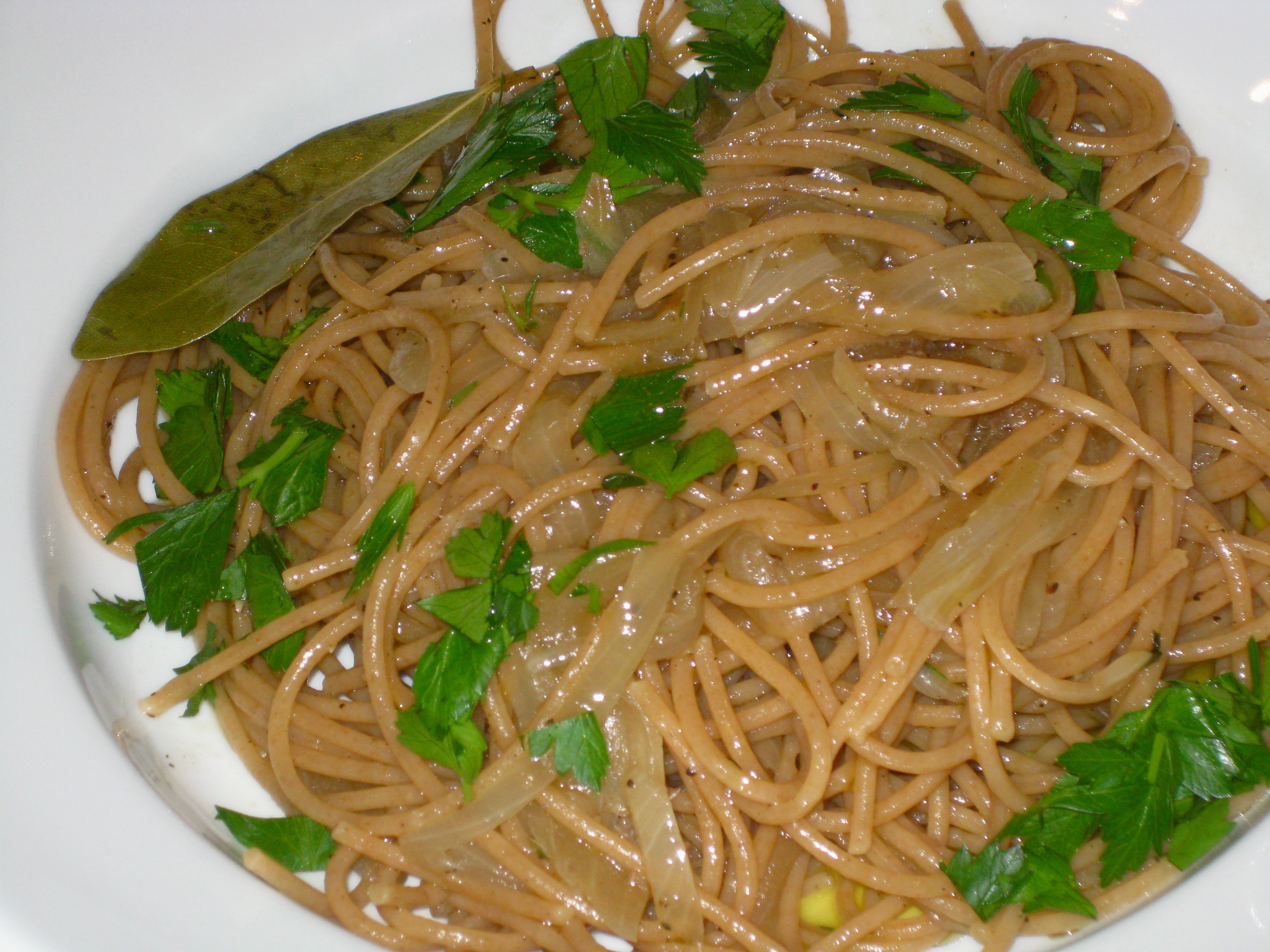
Recipe: Whole Grain Spaghetti with Anchovies, Onions, and White Wine

You know how certain dishes can seem so incredibly intriguing even before you taste them? That was definitely the case for me with this Venetian pasta. Its sauce is made almost exclusively from softened onions and anchovies (or sometimes sardines—salt-packed, not fresh—instead of anchovies). The idea of slow-cooking onions with anchovies just seemed so right. I could imagine the aroma steaming from the pan. I could picture the melting texture of this concoction clinging to the long skinny pasta as I gave it a toss. The dish came out just as I imagined it would. Not so true for all fantasies.

In the Venice region, this absolutely delicious sauce is usually served with buckwheat or whole wheat bigoli, a long pasta with a hollow down the middle, something like a thickish bucatini. It’s such a traditional dish it’s referred to simply as “bigoli in salsa.” To me it is one of the best cold-weather pastas, effortless but with big rewards. Isn’t that what we all ideally want?

I added bay leaf and thyme to achieve a fuller flavor. Some recipes I consulted called for white wine, some didn’t, but  if I can include wine I do, so in it went. It also seemed like a good idea to use Vidalia onions, since they release so much sweetness, a good play against the saltiness of the anchovies. And choose salt-packed anchovies if possible, for the best flavor.

Bigoli pasta is not that easy to find around here, and it’s extremely hard to make at home. A good producer is the Venetian company Borella. I can sometimes find it at Todaro Brothers in Manhattan, but I’ve also seen it for sale on Amazon. I couldn’t manage to procure a bag of bigoli this week, so I used a whole-grain spaghetti by Racconto, a mix of whole wheat, buckwheat, and farro. It was very good, although the texture is different. Bigoli is thicker and a bit softer. But what you definitely want here is a dark, wheaty-tasting long pasta to wrap around the clinging, deeply flavored sauce.

And here’s a little trip to Venice via photos and musica:

Whole Grain Spaghetti with Anchovies, Onions, and White Wine

(Serves 5 as a first course)

Extra-virgin olive oil
3 large sweet onions, such as Vidalia
10 salt packed anchovies, filleted, soaked in water to remove excess salt, and chopped
1 fresh bay leaf
Freshly ground black pepper
½ cup dry white wine
Salt
6 large sprigs of thyme, the leaves chopped
1 pound buckwheat or whole grain bigoli or spaghetti
A handful of flat-leaf parsley leaves, lightly chopped

In a large skillet, heat ⅓ cup of olive oil over medium flame. Add the onions, the anchovies, and the bay leaf. Let sauté until the onions start to soften, about 5 minutes. Add a bit of black pepper and the white wine, and let the wine reduce by half. Now pour in about ½ cup of warm water, cover the skillet, turn the heat down a bit, and simmer until the onions are very soft and the sauce looks somewhat creamy, about 30 minutes.

When the sauce is just about ready, set up a pot of pasta cooking water, add a generous amount of salt, and bring it to a boil. Drop in the spaghetti or bigoli.

Add the thyme to the sauce, and taste for seasoning, adding a little salt if needed.

When the spaghetti or bigoli is al dente, drain it and tip it into a large, warmed serving bowl. Add the sauce, a generous drizzle of fresh olive oil, a few more grindings of black pepper, and the parsley. Give it all a good toss. Serve hot.
Read Full Post »

The Italian Recipe Exchange

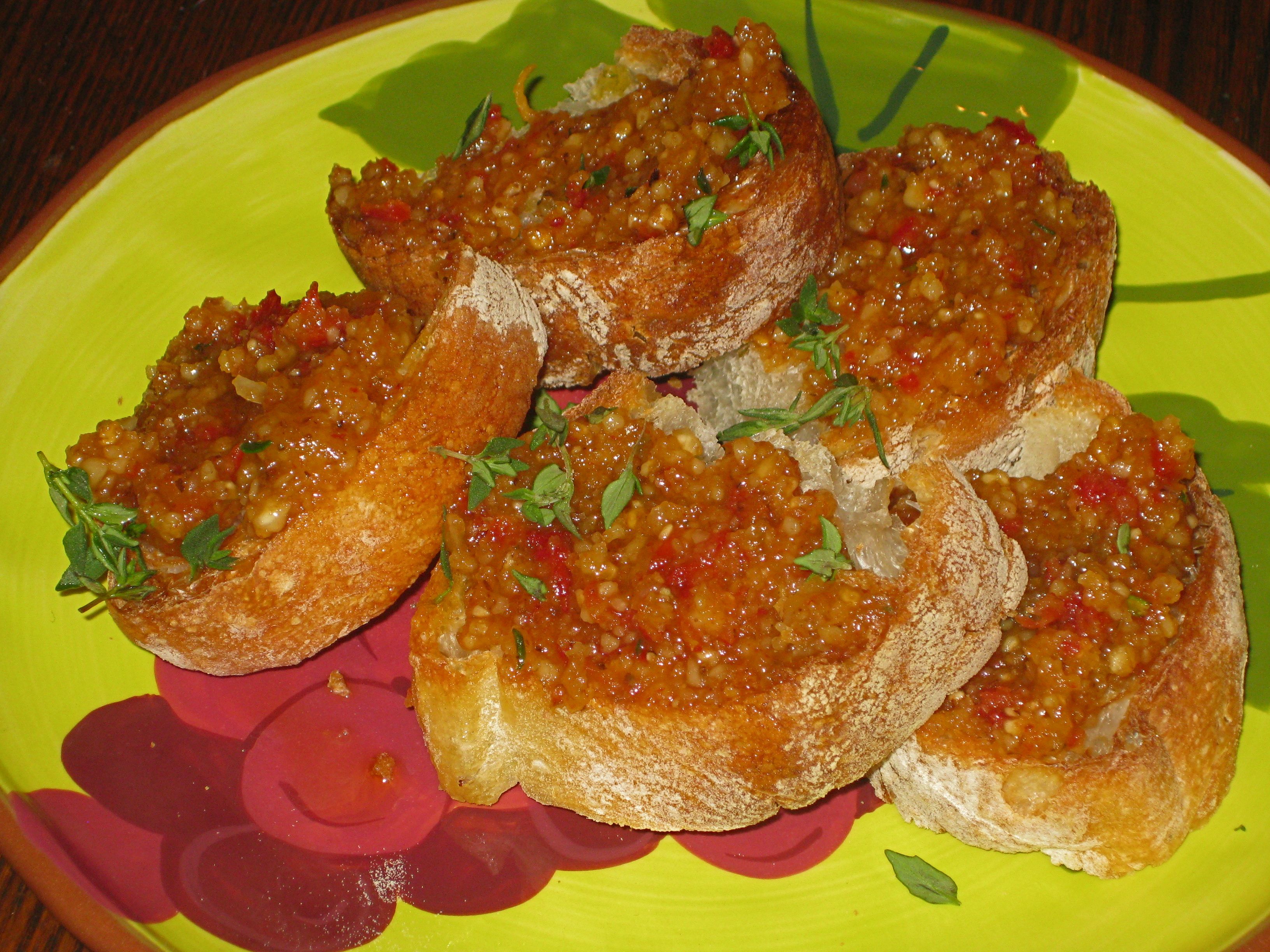
Recipe: Walnut and Roasted Garlic Pesto

Here’s a really delicious recipe I got from Cindy, my hair stylist extraordinaire (go see her at Crown Salon if you want to look gorgeous). In addition to being an expert colorist and hair revamper, she’s also an accomplished and dedicated cook. Routinely she brings little bites of unusual sweet things she’s made, such as chocolate squares flavored with chilies, for her clients to nibble on while they’re in her chair.

This is her interpretation of the walnut pesto served on crostini at Gottino, a wine bar in the West Village in Manhattan that we both like very much. I did a little review of the place when it first opened a couple of years back. The pesto at Gottino, as I recall it, was basically walnuts, a bit of garlic, olive oil, and Parmigiano. Cindy says they also throw in a few sun-dried tomatoes (not sure how I missed that). I make a very simple version, often using instead of the parmigiano a few anchovies. This is great for pasta and spread on crostini, as they do it at Gottino.

Since I concoct my own interpretations of restaurant dishes all the time, it’s always interesting to see how other people taste dishes and then make them their own, and that’s partly what I want these new postings to be about, self expression, whether it’s a restaurant recipe or an old Italian family dish you’ve reconfigured. I say, bring it on.

Cindy’s pesto is more elaborate then the one from Gottino. First off, she roasts the garlic, giving it a rich mellow undertone, and then adds lemon juice and zest for brightness. She goes on to round the whole thing out with fresh thyme and rosemary. It’s a lovely melding of flavors. Her suggestion to toss a little of it into a dish of pasta with spinach seemed right on to me, although I didn’t try it that way. The first night I spread it on crostini, and on night two I decided at the last minute to stir some into chicken sautéed with white wine and shallots. It was really  a lovely addition (and this stuff keeps for about four days, so you can have it ready for impromptu dishes like this one or for an easy appetizer to offer to unexpected drop-ins).

With this Italian recipe exchange, what I try to do is keep the recipe as much as possible in the style written by the cook. Some recipes need more help than others, and I’m happy to tinker or just plain out show someone how to do it. Cindy instinctively knew how to do it. All I did in her case was put the ingredients in the order of use. But even if you send me a “talk it through” style of recipe (the way the great British food writer Elizabeth David wrote many of hers), that’s fine with me.

I love the way Cindy ends the recipe saying, “Taste it, and add more cheese or tomatoes or lemon juice until you like it.” Very good advice and often overlooked.

Here is her note and recipe:

Hey Erica, is this how you do it? Ha!

I often stop into Gottino in the West Village for a lovely glass of Italian wine, and I much enjoy their walnut pesto . . . so I did a variation on my own at home. I enjoy it on a crostini, tossed with pasta and spinach, in an omelette, on pizza . . . let’s just say I ENJOY.

Walnut and Roasted Garlic Pesto

Extra-virgin olive oil
Sun-dried tomatoes (not oil cured), 5 – 8
Walnut halves, 1 – 1½ cups
Garlic, 1 bulb
Fresh lemon, 1
Fresh thyme, 2 – 3 sprigs
Fresh rosemary, 1 – 1½ teaspoon, chopped
Parmigiano Reggiano, 1 – 3 ounces
Coarse sea salt

Place the sun-dried tomatoes in a jar, and cover them with olive oil. Put the lid on. Let it sit out overnight to soften the tomatoes and flavor the oil.

Roast the garlic: I like to peel the cloves, put them on a piece of parchment paper, drizzle them with olive oil and salt, then wrap the parchment into an envelope, then wrap THAT in foil. Then bake at 350 for about 40 minutes, until they are soft.

Zest the lemon, and then squeeze all of the juice out. You’ll need both!

I’m not super perfect with measuring, so maybe Erica can recommend here . . . but I take about 1 to 1½ cups of walnut halves and put them in the food processor. Add 3 – 5 chopped sun-dried tomatoes, the zest of the lemon and about 1 tablespoon of lemon juice, 5 – 6 cloves of roasted garlic, 1 – 2 ounces of Parmigiano Reggiano, and the herbs. Pulse everything, then add the olive oil from the sun-dried tomatoes by mixing in with a fork. Taste it and add more cheese or tomatoes or lemon juice until you like it.

Read Full Post »

Chicken on a White Tablecloth, by Chaim Soutine (1924).

Recipe: Chicken  Braised with Red Wine, Shiitakes, and Juniper Berries

There comes a point each winter, usually in late winter, when I get sick of smelling canned tomatoes. I love them around Christmastime. and they continue to be a gift in the coming cold months, but after I’ve been trapped with them in my kitchen for too long, something about that tinny smell when I open the can, even with really good San Marzano plums, starts to remind me of cafeteria food. That’s when I turn to wine and broth for my sole braisings liquids.

Here’s a version of chicken alla cacciatore, without tomatoes (not so unusual even in Campania), flavored with rosemary (very typical of Campania), and made rich with pancetta, mushrooms, red wine, and home-made chicken stock. There are no sharp edges here. I resisted capers, lemon zest, olives, and other jolting ingredients from my usual Southern Italian bag of tricks. I went easy on the garlic, substituting a mellow, lightly caramelized soffrito of onion and carrot, a sweet touch, and adding juniper berries, a good partner for rosemary, both being piny-tasting elements..

I make this with chicken thighs only, the best part, juicy, tender, really hard to dry out unless you blast them with excessive high heat. I have removed the skin, though not for dietary reasons but simply because even after you brown the skin well, once you get on with the simmering in liquid, the skin will become flabby again and unappealing. So now I flour the skinless thighs, avoiding that problem.

Think making chicken stock is hard? Think again. Do you routinely or even occasionally pick up a preroasted chicken at a supermarket? Keep all the bones (best with snippets of meat and skin still attached), chopping up the carcass into large parts. Put this in a pot with a broken up carrot, a celery stalk if you’ve got one, a piece of an onion or leek, and a few parsley stems. Sauté all this in a little olive oil for a minute or so, then cover the chicken with water. Bring to a boil. Turn down the flame and let it simmer for an hour. Season with a little salt, if you like. Strain and freeze. Very handy. If your takeout chicken has an unpleasant dried herb flavor (many of them are covered with dried rosemary or a mix of stale old herbs), give any remaining skin areas a rinse before sautéing.

And for your viewing pleasure, “The Italian Chicken Dance”.

Chicken Braised with Red Wine, Shiitakes, and Juniper Berries

(Serves 4)

Salt
Freshly ground black pepper
8 chicken thighs, skinned
½ cup all-purpose flour
Extra-virgin olive oil
¼ pound chunk pancetta, cut into small cubes
1 small onion, cut into small dice
1 small carrot, peeled and cut into small dice
1 garlic clove, thinly sliced
3 juniper berries, crushed
4 allspice, ground to a powder
4 sprigs rosemary, the leaves chopped
1 glass dry red wine
1 glass good chicken broth
2 tablespoons unsalted butter
A large handful of shiitake mushrooms, stemmed, small ones left whole, bigger ones cut in half
A splash of grappa
A handful of flat-leaf parsley leaves, lightly chopped

Dry off the chicken thighs, and season them with salt and black pepper. Coat them lightly with flour.

In a large skillet, heat about 3 tablespoons of olive oil. Add the chicken, and brown it well on both sides. Take the chicken from the skillet.

Now add the pancetta, and let it crisp up. Add the onion and carrot, and sauté until they’re softened, about 3 minutes. Add the garlic, juniper berries, allspice, and rosemary, and sauté a minute to release their fragrances. Add the red wine, and let it reduce by half. Add the chicken broth, and bring to a boil.

Put the chicken back in the skillet, turn the heat down, and braise gently, partially covered, until the chicken is just tender, about 20 minutes.

In a small skillet, heat the butter over medium-high flame. Add the mushrooms, seasoning them with a little salt and pepper, and sauté until they’re soft and starting to give off a bit of liquid. Add the grappa, and let it burn off (careful of the flames there). Add the mushrooms, along with any skillet juices, to the chicken, and simmer a minute to blend the flavors. Skim the top of fat if necessary.

Pull the chicken from the skillet, and arrange it on a warmed serving platter. If the sauce seems loose, reduce it over high heat for a minute or so, or if you feel it’s cooked down too much, add a bit more chicken broth.  Check for seasoning,  pour the sauce on top, and scatter on the parsley.

This is really nice served with polenta.

Read Full Post »

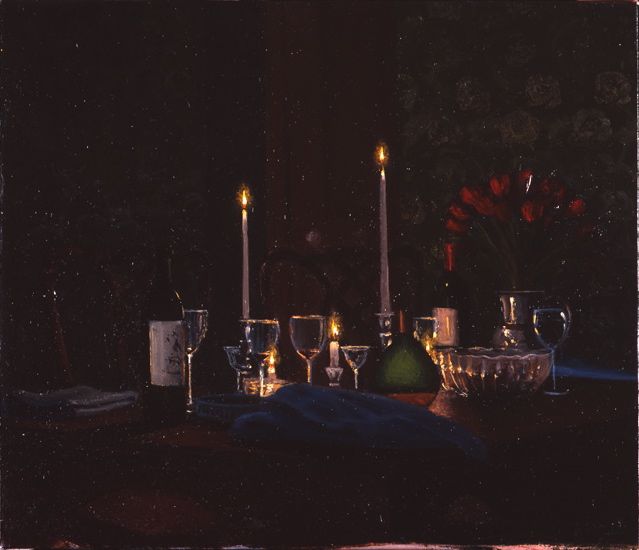
The Dinner Table, by Joseph Keiffer.

The Italian Recipe Exchange

Recipe: Tagliatelle Ragù Bolognese

Here’s the first posting for my new project “The Italian Recipe Exchange,” where you get the chance to send me a recipe you love (please click here to learn how), to share with the world

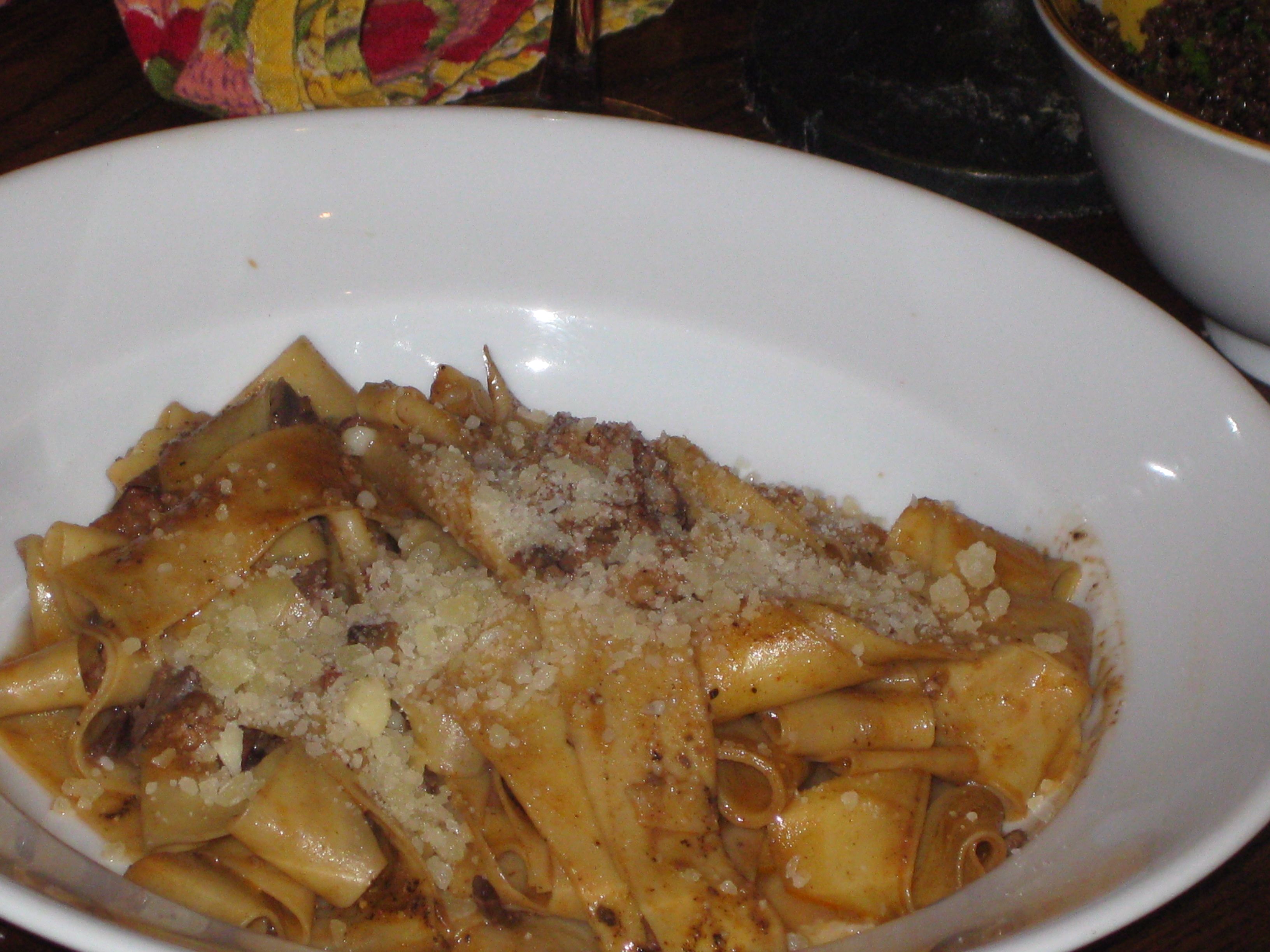
This lovely recipe for a chicken-liver-based ragù was sent to me by Chris, a Facebook friend. I cooked it up last night, invited a few friends over, and had a wonderful Dolcetto- and pasta-filled evening.

The recipe was given to Chris by the chef at Arqua, a restaurant in Tribeca, now unfortunately closed, that we both knew very well. Chris used to live around the corner from it, and I announced my wedding engagement to my parents over a beautiful dinner there. That was in the late 1980s, when the place was hopping but never annoying trendy (though Madonna was there that night). It was an elegant place where you could actually have a conversation.

The ragù turned out quite grand. It’s an opulent dish, for one that cooks so fast (about 40 minutes, as opposed to several hours for most ragù sauces). The key to its success is good ingredients (when aren’t they the key?), so I made sure to purchase free-range chicken livers (no Purdue for this), make my own stock (a mix of chicken and beef), use a glass of the Dolcetto we were drinking as an accompaniment, and have a fine chunk of Parmigiano Reggiano. The recipe says to finish the dish with either lemon zest, something I can never resist, or Parmigiano. Well, I used both, and the flavor was excellent. I didn’t overdo it with the cheese, though. This sauce can stand on its own.

I hope everyone will have a go at this amazingly delicious but easy ragù, and leave comments, especially if you might have something like it in your own repertoire and want to discuss variations or your personal take on it.

The wine I chose to go with it was a Dolcetto D’Alba produced by De Forville. I picked it up from a tiny shop called MCF Rare Wine, Ltd., that just opened on my block. If you happen to live in the West Village or anywhere in downtown Manhattan, do yourself a favor and check it out. The owners only buy from small producers and the stock is always changing. You’ll find bottles there you don’t see anywhere else. Here’s their website: http://mcf-rarewine.com/.

And here’s the note and recipe I received from Chris:

Hi Erica!

This is my all-time favorite recipe for tagliatelle ragu Bolognese, specifically as it is completely unorthodox (according to most recipes, and according to the “official” one). If you make this, your guests will never, ever guess that the sauce is 100% chicken liver. I have served this happily to men, women, and tons of children of all stripe who would faint or worse if they ever knew, and no one, not one person, has ever guessed, asked, or questioned this delicious sauce! The recipe was given to me by the chef at Arqua when I lived around the corner on Hudson Street waaaay back in the day, but I have since seen it in print somewhere. Anyway, this recipe was the chef’s grandmother’s (he from a chicken farm in the region—hence the liver), and I like it because it is very old school. Artusi suggested that the sauce as made centuries ago would contain the “gifts of the chicken,” and this is as close as I’ll come to adding the wattle and etc. Anyway: Mangia bene!

Tagliatelle Ragù Bolognese

Serves 6

2 tablespoons butter
½ cup finely chopped onion
¼ pound pancetta, cut into a fine dice
1 pound chicken livers, trimmed
¾ pound fresh mushrooms
2 tablespoons tomato paste
1 cup dry red wine
2 cups hot beef or veal stock
¾ teaspoon salt
¼ teaspoon pepper
⅛ teaspoon grated nutmeg
½ cup heavy cream
1 pound fresh tagliatelle
1 cup grated Parmesan cheese or 2 tablespoons grated lemon zest

In a large saucepan or flameproof casserole, melt the butter over medium heat. Add the onion and pancetta and cook 3 to 4 minutes, or until the pancetta is lightly browned and the onion is soft.

Add the chicken livers. Increase the heat to medium high, and cook, turning several times, 3 to 4 minutes, or until lightly brown but still pink in the center. Remove the livers with a slotted spoon, and reserve.

Add the mushrooms into the pan, and cook, stirring occasionally, 2 to 3 minutes to brown lightly. Using a slotted spoon, remove the mushrooms to a cutting board with the reserved livers. Chop the livers and mushrooms medium fine. Return them to the pan.

Add the tomato paste, wine, and stock.  Bring to a boil, reduce.

Turn the heat to low, cover, and cook 30 minutes, stirring occasionally. Uncover and boil until the sauce is thick. Stir in salt, pepper, nutmeg, and cream. Simmer 2 minutes.

When the sauce is almost ready, cook the pasta in a large pot of boiling salted water until tender, 2 to 4 minutes; drain. Pour the pasta onto a warmed platter, and pour the sauce over top. Sprinkle with Parmesan cheese or grated lemon zest.

Read Full Post »

Recipe: Farro Penne with Andouille, Cauliflower, and Sage

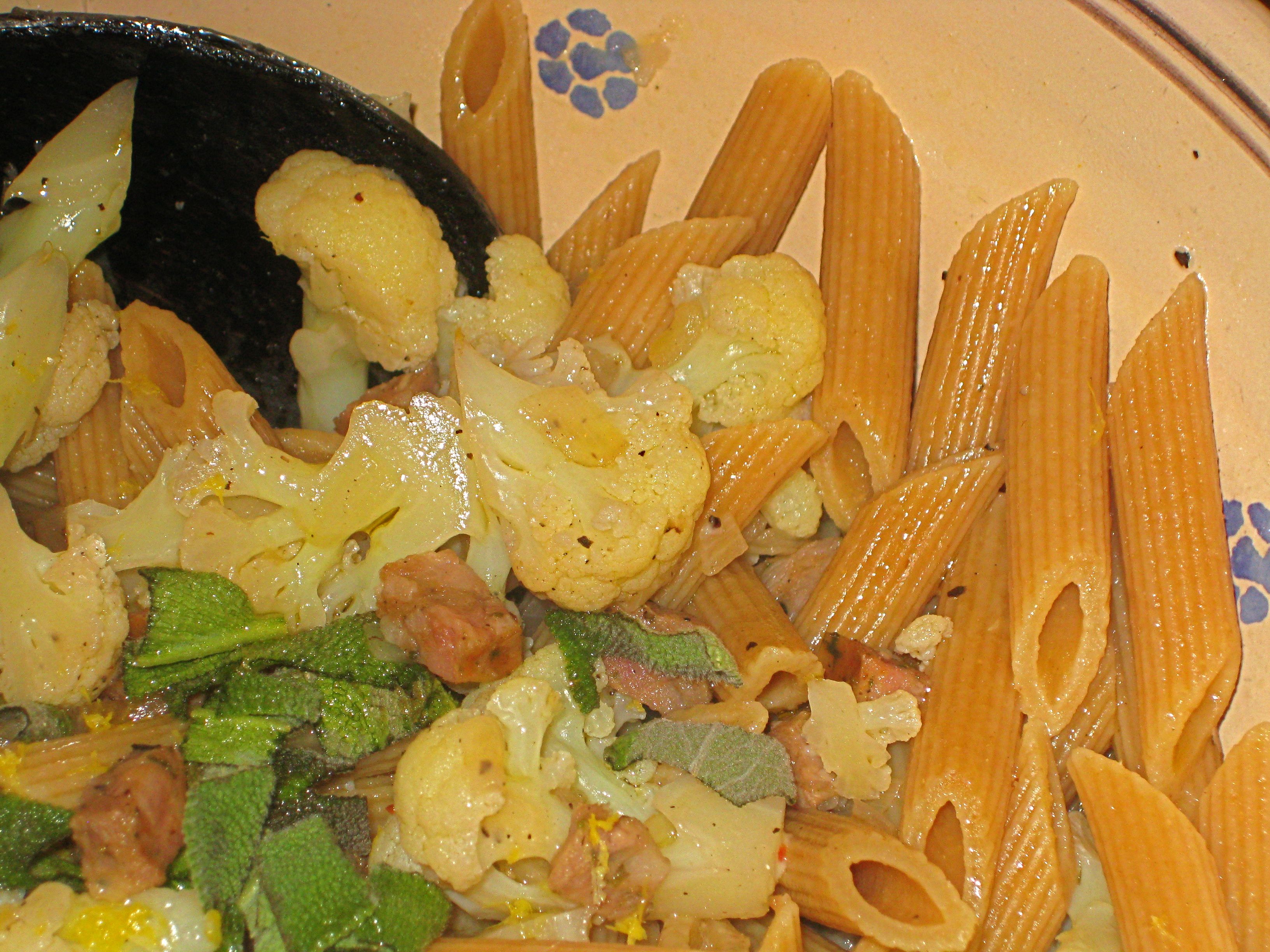
I love andouille sausage, particularly the French type, which is rich, mild, and fatty, not spicy like the Cajun variety or for that matter the Calabrian nduja, which is spicy and spreadable and incidentally most likely got its name from the French sausage many moons ago, when the Bourbons invaded Southern Italy. It’s interesting that the two offshoots evolved into things quite fiery (although just about everything in Calabrian cooking packs some heat). Since the French andouille traditionally has more fat than the Cajun, it’s great for cooking, and it’s a fun change from the more predictable raw Italian pork sausage I usually reach for when I want a pasta-and-sausage dish.

The weather in New York has been a mess of ice, rain, snow, wind, slush, and slop for the past week. Cabin fever and weariness have been making themselves known. The computer screen is burning my eyes. My skin feels tight. A good hearty pasta, one that goes well with nero d’avola, beckons.

What I’m going for here is a strong cauliflower presence. I add a small amount of the andouille, just for flavoring, the way you would pancetta. To my palate, this sausage pairs well with fresh sage, so that became my finishing touch.

Farro Penne with Andouille, Cauliflower, and Sage

(Serves 2 as a main course)

Salt
1 small cauliflower, cut into florettes
½ pound farro penne (Latini is an excellent brand)
Extra-virgin olive oil
1 andouille sausage, cut into small cubes
1 shallot, minced
Salt
Freshly ground black pepper
⅛ teaspoon freshly grated nutmeg
A splash of white wine
½ cup chicken broth
The grated zest from 1 small lemon
6 fresh sage leaves, cut into chiffonade
A small chunk of aged Asiago cheese

Put up a pot of pasta cooking water, and bring it to a boil. Add a generous amount of salt. Add the cauliflower, and blanch for about 2 minutes. Scoop the florettes from the water into a colander, and run cold water over them to stop the cooking. Let them drain, and then spread them out on papers towels to blot up excess liquid (very important if you want them to sauté properly).

Bring the water back to a boil, and add the penne.

In a large skillet, heat about 2 tablespoons of olive oil over medium flame. Add the andouille, and sauté until it starts giving up some of its fat, about 3 or 4 minutes. Add the shallot and the cauliflower, and season with salt, black pepper, and the nutmeg. Sauté for about 2 minutes to coat everything with flavor. Add the white wine, and let it boil out. Add the chicken broth, and simmer for about a minute.

When the penne is al dente, drain it and add it to the skillet, tossing it around to coat everything well.

Pour the pasta into a warmed serving bowl. Add the lemon zest, the sage, a few big gratings of Asiago, and a drizzle of fresh olive oil. Give it a toss. Serve right away, with extra cheese brought to the table.

Read Full Post »


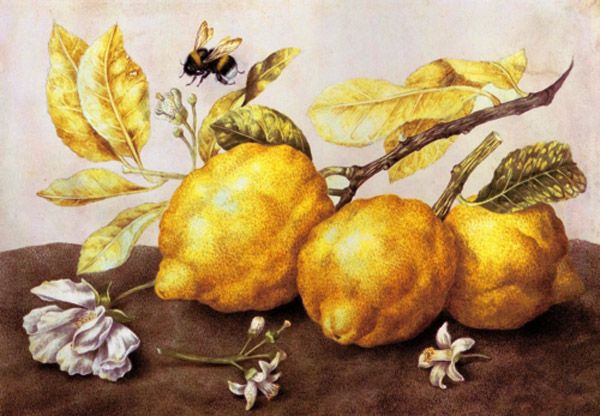
Still Life with Lemons and a Bee, Giovanna Garzoni, 1600-1670.

Recipe: Linguine with Lemon Zest, Olive Oil, and Black Pepper

C’era una volta in the 1980s, you couldn’t go to Rome without encountering a pasta made with lemon zest, tons of cream, and Parmigiano Reggiano. As fragrant and unusual as this dish was, for me, a little went a long way, and after eating it several times, I realized I didn’t like it anymore. I’m never crazy about cream in pasta, so even with all the lemoniness, it became for me a gagger.

But looking through my friend Natalia Ravidà’s book Seasons of Sicily, a personal collection of family recipes, I came upon a lemon pasta made with olive oil instead of cream. Now we’re cooking with gas, I thought. I made the dish her way and didn’t get enough lemon flavor and immediately understood the problem; she was working with Sicilian lemons, which have intense oily skin. One big Sicilian lemon seems to be about equivalent in strength to  three or four of ours, so I had to do some tinkering to make this New York–friendly, including adding lemon juice to boost the flavor and throwing in toasted almonds for texture (almond and lemon are a time-honored Sicilian combination I can never resist). I used organic lemons, which aren’t coated with wax or sprayed, which is something to consider when you’re using mainly the zest. The black pepper is a key to the success of this pasta, deepening the lemon taste and making the whole more savory and full.

The ingredient that makes this perfect winter dish possible is olive oil. It disperses and releases the essence of the lemon zest to coat every stand of pasta with fragrance. Use the best you’ve got. My choice would be Natalia’s family oil, Ravidà.

And for your lemon-scented listening pleasure, here’s Paolo Conte:

Linguine with Lemon Zest, Olive Oil, and Black Pepper

(Serves 6 as a first course)

4 large organic lemons
A pinch of sugar
Salt
Extra-virgin olive oil
A few big scrapings of nutmeg
1 pound linguine or spaghetti
Freshly ground black pepper
A handful of flat leaf parsley, the leaves lightly chopped
A small chunk of Parmigiano Reggiano cheese
A big handful of blanched almonds, toasted and well chopped

Zest the lemon, being careful not to pull up any of the bitter white pith. Pour about ⅓ cup of olive oil into a warmed pasta serving bowl, and add the lemon zest and nutmeg, and squeeze in about a tablespoon of lemon juice. Add the sugar and a little salt (just a touch). Let sit for about 30 minutes or so, to develop flavor.

Set up a pot of pasta cooking water, and bring it to a boil. Add a generous amount of salt.

Drop in the linguine.

When the linguine is al dente, drain it, saving about ½ cup of the cooking water.

Add the linguine to the serving bowl, and give it a good toss. Add a few tablespoons of the cooking water, a generous amount of freshly ground black pepper, the parsley, and about 3 tablespoons of grated Parmigiano.  Toss again, adding a little more cooking water if necessary to loosen the sauce. Garnish with the toasted almonds. Serve right away.

Read Full Post »

« Newer Posts