Feeds:
Posts
Comments

Archive for the ‘2009’ Category

Recipe: Rigatoni with Mushrooms, Anchovies, and Toasted Walnuts

For me a huge bonus of cooking pasta in the winter is all the warming steam it produces in my little kitchen. I love putting up the big pot, letting it slowly come to a boil, throwing in salt when it does, and watching how the salt makes the water surface fizzle a bit, then flatten out, then quickly come back to a big boil. Then I tilt in an open box of rigatoni, which makes the boil go still, but I wait a few seconds and it rushes back again to a hard boil, and all is well. The windows steam up, my hair frizzes up. I’m enveloped in warmth.

But the best is yet to come. The best is when I set up a large colander and pour the al dente pasta along with all the accompanying white steam and scorching water into it, momentarily blinding my view of anything but steam. This is the world’s best facial. Actually it probably isn’t, since no doubt all it does is force little bits of sticky starch into my pores, but it does feel soft on my face and neck.

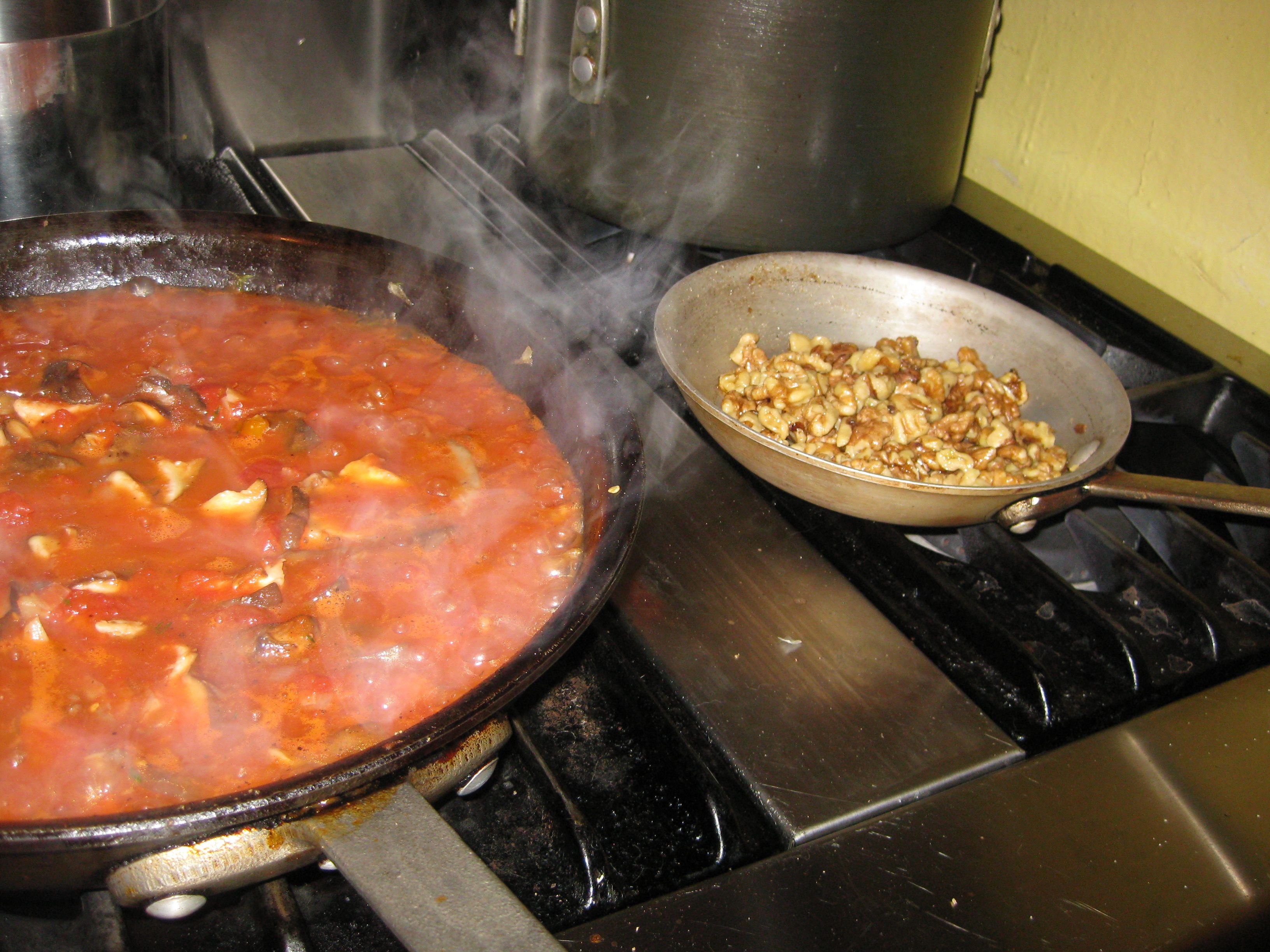
The pasta is still steaming gently as I pour it into a warmed serving bowl and drizzle it with fresh olive oil. Now there’s an amazing smell—warm wheat, sharp oil. On goes a steaming hot sauce, this time my winter concoction of sautéed mushrooms, tomatoes, anchovies, and toasted walnuts. Now my face is steaming with the essences of garlic, fresh thyme, and parsley. A grating of pecorino Toscano immediately melts on top, and off I go out of the greenhouse with my steaming bowl, and out to the dinner table. Happy winter cooking.

Rigatoni with Mushrooms, Anchovies, and Toasted Walnuts

(Serves four as a main course or six as a first course)

Extra-virgin olive oil
1 cup very fresh walnut halves
Salt
Black pepper
A generous pinch of sugar
2 shallots, minced
2 garlic cloves, thinly sliced
1 fresh medium-hot red chili, minced (I used a red Jalapeño)
5 large thyme sprigs, the leaves chopped
4 anchovy fillets, chopped
2 cups sliced mushrooms (I used a mix of shiitake, oyster, and cremini, plus a small bag of dried chanterelles I soaked in hot water)
A splash of dry vermouth
1 35-ounce can Italian plum tomatoes, chopped, with the juice
1 pound rigatoni
A big handful of flat-leaf parsley leaves, lightly chopped
A chunk of pecorino Toscana cheese for grating

In a medium sauté pan, heat a tablespoon of olive oil over medium heat. Add the walnuts, seasoning them with salt, black pepper, and the sugar, and sauté quickly just until they turn golden and release a nice aroma, about 3 minutes. Set aside.

Set up a large pot of pasta cooking water and bring it to a boil. Add a generous amount of salt.

In a large sauté pan, heat 2 tablespoons of olive oil over medium flame. Add the shallots, and sauté until soft. Add the garlic, the hot chili, the thyme, and the anchovies, and sauté for a minute to release their flavors. Add all the mushrooms, and sauté until they’re starting to soften, about 4 minutes or so. Now season them with salt, and add the dry vermouth, and let it bubble for a minute. Add the tomatoes with their juice, and cook, uncovered, at a lively bubble for 8 minutes. Add the walnuts to the sauce, and stir them in.

Cook the rigatoni al dente, and then drain it, saving a little of the cooking water. Add the rigatoni to a large serving bowl, and drizzle on a little fresh olive oil. Give it a toss. Pour on the mushroom sauce, add the parsley, and toss. Add a little of the pasta cooking water to loosen the sauce, if needed. Serve with grated pecorino Toscano.
Read Full Post »

Holiday Chestnuts


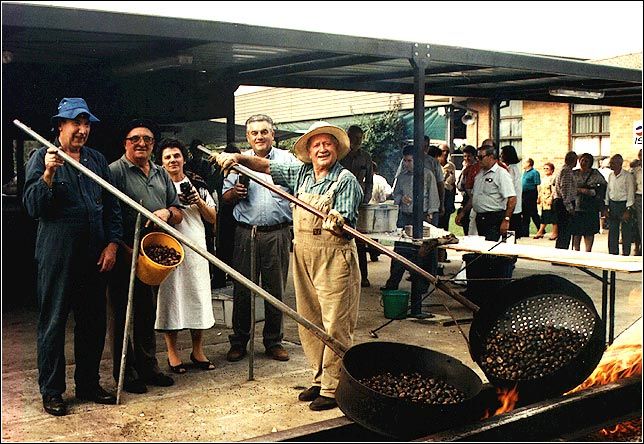
Chestnuts roasting on an open fire in Italia.

Recipe: Roasted Chestnuts

The smells of Manhattan, some good, some disgusting, seem never to leave my head. No matter from how long ago, I don’t forget them. I miss the early morning blood stench of the meatpacking area when I walked to my job at Restaurant Florent. I miss the sour vodka and orange juice smell outside of CBGB’s at 5 a.m. Some smells I was never sure exactly where they came from but I don’t seem to smell anymore. Steam for instance. There doesn’t seem to be much steam coming out of the streets these days. Printing ink? I used to smell printing ink every so often on various corners, especially down in the West Village where Superior Printing Ink had its factory.

Winter smells always strike me as more interesting than summer ones, which tend toward putrid rot and fresh poop. Dried leaves are an aroma of pure beauty. Filthy snow smells divine. A smell I really miss, one that I haven’t smelled on the streets in I don’t know how many years, maybe 15, most likely longer, is hot roasted chestnuts on a cold day. I loved them. I bought them a lot. Hot, burned chestnuts in a bag. We’d eat them on the freezing cold street. It felt very nineteenth-century. Just putting the bag in your pocket made your hands really warm (or at least one of them). Often the same trucks that sold big soft pretzels also sold chestnuts. Now they sell only the pretzels, which aren’t really that interesting, although they do have sort of a good smell. As far as I can tell, there are no more chestnut vendors in Manhattan. Just possibly there was a guy on Fifth Avenue in Midtown until a few years ago, but I don’t get up there much and I may have missed him.


Chestnuts roasted in my oven.

Roasted chestnuts are eaten in Italy to celebrate the new young wine, the novello, sort of like Beaujolais Noveau. It’s not my favorite wine in the world, but when you sip a little and bite into a hot oven-roasted chestnut, you’ll understand the ceremony. My family roasted chestnuts for Thanksgiving. It was a major project, but worth a few sliced fingers to get the job done. To do it, you need to . . .

Roasted Chestnuts

. . . Preheat your oven to about 400 degrees. Choose chestnuts that feel firm in their shells, not light and shrunken (which means they’ve dried out).  Then with a sharp little knife cut a cross into the flat side of each chestnut (Italians love to cut crosses into lots of things).  Be careful when you cut into them, as the knife can slip if you’re not concentrating or if you’re already drunk. Then spread them out on a sheet pan, and roast them until they smell sweet and start to open up, usually about 12 to 15 minutes. You may taste one to see if it’s tender. They need to be eaten really hot or else they become hard to peel, so pile them into a cloth-lined basket, set out a few bottles of Chianti, and go for it.  If this were all I could have for Thanksgiving, I’d be happy. I’m not kidding.

Read Full Post »

Thanksgiving Pears

Recipe: Pears Poached in Marsala with Cinnamon and Pistachios

I don’t really like mushy foods, things like mashed potatoes, mashed yams, smooth purées mixed with butter, or even things like turnips that can be prepared partly lumpy, partly smooth (smashed, as Rachael Ray would call it). That is the main reason I don’t like Thanksgiving all that much. My ideal Thanksgiving dinner would have really crisp turkey skin but none of the meat (it has occurred to me that really crisp turkey skin rolled around a prune would make a great Thanksgiving appetizer, at least at my table). Aside from the turkey skin, I’d like to have rosemary-scented gravy; broccoli rabe with pine nuts, pancetta, and garlic; roasted chestnuts; lots of brunello wine; an arugula salad with a nice piece of mountain gorgonzola; and, to conclude, pears poached in Marsala with cinnamon and pistachios. If only holidays could be that simple and that perfect (in my dreams).

And speaking of alternate Thanksgiving meals, if you’d like  a more sensibly  considered  Italian-inspired menu,  take a look at Marco Canora’s offering in the November issue of La Cucina Italiana. He’s got a turkey roasted with sage, orange, and garlic,  a roasted fennel soup with hazelnuts that looks amazing, a butternut squash risotto with mostarda di Cremona, broccoli rabe with garlic (ha—great minds think alike), a  pignoli tart, and a few other gorgeous side dishes created with a passionate Italian mindset. You can find the entire menu along with beautiful photos at Lacucinaitalianamagazine.com.

Pears Poached in Marsala and Cinnamon with Pistachios

(Serves 6)

6 firm pears, peeled but with the stems left on
A cup of dry Marsala
About ¼ cup rum
½ teaspoon good vanilla extract
½ a cinnamon stick
2 long strips of lemon peel
¾ cup sugar
½ cup shelled, unsalted whole pistachios

Cut a thin slice from the bottom of each pear so it will sit up straight in a dish. Then, excavating up from the bottom, pull out the core with an apple corer. (Don’t go so far as to make a hole in the top, though. This step isn’t absolutely necessary, but it does make it easier to eat.)

Place the pears in a wide pot so they lie down flat. Pour in the Marsala, the rum, and the vanilla extract, and add the cinnamon stick, lemon peel, and sugar. Add water to just cover the pears. Bring to a boil over high heat. Then turn the heat to low, partially cover the pot, and simmer until the pears are tender when poked through, about 20 to 30 minutes, depending on the ripeness of the pears. You’ll want to turn them every once in a while so they color evenly.

Lift the pears from the pot with a large strainer spoon, and place them upright in a large serving dish with sides. Boil down the liquid over high heat until you have a medium thick syrup (when the surface looks glossy and large bubbles start forming all over). Let the syrup cool, and then pour it over the pears. Top with a sprinkling of pistachios.

Read Full Post »

ann with goat
Miss Magnani, my muse, with a lovely goat friend.

Recipe: Frisée Salad with Pomegranate Seeds, Pine Nuts, Sautéed Shallots, and Goat Cheese

I had a dream last night where my front teeth were falling out. That’s a classic, isn’t it? But before they actually fell out they shrank and darkened. In fact, they turned into pine nuts.

Variations on missing teeth dreams are now more unsettling for me than the old classic nightmare of my youth where I was caught walking past Bergdorf Goodman or somewhere equivalent with no pants on (somehow that was much more upsetting that being completely nude,  having just your weenie and butt exposed). Now it’s the horror of missing teeth. Time  marches on.

When I recovered from my dream I remembered I actually had a container of those evil pine nuts in my pantry. I had a pomegranate too, one with really deep red, sweet seeds. I used them both in this wintry salad, figuring the pomegranate would balance out any bad vibes the pine nuts might contribute. It was a delicious salad despite its traumatic birth.

pom

Frisée Salad with Pomegranate Seeds, Pine Nuts, Sautéed Shallots, and Goat Cheese

(Serves 2)

1 head frisée lettuce, torn into pieces
About a half a cup of fresh pomegranate seeds
A handful of pine nuts, lightly toasted
Extra-virgin olive oil
1 large shallot, thinly sliced
A few large sprigs of thyme
Salt
Freshly ground black pepper
½ teaspoon balsamic vinegar
½ teaspoon Spanish sherry vinegar
About a half a cup of crumbled young goat cheese (I used an Italian Caprino)

Place the frisée, the pomegranate seeds, and the pine nuts in a salad bowl.

In a small sauté pan, heat about a tablespoon of olive oil over medium heat. Add the shallot, and sauté until lightly golden. Sprinkle on the thyme, and season lightly with salt. Add all this to the salad bowl.

In a small bowl, whisk together the balsamic and sherry vinegars and about 1½ tablespoons of olive oil. Season with salt and black pepper. Pour this over the salad, and toss lightly.  Scatter on the goat cheese. Serve right away.

(You may have noticed that in my photo of the salad there are torn bits of stale bread thrown in. I like that for crunch, but it’s an inelegant presentation. You can, if you wish, include neatly cut toasted croutons, or just serve good Italian bread on the side).

Read Full Post »

muse
Anna Magnani, my  brooding muse.

Recipe: Penne with Brussels Sprouts, Pancetta, and Lemon

Anna Magnani is speaking to me again. She wasn’t for a while, and boy did that make me anxious. I think she was jealous of my relationship with La Saraghina. But things seem to have settled, and she’s again giving out much needed advice and being a good if somewhat haughty friend. She just told me I wasn’t eating enough pasta.  She knew that. It’s absolutely true. I was trying to knock off a little butt fat. Anna doesn’t approve of knocking off butt fat. She says it goes against my ancient responsibility.

So tonight I decided to follow her instructions and cook pasta with stuff I had on hand (you don’t need to shop, she told me; you need to go to your pantry).  Well, that can sometimes produce great pastas, but what I had on hand happened to be a bag of Brussels sprouts and a hunk of pancetta. That didn’t seem too promising, but she was right. I didn’t need to walk the entire half block to the grocery store to pick up more suitable ingredients. I winged it.

There’s only so much you can do with Brussels sprouts. Boil them up whole, making your kitchen smell like a Porta-Potty, or so I thought. But when I held a buxom Brussels sprout up to a piece of penne,  the only pasta I had an entire bag of, I realized something had to give. I decided the best way to go was to slice my Brussels sprouts thin, and sauté them raw. I used the pancetta, quite a lot actually, since I can’t really fathom eating a Brussels sprout without some kind of pork fat. I added white wine and lemon zest, just to balance all that deep cabbage-ness. And the dish was a success. Thank you Anna again, for your inspiration. And don’t go away for too long, ever again. My muse.

brussels sprout pasta

Penne with Brussels Sprouts, Pancetta, and Lemon

(Serves 6 as a first course or 4 as a main course)

Extra-virgin olive oil
1  ¼-inch-thick round of pancetta, cut into small dice
1 large shallot, minced
2 garlic cloves, thinly sliced
20 Brussels sprouts, trimmed and very thinly sliced
Salt
Freshly ground black pepper
¼ cup dry white wine
¼ teaspoon ground allspice
½ cup chicken broth
1 pound penne pasta
The juice and grated zest from 1 small lemon
Grated pecorino Toscano cheese

In a large skillet, heat 3 tablespoons of olive oil over medium flame. Add the pancetta, and let it get crisp. Then add the shallots, garlic, and sliced Brussels sprouts, seasoning them with salt, black pepper, and the allspice. Sauté until the Brussels sprouts are starting to soften, about 4 minutes. Add the white wine, and let it bubble away. Add the chicken broth, and continue cooking, uncovered, until the slices are just tender to the bite, about 4 minutes longer. Add the lemon juice and zest, and give it a stir.

Cook the penne al dente, and drain, saving a little of the cooking water. Transfer the penne to a warmed serving bowl. Give it a generous drizzle of fresh olive oil, and toss. Pour on the Brussels sprouts sauce. Add a heaping tablespoon of grated pecorino Toscano, and toss again. Add a little cooking water, if needed to loosen everything. Serve hot, with extra pecorino brought to the table.

Read Full Post »

Neapolitan Potato Gattò

mortadella_21
I’d sure love to have one of these nice red mortadella trucks. Italians do understand high style.

Recipe: Neapolitan Potato Gattò

If you’re looking for something really rich, really Neapolitan-tasting, and really calorie-packed, this gattò is it. It’s like a pizza rustica, but made with mashed potatoes instead of ricotta, and much, much easier, since there’s no crust, just a nice coating of breadcrumbs to cradle its soft insides.

Most people don’t associate potatoes with Southern Italian cooking, since pasta rules down there, but Puglia, Calabria, Basilicata, and Campania all have their cucina povera potato creations, some, like this gattò, much less povera than others. Anything filled with meat, cheese, and eggs is a rich man’s dish by typical Southern Italian standards, but this dish is often fashioned with odds and ends—leftover slivers of various cheeses, often including some smoked mozzarella, salami ends, fatty prosciutto chunks. I happened to have a thick slice of mortadella in the refrigerator, so that became the guiding theme for this particular gattò.

Often I layer a gattò, putting down half of my potato mixture and then a thick layer of mozzarella or caciocavallo, or sometimes a layer of crumbled sausage. This version is a lazy version, where I just tossed all the ingredients together and patted them into a well-buttered and -crumbed baking dish.

The name gattò derives from the French gateau, and the dish was no doubt invented, or at least named, in the late nineteenth century, when Southern Italian nobility were in love with all things French, even importing French chefs or sending their local ones to train in France and earn the title “monzu,” a Neapolitan pronunciation of monsieur.

Potatoes highbrow or lowbrow, when mixed with traditional Southern Italian flavorings like sausage, mozzarella, artichokes, or anchovies, produce some really fine, solid offerings. This gattò is one of my favorites. It’s meant to be a first course or a side dish, but I prefer serving it more as you would a quiche, with a side of green salad. Try it for brunch. You can easily double the recipe, or even triple it, if you’d like to serve a small Neapolitan army.

gatto' di patate_edited

Neapolitan Potato Gatto

(Serves 6)

Salt
3 pounds all-purpose potatoes, peeled
1½ cups grated grana Padano cheese
5 tablespoons butter
¼ pounds mortadella, cut into very small cubes
½ pound caciocavallo cheese, cut into small cubes (if you can find Sicilian Ragusano, that will be the best)
1 garlic clove, minced
2 large eggs
⅓ cup milk
A few large sprigs of Italian parsley, the leaves chopped
4 sprigs of marjoram, the leaves chopped
A few big scrapings of nutmeg
Freshly ground black pepper
¾ cups dry breadcrumbs, not too finely ground
Extra-virgin olive oil

Boil the potatoes in abundant salted water until they’re very tender, and then put them through a potato ricer (a food processor will make them gummy).

Preheat the oven to 425 degrees.

Add the grana, 3 tablespoons of the butter, the mortadella, caciocavallo, eggs, milk, nutmeg, garlic, parsley, marjoram, black pepper, and a little more salt to the potatoes, and mix just well enough to distribute everything evenly.

Use a tablespoon of the butter to coat a 10-inch round pie pan or cake pan, and then coat the pan with about ¾ of the breadcrumbs.

Add the potato mixture to the pan, and smooth it down. Decorate the top by making a pattern with the tines of a fork (Southern Italians love to decorate with the tines of a fork). Sprinkle with the remaining breadcrumbs, dot with the last tablespoon of butter, and drizzle with olive oil.

Bake, uncovered, until the top is browned, about 20 minutes

Serve warm, cut into wedges.

Read Full Post »

Women with Fish

Slattery-Woman-with-Fish
A woman lying down with a fish.  Artist unknown.

To see other women with fish, click here.

Read Full Post »

Quickie Porchetta

Mountain-Porchetta-Jun04-D3478sAR
A porchetta sandwich truck in the Abruzzi, just opening for business.

From time to time I stop into Porchetta, a little caffè in the East Village, especially in cooler weather, for their (what else?) porchetta. In my opinion porchetta is the best Italian street food there is, not counting the spleen and ricotta sandwiches from Palermo that I love so much. The East Village version of porchetta is not exactly the same as in Italy, where it’s usually distributed in trucks fitted with wood-burning ovens. Those rather plain white trucks  wheel up to religious festivals and outdoor markets, where people line up for the hot, greasy, herby, salty pork sandwiches, with crackling fat and soft, pully meat. The real Italian thing is usually made from a whole roasted hog, or a boned and rolled shoulder cut, or fresh ham with the skin left on.

Porchetta the caffè doesn’t have a wood-burning oven, and they make their porchetta with a boned pork loin wrapped in pork belly instead of the tougher shoulder cut. But they use all the traditional seasonings, which include fennel seeds (and, I believe, wild fennel pollen too), rosemary, thyme, sage, garlic, red wine (I think), and lots of salt and black pepper. A real Italian porchetta is slow-roasted until the fat is crisp and the color of shellac and the meat is falling-off-the-bone tender. The porchetta at Porchetta, being a tender cut of meat to begin with, doesn’t need hours of roasting. They roast it just until it’s perfectly tender, so it remains very juicy and the pork belly turns to fatty crackling. All in all, it’s an amazing accomplishment for a compromise. So if you want a great porchetta sandwich (or porchetta plate with salad and vegetables) you really should stop by there.The aroma from the front door will draw you right in anyway. You won’t be able to resist. They’re at 110 East 7th Street.

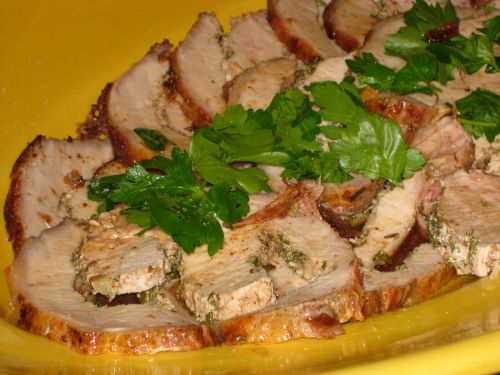
Since my return visit to Porchetta, I’ve been attempting to create my own version of this Italian roast in my own kitchen. I think it finally came out really nice. I certainly got the aroma down. Instead of the pork belly the caffè uses, I chose to wrap my pork loin in pancetta. I butterflied the pork loin and then made a paste out of fennel seeds, black pepper, and all the usual herbs plus vino and olio. I added juniper berries and just a touch of smoked pimenton to capture a subtle woodsy taste, but not so much that it tastes like liquid smoke. The result is less stringy and less fatty than the Italian version but more tender, which is what you’re going to get with a pork loin. But I really love the flavor. I like serving it sliced over a chicory or frisée salad dressed with olive oil and lemon juice.

my porchetta

Quickie Porchetta

(Serves 6)

1 approximately 2½-pound boneless pork loin with the fat left on, butterflied (if you don’t know how to buterfly it, you can ask your butcher to do it for you)
2 teaspoons fennel seeds
1½ teaspoons black peppercorns
4 juniper berries
4 garlic cloves, peeled
8 large sprigs rosemary
12 sage leaves
A branch of thyme
Salt
¼ teaspoon smoked Spanish pimenton (smoked red paprika)
Extra-virgin olive oil
¼ cup dry red wine
¼ pound pancetta, very thinly sliced

Place the fennel seeds, peppercorns, and juniper berries in a mortar and pestle (or a spice grinder), and grind roughly. Transfer to a small bowl.

Slice the garlic cloves very thinly. Stem all the herbs, and give the leaves a rough chop. Add the garlic and herbs to the ground spices. Add a good amount of salt, the smoked pimenton, about 3 tablespoons of olive oil, and the red wine. Mix everything well.

Lay the pork out flat, fat side down. Spread the herb and spice mixture all over the meat, saving some to rub over the outside.

Roll up the pork. Lay the pancetta slices over the roll, and tie it up with kitchen string in about 5 rings. Rub the remaining spice and herb mix over the pork. Cover it with plastic wrap, and let it marinate in the refrigerator for about 3 hours (or overnight). Take the pork from the refrigerator about an hour before you plan to cook it.

Preheat the oven to 350 degrees.

Choose a large ovenproof sauté pan or low-sided casserole big enough to hold the pork. Turn the heat to medium high. When the pan is hot, put the pork in it, and brown the pork well all around, seasoning it with a bit of extra salt as you turn it.

Transfer the pork to the oven, and roast it until it’s just tender, about 35 to 40 minutes or so. Check the temperature with a meat thermometer. You want it to be 130 to 135 degrees at the center.

Take the pork from the oven, and let it rest for about 15 minutes before slicing.  To make a little pan sauce, pour off about half  of the fat from the pan. Add a big  splash of red wine, and boil it for a few moments. Strain and pour this over the pork slices. Serve hot or warm.

Read Full Post »

F_vitti2
How can I be an old Italian hag, when I still look like this?

Recipe: Broccoli Rabe, Anchovy, and Ricotta Bruschetta

I’ve been eating so much broccoli rabe lately, I fear I may turn into a bitter old Italian hag. But I’m probably one already, so I might as well just continue to stuff myself. Seriously, I think what’s happening here is a yearning for cooked greens as I flip my food switch toward winter and away from cool salads.

It’s a mystery to me why anyone wouldn’t love broccoli rabe. It has a depth of flavor that creates an opulent mouth feel, especially when soaked in olive oil, which is really the only way to go. There’s no green better with pasta, and it blends so naturally with the many pork products like pancetta, salami, prosciutto, and capacolla that should be a staple of everyone’s diet, how can anyone resist? Lately, though, I’m liking my broccoli rabe with anchovy instead of pancetta. A wonderful dinner is a big bowl of broccoli rabe laced with anchovy, garlic, and chili, with a big glass of red wine and a big piece of toasted Italian bread. I’m not sure I would serve that for fancy company; they might think I didn’t like them. But when I’m alone and listening to Domenico Modugno sing his creation “Nel Blu Dipinto Di Blu” (aka “Volare”) in his charming light smoker’s voice, it’s the best, a bittersweet mix of great food and light opera.  The broccoli rabe has got to be very oily, steaming hot, and very garlicky. It’s what my mother would call a family meal. If  by any chance you’re having fancy company, try this bruschetta instead. It’s still drippy enough, but at least it’s got some formal structure to it.

broccoli rabe

Broccoli Rabe, Anchovy, and Ricotta Bruschetta

(Serves 8 as a first course or an antipasto offering)

2 bunches broccoli rabe, well stemmed
Salt
Extra-virgin olive oil
3 garlic cloves, thinly sliced
1 fresh, hot chili, minced
4 anchovies, minced
A pinch of ground cumin
A pinch of ground allspice
¼ cup dry white wine
1 cup whole milk ricotta
2 tablespoons pecorino Toscano cheese
1 loaf round, crusty Italian bread, cut in half and then into 14 slices (2 per person)

Fill a big pot with water, and bring it to a boil. Add a little salt, and then drop in the broccoli rabe. Blanch for about 3 minutes. With a strainer spoon, scoop the broccoli rabe from the water into a colander, and run cold water over it to stop the cooking and bring up its green color. Then squeeze as much water from it as possible. Then give it a few chops, so you have smaller pieces.

In a large skillet, heat 2 tablespoons of olive oil over medium heat. Add the garlic, the chili, and the anchovies, and sauté for a few seconds. Add the broccoli rabe, and season with salt and the cumin and allspice. Sauté until it’s all well coated with oil and just tender to the bite. Add the white wine, and let it boil away. Now add a splash of warm water, and turn off the heat.

Mix the grated pecorino into the ricotta.

Toast the bread pieces on both sides, and spread one side of each with a layer of the ricotta. Spoon some of the broccoli rabe on each toast and finish each one with a drizzle of fresh olive oil. Serve right away.

Read Full Post »

nystatelogopage

Recipe: Sautéed Apples with Grappa, Raisins, and Pine Nuts, Served with Sweet Ricotta

Apples are one of the foods we New Yorkers can truly claim as a local specialty. Right now at my Greenmarket I can find about 20 varieties of fragrant area-grown apples, some cherry red, some blackish red, some striped with cordovan, some light green or bright yellow or burnished yellow, some mini, a few outrageously huge. I feel well covered in the apple department, which makes me less jealous of my Italian friends with their 15 varieties of artichokes and their big-deal wild mushrooms and truffles. You think a truffle smells? Well, the aroma in my little kitchen, when I bring home a big bag of New York State fall apples, makes me wild with desire, desire not to eat them raw but to cook with them, forcing every bit of their essence into the air I breath. I’m not that crazy about raw apples, but cooking takes them up to a very high level, a level of greatness. When I go to the market I concentrate on finding the best apples for cooking, ones that have some tang and don’t collapse into a big mush. Cortland, Ginger Gold, Macoun, Jonathan, Mutsu, Northern Spy, Rhode Island Greening, and Winesap are my favorites this fall.

I love apple tarts of all kinds, and pies, and apple things wrapped in filo, and baked apples, but sometimes I want cooked apple fumes in my home and I want them now. Therein lies the beauty of this sauté, sliced apples flash sautéed in butter and then flamed in booze. Calvados is obviously a good booze choice, and so is brandy or rum, but from my point of view the best thing a cook can do with an American symbol like the apple is to Italianize it, so I flamed my sauté in grappa, added the exotic Sicilian combo of raisins and pine nuts, and spooned the apples over sweetened ricotta, which tastes just like cannoli filling. Instant apple gratification.

grappa apples

Sautéed Apples with Grappa, Raisins, and Pine Nuts, Served with Sweet Ricotta

(Serves 4)

1½ cups whole milk ricotta
2 tablespoons powdered sugar
⅛ teaspoon ground nutmeg
3 tablespoons  unsalted butter
4 not-too-sweet apples, such as Cortland or Ginger Gold, cored and thickly sliced (and skinned if you like)
A pinch of salt
¼ cup sugar, possibly a little more if your apples are very tart
A pinch of ground cinnamon
The grated zest from 1 small lemon
¼ cup raisins soaked in ⅓ cup grappa
A handful of pine nuts, lightly toasted

In a bowl, mix the ricotta with the powdered sugar and nutmeg. Set aside.

In a large skillet, heat the butter over medium-high flame. Add the apples and a pinch of salt, and sauté for about 3 minutes. Add the sugar, the cinnamon, and the lemon zest, and sauté until the apples are just tender when poked with a knife but are still holding their shape, about 2 minutes longer. The sugar should turn very lightly golden. Add the raisins with the grappa, and stand back; it may—and should—flame up. When the flames die down, add the pine nuts, and give everything a stir.

Dole out the ricotta into 4 little dessert cups. Top with the apple slices.

Read Full Post »

« Newer Posts - Older Posts »