
Recipe below: Red Snapper Veracruz
When I first started cooking seriously, not professionally yet but seriously, I developed a romance about a dish called pescado a la veracruzana. I had no idea what the dish was, but its name evoked glamor. I daydreamed about floating in a dinghy, drinking tequila, and eating big hunks of fish with my fingers, getting warm from the sun but not painfully burnt. The flavors and colors of Mexico seemed a perfect escape when I was a kid trying to get through the long New York winter. My first boyfriend wore those cotton Mexican peasant shirts with the intricate white embroidery, and I was in love with him. Mexico seemeded like a good place.
It wasn’t until I bought my first Mexican cookbook, The Cuisines of Mexico, by Diana Kennedy, that I saw a recipe for the dish, and believe me it didn’t disappoint. It was titled huachinango a la veracruzana, huachinango being the word for red snapper, a popular fish in Mexico. Her version contained capers, green olives, jalapeño, lime or orange, oregano, thyme, tomatoes, and raisins, ingredients all familiar to a kid growing up in an Italian-American household. I made it a couple of times for my family, and everyone said it tasted like Italian food, sort of like puttanesca.
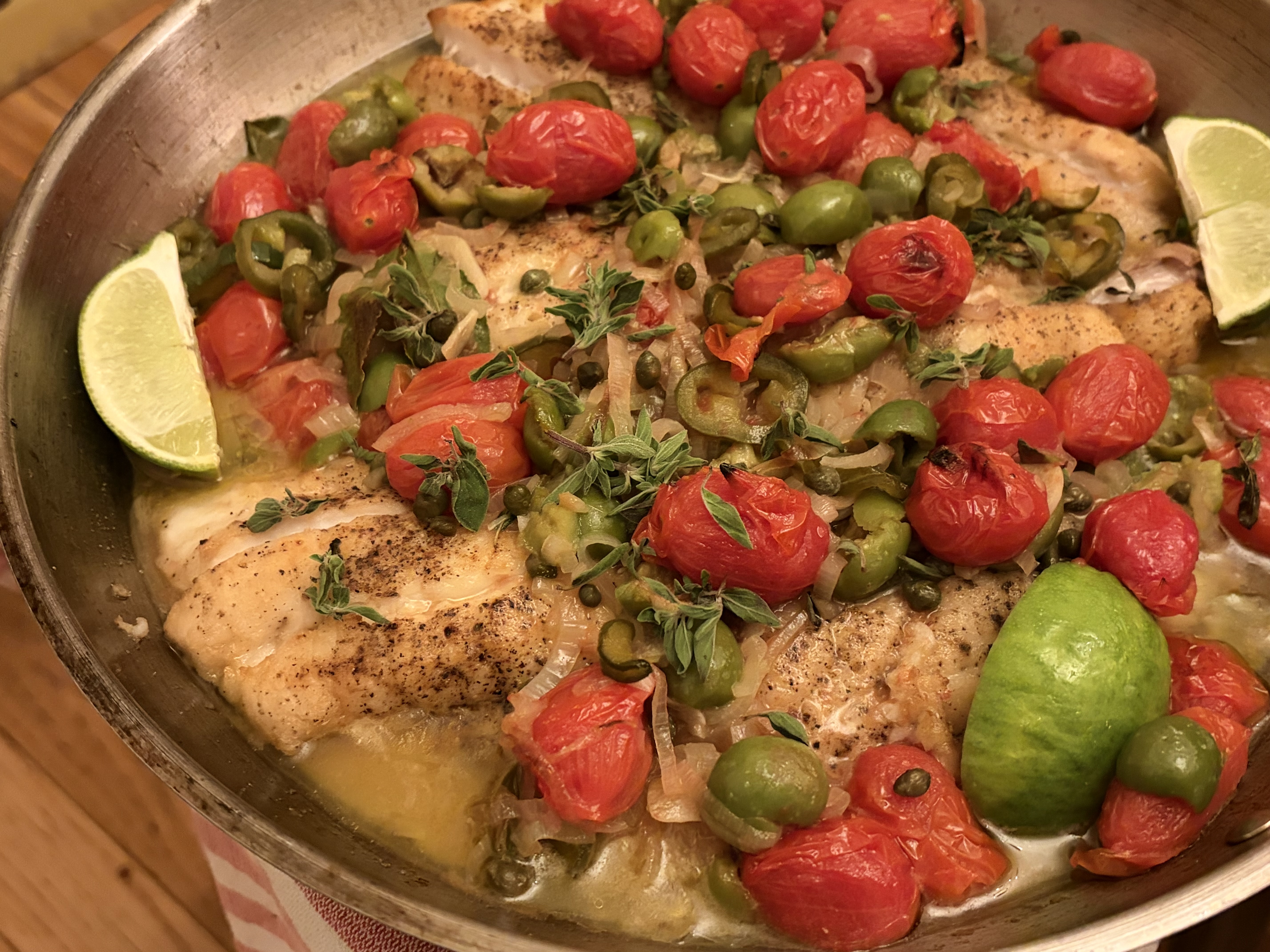
I’ve since learned that there are many interpretations of the dish, but they all seem to keep the green olives and capers, which is, I think, as it should be. Some cooks pan-fry the fish and then pour the sauce on top when serving. Others bake everything all at once. I’ve chosen to pan-fry quicky, spoon the sauce on top, and then give it a short bake on high heat to finish cooking through. Kennedy’s had a hit of cinnamon, which I used to include, but now I feel that drags down the freshness of the sauce. Hers also included raisins, which I decided to forgo this time, adding honey for sweetness. Mostly you’ll see recipes using red snapper, but sea bass works well, too. I’ve also encountered versions made with shrimp, which is delicious. I added bay leaf instead of the thyme called for in Kennedy’s recipe, because that was what I had on hand.
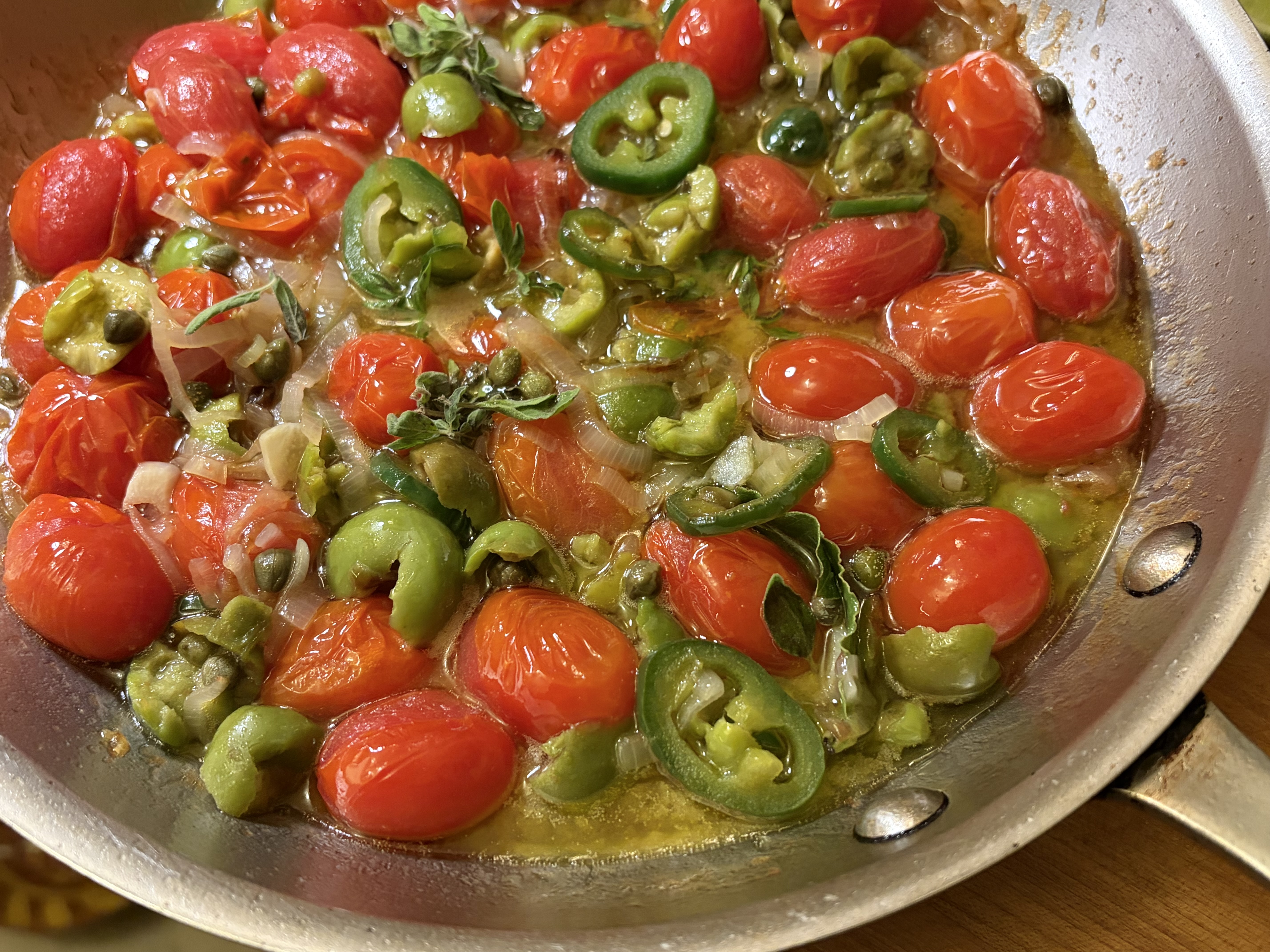
The dish is more Spanish in origin than native Mexican, but the lime and jalapeño underline what a lovely cultural blend it truly is. I hope you’ll give it a try.
Red Snapper Veracruz
Extra-virgin olive oil
1 large jalapeño pepper, cut into thin rounds
1 small shallot, cut into small dice
2 fresh unsprouted garlic cloves, thinly sliced
1 pint grape tomatoes
1 tablespoon honey
1 fresh bay leaf
Salt
A splash of dry sherry
A palmful of good green olives, pitted and torn in half (I used Ascolana del Piceno, but if you want something milder you might want to try Castelvetrano)
⅓ cup salt-packed Sicilian capers, soaked, rinsed, and drained
2 large red snapper fillets, about 6 or 7 ounces each
¼ cup all-purpose flour
About 6 large oregano sprigs, the leaves lightly chopped
A large lime, quartered
Heat the oven to 450 degrees.
To make the sauce (or condimento, as I prefer to call it, since it’s more chunky than saucy), put a big drizzle of good olive oil in a sauté pan, and turn the heat to medium-high. Add the jalapeño slices and the shallot, and sauté for about a minute. Add the garlic, and let it cook for about 30 seconds. Add the tomatoes, and turn the heat to high. Add the honey, bay leaf, and some salt, and cook quickly, just until the tomatoes give off some juice. Add a splash of sherry, and let it bubble away. Add the olives and capers, give it a good stir, and turn off the heat.
Dry off the snapper fillets, and season them on both sides with salt. Coat them lightly with flour.
Get out another sauté pan, one that can go into the oven, and set it over high heat. Add about 2 tablespoons of olive oil, and let it get hot. Add the filets, presentation side down (skin side up), and brown them quickly, about 2 minutes. Turn them over, and turn off the heat. Pour off any excess oil.
Add about half of the oregano to the olive-and-caper sauce, and then spoon the sauce over the fillets. Drizzle with a little fresh olive oil, and squeeze on the juice from two quarters of the lime.
Stick the dish in the oven to finish cooking the fish and heat the condimento through, about 4 minutes. Garnish with the remaining oregano. Serve right away with the remaining lime wedges.
I served it with plain white rice and a watercress-and-avocado salad dressed with lime, salt, and olive oil.


 Erica De Mane
I just prepared your Snapper Veracruz (partial tribute to Diana Kennedy). Fantastico! I’ve prepared many variations of this dish. They usually turn out to be Puttanesca with fish. This was simply a wonderful dish. The substitution of honey for raisins was inspired and raised it to a higher level. I unfortunately had no decent fresh grape tomatoes and used diced, fire-roasted, organic canned tomatoes. The result was still marvelous. Thank you!
Do you have any reflections on linguine with chestnuts. I’ve used what I understood of a description in the book The Man Who Ate Everything by Jeffrey Steingarten. It was quite good, but not the be-all and end-all of what I think the dish could be. I know it included meat broth, but the rest escapes me. I glanced through the book just now and couldn’t find it, (Was it a dream?) Anyway, I’d love to hear your thoughts.
Molte grazie, Sophie Siebert
Hi Sophie,
Hi Sophie,
So glad the recipe turned out well. I love this dish, but I’ve had versions where I thought the sauce was too cooked down. I was going for a fresher flavor here.
I haven’t made a chestnut pasta in a long time, so I can’t really say much about it (having to peel all those chestnut might be one reason). But you’ve now got me thinking about it again. Maybe I’ll give it another go. I don’t remember the Steingarten recipe, although I did have that book at one time. Best, Erica