
Recipe below: Risotto Milanese with Marrow
I recently went to Milano for the first time. I saw Leonardo’s Last Supper. It’s painted on the end wall of the former dining room of the Santa Maria della Grazie monastery. It took Leonardo four years to complete, which doesn’t seem like a long time for the size of the thing, but Sforza, the then duke of Milano, who paid for the work, was evidently constantly angry at him for procrastinating.
They let small groups in for 15 minutes at a time and then kick them out. But it was such an overwhelming yet slightly eerie feeling being in that big space that 15 minutes seemed like a long time. According to our guide, only about 20 percent of the painting is completely original. The outlines of the forms are original, but the colors and much detail has been worked over by various restorers over the years, most recently in 1999. The colors are still lighter than the original. It’s a dark meal now tinted in pastels.
Milano has never been a culinary draw for me so I was perplexed about what I could learn there to expand my knowledge of Italian food. Many of the restaurants I passed by felt New Yorky, with avocados, miso, smoked salmon. So I decided to go full-on retro and sample some of the standards—risotto Milanese, cotoletto. I’ve always loved a fried veal chop, and saffron, the main flavoring in their risotto, is a magic aroma for me.
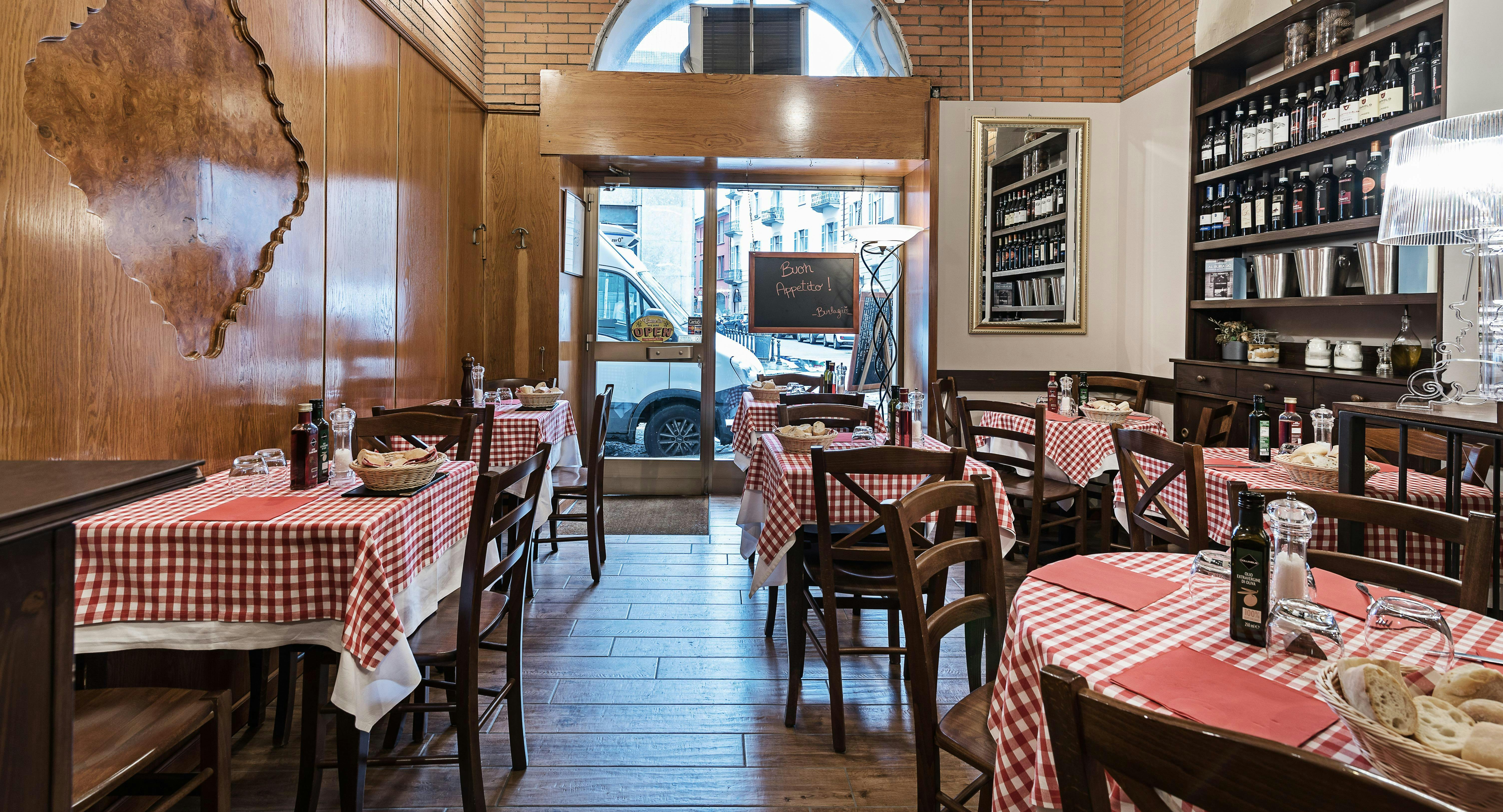
We first decided on a checked tablecloth place called Burla Giò, which translates as something like “throw it down” in Milanese dialect. It was a lovely five-minute walk from our Airbnb. It opened in 1969, and the same family still runs it. From the clientele I could tell that it had over the years turned into a bit of a tourist trap, but not completely. Aside from the Australians and Germans, there were plenty of Italians, mostly older men, who I imagine had nostalgia for this kind of food.
I ordered the cotoletto, a giant, hammered-out veal cutlet, which was pretty good, could have been a touch moister. Mrs. Cavuoti, my next-door neighbor when I was growing up on Long Island, made it better. It came with a small lettuce and fennel salad, which I thought was a nice touch. My husband had guancia di manzo, braised veal cheek, that was tender and had a good smell. It came sitting in a slightly acidic brown sauce dotted with almonds. I tasted it. A good balanced flavor. I spotted a duck with apricot dish on another table that looked appealing. I have no idea if it was. Many tables ordered the osso buco with risotto Milanese, a piatto unico I wasn’t sure I was up to after seeing the huge portions being carried by, but I really wanted to taste the risotto, so we split an order of that as a first course. And it was very good. Thicker than I’d expected, but rich with saffron and parmigiano. Good rice. Well prepared. A drizzle of balsamico finished it off, but the little pile of saffron threads on the top was an extravagant surprise. And this wasn’t an expensive restaurant. All around a fine experience.
For Easter I decided I’d go all out and served a risotto Milanese in the classic manner, with osso buco. It’s not often in an Italian kitchen that you’re served a starch such as pasta or rice alongside a big hunk of meat, but you’ve got that here. It was rich but so worth it. I could hardly believe my guests actually ate my pastiera after it.
I don’t think Burla Giò included it, but I added marrow to my version, which is a traditional variation. After cooking it this way for the first time, now I’m thinking the marrow completely belongs and will be hard for me to leave out in the future. See what you think. And try and find carnaroli rice. It really is the best for this dish.

Risotto Milanese with Marrow
About 7 cups homemade chicken broth (homemade is important, because you want the collagen to help hold the rice in a creamy suspension)
1 teaspoon saffron threads
1 beef marrow bone, split down the middle
A big drizzle of extra-virgin olive oil
4 tablespoons unsalted butter
1 large Vidalia onion, cut into small dice
2 cups carnaroli rice
2 fresh bay leaves
½ teaspoon nutmeg
Sea salt
1 cup dry but fruity white wine (I used a flat prosecco, because I had it hanging around)
A big chunk of Parmigiano Reggiano cheese
Black pepper
A drizzle of real balsamic vinegar, if you’d like to try finishing it with that
The first thing you want to do is pour your broth into a pot and get it hot over medium heat. Once it’s hot, turn the flame down low, and keep in warm. Stick a ladle in it.
Put the saffron threads into a small pan, and set it over a low heat for about 10 seconds. You just want to dry them out enough so you can grind them to a powder (otherwise, the moist strands won’t open up completely, and you’ll lose a lot of their flavor). Put the dry saffron in a mortar, and give it a grind. Add about ¼ cup of the hot broth to the saffron. It should bloom into a bright orange. ( I like keeping this little bit of saffron broth separate, instead of dissolving the saffron into the big broth pot; I then add the saffron halfway through the cooking, so it stays bright and aromatic).
You’ll now want to scrape the marrow out from both sides of the split bone with a small spoon or a dinner knife, and then chop it finely.
Get out a wide, high-sided pan. This will allow the broth to evaporate more quickly than a deep pot and make the stirring easier, even breezy. I used my 11-inch-wide, 3-inch-deep All-Clad.
Add a big drizzle of extra-virgin olive oil and a tablespoon of butter to the pan, and get it warm over medium heat. Add the marrow, and warm it through. As the marrow starts to melt, add the onion, and let it soften for a minute. Add the rice, the bay leaves, the nutmeg, and a little salt, and stir for a minute or so to coat the rice with the fats and flavorings. Pour in the white wine, and let it bubble for a minute or so. I love the aroma of the wine mixing with butter and onion wafting up in my face. That is for me part of what traditional risotto making is all about. You don’t get the full-on experience when you just stick the pan in the oven, a modern approach to preparing risotto.
Now you can start adding the broth. Start with a few ladles, and stir the rice around until you can see the bottom of the pan. Add more broth, and let the pan get almost dry again. You don’t have to go crazy stirring. I tend to stir more in the beginning and then ease up a little. After about 10 minutes, add the saffron broth and stir that in. The rice will turn a beautiful dark yellow.
I find that the entire risotto process takes about 16 to 17 minutes. So after about another 6 or 7 minutes of stirring, the rice should be tender but still firm and its consistency creamy.
Turn off the heat, and add the rest of the butter, stirring it in. Add about ½ cup of grated Parmigiano and a few big grindings of fresh black pepper, and check for salt. Add a little more broth if the texture has gotten too thick. If you’ve run out of broth, just add a little warm water. I like my risotto Milanese loose but not runny. Ladle it into wide bowls. You can drizzle a thread of balsamic vinegar over each serving, but only if you’ve got the really good stuff. In any case, serve it right away, with the rest of the Parmigiano brought to the table.


 Erica De Mane
I adore risotto with saffron and I don’t always make osso bucco to have it. Pretty sure the last time I enjoyed it was with a stew made with lots of wine…not quite a brasato…it was darned good if I do say so, with the rice. It has to be carnaroli in my kitchen. Sounds like you enjoyed your visit to Milano. We’ve not been yet.
Hi Phyllis,
I really love this risotto just by itself, so I can focus on the saffron. It’s a beautiful thing. Erica
Here we go. Beautiful article and recipe, though I’ll probably never make it.Love it.
Lippy
I had to login to WordPress to leave a reply.
Wonderful article and recipe, though I’ll probably never make it. Love it!
Lippy