
Recipe below: Lagane Spagliato with Rosemary, Guanciale, and Ceci
I’ve developed a romance with chickpeas. They’re so solid. I love how they take a while to cook, and how their deep, beany aroma grows stronger as the hour or so slips by. I can see when they’re ready, and I can smell when they’re ready. I’ll never go back to buying canned. Canned chickpeas taste sour and metallic, and their liquid is useless (unless you’re making a vegan meringue). The broth produced by cooking your own ceci is pure gold.
A dish I come back to constantly is pasta with chickpeas. For me it’s perfect. A thing of beauty. Here’s one of my versions of lagane e ceci, semolina pasta with chickpeas, a very old, pre-tomato dish made in various forms in Calabria, Basilicata, Campania, and Puglia (whose version, called ciceri e tria, has a portion of the pasta not boiled but fried crispy—really delicious).
Lagane e ceci is pure cucina povera. What sets it apart from many other pasta-and-chickpea dishes is its homemade semolina pasta, made with only semolina and water. It’s a chewy, sturdy pasta, sort of a shorter, thicker fettuccine. It’s great to eat but for me a little annoying to roll and form, so what I’ve done here is make it considerably less povera by adding eggs and some white flour to the dough. I can’t comfortably call it lagane, since I’ve screwed with it so much, so I’m going with lagane spagliato, false lagane. I’ve also added some rosemary to the dough, to mimic one of the flavors in the sauce.
When I make semolina pasta I usually use Bob’s Red Mill Semolina Four. It’s finely ground and easy to work with. Semolina has a higher gluten content than soft white flour, so you’ll be using a little push and pull to knead it into shape

This time around I tried a new to me chickpea brand called Cece di Poggio Aquilone, grown on the Alberti family’s organic farm in Umbria. I was really happy with how it cooked up. The chickpeas are slightly smaller than the usual ones we all know, and their flavor is rich. I got them from Gustiamo.

Lagane Spagliato with Rosemary, Guanciale, and Ceci
For the pasta:
2 cups unbleached white flour
½ cup semolina flour
A large sprig of rosemary, the leaves minced
1 teaspoon fine sea salt
3 large eggs
2 egg yolks
1 tablespoon extra-virgin olive oil
A drizzle of water, if needed
For the sauce:
A 1-inch chunk of guanciale, diced (about a cup)
Extra-virgin olive oil
2 celery stalks, cut into small dice, including the leaves, lightly chopped
1 Vidalia onion, cut into small dice
2 fresh bay leaves
About ½ teaspoon allspice
A few sprigs of rosemary, the leaves chopped
½ a green medium-hot chili (I used an Italian long hot), chopped
Salt
2 to 2½ cups cooked chickpeas, preserving the cooking liquid (see note on cooking them below)
About ½ cup dry white wine (I used a Fiano di Avellino)
About ½ cup good chicken broth
A few large sprigs of flat-leaf parsley, the leaves lightly chopped
A chunk of Pecorino Sardo, if you’d like some cheese (I can go either way with this—with the hot chili I’ve used here, most of the time I don’t want cheese, but when I make it without the chili, maybe just with black pepper, I almost always add cheese)

To make the pasta:
Start by putting both flours into a food processor. Add the rosemary and the salt, and pulse a few times to blend. In a small bowl mix the whole eggs, the yolks, and the olive oil. Pour this over the flour, and pulse a few times to blend everything well. The dough should clump together in a shaggy ball. If it seems dry, drizzle in a little water, and pulse again.
Dump the dough out onto a work surface, and knead it until it’s smooth, adding a little white flour if it gets sticky. You’ll notice that the dough is a little stiffer than one made with all soft flour, so it will take about 5 minutes of kneading to smooth out. When that’s done, cover the dough with plastic wrap, and let it sit at room temperature for at least an hour so the gluten can relax, making it easier to roll out.
Cut it in quarters, and run each piece through a hand-cranked pasta sheeter to the fifth setting, not super thin, in keeping with the lagane tradition. If the sheets get longer than about 6 inches, cut them in half. Place the sheets on a lightly floured surface, and let them dry for about ½ hour, so you can cut them without sticking.
After that, loosely roll up each sheet and cut it into approximately ¼-inch sections. Unroll the lagane, and toss them in a little flour. Let them sit until you’re ready to cook them.
To make the sauce:
Get out a large sauté pan, and set it over medium heat. Add the guanciale and a tablespoon or so of extra-virgin olive oil, and cook until the guanciale has given up much of its fat and started to crisp. Add the celery, onion, bay leaves, allspice, rosemary, and chili. Season with a little salt, and sauté until everything is fragrant, about 5 minutes.
Set up a pot of pasta cooking water, and bring it to a boil. Add salt.
Add the cooked chickpeas to the pan, and sauté for a minute or so. Add the white wine, and let it bubble out for another minute. Add the chicken broth and about ½ cup of the chickpea cooking liquid, turn down the heat a bit, and let simmer to blend all the flavors.
While the sauce is simmering, drop the lagane spagliato in the water, and cook it for about 3 minutes. Drain it, and pour it into a wide serving bowl. Drizzle on some good extra-virgin olive oil and give it a toss. Add the chickpea sauce and the parsley, and toss gently, adding a little more chickpea cooking liquid if the dish seems dry. Check for seasoning. Serve hot, with or without pecorino.
A note on cooking chickpeas for this dish:
For this recipe I added a few bay leaves, a rosemary sprig, a smashed garlic clove, a slightly soft whole shallot, and a drizzle of olive oil to flavor the water I boiled the chickpeas in. About halfway through the cooking, I added some salt and a thread of red wine vinegar. I didn’t pre-soak these Umbrian chickpeas, and they wound up taking about 1½ hours to get tender. I always cook the whole bagful when I make beans. I used about 2 cups or so of the bag for this pasta, and the rest went into a chickpea-and-escarole soup. For this pasta, make sure to keep the chickpea cooking liquid, since you’ll want some of it for the sauce.
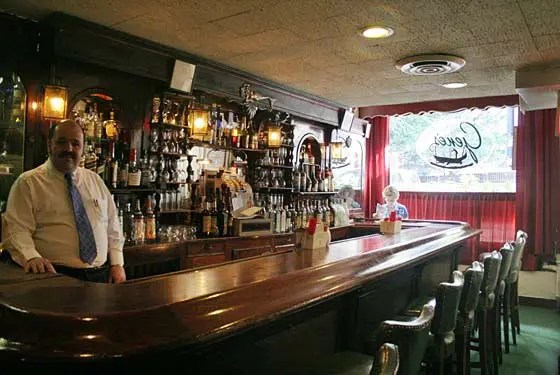
I don’t go to bars by myself as much as I used to, but sometimes they’re just the thing to settle my head, especially with all the crap going down in Washington lately. The bar at Gene’s is often my place. This West Village restaurant opened in 1919, and it doesn’t look like much has changed since then. The bar is deep and lovely, with dark wood and glowing backlit bottles. I can settle right in and immediately be part of it.
The wine list isn’t what I would call up to date, but it serves the purpose of preventing wine snobs from crowding up the place. The Chianti is good, the Côtes du Rhône, not so much, but the pour is beyond generous, almost a little shocking, considering what you usually get for $18 at a trendy place around here. Franco (see photo above), everyone’s favorite bartender, is there most nights. He’s a kind man.
For years Gene’s seemed to be frequented mainly by old neighborhood types who shuffled in for their martinis and meat ravioli. But recently, maybe with the popularity of revamped Italo-Americano places like Don Angie a few blocks away, the place has been discovered by a younger crowd, making it seem almost lively, though, believe me, it is not in any way revamped. The bar can get crowded now. I remember going in there with my father years ago, he ordering a Chivas Regal on the rocks, me with my little glass of sambuca. We’d often be the only ones there, except maybe for that old AP reporter who lived upstairs. I don’t mind crowded, as long as I can get a seat, but I’ve found that now it’s best to go at 5:30 or after 10 (10 is considered late in Gene’s world).
The food is standard old-school red sauce. I’ve found the chicken parm and veal piccata and most of the pastas to be just okay, mostly lacking in salt and pepper (easily remedied, you’d think). However, the broccoli rabe with garlic and hot chili is really good. Sitting at the bar, I often just order a plate of that, with some bread, and call it dinner. Oh, and the baked clams are more than decent.
Sitting at the bar getting vaguely high on a glass or two of Franco’s big pours is a cozy feeling. As I get older, men don’t bother me as much, so I often can just sit and let my mind wander, maybe making plans for the future or maybe just thinking about how happy I am that bars exist.
Happy cooking to you. Soon it will be spring.


 Erica De Mane
Leave a Reply