
Recipe below, in text: Stinging Nettle Soup with Crème Fraîche, Thyme, and Pine Nuts
Every April a stinging nettle patch reemerges in my upstate yard. It is wider every year, and taller and darker, too. The plant brings up welts on my hands and wrists if I touch it without gloves. No big deal. I like it. Its leaves are deep green with touches of black. They have a taste that is richer than spinach but less puckery on the tongue. Nettles are not for salad unless you want a masochistic mouthful. They want to be cooked, though only enough to tame that sting.

I never paid much attention to nettles until I traveled to Liguria many years ago and learned that cooks there use them in a foraged greens-and-herbs ensemble called preboggion. They stuff preboggion into pansotti, a kind of fat ravioli, and also use it in a pesto and in a chunky soup. The taste and drama of these dishes drove me wild. And then I got back to New York and found I had loads of them growing in my backyard.

Almost always the first thing I cook with my newly sprung nettles is a soup, usually a puréed, smooth one, romantic and dark. This happened a few days ago, and it dug me deep into spring. If you’d like to make my nettle soup with crème fraiche, thyme, and pine nuts, enough for four servings, you’ll need a big bouquet of stinging nettles, harvested while wearing gloves, cutting them off about halfway down their stems. (If you don’t have your own nettle patch, you can usually find nettles at farmers’ markets this time of year. I’ve already seen big bunches at Union Square.)
Bring a pot of water to a boil, and add the nettles, letting them bubble for about 3 minutes. Pour them into a colander to drain, and then run cold water over them, to stop their cooking and set their color. I find this step important. It gives you a bright but deep green soup, as opposed to when you just cook the nettles along with all the other soup ingredients, which leaves them a drabber, olive green color. Give the blanched nettles a squeeze to remove excess water.
Get out a good-size soup pot, and set it over medium heat. Add a big drizzle of olive oil and a little butter. Add a chopped spring onion, a chopped young leek, and two sliced tender inner celery stalks with their leaves. Peel and slice a big baking potato. Add it to the pot. Season with a little salt and the leaves from a few large thyme sprigs. Let it all sauté for three minutes or so.
Add a splash of dry vermouth, and let it bubble away. Add 5 cups of light chicken or vegetable broth. Bring that to a boil. Turn the heat down a notch, and simmer until the potato is very tender, about 8 minutes or so.
While the soup is simmering, pull the nettle leaves off their stems. You can keep some of the most tender stems, but the lower, thicker ones really have to go.
When the potato is tender, add the nettles to the pot. Turn off the heat, and let the soup sit there for about ten minutes. This will allow the nettles to soften and all the flavors to blend.
Purée the soup in a food processor, and return it to the pot. Add about ¼ cup of crème fraîche, stirring it in. Add a bit more salt and freshly ground black pepper. Taste for seasoning, adding a few drops of lemon juice if needed for brightness. Add a little water or broth if you need to loosen it up.
The first night, I served the soup hot, garnished with a swirl of extra-virgin olive oil, toasted pine nuts, and fresh thyme leaves. The next day I served it cold, with just the swirl of olive oil. Both were good.
Fiorella La Guardia on La Guardia Place
I’ve lived in Manhattan most of my life. I’ve seen a lot of things come and go—stores, restaurants, hospitals—and replaced with other things. Strangely, I often can’t recall what was there before the new thing replaced it. Manhattan is so packed with stuff, just walking the streets can mess with my head. Of course the things that mean a lot to me I’ll never forget. Scott’s old apartment, Café Loup. But then, conversely, there are things I’m sure have always been there but it turns out maybe not.
There’s a statue of Fiorello La Guardia, our ninety-ninth mayor, friend of FDR, foe of the Mafia, infrastructure king, on, fittingly, La Guardia Place. Since I’ve always lived in the Village, I’ve been walking past the statue seemingly forever, usually pausing, a little surprised by how short the legs are and how big the head is, deformed looking, actually. He was only five-two, but the statue, in my opinion, looks way out of proportion even for a short guy, and for that reason the thing has always stuck with me.
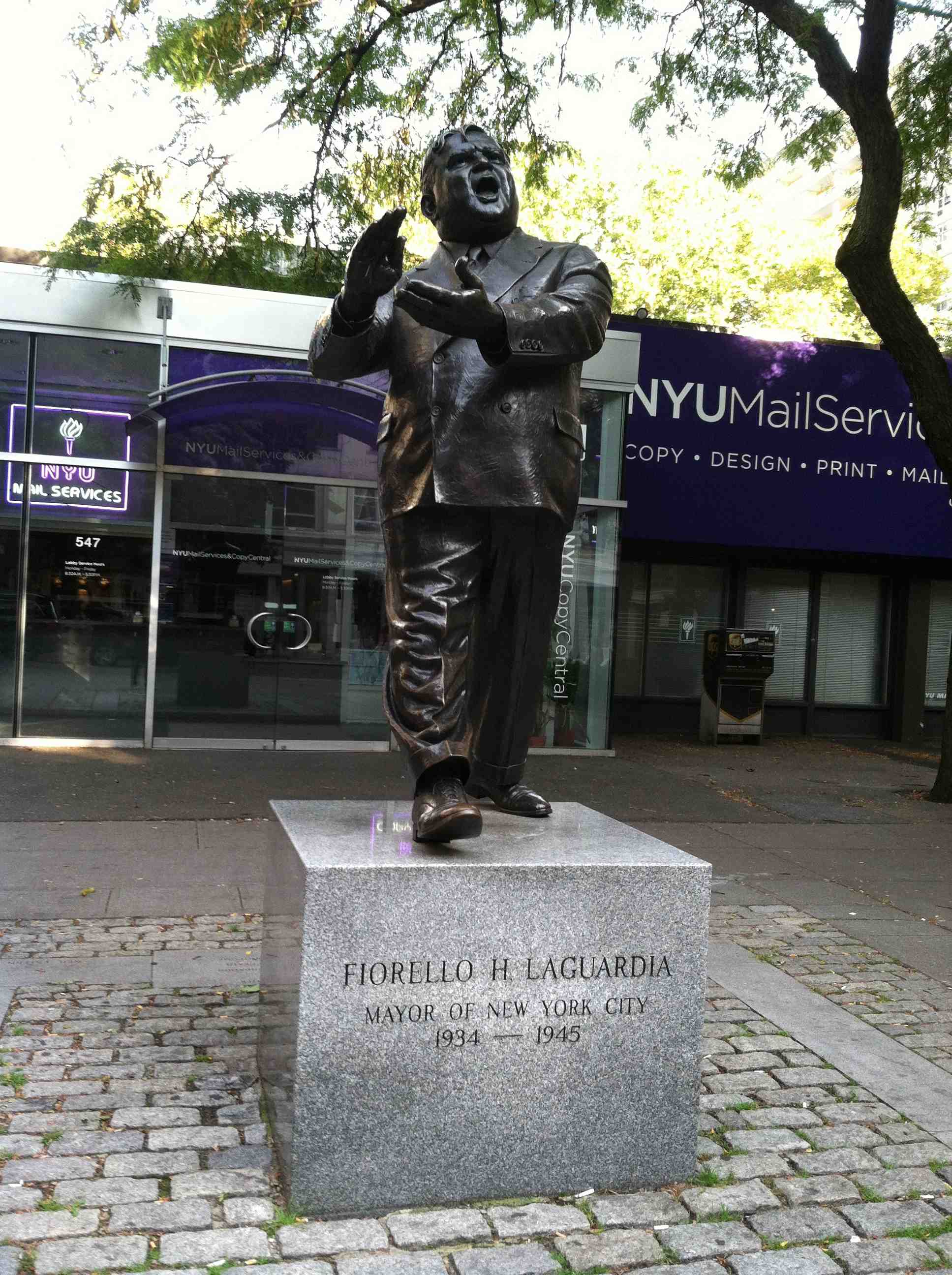
When I recently passed by it again, I got curious about when it had been put up, thinking maybe in the 1950s, or even earlier, possibly not long after he left office. I was shocked to learn it had gone up in 1994. That couldn’t be right. I was sure I had been walking past the strange, squat hunk of metal at least since I was in high school, in the early 1970s. This was a head fuck that I still can’t get over. The mind works in strange ways, and living in New York City can certainly make my environment feel chaotic.
And here’s another strange fact, or maybe non-fact, about La Guardia that’s personal to me. Many years ago a guy who led walking tours through Greenwich Village told my husband he was pretty sure that Fiorella La Guardia had lived in our building, and not only in our building but in our very apartment, probably around 1918, when he would have been a student at NYU Law School. I was thrilled to have this fact become part of my personal city lore, but I researched further and couldn’t find any solid evidence that it was true. Just this walking tour guy’s remark. You’d think a guy who leads walking tours would know what’s what in his hood, but these people are also known to be embellishers, putting on a good show for the out-of-towners. It certainly could be true. I want it to be. It’s fascinating to think so.


 Erica De Mane
Leave a Reply