Feeds:
Posts
Comments

Archive for June, 2009

mortadella
A poster for La Mortadella, the 1971 film directed by Carlo Ponti and, by the way, written by Ring Lardner, Jr.

Recipe: Warm Chickpea Salad with Mortadella and Broccoli Rabe

Summer is cranking into gear at the New York Greenmarkets, with lots of big, scary, leafy greens on display, things that look dark and indestructible. What to do? Take them home and play with them is what I say.

Collards, mustard greens, beet tops, Swiss chard, kale—too healthy for you? I know what you mean. But I’ve also been finding big bunches of broccoli rabe, something close to every Southern Italian’s heart. The bunches I’ve seen from Migliorelli, a Greenmarket farmer based in New York State’s Hudson Valley, look almost unrecognizable alongside the stuff I find at the supermarket. They have fewer buds, more big, leafy greens, and thinner, longer stems. They are beautiful stuff that cooks up tender but with that alluring bitter and sweet taste that goes so well with any number of pork products.

Lucky for me, I’ve also happened to have on hand a chunk of mortadella, one of the few Italian pork specialties, besides prosciutto, that are legally allowed into this country. Many people don’t know you can buy real Bologna mortadella here, and it’s much better than most American brands, with smooth texture and subtle spicing, studded with little bits of fat and pistachios. What a lovely thing, and what a great match for broccoli rabe. No wonder Sophia Loren went ballistic when customs inspectors snatched the giant mortadella she tried to smuggle in through New York’s JFK Airport in the summer of 1971 (this was not real life, but a scene in the Carlo Ponti film called, fittingly enough, La Mortadella). I have to admit to sneaking many Italian sausages through airport customs myself and getting caught only once, with a beautiful soppressata from Lecce, Puglia. It broke my heart having it taken away, especially when I knew those nasty boys would only bring it into some secret back room, pop open a few bottles of confiscated Brunello, and wolf the whole thing down.
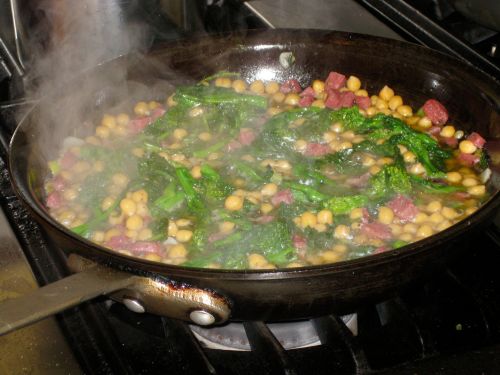
chick peas, mortadella

Warm Chickpea Salad with Mortadella and Broccoli Rabe

(Serves 5 as a side dish or a light supper)

2 cups dried chickpeas, soaked overnight in cool water to cover
1 bay leaf, fresh if possible
Extra-virgin olive oil
Salt
1 big bunch broccoli rabe, the tough stems trimmed
1 small onion, cut into small dice
¼ pound mortadella, cut into small cubes
2 garlic cloves, thinly sliced
1 small, fresh, red peperoncino pepper, minced
A few sprigs of rosemary, the leaves chopped
A splash of dry white wine
A tiny drizzle of red wine vinegar
A chunk of pecorino Toscano cheese

To cook the chickpeas, drain them, and place them in a large pot. Cover them with cool water by at least 3 inches. Add the bay leaf, and turn the heat to high. When the water comes to a boil, lower the heat, and let them simmer gently, partially covered, until tender, about 1½ hours, but it really depends on how hard your chickpeas are. Some can take much longer, but start testing them after about 1½ hours. Add more warm water if needed to keep the chickpeas covered. When they’re tender, season them with salt and a generous drizzle of olive oil, and turn off the heat. Let them sit in their warm cooking water for about a half hour (this will help tenderize them).

Drain the chick peas, saving all their cooking liquid.

Set up a large pot of water, and bring it to a boil. Drop in the broccoli rabe, and blanch for about 2 minutes. Drain it into a colander, and run cold water over it to stop the cooking and to set its green color.  Squeeze as much water as you can from the broccoli rabe, and then chop it roughly.

In a large skillet, heat 3 tablespoons of olive oil over medium heat. Add the onion, and sauté until softened, about 4 minutes. Add the mortadella, the peperoncino, the rosemary, and the garlic, and sauté a minute longer, just to release their fragrances.  Add the broccoli rabe, season with salt, and sauté for a minute or so longer. Add the chickpeas and another drizzle of olive oil, and let them warm through.  Add the splash of white wine, and let it boil way. Add a cup of the chickpea cooking water, and let everything simmer for about 4 or 5 minutes, just to blend all the flavors. You should have a little liquid left in the pot (if not, add a bit more of the chickpea cooking broth). Add a few drops of red wine vinegar and a drizzle of fresh olive oil. Taste for seasoning, adding more salt if needed.  Serve in bowls, with thin slices of pecorino shaved over the top. You can eat this hot or at room temperature.

Read Full Post »

Women with Fish

marthaVelazquez
Christ in the House of Martha and Mary, Diego Velázquez, 1620.

Read Full Post »

grammatico
Maria Grammatico in her pastry shop, in Erice, Sicily.

In all of Italy, Sicily, for me, has the best food. It just makes sense to me all around—the ingredients, the palate, the preparation. I suppose being part Sicilian myself, I’m predisposed to favor Sicilian flavor, and maybe also to be infatuated with Louis Prima. But who really knows why we like what we like? Familiarity no doubt has something to do with fondness, but not everything. Sometimes you just fall in love. For instance, I love the flavor of aqvavit, the strong, caraway-flavored Norwegian booze, although I haven’t got a drop of Norwegian blood in me—and though, by the way, it tastes absolutely terrible with tomato sauce.

Sicilian food is for me a mix of the exotic and the familiar. I love its lows and its highs, from its plain grilled swordfish with lemon, or its raw sea urchins eaten straight from the boat, to its opulent timballi of meats and cheeses encased in sweet pastry, a legacy of an abusive aristocracy with French-trained chefs. I love its Arab touches—cinnamon, saffron, pomegranates,  couscous. I love its citrus and anchovies, and capers. I’m crazy about all its ultrasweet desserts made with honey and pistachios, and especially its works of art made with almond paste, molded into sacrificial lambs or eels or bunches of grapes, as fashioned by Maria Grammatico at her pastry shop in Erice (see the photo above, and if you’d like to know her story, a journey that takes her from convent kid to Sicilian pastry queen, pick up Bitter Almonds, a great little book by Mary Taylor Simeti and her, published in 2003).

New York hasn’t had many Sicilian restaurants that I can remember. I used to love Briscola, at Fourth Avenue and 9th Street, named after a Sicilian card game. They made great pasta con le sarde and a delicious escarole torta. I had several rambunctious, nero d’avola and cassata-soaked birthday parties at that place. They made the most superior ricotta gelato I have ever tasted, something I often craved at strange hours, occasionally making my way over to the restaurant just for it. Briscola repeatedly opened, closed, and reopened in slightly different forms for about ten years, finally packing up for good around 2000. I really miss its ricotta gelato

061017cacioevino_560
Braised octopus at Cacio e Vino, in the East Village.

Over the last few months I’ve been stopping into Cacio e Vino, one of the zillion little Italian places in the East Village with more or less indistinguishable décor that rely on rows of wine bottles to try to set a mood. This one is different. It’s Sicilian, with a real Sicilian menu and Sicilian owners. And they have a wood-burning oven. I first wandered into the place months ago because its doorway was filled with the aroma of good, smoky pizza. I soon discovered that everything that comes out of its wood-burning oven is really good.

I wanted pizza, but I noticed on the menu that they offered other dough-based things too. There’s schiacciate, a flat bread sandwich that can be filled with all sorts of stuff. I decided on a cunzato, filled with anchovies, primo sale (a young pecorino), and oregano. It was beautiful, with thin, crisp, wood-scented bread and oozing cheese. My friend had a Norma, with eggplant, tomato, and aged pecorino. As good as the schiacciate sandwiches are, nothing is quite as impressive as the farciti, a Sicilian version of calzone. Cacio e Vino makes one that looks like a big crab or a gigantic croissant.

On another visit to the little restaurant I ordered a farcito with potatoes, onions, and sausage, and my sister had the mozzarella, anchovy, and onion version. These are not at all like the usual overstuffed Neapolitan-type calzones that can be so densely packed with ricotta and mozzarella that one or two bites and you’re defeated. The farciti are not solid. They have air inside. They look huge but in fact are quite delicate.

The pastas at Cacio e Vino cover just about all the Sicilian favorites. I’ve tried spaghetti cacio e piselli, with pecorino, black pepper, and green peas. It was simple but flavor-packed, despite its few ingredients. Anelletti, the Sicilian ring pasta, tossed with a beef and eggplant ragù, came closed up in pastry and baked in the pizza oven, very Il Gattopardo. Gnocchi al baccala, with salt cod, was salty but enticing, with its mix of strong fish and very light, fluffy gnocchi. Busiate, a kind of thick spaghetti, tossed with a traditional Trapanese pesto made from almonds, basil and tomatoes, was really lovely and is hard to find in New York. The only pasta I wasn’t completely crazy about was their version of bucatini con le sarde. All the flavors were in place—the sardines, the saffron, the fennel, the raisins and pine nuts—but the sauce was heavy with wet, mushy breadcrumbs. I’ve had it made that way in Sicily, so I suppose it’s a traditional rendition, but I prefer a chunkier texture.

First-course standouts include a rather sweet but very appealing caponata, the agro dolce eggplant appetizer, with a side of panelle, Sicily’s version of socca, the Niçoise chickpea-flour pancake. Braised octopus with a marinara sauce comes with garlic bruschetta. This simple dish has good, direct flavor. The sarde a beccafico, stuffed sardines, a real Sicilian classic, could have been fresher the night I ordered it. I think restaurants in general need to keep a more trained nose on their sardines, which go off quickly. Arancini, those Sicilian saffron-flavored, ragù-stuffed, fried rice balls, are on the menu. I love those things when they’re good. I have yet to try Cacio e Vino’s version, but I’ll be back for it soon I’m sure.

It just occurred to me, I’ve been to Cacio e Vino about half a dozen times so far, and I have yet to order a main course. I can’t seem to get my head out of their pizza oven. Maybe next time I’ll order their baccala with lemon risotto cake. Sounds promising.

I did try the homemade cassata, a cassatina really, since it was thin and not elaborately decorated the way  full-blown cakes tend to be. All the flavors were there, the green-tinted almond pasta, the ricotta cream, the fresh little sponge cake. I was very happy to find it house-made and made well.

The wine list is mostly Sicilian, small but good. I love the house rosato, a rosé wine made from Sicily’s famous red wine grape Nero d’Avola. It’s wonderful with the grilled octopus, fennel and orange salad. Check it out.

Cacio e Vino
80 Second Avenue (between 4th and 5th Streets)
New York, N.Y.
(212) 228-3269

Read Full Post »

zucchini still life
Still Life with Zucchini, Giacomo Ceruti, 1700-1768.

Recipe: Spaghetti with Zucchini, Anchovy, and Garlic Toasted Almonds

Finally it’s zucchini time at the New York City Greenmarkets. Big deal, you say? Well, I know what you mean. Zucchini is not exactly the most exciting vegetable. But since it’s the first of the real summer stuff to come into season, I’m always incredibly happy to see it. It is, for me, the great marker, the one dependable thing that tells me summer has officially begun. (It actually hasn’t officially begun on the calendar, but it certainly has culinarily.)

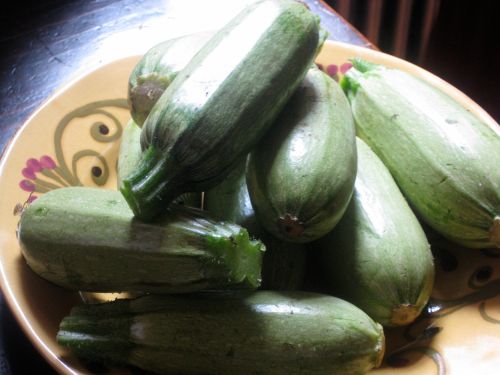
The best thing about buying zucchini and other produce at the Greenmarket, aside from the fact that it’s local and just picked, is that you get to try so many varieties. Every year the New York farmers seem to come up with something new and wacky-looking. This week I saw the usual long, dark green zucchini, and also the deep yellow variation (which I don’t think has much taste, although the things are so beautiful I buy them anyway). There were also little piles of the Italian Costata Romanesco variety, with their raised ribbing. When you cut them into rounds they resemble a snowflake design. I also noticed Magda zucchini, a Middle Eastern variety that look like small, light green torpedoes. So cute, so chubby. Those are my favorites. They have a  thick, softer skin and a rich, dense inside that doesn’t fall apart as easily as do the more common dark green ones. I bought a big bag of them and took them home, itching to make something good and summery.

Zucchini, it goes without saying, needs some help. Everyone who’s ever cooked it knows this. And since offering help is what I’m all about, I’ll tell you that I almost always go for garlic, especially since  fresh summer garlic becomes available at the same time zucchini makes the scene around here. Leafy herbs like basil, mint, or parsley, and a touch (not too much) of hot chili are nice too. Zucchini isn’t boring. It’s just shy and needs a little push to bring it out.

Another thing anyone who’s ever cooked zucchini knows is that it sometimes gives off a bit of water, which is why it can take on an insipid boiled taste. What you want to do is brown it so it gets a slight, crispy caramelization. To accomplish that, I always cook zucchini slices in a large pan, so they spread out, making steaming less likely. I also add a sprinkling of sugar to help the browning along. And I remember to add salt only at the end, so as not to coax out even more liquid from them.

Here I turn to my all-time favorite pasta, spaghetti, to make a simple but richly embellished zucchini-based sauce. I bring out the big guns, choosing garlic, anchovy, and hot chili—one of the grand Southern Italian flavor trilogies. It’s a freewheeling version of an Italian classic that I hope will open the door to summer for you.

Magda
Magda zucchini from the Union Square Greenmarket.

Spaghetti with Zucchini, Anchovy, and Garlic Toasted Almonds

Extra-virgin olive oil
½ cup slivered almonds, lightly chopped
3 cloves summer garlic, thinly sliced
Salt
1 pound spaghetti
6 or 7 Magda zucchini (or small regular green zucchini), cut into half moon shapes
4 scallions, cut into thin rounds, using much of the tender green part
1 medium-hot long green chili, seeded and chopped
A generous pinch of sugar
4 anchovy fillets, minced
A splash of dry vermouth
½ cup light, homemade or good quality store-bought chicken broth, or possibly a little  more
The juice from ½ a lemon
A big handful of fresh mint and basil leaves, very lightly chopped
2 tablespoons grated pecorino Toscano cheese

In a small sauté pan, heat a tablespoon of olive oil over medium heat. Add the almonds, and heat until they just start to color. Add one of the sliced garlic cloves, season with a pinch of salt, and turn off the heat, stirring the almonds around so the garlic can flavor them without browning. Set aside.

Set up a large pot of pasta cooking water, and bring it to a boil. Add a generous amount of salt, and drop in the spaghetti.

In a large skillet, heat about 2 tablespoons of olive oil over medium heat. Add the zucchini, scallions, and green chili, all at the same time. Sprinkle on the sugar, and sauté until the zucchini starts to gets golden at the edges and everything is fragrant, about 4 minutes. Add the anchovy and a little salt, and sauté a minute longer. Add the vermouth, and let it boil away.  Turn off the heat, and add the chicken broth and the lemon juice, mixing everything around so it will loosen up any caramelized stuff in the pan.

When the spaghetti is al dente, drain it, and pour it into a large serving bowl. Add the basil and mint, a generous drizzle of fresh olive oil, and the pecorino Toscano, giving everything a gentle toss. Add the zucchini sauce, and toss again, tasting for salt. Add a little extra chicken broth if it seems dry. Sprinkle the almonds over the top. Serve right away.

Read Full Post »

melendez bread
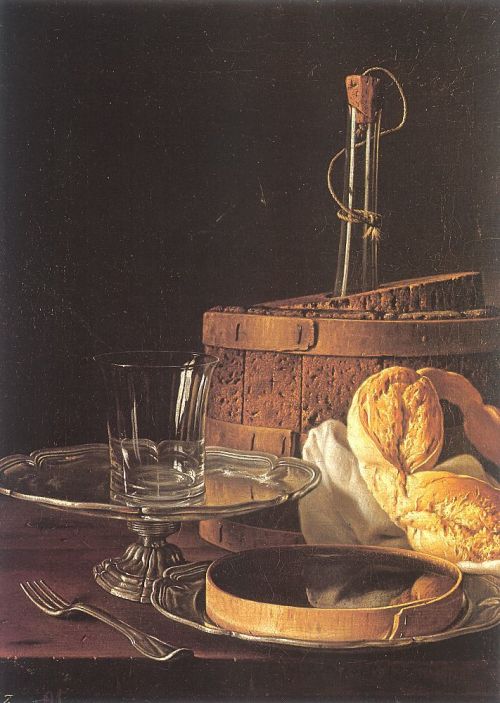
Still Life with Bread, by Luis Melendez,  1715-1780.

To all of you enthusiastic cooks who attended my stale bread class this week (and to any of my readers who just love the idea of finding great ways to use leftover bread), here’s the recipe for the orange cake I made for that class.

And for a schedule of upcoming Recession Cooking Classes, take a look at the notice on the right on the homepage.

Sicilian Orange Cake with Breadcrumbs and Almonds

2 tablespoons softened butter
1 cup home-made dry breadcrumbs, not too finely ground
1 cup sugar
1 cup lightly toasted almonds, finely ground
2 teaspoons baking powder
4 large eggs
¾ cup vegetable oil (one with a mild or almost nonexistent flavor)
The grated zest from 2 oranges
The grated zest from 1 lemon
½ teaspoon orange flower water

For the orange syrup:

The juice of the 2 oranges and of the lemon you zested for the cake
½ cup sugar
½ cinnamon stick
2 tablespoons Grand Marnier or another orange liqueur
½ teaspoon orange flower water

Butter a 10-inch round cake pan (a low-sided springform pan with removable sides is ideal).

In a large bowl, mix together the sugar, the breadcrumbs, the almonds, and the baking powder until well blended.

In a smaller bowl, whisk the eggs together with the oil, and pour the mix in with the dry ingredients. Add the orange and lemon zest and the orange flower water, and mix well.

Pour the batter into the cake pan, and place it in a cold oven. Turn the heat to 350 degrees, and bake until the top is golden and the cake feels firm, about 40 to 45 minutes. Let cool for about 15 minutes.

In the meantime, put all the ingredients for the orange syrup into a small saucepan, and give them a stir. Turn the heat to medium-high, and let the sauce bubble and reduce for about 6 or 7 minutes. Let the syrup cool for about 15 minutes.

Run a knife around the sides of the cake, and unhinge the pan. Slide the cake onto a flat serving platter. Poke a bunch of tiny holes in the top of the cake with something skinny and sharp, like a barbecue skewer or a toothpick. Slowly pour the syrup over the cake, letting it soak in. If too much syrup pools up around the cake, just spoon it over the top again. Let the cake sit for about ½ hour to further soak up the syrup before slicing.

Read Full Post »

Women with Fish

Women_octopus_FWC
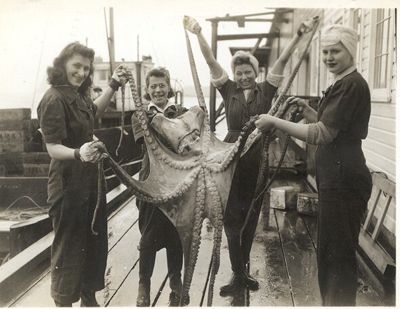
Women with a big octopus, Northern California, year unknown.

Read Full Post »

shrimp

Recipe: Shrimp Cocktail with Jalapeño Fennel Vinaigrette

My love of the American shrimp cocktail remains strong. It’s a clunky but vibrant dish, of boiled shrimp, hopefully not too boiled, dipped in an indescribable red sauce, made primarily from ketchup, horseradish, and Worcestershire sauce. Thinking of it brings back a flood of memories, mostly good ones, of raucous parties (speaking of boiled) that my parents used to throw in the 1960s (at one of the more entertaining ones, at least from my point of view, a golf pro friend of my father’s wound up crawling on the floor, growling like a lion, peed in his pants, and then passed out—possibly from one too many dips into the shrimp cocktail).

At our house, the shrimp was piled high. The extravagance of it drove me wild and unleashed the glutton in me like few other foods of the time. I’d sneak out of my room, making my way through all the go-go-baubled ladies and  grease ball dressed men to grab a handful of shrimp, while also scooping up a good portion of the red sauce in a paper cup before disappearing back to where I belonged.

Shrimp cocktail has had various retro rebirths since that era, and I’m always excited to see it on a buffet or at a friend’s party. I had a craving for it the other night, so I went out and bought some shrimp, figuring I had the stuff to make the sauce in my refrigerator. In fact I had neither ketchup, horseradish, nor Worcestershire (what kind of unruly household do I run?), but being the culinary snot that I’ve now become, I did happen to have on hand a fennel bulb, a green jalapeño pepper, and a bunch of fresh tarragon, so that’s what I cooked up instead. It doesn’t have much tradition behind it, but it’s really good.

A note about jalapeño peppers: I’ve found that the heat from these peppers varies a lot. Sometimes they’re burning hot, sometimes so mild they have almost no kick whatever. The one I used was sort of halfway between, so I used the whole thing, with seeds, to produce an only moderately spicy result. I think the best thing to do is to taste a piece, with a few seeds, and determine what you’re dealing with before adding it to your dish.

Shrimp Cocktail with Jalapeño Fennel Vinaigrette

(Serves 4 as a first course)

2 or 3 small cloves fresh spring garlic, thinly sliced
1 green jalapeño pepper, minced, with its seeds (see note above)
½ teaspoon Sambuca
¼ teaspoon fennel seeds, toasted and finely ground
The juice and zest from 1 small lemon
Extra-virgin olive oil
Salt
1 fresh bay leaf
1½ pounds large shrimp, shelled and deveined, leaving the tails on
1 pint grape tomatoes, cut in half
1 small fennel bulb, very thinly sliced
About 10 large tarragon sprigs, the leaves lightly torn

In a small bowl, mix together the garlic, jalapeño, Sambuca, fennel seeds, lemon juice and zest, and about 3 tablespoons of olive oil, adding a good amount of salt. Let it sit to develop flavor while you get on with the recipe.

Set up a large pot of water. Add the bay leaf and a generous amount of salt, and bring it to a boil. Drop in the shrimp, and boil them until just tender, probably about 2 minutes, depending on their size. Scoop the shrimp from the water with a large strainer, and lay them out on paper towels, separating them a bit, to soak up excess liquid.

Place the shrimp in a serving bowl. Add the tomatoes and the fennel. Pour on the dressing, and give everything a good toss. Refrigerate for about ½ hour, and then add the tarragon and toss again, tasting for seasoning. The jalapeño should have become more pronounced, and all the flavors will have mingled nicely. Serve cold.

Read Full Post »