 Pier Paolo Pasolini and Anna Magnani step out.
Try working off those excess Thanksgiving calories with a celebratory dance. (Whose shoe is that? Gina Lollobrigida’s?)
Happy Thanksgiving to you from Skinny Guinea.
Posted in Uncategorized on November 28, 2008| 1 Comment »
Pier Paolo Pasolini and Anna Magnani step out.
Try working off those excess Thanksgiving calories with a celebratory dance. (Whose shoe is that? Gina Lollobrigida’s?)
Happy Thanksgiving to you from Skinny Guinea.
Posted in Skinny Guinea on November 26, 2008| Leave a Comment »

Recipe: Endive Baked with Marsala and Parmigiano Reggiano
Thanksgiving is not my favorite food holiday. Words that for me describe its tastes are mushy, sweet, and dry. I think the perfect Thanksgiving dinner would be a big piece of crisp turkey skin and a salad drizzled with gravy. Good cheese would improve things. In fact, what’s really missing from Thanksgiving is Parmigiano Reggiano. Its elegant presence and pineapple crunch can focus a meal and provide a taste destination to really look forward to.
So as an attempt to infuse Thanksgiving with a few grand Italian flavors, here’s an endive dish using two of Italy’s treasured ingredients, Parmigiano Reggiano and Marsala. It’s pleasantly bitter, a touch salty, but also light and full of unami. It slips right down, cutting through all the sweet potato build-up.
Happy Thanksgiving to you.

Endive Baked with Marsala and Parmigiano Reggiano
(Serves 6 or 7 as a side dish)
Extra-virgin olive oil
2 tablespoons unsalted butter
10 endives (on the small side)
1 medium shallot, thinly sliced
½ teaspoon sugar
Salt
Black pepper
5 thyme sprigs, the leaves lightly chopped, plus a little extra for garnish
½ cup dry Marsala
¾ cup freshly grated Parmigiano Reggiano cheese
Preheat the oven to 375 degrees.
In a large sauté pan, heat a tablespoon of olive oil and the butter over medium heat. When the mix gets foamy and hot, add the endives and shallot, seasoning with salt, black pepper, and the sugar (this will help the endive to brown). Scatter on the thyme, and sauté, turning the endives around a few times, until they’re lightly browned all over. Pour on the Marsala, turning the endives around in it and letting it bubble for a few minutes. Lift the endives from the pan with tongs, and line them up in a baking dish. Drizzle them with a thread of olive oil, and pour all the pan juices over the them. Cover with foil.
Bake until tender when poked with a thin knife, about 45 minutes. Uncover, and sprinkle on the Parmigiano. Put the dish back in the oven for another 5 minutes or so, just until the cheese is melted and lightly golden (give it a final short run under the broiler if it’s not brown enough). Finish with a few turns of black pepper and a scattering of fresh thyme. Serve hot.
Posted in Skinny Guinea on November 21, 2008| 12 Comments »

A dreamlike egg wash.
Recipe: Pizza di Scarola with Black Olives and Raschera
Many of my dreams involve food preparation. I suppose that’s only natural for someone who cooks as much as I do. The dreams are sometimes truly horrible. A recurring theme is putting a duck or a rabbit in the oven and then discovering the thing is still alive and I’m slow-torture roasting it to death. But sometimes they’re just peculiar (why can’t dreams ever be 100 percent uplifting?). For instance a few nights ago I dreamed that I needed to line up a bunch of old-fashioned glasses and drop an egg yolk into each one. Then I had to pour water into each glass, and stir with a fork until well blended, as they say in cooking. In each glass I placed a pastry brush. There were maybe thirty glasses all lined up on a stainless steel counter. I can’t remember what came next, or maybe that was it. Egg wash. A whole lot of egg wash.
I can’t say what provoked the dream, but I do know one thing: It got me thinking about pastry. I decided I needed to cook up one of my most beloved savory tarts, pizza di scarola (in Southern Italy almost every food that’s round and relatively flat is called pizza, even if it’s sweet). Pizza di scarola is a Neapolitan classic, a double-crusted pie traditional on Christmas Eve but available at pizza shops in Naples year round. I make mine with an olive oil and sweet wine dough, though you can also make it with a yeast dough. For some reason the mix of sweet wine, olive oil, and flour makes the uncooked dough smell like an underripe banana. I kid you not.
Anchovies, capers, pine nuts, raisins, and olives can all find their place in the escarole tart, so if you want you can really load it up. Here I only use black olives, pine nuts, and the gentlest hint of anchovy (gotta have the anchovy).
A little cheese is a must. Caciocavallo is what I usually go for, but this time I had a gorgeous looking hunk of Raschera in my fridge and thought its gentler tang and creaminess would work really well. Raschera is a DOP cow’s milk cheese from Piemonte. It’s firm but moist and, like caciocavallo, a good melter. And it has a lovely hay aroma.
The main reason I made a pizza di scarola this time was to have the opportunity to use an egg wash on something. That’s how it goes sometimes in the wacky world of cooking. But believe me, this great tart is worth making even if your dreams don’t demand it. It’s got a real holiday feel to it. I’m bringing one over to my in-laws’ this year to kick-start our Thanksgiving dinner (which can use some Italian flavors).
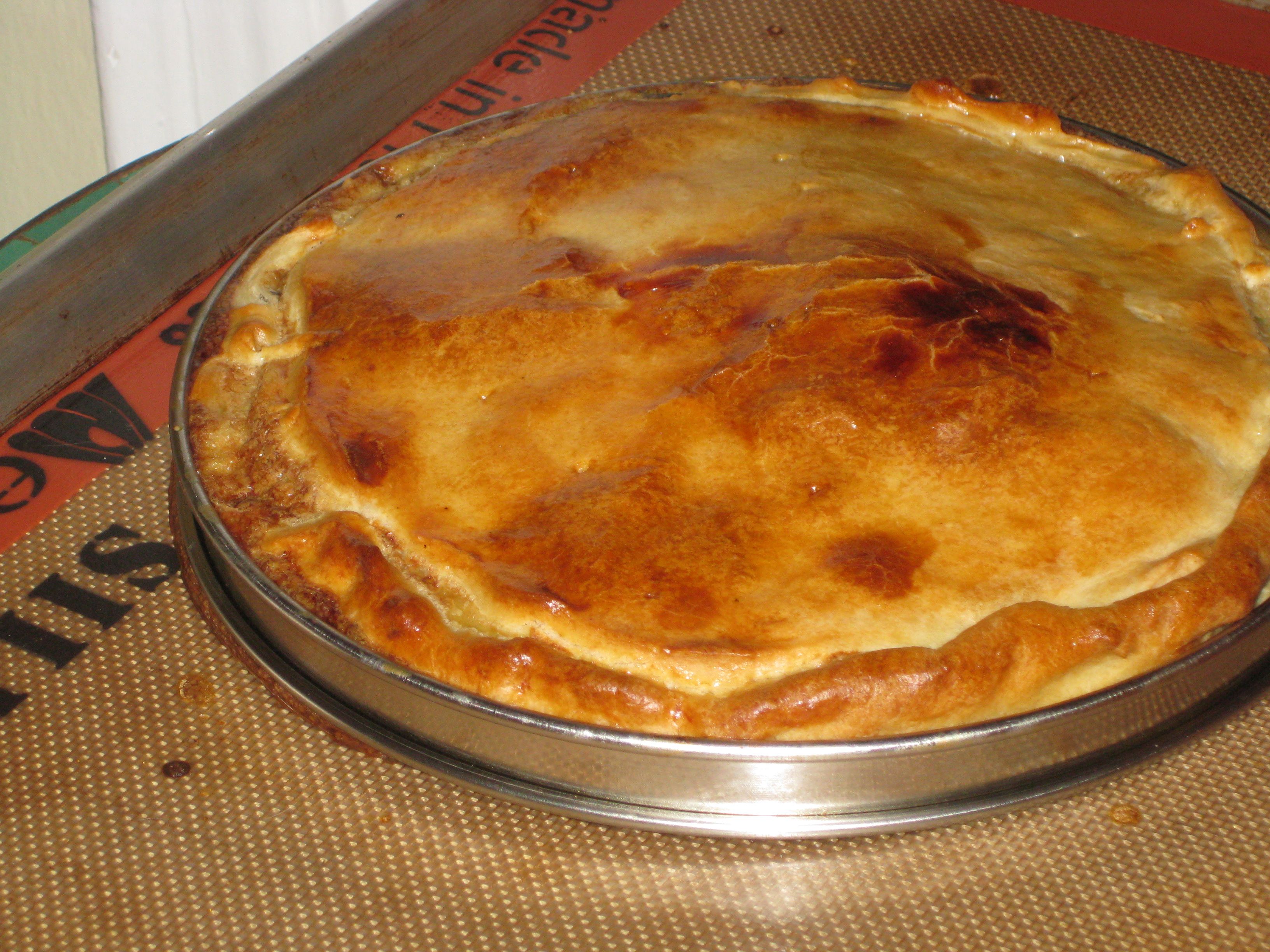
Pizza di Scarola with Black Olives and Raschera
Use a 9-inch tart pan with a removable bottom, ideally one with smooth, not fluted, sides, for a nice rustic look. Or use a pastry ring on a Silpat-lined baking tray (that’s what I did).
(Serves 6 to 8 as an antipasto)
For the crust:
2 1/2 cups flour
1/2 teaspoon salt
3/4 cup sweet white wine, such as moscato
1/4 cup extra-virgin olive oil (a good Sicilian one would be best; I used Ravida)For the filling:
1 large head escarole (about 1 1/2 pounds), washed and cut into small pieces
Salt
Extra-virgin olive oil
1 large garlic clove, minced
4 anchovy fillets, chopped
Freshly ground black pepper
A few big scrapings of nutmeg
1/2 cup pitted black olives, such as Gaeta, roughly chopped
1/2 cup toasted pine nut
1 large egg
1 cup grated Raschera cheese (which is moist, so it’s easiest to grate using the bigger holes on your grater)Plus:
1 egg yolk stirred with a little water for the egg wash.
To make the crust, place the flour in a large bowl. Add the salt, and mix well. Pour the wine onto the flour, and then add the olive oil. Mix well with a wooden spoon until you have a moist ball. Turn the dough out onto a clean surface, and knead briefly, just until it becomes somewhat smooth, about a minute. Cut the dough into two pieces, one slightly larger than the other. Wrap each piece in plastic, and let them rest, unrefrigerated, for about 1 1/2 hours.
Preheat the oven to 400 degrees.
For the filling, set up a pot of water, and bring it to a boil. Add the escarole, and cook for about 2 minutes. Drain it into a colander, and run cold water over it to bring up its green color. Squeeze as much water out of the escarole as you can.
In a large sauté pan, heat a tablespoon of olive oil over medium flame. Add the garlic and the anchovy, and sauté for a minute to release their flavors. Add the escarole, seasoning it with salt, black pepper, and the nutmeg, and sauté a minute or so longer. Take the pan from the burner, and let cool for about 10 minutes.
Lightly oil your tart pan or ring.
Add the olives, pine nuts, the egg, and the cheese to the escarole, and mix them in well.
Roll the bigger dough disk out so it’s a bit larger than the tart pan (no need to flour the surface with this dough; with all the olive oil in it, it’ll peel right off with no sticking). Drape the dough into the pan, leaving some overhang all around. Trim off any excess. Roll the smaller disk out in the same fashion. Pour the filling into the pan, smoothing the top. Place the other dough round on top. Give the edges a quick little egg wash. Pinch the top and bottom together all around with your fingers to form a good seal. Poke a few tiny holes in the top (I do so with a metal barbecue skewer). Brush the top with a thin coat of the dreamy egg wash, and bake until the top is golden, about 40 minutes. Let the tart rest for about 20 minutes before serving. Eat warm or at room temperature.
Posted in Skinny Guinea on November 17, 2008| 7 Comments »
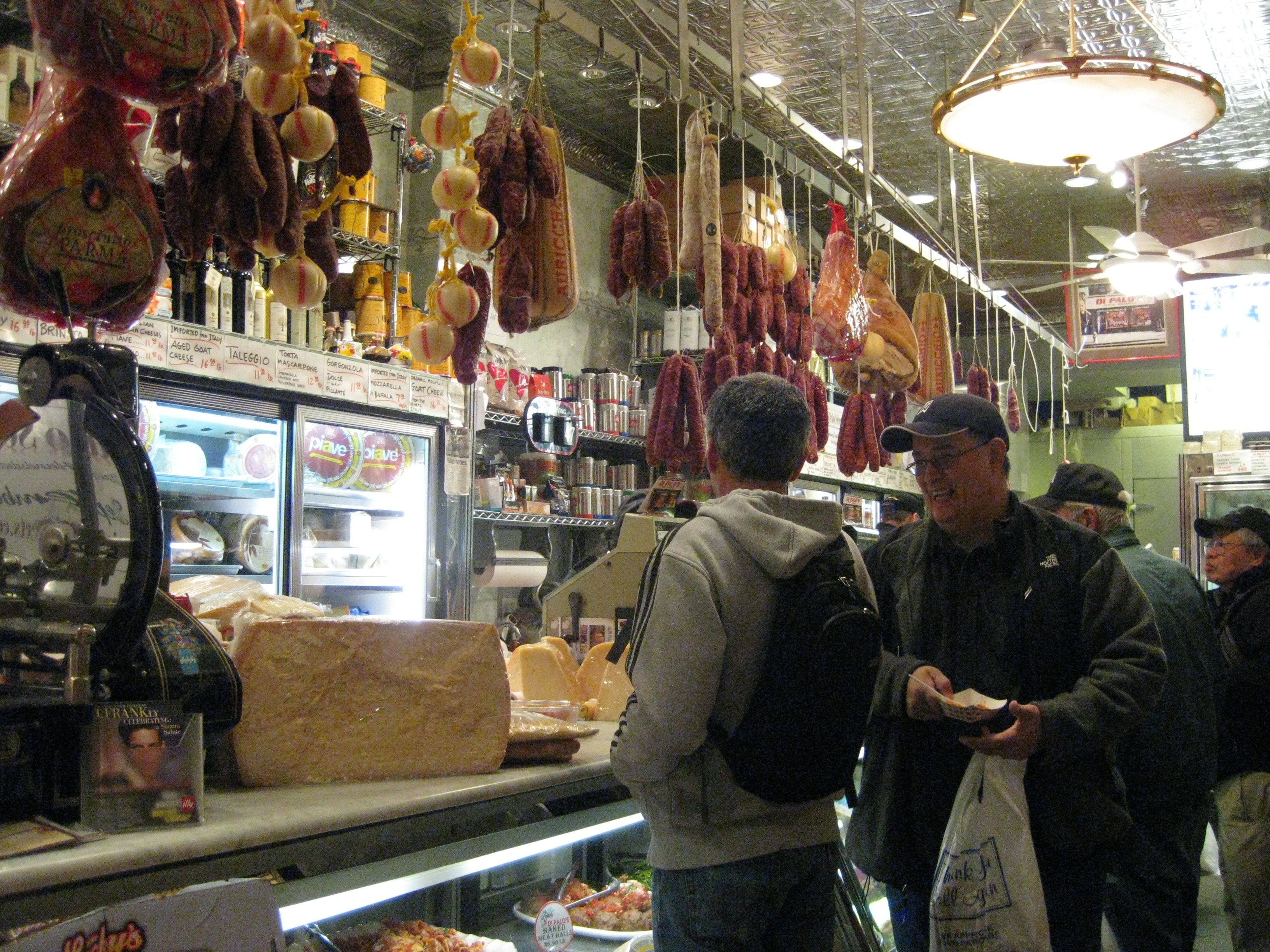
Happy customers at DiPalo’ in Little Italy, New York.
I don’t know if it happens to you, but often when I purchase Gorgonzola, even in fancy Manhattan shops, it’s overripe, mushy and ammonia-stinking. That’s because these days you almost always have to buy cheese with your eyes, not your nose. You’re presented with precut, plastic-wrapped pieces. This could never happen at DiPalo. There the cheeses are meticulously fussed over and never ever presliced. The store actually smells like cheese. What a concept. And they have the fine habit of offering you a sliver of everything you choose, just to make sure it has exactly the taste you were looking for.
They’re dedicated people, Lou, Sal, and Marie DiPalo, still running the shop their family opened in 1910 not long after arriving in New York from Basilicata. DiPalo is one of those rare shops that actually continue to get better every year, something you definitely can’t say of anything else in Little Italy. Lou DiPalo lives and dreams cheese. He seeks out the best Italy has, and he keeps it in peak form. The lines are long, and the service is slow but highly attentive. You miss out on all this fun if you shop from their new website, but if you don’t live in New York, DiPalo’s online shopping is a very nice thing to know about.
DiPalo’s house-made mozzarella is superb. It is not available online; they consider it to fragile to ship. So if you want a treccia, one of their hand-braided fresh mozzarellas, you’ll have to make the trip to their lively little shop, at 200 Grand Street. But a nice hunk of Piacentinu, the saffron-scented Sicilian pecorino? No problem. You can click it into your life. DiPalo carries an especially good selection of Italian sheep’s milk cheeses, stuff that’s hard to find elsewhere and especially in such pristine condition. When all I can find at most groceries is low quality, sharp and often miserable tasting pecorino Romano, DiPalo carries a diverse and really fine assortment of varieties, such as the fresh and mild Brinata, a Tuscan pecorino I picked up the other day to serve with grapes. I often buy Pecorino di Fossa from Le Marche to use as a grating cheese when I’m making a spicy ragu, or I’ll instead choose DiPalo’s Ubriaco Marzemino, a pecorino aged in wine, which shows itself off well in pasta cacio e pepe.
While browsing through the website you’ll notice that DiPalo carries a lot more than cheese. If you live in an area with a dearth of excellent olive oil, fine-tuned salumi, or artisinal pasta, then this new venue for online Italian food shopping is definitely for you.
DiPalo
200 Grand Street
New York, N.Y.
(212) 226-1033
Posted in Skinny Guinea on November 11, 2008| 7 Comments »

My home-preserved tuna in olive oil.
Recipes:
My Preserved Tuna
Preserved Tuna with Cannellini Beans, Celery, and Sage
Cold weather makes me and many cooks I know want to preserve food for storage, despite having no actual need to do so. Every year around early November I click into Southern Italian farmhouse mode and drag out the Ball jars. When I visited my grandmother’s cousin in the desolate town on the border of Puglia and Campania where he was born, I was amazed by the number of jars and bottles in his cellar. There you absolutely need to put up food if you want to eat in the winter. There were no stores in his town. Can you believe it? That’s kind of hard to comprehend for a Manhattanite like me. I can run out for a hanger steak and a glass of Beaujolais at three in the morning. Yet every year I do my sham version of food storage, preparing small quantities of stuff like eggplant and peppers sott’olio that will last in my refrigerator for a few weeks at most. It’s stupid but rewarding. I like the way the color-packed glass jars look in my refrigerator. They trick me into feeling I can take care of myself.
In my book The Flavors of Southern Italy I give a recipe for preserving tuna in olive oil, basically a way to create your own high-quality canned Italian tuna. Lately I’ve played around with the concept and found I get better results by reducing the cooking temperature and the cooking time from my original recipe, producing a more silken, moister fish. I’ve made swordfish this way too.
It’s very reassuring to have a jar of this tuna on hand. I toss it into penne dressed with an easy canned tomato sauce, maybe one that includes sautéed leeks and fennel seeds, or I add it to a chicory and raw fennel salad. But here’s what I did with it last night. I recalled an unbelievably easy but elegant cannellini bean salad with sage and celery that we used to make as a winter antipasto dish at Le Madri restaurant when I cooked there many moons ago. Celery with sage is a taste I associate more with Thanksgiving stuffing than with Italian cooking, but I loved the combination with the biting Tuscan olive oil we used in that kitchen. Last night I put together a big bowl of that bean dish and tossed in some of my preserved tuna. It became my latest most favorite thing to eat.
My Preserved Tuna
2 pounds tuna, yellowfin or albacore, cut into 2-inch chunks (avoid bluefin, which is severely overfished)
Sea salt
2 garlic cloves, peeled and lightly crushed
About 6 black peppercorns
1 fresh bay leaf
1 large thyme branch
1 star anise
1 dried red chili, left whole
2 long orange strips
Inexpensive extra-virgin olive oil
Pour about 2 cups of olive oil into a high-sided sauté pan (something wide like a sauté or braising pan is better than a saucepan, as it allows you to use less oil). Add all the ingredients except the tuna. Make sure to add enough salt so the oil tastes slightly salty (it’s the main seasoning for your fish). Slowly bring the oil to a low boil over medium-low heat, letting it bubble gently for about 3 minutes. Turn off the heat, and let the oil sit on the turned-off burner for a few minutes, just to cool a bit and soak up all the flavors. Slip in the tuna pieces, making sure they’re all covered with oil (add more if needed). Cover the pan, and let the tuna sit in the warm oil for 10 minutes. The waning heat from the oil will gently cook the tuna through, making it tender and letting the flavorings soak in further. Lift the tuna from the oil with a slotted spoon, and let both the tuna and the oil come to room temperature. Place the tuna in a glass jar or a shallow glass dish. Pour on the cooled olive oil (you can strain it if you like, but since it’s not meant to be put up for a long period, leaving the garlic and such in the oil won’t hurt). You can use the tuna now or refrigerate it for up to a week. Return it to room temperature before using.
Preserved Tuna with Cannellini Beans, Celery, and Sage
(Serves 6 as an antipasto offering)
You’ll need about 3 cups of home-cooked cannellini beans, warm or at room temperature. Place them in a big bowl. Season them generously with salt and freshly ground black pepper. Drizzle on a fine extra-virgin olive oil (a green oil with a bite is best), enough to coat the beans well. Finely slice three tender inner celery stalks and one large shallot. Lightly chop the leaves from your celery bunch and about 10 fresh sage leaves, adding all these ingredients to the beans. Add a generous squeeze of fresh lemon juice. Toss gently. Now add about a pound of your preserved tuna, broken into chunky pieces with your fingers. Toss gently again, and let sit for about a half hour before serving, to develop flavor. Taste the olive oil from your preserved tuna. If it’s not too strongly fishy, add a drizzle of it to your salad. Serve at room temperature with a big glass of cold white Italian wine. A Falanghina would be great.
Posted in Skinny Guinea on November 5, 2008| 12 Comments »

Silvana Mangano and friends in their fetching rice picker outfits in the film Riso Amaro.
Recipe: Black Rice with Shrimp, Guanciale, and Rosemary
About a week ago I had a very frustrating dream. I was trying to scoop up buckets of something that looked like black pebbles, but I couldn’t get it into my bucket. It kept falling all around. I just couldn’t scoop it up. It fell off my shovel and slipped through my fingers. At some point I realized that what I thought were pebbles were actually beautiful shiny black rice kernels. That made me even more frustrated, knowing that this was something beautiful and delicious to eat and I couldn’t have it. When I woke up, I contemplated my dream and wondered if it could have anything to do with the coming presidential election. Then I remembered that Gustiamo.com, the Italian specialty food company, sells a black rice from the Piemonte region of Italy. I had never tried it, but now I felt I had to have it, right away. I may have even felt somehow that if I had it and cooked it I could in some small way affect the outcome of the presidential election. Desperate people sometimes come up with odd thoughts. I went ahead and ordered the black rice, along with a half dozen boxes of Latini pasta, my absolute favorite dried pasta (Gustiamo is one of the only places I know of that carry it). I received the rice a few days later. It looked just like in my dream, blackish purple, shiny, and lovely. I was inordinately excited.
The black rice I bought from Gustiamo comes from a company called Crespi, run by a family in Piemonte that has been cultivating and processing rice since 1821. Nero Venere is what they call this gorgeous variety. It means black Venus. It’s a short-grain rice, but not in the risotto style, since it doesn’t throw off a lot of starch. It cooks up firm, turning from black to a stunning cordovan color. It smells nutty and minerally while cooking. When I looked it up on the Crespi website I found that it contains all sorts of healthy minerals, including iron, zinc, selenium, calcium, and magnesium, but that wasn’t what I was focusing on. I wanted to cook something wonderful with it. I immediately thought seafood, probably because it reminded me of rice colored with squid ink. I decided on shrimp and took it from there. The recipe came out fine, really fine. My husband and I ate it for dinner two nights before the election. Did my recipe sway the results just a little bit? I hope so.
Black Rice with Shrimp, Guanciale, and Rosemary
(Serves 4 as a main course)
2 cups Italian black rice
Salt
Extra-virgin olive oil
1½ pounds medium shrimp, peeled and deveined, saving the shells
¼ cup dry white wine
Salt
2 approximately 1/8 inch thick slices guanciale, cut into small dice
1 celery rib, cut into small dice, plus a handful of celery leaves, lightly chopped, for garnish
1 large shallot, cut into small dice
A small branch of rosemary, the leaves chopped
1 garlic clove, thinly sliced
1½ pints grape tomatoes
A few generous pinches of dried ground chili, medium-hot (I used Piment D’Espelette, a sweet Basque chili; Aleppo from Syria would also be wonderful)
A splash of brandy
Place the rice in a large pot. Cover it with abundant water, at least 5 inches. Season with salt. Bring the water to a boil, then lower the heat to medium, partially cover the pot, and cook at a medium boil until the rice is just tender, about 35 minutes. (The package says 45 minutes, but the way I chose to cook it, sort of like pasta, it didn’t take that long.) It will change from black to a dark cordovan color and start to burst just a bit. Drain the rice well, and toss it with a drizzle of olive oil.
In a small saucepan, heat a tablespoon of olive oil over medium flame, and add the shrimp shells. Sauté the shells until they turn pink. Add the white wine, and let it boil until almost evaporated. Add enough water to just cover the shells. Boil uncovered until reduced by half, about 5 or 6 minutes. Strain the broth into a small cup, and season with salt. You should have about half a cup. Boil it down a little further if you have more (this will also up its flavor).
In a large skillet, heat 2 tablespoons of olive oil. Add the guanciale, and sauté until it’s just starting to get crisp. Add the celery, the shallot, and half of the rosemary, and sauté a minute or two longer, just until the vegetables soften. Add the garlic and the grape tomatoes, and turn up the heat a little. Season with salt and a generous pinch of hot pepper, and sauté until the tomatoes just start to burst and give off juice, about 5 minutes. Turn the heat down, add the rice and the shrimp broth, and simmer to blend all the flavors, about 3 or 4 minutes. Your rice should remain just a touch liquidy.
In another skillet, heat 2 tablespoons of olive oil over high heat. Add the shrimp and the rest of the rosemary, season with salt and a bit more hot chili, and sear quickly until the shrimp is pink and just tender. Add the brandy, and let it bubble for a few seconds. Pour the shrimp, with all its pan juices, in with the rice. Simmer a minute to blend the flavors. Pour the rice onto a warmed serving platter, and garnish with the celery leaves.
Posted in Skinny Guinea on November 3, 2008| 8 Comments »

The Chairman, possibly not on Election Day.
I’ve always felt it best to vote on an empty stomach. It makes me feel feisty. But this year I fear the lines will be long, hours may pass, and my feistiness may turn to impatience and then rage. That’s not good. My solution will be the before-voting cocktail. I’ll still be hungry, but I’ll be subtly lulled, just enough to allow me to stand with my neighbors for a prolonged period of time. I recommend it to everyone.
Something strong but vibrant seems best, a drink that sings but will let one stay grounded. I recommend the Limoncello Martini, made with the Southern Italian lemon liqueur limoncello. It’s a wonderful drink. It’s not a brooder’s drink, like a traditional martini. It’s a drink for optimists (and we’re all voting for hope, aren’t we?).
The Limoncello Martini
Chill a martini glass. Have ready chilled bottles of vodka and limoncello (I keep mine in the freezer).
Cut a long strip of lemon zest, and hold it under a lit match for a few seconds so it can release some of its beautiful sharp oils. Drop the lemon zest into your martini glass. Fill the glass with 2 shots of vodka. Add a tablespoon of limoncello (or a little less to taste). Stir briefly. Drink very cold.
Go out and vote.
Posted in Skinny Guinea on November 1, 2008| Leave a Comment »

The maid who became a saint in Pasolini’s Teorema.
Tomorrow is All Saints’ Day, or Ognissanti, as it’s called in Italy. It honors all the holy departed (it first took off around the time the church came to have more saints than there were days in the year to assign to them). It’s an important holiday in Italy, but it never has outshined the even older one a day before, now known as All Saints’ or All Hallows’ Eve, but with pagan origins from before the Christian era. It’s a good holiday—primarily, for me, because it serves to celebrate the fall harvest, and does so with food and wine.
Many years ago my husband and I were in Assisi on November 1. We wandered into one of those strange cave restaurants, the religious-themed tourist traps that Assisi specializes in. The place was damp but had a big wood-burning fire. Everyone was eating roasted chestnuts, a longtime symbol of the fall harvest, and drinking young red wine. The wine, called Novello, is Italy’s answer to France’s Beaujolais Noveau. The pairing, we found out, was an Ognissanti custom. The warmth from the fire, the ritualistic peeling of the chestnuts, their smoke tinged, sweet starchy insides mingling in our mouths with the sharp wine was overwhelming. My husband actually started to weep with joy.
You may not have a dark cave in which to enjoy that culinary experience, but it’s well worth trying anywhere you are.
To prepare the chestnuts all you need to do is: Preheat the oven to 400 degrees. Make a little cross on the flat side of each chestnut with a sharp knife. Lay them out on a large sheet pan, and roast them until they smell fragrant and the skin at the cross mark has started to pop out a bit, about 30 minutes. Pour them into large basket, and cover them with a towel to keep them warm. Peel them while they’re still warm. Their insides should be soft and almost creamy. They get harder to peel as they cool, but that shouldn’t be a problem, since they’re so addictive you’ll want to eat them one after another.
As far as wine goes, I don’t often find Novello here (the Italians don’t have the marketing down the way the French do), and when I do, it’s often acidic and even a little sickening. I’d rather get a good bottle of Dolcetto from Piemonte, which is light and fruity and tastes more like the wine I drank in Assisi (at least according to my recollection). I recently sampled an excellent Dolcetto Langhe made by Eraldo Viberti. If you can get a bottle of that you’ll be in saints’ heaven (is there any other one?).



 Erica De Mane
