
Every engaged cook has patterns. Themes with variations. Repetitive behavior semi-disguised by fresh thoughts. One of my themes is seafood teamed with a starch. If you’ve been following my cooking journey for any length of time, you are all too familiar with my numerous takes on pasta with fish or shellfish. I could write a book on pasta with clams alone, although I would never do that, since it would be ridiculously nuanced.
Pasta is where I most frequently turn when I have the good fortune to get my hands on really fresh seafood. It stretches a luxury ingredient in a very fine way. But I also consider potatoes; rice, in red, black, and risotto varieties; grains, such as farro; and of course all varieties of beans, my favorites for marrying with seafood being ceci and any firm, largish, white bean, like cannellini or the extra huge corona I used here in this shrimp dish. Have you ever tried braised octopus with big white beans, rosemary, fennel, and a hit of Aleppo pepper? It’s pretty good, a nice alternative to the more usual octopus with potato pairing. Swordfish chunks make a good addition to a spring rice salad, especially if you include a seasonal vegetable like freshly shucked peas. I find that that makes much more sense than a pasta salad, which almost always seems stupid and gummy to me. Ceci with mussels is another theme I keep going back to, especially in high summer, when I’ve got tomatoes or sweet peppers and lots of basil. Have you ever tried bits of grilled tuna tossed with warm farro, black olives, and arugula? That’s a thought. Or a warm zucchini and couscous salad with scallops and tarragon. That’s something I’ll be making as soon as the first mini zucchini shows up in the markets, which should be only a few weeks from now.
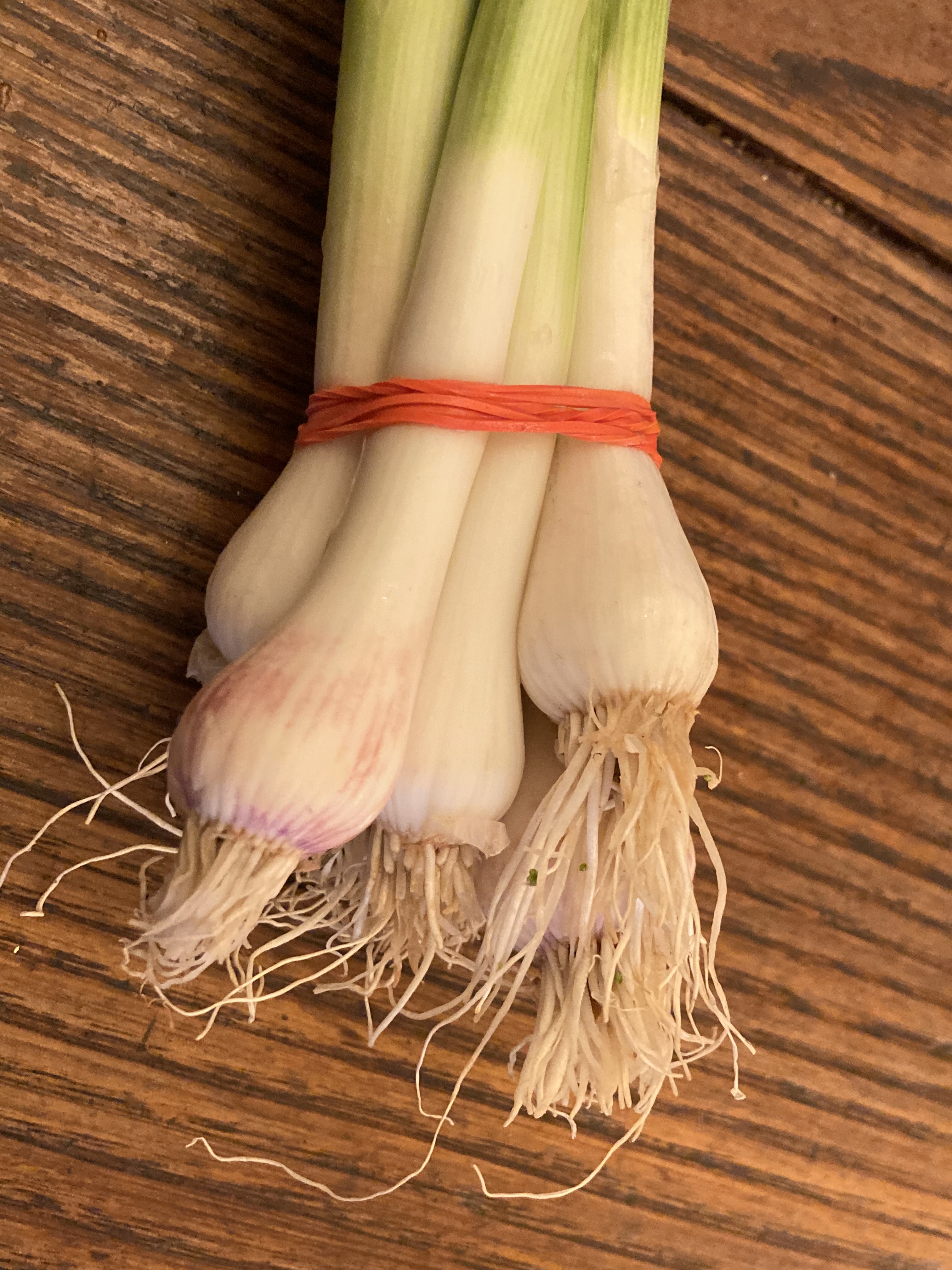
So many choices. This time around I’ve gone with calamari-potato and shrimp-bean combos. Beyond the starch-seafood pairing, what ties these two dishes together is spring garlic, something I wait for, the kickoff to my warm-weather cooking. It’s such a welcome jolt after a long haul with that papery, often acrid supermarket garlic, which at this point in my cooking career I’ve almost completely rejected, preferring to use leeks or shallots in the cold months. When spring garlic first appears in my farmer markets, usually early April, it’s indistinguishable from scallion, long, lean, and white, maybe tinged with purple at its base, working its way up to a dark green, leafy top. As the season progresses, a bulb starts to form. You can see that in my photo. But it still hasn’t broken out into individual cloves. This is when I like it the best. Juicy and sweet but emerging with clear garlic flavor.
I’m just starting to emerge from a long cold spell brought on more by our horrible political atmosphere than by winter weather. Spring cooking is beginning to lift my spirits. I hope it lifts everyone’s.

Calamari Salad with Potatoes, Spring Garlic, and Mint
About 1½ pounds small Yukon Gold potatoes, cut in half
Salt
Rice wine vinegar
A big glass of dry white wine
1½ pounds small calamari, cleaned and cut into not-too-skinny rings, the tentacles halved if large
1 tablespoon white miso
Your best extra-virgin olive oil
3 scallions, cut into thin rounds, using a lot of the tender green part
1 thin spring garlic, chopped, including some of the green part
A small palmful of green peppercorns, coarse-ground
A larger palmful of Sicilian capers, soaked in a few changes of water to remove excess salt and then drained
A handful of fresh spearmint leaves, lightly chopped
A few large sprigs of Italian parsley, the leaves chopped
Put the potatoes into a good-size pot and cover them with at least 2 inches of water. Add a decent amount of salt and a big drizzle of rice wine vinegar. Bring to a boil over high heat, then turn the heat down a bit, and cook at a medium bubble until just tender, about 8 minutes. I like the potatoes still firm enough so their skins haven’t detached. Drain them into a colander.
While the potatoes are cooking, set up another pot of water, add a large glass of white wine and a good amount of salt, and bring it to a boil. Add the calamari, and blanch it until just tender, about a minute. Drain the calamari into a colander, and then spread it out on paper towels to soak up any additional moisture.
Put the miso in a small bowl, and add about 1½ tablespoons of rice wine vinegar. Stir to dissolve the miso. Add about 2½ tablespoons of your best extra-virgin olive oil and a little salt.
Put the still somewhat warm potatoes and calamari into a large serving bowl. Add the scallions, garlic, green peppercorns, and capers. Pour on the miso vinaigrette, and toss (I like using my hands for this, so I don’t break up the potatoes). Add the mint and parsley, and toss lightly. Taste for seasoning. Serve warm or at room temperature.

Corona Beans with Shrimp, Saffron, and Cumin
3 cups dried Corona beans (I used Rancho Gordo), cooked (see note below on how I cooked them)
1½ pounds shell-on large shrimp (if you can find fresh American shrimp, all the better)
Extra-virgin olive oil
A big splash of dry vermouth
Salt
A big pinch of saffron threads, lightly dried and then crushed with a mortar and pestle
3 scallions, cut into thin rounds, using some of the tender green part
1 thin spring garlic, chopped, including some of the tender green part
1 teaspoon cumin seeds, ground
Piment d’Espelette
A drizzle of sherry wine vinegar
A handful of Italian parsley leaves, lightly chopped
Cook the beans (see note below on how I cooked them).
Shell the shrimp, and put the shells in a pot with a drizzle of olive oil. Turn the heat to medium, and sauté the shells until they turn pink, about 2 minutes. Add a splash of dry vermouth, and let it bubble away. Add about 1½ cups of water and a little salt, and simmer at a medium bubble for about 8 minutes. Strain the broth into a small bowl or cup. Add the crushed saffron, and give it a stir. The broth will turn a beautiful dark yellow.
Drain the beans, saving the broth for a soup or stew.
Set a large sauté pan over medium heat. Add a big drizzle of olive oil. When the oil is hot, add the scallion, garlic, and cumin, and warm everything through for about a minute to release its fragrances. Add the beans, and sauté for a minute or so, seasoning with salt and piment d’Espelette.
Set up another large sauté pan over high heat. Add a generous amount of olive oil. When the oil is hot, add the shrimp, spreading it out, and season it with salt. Sauté until the shrimp is just tender, turning it once, about 2 minutes in all. Add the shrimp broth, scraping up any cooked-on bits from the bottom of the pan, and pour the shrimp and broth over the beans. Add a drizzle of fresh olive oil and a few drops of sherry wine vinegar, and give everything a gentle toss. Taste for seasoning. Add the parsley, and toss lightly. Transfer to a large serving bowl. Serve warm.
A note on how I cooked the beans: I covered the beans with cool water by about 4 inches, added 3 fresh bay leaves, a chunk of spring garlic, and a big drizzle of olive oil, and brought it to a boil. I turned the heat down low, covered the pot, and let the beans simmer for about 50 minutes. Then I added a drizzle of sherry wine vinegar and a little salt and continued cooking until the beans were just tender, which took about another half hour. I find that with Rancho Gordo beans I don’t have to presoak, since they’re not overly dry to begin with.




 Erica De Mane