Feeds:
Posts
Comments

Posts Tagged ‘risotto’

Recipe below: Risotto Milanese with Marrow

I recently went to Milano for the first time. I saw Leonardo’s Last Supper. It’s painted on the end wall of the former dining room of the Santa Maria della Grazie monastery. It took Leonardo four years to complete, which doesn’t seem like a long time for the size of the thing, but Sforza, the then duke of Milano, who paid for the work, was evidently constantly angry at him for procrastinating.

They let small groups in for 15 minutes at a time and then kick them out. But it was such an overwhelming yet slightly eerie feeling being in that big space that 15 minutes seemed like a long time. According to our guide, only about 20 percent of the painting is completely original. The outlines of the forms are original, but the colors and much detail has been worked over by various restorers over the years, most recently in 1999. The colors are still lighter than the original. It’s a dark meal now tinted in pastels.

Milano has never been a culinary draw for me so I was perplexed about what I could learn there to expand my knowledge of Italian food. Many of the restaurants I passed by felt New Yorky, with avocados, miso, smoked salmon. So I decided to go full-on retro and sample some of the standards—risotto Milanese, cotoletto. I’ve always loved a fried veal chop, and saffron, the main flavoring in their risotto, is a magic aroma for me.
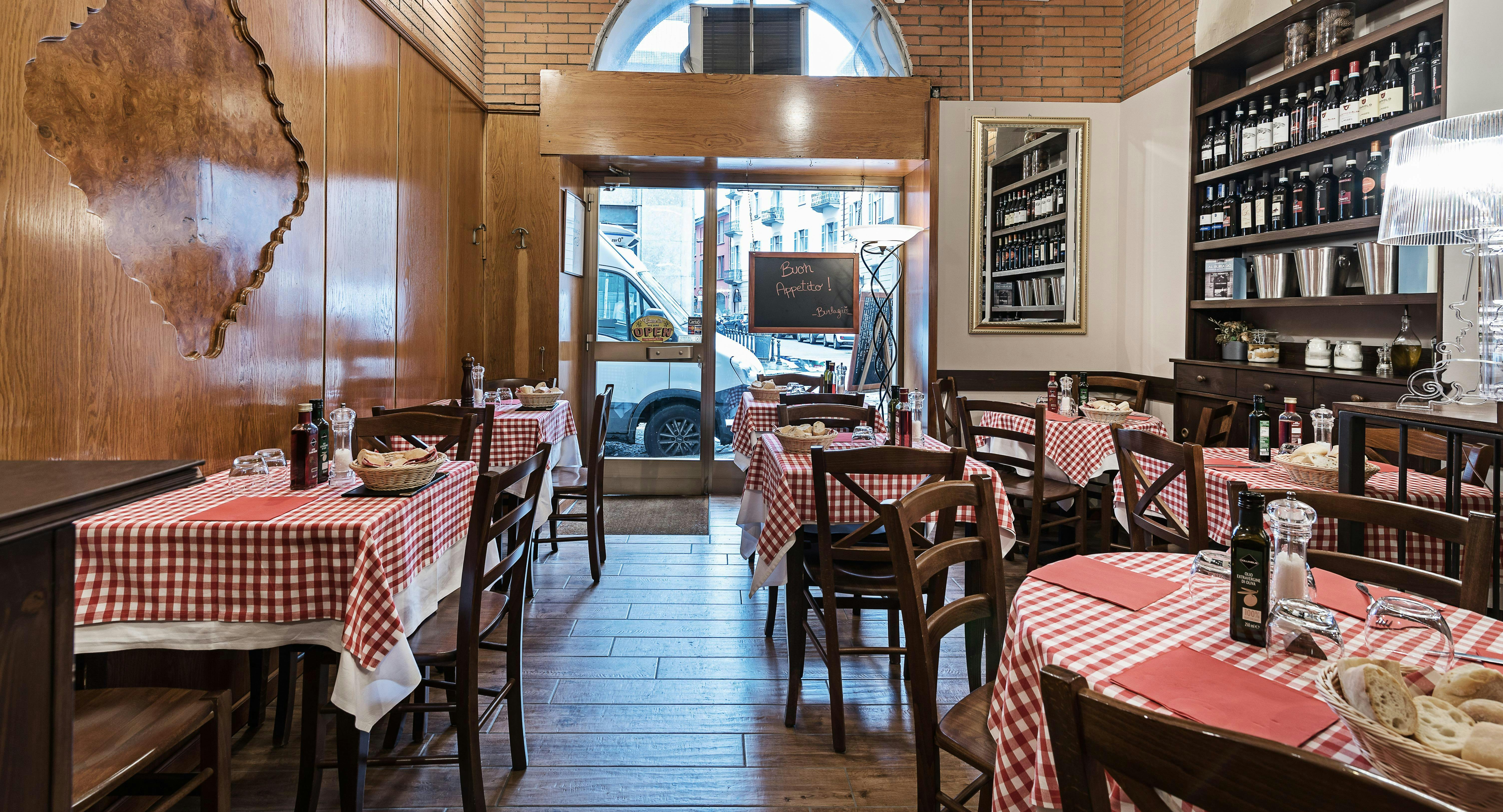
We first decided on a checked tablecloth place called Burla Giò, which translates as something like “throw it down” in Milanese dialect. It was a lovely five-minute walk from our Airbnb. It opened in 1969, and the same family still runs it. From the clientele I could tell that it had over the years turned into a bit of a tourist trap, but not completely. Aside from the Australians and Germans, there were plenty of Italians, mostly older men, who I imagine had nostalgia for this kind of food.

I ordered the cotoletto, a giant, hammered-out veal cutlet, which was pretty good, could have been a touch moister. Mrs. Cavuoti, my next-door neighbor when I was growing up on Long Island, made it better. It came with a small lettuce and fennel salad, which I thought was a nice touch. My husband had guancia di manzo, braised veal cheek, that was tender and had a good smell. It came sitting in a slightly acidic brown sauce dotted with almonds. I tasted it. A good balanced flavor. I spotted a duck with apricot dish on another table that looked appealing. I have no idea if it was. Many tables ordered the osso buco with risotto Milanese, a piatto unico I wasn’t sure I was up to after seeing the huge portions being carried by, but I really wanted to taste the risotto, so we split an order of that as a first course. And it was very good. Thicker than I’d expected, but rich with saffron and parmigiano. Good rice.  Well prepared. A drizzle of balsamico finished it off, but the little pile of saffron threads on the top was an extravagant surprise. And this wasn’t an expensive restaurant. All around a fine experience.

For Easter I decided I’d go all out and served a risotto Milanese in the classic manner, with osso buco. It’s not often in an Italian kitchen that you’re served a starch such as pasta or rice alongside a big hunk of meat, but you’ve got that here. It was rich but so worth it. I could hardly believe my guests actually ate my pastiera after it.

I don’t think Burla Giò included it, but I added marrow to my version, which is a traditional variation. After cooking it this way for the first time, now I’m thinking the marrow completely belongs and will be hard for me to leave out in the future. See what you think. And try and find carnaroli rice. It really is the best for this dish.

Risotto Milanese with Marrow

About 7 cups homemade chicken broth (homemade is important, because you want the collagen to help hold the rice in a creamy suspension)
1 teaspoon saffron threads
1 beef marrow bone, split down the middle
A big drizzle of extra-virgin olive oil
4 tablespoons unsalted butter
1 large Vidalia onion, cut into small dice
2 cups carnaroli rice
2 fresh bay leaves
½ teaspoon nutmeg
Sea salt
1 cup dry but fruity white wine (I used a flat prosecco, because I had it hanging around)
A big chunk of Parmigiano Reggiano cheese
Black pepper
A drizzle of real balsamic vinegar, if you’d like to try finishing it with that

The first thing you want to do is pour your broth into a pot and get it hot over medium heat. Once it’s hot, turn the flame down low, and keep in warm. Stick a ladle in it.

Put the saffron threads into a small pan, and set it over a low heat for about 10 seconds. You just want to dry them out enough so you can grind them to a powder (otherwise, the moist strands won’t open up completely, and you’ll lose a lot of their flavor). Put the dry saffron in a mortar, and give it a grind. Add about ¼ cup of the hot broth to the saffron. It should bloom into a bright orange. ( I like keeping this little bit of saffron broth separate, instead of dissolving the saffron into the big broth pot; I then add the saffron halfway through the cooking, so it stays bright and aromatic).

You’ll now want to scrape the marrow out from both sides of the split bone with a small spoon or a dinner knife, and then chop it finely.

Get out a wide, high-sided pan. This will allow the broth to evaporate more quickly than a deep pot and make the stirring easier, even breezy. I used my 11-inch-wide, 3-inch-deep All-Clad.

Add a big drizzle of extra-virgin olive oil and a tablespoon of butter to the pan, and get it warm over medium heat. Add the marrow, and warm it through. As the marrow starts to melt, add the onion, and let it soften for a minute. Add the rice, the bay leaves, the nutmeg, and a little salt, and stir for a minute or so to coat the rice with the fats and flavorings. Pour in the white wine, and let it bubble for a minute or so. I love the aroma of the wine mixing with butter and onion wafting up in my face. That is for me part of what traditional risotto making is all about. You don’t get the full-on experience when you just stick the pan in the oven, a modern approach to preparing risotto.

Now you can start adding the broth. Start with a few ladles, and stir the rice around until you can see the bottom of the pan. Add more broth, and let the pan get almost dry again. You don’t have to go crazy stirring. I tend to stir more in the beginning and then ease up a little. After about 10 minutes, add the saffron broth and stir that in. The rice will turn a beautiful dark yellow.

I find that the entire risotto process takes about 16 to 17 minutes.  So after about another 6 or 7 minutes of stirring, the rice should be tender but still firm and its consistency creamy.

Turn off the heat, and add the rest of the butter, stirring it in. Add about ½ cup of grated Parmigiano and a few big grindings of fresh black pepper, and check for salt. Add a little more broth if the texture has gotten too thick. If you’ve run out of broth, just add a little warm water. I like my risotto Milanese loose but not runny. Ladle it into wide bowls. You can drizzle a thread of balsamic vinegar over each serving, but only if you’ve got the really good stuff. In any case,  serve it right away, with the rest of the Parmigiano brought to the table.

Read Full Post »

Italian Rice Field, by Angelo Morbelli, 1901.

Recipe below: Risotto with Fennel, Saffron, and Sausage

I like a risotto where you can barely see what’s in it, everything cut tiny, no big chunks. When you take a bite, you’re surprised by all the flavor in a dish that looked like nothing much. The complexity of risotto is hidden by its simple appearance. Finely chopped chicken livers, minced porcini, a fine dice of leeks, a melt of gorgonzola, ingredients like those can be hidden away in a bowl of white grains just ready to burst forth in your mouth. This risotto dichotomy reminds of the couple in the film The Big Night who get talked into ordering the seafood risotto and are completely perplexed when it comes to the table looking like nothing more than a plate of soupy white rice. I don’t remember the exact lines, but it went something like this: “I don’t see any seafood,” the woman says, scraping through the plate with her fork. “Where’s the seafood?” “It’s in there, the chef says. “It’s just cut really small.”  They don’t believe him, and to his horror they order a side of spaghetti. Risotto with a side of spaghetti. What a concept.

I love risotto. I love all the stirring. I’m not a fan of  the oven method where you put the thing together on top of the stove and then stick it in the oven with lots of broth until the rice is tender. It works, sort of, but I find you have to do more last-minute fiddling to get it creamy, meaning stirring it once it’s out of the oven, balancing the seasoning, and adding stuff. For me, that all gets accomplished over the 17 minutes or so of stovetop attention. I don’t stir constantly, but I stir a lot. It’s a beautiful process. I get to experience the aroma of the wine cooking out as the steam rises into my face, the changing smell and look of the thing with each addition, and the way the rice swells up and indicates to me that it’s almost time. I don’t want to miss all that. Maybe if I were working in a restaurant and had to make 50 risotti a night, but at home, why bother at all if you don’t want to get involved?

I prefer carnaroli rice to the other risotto rice varieties I can find here. This time around I used  Acquerello brand, from Piemonte, grown by the Rondolino family since 1935. Carnaroli is the only type of rice they’ve ever grown. I order it from Gustiamo. Its color is not chalk white, like most risotto rice, but more golden, and the aroma when cooking seems a bit deeper than other brands of carnaroli I’ve tried. There are reasons for this. The rice is actually aged, which serves to open it up, allowing for more liquid to flow though the grains. Also, they don’t strip it to stark white when they process it, so you get that pretty yellow hue. And they’ve figured out a way to reintegrate the germ back into the kernels, so you get rice that’s more whole and healthy. Nice to know.

Saffron Still Life, by Iris Richardson.

Fennel and saffron make a beautiful flavor combo that you’re familiar with if you’ve ever cooked, or even eaten, a bouillabaisse. It’s also used in the cooking of Sardinia, most beautifully in their sausage ragù served with malloreddus, a gnocchi-shaped pasta. I love that dish, and it was my inspiration for this risotto. I use a fair amount of saffron in my cooking. I’m drawn to its sweetly medicinal flavor, which to me is not at all floral in the usual sense , despite being made from the red-orange pistils of a type of crocus. It’s a unique flavor, hard to describe. Maybe like bitter honey, but that’s not quite right either.  Maybe bitter honey with a hint of barnyard?

In the past I’ve mostly bought Spanish saffron, usually from Kalustyan’s, an amazing spice shop on Lexington above 28th Street. If you’ve never been, visit! The aromas will blow your mind. This time around I bought saffron from Iran, which was beautifully flavored and moist. There’s also such a thing as American saffron. Last summer I met the people at Green Owl Farm, in Rhinebeck, N.Y., who grow saffron crocuses and harvest their own saffron from them. I didn’t know you could grow those flowers upstate, but I guess why not? Regular non-saffron crocuses are popping up all over my backyard as of this writing. Green Owl packs big pinches of saffron threads into little glass bottles. I haven’t yet bought from them, but I will. Theirs is a labor of love to be sure.

Risotto should get to the table pretty soon after it’s done just tender, but you don’t have to get crazy about it. If you need time to get people seated, you can let it sit for 5 to 8 minutes. It will thicken some, but then just add another ladle of broth and stir it in right before bringing it out. It’ll be fine.

Risotto with Fennel, Saffron, and Sausage

About 6 cups homemade chicken broth
½ teaspoon saffron threads, lightly dried and ground with a mortar and pestle (see note below)
4 tablespoons unsalted butter
A big drizzle of extra-virgin olive oil
2 cups carnaroli rice
1 Vidalia onion, cut into small dice
3 mild, fresh Italian sausages, the casings removed, the meat pulled into little bits with your fingers
1 large fennel bulb (choose a bulb with lots of fronds), cut into small dice, the fronds lightly chopped
½  teaspoon fennel pollen or freshly ground fennel seed (if you’re sausage is heavily seasoned with fennel, you’ll want to use about half as much)
A few big scrapings of nutmeg
Salt
About ½ cup dry white wine
Freshly ground black pepper
A big chunk of Parmigiano cheese

You’ll want to have ready a wide, shallow-sided pan. I’ve found that that’s best for keeping the evaporation constant and the stirring smooth and easy. I used an 11-inch-wide, 3-inch-deep All-Clad pan.

Pour the chicken broth into a saucepan, and bring it to a boil. Turn the heat to really low, and stick a ladle in the pan.

Put the ground saffron in a small cup or bowl, and add about ½ cup of the hot chicken broth, giving the saffron a stir to dissolve it. The broth will turn a beautiful bright orange. Set it aside.

Set your risotto pan on a burner right next to the chicken broth. Turn the heat to medium. Add half of the butter and a big drizzle of olive oil. Add the rice, the onion, the sausage, and the fennel, holding back the fronds, and stir everything around to sauté it well. Try to break the sausage up into little pieces. Season with the fennel pollen or seed, the nutmeg, and a little salt. When the rice and everything is well sautéed, about 3 minutes or so, add the wine, and let it bubble for about 30 seconds.

Now start adding broth, a few ladles at a time, stirring fairly often (but not obsessively) until the pan goes almost dry. Keep adding more broth and letting the pan go almost dry repeatedly until the rice is just tender. After about 10 minutes, add the saffron broth. I like to add it at this point instead of at the beginning so it stays really fresh-tasting. Saffron has an ephemeral nature and can fade out if cooked too long.

After about 12 minutes or so, you’ll  notice the rice start to swell and the entire dish start to look creamy. I usually give it a taste after about 15 minutes to see where it’s at. In my experience the entire process takes about 16 or 17 minutes for tender but still firm kernels. 

When you’ve reached this point, add the rest of the butter, a good amount of black pepper, and a few big gratings of Parmigiano, and give it a good stir. Turn off the heat, and adjust the consistency by adding more broth if needed. I like my risotto loose but not soupy. Taste for salt, and ladle the risotto into bowl. Top with the chopped fennel fronds and an extra sprinkling of Parmigiano. Serve right away.

A note on saffron: Saffron should be slightly moist and have brilliant red orange color when you buy it. If the threads are maroon and brittle, it’s old. Yet for it to open up and release its essence, it needs to be dried enough to be ground (dropping moist saffron threads in hot liquid is a bit of a waste). What I do is take a small sauté pan and set it over medium heat. When it’s warm, I turn off the flame and add my saffron threads, letting them dry for about a minute, just long enough so they lose a bit of moisture. Then I can grind them to a powder in a mortar and pestle. Now when I add a hot liquid to the saffron, the flavor will open full-force. Not a thread will be wasted.

Read Full Post »