Recipe below: Lamb Tagine with Prunes and Parsnips
My love of Moroccan cooking grows stronger all the time. I was first pulled in by Paula Wolfert’s book Couscous and Other Good Food from Morocco, which came out in the early 1970s. I could hardly believe this beautiful food really existed. I cooked my way through the book my last year of high school, and I’ve kept it close ever since. I’ve always felt that Moroccan flavors complement the cooking of Puglia, Campania, and Sicily, the ancestral cuisine I grew up with. It seemed a natural path.
There are, however, two obstacles to my complete Moroccan food immersion. First, I absolutely hate cilantro. Second, I absolutely love wine, both for cooking and for drinking. To solve the first problem, I usually substitute mint or parsley, or sometimes a mix of parsley and thyme, depending on the dish. I know none of those herbs are anything like cilantro in taste, but that’s the way I’ve found to get around it. Moroccan cooking and eating, for the most part, does not include alcohol, but I can never resist adding a little wine or vermouth to long-simmered meat dish, such as the tagine I offer you here. Wine adds depth and a bit of acidy, cutting through the Moroccan taste for sweetness in savory dishes that can sometimes be a little too much for my palate. I also tend to brown meat before a long braise, a French and Italian approach to stews that’s not often done in Moroccan cooking. I call my style Moroccan cooking in the French manner, which is a concept I first picked up while cooking Moroccan dishes at several French bistros in Manhattan. I haven’t delved deeply into the various regional Moroccan cuisines. I wouldn’t win any prizes if asked to explain the intricate difference between Berber and Arab, or Moorish and Sephardic cooking. Moroccan flavors are a sideline for me, but a serious one, an improvisational one.
One thing I never screw around with is the subtlety of the Moroccan touch with spices. My favorite spice combination for meat tagines and couscous is cinnamon, ginger (mostly dried but occasionally fresh), and saffron. I love these spices separately (a good starting point), but when I blend them together I get a sweetness with an underlying sharp hit that I find irrestible. If you try my lamb tagine recipe, you’ll see what I mean.
I most often use Ceylon cinnamon, which is soft and sophisticated, but I go for Cassia if I want a more direct cinnamon-bun effect. I sometimes add coriander seed to cinnamon when I make, for instance, a bisteeya, the pigeon (or, more likely for me, chicken) and almond–enclosed pastry. Interestingly coriander seed tastes nothing like the same plant’s foliage, cilantro, and I find that a relief.
I used to add turmeric to this mix more often, but now I find it can drag a dish down. When I do use it I prefer to highlight its bitter dustiness, for instance in braised chicken with saffron and turmeric, a gorgeous flavor combination and a very yellow dish.
I love cumin, but I’m not crazy about it mixed with cinnamon, as you sometimes find in some Moroccan dishes. I use it most in fish tagines, warm vegetable dishes, and in a marinade for lamb kebabs (sometimes along with a pinch of clove). And I love mixing cumin with anise or fennel seed to use with shrimp or in a monkfish tagine. Cumin and coriander and ginger make a great dry rub for roasted lamb.
Ras el hanout, a blend of up to about thirty spices, can be interesting if you find a good one, but I find that if I rely on it too much it makes everything taste the same. Over the years I’ve sampled many ras el hanout blends. I currently like one called Tangier made by La Boîte. And Kalustyan’s makes a nice one, although maybe a touch too sweet. I also blend my own, making it a little different each time. Here’s one way I do it.
I have to say that generally I prefer to add spices separately, so I have control over what results. Also I don’t want to wind up with a muddy taste, which can happen sometimes with spice mixes, especially if you add more spices on top of them.
Moroccan cooking isn’t big on heavy chili heat, like the cooking of Tunisia, where harissa was born. I make my own harissa, and I used to put it on almost every Moroccan dish that came out of my kitchen. I don’t do that anymore, finding it insulting to what I’m trying to create, but sometimes I add a gentle dried chili like Aleppo, which doesn’t overpower all a dish’s other spices, or the slightly stronger Spanish piment d’espelette, or I choose freshly ground black pepper and let that shine through. I do, however, love harissa on meat shish kebabs, and also on a San Gennaro–style sausage and pepper hero.
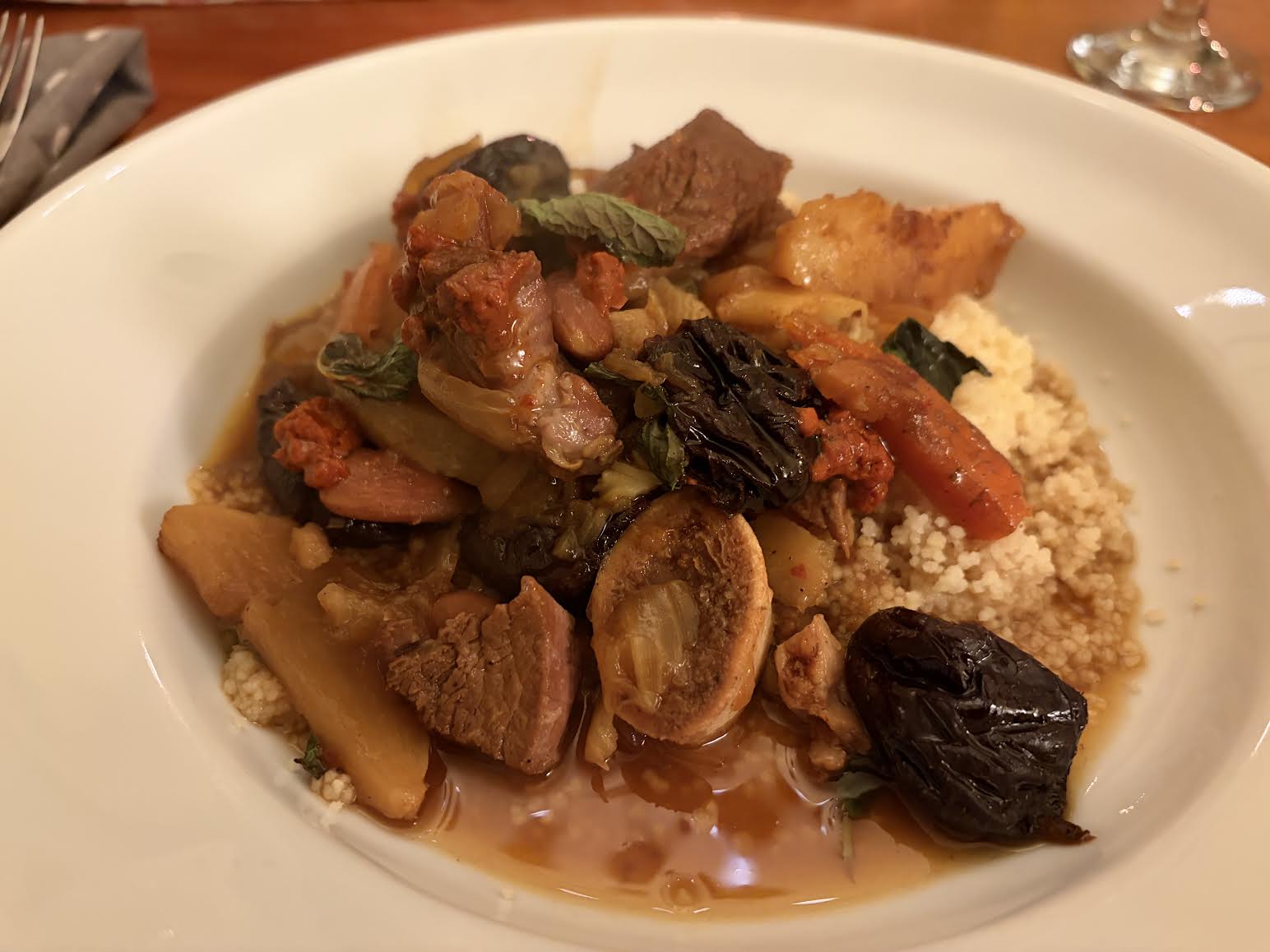
Lamb Tagine with Prunes and Parsnips
2½ pounds bone-in lamb shoulder, cut into chunks
1 teaspoon cinnamon (I used Ceylon, but cassia is fine too)
1 teaspoon powdered ginger
1 teaspoon turmeric
Black pepper
Salt
Extra-virgin olive oil
2 tablespoons unsalted butter
1 large Vidalia onion, cut into small dice
Aleppo pepper
A drizzle of honey
A big splash of dry vermouth
A big pinch of saffron threads, lightly dried and ground in a mortar and pestle and dissolved in about ¼ cup hot water
3 cups homemade chicken broth
3 medium parsnips, peeled and cut into batons
3 medium carrots, peeled and cut into batons
2 small turnips, peeled and cut into wedges
About 2 dozen pitted prunes
About ½ teaspoon rice wine vinegar
A handful of lightly toasted whole blanched almonds
A handful of mint leaves
Preheat the oven to 350 degrees.
Dry off the lamb chunks, and toss them in about half of the cinnamon, ginger, turmeric, black pepper to taste, and a little salt.
Get out a large casserole fitted with a lid. Add about 2 tablespoons of olive oil, and get it hot over medium-high heat. Add the lamb, and brown it all over (do it in batches if it’s too crowed). Take the lamb from the casserole. Pour off excess fat, if necessary.
Add the butter to the casserole. Turn the heat to medium, and add the onion and a little salt. Let the onion soften, about 4 minutes. Add the lamb, a little Aleppo, and the honey, and give it all a stir. Add a big splash of vermouth, and let it bubble away. Add the saffron water and the chicken broth, plus a little extra water, if necessary to almost cover the lamb. Bring it to a boil, put the lid on, and stick it in the oven for 1½ hours.
Pull the casserole from the oven, and skim the surface. Place the parsnip, carrot, and turnip on top of the lamb in an attractive pattern (I made a sunburst sort of look, alternating colors). Sprinkle on the remaining cinnamon, ginger, and turmeric, and add a little more salt. Cover the casserole, and stick it back in the oven for about another hour, just until the lamb is very tender.
Take the casserole out, and tuck the prunes in around the vegetables. Scatter on the almonds. Cover it again, and just leave it on the stovetop. The residual heat from the tagine will soften the prunes.
When you’re ready to serve, taste the broth for seasoning. I added a drizzle of rice wine vinegar to balance its sweetness, but that’s a personal call. You might also want a bit more Aleppo, one of the other spices, or a little more salt. The sauce by this time should be cooked down and not too brothy. If needed, let it reheat, uncovered, over medium-low heat to reduce slightly.
Scatter the mint over the top, and serve the tagine from the casserole. You can serve it over couscous or just with good bread.


 Erica De Mane