
Feeds:
Posts
Comments

Posts Tagged ‘fish’

Red Snapper Veracruz

Recipe below: Red Snapper Veracruz

When I first started cooking seriously, not professionally yet but seriously, I developed a romance about a dish called pescado a la veracruzana. I had no idea what the dish was, but its name evoked glamor. I daydreamed about floating in a dinghy, drinking tequila, and eating big hunks of fish with my fingers, getting warm from the sun but not painfully burnt. The flavors and colors of Mexico seemed a perfect escape when I was a kid trying to get through the long New York winter. My first boyfriend wore those cotton Mexican peasant shirts with the intricate white embroidery, and I was in love with him. Mexico seemeded like a good place.

It wasn’t until I bought my first Mexican cookbook, The Cuisines of Mexico, by Diana Kennedy, that I saw a recipe for the dish, and believe me it didn’t disappoint. It was titled huachinango a la veracruzana, huachinango being the word for red snapper, a popular fish in Mexico. Her version contained capers, green olives, jalapeño, lime or orange, oregano, thyme, tomatoes, and raisins, ingredients all familiar to a kid growing up in an Italian-American household.  I made it a couple of times for my family, and everyone said it tasted like Italian food, sort of like puttanesca.

I’ve since learned that there are many interpretations of the dish, but they all seem to  keep the green olives and capers, which is, I think, as it should be. Some cooks pan-fry the fish and then pour the sauce on top when serving. Others bake everything all at once. I’ve chosen to pan-fry quicky, spoon the sauce on top, and then give it a short bake on high heat to finish cooking through. Kennedy’s had a hit of cinnamon, which I used to include, but now I feel that drags down the freshness of the sauce. Hers also included raisins, which I decided to forgo this time, adding honey for sweetness. Mostly you’ll see recipes using red snapper, but sea bass works well, too. I’ve also encountered versions made with shrimp, which is delicious. I added bay leaf instead of the thyme called for in Kennedy’s recipe, because that was what I had on hand.
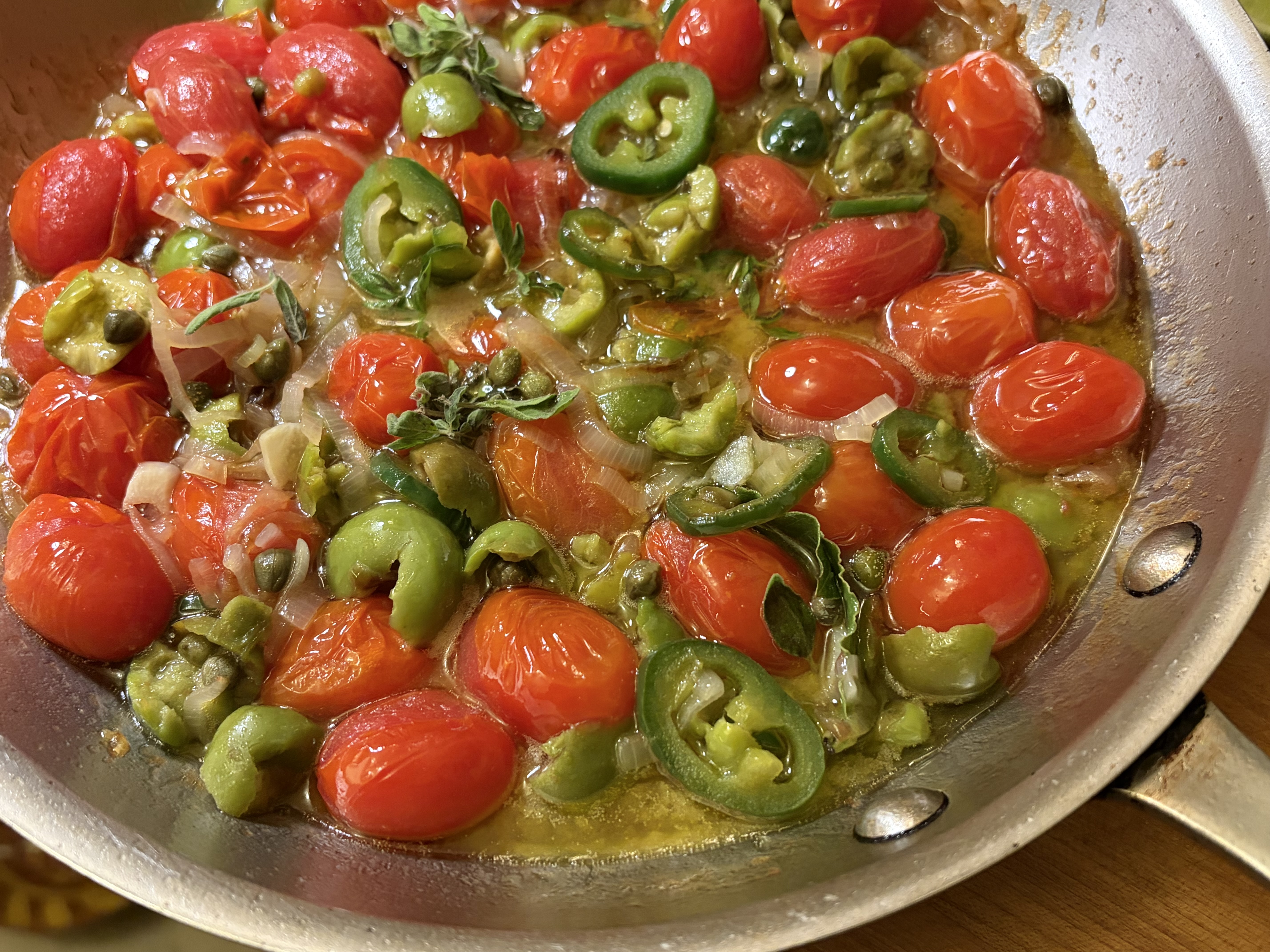
The dish is more Spanish in origin than native Mexican, but the lime and jalapeño underline what a lovely cultural blend it truly is. I hope you’ll give it a try.

Red Snapper Veracruz
Extra-virgin olive oil
1 large jalapeño pepper, cut into thin rounds
1 small shallot, cut into small dice
2 fresh unsprouted garlic cloves, thinly sliced
1 pint grape tomatoes
1 tablespoon honey
1 fresh bay leaf
Salt
A splash of dry sherry
A palmful of good green olives, pitted and torn in half (I used Ascolana del Piceno, but if you want something milder you might want to try Castelvetrano)
⅓ cup salt-packed Sicilian capers, soaked, rinsed, and drained
2 large red snapper fillets, about 6 or 7 ounces each
¼ cup all-purpose flour
About 6 large oregano sprigs, the leaves lightly chopped
A large lime, quartered

Heat the oven to 450 degrees.

To make the sauce (or condimento, as I prefer to call it, since it’s more chunky than saucy), put a big drizzle of good olive oil in a sauté pan, and turn the heat to medium-high. Add the jalapeño slices and the shallot, and sauté for about a minute. Add the garlic, and let it cook for about 30 seconds. Add the tomatoes, and turn the heat to high. Add the honey, bay leaf, and some salt, and cook quickly, just until the tomatoes give off some juice. Add a splash of sherry, and let it bubble away. Add the olives and capers, give it a good stir, and turn off the heat.

Dry off the snapper fillets, and season them on both sides with salt.  Coat them lightly with flour.

Get out another sauté pan, one that can go into the oven, and set it over high heat. Add about 2 tablespoons of olive oil, and let it get hot. Add the filets, presentation side down (skin side up), and brown them quickly, about 2 minutes. Turn them over, and turn off the heat. Pour off any excess oil.

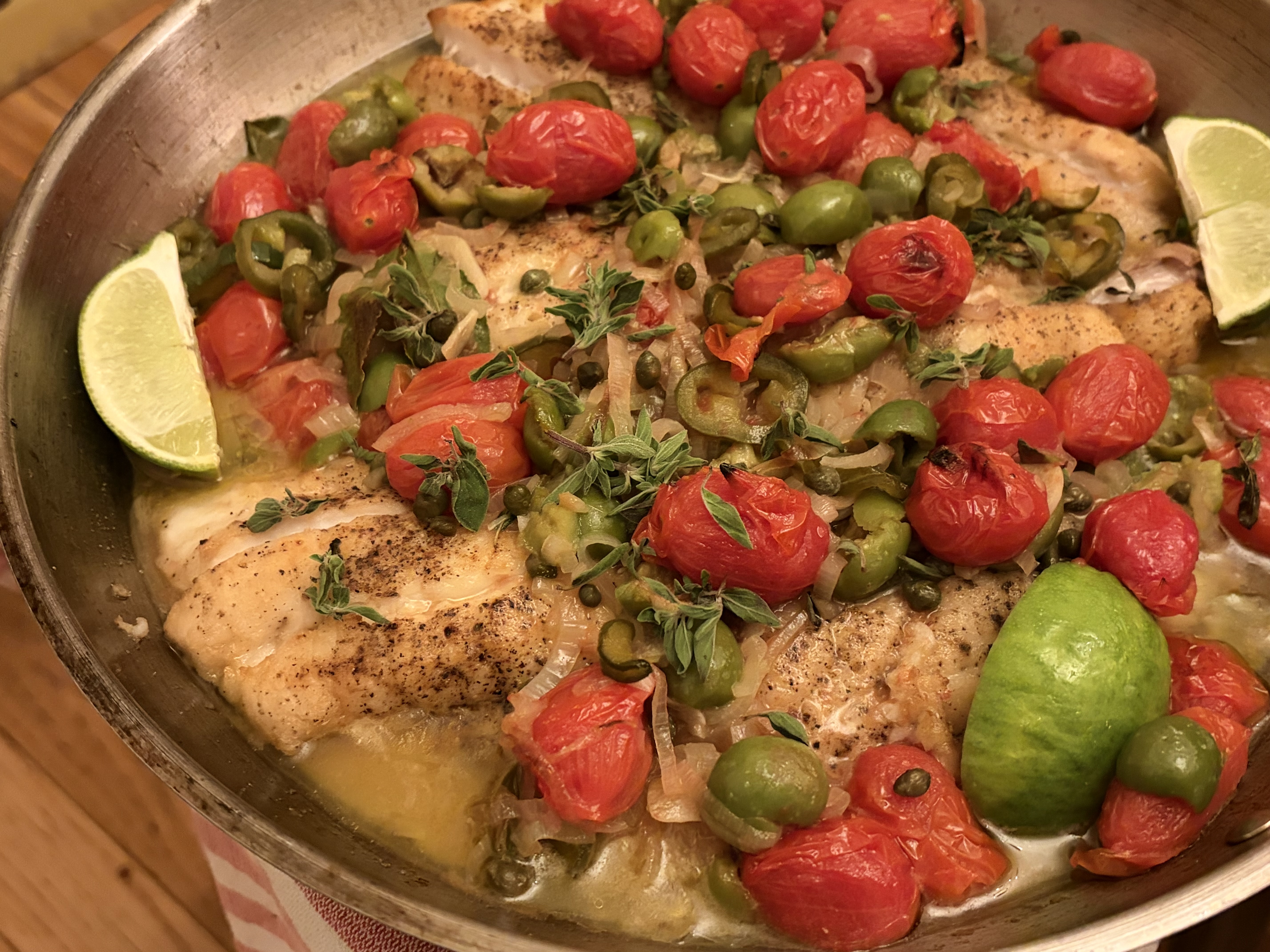
Add about half of the oregano to the olive-and-caper sauce, and then spoon the sauce over the fillets. Drizzle with a little fresh olive oil, and squeeze on the juice from two quarters of the lime.

Stick the dish in the oven to finish cooking the fish and heat the condimento through, about 4 minutes. Garnish with the remaining oregano. Serve right away with the remaining lime wedges.

I served it with plain white rice and a watercress-and-avocado salad dressed with lime, salt, and olive oil.
Read Full Post »

Glowing Snapper Lady, by Tracey Berglund.

Cooking a fish whole can be emotionally fraught. Not because it’s a difficult job. It’s not at all. But because you have to look into those swollen, glassy eyes and say, you’re dead and I’m still alive. You’d think I’d be used to that, cooking as long as I’ve cooked. But it’s always a new death staring back at me. However, it’s good to be reminded, when we want to eat fish or meat, that we or someone has to kill it. It’s a big ugly food chain out there. I’ll eat just about anything, and I’m glad about that. I’m also glad I didn’t grow up on a farm. That would have demolished my open-mindedness. I know that people say the closer your connection to food, the more respect you have for it. True up to a point, but unless I was literally starving to death, I could never personally kill a baby goat (I might be able to kill an old goat—not sure). I need to keep a certain distance to stay free. A coward’s way out. Although I know I can kill an oyster.

Now that we’ve discussed that, I’d like to tell you why you should cook a fish whole anyway. First off, the presentation is beautiful.  If you want to impress someone, this is a nice way to do it. But the most important reason is flavor. It will be the best tasting fish of your life. The skin and bones add moisture and body and a certain lovely stickiness that you miss out on when you cook fillets. It’s that gelatinous quality that lures me every time.

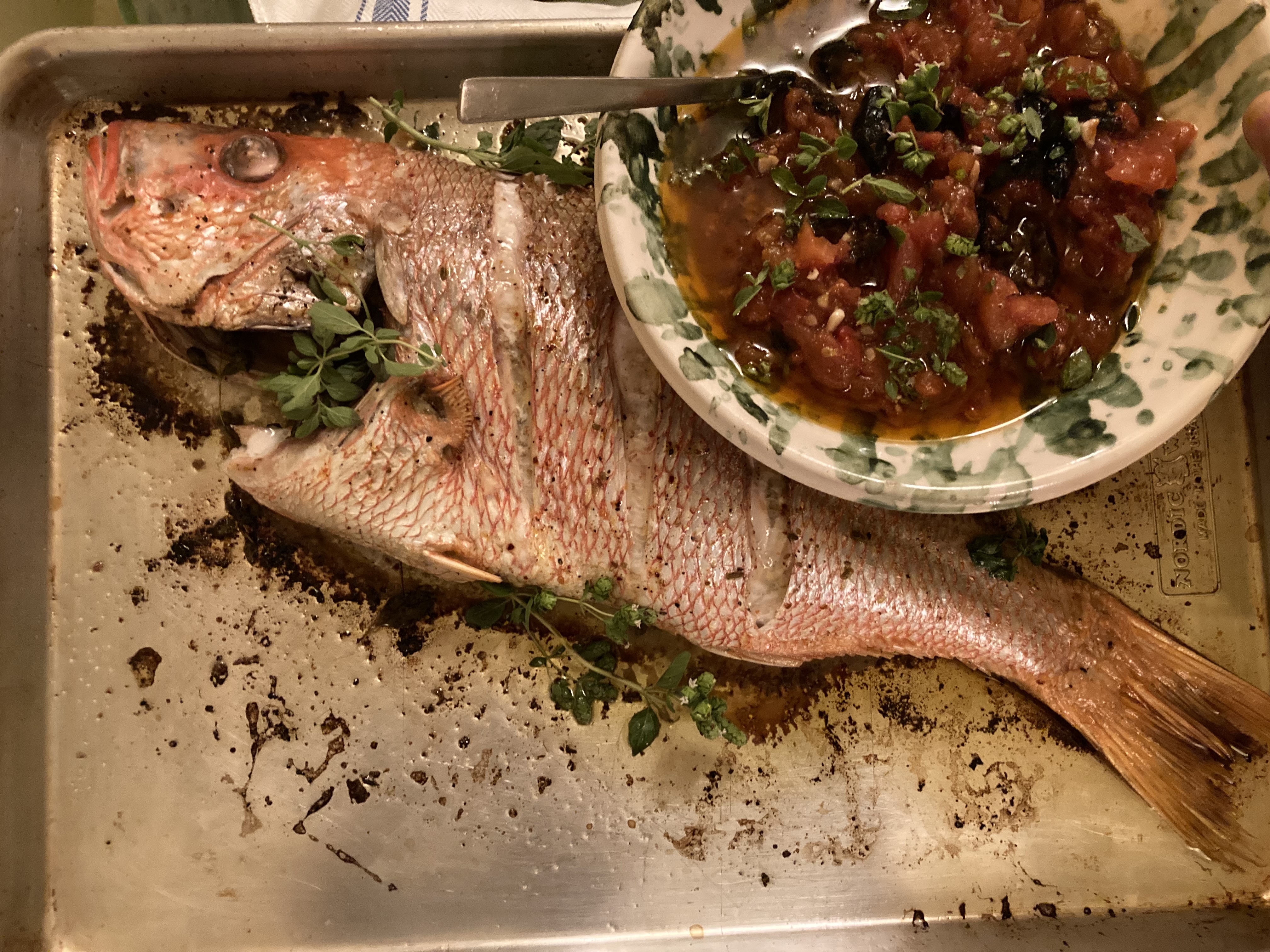
To roast a whole fish what you’ll want to do is stick it in the oven. I’m not being condescending here, but that’s really it.  From my experience, a 2½-to-3-pound whole fish, the size I used for this recipe, will take about 20 to 25 minutes at 425 degrees. Once you know that, the rest is style.

This time around I made a vibrant vinaigrette with lemon, good olive oil, and fennel seeds, and rubbed it all over the fish, inside and out, and then stuffed the inside with Italian oregano. That’s a favorite oregano of mine, not too harsh like the Greek variety. It’s actually a cross between Greek oregano and marjoram, so it’s more floral and less biting. It’s good for a mild fish like red snapper.

I also wanted to make a sauce with our peak-season New York tomatoes, cooking them quickly so not to drain any of their glory. Italian oregano came back as an element of the sauce. I also added those oily, wrinkled Moroccan olives, because I love them.

In the past, my problem with serving whole fish (aside from having to look it in the eyes), has been not how to cook it but how to fillet it when it’s done so my people don’t wind up with a mouthful of bones.  Here’s a good video that shows you how to do that. The spoon he uses is a great idea. Long ago I used to try to lift the fillets off with a spatula, but that scraped up a ton of bones along with the fish. The spoon lets you move gently, feeling as you go.

Roasted Red Snapper with Tomatoes, Cumin, Moroccan Olives, and Italian Oregano

1 approximately 2½-to-3-pound red snapper, cleaned and scaled, the head left on
The juice and zest from 2 lemons
½ cup extra-virgin olive oil, plus a little more for serving
1 tablespoon freshly ground fennel seeds
Salt
Black pepper
6 or so long Italian oregano sprigs

For the sauce:

Extra-virgin olive oil
2 summer garlic cloves, thinly sliced
1 fresh red chili, minced (and seeded if you like less heat)
1 teaspoon freshly ground cumin seed
3 anchovy fillets, chopped
A splash of white wine
3 large red, round summer tomatoes, peeled, chopped, and lightly drained
Salt
A handful of oil-cured, wrinkled black Moroccan olives, pitted and halved
5 sprigs Italian oregano, the leaves lightly chopped

Preheat the oven to 425 degrees.

Get out a sheet pan, and place the fish on it. Make three shallow slashes through the body of the fish on both sides (this will help it cook evenly and also work seasoning into the flesh). Mix the lemon juice and zest, olive oil, fennel seeds, salt, and black pepper together in a bowl. Pour it over the fish, working it into the inside and into the slashes. Make sure both sides of the fish are covered.

Stick the oregano sprigs inside the fish, and put the pan in the oven.

While the fish is cooking, make the sauce. Get out a sauté pan, and set it over medium-high heat. Drizzle in a little olive oil. When the oil is hot, add the garlic, chili, cumin, and anchovies, and sauté until fragrant, about a minute or so. Add a splash of white wine, and let it bubble away. Add the tomatoes, seasoning with a little salt, and sauté about 3 or 4 minutes. Turn off the heat, and add the olives and the chopped oregano. Add a drizzle of fresh olive oil.

Take a look at the fish after 20 minutes. Check  for doneness by sticking a thin knife into it along the backbone. If the flesh pulls away with just a little touch of pull, it’s done. And remember that it’ll cook further as it sits. Depending on the size and thickness of your fish, it may take a little longer.

When the fish is done, you can transfer it to a big platter, if you want to get fancy, but I just left it on the sheet pan with all the roasted herbs and juices spilling out. I thought it looked beautiful.

Fillet the fish (reviewing the video if necessary). Drizzle the fillets with fresh olive oil and a sprinkling of salt. Top each serving with some of the sauce.

Read Full Post »