Feeds:
Posts
Comments

Posts Tagged ‘eggplant’

Dates, Pomegranate, and Persimmon with Silver Cup, by Julian Merrow-Smith.

Here we are in full-blown New York summer. I love the solid heat, the exciting thunderstorms, the rainbows, and, most of all, the produce the wild weather unleashes. Which means it’s ciambotta time.

Ciambotta is Southern Italy’s version of ratatouille. It was a late summer ritual in my family, often using vegetables from my father’s backyard garden. Now it’s my responsibility to carry that on. Ciambotta translates to something like a big mixup or a mess, and the word is often used when someone has created a big emotional mess in their life, as in, “Richie made a real jambot outta his marriage.” (That’s how my family, and most Southern Italian Americans, pronounce the word.) The dish almost always contains the summer quartet of eggplant, sweet pepper, zucchini, and tomato, just like ratatouille, but the Italian version tends to be more freewheeling. Often potatoes or celery, and sometimes chunks of sausage or pancetta, are mixed in, making it a piatto unico, a one-course dish. One thing not to my knowledge ever added to it is dates. But this year they’ve made their way into my version, and I was very happy with how that turned out, the sweet dates playing again the bitterness of eggplant and the acidity of the tomatoes. A success.

I believe I got the idea of adding dates and North African spices to eggplant dishes from one of my Moroccan cookbooks, but I can’t figure out which one (I’ve got a lot of them). I’m thinking it was in a Ghillie Basan book. (If you don’t know her, maybe pick up Flavors of Morocco as a starter. Beautiful recipes, photos, and stories.) Wherever I got the idea from, I just went with it. As you’ve probably noticed, I often add North African touches to my southern Italian food. For me, that’s a natural, flowing from Naples and Sicily’s long-ago history. Much of the Arab influence in Southern Italy has diminished, but I’m here to bring some of it back.

Dates have always fascinated me. How can anything be as sweet as candy and yet be natural? When I was a kid I assumed dates were soaked in sugar, given a sort of candied-cherry treatment. I was amazed to find out they’re just dried. But what excited me more was discovering that those sticky brown dates actually start out as a fresh fruit. I first saw them at Kalustyan’s, the amazing Middle Eastern spice shop in Little India in Manhattan. They were plump, smooth, golden, hanging off of stems in clusters, like bloated grapes. The checkout lady gave me one to taste, and it exploded in my mouth in a sweet gush. Revelation. I try to make it back to Kalustyan’s each year in fresh date season, which happens to start right now and last through September. If you’re interested in tasting a fresh date, make your way over (maybe call first to make sure they’re in stock). However, you’ll want traditional dried dates for this recipe.

Also, if you’d like to read more about ciambotta and consider other approaches to putting this dish together, check out three of may earlier blog posts on the subject here, here, and here.
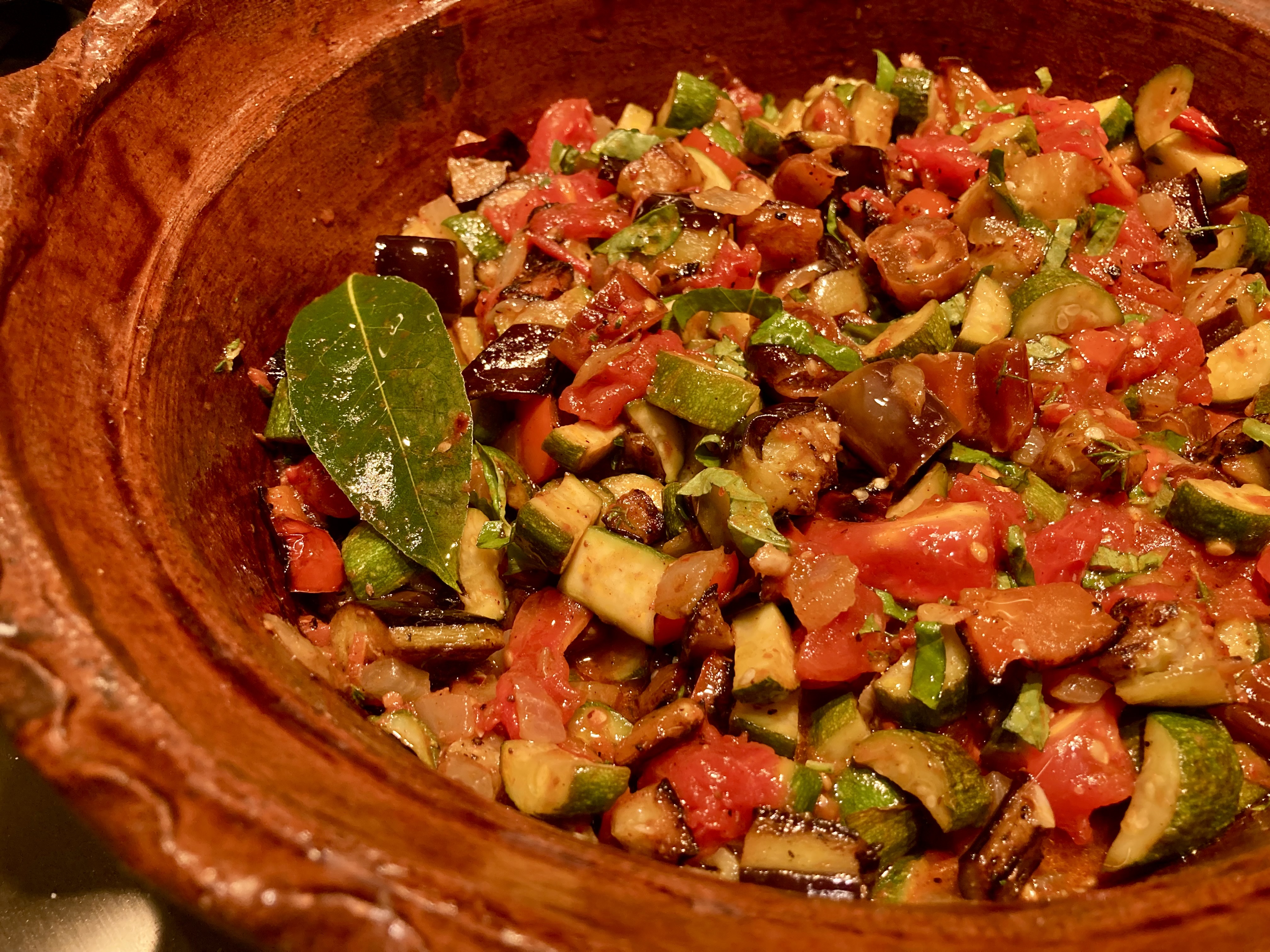
Ciambotta with Dates and Ras el Hanout

Extra-virgin olive oil
1 big summer onion, diced
1 red bell pepper, diced
½ a fresh peperoncino, minced
2 summer garlic cloves, thinly sliced
1 teaspoon ras el hanout spice mix (if you want to make your own, you might want to try my version)
1 large eggplant, stripe-peeled and cut into small cubes
2 fresh bay leaves
A few large sprigs summer savory or thyme
Salt
2 medium zucchini, cut into small cubes
3 medium-size summer tomatoes, peeled, seeded, and chopped, lightly salted, and left to drain in a colander for about 15 minutes (save the tomato water, as you might want it to loosen the dish at the end)
A big splash of dry Marsala
10 to 12 pitted dates, cut into quarters
A few drops of rice wine vinegar
A handful of basil leaves, lightly chopped

Get out a large sauté pan, and set it over medium heat. Add a tablespoon or so of olive oil. Add the onion, bell pepper, peperoncino, half of the garlic, and half of the ras el hanout. Let sauté until everything is fragrant and starting to soften, about 2 minutes. Add the eggplant, one of the bay leaves, and the savory or thyme. Give it a drizzle of olive oil and some salt, and sauté until the eggplant is tender, about 6 minutes. Turn off the heat.

Get out another sauté pan, turn the heat to medium, and add a big drizzle of olive oil, the rest of the garlic, the remaining ras el hanout, and the other bay leaf. Sauté a few seconds, and then add the zucchini, sautéing until it’s tender, about 3 or 4 minutes. Add the tomatoes and a little more salt, and cook for about another 3 minutes. Add the Marsala, and let it bubble away.

Add  this to the eggplant mixture. Add the dates, and mix well. Let everything sit for about 5 minutes. The waning heat from the vegetables will soften the dates but not enough to turn them into mush. Taste for seasoning, adding more salt plus possibly a few drops of rice wine vinegar, to bring up the acidity. Add a little of the tomato water if the ciambotta seems too tight. Add the basil.

Serve hot or warm, or even at room temperature. I love this served with scrambled eggs, but it’s really good with lots of things, such as lamb kebabs, or just as is, with Sicilian-style sesame seed bread, for instance.

Read Full Post »

Still Life with Aubergines, by Henri Matisse, 1911.

Eggplant is a vegetable of my childhood. It cemented my upbringing in Italian-American land. I grew up wanting it. All these years later I still want it, partly now for the various colors of its skin: deep purple verging on black, violet, clear purple, streaky purple, pure white, all shiny. Magnificent. I’m involved in the colors of food more than I used to be. They help me plan, not just my recipes but also my day. Color theme days. I have them, not every day but some days.

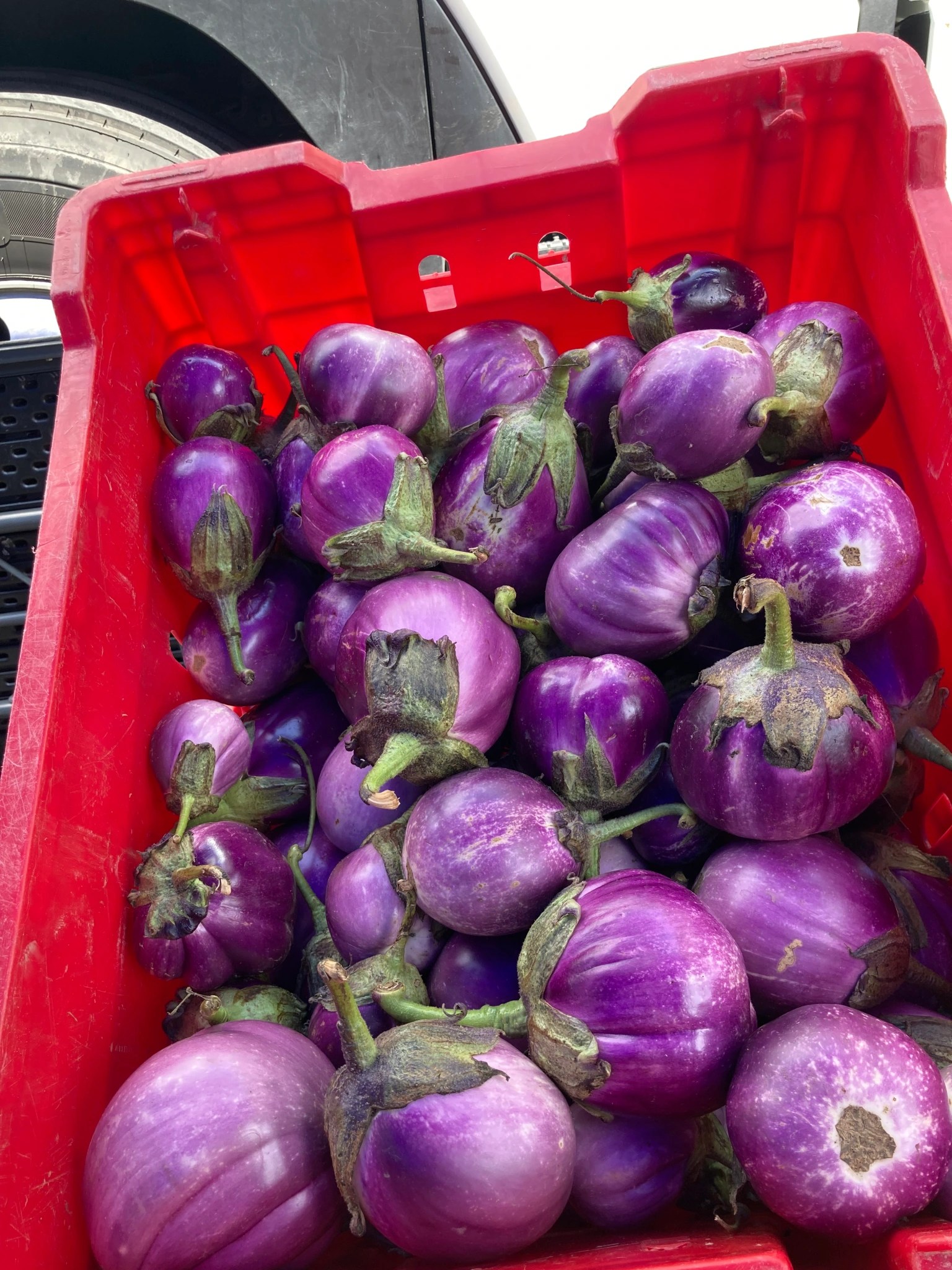
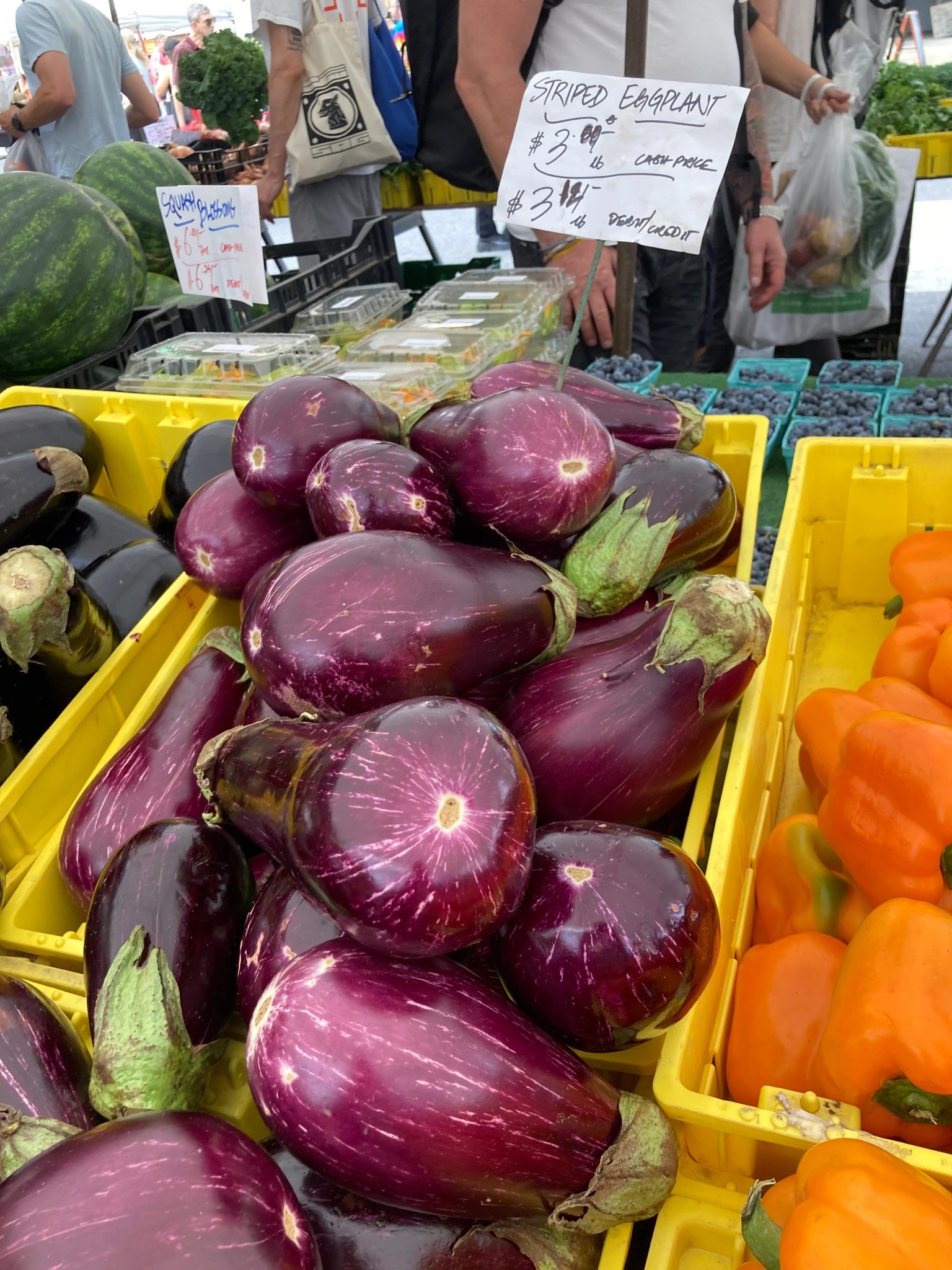
A type of graffiti eggplant, purple pink with streaks of white.

Unfortunately eggplant is not so beautiful when it’s cooked. It’s gray-beige, but its taste is rich. It soaks up herbs, garlic, olive oil, and wine better than most things. It’s a flavor trap.

Barbarella, a type of globe eggplant, blue-purple with hits of white.

Here’s a baked eggplant without tomato, a drift away from Parmigiano. It gets its togetherness from goat cheese and crème fraîche. I think it came out really well. I hope you like it.

I served it with grilled lamb chops marinated in rosemary, fennel seed, and garlic and a radicchio salad dressed with lemon, salt, and good olive oil.

It’s almost August. Tomato recipes will be coming soon. I’m working on a few that should be unexpected. Stay tuned.

Plus: Emergency. Happening now. Starvation in Gaza. I know we can feel angry and helpless in a terrible situation like this, thinking there’s nothing we can do, but there is something. We can support World Central Kitchen, either by donating our time or our money. Please help, if you can. Here’s their link.

Gray-beige but beautiful.

Eggplant Gratin with Goat Cheese, Honey, and Thyme

Extra-virgin olive oil
2 medium eggplants, stripe-peeled and cut into ½-inch-thick rounds
Salt
Black pepper
1 fresh summer garlic clove, minced
1  large egg
1 4-ounce-or-so log soft goat cheese, at room temperature (I used Président brand)
¾ cup crème fraîche
¼ cup whole milk
6 or 7 large thyme sprigs, the leaves lightly chopped
¼ teaspoon allspice
1 tablespoon runny honey (I used an acacia honey)
¼  cup grated Parmigiano Reggiano cheese
¼ cup panko breadcrumbs

Heat the oven to 400 degrees. Lightly coat 2 sheet pans with olive oil. Lay out the eggplant slices on them in a single layer. Drizzle the slices with olive oil, and season them with salt and black pepper. Bake until the eggplant is tender and lightly browned, about 20 to 25 minutes. Take the pans from the oven, and sprinkle the minced garlic over the slices.

Put the egg, goat cheese, crème fraîche, milk, half of the chopped thyme, the allspice, and the honey into a food processor. Add a little salt and black pepper, and pulse a times to blend everything well. It should be thick but pourable.

Turn the oven down to 375.

Coat a baking dish lightly with olive oil (I used an 8-by-12-inch, 2-inch-deep oval).  Lay down a layer of eggplant slices (a little overlap is okay). Drizzle on about ¼ of the goat cheese mixture. Make another layer of eggplant, using it all up. Pour on the rest of the goat cheese mix.

In a small bowl, mix the Parmigiano with the panko and the rest of the thyme. Add a little salt and black pepper and a drizzle of olive oil. Mix it with your fingers, and then scatter it fairly evenly over the top of the gratin.

Bake at 375 until it looks firm and the top is lightly browned, about 30 minutes. Serve hot or warm.

Read Full Post »

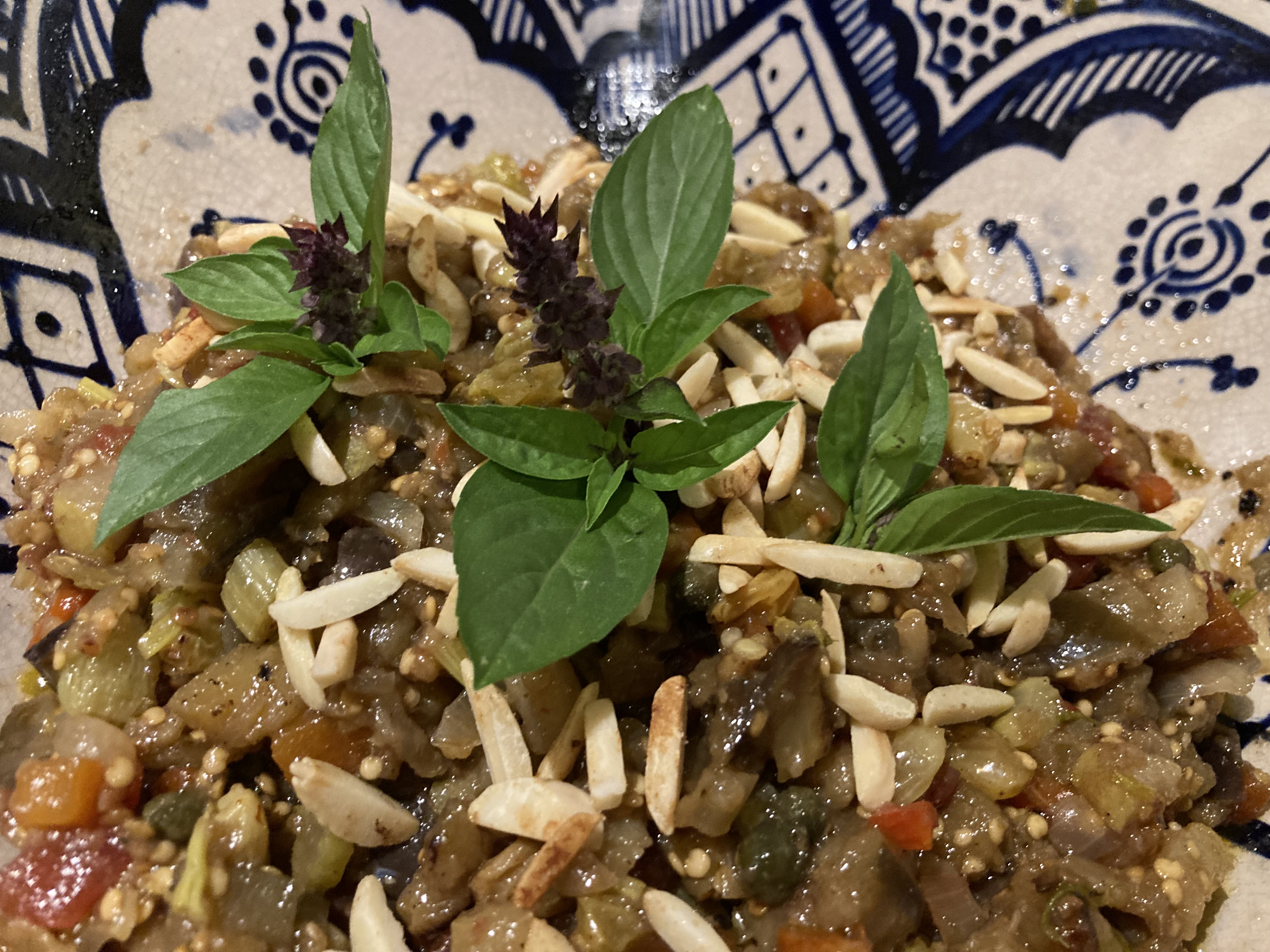
Recipe below: Caponata with Lovage, Thai Basil, and Pear

If you ever get to upstate New York, you probably notice a lot of pizza trucks rumbling around. They show up at farm stands, breweries, wineries, fairs. They pull up and set up, churn out pizzas for a few hours, and then they’re gone. They’re not all great, but some are.

I often hang out at Slow Fox Farm Brewery, in Rhinebeck. It’s both a brewery and a farm, with its own tomatoes, herbs, cabbage, kale, beets, arugula, and rows of, at the moment, zinnias, cosmos, and celosia that you can pick while drunk. As well as more than half a dozen fine house-brewed beers and ales. You can often eat pizza there. So far they’ve had I think three or four different pizza trucks this summer (this should go on into the early winter, before they close up until the spring). All the pizza has been good, but one stands out for me.

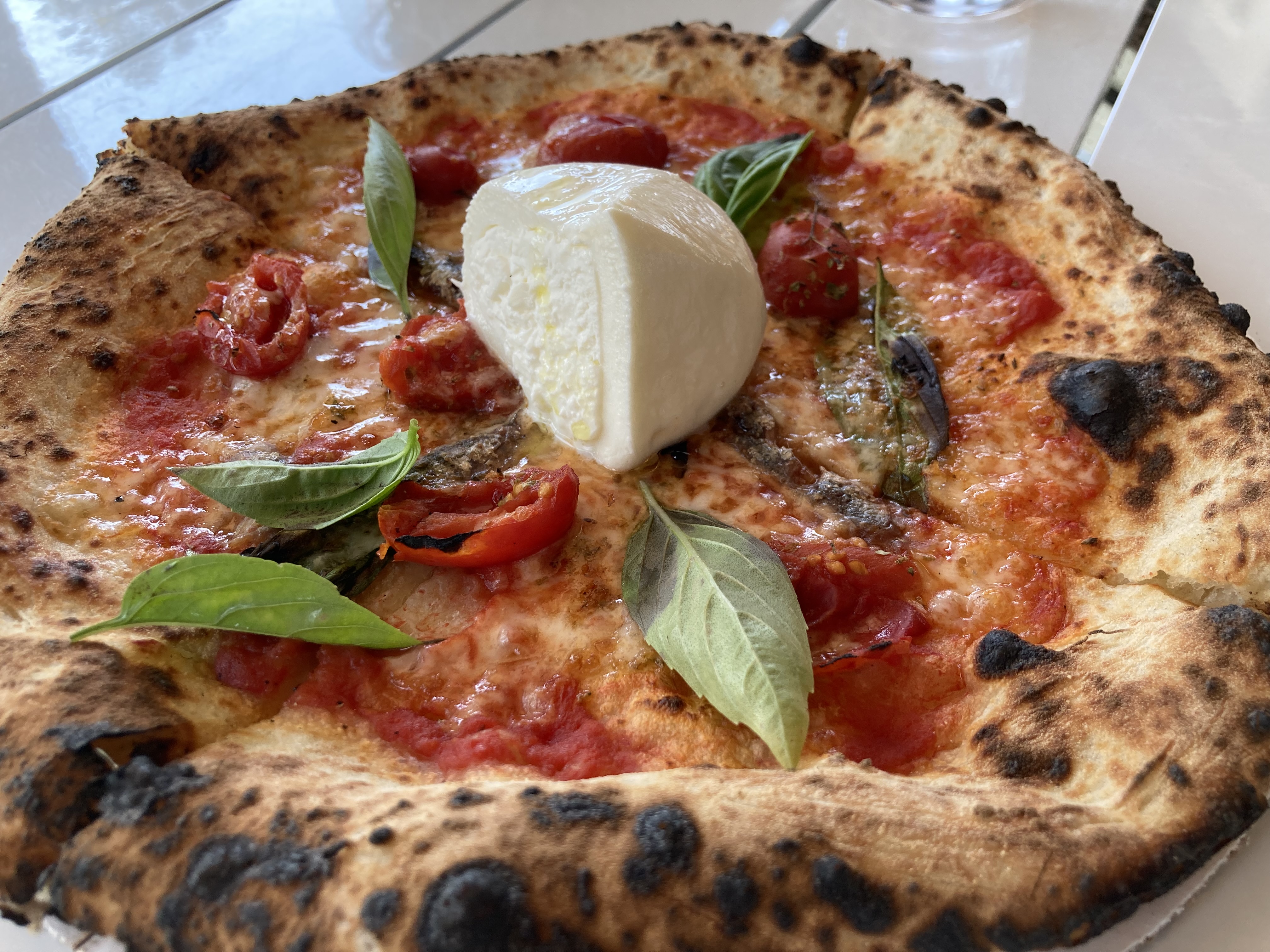
I could tell right away from the aroma wafting out from the Mommò truck that I was going to like its pizza. Mommò, I just learned, is Neapolitan for “right now,” and that’s about right. The pizza takes three minutes to cook. Luca, the owner and pizzaiolo, is from Italy, and he has the Neapolitan flavor down. The crust is yeasty and pully and just a touch salty, with charred but not too charred bubbles circling its rim. That is the taste I want but often don’t get. He’s got wood, but unlike most of the pizza people who drag around a wood burning oven with their truck, Luca had it built right into his truck. It doesn’t seem possible, but I’ve seen it. He explained to me that it’s a stainless steel pizza oven made in Naples for backyard use. It’s a little tight, but he got it to fit. If he turns around without thinking, he can burn his arm. But he’s been doing this for almost three years now, and I guess he’s got the reflex down.

Luca makes an effort to use good ingredients, as not everyone does. He’s got that bright red tomato sauce I always look for, the type that’s ladled on raw but gets flash blasted in the extra-hot oven. So far I’ve tried his margarita, his pizza with shiitake mushrooms, an anchovy and burrata one, and his sausage pizza topped with a nice mellow local sausage. In true Neapolitan style he’s light on the toppings, but you still get that traditional Neapolitan moist spot in the middle that I love. There’s a gorgonzola pizza I’m interested in, too. Next time. If you feel like following Luca around the Hudson Valley, you can track his whereabouts at www.mommopizza.com.

As you probably gather, I do love a good pizza, but what about caponata? Not that they’re related, except for the fact that they’re both Southern Italian. It’s still eggplant season here in New York, so I’ve got to use eggplants every way I can while they’re still young and vibrant. Caponata is of Sicilian origin, one of those full-bodied Spanish- and possibly Arab-inspired dishes with strange lists of ingredients that combine to open up lusciously on the tongue. Eggplant is caponata’s anchor, and agrodolce gives it its swing. It’s an old dish (tomato being a recent addition), which when done up for high-class Sicilians used to include (and sometimes still does) Baroque garnishes such as chocolate, cinnamon, hard-boiled eggs aged in vinegar, and even baby octopus. I kept the cinnamon.

Basil, parsley, and mint are traditional contemporary herbs for caponata. But this September, since I’ve still had tons of lovage in my garden, I’ve decided to add a little of that. And it makes sense, since celery is almost always a component of the dish and lovage has a strong celery-like flavor. If you don’t have lovage, use a palmful of celery leaves instead. I also had Thai basil hanging on, so that went in as well. And since it’s early fall, instead of the more typical dried fruit, usually raisins, I went with pear, just to freshen things up. And I decided on almonds instead of pine nuts because they seemed to go better with the pears. Not sure why. Just a feeling.

And just one more thing about caponata: I don’t care what anyone says, caponata is not ratatouille. It’s not a side dish. It shares basic ingredients, such as eggplant, but the seasoning couldn’t be more different. Its agrodolce boldness steers it toward the antipasto category.  I like it served room temperature, along with bruschetta brushed with good olive oil.

Caponata with Lovage, Thai Basil, and Pear

  • Servings: 6, as an antipasto dish
  • Print

Extra-virgin olive oil
2 firm medium-size eggplants, stripe-peeled and cut into medium dice
Salt
A big pinch of cinnamon (about ¼ teaspoon)
A drizzle of honey (about a teaspoon)
1 red bell pepper, seeded, ribbed, and cut into small dice
1 medium onion, cut into small dice
2 teaspoons Spanish sherry vinegar
3 small inner celery ribs, cut into small dice, plus a handful of celery leaves (especially if you don’t have lovage)
1 firm pear, skinned and cut into small dice
A splash of dry Marsala
1 large, round summer tomato, skinned and cut into small dice
1½ teaspoons sugar
A palmful of salt-packed capers, soaked and rinsed
Black pepper
A handful of Thai basil leaves, lightly chopped, plus whole sprigs for garnish
3 lovage leaves, lightly chopped
A big handful of blanched almonds, lightly toasted and roughly chopped

Have a large serving bowl ready near the stove. In a large skillet, heat a big drizzle of olive oil over medium heat. Add the eggplant, and sauté until it’s tender but still keeping its shape, about 8 minutes. Season it with a little salt and the cinnamon. Add the honey, giving everything a mix. Spoon the eggplant into the bowl.

Add another drizzle of olive oil to the skillet, add the red pepper and onion, and sauté over medium heat until softened, about 4 minutes or so. Add 1 teaspoon of the vinegar, and let it bubble for a few seconds. Add this mixture to the bowl with the eggplant.

Add another drizzle of olive oil to the skillet, and then add the celery and celery leaves, sautéing them until they just start to soften, about 2 minutes. Add the pear, and let it sauté about a minute longer. Pour in the Marsala, and let it bubble away. Add all this to the bowl, and give everything a gentle toss.

Add one more drizzle of olive oil to the skillet, keeping the heat on medium. Add the tomato, seasoning it with a little salt. Add the sugar, and sauté the tomato for about 2 minutes (you want it to remain red and fresh-tasting). Add the other teaspoon of vinegar, and let it boil for a few seconds. Pour the tomatoes into the bowl.

Add the capers and a few big grindings of black pepper to the bowl. Add the Thai basil, lovage, and about ¾ of the almonds. Give everything another mix. Taste for seasoning. The caponata should have a gentle, well-balanced sweet-and-sour taste. Add a little more salt if you need to to bring all the flavors into focus. Let the dish sit and come to room temperature. Then give it another taste, just to check the seasoning. (Dishes taste different at different temperatures, and this one in particular will change flavors as all its various components meld. It might need a little drizzle of vinegar or a bit more black pepper.) Garnish with the remaining almonds and the Thai basil sprigs. Serve at room temperature.

Read Full Post »