Feeds:
Posts
Comments

Posts Tagged ‘cooking’

I’m constantly revising my list of animals I won’t eat. I have the luxury of doing so because I can pay for alternate sources of protein. I used to eat frog legs with butter and garlic and herbs, and they were delicious, but now I can’t. I’ve held frogs many times and felt their skin, thick, green, and rubbery. I know their skin is removed before cooking, but I can’t help remember it was once there. I think about chewing it and choking it down. Completely irrational. I used to eat rabbit too, but when I began working in restaurants and had to skin their soft fur from their dead bodies over and over and over, I decided I couldn’t do that anymore. (Now rabbit usually comes into a restaurant already skinned, but back in the day scalping it was a sad job.) This turnaround is unfortunate for me, because Italian rabbit recipes are very good (coniglio agrodolce, for instance, with green olives, pine nuts, vinegar, honey, and mint). Also, I do understand that frogs and rabbits have very low greenhouse gas issues compared with cows, which are off-the-charts problematic, but I seem to have no problem eating cows. I’m working on changing my thinking about rabbit.

I have never had any problem with any type of poultry, especially duck. I’ve known some ducks personally, but still I can eat them. I could even kill them if I had to, although I’ve never had to.

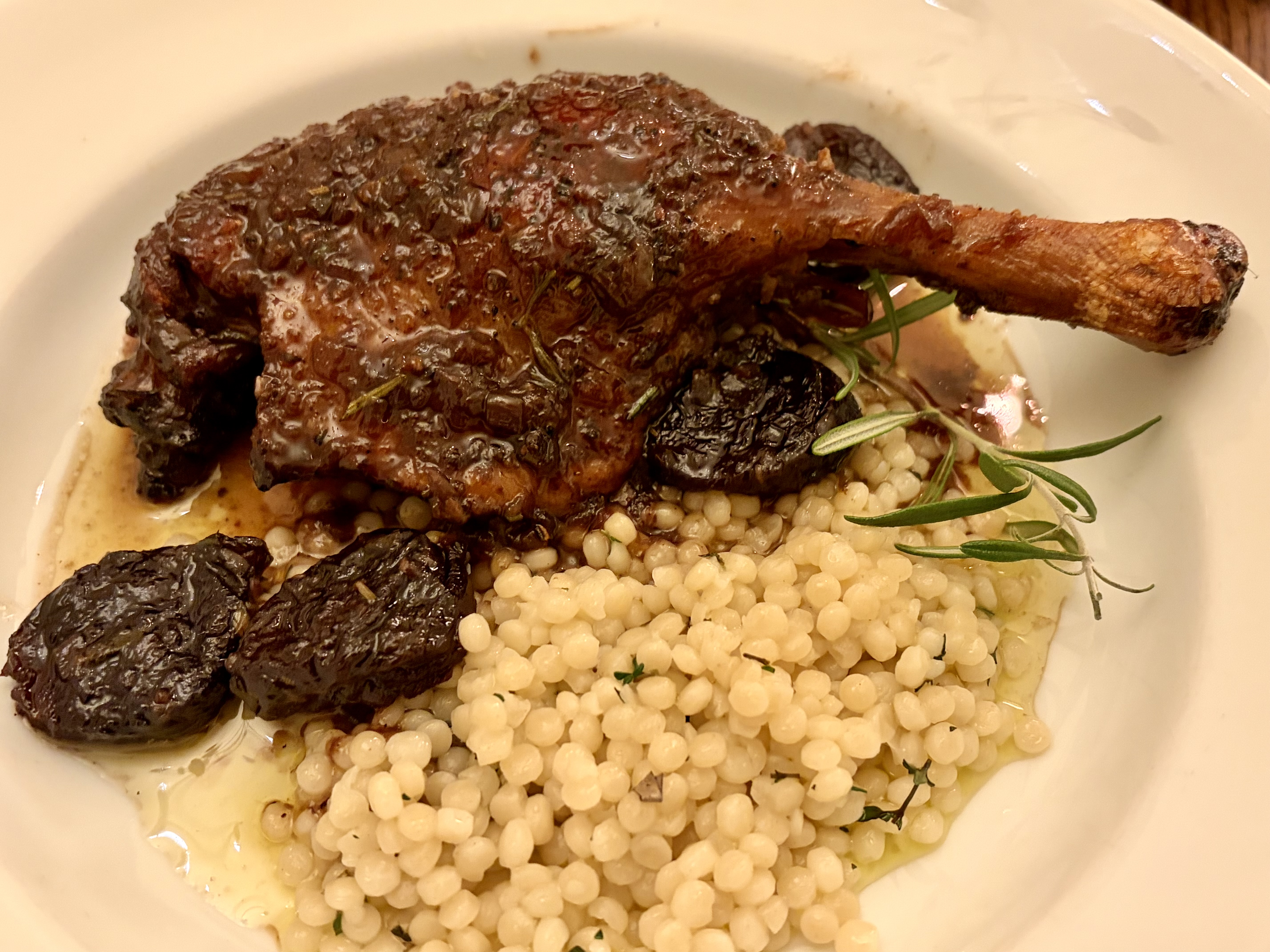
I like cooking duck legs. Once I’ve seared and melted off most of their fat (ducks carry an astonishing amount of fat), I put them into a low oven to braise until tender, a long time, but then there’s no further work for me. The kitchen starts to smell wonderful, especially if red wine is involved in the braise. And their color when they’re tender, a deep burnished red-brown, is just like the few leaves that are now left on the trees outside my apartment window.

For the braised duck I used D’Artagnan whole duck legs on my first try. These are  Rohan ducks, a hybrid that includes both the mallard and Pekin breeds. For my next go-round I tried Hudson Valley Foie Gras Moulard duck legs. Both brands were good and took about two hours to become tender, but the Hudson Valley duck had much more fat, which I trimmed a bit. It also had more meat. Both cooked up tender with excellent flavor.

Braised Duck with Red Wine, Prunes, and Grappa

4 whole duck legs
Salt
Black pepper
Extra-virgin olive oil
1 large shallot, finely diced
1 carrot, finely diced
About ½ teaspoon allspice
5 large sprigs rosemary, the leaves well chopped
A big splash of grappa (if you don’t have any grappa, use  cognac or brandy)
½ bottle red wine (I used a Barbera)
2 cups homemade chicken broth, possibly a little more
12 pitted prunes

Preheat the oven to 350 degrees.

If it looks like you’ve got a ton of fat on your duck legs, carefully trim a little off (I used scissors for this).  Get out a big skillet or sauté pan that will fit the duck legs comfortably (if you have cast iron, I’d use it). Set it over medium heat. Season the legs generously on both sides with salt and black pepper. Drizzle a little olive oil into the pan. Add the duck legs, skin side down, and let them sit there, not moving them around, until they’re well browned. This will take about 8 minutes. You want to cook out much of the fat. If the legs are browning too fast, turn the heat down a little. Give them a flip, and sear the other side for about 2 minutes. Remove the duck from the pan.

Pour off most of the duck fat (keep it for sautéing potatoes or something), leaving about a tablespoon. Set the pan over medium heat again, and add the shallot, carrot, allspice, and about half of the chopped rosemary.  Let the mix sauté until softened, about 3 minutes. Add a big splash of grappa (or cognac), and let it bubble up for about 30 seconds. Add the red wine, and let it reduce by about half.

Put the duck back in the pan, skin side up. Add enough chicken broth to come up a little more than halfway, to just under the edge of the skin. Sprinkle the rest of the rosemary over the duck. Bring the liquid to a gentle boil, and then stick the pan in the oven and braise it there uncovered (which will help keep the skin crisp), for about 2 hours. Add the prunes after 1½ hours. Check once in a while to make sure the liquid isn’t getting too low, and add a little more broth or even water if needed. I didn’t have this problem, but you never know.

Remove the duck to a plate, skin side up. Spoon off excess fat from the pan, and then reduce the sauce if necessary (you want a little thickness in it). Check for seasoning. Plate the duck, and pour some sauce and prunes over each serving.

The first time I made this I served it over a celery root purée and that, I thought, was a good accompaniment. The second time I made Israeli couscous, also good but more neutral, maybe better in a way better for soaking up all the wine and prune sauce.

I also love duck legs slow braised and shredded into a ragù for pasta. If you’d like to try that, here’s recipe I did for it a few years back, using black olives, orange, and basil.

Read Full Post »

An Islamic herb doctor, painted in 1224.

I’ve never done this in any organized way before, but I just now decided it would be a nice thing to rank my favorite herbs by how much I love them. I wanted to write it out for myself, and then I thought possibly you’d be interested in it, too.

I find good uses for every herb except cilantro, which makes me gag. I love summer savory with beans and braised beef and pork dishes, and in minestrone, but it’s not my favorite smell straight on. Thyme is an herb I use in many dishes, often as an anchoring flavor in the early stages of cooking. It’s amazing in a compound butter to melt over a thick pork chop, or as a starting point for chicken alla cacciatore, but cutting a few sprigs and bringing them up to my nose, why do I sometimes smell toothpaste? Strange.  Oregano has a bite I expect to accompany certain grilled vegetables, eggplant and sweet peppers, for instance, and meats, sausages especially. It takes me back to my Italian American childhood. Yet a clean chomp on an oregano sprig doesn’t make me so happy. I love these herbs as tools for cooking, but for all-out beauty of aroma and taste, there are herbs that fall into a different category, ones of pure intoxication. Here are the herbs that are knocking me out right now, in early summer, best, then next best, then down to almost best.

This ranking will likely change as the season progressives. But this is my up-to-the-minute report.

Thai basil

Thai basil’s deep anise aroma is for me an exotic joy, but the herb’s taste is different from its smell, more like licorice. It’s really bold, but somehow I never tire of it. The herb still surprises me, even after years of cooking with it. And its strength doesn’t fade out with heat, unlike other basils. That’s a bonus. Siam Queen is the type I plant. It’s the standard Thai variety that’s easiest to find and grow in the Northeast.  So different from Italian basil varieties. (Actually no basil is originally Italian. Their origins lie in India, Southeast Asia, and parts of Africa, but Liguria and all of Southern Italy have made basil their own.) Every spring when I plant my Siam Queen (it’s an annual), I feel like I’m giving myself a huge gift. Braised calamari with cannellini beans and Thai basil is an exception thing.

Marjoram

If it weren’t for my current love affair with Thai basil, marjoram would be number one. I consider it a perfume, meaning something I’d personally love to smell like. I use it so much in my cooking, I guess I do often smell like it. Even though it’s closely related to oregano, to me they are so different. Marjoram is sweet and floral, with none of the camphor tones of oregano. I do pick up a gentle pine taste, but there’s so much sweetness, too, that nothing registers as sharp. I even made a sweet marjoram sorbetto last summer, and you wouldn’t believe how desserty it was. (I tend to like desserts than could pass as appetizers.) Marjoram is my current favorite flavoring for shellfish. I recently used it in place of Italian parsley in a linguine with clam sauce, I thought with good results.

Genoa basil

Genoese basil is what Genoese pesto is all about. It’s a beautiful clean basil, without a profound hit of anise. For me, it’s a perfect blend of sweet and savory. My father always grew it in his backyard garden. Each leaf was precious. At the end of the season he’d salt what was left, wrap it in plastic and then in aluminum foil, and stick his little packages in the freezer, only to pull them out in December, the leaves now black as could be, to add to our Christmas Eve zuppa di pesce. Floating black strips in a sea of  mussels and shrimp. That memory now makes me sad, I guess because we can now buy fresh basil at the supermarket year-round. He worked so hard on his basil. But there’s nothing like summer basil, picked from the garden and immediately ground down into a pesto.  That ritual is reserved for high summer.

Rosemary

I’m crazy about rosemary, but I think I overdid it with it last year. I used it in places where I should have chosen something less obvious. I also added it many sweet things, like sugar cookies and polenta cake.  It started to wear on me. But its pure pine aroma is such a draw, I reach for it sometimes when I’m feeling disgusted or agitated, knowing it will likely lift me up. However, it offers no sweetness. When I crush a needle in my fingers I capture fresh eucalyptus. I think the beauty of rosemary comes through best when you let heat open it up and diffuse its oils. Rosemary-and-garlic lamb spiedini, and rosemary-and-lemon roast chicken come to mind. Classics.

Fennel

Fennel is a natural flavor for me, maybe because I grew up smelling and tasting all the Italian fennel or anise liqueurs that appeared on our table after dinner. Sweet and bitter are stamps of many Italian childhoods. I grow a cultivated variety of wild fennel in my garden, mainly for its fronds. It has become a perennial there, in upstate New York. Not sure why. Maybe global warming? It grows tall and bushy and attracts Eastern swallowtail caterpillars, which is one of the reasons I plant it. Its fluffy fronds are excellent raw in salads and are a main component of pasta con le sarde, which I make at least once every summer. But the big event is when it goes to seed in the early fall. I cut off its umbrella-like flower stalks, which contain its seeds, and plunge them into Everclear to make my bright green finocchietto, a liqueur stronger and way less sweet than the sticky ones I grew up with. My finocchietto clears the head, and it’s also great worked into a big bowl of mussels with crème fraîche and tarragon.

Spearmint

A few years back I planted Berries and Cream mint, a spearmint cultivar. It jumped pot and is now taking over part of my garden. That’s a good thing. I use a lot of spearmint, especially since I began cooking Sicilian food years ago. Zucchini with anchovies, summer garlic, and fresh mint I make as soon as I see the first zucchini show up at the local farm stands. I just cooked up a pot the other day. Blood oranges, spearmint, a little red onion, salt. It is a dish I wait for every winter.  

Spearmint is soft and sweet, good to just stick your nose into, which I often do. A strange thing happens when you heat spearmint. A caraway taste is released. That’s because both plants carry a molecule called carvone. I like its flavor, but I don’t want it in the forefront, so to preserve a clean mint taste I don’t let the herb stew in a dish. I add it at the last minute instead. And on a sweaty summer day I love grabbing a handful and sticking it into a pitcher of cold water, a glass pitcher so I can admire the herb’s beauty.

Lemon verbena

Its aroma is phenomenal, like pure, clear lemon zest without any of the bitter. But since lemon verbena’s brilliant aroma fades with heat, it’s a waste to add the leaves to a stew or a braise. I’ve learned that the best way to harness its beauty is to mince it raw into a semi-damp cluster. Then you can scatter it over cooked dishes or work it into an ice cream mix. I make a gremolata substituting lemon verbena for the lemon zest, mixing it with Italian parsley, maybe some sage, and fresh garlic. Grilled swordfish with that is a wonderful thing.

Bay leaf

If I tear a fresh bay leaf in half and bring it up to my nose and sniff it in, I sense a softness of atmosphere, a gentle mix of pine and thyme. Some people say bay leaves have no flavor. That’s just crazy. Maybe those dried-out things you buy in jars don’t offer much, but since now you can find fresh bay leaves year-round at many supermarkets, there’s no excuse for those. I like to use a few bay leaves to perfume a chicken broth that will go into risotto, and I often add the leaves to a winter tomato sauce. A dish I learned years ago from Giuliano Bugialli and still make often is baked ricotta lined with bay leaves, a lot of bay leaves. Their perfume penetrates the entire cheese. I love it drizzled with honey and served warm. Make sure you deal with true bay, with the fatter, more rounded leaves. The long, tapered California bay leaves can be harsh.

Italian parsley

After traditional Genoese pesto, my second favorite pesto is made with all Italian parsley, almonds, a little grana Padano, and fresh summer garlic. I love Italian parsley’s clean, slightly black pepper taste. I use it so often with seafood that I sometimes taste a fishy undertone when I bite a leaf, but I don’t think that actually exists. It’s just a brain jump. Have you ever tried making a salad of all Italian parsley? I eat that alone, dressed with good olive oil and a few drops of sherry wine vinegar. It tastes surprisingly deep to me. It also makes a great bed for roasted chicken.

And now for the recipe . . .

As you can see above I happened to buy one very large skate wing, which I knew would be difficult the cook and flip without breaking. I had a lucky flip, and it stayed in one piece. I’d suggest that for this recipe you get two smaller wings to make your life easier.

Sautéed Skate with a Marjoram Caper Salsa Verde

For the salsa verde:

Salt
¾ cup marjoram leaves
⅓ cup extra-virgin olive oil (a good one—I used Benza Taggiasca oil from Liguria, which Gustiamo carries)
A palmful of Sicilian salt-packed capers, soaked for about 10 minutes, changing the water a few times, and then drained
The grated zest from a large lemon

For the fish:

2  cartilage-free skate wings, about ½ pound apiece
Salt
Black pepper
Extra-virgin olive oil
2 tablespoons unsalted butter
About ½ cup fine semolina (I used Bob’s Red Mill)
The juice from 1 large lemon

To make the salsa verde, set up a pot of water, add salt, and bring it to a boil. Drop in the marjoram leaves, and blanch them for about 30 seconds. Drain them, and run cold water over them to stop the cooking and set their color.  Give them a squeeze to remove excess water. Give them a rough chop. Mix the marjoram with ⅓ cup of your best olive oil, the capers, a little salt, and the zest from a large lemon. That’s your salsa.

Pat your skate wings dry with paper towels, and season them well, on both sides, with salt and black pepper.

Get out a sauté pan large enough to hold the fish without overlapping (you might need to use two pans). Set it over high heat, and add a few tablespoons of olive oil and the butter.

Pour the semolina out on a plate, and coat the skate on both sides, shaking off excess.

When the oil is hot, add the skate, and let it brown, about 3 minutes or so. Gently give the pieces a flip with a large spatula, and brown them on the other side, about another 3 minutes. When the skate pulls apart easily when poked with a knife, it’s done. Squeeze the lemon juice on the skate, and plate it. 

Spoon a generous amount of the salsa verde down the middle of the fish. Serve right away.

Read Full Post »

Fumée d’Ambre Gris, by John Singer Sargent, Morocco, 1880.

Does every moderately successful person have a mentor? I don’t know the answer to that. I’d call myself moderately successful. I could have had more opportunities, to write more books for one thing, if I wanted to be more well-known. But I didn’t want that. So here I am writing to you on this rainy day in Manhattan. What I’ve learned so far, I’ve learned pretty much on my own. And I know a hell of a lot about Italian cooking.

If I had to name a culinary mentor, it would be Paula Wolfert. You’d think it would be someone who cooked Italian, like Marcella Hazan for instance, but that didn’t happen (one of my problems with Hazan was that I got the feeling she didn’t have much respect for Southern Italian flavors). Wolfert’s book Couscous and Other Good Food from Morocco came out in 1973. I didn’t discover her until 1979. I had already learned basic Southern Italian from mimicking the food my family cooked. I bought her book because it looked like an adventure. And it was. I quickly cooked my way through it. I couldn’t stop. And I liked her attitude, the fact that she went to Tangier initially to study poetry but found her teacher Paul Bowles such a drugged-out bore that she began visiting the local ladies to see what they were up to in the kitchen. And her culinary career was born.

Aside from Southern Italian cooking, the only cuisine I’ve absorbed in a deep way is Moroccan. The flavors immediately made sense to me, since Southern Italian cooking still carries hints of its Arab past. My only problem with traditional Moroccan cooking is its reliance on cilantro. I can’t even be in the same room with the stuff. I’ve gotten around it by subbing mint, basil, or parsley (and sometimes thyme or oregano), creating different dishes to be sure, but in the process coming up with ones that are truly my own. Here’s one of my Southern Italian–Moroccan hybrids.  

I hope everyone had a successful No Kings Day.

Monkfish Tagine with Saffron, Almonds, and Mint

2 pounds monkfish, cut on an angle into ½-inch-thick medallions
Salt
Piment d’Espelette
Extra-virgin olive oil
2 tablespoons butter
2 shallots, cut into small dice
½ teaspoon ras el hanout (here’s my recipe, if you’d like to try making your own, in a post that also includes my recipe for carrots roasted with ras el hanout, summer savory, and crème fraîche)
1 1-inch chunk fresh ginger, peeled and minced
2 summer garlic cloves, sliced
2 fresh bay leaves
6 thyme sprigs, the leaves chopped
A big splash of dry vermouth
A big pinch of saffron threads, lightly dried, ground to a powder, and opened up in about ½ cup of hot water
1 35-ounce can Italian plum tomatoes, chopped, using some of the juice (if yours are packed in a thick purée, wash most of it off)
1 teaspoon honey
About ½ cup flour
A handful of fresh spearmint leaves, lightly chopped
A palmful of toasted almonds, lightly chopped

Pat the fish pieces dry. Season them with salt and some piment d’Espelette.

Get out a wide sauté pan, and set it over medium heat. Add a big drizzle of olive oil and a tablespoon of butter. When hot, add the shallot, ras el hanout, and ginger, and let it soften for a couple of minutes to release its flavors. Add the garlic and a little salt, and sauté for another minute. Add the bay leaves and thyme, and let them warm through. Add the dry vermouth, and let it bubble for a minute. Add the saffron water, tomatoes, honey, and another good pinch of piment d’Espelette. Simmer uncovered for about 5 minutes. Turn off the heat.

In another wide sauté pan, turn the flame to high, and add about 2 tablespoons of olive oil and a tablespoon of butter.

Put the flour on a plate, spread it out, and coat the monkfish slices on both sides with it, shaking off excess.

When the oil is hot, add the fish slices. Brown them quickly on both sides.

Turn the heat back on under the tomato saffron sauce, and add the fish to it, spooning the sauce over the top and cooking just until the fish is tender, about 3 or 4 minutes, depending on thickness. Check the seasoning.

Transfer to a serving platter. Scatter the mint and almonds over the top.

I served this with a buttery couscous seasoned with a pinch of cinnamon, but you could instead just buy some good bread to go with it. Or make rice.

Read Full Post »

7 Chickpeas, by Ausra Kleizaite.

Recipe below: Lagane Spagliato with Rosemary, Guanciale, and Ceci

I’ve developed a romance with chickpeas. They’re so solid. I love how they take a while to cook, and how their deep, beany aroma grows stronger as the hour or so slips by. I can see when they’re ready, and I can smell when they’re ready. I’ll never go back to buying canned. Canned chickpeas taste sour and metallic, and their liquid is useless (unless you’re making a vegan meringue). The broth produced by cooking your own ceci is pure gold.

A dish I come back to constantly is pasta with chickpeas. For me it’s perfect. A thing of beauty. Here’s one of my versions of lagane e ceci, semolina pasta with chickpeas, a very old, pre-tomato dish made in various forms in Calabria, Basilicata, Campania, and Puglia (whose version, called ciceri e tria, has a portion of the pasta not boiled but fried crispy—really delicious).

Lagane e ceci is pure cucina povera. What sets it apart from many other pasta-and-chickpea dishes is its homemade semolina pasta, made with only semolina and water. It’s a chewy, sturdy pasta, sort of a shorter, thicker fettuccine. It’s great to eat but for me a little annoying to roll and form, so what I’ve done here is make it considerably less povera by adding eggs and some white flour to the dough. I can’t comfortably call it lagane, since I’ve screwed with it so much, so I’m going with lagane spagliato, false lagane. I’ve also added some rosemary to the dough, to mimic one of the flavors in the sauce.

When I make semolina pasta I usually use Bob’s Red Mill Semolina Four. It’s finely ground and easy to work with. Semolina has a higher gluten content than soft white flour, so you’ll be using a little push and pull to knead it into shape

This time around I tried a new to me chickpea brand called Cece di Poggio Aquilone, grown on the Alberti family’s organic farm in Umbria. I was really happy with how it cooked up. The chickpeas are slightly smaller than the usual ones we all know, and their flavor is rich. I got them from Gustiamo.

Lagane Spagliato with Rosemary, Guanciale, and Ceci

  • Servings: 4 as a main course
  • Print

For the pasta:

2 cups unbleached white flour
½ cup semolina flour
A large sprig of rosemary, the leaves minced
1 teaspoon fine sea salt
3 large eggs
2 egg yolks
1 tablespoon extra-virgin olive oil
A drizzle of water, if needed

For the sauce:

A 1-inch chunk of guanciale, diced (about a cup)
Extra-virgin olive oil
2 celery stalks, cut into small dice, including the leaves, lightly chopped
1 Vidalia onion, cut into small dice
2 fresh bay leaves
About ½ teaspoon allspice
A few sprigs of rosemary, the leaves chopped
½ a green medium-hot chili (I used an Italian long hot), chopped
Salt
2 to 2½ cups cooked chickpeas, preserving the cooking liquid (see note on cooking them below)
About ½ cup dry white wine (I used a Fiano di Avellino)
About ½ cup good chicken broth
A few large sprigs of flat-leaf parsley, the leaves lightly chopped
A chunk of Pecorino Sardo, if you’d like some cheese (I can go either way with this—with the hot chili I’ve used here, most of the time I don’t want cheese, but when I make it without the chili, maybe just with black pepper, I almost always add cheese)

To make the pasta:

Start by putting both flours into a food processor. Add the rosemary and the salt, and pulse a few times to blend. In a small bowl mix the whole eggs, the yolks, and the olive oil. Pour this over the flour, and pulse a few times to blend everything well. The dough should  clump together in a shaggy ball. If it seems dry, drizzle in a little water, and pulse again.

Dump the dough out onto a work surface, and knead it until it’s smooth, adding a little white flour if it gets sticky. You’ll notice that the dough is a little stiffer than one made with all soft flour, so it will take about 5 minutes of kneading to smooth out. When that’s done, cover the dough with plastic wrap, and let it sit at room temperature for at least an hour so the gluten can relax, making it easier to roll out.

Cut it in quarters, and run each piece through a hand-cranked pasta sheeter to the fifth setting, not super thin, in keeping with the lagane tradition. If the sheets get longer than about 6 inches, cut them in half. Place the sheets on a lightly floured surface, and let them dry for about ½ hour, so you can cut them without sticking.

After that, loosely roll up each sheet and cut it into approximately ¼-inch sections. Unroll the lagane, and toss them in a little flour. Let them sit until you’re ready to cook them.

To make the sauce:

Get out a large sauté pan, and set it over medium heat. Add the guanciale and a tablespoon or so of extra-virgin olive oil, and cook until the guanciale has given up much of its fat and started to crisp. Add the celery, onion, bay leaves, allspice, rosemary, and chili. Season with a little salt, and sauté until everything is fragrant, about 5 minutes.

Set up a pot of pasta cooking water, and bring it to a boil. Add salt.

Add the cooked chickpeas to the pan, and sauté for a minute or so. Add the white wine, and let it bubble out for another minute. Add the chicken broth and about ½ cup of the chickpea cooking liquid, turn down the heat a bit, and let simmer to blend all the flavors.

While the sauce is simmering, drop the lagane spagliato in the water, and cook it for about 3 minutes. Drain it, and pour it into a wide serving bowl. Drizzle on some good extra-virgin olive oil and give it a toss. Add the chickpea sauce and the parsley, and toss gently, adding a little more chickpea cooking liquid if the dish seems dry. Check for seasoning. Serve hot, with or without pecorino.

A note on cooking chickpeas for this dish:

For this recipe I added a few bay leaves, a rosemary sprig, a smashed garlic clove, a slightly soft whole shallot, and a  drizzle of olive oil to flavor the water I boiled the chickpeas in. About halfway through the cooking, I added some salt and a thread of red wine vinegar. I didn’t pre-soak these Umbrian chickpeas, and they wound up taking about 1½ hours to get tender. I always cook the whole bagful when I make beans. I used about 2 cups or so of the bag for this pasta, and the rest went into a chickpea-and-escarole soup. For this pasta, make sure to keep the chickpea cooking liquid, since you’ll want some of it for the sauce.

The bar at Gene’s Restaurant.

I don’t go to bars by myself as much as I used to, but sometimes they’re just the thing to settle my head, especially with all the crap going down in Washington lately. The bar at Gene’s is often my place. This West Village restaurant opened in 1919, and it doesn’t look like much has changed since then. The bar is deep and lovely, with dark wood and glowing backlit bottles. I can settle right in and immediately be part of it.

The wine list isn’t what I would call up to date, but it serves the purpose of preventing wine snobs from crowding up the place. The Chianti is good, the Côtes du Rhône, not so much, but the pour is beyond generous, almost a little shocking, considering what you usually get for $18 at a trendy place around here. Franco (see photo above), everyone’s favorite bartender, is there most nights. He’s a kind man.

For years Gene’s seemed to be frequented mainly by old neighborhood types who shuffled in for their martinis and meat ravioli. But recently, maybe with the popularity of revamped Italo-Americano places like  Don Angie a few blocks away, the place has been discovered by a younger crowd, making it seem almost lively, though, believe me, it is not in any way revamped. The bar can get crowded now. I remember going in there with my father years ago, he ordering a Chivas Regal on the rocks, me with my little glass of sambuca. We’d often be the only ones there, except maybe for that old AP reporter who lived upstairs. I don’t mind crowded, as long as I can get a seat, but I’ve found that now it’s best to go at 5:30 or after 10 (10 is considered late in Gene’s world).

The food is standard old-school red sauce. I’ve found the chicken parm and veal piccata and most of the pastas to be just okay, mostly lacking in salt and pepper (easily remedied, you’d think). However, the broccoli rabe with garlic and hot chili is really good. Sitting at the bar, I often just order a plate of that, with some bread, and call it dinner. Oh, and the baked clams are more than decent.

Sitting at the bar getting vaguely high on a glass or two of Franco’s big pours is a cozy feeling. As I get older, men don’t bother me as much, so I often can just sit and let my mind wander, maybe making plans for the future or maybe just thinking about how happy I am that bars exist.

Happy cooking to you. Soon it will be spring.

Read Full Post »

A poster with a calzone on a maiolica plate.

Recipe below, in text: Calzone with Scamorza and a Spring Herb Pesto

The word calzone doesn’t immediately make me think warm weather cooking. It reminds me more of being a broke, hungry 20-year-old, on a freezing day in downtown Manhattan, urgently needing to get hold of the most filling food I can find for the smallest amount of cash. Industrial prosciutto, dough, dripping ricotta, all in a hot, oily package. I worshipped the calzone back then. Still do, but maybe not as desperately.

National Calzone Day is November 1.

A calzone is not a thing of elegance (the word means pants leg, which kind of sums up its clunky look and feel), but as I was thinking about new dishes to make with all the herbs now exploding in my garden, I thought, why not a calzone? Why not lighten one up with fresh greenery?

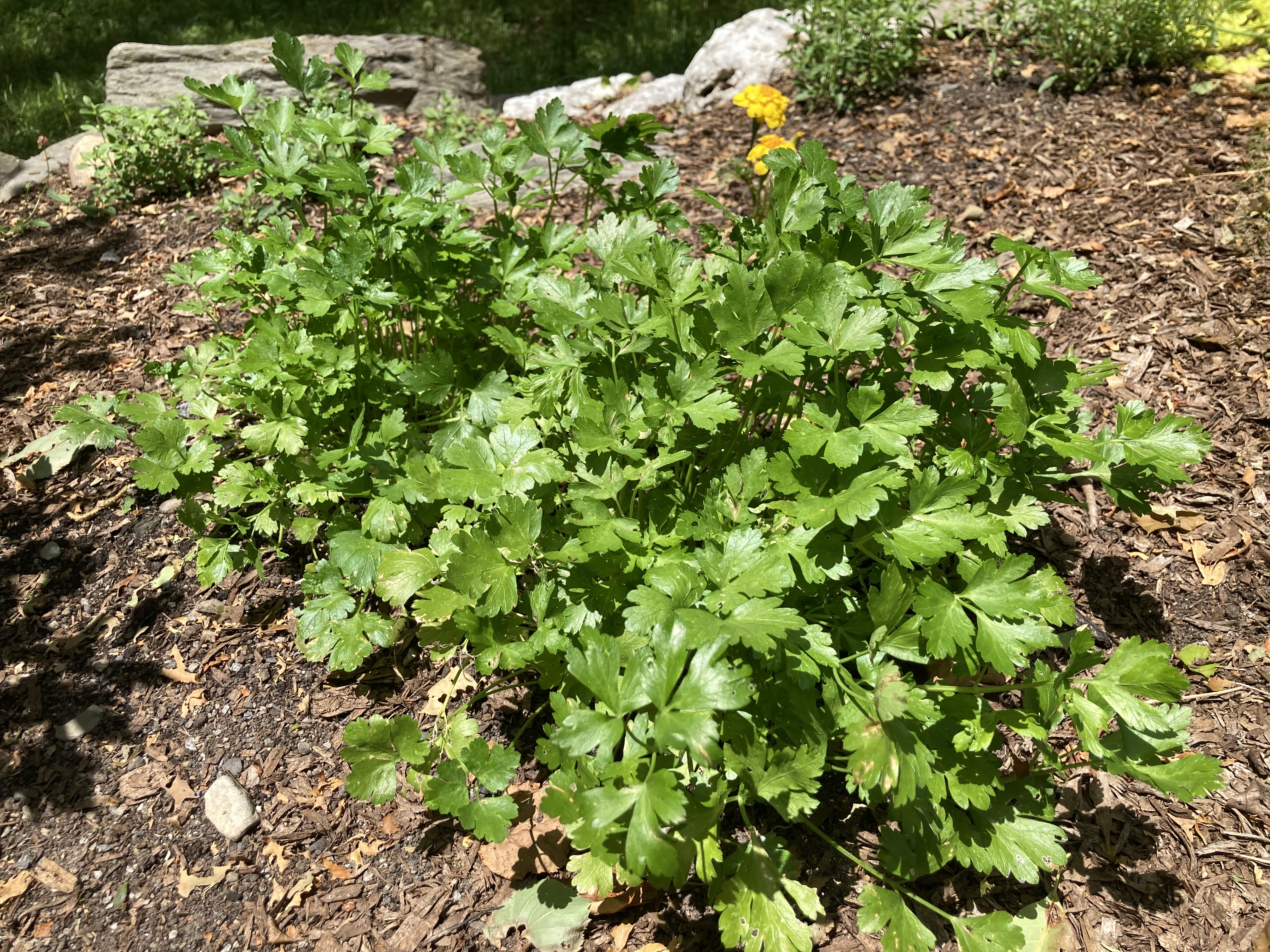
My Italian parsley was growing fluffy and deep green, and it became the anchor for the pine nut–heavy pesto that got smeared inside my calzone. The rest was just Southern Italian knowhow, meaning I chose my cheeses wisely.

My parsley.

And speaking of Southern Italy, I always knew the calzone had been born in Napoli, since it’s basically a folded over pizza. It completely makes sense to me as a possibly unintended creation. I’ve inadvertently created many calzoni when shooting a pizza with a little too much force off its peel and onto the back of the oven, making a folded up but deliciously messy pocket. This may have also happened in Naples sometime in the eighteenth century, when the calzone became the perfect, self-contained street food.

In New York it was always a pizza shop option, and when a slice wasn’t enough I’d chose the calzone. In my experience, the New York versions were larger than Southern Italian ones, which is typical of Italian-American food in general, where more is somehow considered better. I certainly felt more was better as a starving 20-year-old.

For this version of calzone I went with a no-knead dough that spent an overnight in the refrigerator. It was soft but not hard to work with. I just pressed it out with my fingers into a round.

My calzones.

To make the dough, shake a package of dry yeast into a large bowl. Add a cup of warm water (110 degrees is ideal), a tablespoon of honey, and 2 tablespoons of extra-virgin olive oil. Give everything a stir, and let it sit and bloom. That should take around 6 minutes. The surface should be a little bubbly.

Add 2½ cups of regular flour and about a teaspoon of fine sea salt. Stir everything around with a spoon until it comes together into a sticky ball, adding a little more flour if needed to make it easier to handle. The dough will be soft. Turn the dough out onto a floured surface, and form it into a ball.

Get out another bowl, and coat it well with olive oil. Drop the dough ball into it, turning it around once or twice to coat it with oil. Cover the bowl with plastic wrap, and stick it in the refrigerator overnight and into the next day, for at least 18 hours. By then it should have doubled in size.

Turn the dough out onto a floured surface, and punch it down. Divide it into four pieces, and roll each piece into a ball. Place the balls onto a floured surface, and let them sit, unrefrigerated, for about an 1½ hours. By then they will have puffed up a bit.

In the meantime, make the pesto. You can use whatever herbs you have or like, but what I did was grab a handful of parsley and basil leaves, a smaller one of tarragon, and 2 lovage leaves, about 2 cups in all. I blanched them for about a minute in boiling water and drained and then shocked them in cold water to set their bright green color. When you’ve done that, squeeze out most of the water. If you want to include stronger herbs such as rosemary, thyme, sage, savory, or oregano, use only a little and bulk them up with basil and/or parsley.

I put a palmful of pine nuts, along with 1 spring garlic clove, into a food processor and pulsed a few times. Then I added the blanched herbs, salt, and good Sicilian olive oil (about ½ cup), processing until it was all fairly smooth.

Then I put about 2 cups of whole-milk ricotta into a bowl, added a cup of grated scamorza cheese, salt, black pepper, a  few scrapings of nutmeg, and a drizzle of olive oil, mixing it all together well. If you can’t find scamorza, caciocavallo is similar and will make an excellent substitute.

About an hour before you’d like to cook your calzoni, put a pizza stone in your oven, and turn the heat up as high as it goes.

Pour about ½ cup of good olive oil into a small bowl. Add a pinch of sugar and a more generous pinch of salt. Stick a pastry brush into the bowl, and keep it nearby.

When your oven is hot, flour a work surface, and press out one of your four dough balls to about a 6- to 7-inch round. Flour your pizza peel, and transfer the dough round onto it. Smear pesto all over the dough, leaving a little rim around the edges. Blob some of the ricotta mix onto one side, smoothing it out. Fold the dough over into a half moon, and crimp the edges.  

Brush the top of the calzone with the olive oil mix, and slide it on to the stone. With this method you really can bake only one at a time. Bake it until it’s golden brown. This will take about 7 or 8 minutes, depending on how hot your oven is.  I like eating these just out of the oven, with a glass of dry Italian white wine, such as a Greco di Tufo. They also reheat well.

Note: If you don’t have a pizza stone, just prep each calzone on an oiled sheet pan, and stick the pan in your hot oven. The stone will give you a quicker cook time and a crunchier crust, but both ways work fine. Just leave the calzone in until it’s good and brown.

Read Full Post »