
Fish Woman, Auguste Rodin
I need air. I need to get air. I need more air.
Posted in Uncategorized on March 8, 2024| 2 Comments »
Posted in Uncategorized on February 28, 2024| 2 Comments »

Still Life with Organs, Caos,soy
Recipe below, incorporated into the text: Chicory Salad with Chicken Livers and Grappa-Flamed Grapes
Chicken livers haven’t been a constant in my life, but when they’ve shown up they’ve been memorable. I don’t recall my family doing anything particularly Italian with them. What I do recall was Eastern European Jewish–inspired, probably passed down to my mother through some of her lady friends. That, of course, was a classic chopped liver dish, bland but enticing to my young self. My mother presented it in an old-fashioned crystal bowl. It was chunky and tan, studded with bits of onion and hard-boiled eggs, always eaten with Triscuits. It looked lumpy, but its mouth feel was creamy. Its taste had a bitter undertone that I now associate with anything made with chicken livers, and that was what kept me coming back. My mother made it for Thanksgiving but also when they were having friends over for drinks. It went well with both gin and vodka.
And then there was a years-long gap in my appreciation of chicken livers, aside from enjoying various takes on traditional chopped liver, mostly made by New York delis and served on bagels (the 2nd Ave Deli rendition was a favorite). Years of no focus. Lots of dancing but no chicken livers. Then one weekend I went to visit my old friend George, who had recently moved to Massachusetts. For a welcoming dinner he cooked a risotto with chicken livers, a recipe from his Piedmontese mom. Coming from a Southern family, I hadn’t had risotto at home (it was Northern restaurant fare), so this was new. The chicken livers were minced and sautéed with onion and, I think, butter. That’s the ground floor of the recipe. Then I’m not sure what went in, but the end result tasted like Parmigiano, with the chicken liver anchoring it in a deep, musky place. I tried recreating it when I got home. What I made wasn’t bad, except that after many tries it still had an uncooked-wine taste that made it sour. My version got progressively better as my culinary brain shifted into drive and my desire for chicken livers intensified.
Before I started thinking seriously about a career in cooking, I worked at Amnesty International, which believe it or not was fun, deadly serious but strangely fun. The office was on 57th Street, and only a few blocks away was Ralph’s, a solid old red sauce place. We stressed-out Amnesty workers often wound up going there after work for cheap spaghetti and acidic Chianti. Most old-school places like Ralph’s had predictable menus. Ralph’s did, except that they offered penne with chicken liver sauce, a dish you didn’t find in Little Italy, as far as I can remember. I zeroed right in on it. It was basically their thick dark red sauce plus sautéed chicken livers. It was a tad unbalanced, but I loved it, and I improved it with a shower of shaker-can “parmesan.”
I went on to improvise numerous versions of pasta with chicken livers, adding Marsala and capers, doing a deep take with tagliatelle, prosciutto, thyme, and juniper berries, and turning out a lighter version where I tossed penne with summer tomatoes, rosé wine, and basil. I also made several all-out ragùs, heavy-duty but mostly good.
Crostini di fegatini came into my life when I was going to cooking school and starting to plan my uncertain future. Chicken liver pâté on toast was a fad in the early eighties, and cooking schools were into it. I cooked up many variations, from the intense Tuscan kind with anchovies, capers, red wine, and sage, to Marcella Hazan’s demur Venetian style, with red onion and butter, and the French pâté of Jacques Pepin, with thyme, cognac, and bay leaf, all mounted with cold butter. These I decided weren’t better or worse than the New York Jewish chicken livers I had grown up with. They were just different.
My first cooking job was at Restaurant Florent. I started there when it first opened and stayed for four years. In the beginning, when the place was mimicking a Paris Les Halles bistro, we cooked a lot of organ meat and butcher’s cuts. Frisée and chicken liver salad was often on the menu, and I was fascinated by it. It had never occurred to me to add chicken livers to a green salad. And Renee, the lunch chef, taught me an important chicken liver cooking tip: Flame your livers in cognac or brandy, pushing their iron taste into the background. To this day I always finish sautéed livers with a splash of cognac or an eau de vie like Poire Williams. Grappa is also good.
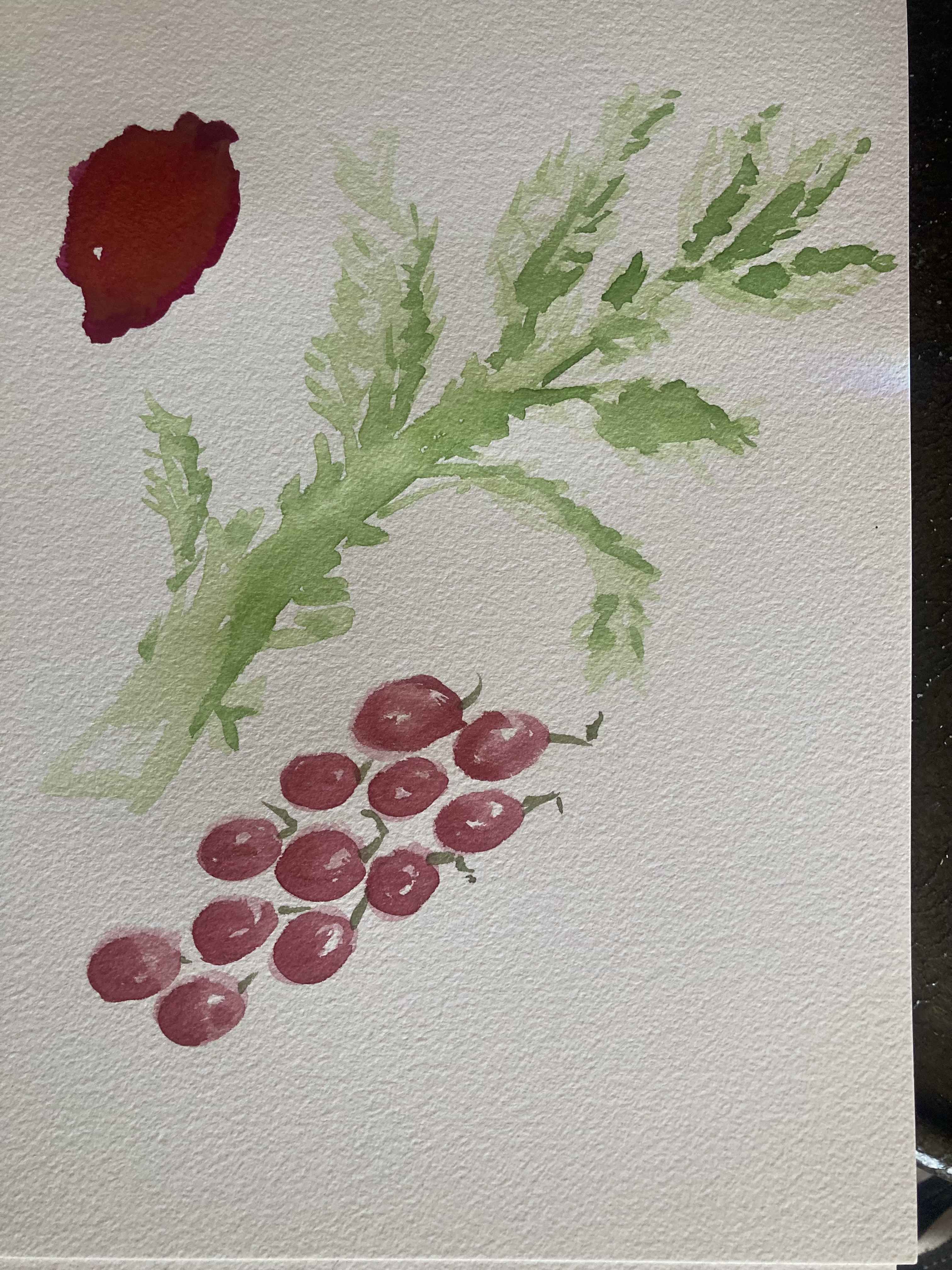
I guess you can tell I love chicken livers. I think everyone should, and they’re easy to cook once you get over the look and feel of them. Raw, they’re an almost startling and weirdly glossy deep burgundy color, and they’re slippery and often a little bloody in your hands. There is also that connecting white tissue that needs to be cut away, but that’s the extent of necessary cleaning. Once they’re tidied up and ready to go, they’re quite beautiful. Most of the time I prefer to leave them in large hunks and cook them fast on high heat. That produces some popping and splattering. Don’t let it alarm you. Just stand back. And when you add the booze you will see a gorgeous, high flame. I live for that kind of thing, but you can always squelch it out by taking the pan off the fire or smothering it.
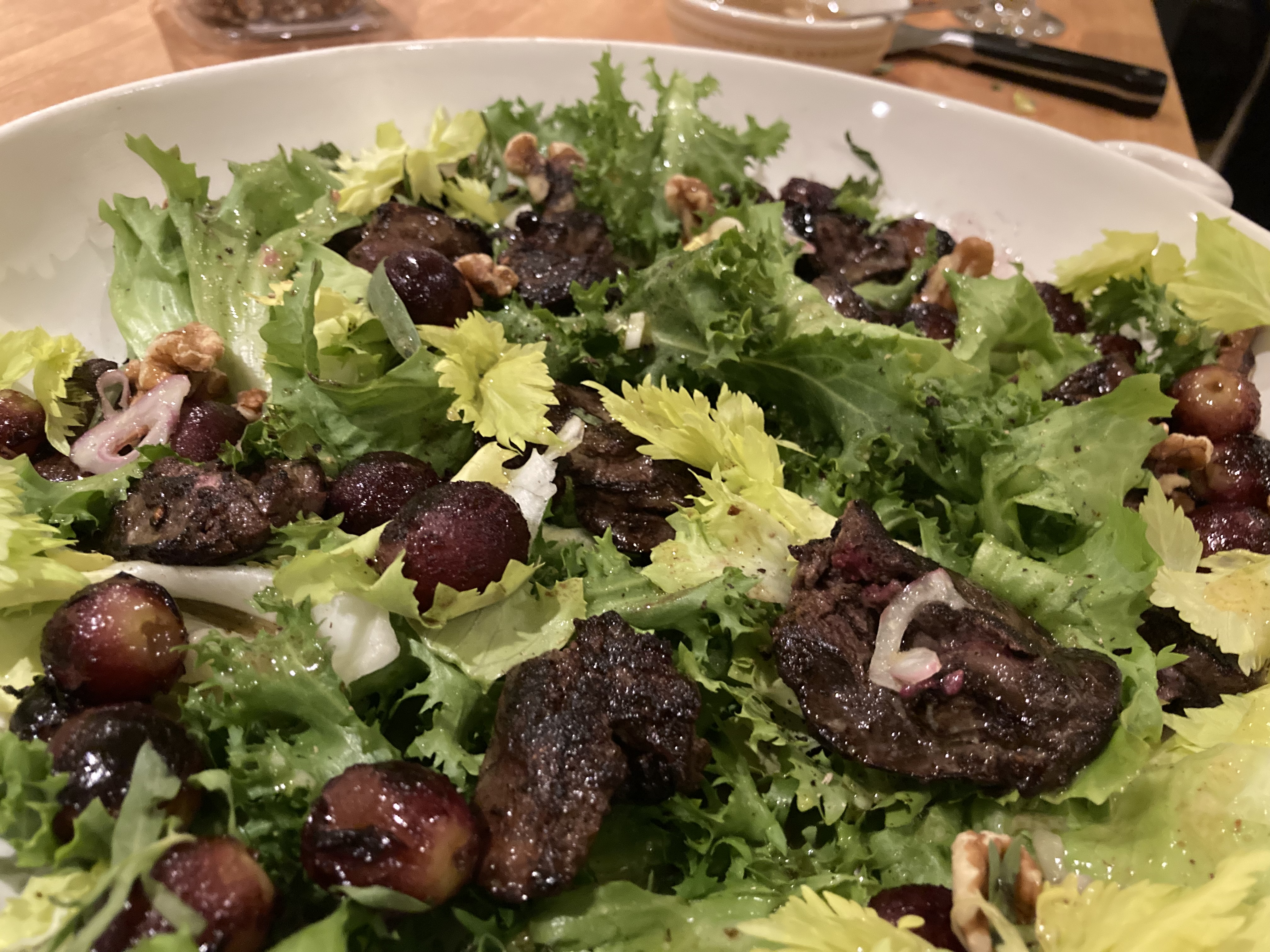
Here’s a new take on my favorite frisée and chicken liver salad. This one used chicory, a close relative to frisée but easier to find, and a fast sauté of grapes. I really liked the flavor combination, and it looked pretty on the plate.
To make it for two, take two big handfuls of chicory (I also included some escarole, because I had it), and place them in a wide salad bowl. Add one or two small inner celery stalks, sliced, plus the leaves, left whole.
Make a vinaigrette with ½ a small shallot, thinly sliced, a little mustard, salt, a pinch of sugar, tarragon vinegar or champagne vinegar, good olive oil, black pepper, and maybe some fresh tarragon, if you like.
Stem a big handful of red grapes, seeded or not, your choice, and sauté them briefly on high heat in a little olive oil and a pinch of salt, until they just start to soften but don’t yet collapse completely, about 4 minutes. Add a splash of grappa, and let it flame off.
Clean about 1/2 pound of chicken livers, and cut them into pieces about an inch across. Dry them off, and season them with salt. Take out another sauté pan, and get it hot over medium high flame. Add enough olive oil to coat the bottom of the pan. Add the livers, spreading them out as best you can so they’re mostly not touching. Sear them on one side, and then give them a flip to sear the other side. That should take only about 4 minutes total. You want them to stay pink at their centers. Grind on some black pepper, and then splash them with grappa. Stand back to watch the flame.
Pour the chicken livers over the chicory. Add the grapes. I also added a handful of toasted walnuts, which I thought a nice touch. Pour on the vinaigrette, and toss gently. Serve right away.
Posted in Uncategorized on February 13, 2024| 6 Comments »

Recipes below, worked into the text: Roasted Sweet Peppers with Mozzarella, Marjoram, and Anchovy Oil; Celery with Walnuts and Gorgonzola Dolce; Mushrooms Stuffed with Piave Vecchio Cheese, Pine Nuts, and Thyme
New York in midwinter always gets me thinking about cheese. I eat a lot of cheese, and in the winter I eat even more. Bringing cheese into my home on a cold night is a solid and nurturing act. I have several good cheese shops near my place in the West Village, but winter can make me lazy and I often just go around the corner to West Side Market to get cheese. That is sometimes a bad move. Their cheese is mostly shrink-wrapped and suffocated, with “today’s special” labels slapped on iffy-looking specimens.
I’ve been thinking lately about making gorgonzola-stuffed celery sticks, a thing my mother used to serve at her ring-a-ding cocktail parties, always a thrilling evening for my sister and me, watching drunken adults crash into table lamps and piss without closing the bathroom door. When I went recently to buy gorgonzola, West Side Market’s blue cheese department looked sad, the gorgonzola in particular having a strange brown tint and proving both grainy and mushy when I poked at it. They had about fifteen different types of blue cheese, French, Italian, American, most looking past their prime. What the store lacks in quality I guess it figures it will make up in quantity. True American spirit at work.
They did have Arthur Avenue cow’s milk mozzarella with a fresh sell-by date. That’s usually dependable if I get it on the day it arrives (pain in the ass that I am, I always ask when it showed up, and I think they always lie to me), and if, when I get it home, I let it warm up on the counter to become a little pillowy. Bland but pleasant enough. I had two nice-looking but obviously out of season red bell peppers in my fridge, so I put together an easy antipasto of roasted peppers with mozzarella, marjoram, and anchovy oil. It was good with a glass of Chianti.
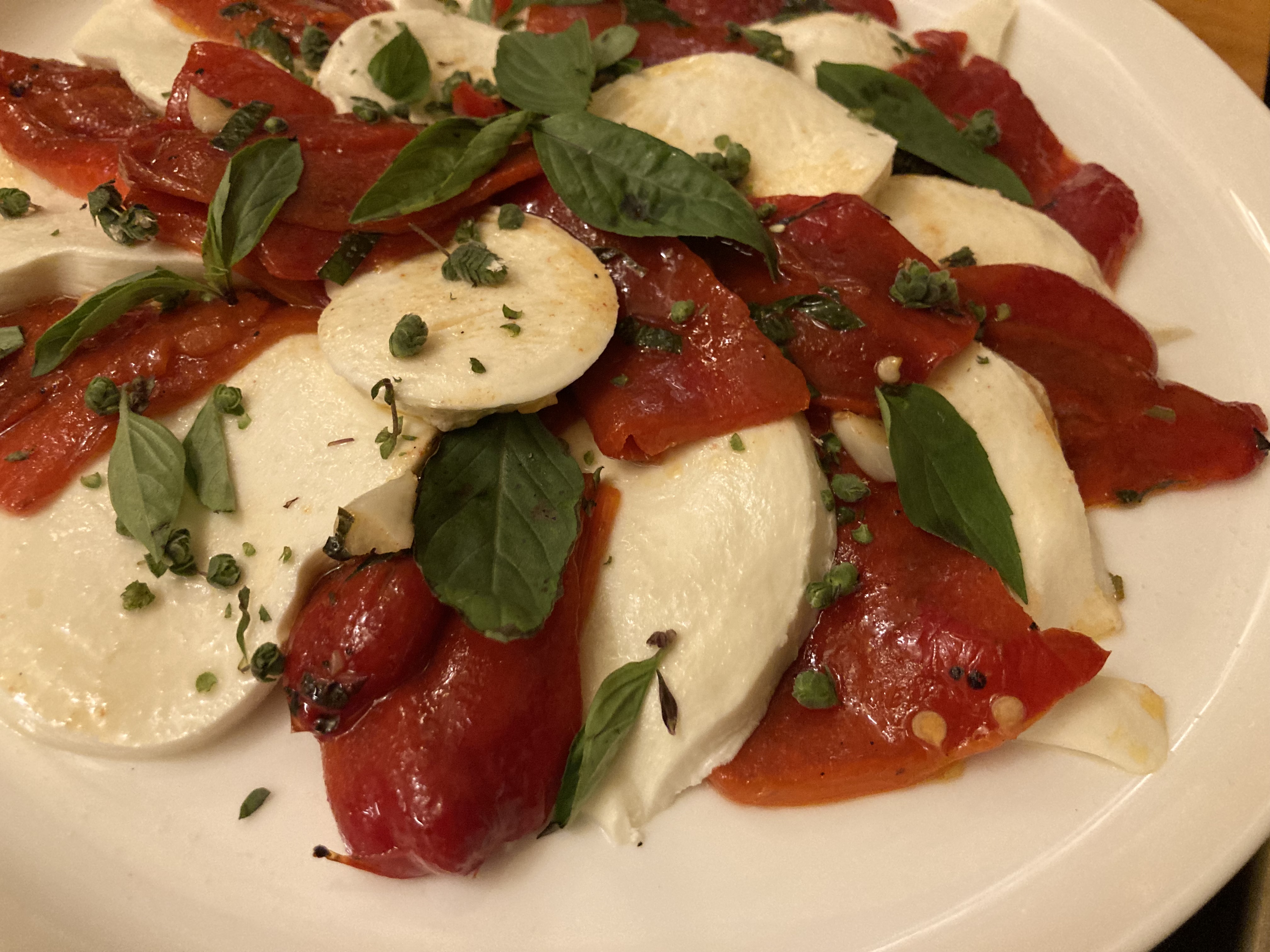
If you’d like to make it, you’ll want to start by roasting, skinning, and seeding a few sweet red peppers. Cut them into fairly large pieces and let them sit in a drizzle of olive oil, a pinch of sugar, and a little salt for at least an hour before you assemble the dish. That’s always a good way to brighten up winter supermarket peppers.
Layer a platter with alternating mozzarella and pepper slices. Mash a few oil-packed anchovies (I used the Ortiz brand) with good olive oil and a few drops of sherry wine vinegar. You can add a touch of chopped garlic if you like. Drizzle that over the dish, and finish with chopped fresh marjoram. I had a few leaves of basil in the fridge, so they’re included in the photo, but frankly I think it’s best with just the marjoram.
I’ve also in the past made something similar by substituting wedges of lightly roasted radicchio di Chioggia, the tight ball radicchio, for the peppers, which adds a nice bitter note. Another good winter option.
I finally did get my hands on a nice hunk of gorgonzola, finding it, of course, at Murray’s on Bleecker Street, a real cheese shop, where I should have gone to begin with. I don’t know why I get so lazy in cold weather. It’s only a five-minute walk to Murray’s, and their cheese is always first rate. Now I was in business and was easily able to throw together my slightly retro celery with walnuts and gorgonzola dolce for a small dinner I was having the next night. It was a hit and also a surprise, because my guests hadn’t thought about that excellent ensemble in a long time. We had a baby boomer brain click.
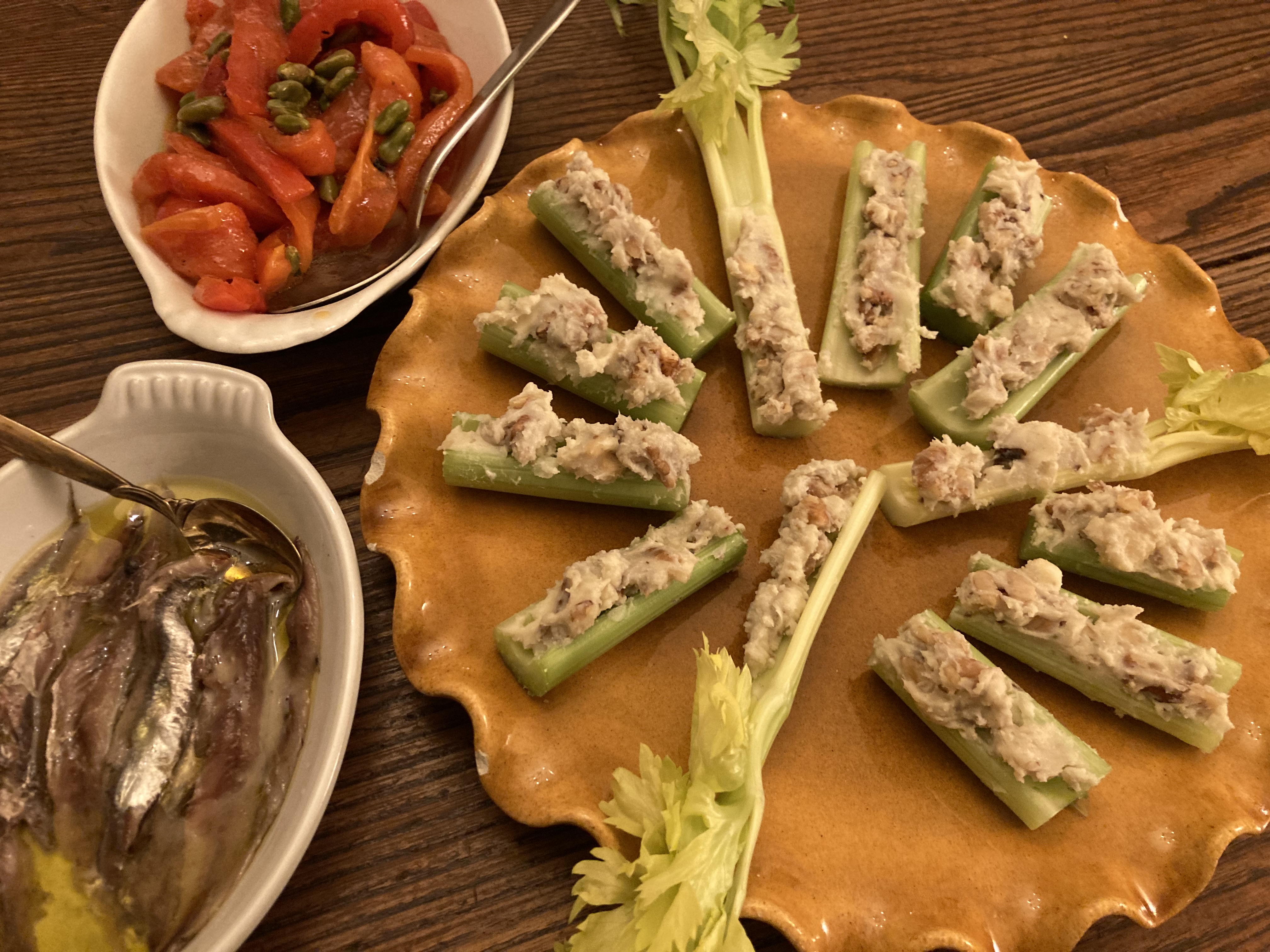
To make it, all you need to do is mash up some room-temperature gorgonzola dolce with a handful of roasted (but cooled) chopped walnuts. You can use regular gorgonzola, but the dolce is creamier and gentler tasting. Get a head of crisp celery, cut it into your desired lengths, and fill the grooves with the gorgonzola mix. I look for celery that has a lot of leaves still attached. The filled stalks look pretty with their frilly tops, and the leaves add an additional texture experience. You can grind a little coarse black pepper to the mix, if you like. Serve it at room temperature.
While at Murray’s I also picked up a good-size piece of Piave Vecchio. It’s one of my favorite grating cheeses, and it’s not so easy to find, so when I see it, I buy it. Piave is a DOP cow’s milk cheese from the Veneto region. It comes in young and aged forms. The Vecchio version is aged at least 6 months, which concentrates its sweetness and gives it a good flaky crunch. It’s a nice change from the more predictable Parmigiano Reggiano or grana Padano.
I had a bag of medium-size cremini mushrooms that needed desperately to be used, so I decided to stuff them and came up with a filling of pine nuts, some panko crumbs, the Piave, and fresh thyme. I liked the result, finding it a little lighter than many stuffed mushroom antipasti I’ve tried over the years, probably because the inclusion of pine nuts made it less packed down.
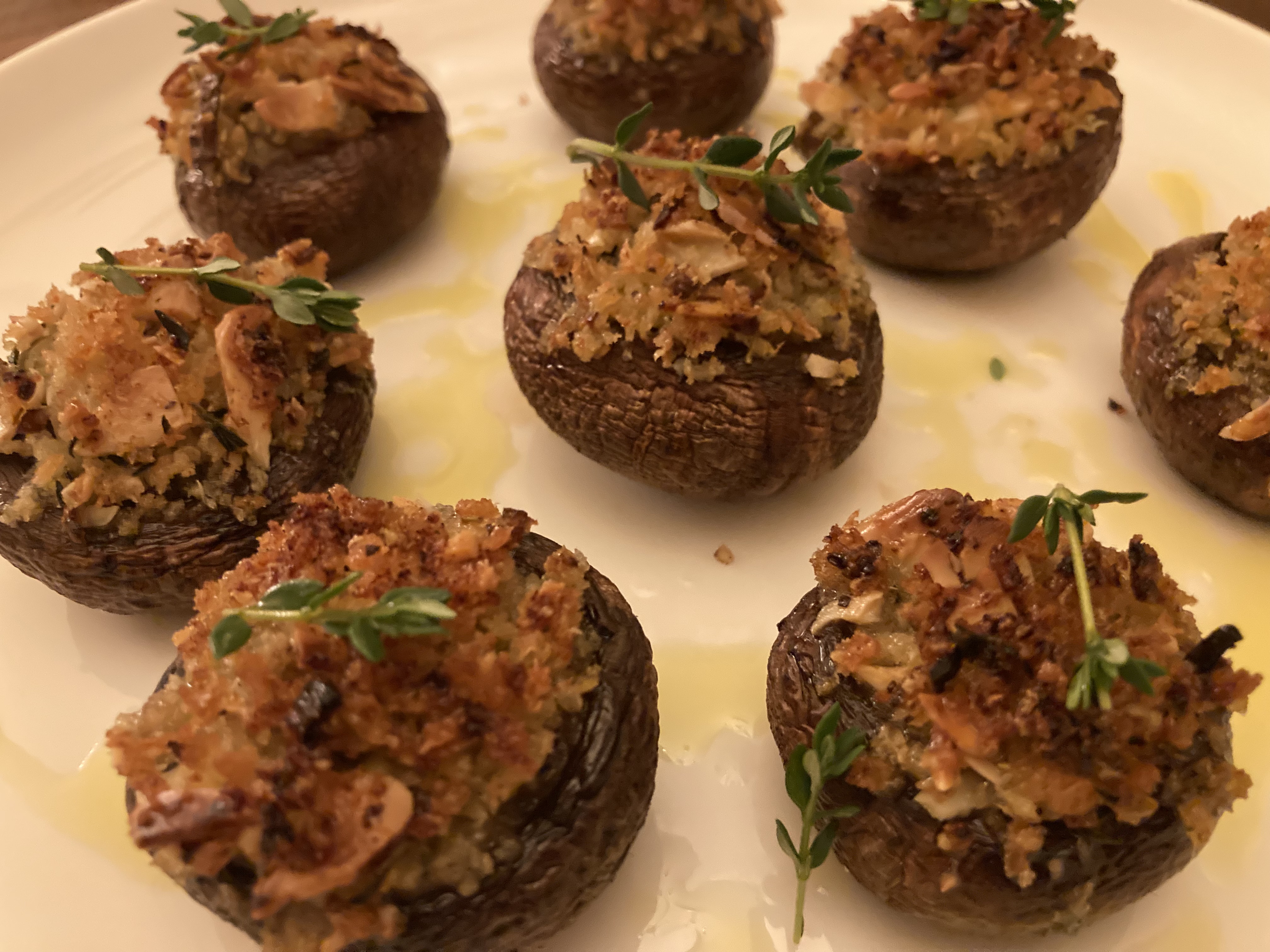
To make this what you’ll want to do is stem your mushrooms and then give the stems a good mince. Sauté the minced stems with chopped shallot and a little garlic. I did this in a mix of butter and olive oil. Finish it with a splash of cognac. Add a handful of panko breadcrumbs, chopped thyme, lemon zest, and some toasted whole pine nuts. Grate in your Piave Vecchio, and season with salt and black pepper. Drizzle olive oil inside the mushrooms, and season them with a little salt. Fill the mushrooms with the stuffing, and put them, stuffing side up, in a low-sided baking dish. Squeeze on some lemon juice, and drizzle with olive oil. Bake for about ½ hour at 400 degrees, just until the mushrooms are tender and the tops are lightly browned. Garnish with thyme sprigs, if you like. These are best served warm, not boiling hot.
Winter cooking can be drab if I let it, but it can also be beautiful when I make sure to walk myself to a good cheese shop and stock up on lots of excellent cheese.
Happy winter cooking to all my friends.
Posted in Uncategorized, tagged dinner, food, italian, pasta, recipes on January 19, 2024| Leave a Comment »

Recipe below: Black Fettuccine with Calamari, Jalapeño, Basil, and Miso
The past few weeks have been rough. Family problems have kept my cooking and writing unfocused. That’s just the way it goes sometimes. I had what I thought were a few good ideas for blog posts but they came out garbled. I’m letting them sit in their messed-up state for a future time when I hope I can look at them fresh. In the meantime, instead of one of my intriguing stories, I’m sharing with you a good pasta dish.
Pasta with calamari in its many incarnations has always been a favorite of mine. I circle back to it often. If you want to call it comfort food, you won’t be wrong, but for some reason I can’t stand that expression. Any food is comfort when I’m hungry. But I do especially like pasta with calamari.
This recipe drifts a bit into non-Italian flavors. I like the taste of jalapeño. It’s obviously not Italian, but its sharp medium spice goes well with seafood, and by extension, with seafood with pasta. I like jalapeño so much I even decided to grow some this past summer, which I never felt compelled to do before, since it’s piled high in every supermarket year round. I saw cute seedlings at the nursery, and I impulsively bought and planted them. They came up in July, firm, dark green, and abundant. I let some go through their natural progression to deep red. Those were an August treat. I never see them red in supermarkets. I used green ones for this pasta. They blend well with miso, again not an Italian taste, obviously, but I’ve found that it can impart a useful umami, not unlike that of anchovies, when used in an otherwise Italian-leaning dish.
I have a strong attraction to squid ink pasta. Often when I see it I buy it. I also make my own, not only with squid ink but also with cuttlefish ink, which seems easier to find. This time I didn’t make my own pasta, as I ran across a new black pasta, new to me and to Citarella, that intrigued me. It’s from an American company called Al Dente. Stupid name aside, the semidark dried fettuccine, made with eggs and semolina, turned out to be a find. It cooked up silky but stayed firm and slippery, which I loved. The color was good too, a greenish black, a bit dusty looking. If you see it anywhere, give it a try.

Altogether the colors of this pasta were beautiful, like the Italian flag but less patriotic with the jalapeño and miso. Cooking it helped my mood considerably. If you’re having trouble of some sort, and who isn’t, I would consider getting a bag of squid ink pasta and some really fresh calamari and just going for it in a free, improvisational way. Cooking is therapy.

Salt
Extra-virgin olive oil
4 scallions, cut into thin rings, using much of the fresh green tops
2 fresh, moist garlic cloves, thinly sliced
½ to 1 green Jalapeño pepper, depending on how much heat you like, well chopped
2 pints grape tomatoes
1 pound squid ink fettuccine or spaghetti
1 tablespoon white miso dissolved in ¾ cup dry Marsala
1 pound very fresh, small squid, cut into rings, the tentacles cut in two
A handful of basil leaves, lightly chopped
This dish comes together fast, so it’s best to have all your stuff prepped and ready where you can grab it.
Set up a pot of well-salted pasta cooking water over high heat. While it’s coming to a boil, get out a large sauté pan, and place it over a medium-high flame.
Put about 2 tablespoons of olive oil in the sauté pan, and let it get hot. Add the scallions, garlic, jalapeño, and tomatoes at the same time. Add a little salt. Let cook, shaking the pan frequently, until the tomatoes start to burst, probably about 5 minutes.
Add the fettuccine to the now boiling water, and give it a stir.
Add the mix of miso and Marsala to the pan, and let it bubble for about 30 seconds, to cook off some of the alcohol. Add the squid, stirring it into the sauce, and cook it fast, just until tender, no more than about 4 minutes. Taste a piece if you’re unsure. It should be cooked through and tender, with a slight bite but not rubbery. Take the pan off the heat.
Drain the fettuccine, and pour it into a large, wide serving bowl. Drizzle on a generous amount of fresh olive oil, and give it a toss. Add the squid sauce and the basil, and toss again.
Posted in Uncategorized on January 4, 2024| Leave a Comment »
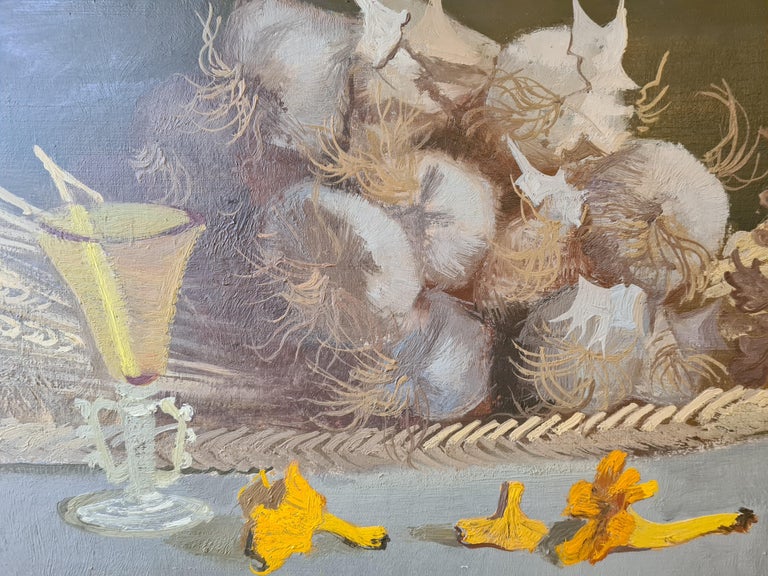
You know how sometimes you set out to cook something improvisational and then realize you’re all unfocused? Maybe you have three different herbs on your counter, various alliums, and some stuff you pulled from your cheese drawer. You’ve bought good pasta at the Italian shop, too. But it’s not all forming a pretty picture in your mind’s eye. I find myself at that place sometimes, and it frustrates me. I guess I was subconsciously looking for a way to fix this occasional problem when this New Year I found myself clarifying my culinary head with color. I started making swatches in watercolor and placing them alongside a list of ingredients that seemed right for a dish I had in mind. The colors helped me make purer choices and get rid of excess without leaving my cooking austere. I think with luck they may reveal the soul of a dish.
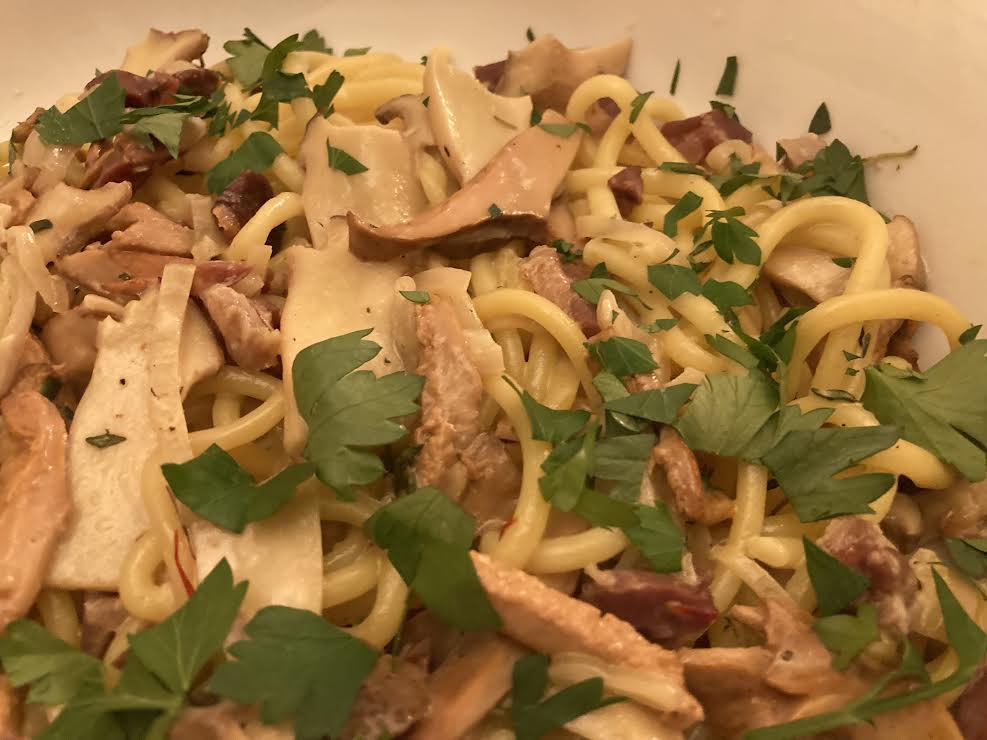
I started this color matching game when I had made a pasta with chanterelles but wasn’t happy with it. It felt clunky, which was surprising, since chanterelles are so elegant. I had a few chanterelles left over, so I thought I’d try the dish again the next day. I laid out the uncooked leftover mushrooms on my counter. Their peachy beige color was so lovely, I got curious to see if I could match it. I took out my paints, and after some adjusting was happy with the color swatch I made, all at once yellow, brown, orange, and transparent. So I went on, choosing other flavors I was thinking about for the second version of the dish and painting them. I dissolved saffron in a half cup of warm chicken broth and watched the maroon threads blossom in a swirl of pure orange. My head lightened as I stared at the color. It seemed to direct me to construct the pasta in a more pinpointed way. It became apparent to me what ingredients needed to go from my first try. What went were prosciutto fat, leeks, and parsley. What stayed were what you see below to the right of my color patches.

This exercise reminded me of a few things I know but don’t always remember. For starters, not every dish needs a pork product. When I first made this pasta with chanterelles I included chopped prosciutto fat because I had it, and for no other reason. All it did was pull focus away from the delicate taste of the mushrooms. I have a tendency to enrich food with pork fat when it’s not needed. Lazy.
Not every dish needs a lot of herbs either. I chose thyme for this because I love thyme with mushrooms. But then I added parsley at the end, to finish the dish and to interrupt its more or less uniform beige color. Mistake. It visually muddied everything, making for a confusing photograph while adding nothing. Using parsley as a throwaway is culinary abuse. I know this, but sometimes I do it anyway, probably in a reflex from years cooking in French bistros where they scatter it over everything that leaves the kitchen. Parsley is a unique flavor and should be treated the same as you treat rosemary or any other aromatic. Italians know that. For instance it was the main flavoring in my mother’s pasta e fagiole, and is in my own bucatini with clams, too.
Not every Italian dish needs garlic. I didn’t include garlic in the original version of this dish, but I thought I’d mention it here, since I have sometimes thrown it in without much thought. Since I don’t always love the taste of papery winter garlic, I wasn’t tempted this time. I debated using shallots and leeks. I had both and added both to the first version of the pasta, but they only created an unrefined undertaste. Take one out, I said. I stuck with the shallots, which not only tasted sweet and deep but also had a lovely violet hue, which I think I captured with my paint.
I’m going to make more color swatch recipes, and I’ll keep you posted on my progress. The ingredient list for my tagliatelle with chanterelles and saffron is in order of use on the swatch card, so if you’re interested in trying it you can do a version with your own personal stamp, improvising the measurements.
Happy New Year, and may all your cooking be bright and clear.
Posted in Uncategorized on December 17, 2023| 3 Comments »

Recipe below: Cod Roasted with Orange, Tarragon, and Pastis
Anyone who has followed me on Facebook may know this de Chirico painting. For many years I’ve used a crop of it as the image that runs across the top of my Facebook page. I’ve had no interest in changing it because it keeps feeling exactly right, and I use a different de Chirico at the top of ericademane.com. I hadn’t seen this painting whole in several years, but since it has always reminded me of Christmas Eve, I recently hunted it down again online, and I love it more now than ever. The original is in the Galleria Nazionale d’Arte Moderna in Rome. I’ve never been there, but that will be rectified on my next trip.
Fish and oranges are two foods that always appear on my Christmas Eve table, sometimes in the same dish, sometimes not. As I revisit this de Chirico in its totality, I’m reminded of how much I love its orange colors, the curves of the fish, and its Mediterranean Sea, turquoise and active. His placement of ancient sculpture ties it all into my ancient heritage, making it familiar and comforting to me, even though that’s just a bodyless head made from paint. But there’s also the edge that I’m drawn to. How can something be so both anxiety-provoking and comforting? De Chirico said that “what is especially needed is great sensitivity, to look upon everything in the world as enigma. To live in the world as in an immense museum of things.” I try to think of certain aspects of nature that way, oceans for instance, or animals that are killed so I can eat them, which bring me both anxiety and comfort. A pantheistic approach.
I’ve never fished. Maybe the squirming before the fish dies would horrify me. I don’t know. I might try it someday. I cook a lot of seafood. This de Chirico painting got me combining fish with orange and adding a touch of anise to pull it together, a sort of bouillabaisse-inspired ensemble. The orange zest is key. You need a good amount. The result will be mellow but vibrant, not unlike the painting. I hope you’ll give it a try.

I still love scungilli on Christmas Eve. It has fallen out of fashion among many italoamericani. It has the strangest taste, always reminding me of musty incense from an old hippy shop. Very unseafoody but so alluring. I need a little scungilli on my Christmas Eve table, even if I’m the only one who eats it. P.E. & D.D. Seafood, at the Union Square Greenmarket, out of Riverhead, Long Island, is where I purchased the beautiful, thick cod fillets for this recipe. P.E. & D.D. also sells locally caught conch (scungilli) that they precook in the shell so it’s ready for slicing, for a salad, or to mix into pasta. They also make their own scungilli salad, which is good but maybe a touch too garlicky for me. If you want scungilli for Christmas Eve, you can find P.G.& E.E. at Union Square market on Monday and Friday and at Abingdon Square Saturday. They’ve also got beautiful Little Neck clams right now, in case you’re considering linguine and clam sauce for the holiday.

3 large oranges
1 garlic clove, peeled and crushed with the side of a knife
Salt
Piment d’Espelette
1 tablespoon pastis (I used Ricard)
1 teaspoon tarragon vinegar
1½ teaspoons sugar
Extra-virgin olive oil
About 1 pound thick cod fillets, 2 or 3 pieces, each 1¼ inch thick or a little thicker. I used 3 1¼-inch pieces
A big branch of tarragon, the leaves lightly chopped
Zest 2 of the oranges. Mix the zest, the garlic, a little salt, some Espelette, the pastis, the vinegar, a teaspoon of the sugar, and 3 tablespoons of good olive oil together in a small bowl, and give it a good mix. You won’t need the juice from these oranges, but you can use it to make a nice vodka drink.
Preheat the oven to 425 degrees.
Get out a low-sided baking dish that will hold the fish chunks with a fair amount of room to spare. I used a 12-by-8-inch oval Le Creuset. Coat it with olive oil.
Slice the remaining orange thinly, and place the slices, slightly overlapping, in the baking dish. Drizzle on a little olive oil, season with salt, and sprinkle on the remaining ½ teaspoon of sugar. Place the dish under a broiler for about a minute or so, just to caramelize the oranges slightly.
Place the fish in the middle of the baking dish, on top of the oranges. Pour the orange-and-pastis mix over the top of the fish. Season with a little more salt and espelette.
Roast until the fish is just tender. Mine took about 8 minutes, but that will depend on the thickness of your pieces. When you can stick a thin knife in to the middle of a piece with no bouncy resistance, it’s ready. For the last minute of cooking, turn on your broiler, to lightly color the top.
Scatter on the tarragon. Plate the fish, and surround each serving with a few orange slices. Spoon the pan sauce over the top.
Posted in Uncategorized on December 15, 2023| Leave a Comment »
Posted in Uncategorized on December 10, 2023| 3 Comments »
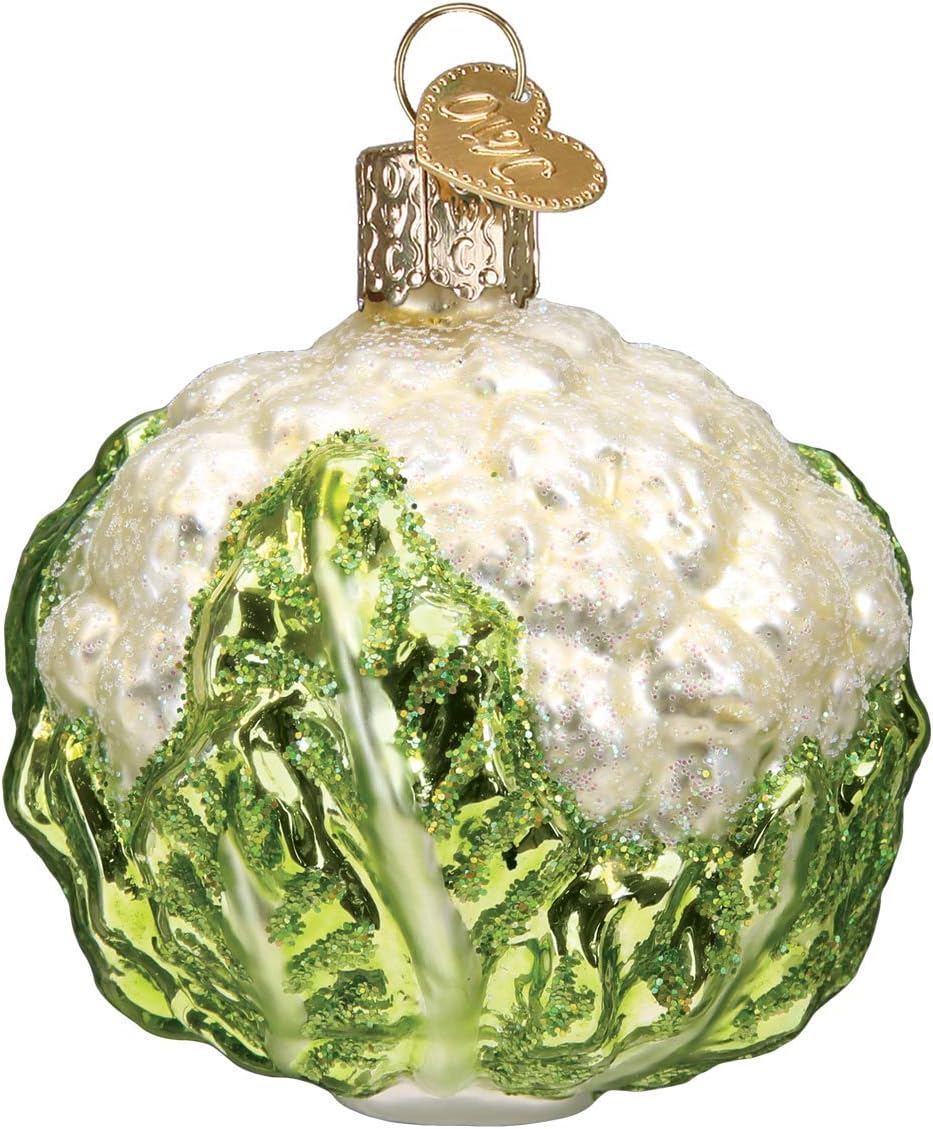
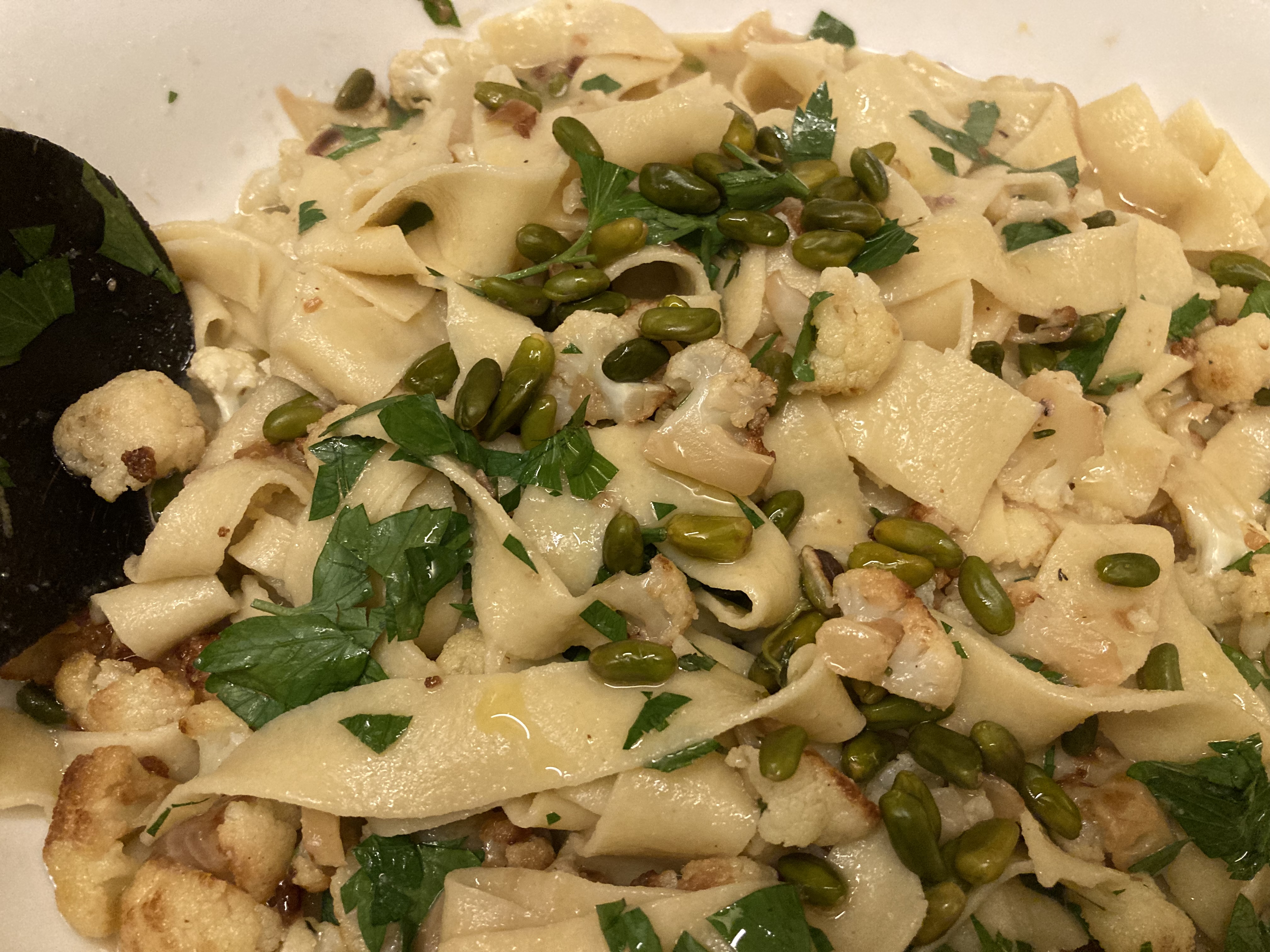
Recipe below: Tria with Cauliflower, Pistachio, and Anchovy, for Christmas Eve
Ever since I was a kid I’ve been drawn to humidity. New York summers have plenty of it. Manhattan streets in August have a disgusting appeal for me. Heat, sweat, and a little grime work wonders, keeping me alert. This is likely one of the reasons I always found commercial kitchens not only exciting but homey. All kitchens, really, but especially busy, hot, hectic ones. A summer street in New York is like a big hot kitchen. A winter street not so much, yet sometimes, if I’m lucky, I’ll look west down 13th Street and see winter fog steaming off of Hudson River. That’s a mood boost.
There’s nothing I dislike more than a clear, crisp winter day, but a good winter rain or snow is a thing of moist beauty. Entering my apartment out of a cold rain is one of my favorite winter experiences, provided the heat is working, especially if I’ve been to the Greenmarket or even a regular grocery store and bought root vegetables, chicories, or cabbage things, and can cook something I love, like broccoli rabe with anchovies, escarole with ceci, or celery root soup with pancetta. Right now I can still find local cauliflower at the Union Square market, sometimes even the orange ones or light green Romanesco spirals, all pretty, with tons of possibilities.
Last week I came back from the market with a big white cauliflower. I love cauliflower flavored with anchovy, so I immediately thought of that combination as a starting point, and I worked out this pasta dish. It came out so well I’m thinking of making it again on Christmas Eve.
Tria is the name of the pasta I made. It’s a semolina tagliatelle-type cut from the Salento area of Puglia. It’s usually made a little thicker than the soft wheat tagliatelle known northward, and it’s often cooked up with chickpeas. It was a good match for my cauliflower, anchovy, and pistachio condimento. If the sauce appeals to you and you don’t want to bother with the homemade pasta, you can make this nicely with a store-bought orecchiette. But, just so you know, semolina pasta is about the easiest homemade type you can turn out. Semolina and water are all it is. It’s smooth to handle and easy to roll, a great pasta with a little chew to it. I hope you’ll give it a try.
1 cup hot water
Salt
2 cups semolina flour (I used Bob’s Red Mill brand)
3 tablespoons unsalted butter
Extra-virgin olive oil
1 large head cauliflower, cut into small florets
1 large shallot, minced
1 fresh, moist garlic clove, thinly sliced
5 or 6 oil-packed canned anchovies, chopped (Agostino Recco is a good brand)
A big splash of dry vermouth
½ cup good chicken broth
The grated zest from 1 lemon
Black pepper
A handful of unsalted pistachios
A palmful of flat-leaf parsley leaves, lightly chopped
A chunk of grana Padano cheese
To make the tria, dissolve a teaspoon of salt in the hot water (hot tap water is good). Put the semolina in the bowl of a food processor. Pour on the water, and pulse until you have a mass of moist dough that’s just starting to form a ball. If it looks dry, add a drizzle more water. If it looks too wet, sprinkle in a bit more semolina. Turn the dough out onto a work surface, and knead it until it’s smooth and springy, about 5 minutes or so, adding more semolina if it starts to stick. Wrap the dough in plastic and let it rest, unrefrigerated, for at least an hour. This will give the liquid time to evenly seep into the dough to make it uniformly smooth and workable. I often let it sit a half hour or longer.
Next I generally cut the dough in four and run each piece through my hand-cranked pasta machine down to setting 5, making sure to sprinkle it with semolina as I go if it gets sticky. Then I cut the four sheets into approximately 5-inch-long pieces and let them sit on a semolina-floured sheet pan or work surface for about a half hour, so they can dry out a bit before cutting. Otherwise the strands might stick together, which is really annoying after all this work.
I like cutting this type of pasta by hand, so I dust each sheet with a little more semolina and loosely roll it up. Then, with a sharp knife, I cut it into approximately ¼-inch-wide rings. You’ll now want to unroll each ring and place it on a sheet pan or a cool surface, coating it all with semolina and tossing well so it doesn’t stick. Now the pasta will be ready to cook right away, or you can let it sit for a few hours, if you prefer.
Set up a large pot of pasta cooking water, add salt, and bring it to a boil.
While the water is coming to a boil, get the sauce going. Get out a large sauté pan, and set it over medium heat. Add the butter and a drizzle of olive oil, and let it foam up for a few seconds. Add the cauliflower and the shallot, and sauté until the cauliflower is tender and taking on a little color, about 5 minutes. Add the garlic and anchovies, and let it sauté for about a minute longer.
When the water comes to a boil, drop in the pasta, and give it a stir. In my experience this type of pasta takes about 5 or 6 minutes to become al dente, which is what you’re looking for.
Add the vermouth to the sauté pan, and let it bubble for a few seconds. Add the chicken broth, the lemon zest, and some black pepper, and simmer a minute or so longer.
When the tria is ready, drain it, saving a little of the cooking water, and tip it into a large, wide serving bowl. Give it a drizzle of fresh olive oil, and toss it gently. Add the cauliflower sauce, the pistachios, and the parsley, and toss again. Taste for salt. You may or may not need any, depending on your anchovies. Add a little cooking water, if needed, to loosen it up. Serve right away, bringing the grana Padano to the table for grating.
Posted in Uncategorized on November 8, 2023| Leave a Comment »

Recipe below: Scialatielli with Clams, ’Nduja, Pernod, and Basil
I often walk over to Buon’Italia in the Chelsea market just to look around, not needing anything but wanting something to bring into my kitchen when too many non-Italian ingredients like miso, or chili crunch, garam masala, or grainy mustard start to invade my workspace. When jagged effects intrude (too much soy, too much cumin, too much lime), even if I love the tastes I can get irritable or just messed up. Recently I sensed I needed a drizzle of colatura to fix a gemelli with escarole and almonds that fell flat even after adding anchovies, but to my surprise I didn’t have any colatura. How did that happen? All I had was a bottle of Red Boat Vietnamese fish sauce, which of course is similar but not the same. I added a little, drop by drop, knowing it was stronger and had a different undertaste from colatura. After a few drops I realized I had ruined the dish by complicating it with unclear thinking.
When I most recently went over to Buon’Italia, I actually did need something. I needed colatura, which I bought. I also picked up a big wedge of caciocavallo, which is strangely hard to find even in New York. I grabbed Sicilian salt-packed capers, two bags of squid ink fusilli, some sheep milk ricotta, a jar of bluefin tuna packed in olive oil, amaretti cookies, a can of pomodorini, a bag fennel taralli, a bag of Scialatielle pasta made by the Neapolitan company Setaro, and, since I couldn’t resist, a deep red, bloody-looking hunk of Buon’Italia’s mushy, fatty ’nduja. I figured the haul should set my kitchen straight.
Buon’Italia sells good ’nduja, but as most of my Italian cooking friends know, real Calabrian ’nduja is still not available here. You can get an imported loose, pasteurized ’nduja product in a jar. I’ve tried the Tutto Calabria one pictured in the advertising poster above. ’Nduja light. Not worth it. I’d rather buy a good American-made one. So that’s what I got at Buon’Italia. It’s made somewhere in Queens. It’s got a flavor reminiscent of the ones I sampled in Calabria, where the soft, spicy sausage was invented, and has no weird added flavors, such as oregano or garlic. Just pure pork fat and Calabrian heat. I also like the version made by Salumeria Biellese, here in New York. Unlike when I first began searching out the American-made stuff, about ten years ago, now I find lots of good versions made all over our country. Have any of you tried the Tempesta brand? I haven’t yet. If you’ve discovered one you particularly like, please let me know. I’m starting to collect them.
With my Queens-made Buon’Italia ’nduja, I decided to prepare a pasta featuring the littleneck clams I buy from a Long Island fish guy who sells at the Union Square market. Spicy pork sausage and shellfish are an excellent match, as Spanish and Italian cooks discovered ages ago. I loved adding only fennel flavors and basil to pull it all together.
And in case you’re not familiar with scialatielli, it’s a thick, chewy, slightly stubbier tagliatelle-like cut popular on the Amalfi Coast and throughout Campania and used mainly for seafood sauces. When it’s made fresh, basil and Parmigiano are often worked into the dough. Dried versions usually don’t have those flavors, but even without them its chewiness is really appealing.

3 dozen medium to small clams (I used Long Island littlenecks from my Greenmarket), well cleaned
1 small glass dry white wine
Salt
Extra-virgin olive oil
1 pound scialatielli or tagliatelle
1 large shallot, finely chopped
1 teaspoon freshly ground fennel seed
About 2 heaping tablespoons ’nduja, depending on how much heat you like and how hot the stuff you’ve got is
1 35-ounce can Italian plum tomatoes without purée, chopped
A splash of Pernod or another pastis
A handful of nice-looking basil leaves, lightly chopped
Put the clams in a large pot, and pour on the wine. Turn the flame to high. When the wine starts to boil, stir the clams around a little, and cover the pot to get some steam going. After a minute or so, uncover the pot, and stir the clams a little more. This is so they cook evenly. Have a large bowl ready near the stove. As the clams start to open, pull out each one with tongs, and stick it in the bowl. The thing about clams, unlike mussels, is that they don’t all open at the same time. I know this step seems tedious, but if you wait for them all to open, the early openers will get way overcooked. When all the clams are open, drizzle a little olive oil over them. Pour the clam cooking liquid through a fine strainer into a bowl (this is to remove any sand).
Set up a pot of pasta cooking water, and bring it to a boil. Add salt, and drop in the scialatielli.
Get out a large sauté pan, and set it over medium heat. Drizzle in a little olive oil. Add the shallot and the fennel seed, and sauté until fragrant, about two minutes. Add the ’nduja, and stir it around until it melts into a red puddle. Add the clam cooking juice and the tomatoes. Let cook at a gentle bubble for about 5 minutes. Add the Pernod. Taste the sauce, adding a little more ’nduja if you want more oomph. Add the clams to the pan, and stir them around to gently reheat them.
When the scialatielli is al dente, drain it, and pour it into a large, wide serving bowl. Drizzle on a little fresh olive oil, and toss lightly. Pour on the clam sauce, and add the basil, giving everything another toss. Taste for salt. You may or may not need any, depending on and how salty your clams are. Serve right away.
Posted in Uncategorized on October 31, 2023| 10 Comments »

Recipe below (in text): Spaghetti with Bottarga, Green Chili, and Almonds
Bottarga is a salted fish roe sac that has been pressed to compactness and then left to dry. As you can see in the arty photo above, it looks like a big orange tongue. It’s made in various forms in many countries and has an ancient lineage. In Japan it’s called karasumi, in France it’s poutargue. Butarkah is its Arab name, which is where the Italians got the word bottarga from. I first tasted Italian bottarga in Trapani, Sicily, and even I who love all things sea was perplexed. Why didn’t I like it more? What I ate was Sicily’s bottarga made from tuna roe. It was, I’d say, direct in flavor, a hit of fish without nuance, nothing I’d go on to dream about, the way I dream about the anchovies from the town of Cetara on the Amalfi Coast. Sometime after my first encounter with Sicilian bottarga, I tasted bottarga di muggine, bottarga made in Sardegna from grey mullet roe, not tuna. It still had that characteristic bitterness but also a whiff of sweet sea breeze and a more delicate taste.
Back in New York City, Il Buco Alimentari, on Great Jones Street, has been serving a good spaghetti tossed with shavings of Sardinian bottarga since the place opened in 2011, adding just lemon and a little parsley. That is my all-time favorite way to eat good bottarga, tossed with spaghetti. You could, I suppose, use a fresh egg tagliatelle instead, but I wouldn’t go with anything like rigatoni, for instance. That would be too robusto for such a delicate dish. I go to Il Buco Alimentari when I want to have this perfect dish in a restaurant and not make it at home. But making it at home is simple. You just have to have the bottarga. I can’t say bottarga is a typical pantry item in my kitchen, but I’ve definitely been buying it more often lately.

I like to purchase bottarga di muggine made by L’Oro di Cabras, in Sardegna, from Gustiamo. It’s the best one I’ve used so far. You can buy it from Gustiamo directly or via Amazon. If I need bottarga fast and can’t wait for a delivery (that’s been known to happen), I sometimes get it at Buon’Italia, in the Chelsea Market. If you don’t know the shop, please try to go when you’re in the neighborhood. It’s home to Latini pasta from the Marche and all sorts of Italian cheeses and cured and fresh meats, including excellent ’nduja and pork sausage, and just about any Italian food item you might be dreaming about, such as fusilli flavored with spirulina algae, which looks intriguing but I’ve yet to actually purchase. And if you can’t deal with the push of tourists lining up for steamed lobsters or tongue tacos on the main floor, there’s a side door you can slip through on 15th Street that takes you directly downstairs to where most of the real grocery stores are. You’ll avoid a lot of backup that way.
For my most recent version of spaghetti with bottarga, I got a little more elaborate than the lemon-and-parsley approach I learned from Il Buco Alimentari. This time I added toasted almonds and found that their richness tempered the slight bitterness of the roe, making the whole thing taste lusher, more rounded. Along with a good amount of lemon, I added a fine dice of green jalapeño, whose gentle heat played against the lemon, charging the dish up from both ends.
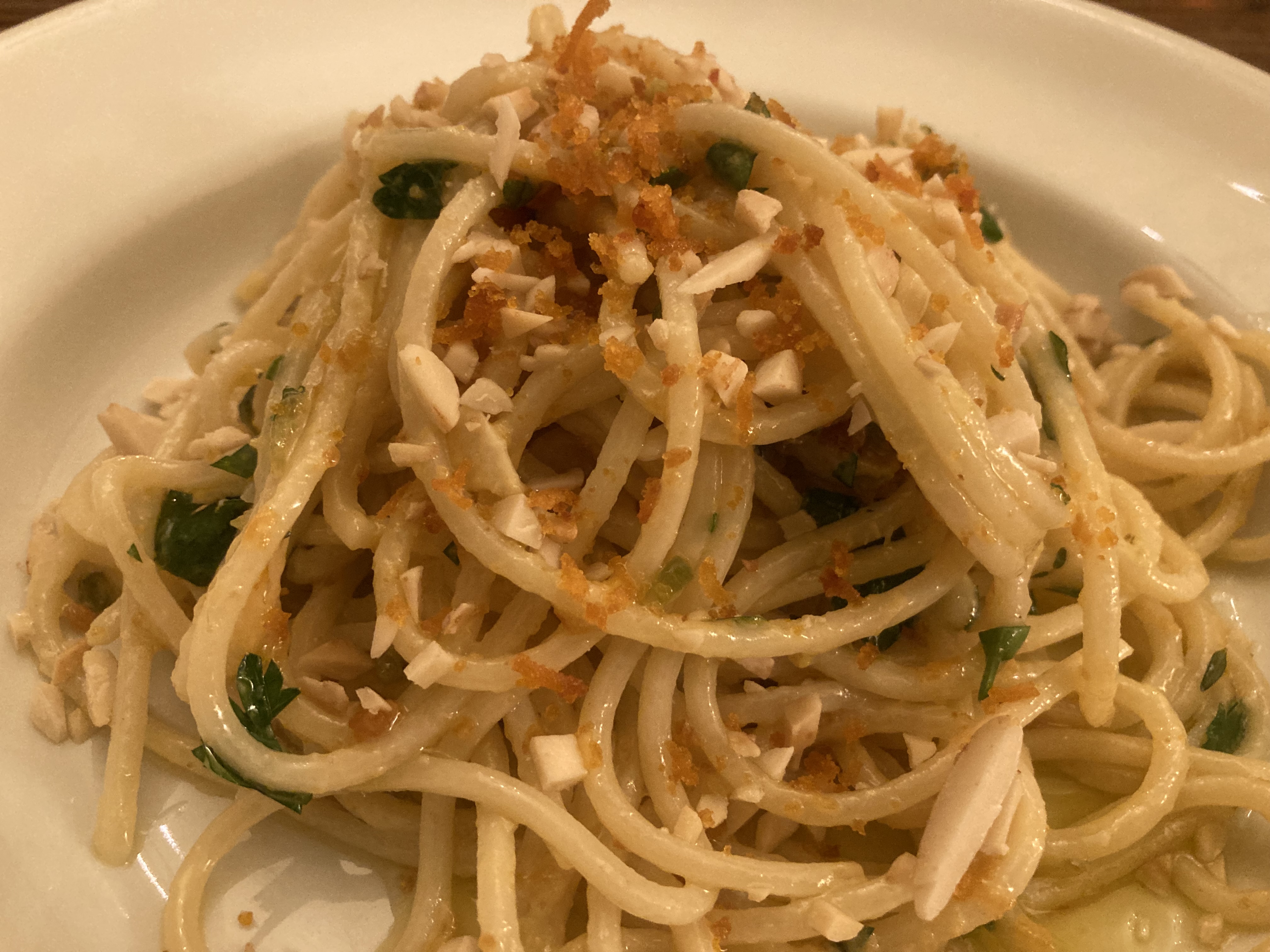
To make my spaghetti with bottarga, green chili, and almonds for two, the first thing you’ll want to do is toast a handful of whole blanched almonds and then chop them lightly. The better your almonds, the deeper the taste. I used Sicilian almonds from Noto, which have the aroma of almond extract (I always wondered where they got the idea for that aroma).
Next you’ll need to peel the outer membrane off your bottarga. That is the thin skin that encloses the roe sac. It turns kind of papery after drying. It’s not unhealthy to eat; I remove it mainly because it shreds when you grate the bottarga, and it could get stuck in your throat (which I guess would actually make it unhealthy). It may or may not come off in large pieces, so just do the best you can. Peel off about as much as you think you’ll be using. Grate about ¾ cup of the bottarga onto a plate, using a cheese grater. I used a medium, not really fine, grate since I didn’t want it to turn the bottarga to dust. You’ll ideally wind up with a nice pile a fluffy orange bits. (Please don’t waste your money on pre-grated bottarga—the ones I’ve tried have all been dry. The good news is that bottarga roe purchased whole is so tightly packed it lasts for months and months even after you open it, which is why it was invented in the first place. Just keep it in your fridge, wrapped in plastic.)
Put up a pot of pasta cooking water, add salt, and bring it to a boil. Drop in about ⅓ pound of spaghetti.
Thinly slice two fresh garlic cloves. Seed and mince a small jalapeño. Zest a small lemon, and then cut it in half, since you’ll need some of its juice later on. Chop the leaves from a few large thyme sprigs and a larger amount of flat-leaf parsley. It’s important to get your prep in order before you start cooking, since it will all go fast.
Get out a large sauté pan, set it over medium heat, and add about 3 tablespoons of good olive oil. Add the garlic and the jalapeño, and let it warm through just until you get a nice aroma. You don’t want the garlic to color. Add a big splash of dry vermouth, and let it bubble for about 30 seconds.
When the spaghetti is al dente, drain it, leaving some water clinging to the strands, and add it to the pan. Toss it briefly. Turn off the heat, and add the lemon zest, a big squeeze of lemon juice, and a little more of your good olive oil. Add the thyme and the parsley. Add all but about a tablespoon or so of the bottarga, and toss again, making sure you’ve turned off the heat. You don’t want the bottarga to actually cook or it will lose its freshness.
Portion out the spaghetti into two bowls. Sprinkle on a generous amount of the almonds, and finish with the remaining bottarga. Serve right away.




 Erica De Mane