The winter of 1977, when I moved into my first Manhattan apartment, was an exciting if sleazy time to be in the city. Fine with me. My place was right off Union Square, the pre-Greenmarket Union Square that no one except drug dealers and derelicts would dare enter even in daylight, which gave it a certain charm. My life would have been a bit better if I’d had a little soldi, but my bank account was beyond ridiculous. About three days a week I had literally no money. I had graduated from college, but that hadn’t helped direct me to reasonable employment. I was as lost as ever. So I worked at various freak show bookstores—at the Strand and then in the surreal circus known as “the phones” at the back of the 18th Street Barnes & Noble. That was a row of elementary school desks jammed with phones (not cell phones) and spiral notepads, stuffed away near the storage room. People would call and you’d have to race around the vast store scanning the shelves for a particular book while your customer hung on the line. It was a sweaty race and probably very good exercise, if I’d given a crap back then. I met lots of enchanting and seductive people at those jobs, but the money remained problematic.
I began searching for dishes from my childhood that seemed doable on my salary. Spaghetti puttanesca was mostly a winter dish when I was a kid, a pantry pasta made with canned tomatoes and bits of salty preserved things such as anchovies that my mother always had on hand. Not only was it one of my favorite pastas, but I figured I could scrape together the pennies it cost. So I went out collecting what I now consider were some of the poorest quality Italian ingredients on the market—metallic anchovies, limy olives that hinted of poison, capers that exploded into shreds at the touch of heat, stale oregano that broke down into dust, and canned tomatoes that went from acidic to horrendously acidic after hitting the pan. Buitoni pasta or an equivalent. My mother sometimes added canned tuna to her puttanesca, a touch I loved. I’d occasionally throw in a can, preferably olive oil packed, if I could swing it, since that was what she used. On occasions I’d just steal that. Yes, I stole Italian tuna. A girl’s gotta do what a girl’s gotta do. I’d have to say the only thing that truly saved these dishes were the hot pepper flakes my friends dumped into napkins at Stromboli Pizza and then brought up to my dark, stuffy, cockroach-ridden apartment. Those friends were wanderers with varying degrees of ambition and all as broke as I was.
I cooked many versions of this pasta for a few years. It was sad and damn frustrating to see how lousy my cooking was, because of lack of funds. When living with my parents I had cooked great pasta all the time, and they had seemed to have money to buy good olives. How did they do it? After a few years on my own, I got educated at finding better quality ingredients, if not at making money. I grew pickier about my garlic. I bought fresh herbs like parsley and basil, which weren’t all that easy to find at supermarkets then. I went to Bleecker Street, Little Italy, and Arthur Avenue for the good stuff. It was interesting to discover that buying quality, at the time, at least, wasn’t that much more expensive than buying garbage.
Puttanesca is not strictly a Neapolitan dish, as some people think. It’s made throughout the South, with variations. The backbone of a traditional puttanesca is the Southern Italian trilogy of olives, capers, and anchovies, but in some regions and even households they’ll keep the capers and drop the olives, or vice versa. I can’t imagine not including anchovies. That, I think, must be some type of sin. Even considering regional adjustments, there’s not much improvisation room with this pasta—I mean, without turning it into something else. For instance, I’ve tried it without tomatoes and come up with a bowl of greasy, salty goodness, but I wouldn’t call it puttanesca.
Switching up my fresh herbs has been the key to variety. My mother, if I recall correctly, used flat-leaf parsley only. I love puttanesca with marjoram or Thai basil. A mix of thyme and parsley is also lovely. My more recent and somewhat better-heeled puttanesca attempts have evolved to cover a broader territory. This week I made one with seared cherry tomatoes, so decent in winter, fresh tuna, abundant mint leaves, and a sprinkling of za’atar, adding black olives and of course anchovies. I may be cooking dangerously on the edge here, but it still tastes like puttanesca to me. Please don’t call the Italian food police.


 The FIAT 500 Giardiniera, a station wagon—maybe to transport large amounts of pickled vegetables.


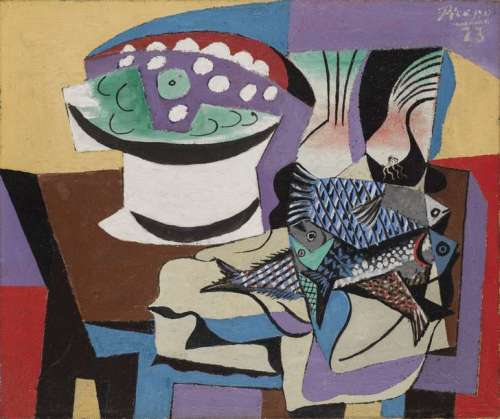 Still Life with Fish, by Pablo Picasso.
 Night squid fishing off Procida.