Feeds:
Posts
Comments

Archive for the ‘Uncategorized’ Category

a9867d405eeb9ec98ebbce4473684b03

Recipe below: Mussels with Leeks, Saffron, and Cream

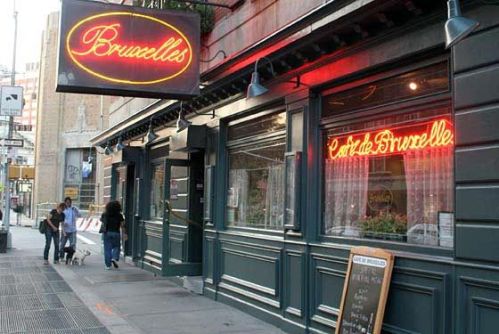
A strange phenomenon occurs in Manhattan. It concerns restaurants. With so much turnover, often two or three changes a year, we often can’t remember what was there before. Was Reno Sweeney in the Sotto 13 building or next door in the kid’s school? Or was it where that hairdresser recently moved in? Is the new sushi joint in the former Filipino takeout counter or at that nice looking taco place I never went into? I sometimes think it’s just me going a bit senile, but so many people experience it, having things pulled out from under us. Ungrounded New York. But there are places I’ll never forget. Café de Bruxelles is one of them.

Beginning in the mid-1980s you could find me at Bruxelles several times a week. It was a true hangout, something hard to come by in this erratic city. It was on the corner of Greenwich and Horatio, right down the block from my apartment. With its yellow neon and odd grayish-greenish-blue paint job, it pulled me right in. It was in a one of those West Village triangular buildings immortalized by Edward Hopper in his 1942 painting Nighthawks (which was supposedly patterned after a triangle-shaped building just down on Greenwich, at the corner of Seventh Avenue).

At Bruxelles it was the barroom, not the restaurant itself, that drew me. There was a lumpy old Zinc bar, on which it was hard to balance a wine glass. The few bar tables that overlooked Greenwich Avenue had large windows with short lace curtains that had seen better days. It got busy on weekends, but I always found a bar seat on a Tuesday or Thursday. There was a Duvel beer poster on one wall (or was it Orval?), and on another a recent (at that time) New York magazine writeup stating that the frites at Bruxelles were the best in the city. That was, in my opinion, pretty much true. The general ambiance was a blend of dowdy European and New York chic. An odd mix that really worked for me.

The French chef and wife owners were gracious and aloof. She worked the house with a tight jaw and all-seeing eyes. Francine or Frances (why can’t I remember her name?) was thin and petite, her dark hair pulled back with a scrunchie, her knee-length straight skirt, white blouse, and ballet flats signaling some sort of French preppy look. She mostly ignored the bar crowd, I think not really understanding the watering hole mentality. Her chef husband was sweaty and anxious when he occasionally emerged from the basement kitchen. Francine gave out little boxes of Leonidas Belgian chocolates to her regulars every New Year. I felt proud that I always got one.

Bruxelles wasn’t as freewheeling as some looser American places. The bartenders were instructed not to do too much chatting, and, more important, not to give away too many drinks, a rule they followed only when Francine (or Frances) was around. It wasn’t at all a pickup place. The clientele was a mix of the old West Village gray hair, Mexican skirt, and Birkenstock crowd, slightly worn-out middle-aged regulars who still had a bit of cool in them (like me), and younger people who drank strong cocktails. I sat there next to Lou Reed a few times.

Dinner at the bar for me was often two parchment paper cones of their exceptional frites (which came with homemade mayonnaise), three or four glasses of Côtes du Rhône red, and half dozen Marlboro Lights, which I bummed from friends or guys hanging at the bar (in later years, of course, we couldn’t smoke anywhere, and by that time, luckily, I had lost interest anyway). I know this “dinner” sounds sort of disgusting, but I can assure you that at the time it was perfection. When I wanted a real meal, I’d get a big bowl of mussels with cream and leeks and maybe a Delirium Tremens, one of the powerful Belgian beers they stocked. The serious food, such as waterzooi, a murky braise that, I was surprised to learn, was made with chicken, or the carbonade flamande, a beef stew cooked in beer, was mushy and dull. I usually stuck to the frites.

And they had mice. The mice would come out at night. One night I arrived at the bar, straight off a long plane ride, tired and seriously hungry, and after a few wines and a cone of frites I started experiencing a weird jet lag sensation, a sort of out of body feeling of falling backward in slow motion, even though I was sitting still. Not altogether bad, actually. But I sensed some kind real motion at my feet. I looked down and saw mice scurrying around my bar stool. I wasn’t sure if they were real or just my jet-lagged mind playing tricks. So many tiny baby mice. They were real. I asked Robert, the bartender, about them and he said, smirking, that the owners didn’t think they had any mice, so he guessed they didn’t have mice. Since they didn’t exist, I just went on with my bowl of mussels, staring out at the hard rain and the street lights. Robert said he liked my sweater. “Is it cashmere?” It wasn’t, but I felt good in my neighborhood, in my mousy place, on a chilly night, in my faux cashmere sweater.

Bruxelles closed in 2010. At first the owners said it was temporary, damage from a kitchen fire. That might have been the case, but we soon learned they’d sold the lease to a guy who planned to open a pricey, hip French place. That was very hard to bear. In a few months, there it was, the new place, zinc bar gone, packed with banker types, bone marrow on the menu. That didn’t last long. Then I think an eclectic American something or other opened up, also with bone marrow. I never ate there. And now Rossopomodoro, a more than decent, slick-vibed Italian trattoria run by people associated with Eataly. I can take it or leave it. I want Café de Bruxelles back.

red wine re-do

Red Wine with Mussels, by Carolyn Ritchie Bedford.

Mussels with Leeks,  Saffron, and Cream

(Makes 2 large servings)

Extra-virgin olive oil
2 medium leeks, cleaned and cut into thin rounds, using some of the tender green part
About 8 large sprigs of thyme, with the blossoms, if available, the leaves chopped
About 2 or so pounds black mussels, on the small side, well washed
¼ cup dry vermouth
A big pinch of saffron threads, dried and ground, and then dissolved in ½ cup of warm chicken broth
½ cup heavy cream
Black pepper
2 tablespoons butter
Salt, if needed
A handful of flat leaf parsley leaves, chopped

Get out a really big pot, and set it over medium-high heat. Add about 2 tablespoons of olive oil. Add the leeks and the thyme (saving the blossoms, if you have any, for garnish), and sauté until everything is fragrant and the leeks are softened, about 4 minutes. Add the mussels, and stir them around in the leeks for a minute. Add the vermouth, and let it boil out for about another minute. Now add the saffron-scented  chicken broth. When the liquid starts bubbling, stir the mussels so they’re well moistened, and then cover them for about about half a minute, just to build up some heat. Uncover,  adding the cream, and stir the mussels a few more times. They should start to open after about 5 minutes (a few might take longer, but don’t wait too long for them or the others will get overcooked).

Add the butter, the parsley, and the thyme blossoms, if you’ve got them. Toss. Taste for salt—you may or may not need any depending on the saltiness of the mussels. Serve right away. And have plenty of good bread to soak up the juices.

After the mussels, a big salad of bitter greens and a good soft goat cheese will be perfect—and very Bruxelles.

Read Full Post »

Tomato-with-Branch-12-X-16

Still Life with Tomato, by Kevin H. Adams

Recipe below: Braised Eggplant with Tomatoes, Crème Fraîche, and Cinnamon Basil

Late summer in Manhattan can be sweltering. Last week we went into the mid nineties. I have to admit I love when high heat and humidity hang in the city air, making me feel cloaked in a matted hot wool blanket. But the heat can’t disguise the fact that summer is coming to an end. This year I’m more apprehensive about that than usual. I wish I had a big project, driving me into the fall. Instead I have several intimate projects, things that can require greater immediate concentration than, say, a major book deal, but may not, to the outside world, seem as cool. That’s fine. I also worry about our country and our planet. Existential anxiety you say? Why, yes. It’s my specialty.

At this particular summer’s end, when our elected rulers are acting especially tawdry, the garden brings me something grand: tomatoes. All the rain and sun and heat have come together to produce late summer’s ultimate gift. My plants are ten feet tall and covered with various types of little Italian tomatoes, some deep red or orange, others still green and tight. The little guys are perfect for tarts, which I’ve been making a lot of, or for quick-seared sauce for pasta, which I’ve been eating tons of. I’ve yet to try growing bigger tomatoes. They seem too heavy for my small space. For those, I go to the farmer’s market.

To keep your mind off the petulant three-year-old running the paranoid circus we’re all forced to attend, why not consider a combination of eggplant, tomatoes, crème fraiche, and cinnamon basil. I can tell you it’s wonderful. The crème fraîche adds just the right touch of acidity to cut through eggplant’s richness. I don’t think I ever blended those two ingredients before. Is that possible? I just happen to have cinnamon basil growing on my deck. I’m not sure why I planted it. On a whim, I guess, and I don’t use it much. But somehow it seems exactly the thing for this dish. If you don’t have it (and why would you?), regular basil will be perfect here.

I served this with a side of merguez, but it stands alone, with a green salad and good bread, as an all vegetable dinner. And don’t forget a glass of cold rosato.

Happy end of summer to all my Italian food friends.

IMG_3183.JPG


Braised Eggplant with Tomato, Crème Fraîche, and Cinnamon Basil

(Serves 4)

Extra-virgin olive oil
5 or 6 small Japanese eggplants, cut into small chunks
1 large shallot, cut into small dice
5 or 6 sprigs thyme, the leaves chopped
1 large summer garlic clove, thinly sliced
Salt
1 teaspoon ras el hanout
Black pepper
4 medium-sized round summer tomatoes, seeded and cut into medium dice
A splash of dry Marsala
A drizzle of honey
Aleppo pepper
A heaping tablespoon of crème fraîche
Cinnamon basil or regular basil

Get out a big sauté pan, and set it over medium heat. Add about 2 tablespoons of good olive oil. When the oil is hot, add the eggplant, the shallot, and the thyme, and let them sauté until the eggplant is golden and tender, about 10 minutes. Now add the garlic, some salt, the ras el hanout, and a bit of black pepper. Sauté a minute or so longer, just to blend all the flavors.  Add the tomatoes and continue cooking until the they’re soft and starting to give off juice, about 5 minutes longer.

Give the pan a splash of Marsala and let it boil off. Add the honey and a sprinkling of Aleppo.

Pull the pan from the heat, and stir in the crème fraîche.

Spoon the eggplant into a wide serving bowl, and scatter on the basil. Serve hot or warm.


Read Full Post »

Recipe below: Fusilli with Zucchini and Lemon Mint Ricotta

19426529-small-green-zucchini-squash-and-a-big-yellow-italian-lemon-still-life-composition-handmade-acrylic-p

One night last week I binge-watched the YouTube series Pasta Grannies. If you don’t know about it, you should really take a look. As an Italian food lover, I find it a must-see. Older women from all over Italy show you how they make the pastas they’ve been creating for decades, classics from their regions, some so intricate, so rich with history that they seem born from religious fervor. Watching one of these ladies roll thin semolina pasta strands around a skinny metal rod, repeatedly, until she has a huge pile of delicate threads, made my mind spin with anxiety.  All I could think was, I’m so glad I don’t have to do that.

Many of these regional pastas are on the verge of dying out, as the show makes clear. Younger people aren’t inclined to quit their jobs so they can stay home and roll and stuff pasta all day. I get that. But I want these regional pastas to survive, even if made only on special occasions, the way I make orecchiette or cavatelli, pasta shapes typical of my ancestral town of Castelfranco in Miscano. And cavatelli are not all that hard, compared with the wild things some of these grannies are making (I was fascinated to learn, for instance, that some dishes traditionally contain two types of pasta, in one case mini ravioli placed on the bottom of a bowl, a long spindly pasta over that, and then the whole thing topped with a long-cooked ragù. That’s a lot of work.)

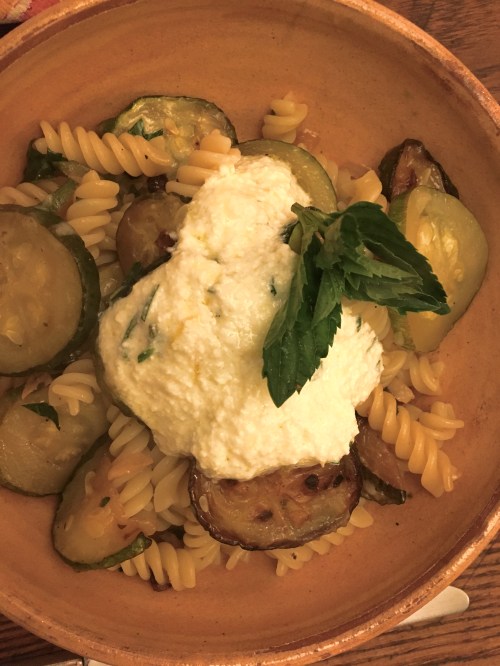
In one of the Pasta Grannies segments, a woman makes a slightly sweet pasta filling using ricotta, lemon, mint, and just a touch of sugar. Lemon and mint to flavor ricotta. Yes. I had forgotten how fragrant that combination is. I woke up the next morning thinking about those flavors and wanted to watch the segment again. But I had watched so many Pasta Grannies, and while drinking an ample amount of good Sicilian rosato, that when I went  back to look for the show, I couldn’t find it (there are more than 200 segments, and more in the works). And I can’t even remember exactly what type of pasta she made or what region it was from. Brain overload. Nevertheless, I was so inspired by that lady, I put together a simple summer pasta topped with a dollop of ricotta flavored with lemon and mint (using store-bought fusilli, I have to confess). I loved the way it came out. Thank you, Pasta Granny, wherever you are.

IMG_3128.jpg

Fusilli with Zucchini and Lemon Mint Ricotta

(Serves 5 as a first course)

For the ricotta:

1½ cups ricotta, sheep’s milk if available
The grated zest from 2 large lemons
1 teaspoon sugar
A few big scrapings of nutmeg
A pinch of salt
About 10 spearmint leaves, chopped

For the rest:

Salt
Extra-virgin olive oil
1 summer onion, diced, using all of the tender green stem
10 small summer zucchini (or about 5 bigger ones), cut into thin rounds
1 large summer garlic clove, sliced
Black pepper
A few big scrapings of nutmeg
1 pound fusilli
A splash of white wine
A squeeze of lemon juice
A handful of spearmint leaves, lightly chopped
A chunk of pecorino Toscano or Sardo cheese

Mix all the ricotta ingredients together in a bowl, adding a little warm water to loosen them and smooth them out.

Set up a pot of pasta cooking water and bring it to a boil, adding a generous amount of salt.

While the water is coming to a boil, drizzle about 2 tablespoons of olive oil into a large skillet over medium heat. When it’s hot, add the onion and the zucchini. Sauté until the zucchini just starts to brown at the edges, about 8 minutes. Add the garlic, and season with black pepper, salt, and the nutmeg. Continue cooking until the zucchini is tender but still holding its shape, a minute or so longer. Add the splash of wine to the skillet, and let it boil away.

Drop the fusilli into the boiling water. When it’s al dente, drain it, saving a little of the cooking water, and tip it into a large serving bowl. Add the zucchini sauce, the lemon juice, the mint, a fresh drizzle of olive oil, and a few gratings of cheese. Toss, loosening the pasta with some cooking water if it’s too dry. Check for seasoning.

Serve in bowls with a big spoonful of the ricotta on top, and a little more grated pecorino, if you desire.

And here’s the introduction to Pasta Grannies, to get you started:

Read Full Post »

Women with Fish

Read Full Post »

david-and-bathsheba

Every spring I plant one new herb. Something uncommon, often an herb I have no idea what to do with. I’ve grown angelica, lovage, epazote, mentuccia. I’ve learned to love a few of them; others I’ll never bother with again. This year I chose hyssop, an ancient Southern Mediterranean and Middle Eastern herb in the mint family.  Hyssop is so ancient it’s mentioned in both the Old and New Testaments. In Psalms 51:7 David says, “Cleanse me with hyssop, and I will be clean; wash me, and I will be whiter than snow.” Well, let me tell you, I tried this, and it didn’t work. My skin remains the same old Mezzogiorno greenish gray. Possibly David didn’t mean physical cleansing, rather he was asking God to cleanse him spiritually as he confessed his sins of adultery and murder. I’m not sure how it can be determined that the herb I’m now growing on my deck is the exact one in the Bible, but contemplating the history of herbs is one of the reasons I love growing them and cooking with them (did my great-great-great grandparents in Southern Italy flavor eggplant with oregano like I do? Did the oregano taste the same? Did they use hyssop?)

IMG_6453.JPG

My hyssop is growing straight up and strong. It’s just starting to bloom bright purply blue flowers. It tastes to me like a mix of thyme and oregano with hints of summer savory and an undertone of camphor. Taking a sprig to chew, I find it harsh at first and ending with a numbness on my tongue. It’s supposed to be the original dried herb used in za’atar, the Middle Eastern mix that also contains sesame and sumac. Nowadays you’ll more often find za’atar made with dried oregano or thyme (at least that’s what the packages say), but the three herbs are used interchangeably in the Mideast, so I imagine you get what’s available. I can’t say I can make it out by taste, but evidently hyssop is one of the chief flavorings in Chartreuse, that strong green liquor made by Carthusian monks. I love it in a martini in place of dry vermouth.

Note that true hyssop, which I’m growing, is not the same as anise hyssop, a North and Central American wildflower, not technically an herb at all. Anise hyssop has leaves and flowers that do taste of anise but that also have, in my opinion, a strong undertone of gasoline. I grew that for the first time last year. It attracted a lot of bees, which was good, but its flavor was a drag. After I ate the flowers in a few salads, I was done. That’s when I decided to try the real hyssop.

Jekka McVicar, the best known herb farmer in England, is someone I often consult when faced with an unfamiliar herb. I learned from her that there are all kinds of medicinal uses for hyssop, most pretty ancient and none confirmed by Western medicine. Herbalists use it as an antiseptic (there’s that cleansing thing again) and to sooth sore throats and asthma. While reading through Jekka’s hyssop entries, I came across her recipe for roasted peppers filled with cherry tomatoes, hyssop, and anchovies. I knew immediately that pairing the strong herb with sweet peppers and anchovies was absolutely right, so I played around with the concept, adding mozzarella and other things to make it more a solid meal. I’m really happy with the way the herb came through, rich and savory, with no medicinal tone at all. Now I know that I can use hyssop pretty much any time I’d reach for thyme or oregano or summer savory. Herbal expansion calling from the souls of dead ancestors.

IMG_3101.JPG

Roasted Sweet Peppers with Mozzarella, Anchovy, and Hyssop

(Serves 6 as a first course)

3 red summer bell peppers, cut in half and seeded
Extra-virgin olive oil
Salt
2 medium summer tomatoes, seeded, cut into small dice, and then drained
A big ball of mozzarella (about a pound), cut into small cubes (you won’t want a just-made milky cheese, it would give off too much liquid during cooking, so buy a good one earlier and stick in in the refrigerator for a few hours to firm up)
1 large summer garlic clove, minced
6 oil-packed anchovies, roughly chopped
3 long sprigs hyssop, the leaves lightly chopped (or use a mix of fresh oregano and thyme), plus a few hyssop flowers or nice looking sprigs for garnish
Black pepper
A splash of dry white wine
¼ cup grated pecorino Toscano cheese
½ cup homemade breadcrumbs, not too finely ground

Preheat the oven to 425 degrees.

Put the pepper halves on a sheet pan, cut side up. Sprinkle them with olive oil and a little salt. Roast them until they just start to get tender and fragrant, about 10 minutes (you don’t want them soft and collapsing, so rescue them before that). Pull them from the oven, and let them cool a bit.

In the meantime, put the mozzarella, tomato, garlic, and anchovies in a bowl. Add the hyssop, black pepper, a tiny bit of salt (remember that the anchovies are salty), and give it all a drizzle of olive oil. Toss.

Fill the peppers with the mozzarella mix. Drizzle a little white wine over each pepper. Mix the breadcrumbs with the pecorino, and sprinkle that over the peppers. Give them another little drizzle of olive oil and a touch of salt.

Bake until the peppers are tender, their insides are gooey, and the top is lightly golden, about 15 minutes. Garnish with the remaining hyssop. Serve right away.

Read Full Post »

d33222c3bbcc5ef2a7b7620af833ab3f_rwh-competitions-in-schools-lanka-rain-water-harvesting-forum-rain-water-harvesting-images-for-drawing-competition_540-698

Recipe below: Rice Salad with Filetto di Pomodoro, Corn, Miso, and Basil

We had a dramatic rain in Manhattan last week. I got caught in it. I was walking down 14th Street, heading toward Seventh Avenue, when it suddenly came crashing down, unexpectedly, at least for me who hadn’t bothered with the weather report. Totally drenched, I made my way to a corner with leaky scaffolding and crammed in there, underneath the wood planks, with about thirty other soaking people. The thunder was the most raucous and crackling I can recall in a long time, and the rain came down almost horizontally.  A spotty dachshund cowered, but I felt free and good. Hard rain almost always lifts my spirits.

While waiting out the rain with my city mates, I thought of the backyard porch on Long Island where I grew up, which I loved especially when it rained hard. There I could be surrounded by rain but at the same time protected from it, just like on 14th Street. Our porch had a forest green canvas awning with white tassels, charmingly old-fashioned even back in the 1960s. During a hard rain I’d drag out my mother’s pasta pots and the bottom of our huge lobster cooker and set them up so they could collect rain water.  That was a hobby of mine. I’d sit on the cushioned love seat and listen to the thunder and watch the pots fill with water. Why? Was I trying to catch what might be needed for family well-being? We weren’t likely to face a life-threatening drought in Nassau County, twenty miles east of Manhattan. Maybe it was an element of housekeeping imprinted in my DNA, or some ancient Puglian relative guiding my survival instinct. Whatever provoked me, I collected rain water, a lot of it. And this wasn’t just an early childhood urge, like making mud pies. Water collecting lasted well into my late teens.

Unfortunately we eventually replaced our green canvas awning with an Italian-American update, a white aluminum roof that made machine gun sounds whenever it as much as drizzled, ruining the experience completely. Luckily, that wasn’t too many years before I moved into Manhattan and replaced the awning experience with city scaffolding.

Rain water harvesting is illegal in some states, because some arcane laws say rain doesn’t belong to you. It belongs to someone who may have laid claim to it far in the past—a wheat farmer or a cowboy, possibly—even if a cascade is pouring off your roof. New York doesn’t have that ridiculous law, or didn’t that I knew of at the time. I can’t say I harvested the water, exactly. It was more like hoarding it. I’d keep it for a few days and then, as I recall, pour it around my father’s tomato plants. He asked me to do that.

My father often talked about rain. He’d say, we could use some rain, or we really need a good rain. When I was very young I wasn’t sure what needing rain meant, growing up in a place that didn’t seem to need anything. I soon learned that he meant he wanted his tomatoes to be well provided for. Now that I grow my own tomatoes, rain has an added importance. I need it.

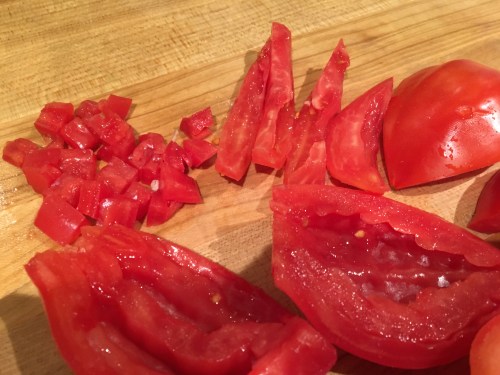
IMG_3047.JPGIn my opinion, tomatoes are nature’s greatest summer gift. A fine thing to do with them is to make an Italian-style rice salad, which is like a pasta salad but more authentically Italian. To cut down on excess wateriness in my rice salad, I slice the tomatoes into a filetto di pomodoro. That means I cut away all the seeds and watery gel from the inside of the tomatoes and then chop the remaining fillets. The deep red tomato bits look like a pile of rubies sitting on my counter (see the photo above). Don’t throw away those slippery seeds. You can take all that and throw it into a blender. Then you can easily strain it, making a thick tomato juice that’s great in a Bloody Mary, or for loosening up pastas or soups.

IMG_3053.JPG

Rice Salad with Filetto di Pomodoro, Corn, Miso, and Basil

(Serves 4 or 5)

3 medium-size summer tomatoes
2 cups cooked long- or medium-grain white rice
The kernels from 2 cooked ears of corn
1 small shallot, well chopped
A palmful of Niçoise black olives, pitted and lightly chopped
A palmful of toasted pine nuts
1 tablespoon white miso, at room temperature
1 tablespoon rice wine vinegar
A teaspoon of dry vermouth
1 small summer garlic clove, minced
Extra-virgin olive oil
Salt
Black pepper
A big pinch of pimento d’espelette
A handful of Thai basil leaves or regular basil (or a mix), roughly chopped

Quarter the tomatoes, and then cut out their insides, leaving the juicy, thick skin. Slice the skin into strips, and then cut the strips into little cubes (see the photo above). You’ve now got your filetto di pomodoro.  For suggestions on what to do with the tomatoes’ insides, see the essay above.

Place the rice in a nice-looking serving bowl; one more wide than deep is best. Add the filetto di pomodoro, the corn, the shallot, the olives, and the pine nuts. Give it all a toss.

Whisk the miso together with the rice vinegar, the vermouth, and the garlic. Whisk in 2 tablespoons of olive oil. Season the vinaigrette with salt, black pepper, and a little pimenton d’espelette. Pour this over the rice, adding the basil, and toss well. Let the rice sit for about a half hour so all the flavors can blend. Now give it another toss, correct the seasoning if necessary, and serve.

I find this especially good alongside grilled Italian sausages.


Read Full Post »

2861168-MLGMQQOJ-7.jpg

Still Life with Goat Skull and Beets, by Viktoria Kiss.

Recipe below: Beet and Goat Cheese Torta with Olives and Summer Savory

“Great cooking favors the prepared hands” —Jacques Pépin

That is a fairly well-known quotation from M. Pepin about creativity. Its truth has never been more apparent to me than in the last few months, when I’ve tried painting illustrations for my next cookbook. I’d had the idea before but never acted on it. This time I started painting. Oh, boy.  When things didn’t turn out instantly impressive, I got demoralized. What was I expecting? Instant greatness? My culinary skills, at this point, are pretty well rooted, allowing me to improvise freely.  After decades of cooking in restaurants, creating recipes, and writing cookbooks, I’ve got what M. Pépin calls prepared hands. Painting is another story.

Feeling like a beginner at this point in my life, felt, well, bad. I was a decent painter in high school (as in 40 years ago), and figured it would all come flowing back. I made the situation worse by choosing to paint in gouache, a medium I was completely unfamiliar with. I’m not sure why I went for that, except that possibly my love for Leonetto Cappiello’s posters drew me to his opaque matte finishes and bold shadows. I was hoping to turn out a first painting with a blue-gray sky and a scattering of stars under which a guy in a shiny suit, with Italian bags beneath his eyes, would float away with a handful of zucchini. Perfect cookbook material, no? So far, it hasn’t turned out as planned. But I haven’t given up.

This artistic frustration has led me, as many things do, to the Greenmarket, searching for color and all-around inspiration. High summer is definitely in bloom there. Lots of varieties of beets, a vegetable with a strong pull on me. Are you familiar with the Chioggia beet? It’s bright burgundy outside, which seems normal enough, but when you cut it open you reveal a spiral of fuchsia and white, a candy-stripe swirl. Amazing. But this is not some designer hybrid. It’s the real deal, a Northern Italian heirloom that became popular in the nineteenth century. Chioggia beets are very sweet and tender, and, another big plus, they don’t bleed all over the place.  When they’re cooked, their brilliant spiral design is replaced with an ombré effect, with colors moving from dark pink to orange and then to a creamy beige. Quite beautiful in its own right.

IMG_3021.JPGSo I made this beet and goat cheese torta. It’s a lot more beautiful and delicious than any painting I can turn out at the moment. I offer it to you as a high summer thought. You’ll notice that it has touches of sweetness, in the beets, of course, but also in the sweet pasta frolla, and the honey-vinegar drizzle I add right before baking. But to balance that out, I’ve added olives and a strong herb, making it suitable for an antipasto pass-around. Nice with a glass of rosé.

IMG_3032.JPG

Beet and Goat Cheese Torta with Olives and Summer Savory

(Serves 8 as an antipasto)

For the pasta frolla:

2½ cups regular flour, plus a little more for rolling
¼ teaspoon salt
¼ teaspoon baking powder
2 tablespoons powdered sugar
½ teaspoon ground allspice
The grated zest from 1 lemon
1½ sticks butter, cut into tiny cubes
2 large eggs, lightly whisked
About 2 tablespoons dry vermouth, maybe a little more

For the filling:

6 small beets, either Chioggia or another variety that doesn’t bleed too much
1 8-ounce log of fresh goat cheese
3 tablespoons heavy cream
1 small summer garlic clove, minced
1 large egg
Salt
Black pepper
About 10 black Niçoise olives, pitted and cut in half
About 6 large sprigs of summer savory or thyme (or a mix), the leaves lightly chopped
1 tablespoon extra-virgin olive oil
1 tablespoon runny honey
1 tablespoon rice wine vinegar

To make the pasta frolla, put the flour, salt, sugar, allspice, and lemon zest in a food processor. Pulse a few times to mix.  Add the butter, and pulse until it’s broken up into pea-size bits. Add the eggs and vermouth, and pulse again, quickly,  just until all the ingredients come together into a crumbly, moist mass (pinch a bit of dough; if it doesn’t hold together, add a touch more vermouth and pulse again). Tilt the dough out onto a lightly floured work surface, and knead briefly, maybe 3 or 4 strokes, until it comes together in a ball. Wrap it in plastic, and refrigerate for an hour or so.

Preheat the oven to 425 degrees. Wrap the beets in aluminum foil, stick them on a sheet pan, and roast them until fragrant and tender, about ½ hour (depending on the size of the beets they may need to go a little longer). Now let them cool until you can slip their skins off. Slice them into thin rounds.

Take the dough from the refrigerator, and let it warm up for about 15 minutes (this will make it easier to roll).

In the meantime, place the goat cheese, cream, egg, garlic, and a little salt and black pepper in a food processor. Pulse a few times to blend. Add the olives and the savory or thyme, and stir them in by hand (I don’t like pulsing the olives. It breaks them up too much).

Roll the dough out on a lightly floured surface and drape it into the tart pan, leaving overhang. Pour in the goat cheese cream. Now arrange the beet slices in a circular, slightly overlapping pattern. Trim the edges.

In a small saucepan, heat the honey with the olive oil and the vinegar, just until the honey is melted, about 30 seconds. Pour this over the beets. Season the top with a little salt.

Bake at 425 degrees until the inside is puffed and the crust is lightly browned, about 30 minutes. Let the tart sit about ½ hour before slicing, so it can firm up a bit.


Read Full Post »

oplontis-fig-basket-villa-poppaea1.jpg

Fig Basket, Villa Poppaea, Oplontis


Figs

D.H. Lawrence


The proper way to eat a fig, in society,
Is to split it in four, holding it by the stump,
And open it, so that it is a glittering, rosy, moist, honied, heavy-petalled four-petalled flower.
Then you throw away the skin
Which is just like a four-sepalled calyx,
After you have taken off the blossom with your lips.
But the vulgar way
Is just to put your mouth to the crack, and take out the flesh in one bite.
Every fruit has its secret.
The fig is a very secretive fruit.
As you see it standing growing, you feel at once it is symbolic:
And it seems male.
But when you come to know it better, you agree with the Romans, it is female.
The Italians vulgarly say, it stands for the female part; the fig-fruit:
The fissure, the yoni,
The wonderful moist conductivity towards the centre.
Involved,
Inturned,
The flowering all inward and womb-fibrilled;
And but one orifice.
The fig, the horse-shoe, the squash-blossom.
Symbols.
There was a flower that flowered inward, womb-ward;
Now there is a fruit like a ripe womb.
It was always a secret.
That’s how it should be, the female should always be secret.
There never was any standing aloft and unfolded on a bough
Like other flowers, in a revelation of petals;
Silver-pink peach, venetian green glass of medlars and sorb-apples,
Shallow wine-cups on short, bulging stems
Openly pledging heaven:
Here’s to the thorn in flower! Here is to Utterance!
The brave, adventurous rosaceæ.
Folded upon itself, and secret unutterable,
And milky-sapped, sap that curdles milk and makes ricotta,
Sap that smells strange on your fingers, that even goats won’t taste it;
Folded upon itself, enclosed like any Mohammedan woman,
Its nakedness all within-walls, its flowering forever unseen,
One small way of access only, and this close-curtained from the light;
Fig, fruit of the female mystery, covert and inward,
Mediterranean fruit, with your covert nakedness,
Where everything happens invisible, flowering and fertilisation, and fruiting
In the inwardness of your you, that eye will never see
Till it’s finished, and you’re over-ripe, and you burst to give up your ghost.
Till the drop of ripeness exudes,
And the year is over.
And then the fig has kept her secret long enough.
So it explodes, and you see through the fissure the scarlet.
And the fig is finished, the year is over.
That’s how the fig dies, showing her crimson through the purple slit
Like a wound, the exposure of her secret, on the open day.
Like a prostitute, the bursten fig, making a show of her secret.
That’s how women die too.
The year is fallen over-ripe,
The year of our women.
The year of our women is fallen over-ripe.
The secret is laid bare.
And rottenness soon sets in.
The year of our women is fallen over-ripe.
When Eve once knew in her mind that she was naked
She quickly sewed fig-leaves, and sewed the same for the man.
She’d been naked all her days before,
But till then, till that apple of knowledge, she hadn’t had the fact on her mind.
She got the fact on her mind, and quickly sewed fig-leaves.
And women have been sewing ever since.
But now they stitch to adorn the bursten fig, not to cover it.
They have their nakedness more than ever on their mind,
And they won’t let us forget it.
Now, the secret
Becomes an affirmation through moist, scarlet lips
That laugh at the Lord’s indignation.
What then, good Lord! cry the women.
We have kept our secret long enough.
We are a ripe fig.
Let us burst into affirmation.
They forget, ripe figs won’t keep.
Ripe figs won’t keep.
Honey-white figs of the north, black figs with scarlet inside, of the south.
Ripe figs won’t keep, won’t keep in any clime.
What then, when women the world over have all bursten into self-assertion?
And bursten figs won’t keep?
fig-tart

Fig Tart with Limoncello and Thyme

(Serves 6 to 8)

For the crust:

5 tablespoons unsalted butter
2 tablespoons extra-virgin olive oil
4 tablespoons sugar
A pinch of salt
2 tablespoons Limoncello
1¾ cups all-purpose flour
4 thyme sprigs, the leaves lightly chopped

For the custard:

¾ cup non-ultrapasteurized heavy cream
1 large egg
2 tablespoons sugar
1 tablespoon Limoncello
The grated zest from 1 lemon
4 thyme sprigs, the leaves lightly chopped
1 teaspoon finely ground flour, such as Wondra

Plus:

15 or 16 fresh figs, either black or green, cut in half lengthwise
Extra sugar for the top

Preheat the oven to 375 degrees.

In a small saucepan, melt the butter. Add the olive oil to the butter, give it a stir, and then let the butter mixture cool completely. With a pastry brush, use about a tablespoon of the melted butter mixture to coat a 9-inch tart pan with a removable bottom.

To make the crust: In a medium bowl, combine the remaining butter mixture with the sugar, salt, Limoncello, and about a tablespoon of water. Stir to blend. Add the flour and the thyme, and mix briefly until you have a mass of moist, crumbly dough (don’t blend so much that it forms a ball). Tip the dough into the tart pan, and pat it down and out to the edges and all the way up the side to form a thin crust. Bake for about 15 minutes, until lightly colored and slightly puffy.

In a small bowl, combine all the ingredients for the custard, and whisk until they’re well blended.

Place the figs, cut side up, in the crust, in a slightly overlapping circular pattern. Pour the custard evenly over the figs, and sprinkle the top with sugar. Bake until the crust is golden and the custard is set, about 45 minutes. Let sit for about ½ hour before serving.

Read Full Post »

db9a0032602c3a5e076a55b94133d4fb

A Bunch of Carrots, by Kay Smith.

Recipes below: My Ras el Hanout; Carrots Roasted with Ras el Hanout and Summer Savory, Served with Crème Fraîche.

Growing up I didn’t have much contact with carrots. I’m trying to think if we ever even had them as a side dish when I was a kid. I don’t think so. They were for soffritto, little bits of orange that would float around in a ragù. My mother did put them out raw, along with celery and black olives, at cocktail parties, with blue cheese dip. I liked the dip.

What is the taste of a carrot?  It’s elusive. If I think too much about it I start to doubt my taste buds. Winter ones seem soapy. Early summer market carrots aren’t soapy. They’re sweeter, but, I don’t know, they just need something. Cooking helps, but even then, unless they come out somewhat spiced or candied, I’m not all that interested. Roasting is a very good way to concentrate their flavor, as are sweet and hot spices, too, or honey, salt, or, as I’ve just discovered, summer savory.

IMG_2893.JPG

My summer savory.

This is the first year I’ve grown that herb. The plant is already full and bushy. It tastes to me like a cross between thyme and oregano, so I’d give it a try anywhere I’d use those herbs, but it releases more strength than either of them, and it’s a little bitter, maybe closer in taste to a wild herb.

My Ras el Hanout

Toast cumin and coriander seeds, about a teaspoon of each. Then grind them together in a mortar and pestle, along with a small piece of Ceylon cinnamon stick. Add ground turmeric, sweet paprika, salt, dried ginger, and black pepper, about ½ teaspoon of each. Mix everything well. I like to leave the mix a little gritty, not too powdered. Close it up in a little jar. It will keep fragrant for about 2 months, providing you start out with fresh spices. I find it best to make in small batches, but feel free to double or triple this recipe if you think you’ll be using it up fast enough.

IMG_2977

My carrots, before roasting.

Carrots Roasted with Ras el Hanout and Summer Savory, Served with Crème Fraîche

(Serves 4)

2 bunches of thin summer carrots (multicolor will look especially pretty), scrubbed clean, leaving about ½ inch of their green stems (if your carrots are thick, as mine were, try cutting them lengthwise; see the photo above)
Extra-virgin olive oil
Salt
Aleppo pepper
1 teaspoon Ras el Hanout (see my recipe above or use a good store-bought brand)
1 scallion, cut into thin rounds, using some of the tender green part
1 tablespoon runny honey
A sprinkle of rice wine vinegar
10 large sprigs of summer savory, stemmed (if you don’t have it, use fresh thyme instead)
½ cup crème fraîche

Preheat the oven to 425 degrees.

Lay the carrots out on a sheet pan. Drizzle them with olive oil, and toss them well. They should be nice and coated. Sprinkle with salt and a little Aleppo, and toss again. Stick them in the oven, and roast them for about 5 minutes. Pull them out, and give them a gentle toss. Sprinkle on the ras el hanout, the scallion, and drizzle with honey. Toss to blend it all. Put the carrots back in the oven, and roast them until they’re golden, tender, and fragrant, about another 10 minutes, depending on how thick they are. Pull them from the oven, sprinkle on the rice vinegar (just a little sprinkle), and then scatter on the summer savory.

Pile the carrots up on a good looking platter.  Give each serving a dollop of crème fraîche.

Read Full Post »

982010-XADTJDAS-7

An Arrangement of Peas, by Mark Brooks.

Recipe below: Conchigliette with Shell Peas, Fennel, Prosciutto, and Basil

“Improvisation is the expression of the accumulated yearnings, dreams, and wisdom of the soul.” —Yehudi Menuhin

Can this quote, attributed to a great violinist, be applied to pasta cooking? I think so. There’s nothing more soulful and dreamed up than a bowl of good pasta. It’s the best thing an Italian cook can offer you. I make spur-of-the moment pasta a lot, but it doesn’t often find its way onto my blog. Not original enough? Not special enough? Too everyday? Yes, I guess all of those things. But don’t you love when a whim just hits, when flavors blend effortlessly, and the thing cooks along like in a nice dream? No snags, no thinking, all floating. The aroma is right from step one. In warm weather, when I’ve got such good produce to work with, these unrehearsed pastas can be memorable. I’d make this again.

wright-conchiglie


Conchigliette with Shell Peas, Fennel, Prosciutto, and Basil

(Makes 2 large servings)

Salt
4 thin slices prosciutto di Parma or San Daniele, the fat removed, chopped, and saved, and the rest cut into thin strips
Extra-virgin olive oil
1 fennel bulb, cored and thinly sliced, chopping and saving a few of the big feathery fronds
1 small summer onion, sliced, using some of the green stem
1 cup freshly shelled peas
2 allspice, ground to a powder
6 or so fennel seeds, ground
A splash of rosé wine
½ cup of chicken broth, possibly a little more
2 tablespoons unsalted butter
Black pepper
A few drops of rice wine vinegar
About a dozen basil leaves, cut into chiffonade
A small chunk of Parmigiano Reggiano cheese

Set up a pot of pasta cooking water. Add salt.

While that’s coming to a boil, get out a large sauté pan, and set it over medium heat. Add a generous drizzle of olive oil and the chopped prosciutto fat. When the fat starts to melt a bit, add the fennel and the onion, and sauté until softened, about 4 minutes.

Now add the peas, the allspice, and the fennel, and season with salt. Sauté for about a minute (this will bring out their flavor). Add the splash of rosé (or any crisp white wine), and let it boil away. Add the chicken broth, and simmer until the peas are just tender, about another 4 minutes or so.

Drop the conchigliette into the water, and cook until al dente.

Drain the pasta and add it to the sauté pan over a low heat. Add the butter, and season with black pepper and a few drops of the vinegar while tossing gently just until everything is mixed. Add a little more chicken broth, if it seems dry.

Pour the pasta into a serving bowl. Add the prosciutto and basil, and toss again. Serve with a generous grating of Parmigiano.

Read Full Post »

« Newer Posts - Older Posts »