Feeds:
Posts
Comments

Archive for the ‘Uncategorized’ Category

Espelette, by Helene Miguel.

Recipe below (in text): Fresh Espelette Salsa with Thyme Vinegar and Allspice

I’m growing espelette chilis in my garden this year. They are traditional Basque chilis mainly used dried to produce piment d’Espelette, a sweet and moderately spicy paprika. So far mine are runty and green. Maybe they don’t like upstate New York weather. Considering that it’s already mid-August, I’m not sure they’ll ripen before the first frost. That’s pretty sad. But when I went over to the Union Square Greenmarket the other day, there were bins of espelettes, deep red, shiny, smelling sweet but with that touch of raw spice that glows forth even before you cut into one. Those were from South Jersey. I guess they like it there better.

The espelette pepper at peak ripeness is an amazing color that appeals to me like few others. It’s not a fire engine red, but not dark ruby either, and nothing like a blood-red beet. It’s something in between, closer to the best lipstick shade for me and many Italian American types, and it might be described as rich red. I have synesthesia, and deeply pigmented red has always been the number five for me. This color screams five.

I love making fresh chili sauces, so when I saw these espelette beauties, I knew what I had to do. I always make any chili sauce in a small batch so it will keep about two weeks and stay vibrant. I used a dozen good sized espelettes and got about two cups of beautiful salsa. It didn’t emerge as the Italian American lipstick of my dreams, but rather as a clear, deep orange, also a lovely shade. It had a nice balance of sweet, acid, and heat.

So here’s what I did:

I roughly chopped and seeded my dozen espelettes. I then heated a little olive oil in a good-size sauté pan, dropping in the chilis and letting them sauté over medium heat for a few minutes, to start softening. I added a small, chopped summer onion and a big garlic clove, sliced, plus some salt, and let that sauté for a minute or so longer. Then I added about ½ teaspoon of allspice and a teaspoon of sugar, letting them warm through to release their flavors. I gave everything a splash of thyme vinegar (if you don’t have that, just add a few thyme sprigs when you add the allspice), and let it bubble for a few seconds. I threw in about a half a cup of warm water, turned the heat down a notch, covered the pan, and let everything simmer until the chilis were very soft, about another 8 minutes. Then I turned off the heat, added a drizzle of fresh olive oil, and let things cool off a bit before puréeing the result in a food processor. Taste it after you purée for a good balance of salt, sweet, and acid, adjusting as needed.

Read Full Post »

Read Full Post »

Still Life with Green and Black Olives, Vita Schagen

Often I have a hundred ideas about how to start a meal—and those ideas add up to appetizer chaos. Too many options? I’m not sure. My need to feed from beginning to end is strong, but it’s got to be smooth. Each meal must be of a piece, all the courses fitting together to create a meaningful flow. That’s not so hard in concept, so why do I get confused in my kitchen?

When I first read Lulu’s Provençal Table, Richard Olney’s book about Lulu Peyraud, a famous home cook of Provence and a muse to Olney, Alice Waters, Kermit Lynch, Paul Bertolli, and Jeremiah Tower, I was surprised to learn she only had a handful of amuse-gueules, openers she offered on rotation. They inevitably involved tapenade or anchoïade (olive or anchovy spreads) served on little toasts, or buttered sardines served on little toasts, or fresh garlic and olive oil rubbed on little toasts.  That is what happens when you focus your culinary mind exclusively on your region. If you’re a good cook, every dish can be a local jewel.

Being Italian American doesn’t always focus me enough. My soul is purely Mediterranean, but living in Manhattan I’m hit with culinary influences from all directions and frequently derailed. When I’m truly focused I remember that my reason for cooking is to revisit the flavors I grew up with and love, and to let those flavors naturally evolve. I’m not here to create fancy new versions of haikara soba.

So I was recently putting together a little birthday dinner for a good friend. I set out to buy olives but was immediately frustrated to find that my market had only Gaetas, not my favorite olives. I went looking for the smaller, sweeter Taggiasca ones from Liguria, but my shop was out. I bought the Gaetas anyway. They tasted a bit sharp, so I figured I’d doctor them up, settling on the rosemary fennel flavor combination that I wrote about in my last blog and find so appealing. Then I decided to bake the olives, something that I hadn’t done in a long time and had sort of forgotten was a thing to do. It’s a good solution if you ever need to mellow out a batch of sharp olives.

Here’s what I did:

Get out a nice looking baking dish that will fit your olives fairly snuggly in one layer. For this version I scattered on a palmful of fennel seeds and a generous amount of fresh rosemary sprigs. I also added the budding tops from a bunch of garlic scapes I had on hand. Then I drizzled on some good olive oil and added a few turns of coarse black pepper. I gave it all a good toss and then baked it, uncovered, in a 400-degree oven for about 10 minutes, just until the olives were hot through and starting to look a bit puffy. The aroma was intense and really appealing. I let them cool off slightly before serving them, so my guests wouldn’t burn themselves, but they were definitely still warm and juicy to bite into, and that is the beauty of this simple appetizer. It feels more substantial that cold olives, more like real food. Everyone loved it.  And it will be a good thing to remember the next time I freak out trying to come up with a simple opener to get a meal flowing. 

Read Full Post »

Koi Pond, by Adrianne Lobel, 2005.

Recipe below: Roasted Red Snapper with Fennel Rosemary Vinaigrette

It has been pouring here on and off for about two weeks. My basil is flooded and my garlic soaked. I’m worried. My garden needs a dryout. And I’ve been dreaming of fancy outdoor grilling, but due to all this rain, it has not yet happened. I love doing a whole fish on the grill. It’s a romantic experience, and with all the herbs I’ve got growing, providing they’re not all drenched out, it can be high-end fragrant. I will get out there soon, I promise you. In the meantime, I’ve been at my oven, which is also a very good place to cook a whole fish.

As you’ve all heard a zillion times, cooking fish whole brings out more flavor than just doing a fillet. I don’t like to beat you over the head with this, but it’s true. Everything stays contained under the skin—the fat, the natural moisture, the gelatinous stickiness from the bones, plus all the flavors you stuff inside it. I think the hesitation for most people is not knowing when the fish is cooked, but that’s not hard to gauge. I like a high-heat roast, so I’ll go with 425, even 450 degrees. My 3½ pound red snapper took about 20 minutes. I started checking after about 15 minutes by inserting a paring knife alongside the backbone to see if the meat could be lifted from the bone but stay pretty much in one piece. Once it could, the fish was ready. I didn’t let it get into “easily flaked” territory, especially since a fish will continue to cook a little after you take it out.  

I went to the market looking for my favorite little rougets (called red mullets in this country), but my fish guy at the Chelsea Market was all out. I guess I had the color red on my mind, so I instead went with a red snapper, a beautiful fish, very mild and white-fleshed. For flavoring I returned to my much-loved fennel rosemary blend, a tradition for porchetta that works well with all sorts of seafood as well. Fennel alone is, of course, classic with fish, but when you blend it with rosemary the flavor is fuller yet not overly assertive. A deep perfume develops.

Roasted Red Snapper with a Fennel Rosemary Vinaigrette

Extra-virgin olive oil
1 whole red snapper, gutted and scaled (mine was about 3½ pounds)
Salt
Black pepper
A handful of stalks from wild fennel, or 1 large bulb fennel sliced lengthwise, plus a bunch of fronds
About 10 large rosemary sprigs
2 lemons, 1 sliced into half rounds, the other cut in half
3 whole summer garlic cloves, lightly crushed
A splash of dry vermouth
A teaspoon of fennel pollen
5 or so flat-leaf parsley sprigs

Heat the oven to 425 degrees.

Get out a small sheet pan or a large roasting pan, and drizzle in some olive oil. Coat the fish well, inside and out, with olive oil, and season it with salt and black pepper. Place the fennel stalks or slices in the pan, and lay the fish on top. Stuff the fennel fronds and half of the rosemary inside the fish. Stick as many lemon rounds as you can inside. The rest place around the fish. Stick the garlic inside the fish. Drizzle the vermouth over the fish.

Put the fish in the oven.

While the fish is roasting, chop the remaining rosemary well. Put it in a small bowl, along with the fennel pollen, about ½ cup of good olive oil, and the juice from the cut lemon. Chop the parsley, and add it to the sauce. Season with salt and black pepper, and give it a good stir. Let the sauce sit to develop flavor while the fish continues to cook.

My fish took about 20 minutes, but you’ll want to check by sticking a knife in along the backbone. If the meat pulls away from the bone but stays more or less in one piece, it’s ready. You don’t want to cook it any further than that. If it’s really flaky, it’s slightly overcooked. Depending on the size of your fish, I’d start checking after 15 minutes.

Let the fish sit for about 5 minutes so it can settle. Pull the skin off, and fillet the top side, plating it. Pull out the skeleton, and lift the other side off its skin onto another plate. Take one of the garlic cloves out of the fish, and mince it. Add it to the vinaigrette, giving it a stir. Spoon the vinaigrette over the fish. Eat it right away.

Read Full Post »

What a prickly beauty. Big tail, small head. Will she ever get out without tiny, bloody scratches? I say, not likely. But artichokes are always worth the effort.

Read Full Post »

Here’s a guided tour.

Read Full Post »

Zucchini on Newspaper, by Katia Ricci.

Recipe below: Zucchini Gratin with Thyme and Goat Cheese

It seems a lot of people need help with zucchini, mostly with how to change it up from the usual pan sauté. I know I do, so when I come up with a good recipe, I want to share it with you. And if you’re growing zucchini and now have tons of it coming in all at once, you really do need help.

This is an easy gratin, but it looks kind of fancy. Good for a dinner party. I served it with huge grilled shrimp marinated in marjoram, garlic, and lemon, a nice fit but I could imagine grilled lamb or chicken kebabs just as easily.  I’m thinking the grill texture and flavor would juxtapose nicely with the gentleness of the gratin.

Happy summer cooking to you.

Zucchi Gratin with Thyme and Goat Cheese

10 medium zucchini (they will shrink up), cut into rounds
1 shallot, thinly sliced
Extra-virgin olive oil
Salt
Black pepper
1 small log (4 ounces) fresh, soft goat cheese, at room temperature
½ cup crème fraîche, at room temperature
¼ teaspoon ground nutmeg
1 small summer garlic clove, chopped
Possibly a little milk
12 big sprigs fresh thyme, lightly chopped but with flowers if it has them
¾ cup grated grana Padano cheese

Preheat the oven to 425 degrees.

Oil a large sheet pan. Lay the zucchini out on it in more or less one layer (a little overlap is fine). Scatter on the shallot, drizzle with olive oil, and season with salt and black pepper. Roast until the zucchini just starts to brown lightly at the edges, about 8 minutes or so. I find this step important for removing excess water from the zucchini. If you skip it, your gratin may wind up quite liquidy.

Put the goat cheese and crème fraîche in a food processor. Add the nutmeg and garlic, and season with salt and black pepper. Give the mixture a few pulses to blend everything. It should be thick but pourable, a bit thicker than heavy cream. If it’s too thick, add a drizzle of milk and pulse again.

Get out baking dish. I used a 11-by-8-inch Le Creuset oval, but anything more or less equivalent will work fine. Oil the inside lightly. Add half of the zucchini, spreading it out. Sprinkle on half the thyme and some grana Padano. Add the rest of the zucchini.

Pour the goat cheese cream evenly over the top, and wait for it to sink into the zucchini a little. Sprinkle on the rest of the grana and the remaining thyme. Bake, uncovered, until it’s bubbly and the top is browned, about 12 to 15 minutes.

Let the gratin cool a few minutes before serving, so it can firm up.

Read Full Post »

Herbs, by Evelina Poplian.

Recipe for a soft herb salad in the next-to-last paragraph below.

So far all my herbs look good. I knew they were starting out in that direction when in early spring my lovage came bursting out of the ground and grew huge in only three weeks. Lovage is a powerhouse herb, in growth but also in taste, like celery condensed into a speeding bullet. I use only a leaf or two when I cook a pot of beans or make a potato salad. I find it interesting that the herb I use the least of is the biggest thing in my garden. Although my fennel is also already gigantic. 

My fennel.

I planted a lot of other herbs this year too, some, like hyssop and za’atar, for this first time. They all look promising. I always lighten up when I see that my plants are starting to take. My father had the same early season gardening anxiety when he planted and tended his tomatoes. He’d be out in his garden at weird hours, chain-smoking and staring hard at the little seedlings, maybe trying to instill some fear in them. I’m not sure what his method was, but we always had good tomatoes. I go out to my herb garden and stare and worry and sometimes plead with them. It’s part of the process.

Salad burnett in my garden. It tastes like cucumber.

Up here in Dutchess County, New York, only a handful of herbs are perennial, and sometimes even the perennials get defeated by our miserable winters. But this year everything I hoped would come back did. In addition to my out-of-control lovage and fennel, all my various thymes and oreganos returned, as did my nepitella, winter savory, tarragon, sage, and borage, which is popping up all over the place. The lavender didn’t make it this year, and rosemary always gets freezer burn and needs a fresh start. That makes me sad, especially knowing how big and gorgeous those things can get in the right climate. This slate-riddled upstate soil, frozen for months each year, is obviously nothing like the Southern Mediterranean, but my Southern Italian blood pushes me to pretend it is. I just have to keep on top of things.

In the meantime, here’s something nice you can make with fresh herbs, whether you have five or six types or only a couple. It isn’t so much a recipe as a reminder that you can make a salad out of nothing but herbs. 

An herb salad from my garden, not yet dressed.

When I compose an herb salad I concentrate on leafy, soft, gentle herbs, avoiding piney, musty, and tough-stalked ones like rosemary, thyme, oregano, and sage. For this version I clipped Italian parsley, burnet, chervil, fennel fronds, a few sprigs of tarragon, and a handful of watercress, which I consider an herb. You can add arugula or sorrel, or lots of basil (my basil isn’t yet big enough to pick from). I prefer to dress an herb salad with my best olive oil, a tiny splash of rice wine vinegar, and a sprinkling of salt. I find a gentle vinegar best here, even better than lemon, which to my taste, can be too direct.

This salad is good to eat neat, but it also makes a nice, perfumed bed for something grilled, like shrimp, lamb kebab, or eggplant.

Read Full Post »

Three Peas in a Pod, Me and My Sisters Laura and Dottie, by Judy Seay.

Recipe below: Ditalini with Shell Peas, Prosciutto Cotto, Cinnamon, and Basil

Ditalini goes into pasta fazool (or pasta e fagiole in proper Italian), and in traditional Italian-American land it goes nowhere else. It’s a soup pasta. Small. Compact. Pasta e fagiole is sort of a soup, or it can be one. My family’s version was a cross between a soup and a pasta. A soupy pasta with ditalini, cannellini beans, lots of celery and onion, bay leaf, sometimes pancetta, sometimes sage, sometimes rosemary or basil, and occasionally just Italian parsley. Always hot chili flakes on the side. It was special any time of year, but especially in the winter, because it was thick and rich. And I loved ditalini, the little tubes, mixed in with the beans and the heavy broth.

It’s funny how certain pasta shapes become associated with specific dishes and then get etched in stone. When I was a kid there was linguine with clam sauce, rigatoni with meat sauce, penne with pink sauce, and ditalini with pasta fazool. That was all correct, and back then I wouldn’t have dared contradict any of it. But now I don’t think that way. I’m out of pasta prison. So here’s ditalini with fresh peas. Not so different from the bean versions, really, but the entire dish is much lighter. This one’s perfect for those lovely few weeks when spring blends into summer.

I don’t love shelling peas, but I do it because I want the peas. Also it’s nice when your fingers stain green and the kitchen smells like a mix of grass and potato (that’s how raw peas smell to me). And then you’ve got a nice pile of shells to make stock with. I like simmering a handful in a light chicken broth. I used chicken broth for this dish, but you can easily make it all-vegetable by adding the pea shells to a soffritto of onion, celery, carrot, a few leek tops, fennel trimmings, whatever you’ve got on hand.

I’ve included a little cinnamon, which I find gives the dish a bit of a Renaissance feel, or at least what I imagine would be that feel. It also deepens the sweetness of the peas. And cinnamon with basil is a beautiful combination. If you’ve ever grown the herb called cinnamon basil, which tastes and smells exactly how you’d imagine, you already know how alluring this pairing can be.

Ditalini with Shell Peas, Prosciutto Cotto, Cinnamon, and Basil

Salt
Extra-virgin olive oil
2 tablespoons unsalted butter
1 small spring onion, diced, including some of the green stem
1 medium shallot, diced
¼ teaspoon freshly ground cinnamon
1 fresh bay leaf
½ pound ditalini
1 ½ cups freshly shelled peas
A splash of white wine
¾ cup chicken broth, possibly a little more, simmered with a handful of pea shells if you like
3 thin slices prosciutto cotto, diced or cut into thin strips
About a dozen basil leaves, roughly chopped or torn
Black pepper
A small chunk of Parmigiano Reggiano cheese

Set up a pot of pasta cooking water. Add a generous amount of salt, and bring it to a boil.

While the water is coming to a boil, get out a large skillet and set it over medium heat. Add a drizzle of olive oil and the butter. When that heats up, add the onion and the shallot, the cinnamon, and the bay leaf, and let all the flavors open up for a few minutes.

Drop the ditalini in the water.

Add the peas to the skillet. Add some salt, and stir everything around to coat the peas with flavor. Add the splash of wine, and let it bubble out. Add the chicken broth, enough to just barely cover the peas. Let simmer, uncovered, until the peas are tender, about 5 minutes.

When the pasta is al dente, drain it, and pour it into a large serving bowl. Drizzle on some fresh olive oil, and give it a toss. Pour on the pea sauce, add the prosciutto cotto and the basil, and grind on a generous amount of fresh black pepper. Toss again, adding a little more chicken broth if needed to coat everything nicely.  Serve hot, adding grating Parmigiano at the table.

Read Full Post »

Nettle Sting, by Lizzie Harper.

Recipe below: Gemelli with Nettle Lemon Pesto and Mussels

The thing about stinging nettles is that they really do sting. I was surprised to learn this. I thought it was just romantic folklore. They don’t sting bad, just a little, but if you keep grabbing them without gloves, your hands will likely blow up and get red and itchy. You just need gloves, and then there’s no problem. And once the nettles are blanched their little sting is completely gone, never to come back.

The first time I ever ate stinging nettles was in Rome many years ago. They were in a beautiful jade green risotto, a little on the loose side. The taste was an earthy mix of spinach and potting soil. I loved it. I came back from that trip wondering if I could ever find nettles in New York. And I did find them, at the Union Square market in Manhattan. I tried to duplicate my Roman risotto. It came out pretty well and I was very proud of myself. And then years later, when I got my little house in upstate New York, to my astonishment I discovered a big patch of stinging nettles growing in the backyard. That was some huge excitement. Now I cook with them every spring.

My stinging nettle patch.

Stinging nettles are called ortiche in Italy. They’re most common in the middle and north of the country, where the soil is moister. Since my Roman experience, I’ve eaten ortiche several times in Liguria, usually as an ingredient in preboggion, the wild herb mix that’s used to fill pansoti, a bloated little ravioli, and other nice things, like savory torte, soup, and frittate.  I’ve recently discovered that it makes an excellent pesto.

I originally made my ortica pesto using the classic Ligurian basil pesto formula, simply replacing the basil with blanched nettles. Last night I cut back on the cheese, replaced the pine nuts with pistachios, and added a good amount of lemon zest. I tossed the resulting deep green pesto with steamed mussels and gemelli. I think another mild seafood such as scallops or trout would work just as well. You could certainly serve the nettles simply tossed with pasta, no fish, but the mussel combo was, in my opinion, a success.

I really love the color of blanched nettles. They’re a deep, almost bluish-tinged green. You’ll really notice that when you’re squeezing them dry, when lots of lovely emerald water will cascade into your sink.

Gemelli with Nettle Lemon Pesto and Mussels

For the pesto:

1 medium bouquet of stinging nettles, gathered wearing gloves (I cut them about 6 inches from the tops, stems and all)
1 spring garlic clove, chopped
¾ cup unsalted shelled pistachios
¾ cup freshly grated Parmigiano Reggiano cheese
The grated zest from one lemon
Extra-virgin olive oil
Salt
Freshly ground black pepper

For the mussels:

1½ pounds mussels, cleaned
A drizzle of extra-virgin olive oil
About ½ cup dry vermouth

Plus:

¾ pound gemelli

Still wearing your gloves, pull all the leaves off of the nettle stems. Discard the stems. Set up a pot of water, and bring it to a boil. Drop in the leaves, and blanch them for about a minute. Drain them into a colander, and run cold water over them to stop the cooking and to bring up their brilliant green color. Squeeze out as much water as you can. Aside from all the lovely green water that they’ll produce, you’ll also probably notice that the leaves feel dry, which I found to be an odd sensation.

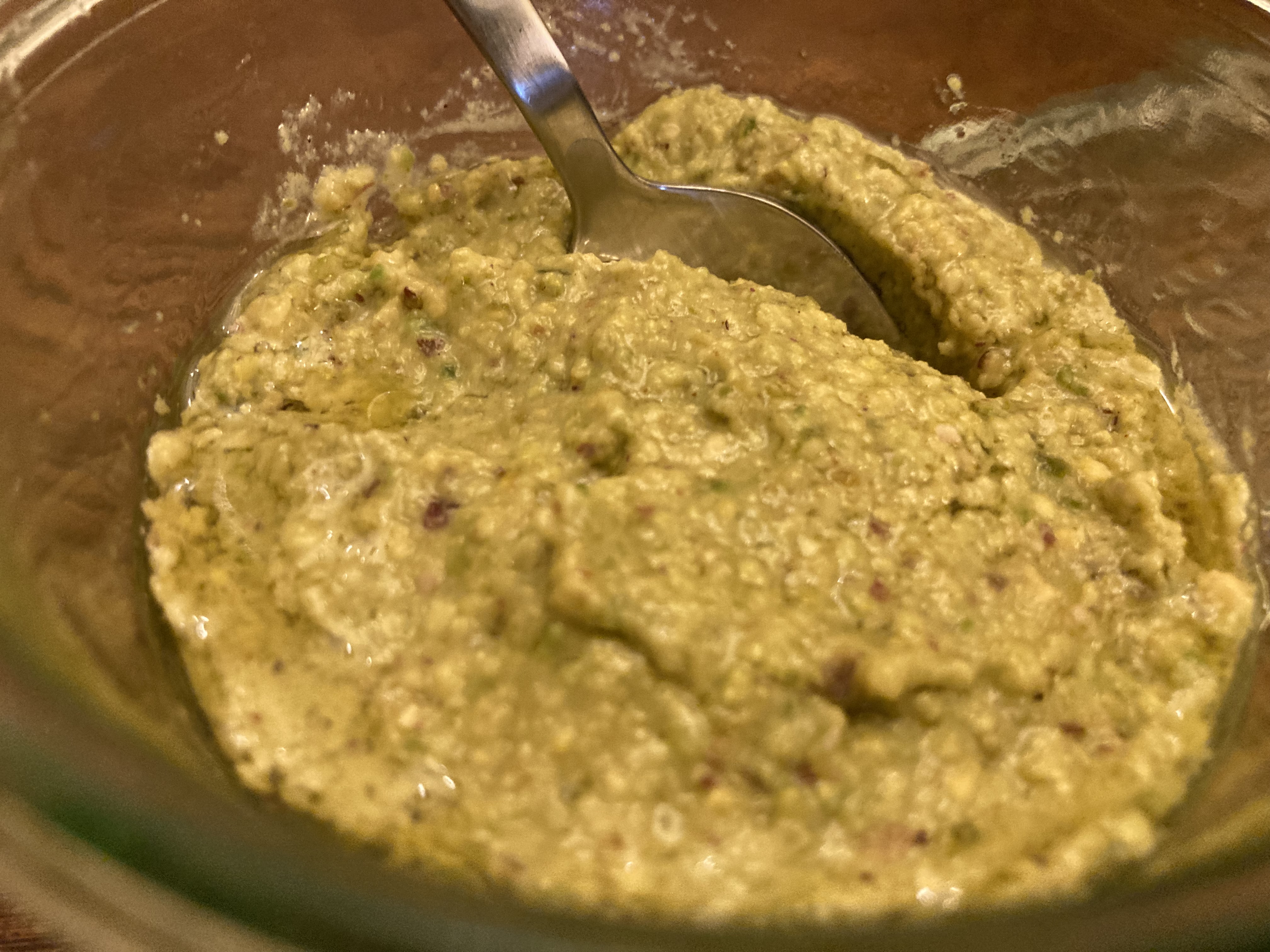
Put the garlic and the pistachios in a food processor, and pulse until you have a rough chop. Add the nettles, Parmigiano, lemon zest, and about ⅓ cup of good olive oil. Season with salt and black pepper, and pulse until you have a smooth paste, adding more olive oil if needed to get a creamy consistency.

Put the mussels in a large pot. Drizzle them with some olive oil, and pour on the vermouth. Cover the pot, and let the heat come up a bit. Uncover the pot, and cook the mussels, stirring them around occasionally until they open. When they’re cool enough to handle, take them from their shells, and place them in a bowl. Strain the mussel cooking broth, and pour about ½ cup of it over the mussels. Cover the mussels to keep them warm.

Cook the gemelli in a large pot of salted water until it’s al dente. Drain it, saving about a cup of the cooking water. Pour the pasta into a large serving bowl. Add the mussels with their liquid. Add about half the pesto and a little of the cooking water. Give everything a good toss, adding a bit more of the pesto if needed, and subsequently a little more of the cooking water to make it creamy. Serve right away. Leftover nettle pesto is great in a frittata.

Read Full Post »

« Newer Posts - Older Posts »