Archive for the ‘Uncategorized’ Category
My Herb Garden on Fourth of July Weekend
Posted in Uncategorized on July 3, 2023| 1 Comment »
Zucchini Gratin with Thyme and Goat Cheese
Posted in Uncategorized on July 1, 2023| Leave a Comment »

Recipe below: Zucchini Gratin with Thyme and Goat Cheese
It seems a lot of people need help with zucchini, mostly with how to change it up from the usual pan sauté. I know I do, so when I come up with a good recipe, I want to share it with you. And if you’re growing zucchini and now have tons of it coming in all at once, you really do need help.
This is an easy gratin, but it looks kind of fancy. Good for a dinner party. I served it with huge grilled shrimp marinated in marjoram, garlic, and lemon, a nice fit but I could imagine grilled lamb or chicken kebabs just as easily. I’m thinking the grill texture and flavor would juxtapose nicely with the gentleness of the gratin.
Happy summer cooking to you.

Zucchi Gratin with Thyme and Goat Cheese
10 medium zucchini (they will shrink up), cut into rounds
1 shallot, thinly sliced
Extra-virgin olive oil
Salt
Black pepper
1 small log (4 ounces) fresh, soft goat cheese, at room temperature
½ cup crème fraîche, at room temperature
¼ teaspoon ground nutmeg
1 small summer garlic clove, chopped
Possibly a little milk
12 big sprigs fresh thyme, lightly chopped but with flowers if it has them
¾ cup grated grana Padano cheese
Preheat the oven to 425 degrees.
Oil a large sheet pan. Lay the zucchini out on it in more or less one layer (a little overlap is fine). Scatter on the shallot, drizzle with olive oil, and season with salt and black pepper. Roast until the zucchini just starts to brown lightly at the edges, about 8 minutes or so. I find this step important for removing excess water from the zucchini. If you skip it, your gratin may wind up quite liquidy.
Put the goat cheese and crème fraîche in a food processor. Add the nutmeg and garlic, and season with salt and black pepper. Give the mixture a few pulses to blend everything. It should be thick but pourable, a bit thicker than heavy cream. If it’s too thick, add a drizzle of milk and pulse again.
Get out baking dish. I used a 11-by-8-inch Le Creuset oval, but anything more or less equivalent will work fine. Oil the inside lightly. Add half of the zucchini, spreading it out. Sprinkle on half the thyme and some grana Padano. Add the rest of the zucchini.
Pour the goat cheese cream evenly over the top, and wait for it to sink into the zucchini a little. Sprinkle on the rest of the grana and the remaining thyme. Bake, uncovered, until it’s bubbly and the top is browned, about 12 to 15 minutes.
Let the gratin cool a few minutes before serving, so it can firm up.
An Herb Garden Update for Late June, with a Recipe for a Soft Herb Salad with Rice Wine Vinaigrette
Posted in Uncategorized on June 28, 2023| Leave a Comment »

Recipe for a soft herb salad in the next-to-last paragraph below.
So far all my herbs look good. I knew they were starting out in that direction when in early spring my lovage came bursting out of the ground and grew huge in only three weeks. Lovage is a powerhouse herb, in growth but also in taste, like celery condensed into a speeding bullet. I use only a leaf or two when I cook a pot of beans or make a potato salad. I find it interesting that the herb I use the least of is the biggest thing in my garden. Although my fennel is also already gigantic.

I planted a lot of other herbs this year too, some, like hyssop and za’atar, for this first time. They all look promising. I always lighten up when I see that my plants are starting to take. My father had the same early season gardening anxiety when he planted and tended his tomatoes. He’d be out in his garden at weird hours, chain-smoking and staring hard at the little seedlings, maybe trying to instill some fear in them. I’m not sure what his method was, but we always had good tomatoes. I go out to my herb garden and stare and worry and sometimes plead with them. It’s part of the process.

Up here in Dutchess County, New York, only a handful of herbs are perennial, and sometimes even the perennials get defeated by our miserable winters. But this year everything I hoped would come back did. In addition to my out-of-control lovage and fennel, all my various thymes and oreganos returned, as did my nepitella, winter savory, tarragon, sage, and borage, which is popping up all over the place. The lavender didn’t make it this year, and rosemary always gets freezer burn and needs a fresh start. That makes me sad, especially knowing how big and gorgeous those things can get in the right climate. This slate-riddled upstate soil, frozen for months each year, is obviously nothing like the Southern Mediterranean, but my Southern Italian blood pushes me to pretend it is. I just have to keep on top of things.
In the meantime, here’s something nice you can make with fresh herbs, whether you have five or six types or only a couple. It isn’t so much a recipe as a reminder that you can make a salad out of nothing but herbs.

When I compose an herb salad I concentrate on leafy, soft, gentle herbs, avoiding piney, musty, and tough-stalked ones like rosemary, thyme, oregano, and sage. For this version I clipped Italian parsley, burnet, chervil, fennel fronds, a few sprigs of tarragon, and a handful of watercress, which I consider an herb. You can add arugula or sorrel, or lots of basil (my basil isn’t yet big enough to pick from). I prefer to dress an herb salad with my best olive oil, a tiny splash of rice wine vinegar, and a sprinkling of salt. I find a gentle vinegar best here, even better than lemon, which to my taste, can be too direct.
This salad is good to eat neat, but it also makes a nice, perfumed bed for something grilled, like shrimp, lamb kebab, or eggplant.
Ditalini with Shell Peas, Prosciutto Cotto, Cinnamon, and Basil
Posted in Uncategorized on June 12, 2023| 4 Comments »

Recipe below: Ditalini with Shell Peas, Prosciutto Cotto, Cinnamon, and Basil
Ditalini goes into pasta fazool (or pasta e fagiole in proper Italian), and in traditional Italian-American land it goes nowhere else. It’s a soup pasta. Small. Compact. Pasta e fagiole is sort of a soup, or it can be one. My family’s version was a cross between a soup and a pasta. A soupy pasta with ditalini, cannellini beans, lots of celery and onion, bay leaf, sometimes pancetta, sometimes sage, sometimes rosemary or basil, and occasionally just Italian parsley. Always hot chili flakes on the side. It was special any time of year, but especially in the winter, because it was thick and rich. And I loved ditalini, the little tubes, mixed in with the beans and the heavy broth.
It’s funny how certain pasta shapes become associated with specific dishes and then get etched in stone. When I was a kid there was linguine with clam sauce, rigatoni with meat sauce, penne with pink sauce, and ditalini with pasta fazool. That was all correct, and back then I wouldn’t have dared contradict any of it. But now I don’t think that way. I’m out of pasta prison. So here’s ditalini with fresh peas. Not so different from the bean versions, really, but the entire dish is much lighter. This one’s perfect for those lovely few weeks when spring blends into summer.
I don’t love shelling peas, but I do it because I want the peas. Also it’s nice when your fingers stain green and the kitchen smells like a mix of grass and potato (that’s how raw peas smell to me). And then you’ve got a nice pile of shells to make stock with. I like simmering a handful in a light chicken broth. I used chicken broth for this dish, but you can easily make it all-vegetable by adding the pea shells to a soffritto of onion, celery, carrot, a few leek tops, fennel trimmings, whatever you’ve got on hand.
I’ve included a little cinnamon, which I find gives the dish a bit of a Renaissance feel, or at least what I imagine would be that feel. It also deepens the sweetness of the peas. And cinnamon with basil is a beautiful combination. If you’ve ever grown the herb called cinnamon basil, which tastes and smells exactly how you’d imagine, you already know how alluring this pairing can be.

Ditalini with Shell Peas, Prosciutto Cotto, Cinnamon, and Basil
Salt
Extra-virgin olive oil
2 tablespoons unsalted butter
1 small spring onion, diced, including some of the green stem
1 medium shallot, diced
¼ teaspoon freshly ground cinnamon
1 fresh bay leaf
½ pound ditalini
1 ½ cups freshly shelled peas
A splash of white wine
¾ cup chicken broth, possibly a little more, simmered with a handful of pea shells if you like
3 thin slices prosciutto cotto, diced or cut into thin strips
About a dozen basil leaves, roughly chopped or torn
Black pepper
A small chunk of Parmigiano Reggiano cheese
Set up a pot of pasta cooking water. Add a generous amount of salt, and bring it to a boil.
While the water is coming to a boil, get out a large skillet and set it over medium heat. Add a drizzle of olive oil and the butter. When that heats up, add the onion and the shallot, the cinnamon, and the bay leaf, and let all the flavors open up for a few minutes.
Drop the ditalini in the water.
Add the peas to the skillet. Add some salt, and stir everything around to coat the peas with flavor. Add the splash of wine, and let it bubble out. Add the chicken broth, enough to just barely cover the peas. Let simmer, uncovered, until the peas are tender, about 5 minutes.
When the pasta is al dente, drain it, and pour it into a large serving bowl. Drizzle on some fresh olive oil, and give it a toss. Pour on the pea sauce, add the prosciutto cotto and the basil, and grind on a generous amount of fresh black pepper. Toss again, adding a little more chicken broth if needed to coat everything nicely. Serve hot, adding grating Parmigiano at the table.
Gemelli with Nettle Lemon Pesto and Mussels
Posted in Uncategorized on May 28, 2023| Leave a Comment »

Recipe below: Gemelli with Nettle Lemon Pesto and Mussels
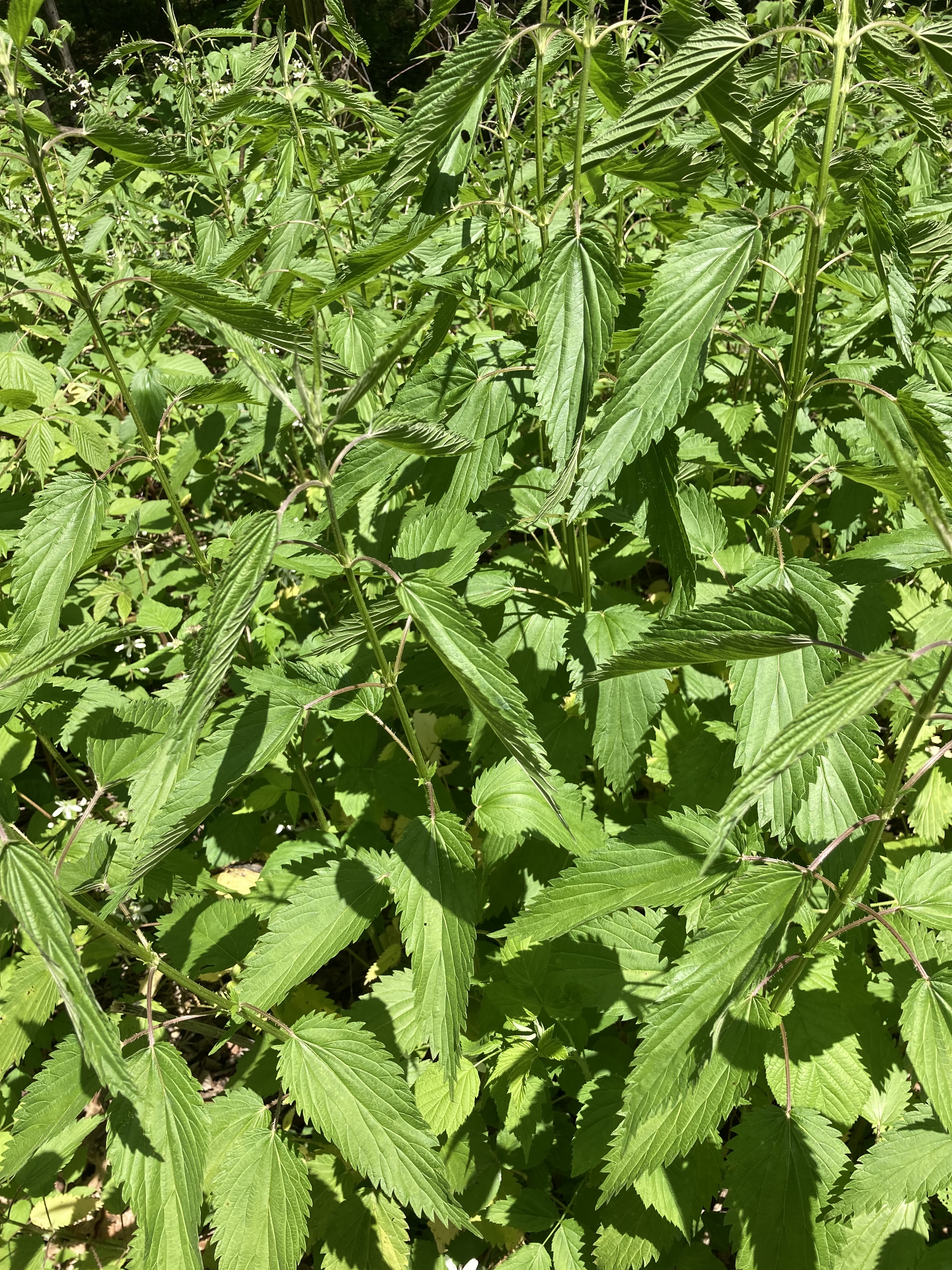
The thing about stinging nettles is that they really do sting. I was surprised to learn this. I thought it was just romantic folklore. They don’t sting bad, just a little, but if you keep grabbing them without gloves, your hands will likely blow up and get red and itchy. You just need gloves, and then there’s no problem. And once the nettles are blanched their little sting is completely gone, never to come back.
The first time I ever ate stinging nettles was in Rome many years ago. They were in a beautiful jade green risotto, a little on the loose side. The taste was an earthy mix of spinach and potting soil. I loved it. I came back from that trip wondering if I could ever find nettles in New York. And I did find them, at the Union Square market in Manhattan. I tried to duplicate my Roman risotto. It came out pretty well and I was very proud of myself. And then years later, when I got my little house in upstate New York, to my astonishment I discovered a big patch of stinging nettles growing in the backyard. That was some huge excitement. Now I cook with them every spring.

Stinging nettles are called ortiche in Italy. They’re most common in the middle and north of the country, where the soil is moister. Since my Roman experience, I’ve eaten ortiche several times in Liguria, usually as an ingredient in preboggion, the wild herb mix that’s used to fill pansoti, a bloated little ravioli, and other nice things, like savory torte, soup, and frittate. I’ve recently discovered that it makes an excellent pesto.
I originally made my ortica pesto using the classic Ligurian basil pesto formula, simply replacing the basil with blanched nettles. Last night I cut back on the cheese, replaced the pine nuts with pistachios, and added a good amount of lemon zest. I tossed the resulting deep green pesto with steamed mussels and gemelli. I think another mild seafood such as scallops or trout would work just as well. You could certainly serve the nettles simply tossed with pasta, no fish, but the mussel combo was, in my opinion, a success.
I really love the color of blanched nettles. They’re a deep, almost bluish-tinged green. You’ll really notice that when you’re squeezing them dry, when lots of lovely emerald water will cascade into your sink.

Gemelli with Nettle Lemon Pesto and Mussels
For the pesto:
1 medium bouquet of stinging nettles, gathered wearing gloves (I cut them about 6 inches from the tops, stems and all)
1 spring garlic clove, chopped
¾ cup unsalted shelled pistachios
¾ cup freshly grated Parmigiano Reggiano cheese
The grated zest from one lemon
Extra-virgin olive oil
Salt
Freshly ground black pepper
For the mussels:
1½ pounds mussels, cleaned
A drizzle of extra-virgin olive oil
About ½ cup dry vermouth
Plus:
¾ pound gemelli
Still wearing your gloves, pull all the leaves off of the nettle stems. Discard the stems. Set up a pot of water, and bring it to a boil. Drop in the leaves, and blanch them for about a minute. Drain them into a colander, and run cold water over them to stop the cooking and to bring up their brilliant green color. Squeeze out as much water as you can. Aside from all the lovely green water that they’ll produce, you’ll also probably notice that the leaves feel dry, which I found to be an odd sensation.
Put the garlic and the pistachios in a food processor, and pulse until you have a rough chop. Add the nettles, Parmigiano, lemon zest, and about ⅓ cup of good olive oil. Season with salt and black pepper, and pulse until you have a smooth paste, adding more olive oil if needed to get a creamy consistency.
Put the mussels in a large pot. Drizzle them with some olive oil, and pour on the vermouth. Cover the pot, and let the heat come up a bit. Uncover the pot, and cook the mussels, stirring them around occasionally until they open. When they’re cool enough to handle, take them from their shells, and place them in a bowl. Strain the mussel cooking broth, and pour about ½ cup of it over the mussels. Cover the mussels to keep them warm.
Cook the gemelli in a large pot of salted water until it’s al dente. Drain it, saving about a cup of the cooking water. Pour the pasta into a large serving bowl. Add the mussels with their liquid. Add about half the pesto and a little of the cooking water. Give everything a good toss, adding a bit more of the pesto if needed, and subsequently a little more of the cooking water to make it creamy. Serve right away. Leftover nettle pesto is great in a frittata.
Asparagus with Anchovy Parmigiano Breadcrumbs
Posted in Uncategorized on May 21, 2023| 1 Comment »

Recipe below: Asparagus with Anchovy Parmigiano Breadcrumbs
For many people asparagus tastes like grass. Like grass but sweet. I guess I’d somewhat agree, but what does this even mean exactly? Fresh mown grass, or cooked grass? Lawn grass or wild grass? Grassy is something people say when trying to describe the tastes of many green vegetables. It’s sort of like when people say that cheeses or mushrooms or dairy products taste nutty. I’ve even heard people say that particular nuts, almonds for instance, taste nutty. Which means I guess, that they taste likes other nuts, and that all nuts taste similar—which they don’t. Describing the taste of food is hard. Food writers struggle with it all the time. The frustrating thing is that you can’t convey a taste without comparing it to something else. How do you get around that? This spring I’ve been trying to concentrate on the taste and smell of asparagus. It’s hard. I mean green asparagus, not white or purple, which are variations I don’t find at spring farm stands. Raw asparagus has no smell, and its taste registers only a faint sweet bitterness for me. But cooking it brings out all kinds of tastes. Grassy? Maybe. But for me, I now realize, asparagus tastes like a cross between artichoke and broccoli. I’ve settled in on that description for now.

And what about asparagus pee? That aroma is really something special. I look forward to it every spring. It never fails me. It’s asparagusic acid that causes it, a chemical unique to asparagus and commented on since the dawn of the vegetable. The acid gets broken down in your gut into sulfur. Sulfur itself can smell disgusting, as in heavily cabbage-laced fart, but to me asparagus sulfur isn’t nasty. It’s a kind of sweet sulfur. It’s a marker of spring for me. And did you know that about 30 percent of people can’t smell their asparagus pee? The medical explanation for this is that some people break sulfur down better than others, leaving little left to smell. I have another theory: Some people just smell things better than others. I think I’m a super smeller.

Asparagus with Anchovy Parmigiana Breadcrumbs
1 large bunch medium-thick spring asparagus (1 pound or a little more), the tough ends trimmed
Extra-virgin olive oil
2 tablespoons unsalted butter
5 or 6 oil-packed anchovies, minced
1 small clove fresh spring garlic, minced
¾ cup panko breadcrumbs
¾ cup freshly grated Parmigiano Reggiano cheese
½ teaspoon sugar
The grated zest and juice from 1 medium lemon
8 or so large thyme sprigs, the leaves lightly chopped
Salt
Freshly ground black pepper
Blanch the asparagus in a pot of boiling water for 3 to 4 minutes, depending on its thickness. You’ll want it left a bit crunchy, since it will briefly cook again in the oven. Scoop the asparagus from the water into a bowl of ice water to cool it and bring up its green color. Drain it well on paper towels.
Preheat the oven to 450 degrees.
In a medium skillet, heat a tablespoon of olive oil and the butter over medium-low heat. Add the anchovies and the garlic and briefly let them melt and release their flavors into the oils. Turn off the heat, and add the breadcrumbs, the Parmigiano, the sugar, the lemon zest (but not the juice just yet), and the thyme, seasoning with salt and black pepper. Mix everything well. The crumbs should be moist. If they seem dry, add a little more olive oil.
Place the asparagus spears in a baking dish with enough room to spread out a bit. Some overlap is fine. Drizzle them with a little olive oil, the lemon juice, and some salt, turning them around in it to coat them lightly. Sprinkle the breadcrumb mix more or less evenly over the asparagus, leaving the tips and bottoms free from crumbs. Bake until the crumbs are golden and crisp, about 8 minutes or so. Serve hot or warm.
Braised Chicken with Morels, Tarragon, and Thyme
Posted in Uncategorized on April 23, 2023| 1 Comment »

Morelscapes by Don Huber
Recipe below: Braised Chicken with Morels, Tarragon, and Thyme
Last night we had a thunderstorm that lasted for more than an hour. It was the low rumbling kind but with hardly any lightning, so the night sky remained dark. The rain wasn’t heavy, which was a good thing, as in a heavy rain we often lose power and I wasn’t in the mood for that (sometimes I am). I sat in bed with the cats, listening to the entire show. The cats weren’t scared, but they were upright and alert, with big eyes. A storm like this one, without lightning, is odd to sit through, but it let my head wander to thoughts of spring food, of everything I was eager to cook again. I focused on morels, with their honeycomb weenie caps, dry texture, and hollow insides.
Yesterday I had gone out looking for morels, searching in the correct places, around the moist, decaying crud that builds up under elms, ash, and old apple trees. I’ve had this house in the Hudson Valley for seven years. Every April when morel season starts, I go a little apeshit looking for them, but I’ve never found any. A neighbor, Larry, brought me about a dozen huge ones several years ago, all about six inches long, that he found somewhere around here. He wouldn’t say where. I wasn’t furious with him, but I was definitely irritated, and he knew it. I sliced them all in half, lengthwise, checking for bugs, which are common in these mushrooms, but I didn’t find any, so I just quickly sautéed his mega morels in butter and splashed them with grappa. That is one of the best ways to bring out their earth flavor. And just so you know, you don’t want to eat them raw; their toxins need to be heated out and away.
Today, after last night’s rain, I figured I’d go out again, looking. But it’s still raining, so I guess I’ll wait until later, when things dry out a bit.
In the meantime I want to share with you a very good recipe for chicken with dish that I made the other night with morels I had bought at Eataly for $55 a pound. I swear that was the price. I bought exactly ten of them, and the bill came to $12. I justified the expense by telling myself that at least I didn’t get the golden morels, the lighter ones piled up next to the run-of-the-mill ones I did buy. Those were going for $85 a pound. I have a love-hate relationship with that store.
This recipe is a pretty straightforward braise. Morels, chicken, and tarragon are a classic French trio, but I decided to strengthen it by adding thyme at the beginning of cooking, as an underpinning, and then introducing the tarragon right at the end, so it wouldn’t lose any of its potency. I was really happy with the result, and it produced lots of rich, earthy sauce to flavor rice I served with it.
Morel season is just beginning up here, and I’ll continue to scout around, like I always do. I don’t have high hopes for success, but you never know. I might get lucky. I’ll keep you posted.

Braised Chicken with Morels, Tarragon, and Thyme
½ cup all-purpose flour
Salt
Black pepper
½ teaspoon ground allspice
½ teaspoon ground coriander seed
8 chicken thighs, including their bone and skin, or a mix of thighs and drumsticks
Extra-virgin olive oil
2 tablespoons unsalted butter
1 large shallot, finely diced
A dozen or more morels, cut in half lengthwise (and don’t forget to check for bugs)
6 large thyme sprigs, the leaves chopped
A big splash of cognac or brandy
A small glass of dry vermouth
1 cup good-quality chicken broth
1 heaping tablespoon crème fraîche
About 8 large tarragon sprigs, the leaves chopped
Pour the flour out onto a plate. Add salt, black pepper, and the allspice and coriander seed, mixing everything together.
Dry off the chicken pieces, and season them with a little salt and black pepper. Coat them all lightly with the seasoned flour.
Get out a large skillet, and set it over medium high heat. Add a drizzle of olive oil and the butter, and let it heat up. Add the chicken, skin side down, and let it cook without moving it around until it’s well browned and about halfway cooked through, probably around 6 or 7 minutes. You may need to turn the heat down a bit if it’s browning too quickly. Next flip the chicken over, and cook it until it’s just tender with a touch of pink at the bone, about another 6 minutes. Take the chicken out of the pan and place it on a plate, skin side up. Pour off some, but not all, of the pan fat.
Add the shallot, morels, and thyme, and season with salt and black pepper. Sauté until the mushrooms have softened some and start giving off a nice earthy fragrance. Splash on the cognac, and let it boil away. Add the vermouth, and let it bubble for a few seconds. Add the chicken broth. Turn the heat to medium low, and simmer for about 5 minutes to lightly reduce the sauce. Add the crème fraîche, stirring it in, and let it simmer and blend in.
Return the chicken to the pan, skin side up. Scatter on the tarragon, and heat the chicken through over a low flame, spooning some of the sauce on it and letting the whole thing come together, about another five minutes. Check for seasoning, and serve hot.
You’ll have a rich sauce, so you’ll best serve the dish with something that will soak it up, like plain rice or orzo.
Women with Fish
Posted in Uncategorized on April 6, 2023| Leave a Comment »
On Rosemary Candles, and a Recipe for Penne with Clams and Red Pepper Rosemary Sauce
Posted in Uncategorized on March 20, 2023| 1 Comment »

Recipe below: Penne with Clams and Red Pepper Rosemary Sauce.
I’m always cold in March. There’s never enough heat inside or out. Candles are good, though. Not that they give off heat, but they create an illusion.
I’ve never been a fan of scented candles. Patchouli, musk, sandalwood and me never got along, and patchouli in general has been known to give me the gags. It was in the air when I was a teenager. I’ve rejected men who wore it. Those oppressive scents are big in the scented candle business, so I’ve always disliked all scented candles as intrusive and even nauseating.
But as the New York cold drags on to the last mess of sloppy, gray sadness, I’ve turned to candles to create a contained space around my couch, along with my Mediterranean cookbooks, my wirebound notebook, cheap Pilot Varsity pens I buy in bulk, Italian food catalogs, biographies of dead gay artists, and, a new addition, a rosemary candle to bring the whole cocoon into focus. It smells not like perfume but more like food, like the polenta, rosemary, and olive oil cake I sometimes cook up for my husband’s breakfast. I’ve tried other scented candles I thought might work—bergamot, bitter orange, mint, sage (sage was disgusting)—but the rosemary one just fell naturally into place.
Rosemary the naked herb smells thick. It feels thick and even sticky. It’s like adding a piece of a tree to your food rather than adding a regular herb. It’s not truly savory either. It has sweetness underneath all its piney bitter. It’s not fresh like young pine sprigs. It’s richer. If I fry a sprig and eat it hot, it tastes sweet. If I eat a sprig raw, it’s bitter and can even make me want to spit it out. But it’s good infused raw in olive oil or cream, or in vodka. A rosemary vodka martini is substantial, especially if you use a little more vermouth than you might normally think proper and garnish it with green olives and a fresh rosemary sprig. If you’re not crazy about martinis, you can simply flavor green brownish Taggiasca olives (my favorites) with fresh rosemary sprigs, strips of lemon or orange zest, and Ligurian olive oil. I’ve made rosemary pesto, cutting it only with a little parsley. Its sweet pine scent, when it’s ground down with pine nuts and grassy olive oil, creates exotic beauty to spoon over grilled swordfish or even grilled bread.
Have you ever dripped rosemary-vanilla syrup over sliced blood orange? That can be mind blowing. So can rosemary-vanilla ice cream. And if in summer you have your own bush and you’re lucky enough to gather some of its blue flowers, try scattering them over rosemary roasted potatoes. I grow an upright rosemary variety called Tuscan Blue. I’ve found that rosemary goes with almost anything. I know because I’ve tried it with almost everything.
Most cooks say rosemary should be used with a light touch; I say not necessarily. I used quite a bit in this clam pasta, but it didn’t compete in an obnoxious way since I balanced it with the clams, for one, but also with roasted red pepper and hits of both fennel seed and hot chili. I loved the way that made a red clam sauce but not a tomato sauce. I sort of knew what it would taste like when I dreamed it up, but it was even better.

Penne with Clams and Red Pepper Rosemary Sauce
3 to 4 dozen small clams, well cleaned (I used 3 dozen littlenecks that were closer to medium-size. If yours are really small, you’ll likely want 4 dozen)
¾ cup dry sherry
Extra-virgin olive oil
2 red bell peppers, roasted, skinned, seeded, and roughly chopped (I strongly advise you roast your own. All the jarred peppers I’ve tried are too acidic and full of preservatives, giving them a chemical taste)
4 canned plum tomatoes, skinned and chopped
3 tablespoons unsalted butter
1 large shallot, minced
1 juicy garlic clove, thinly sliced
1 large sprig rosemary, the leaves well chopped (about a tablespoon)
1 teaspoon fennel pollen or ground fennel seeds
1 fresh bay leaf
1 teaspoon sugar
Salt
A big pinch of dried Calabrian chili flakes
1 pound penne
A palmful of flat-leaf parsley leaves, lightly chopped
Put the clams in a big pot. Pour on the sherry. Turn the heat to medium high, cover the pan, and cook until the clams start to open, stirring them around occasionally. I take each clam from the pot as it opens and stick them in a bowl. In my experience, clams, unlike mussels, don’t all open around the same time, so this way I’m assured that none of them overcooks. Strain the clam cooking liquid into a bowl (to make sure there’s no sand in the broth), and set it aside. When the clams are cool enough to handle, shuck them, and stick their meat in a bowl. Give it a drizzle of good olive oil.
Put the roasted peppers and tomatoes in a food processor, and pulse until fairly smooth but still with a little texture.
Set up a pot of pasta cooking water, and bring it to a boil. Add a good amount of salt.
While the water is boiling, take out a large sauté pan, and set it over medium heat. Add a drizzle of olive oil and a tablespoon of the butter. Add the shallot, and sauté until it’s soft, about 3 minutes. Add the garlic, rosemary, fennel pollen or seed, bay leaf, sugar, a little salt, and the chili flakes, and sauté everything to release its flavors, about another minute. Add the reserved clam cooking liquid and the puréed pepper-and-tomato mixture. Turn the heat down a bit and simmer to blend the new flavors, about 4 minutes. Add the shucked clams with any liquid they may have given off, and then turn off the heat.
While the sauce is simmering, cook the penne.
When the penne is al dente, drain it, saving a little of its cooking water. Pour the penne into a large serving bowl, add the remaining butter, and give it a good toss. Pour on the clam sauce, add the parsley, and toss again, adding a little pasta cooking water, if needed, to loosen it. Serve right away.
Duck Ragù with Black Olives and Orange
Posted in Uncategorized on March 9, 2023| 2 Comments »

Recipe below: Duck Ragù with Black Olives and Orange
In the early 1980s when I met the man who was to become my husband, he was involved in a rented group house out in Riverhead, Long Island. About ten friends rented the house. I eventually became a member of the group, with both good and really bad outcomes. There was one woman who was nasty to me for no apparent reason, I came to think of her as pinch-faced and bitter and maybe even slightly unhinged. At one point a string of pearls my father had given me for Christmas disappeared from my room. I suspected her of taking it, but I never confronted her because I couldn’t truly imagine anyone doing such a creepy thing, even though she was pretty creepy. They were never found, and now, 35 years later, I’m still convinced it was her.
They called this fairly large, two-story, seen better days house and its property the duck farm, because it had once actually been one. You could still wander the acreage and enter a few of the dilapidated barns and imagine all the ducks crammed in there quacking like crazy. Long Island used to have a lot of duck farms, but by this time there were only a handful left. We’d occasionally purchase a few ducks for our group meals. Compared with now, they were cheap. I cooked many ducks back then, mostly roasting them whole, making sauces from oranges or cherries or green olives and rosemary, or once with kumquats, that one sort of a bitter mess but still good if you drank enough cheap red wine. The nasty person didn’t come to the table when I cooked dinner. At first that made me uncomfortable, but after a while I didn’t give a shit. I really liked cooking in the big square kitchen, its cupboard filled with authentic Fiestaware in haunting colors like mauve, olive, and teal.
I tried different duck roasting methods, since back then I was just learning, from hot and fast to low and slow and to low and really slow, and what I discovered, which was frustrating and also a bit of a mystery, was that often the duck would taste like liver. I was perplexed. It never tasted like that in Chinatown. I don’t detect that taste now when I cook duck. It might be that by now I’m just better at cooking it, but I also wonder if maybe there was too much blood left in those Long Island ducks, too much iron in the muscle. Lazy duck farmers? I’m not sure, but duck is high in not only iron but also magnesium, selenium, phosphorus, and B vitamins, so it has good healthy gaminess going on. You can’t expect it to be bland, but that liver taste was a stretch for my palate. I now find it easier to cook the breast and legs separately. I buy D’Artagnan mulard duck breasts and legs at Citarella. Mulard is a cross between Muscovy and Peking breeds. As far as I can remember, all the Long Island ducks were Peking, which had more fat and less meat. Mulard ducks are dark and meaty.
For this recipe you’ll need three whole duck legs. They get cooked low and slow until you can pull the meat off with your fingers and throw it all back into the sauce to create a rich ragù. I’ve chosen flavors—orange, and black olives—that I initially thought of as Provençal, but I’ve also added cinnamon, which in the final tasting gives it a Sicilian aroma, or possibly a Venetian Renaissance one. In any case it is really good, and I hope you’ll give it a try.

Duck Ragù with Black Olives and Orange
3 duck legs (I used D’Artagnan mulard duck legs)
Salt
Freshly ground black pepper
1 onion, cut into small dice
1 carrot, cut into small dice
1 celery stalk, cut into small dice, plus a handful of leaves, if you have them, lightly chopped
½ teaspoon cinnamon
½ teaspoon allspice
¾ cup of dry vermouth (I really like Dolin)
2 cups homemade chicken broth
2 fresh bay leaves
1 teaspoon honey
1½ cups well-chopped canned tomatoes
The juice from 1 large orange and the grated zest from 1½
A palmful of black Taggiasca or Niçoise olives, pitted if you like
Possibly a few drops of rice wine vinegar
1½ pounds fresh tagliatelle or pappardelle
About a dozen basil leaves, lightly chopped
A good-sized chunk of Parmigiano Reggiano cheese
Preheat the oven to 325 degrees.
Lightly score the duck through its fatty skin in a crisscross pattern. Rub the legs with salt and pepper. Get out a large casserole fitted with a lid (I used an 11-inch-long oval Le Creuset). Get it hot over medium heat, and add the duck legs, skin side down. Let them give off much of their fat and get a bit brown. That should take about 5 minutes. Flip them over, and brown their undersides, about another 4 minutes. Take them out, and stick them in a bowl or on a plate.
Pour off all but about 2 tablespoons of the duck fat (I had more than a cup of fat at this point, so I froze it for a later use, probably in something involving potatoes). Turn the heat back to medium, and add the onion, carrot, celery (and leaves if you have them), cinnamon, allspice, and a little more salt and black pepper. Sauté until everything is soft and fragrant. Put the duck and any juices it has given off back in the casserole, and sauté for another minute or so. Add the vermouth, and let it bubble for about a minute. Add the chicken broth, bay leaves, honey, and tomatoes, and bring it to a boil. Cover the casserole, and stick it in the hot oven.
After about an hour, open to pot, and add the orange juice and zest. If the liquid has cooked down a lot, you may want to add a bit more chicken broth or a little water. Give the duck legs a turn, cover the pot, and put it back in the oven for another 1½ hours.
Take the casserole from the oven. By this time the duck should be tender and pretty much falling off the bone. Remove the duck legs from the pot, and place them on a large plate. Let them sit until they’re cool enough to handle.
The sauce should have a nice maroon sheen to it and have thickened but still be loose enough to make a clingy pasta sauce. Skim off any excess fat.
When the duck is somewhat cool, pull off all the meat and shred it up a bit with your fingers, dropping it all into the pot with the sauce. Add the olives, and give it a good stir. Check the consistency and judge whether you might need to add a little water or broth. Give it a taste. I find sometimes that the richness of duck needs a little extra acid, and even here with all the vermouth, tomato, and orange, I found I wanted a few drops of rice wine vinegar to brighten the flavors. You may also want more black pepper.
Cook your tagliatelle or pappardelle until tender. While the pasta is cooking, put a low flame under the sauce to gently keep it hot.
Drain the pasta, and pour it into a large serving bowl. Add the duck sauce and the basil, and gently toss. Serve right away, bringing the chunk of Parmigiano to the table for grating.