Feeds:
Posts
Comments

Archive for the ‘Skinny Guinea’ Category


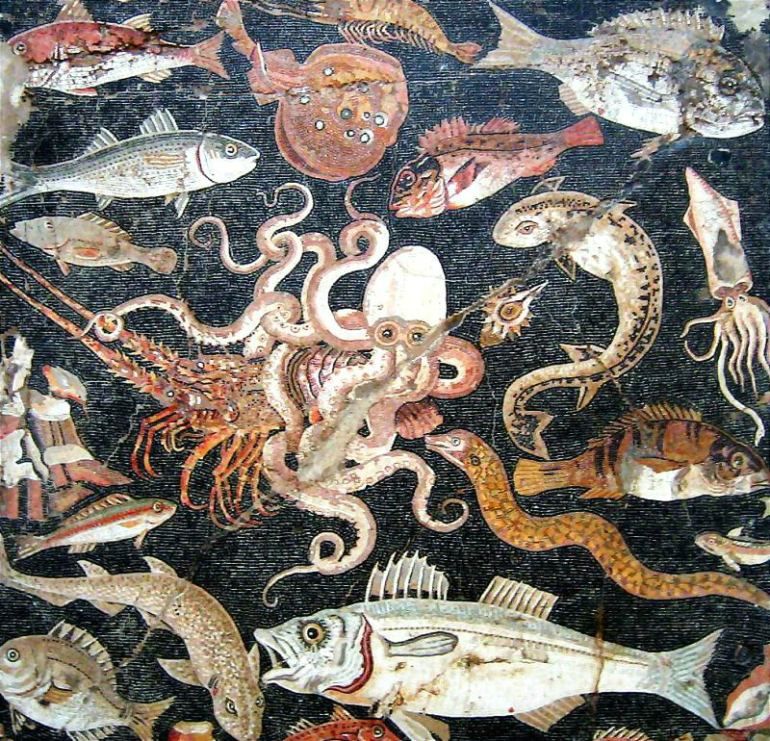
A fish mosaic from Pompeii, 79 A.D.

Recipe: Farro Tagliatelle with Shrimp, Pancetta, and Leeks

Farro pasta, I’ve come to realize, can be a beautiful thing, especially if you buy a great artisanal brand such as Latini. Figuring out proper sauces to match farro’s robust flavor can be a bit tricky at first. Anchovies are a classic with this pasta, in Northern Italy, and I do love a simple anchovy and garlic condimento with it, but I’ve been discovering that lots of gentler mixes can work too. You just have to kick them up a notch (that tired expression is almost starting to sound fresh again to me). I chose shrimp for this recipe. You might not  think shrimp would be a good match for such a strong pasta, but I added a few fortifiers, for instance leeks, which have a strong flavor, and black pepper. At first I tried adding a few anchovies as well, but somehow the anchovy overpowered the shrimp, adding a fishy taste, so I went with pancetta instead, and I believe I came up with a winner.

I found that a simple shrimp broth, made with the shrimp shells and some of the herb and vegetable trimmings, helps immensely to distribute all the flavors. It’s well worth the ten minutes you’ll need for the dish to get a really well rounded flavor.

Farro Tagliatelle with Shrimp, Pancetta, and Leeks

(Serves 2 as a main course)

Extra-virgin olive oil
1 ⅛-inch-thick round of pancetta, diced
3 medium leeks, trimmed and well rinsed, cut into medium dice, using only the white and the tenderest green (reserve some of the trimmings for the shrimp broth)
6 or 7 large sprigs of thyme, the leaves lightly chopped (reserve a few stems for the shrimp broth)
4 allspice, ground to a powder
Salt
Freshly ground black pepper
A big splash of dry white wine
3 round tomatoes, skinned, seeded, and chopped
½ pound farro tagliatelle
1 tablespoon unsalted butter
¾ pound large shrimp, shelled and deveined (reserve the shells for the broth)
A handful of flat leaf parsley, lightly chopped, reserving a few stems for the shrimp broth

To make the shrimp broth:

This requires the usually discarded stems and such that I direct you to save in the ingredients list.

In a small pot, heat a tablespoon of olive oil over medium heat. Add the shrimp shells, the leek trimmings, the stems from the thyme, and the parsley, and sauté until the shrimp shells turn pink. Now add about a cup of warm water, and let it bubble away until you’ve got about ½ cup of broth. Strain it into a small bowl.

Bring a large pot of pasta cooking water to a boil.

In a large skillet, heat 2 tablespoons of olive oil over medium heat. Add the pancetta, and sauté until it’s just starting to crisp. Add the leeks, seasoning them with thyme, allspice, salt, and black pepper, and sauté until softened, about 10 minutes. Add the white wine, and let it boil away.

Add a generous amount of salt to the pasta cooking water, and drop in the tagliatelle.

Add the tomatoes to the skillet with the leeks, and sauté for about 2 minutes. Now add the shrimp broth, and let it simmer for about 2 minutes longer. Taste for seasoning, adding a little more salt and black pepper if needed.

In another large skillet, over medium heat, heat the tablespoon of butter and a tablespoon of olive oil . When the skillet is very hot, drop in the shrimp, seasoning it with salt and black pepper. Spread it around, and let it cook without moving it around much. When you see it’s getting dark pink at the edges, turn it over and sauté the other sides. This should take no longer than about 2 minutes. Add the leek mixture to the shrimp, and turn off the heat.

When the farro tagliatelle is al dente, drain it into a warmed large serving bowl. Drizzle with fresh olive oil, and add the parsley. Give it a toss. Add the shrimp with all the broth, and toss again, gently. Serve right away.
Read Full Post »


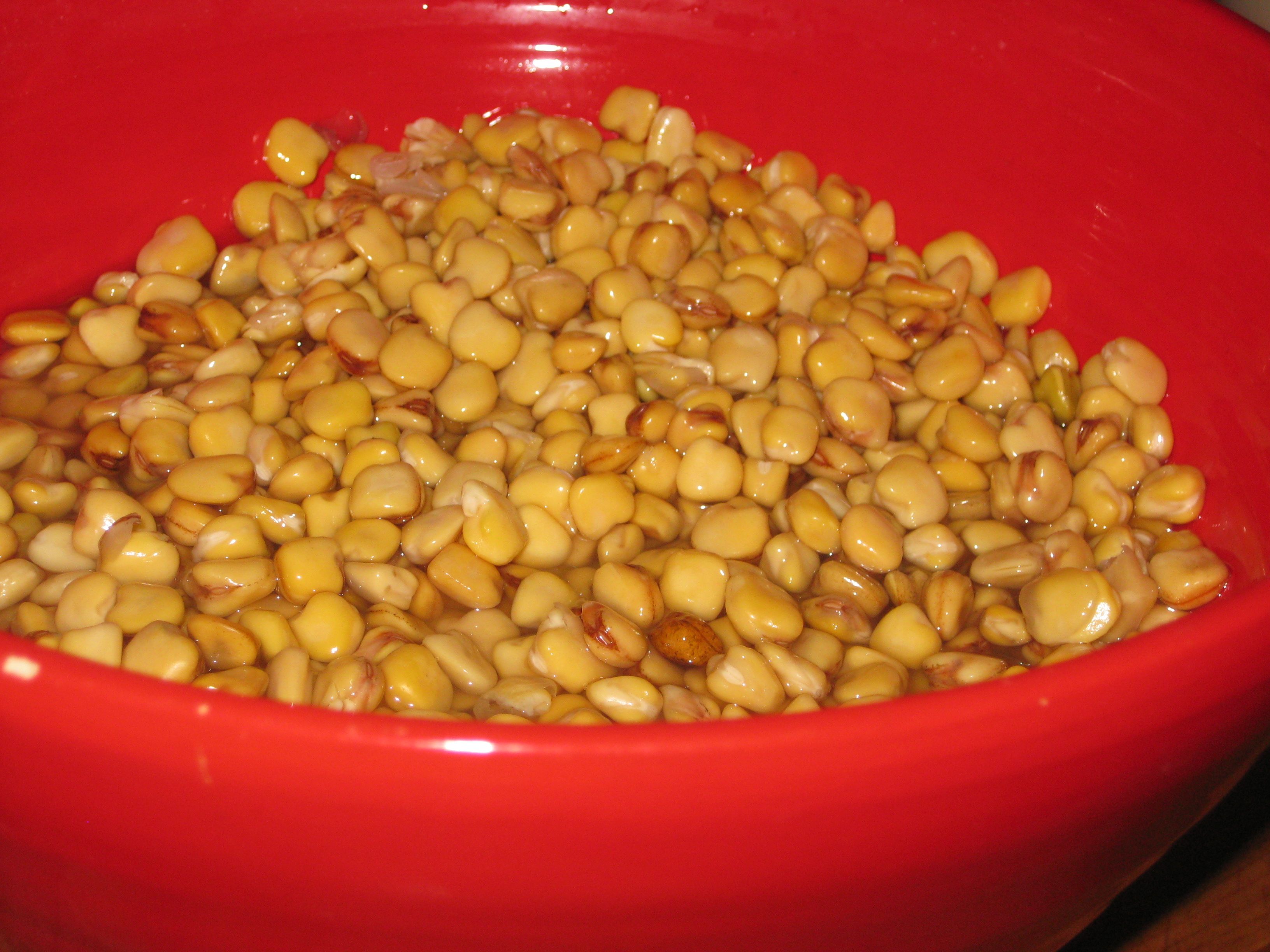
Cicerchie after soaking.

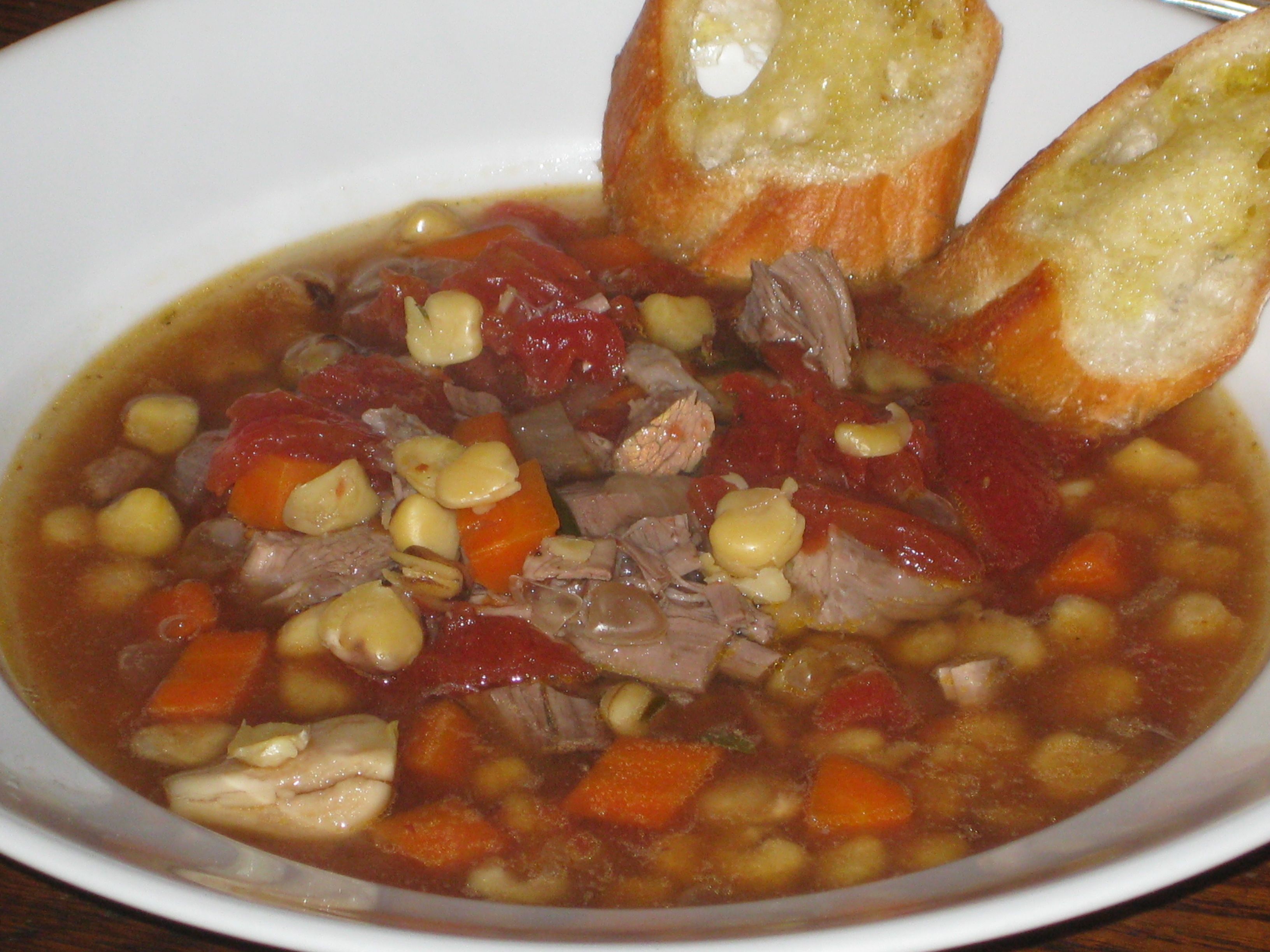
Recipe: Minestra with Cicerchie, Lamb Shank, and Rosemary

Cicerchie are small dried beans that look to me like old rotten teeth but are in fact an older, more primitive form of ceci beans. Aside from looking like beaten, yellowed teeth, what they most resemble, in the bean department, are miniature dried favas, or even posole, the Southwestern American preserved corn kernels, if you’re familiar with those. In Umbria, Campania, and Puglia cicerchie have long been associated with la cucina povera, which is primarily why they appeal to me. Until recently they had almost disappeared in Italy, but like other heirloom foods that have been rediscovered by chefs and farmers, they’re now available again, although at slightly higher cost.

Cicerchie don’t taste much like ceci to my palate. I taste a mix of dried favas and posole, with a bit of split pea thrown in. The taste is richer than your run-of-the-mill ceci. Cicerchie make a great soup and look a lot prettier once they’ve been cooked. You can also use them in salads, adding small chunks of salami, roasted peppers, and herbs, for instance, or you can mash them and reheat them with some extra rosemary, garlic, and olive oil to use as a topping for crostini. I also like serving cicerchie as a side dish, with braised broccoli rabe or escarole folded in.

I get my cicerchie from www.gustiamo.com. They’re produced by La Valletta, a family-run organic company in Umbria that uses sustainable methods to produce the highest quality heirloom grains and legumes (check out Gustiamo to see what other great stuff La Valletta produces). The company is run by Alessandro and Rosalba Cappelletti, a brother and sister team dedicated to preserving plants native to the border of Umbria and Marche. I’ve been served these beans in Umbria and also in Puglia, where they’re also gaining in popularity again.

Minestra with Cicerchie, Lamb Shank, and Rosemary

(Serves 4 as a main course soup)

1 pound cicerchie
Extra-virgin olive oil
Salt
1 large lamb shank, about 1½ to 2 pounds
A pinch of sugar
2 large carrots, peeled and cut into small cubes
1 Vidalia onion, cut into small dice
2 garlic cloves, peeled and smashed
1 small branch rosemary, the leaves chopped
6 allspice, ground to a powder
A generous pinch of Aleppo or another medium hot dried chili
Freshly ground black pepper
½ cup dry Marsala
1 quart meat or chicken or vegetable broth,  not too heavy
1 28-ounce can plum tomatoes, drained and chopped

Soak the cicerchie overnight in a large pot of cool water.

Drain the beans, and put them in a pot of fresh water to cover by at least 5 inches. Bring it to a boil. Turn the heat down to low, and simmer, partially covered, until the cicerchie are just tender but not falling apart. The La Valletta brand I cooked took about 1½ hours, but test from time to time to make sure. When they’re tender, add a generous drizzle of olive oil to the pot, and season with salt. Turn off the heat, and let them sit for about 20 minutes (I find this helps them soak up extra flavor). Now drain the beans into a colander, saving about 2 cups of their cooking water. Transfer them to a bowl, and give them another drizzle of olive oil and a gentle toss. Set them aside.

While you’re cooking the cicerchie you can start on the rest of the soup. In a large soup pot, fitted with a lid, heat about 2 tablespoons of olive oil over medium flame. Add the lamb shank, and season it with a pinch of sugar. Brown it on both sides. Now add the carrot and the onion, and sauté until the vegetables have softened. Add the garlic, the rosemary, the allspice, the Aleppo, some black pepper, and a little salt, and sauté a few moments to release their flavors. Add the Marsala, and let it bubble for a few seconds. Add the broth and enough water to just cover the lamb. Bring to a boil, and then add the tomatoes. Turn the heat to low, cover, and simmer very gently until the lamb is falling-off-the-bone tender, about 2 hours or possibly a bit longer.

Pull out the lamb shank, and let it sit until cool enough to handle. Skim the soup.

Add about 3 cups of the cicerchie to the soup (for ideas on what to do with leftover beans, see above).

Pull or chop the lamb into small pieces, discarding any fat. Add the lamb to the soup, and reheat it gently. Check for seasoning, adding more salt, hot or black pepper, and a drizzle of fresh olive oil, if you like. If the soup has become too thick, add some of the bean cooking liquid (the texture is up to you, of course, but I like this soup a little loose).

Serve with crostini that have been toasted, rubbed with garlic, brushed with olive oil, and sprinkled with a little salt.

And in case you feel like dancing and singing while making this soup, check out this old Umbrian folk dance. Kind of rocks, no?

Read Full Post »


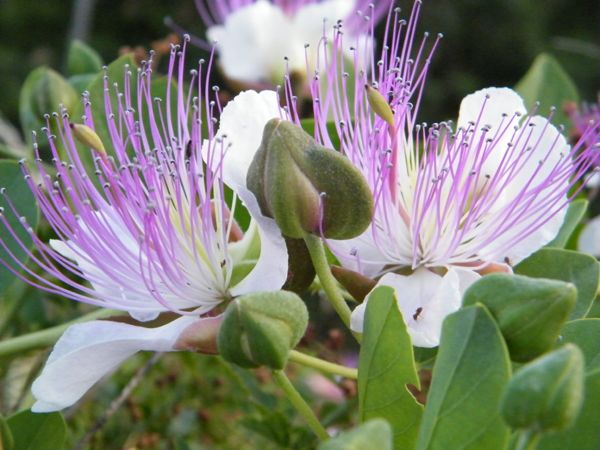
Caper flowers, plus a few buds.

Recipe: Cavatelli with Sicilian Tuna, Capers, and Celery Leaves

Here’s a pantry pasta of the highest order, using two of Sicily’s best products, tuna preserved in olive oil and salt-packed capers from the white hot island of Pantelleria. This particular pasta gave me the chance to use up the last of the big pear-shaped Calabrian tomatoes La Marchesa Calamari grew this summer in her compact manure-laced beds (tomato beds, that is) in Delaware County, New York—not exactly a Southern Italian clime, but she’s just some kind of tomato wizard, able to get the taste of the Mediterranean in what you’d think would be a very hard environment.

Both the Sicilian islands of Lipari and Pantelleria grow excellent capers, which most of you Italian cooks out there know to be the buds from a Mediterranean shrub that when left to blossom produces pretty little white flowers with violet stamens. Not many of those buds are left to flower. The capers I used for this I got from Gustiamo, the great Italian food importer I’ve talked about many times. They are preserved in Sicilian sea salt and packed with care by Gianni Busetta. They are amazingly floral, with a nuanced tang.

When I’m using Sicilian oil-packed tuna for a pasta dish, I don’t go for an absolute top-of-the-line product; even though I add it at the last minute, it warms through, and that takes the edge off its delicate charm. The exquisite Tre Torri bluefin tuna I sometimes purchase from Gustiamo (do all the best things come from Gustiamo?) is nicest used as part of  a very simple antipasto, maybe with just some olives and slices of raw fennel. Usually when I add canned tuna to pasta I take it down a notch or two. Flott is a reliable Sicilian brand that has very good flavor but that I feel I can toss with a warm sauce without committing a huge crime (well, maybe a misdemeanor, but what can you do?).

For me the mingling of the floral capers with the slight bitterness of the celery leaves really seals this dish. If you can still find sedano, the Italian celery grown for its intense leaves, use that (I still see it at the Union Square market in Manhattan). Otherwise regular celery leaves will be fine.

And just to get you in that dreamy but rugged Sicilian frame of mind, here’s the Sicilian folk song “Vitti Na Crozza,” sung soulfully by Roberto Alagna.

Cavatelli with Sicilian Tuna, Capers, and Celery Leaves

(Serves 4 as a main course or 6 as a first course)

Extra-virgin olive oil
A small piece of fatty prosciutto end, chopped (about ½ cup)
2 small, tender inner celery stalks, cut into small dice, plus a handful of celery leaves, stemmed but left whole (you’ll want about ½ cup)
1 small onion, preferably a fresh summer type
About a dozen fennel seeds
A tiny splash of Pastis, such as Pernod or Ricard
4 large end-of-summer tomatoes, peeled and diced, or 1 35-ounce can of plum tomatoes, well chopped, with the juice
Salt
A pinch of Aleppo pepper or another medium hot, dried chili
1 pound cavatelli pasta
1 can oil-packed Italian tuna, drained
A big palmful of salt-packed Sicilian capers, soaked for about 10 minutes, rinsed, and dried
A handful of pine nuts, lightly toasted

Set up a large pot of pasta cooking water over high heat, and bring it to a boil.

In a large skillet heat 2 tablespoons of olive oil over medium heat. Add the prosciutto, the celery, the onion, and the fennel seeds, and sauté until everything is soft and fragrant. Add the pastis, and let it boil away. Add the tomatoes, season with salt and Aleppo pepper, and cook, uncovered, at a lively bubble for about 10 minutes. Turn off the heat.

Add a generous amount of salt to the boiling water, and then drop in the cavatelli, giving it a stir to make sure it’s not sticking.

When the cavatelli is al dente, drain it, and pour it into a large serving bowl. Drizzle on a generous amount of fresh olive oil, and add the celery leaves. Give it a quick toss. Add the tuna, caper, and pine nuts to the sauce, leaving the tuna in  chunks. Gently toss again. Serve hot.

Read Full Post »


Still Life with Plums, by Georges Braque.

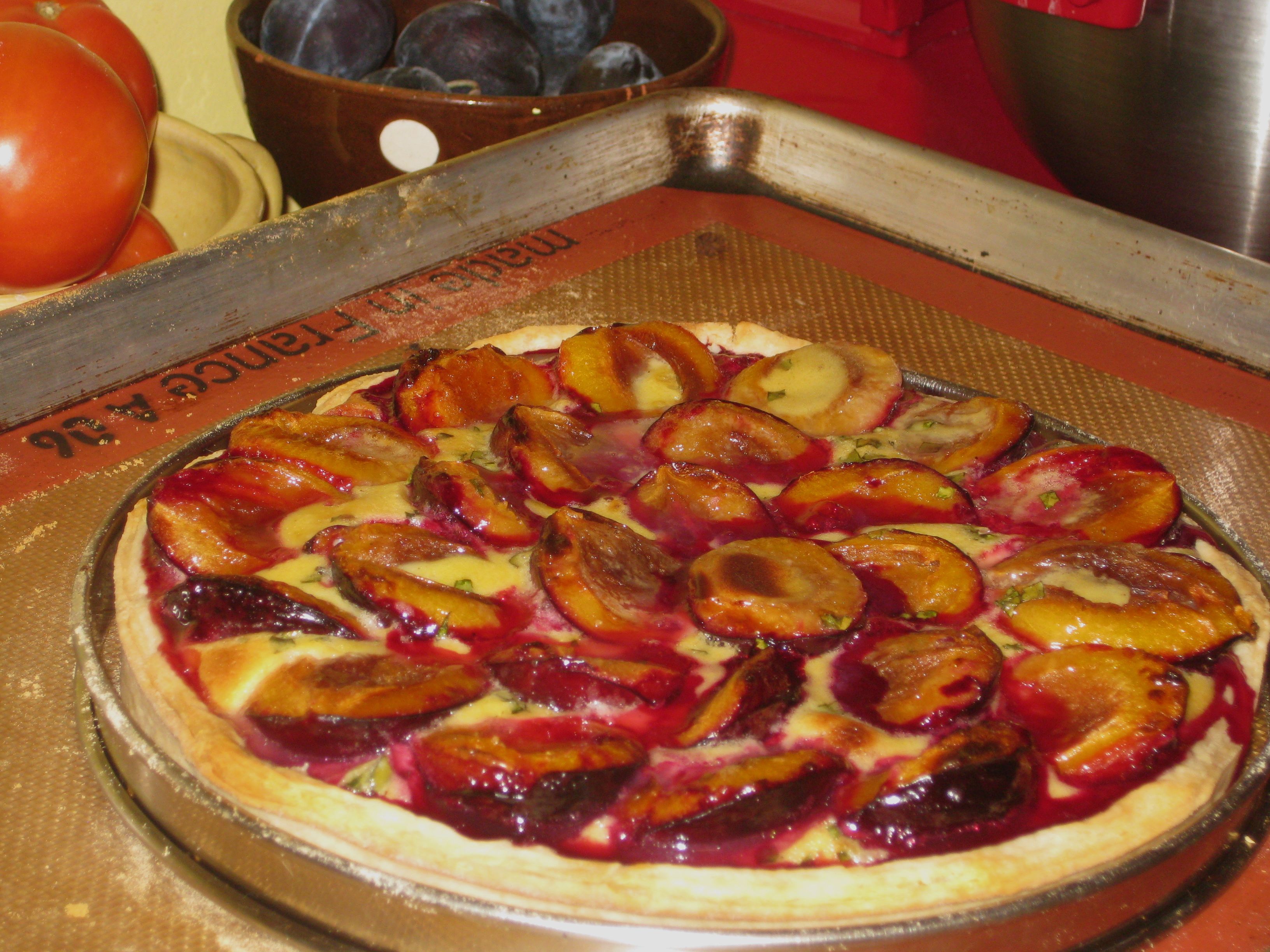
Recipe: Italian Plum Tart with Cardamom and Basil

As all my cook friends know, this was an incredible summer for fruit. There was so much heat that the sugar content went through the roof. I’ve just started tasting this year’s apples, and they are amazing—firm, heavily perfumed, and just packed with flavor. Global warming is, sadly, good for something.

I’m still finding plums at my Greenmarkets. My favorites to cook with are the pointy dark purple Italian variety. You’ve only got maybe a week left to find those gorgeous things in the New York area, so I say get ’em while they’re hot or you’ll have to wait another year to make a plum tart. I’ve done a little flavor mix with cardamom and fresh basil for this version, putting a bit of the two ingredients in both the pastry and the filling. Wow, what a beautiful combination. With the dark, almost electric-looking purple juice that runs out of these plums, it’s regal.

You’ll need a 9-inch tart pan with a removable bottom.

Italian Plum Tart with Cardamom and Basil

(Makes 1 9-inch tart)

For the pastry:

1¾ cups all-purpose flour, plus a little extra for rolling
¼ teaspoon ground green cardamom
A generous pinch of salt
A few quick grindings of black pepper
2 tablespoons sugar
1¼ sticks unsalted butter, chilled
¼ cup dry white wine, maybe a bit more

Plus:

About 14 or 15 purple Italian plums, cut in half lengthwise and pitted
A splash of Kirsch
¼ cup sugar

For the custard:

½ cup heavy cream
2 large eggs
2 tablespoons honey
⅛ teaspoon ground green cardamom
A few quick grinds of black pepper
3 small very fresh basil leaves, minced

Put the flour, cardamom, salt, black pepper, and sugar in the bowl of a food processor, and pulse briefly to blend. Add the butter bits, and pulse quickly two or three times, just to break them up. Drizzle on the white wine, and pulse once or twice more, just until you can squeeze a bit of the dough with your fingers and it holds together. If it’s still dry, add a drizzle of white wine or cold water, and pulse again. You don’t want to pulse until it forms a ball. The texture should be crumbly. Turn out the dough onto a work surface, and bring it together with your hands into a big ball. Give it a quick one-two knead, just to make sure it’s holding together. Cover it with plastic wrap, and refrigerate for about 2 hours.

Preheat the oven to 400 degrees.

Take the dough from the refrigerator, unwrap it, and place it on a lightly floured work surface. Give it a few whacks with a rolling pin to get a flat surface going. Now roll it out, adding a little more flour if it starts to stick, until you have a round about 2 inches wider than your tart pan. Drape the dough into the pan, pressing it into the sides. Run the rolling pin over the top to cut off excess. Build up the sides a bit, so the dough extends a little past the edge of the pan. Give the bottom a bunch of light pricks with a skewer or pointy knife.  Stick the tart shell back in the refrigerator for about 10 minutes, or until the oven heats up.

Now you’ll want to blind bake the tart crust. Cover it with a big piece of aluminum foil, and load the foil with dried beans or those little ceramic thingies some people buy just for this purpose, to hold it down. Bake for 20 minutes. The tart’s edges should be very lightly golden. Take the tart shell from the oven, and let it sit on a rack for a few minutes to cool off.

While the tart shell is baking, place the cut plums in a bowl. Drizzle on a splash of Kirsch, and add the sugar. Give them a good toss.

Whisk all the ingredients for the filling together in a bowl.

Line the tart shell with the plums, cut side up, working in a circular pattern. Add any plum juice left in the bowl to the custard mixture. Slowly pour the custard over the plums, making sure none of it seeps in between the pan and the dough (if you have a little extra, just leave it in the bowl, or drink it). Place the tart on a baking sheet, and bake for about 30 to 35 minutes, or until the crust is golden brown and the top is set.  Let the tart rest for about 30 minutes before slicing.

Read Full Post »

Recipe: Chicken alla Cacciatora, Late Summer Style

It’s the time of year for tender transitions. Isn’t it that way with your cooking too right now, as you try to integrate a little depth into your dishes without completely relinquishing that summer vibe? This is a cooking truth. We’ve got that settled.

With this little ache in my heart working on my culinary head, I zeroed in on lightening up chicken alla cacciatora, always a winter dish when I was growing up, and still one for me now that I’m more or less an adult. Why now? Because lots of summer tomatoes are still around, and fresh herbs, which I added at the last minute to retain clarity. My winter versions always included canned tomatoes and rich herbs, rosemary in particular but also on occasion thyme. I gave this dish a lift with a little fresh marjoram and a generous amount of Italian parsley. Nice.

Chicken alla Cacciatora, Late Summer Style

(Serves 4)

Extra-virgin olive oil
4 whole chicken legs, separated into thigh and drumstick
A sprinkling of sugar
Salt
Black pepper
1 approximately ¼-inch-thick half round of pancetta, cut into small dice
2 shallots, cut into small dice
1 tender inner celery stalk, cut into small dice, with a handful of the leaves, roughly chopped
1 carrot, cut into small dice
1 garlic clove, very thinly sliced
A few big scrapings of nutmeg
½ cup dry white wine
½ cup chicken broth, homemade if possible
3 medium-size round summer tomatoes, peeled, seeded, and cut into a medium dice (also drained, if very juicy)
5 sprigs fresh marjoram, the leaves left whole
A handful of flat-leaf parsley, the leaves left whole

In a large skillet, heat about 2 tablespoons of olive oil over medium flame. When hot, add the chicken pieces, seasoning them with the sugar, salt, and black pepper. Brown them on both sides. Take the chicken from the skillet, and pour off all but about 2 tablespoons of fat.

Add the pancetta, and let it get crisp, about 4 minutes. Add the shallots, celery, and carrot, and sauté a few minutes to soften. Add the garlic and the nutmeg, and sauté briefly, just to release their flavors. Return the chicken to the skillet. Add the white wine, and let it bubble for a minute. Add the chicken broth. Turn the heat down low, cover the skillet, and simmer for about 20 minutes, turning the chicken once or twice.

Add the tomatoes, and simmer uncovered at a low bubble until the chicken is cooked through and tender, about another 15 minutes. Season with a little more salt and black pepper.

Take the chicken from the skillet, and place it on a rounded serving platter. With a slotted spoon, scoop out most of the tomato chunks, and spoon them over the chicken.

Boil down the liquid left in the skillet until it thickens slightly. Pour it over the chicken, and then scatter on the marjoram and the parsley. Serve hot.

Read Full Post »

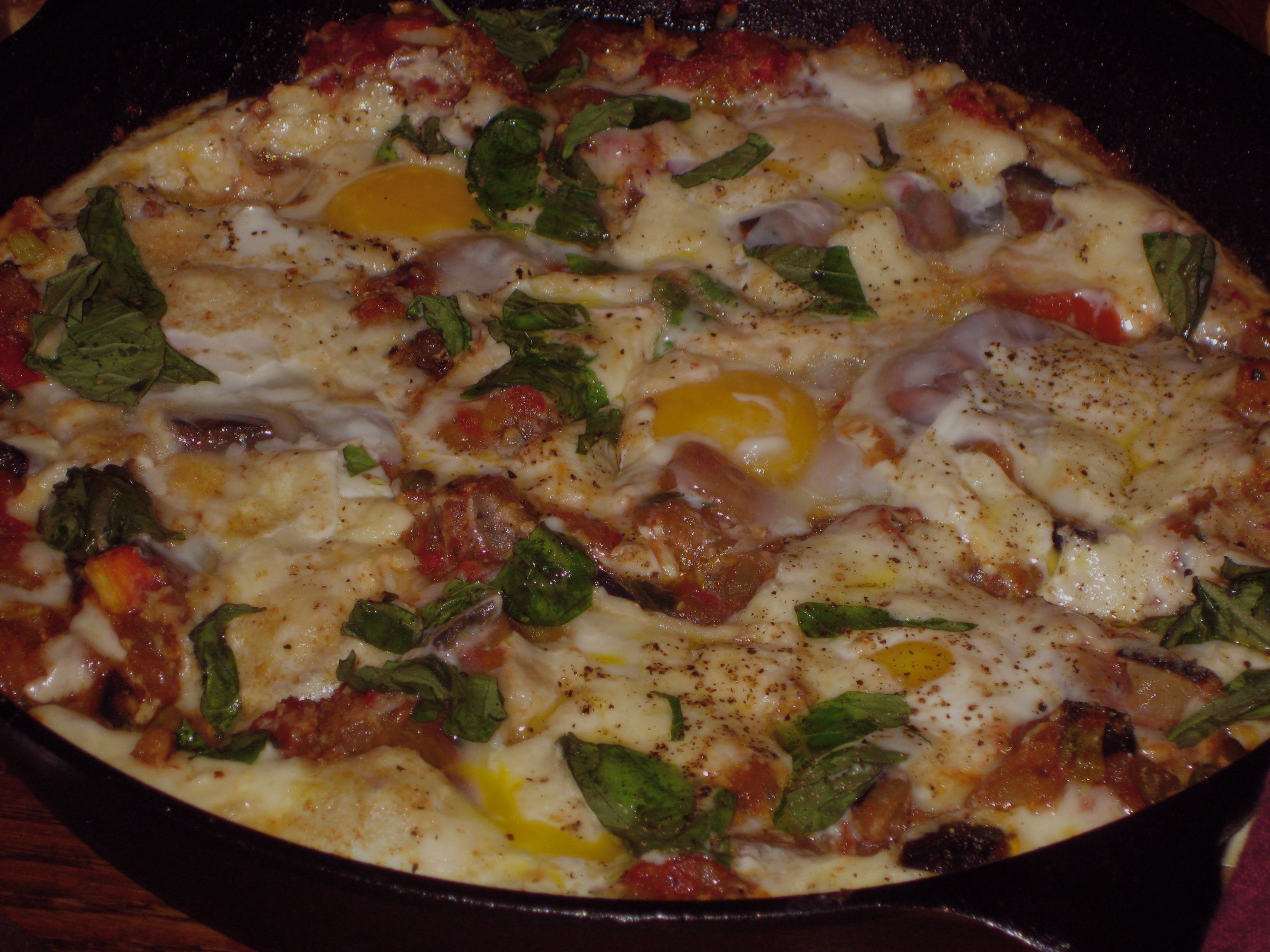
Recipe: Ciambotta with Baked Eggs, Savory, and Ragusano Cheese

Does the end of summer scare you, make you feel like diving head first into a big red watermelon and never coming out? I sometimes feel that way.

Got anxiety? I’ve found that a good solution is to gather what I can of the waning summer produce—eggplant, tomatoes, maybe corn, zucchini, sweet and hot peppers—and fashion them into something with a little more structure than your typical freewheeling summer fare, a dish that can address that back-to-school reflux burning up your throat. Cook something that means business. Turning on the oven will help you feel like an adult on a path to a serious life, walking in sturdy pumps, not flip-flops.

So here it is, a ciambotta, a summer dish, yes, but when piled into a baking dish, with eggs cracked on top, and finished with Ragusano, that excellent Sicilian caciocavallo cheese, it’s, well, a casserole, and a casserole always makes me feel as if I’ve really got a handle on the situation. I think.

Ciambotta with Baked Eggs, Savory, and Ragusano Cheese

(Serves 3 as a light supper)

Extra-virgin olive oil
3 red summer scallions, chopped
2 small inner celery stalks, chopped, plus a handful of celery leaves, lightly chopped
1 red bell pepper, seeded and cut into small dice
½ a fresh red peperoncino, seeded and minced
2 garlic cloves, thinly sliced
2 medium eggplants, unpeeled, cut into small cubes
2 medium zucchini, cut into small cubes
About 6 large sprigs of summer savory, the leaves lightly chopped
¼ cup dry Marsala wine
Salt
3 medium-size round summer tomatoes, peeled, seeded, chopped, lightly salted, and left to drain in a colander over a bowl for 30 minutes (save the tomato water)
½ cup capers, well dried
6 large eggs, room temperature
A small chunk of Ragusano cheese (a Sicilian caciacavallo), roughly grated
A handful of basil leaves, lightly chopped

In a very large skillet (one you can put in the oven, perhaps cast iron), heat 2 tablespoons of olive oil over a medium flame. Add the scallion, celery, red bell pepper, and peperoncino, and sauté until fragrant, about 4 minutes. Add the garlic, and sauté a minute longer. Add the eggplant, zucchini, and savory, season with salt, and sauté about 5 minutes longer, covering the skillet for a few minutes if the vegetables get too dry. Add the Marsala, and let it boil for a few seconds. Add the tomatoes, and simmer, uncovered, at a lively bubble for about 8 minutes longer, or until all the vegetables are just tender, adding the reserved tomato water if the ciambotta looks dry. The texture should be chunky, not too cooked down, with the tomatoes adding some liquid. Add the celery leaves and the capers, and season with a little more salt if needed. Give it a stir.

Preheat the oven to 425 degrees.

Make 6 indentations by pressing a spoon down into the surface of the ciambotta, more or less equally spaced, getting them as deep as you can. Crack an egg into each one. Season each egg with a little salt, and scatter on the Ragusano. Give everything a drizzle of fresh olive oil, and bake until the whites of the eggs are set but the yokes are still a little runny, about 12 to 15 minutes. Garnish with the basil. Serve hot.

Read Full Post »


Tomato plant, by Picasso

Recipe: Tomato Torta with Crème Fraîche, Parmigiano, and Thyme

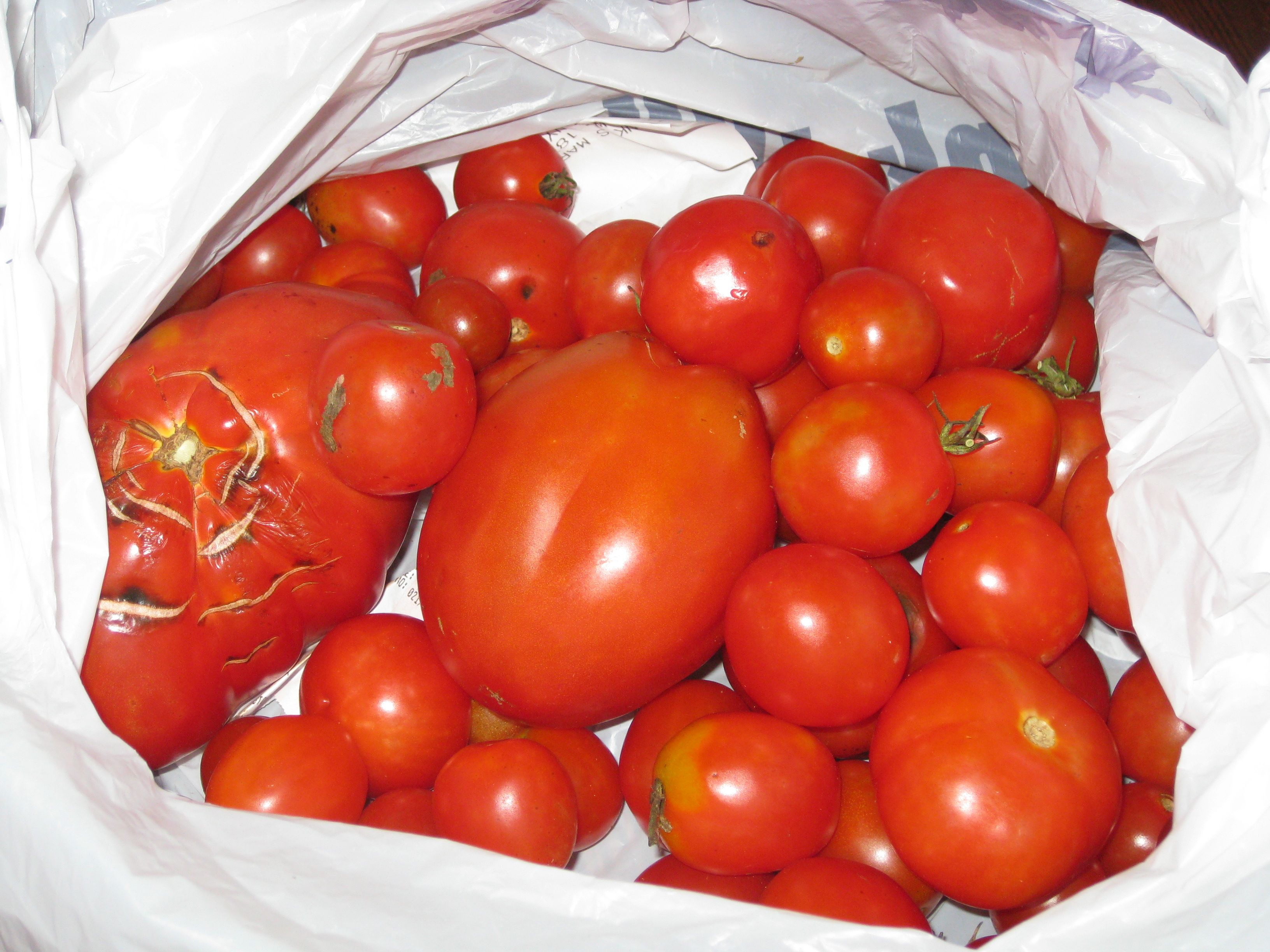
Once or twice a year I make a summer tomato tart. It happens when Barbara Calamari arrives at my apartment with a big bag of the Italian heirloom tomatoes she grows each year at her upstate palazzo (except for last year, which was a complete bust because of a tomato blight—so sad). This year, with all the heat, she’s had an especially sweet, rich, early crop. She usually plants a large Neapolitan cherry tomato that I really love in salads or just sprinkled with salt, but when she gives me enough of them they go into my tart, simply cut in half, lined up in circles in my pastry shell, baked to just withering, with a burst of juice still locked into each one. This year she gave me plenty.

I create a different tomato tart each year, inspired by the kind of tomatoes I’m using and, uh, I’m not sure exactly what else—although this year I can say for a fact that the tart was inspired by stuff I had in the refrigerator, which was fresh thyme, a half tub of crème fraîche, some Niçoise olives, a small chunk of Parmigiano, and a few eggs. It tastes a lot like a pizza.

You’ll want a nine-inch tart pan with a removable bottom for this.

Tomato Torta with Crème Fraîche, Parmigiano, and Thyme

(Serves 4 as a lunch or light dinner, or 8 as an appetizer)

For the crust:

2 cups all-purpose flour
5 large thyme sprigs, the leaves lightly chopped
Salt
1 tablespoon sugar
1¼ sticks cold unsalted butter, cut into bits
¼ cup cold white wine, maybe a bit more

For the filling:

⅓ cup crème fraîche
2 large eggs
½ cup freshly grated Parmigiano Reggiano cheese
A drizzle of whole milk
About 6 big scrapings of nutmeg
1 small garlic clove, minced
Salt
Freshly ground black pepper
A handful of Niçoise olives, pitted and cut in half
5 thyme sprigs, the leaves very light chopped

Plus:

About 2 dozen cherry tomatoes, cut in half
A drizzle of olive oil

Put the flour, thyme, salt, and sugar in the bowl of a food processor, and pulse briefly to blend. Add the butter bits, and pulse quickly two or three times, just to break them up. Drizzle on the white wine, and pulse once or twice more, just until you can squeeze a bit of the dough with your fingers and it holds together. If it’s still dry, add a tiny drizzle of wine or cold water, and pulse again. You don’t want to pulse until it forms a ball; the texture should be crumbly and loose. Turn the dough out onto a work surface, and bring it together into a big ball with your hands. Give it a quick two kneads, just to make sure it’s holding together. Cover it with plastic wrap, and refrigerate for about 2 hours.

Preheat the oven to 400 degrees.

Take the dough from the refrigerator, unwrap it, and place it on a lightly floured work surface. Give it a few whacks with a rolling pin to flatten its surface. Now roll it out, adding a little more flour if it starts to stick, until you have a round about 2 inches wider than your tart pan. Drape the dough into the pan, pressing it into the sides. Run the rolling pin over the top to cut off excess. Build up the sides a bit, so that the dough extends slightly over the edge of the pan. Give the bottom a bunch of light pricks with a skewer or pointy knife.  Stick the tart shell back in the refrigerator for about 10 minutes, or until the oven heats up.

Now you’ll want to blind bake (pre-bake) the tart crust. Cover the tart crust with a big piece of aluminum foil, and on top of that put dried beans or those little ceramic thingies some people buy just for this purpose. Bake for 20 minutes. The edges should be very lightly golden. Take the tart shell from the oven, and let it sit on a rack for a few minutes to cool off.

Whisk all the ingredients for the filling together in a bowl.

Line the tart shell with cherry tomatoes, cut side up, working in a circular pattern. Slowly pour the filling over the tomatoes, making sure none of it seeps  between the pan and the dough. Place the tart on a baking sheet, and bake for about 30 to 35 minutes, or until the crust is golden brown and the top is set.  Let the tart rest for about 30 minutes before slicing and serving.

Read Full Post »


Still life with eggplant, Picasso, 1946.

Recipe: Eggplant Rollatini with Ricotta, Mortadella, and Arugula

Southern Italians love to stuff and roll food. You’d almost think they didn’t have enough fun in their lives and were desperate for entertainment. Making food rolls is fun, and it’s a big feature in cucina povera, since it stretches a meal so you can feed a group. To me, little rolls can be prettier than just plain stuffed offerings, too. Sicily has lots of rolled and stuffed dishes in its fine repertoire, and they usually go by the name involtini. The rollee can be skinny slices of swordfish or tuna, gutted sardines, tough cuts of pork or lamb that need long simmering to become edible, or sheets of zucchini or sweet peppers or, in this case, eggplant. I’ve even made rolls using butternut squash (gotta be careful not to overcook them or they’ll turn into mush; maybe good for a pasta sauce in that case, though).

Rollatini is the usual Neapolitan term for the roll-and-stuff, and eggplant rollatini was the queen of the New York pizza parlor takeout menu when I was a kid, usually filled with ricotta and smothered in red sauce. I did love that dish, but here I’ve done it my way. It’s much lighter, with its uncooked tomato sauce and with baby arugula used more as an herb than as a salad green, giving the completed baked dish a spicy end-of-summer feel. For a completely vegetarian version, just leave out the mortadella. For a stronger, meaty taste, replace the mortadella with a small dice of a soft sopressata.

Eggplant Rollatini with Ricotta, Mortadella, and Arugula

(Serves 4  as a main course)

For the sauce:

2 large, ripe summer tomatoes, skinned, cut into small dice, and drained for about ½ hour
Salt
1 fresh summer garlic clove, very thinly sliced
Extra-virgin olive oil
A few small sprigs of marjoram, the leaves lightly chopped
Freshly ground black pepper

Also:

2 medium eggplants (long and thin are better than round ones for this), partially peeled and cut lengthwise into approximately ½-inch-thick slices

For the filling:

1 packed cup baby arugula, well stemmed
1½ cups whole milk ricotta
¼ pound mortadella, cut into very small cubes
1 fresh small summer garlic clove, minced
1 egg
¾ cup grana Padano cheese
About 10 scrapings of nutmeg
Salt
Freshly ground black pepper

Preheat the oven to 425 degrees.

Place all the ingredients for the sauce in a bowl, and give them a stir. Add about ¼ cup olive oil. Let  sit at room temperature to develop flavor

Brush the eggplant slices on both sides with olive oil, and season them with salt and black pepper. Place them on a sheet pan, and roast them until tender and lightly browned, about 15 to 20 minutes. No need to turn them.

To make the filling, chop about ¾ cup of the arugula, and place it in a large bowl. Add the ricotta, mortadella, garlic, egg, ½ cup of the grana Padano, the nutmeg, salt, and black pepper, and mix well.

Set out a baking dish large enough to hold all the rolls loosely. Coat it with a little olive oil.

When the eggplant is cool enough to handle, lay the slices, browner side down, on a work surface. Spoon about a tablespoon of the ricotta mixture onto each slice, and roll them up. Lay the rolls, seam side down, in the baking dish. Pour on the tomato sauce so it falls mostly between the rolls. Scatter on the remaining grana Padano, and bake until bubbly and lightly browned, about 20 minutes. Garnish with the remaining arugula leaves, and serve hot or warm.

Read Full Post »

Recipe: Pomodoro Crudo with Capers, Almonds, Peperoncino, and Basil

I was recently talking with my friend Eddie, who’s just started doing some serious cooking, about good things to do with summer tomatoes. He wanted to make something impressive but relatively effortless, and pomodoro crudo, a raw tomato sauce, was the first thing I thought of. Not only is it easy, but it highlights summer tomatoes like nothing else. The secret, I believe, is in the chop, and in the bath of good olive oil I give them. A small dice (I don’t even bother to skin them) is essential not only for texture but, it seems to me, for flavor too. Sliced tomatoes can sometimes have a slight sea taste. (I have no idea why this would be. Any ideas out there?) A small dice, to my palate, produces a full blown sweetness that just bursts forth. And then, to expand the flavor even further, you want to let the tomato cubes sit in some really good olive oil, so the oil can mingle with the tomato essence to create a beautiful sauce for pasta or fish, or bruschetta, or any number of things. (For mozzarella? Definitely.)  And if you do toss it with pasta, like I did here, you’ll notice the heat from the pasta opens up all the flavors in the sauce even further, so maybe that’s the best way to enjoy its fragrance.

Tomatoes and olive oil are the starting point. If you want you can just add a little salt and leave it at that. Lovely. But since I always want to play with my food, I like to include a few flourishes. I make this sauce several times each summer and never the same way. I gave Eddie a few suggestions for add-ins, and I think he wound up including red onion, parsley, a little dill, pine nuts, and olives of some sort. Sounds good. I can never resist adding summer garlic, so that was a given for the version I made last night; then I threw in toasted almonds, good Sicilian salt-packed capers, a fresh, minced peperoncino, which added a subtle heat that didn’t overwhelm the goodness of the tomatoes. And for herbs I went with tarragon and basil. I used this on pasta, but these flavorings to me also suggest seafood. Had I had a few catfish fillets on hand, I would have sautéed them up crispy and spooned the sauce on them.

No matter what you decide to include in the personal touch department, a crucial step with pomodoro crudo is draining your tomatoes. Summer tomatoes, unless you work with the plum variety, give off tons of juice, and you don’t want all that liquid in your sauce. So after you chop the tomatoes, sit them in a colander or strainer, toss them with a little salt, and let the tomato water collect in a bowl. And keep that gorgeous, delicious water, especially if you’re planning to use the sauce to dress pasta. It’s the perfect thing if you find the finished pasta dish a bit dry. I wound up using about a quarter cup of it to loosen my sauce, and it had the added bonus of making the whole thing even more voluptuous.

If while trying to fashion a pomodoro crudo you feel a little stuck, creatively speaking, here are a few other flavor combinations I’ve had success with:

—A small dice of cantaloupe, basil, red onion, mozzarella
—Thyme, parsley, orange zest, black olives
—Fresh mint, pine nuts, grated mild pecorino, garlic
—Pistachios, green olives, scallions, fresh marjoram
—Peperoncino, diced anchovies, garlic, baby arugula
—A small dice of both soppressata and caciocavallo, basil, garlic
—Red shallot, tarragon, chervil, capers, lemon zest
—Canned Italian tuna, capers, green olives, garlic, parsley
—Chopped speck, a small amount of sage, parsley, scallions
—Walnuts, garlic, crumbled ricotta salata, basil

Pomodoro Crudo with Capers, Almonds, Peperoncino, and Basil

(Serves 6 as a first course)

5 round summer tomatoes, cut into small dice
Salt
Extra-virgin olive oil
About ⅓ cup salt-packed capers, soaked, rinsed, and drained
About ⅓ cup lightly toasted slivered almonds
2 fresh summer garlic cloves, very thinly sliced
1 fresh red peperoncino, minced
A big handful of basil leaves, lightly chopped
A few tarragon sprigs, the leaves lightly chopped
1 pound fusilli, penne, or ziti

Place the tomatoes in a colander or strainer over a bowl. Sprinkle them with a little salt, toss, and let them drain for about a half hour. If they are extremely juicy, you might let them go a little longer. Save the tomato water.

Place the drained tomatoes in a serving bowl. Add ⅓ cup of olive oil and all the other ingredients for the sauce, except for the basil and tarragon. Let sit for about 20 minutes, unrefrigerated, to develop flavor.

Cook the pasta al dente, and drain it well. Add it to the bowl. Add a little extra salt, and give it all a toss. Add the basil and tarragon, and toss gently. If the pasta seems dry, add a bit of the tomato water. Serve right away. To my taste, pasta with hot chilies tastes best without grated cheese, but that’s up to you.

Read Full Post »


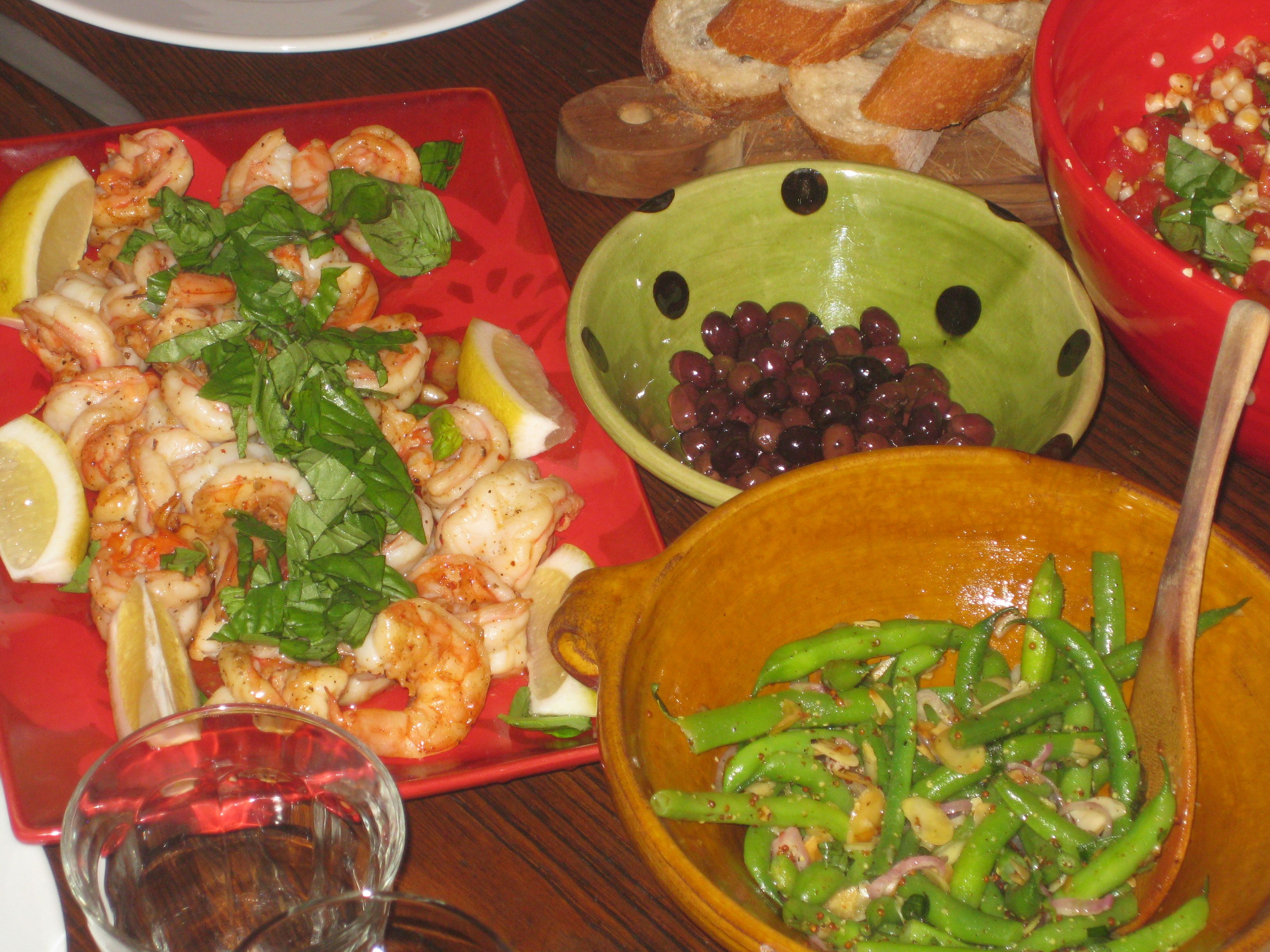
I served my Sambuca shrimp along with a salad of string beans, shallots, and toasted almonds.

Recipe: Shrimp with Sambuca, Summer Garlic, and Basil

For years I’ve been spending occasional weekends at La Duchesse Anne, a boho inn in Mt. Tremper, New York, a town near Woodstock. It is one of the last or possibly the very last of the inns and restaurants in what was once called the French Catskills that were originally run by people from Brittany who came to New York in the 1940s and ’50s. Most of those people opened restaurants in Manhattan, but some who didn’t like the vibe there wound up clustered together in the rather run-down (at least today) mountainy resorts along Route 28.

Fifteen or so years ago, when I first visited the area, there were a handful of those cute French places left, but little by little they closed. La Duchesse Anne seems to be the one holdout. Its original owners packed it in a few years ago, but they leased the place to a young Breton chef named Fabrice. He and his wife, mini dog, giant cat, and now little boy moved in to get the place back on its feet. I was at first heartbroken by what he had done to the menu. Gone were the kidneys in mustard cream, sweetbreads sautéed in tons of butter, chicken gizzard salad (a great hangover helper—it was on the breakfast menu), crêpes with Gruyère, and the previous owners’ famous game dinners with platters of things like venison, house-made wild boar pâté, and ostrich. Those quirky French specialties were mostly replaced by more standard fare that you might find on a country club menu, such as seared salmon, roast chicken, and steaks. Everything was nicely done, and Fabrice does have more up-to-date ideas about vegetables, actually serving them in pieces and slightly crunchy (the old owners puréed every vegetable to death). I missed the old funky menu, but I liked Fabrice and the energy he brought to the place, so I’ve kept going up.

Fabrice does occasionally come up with something earthy, like the local chanterelle salad I ordered last time, which was loaded with flavor. And there’s one dish in particular I absolutely love, his snails sautéed in Pernod. It’s a lovely change from the usual ramekin of snails in garlic butter, a staple on the old menu. He sets the Pernod snails on a salad, and their anisey juices create a beautiful dressing for the greens. That is a really great flavor combination. Fabrice, now just give me back my sweetbreads, and I’ll be very happy.

I recreated Fabrice’s snails with Pernod at home, and they turned out very nicely, so I started playing theme-and-variation and came up with an Italianized version, substituting shrimp for the snails, Sambuca for the Pernod, and basil for the parsley.

The main difference between a French pastis like Pernod and an Italian anise liquor is sugar content. Sambuca and anisette are sweeter than Pernod or Ricard, so you will get a slight sweetness in this dish, which I really like. I prefer Sambuca to anisette, which I find just too sweet, so for cooking I’d go with the former.

This dish cooks in about two minutes, so have everything you’ll need right next to the stove, jack the flame to very high, and go for it.

Shrimp with Sambuca, Summer Garlic, and Basil

(Serves 4 as a first course or side dish)

Extra-virgin olive oil
1½ pounds large shrimp, peeled and deveined
3 fresh summer garlic cloves, very thinly sliced
A generous pinch of medium hot paprika, such as the Basque Piment d’Espelette
Salt
1 shot Sambuca
The juice from ½ lemon
A handful of basil leaves, lightly chopped

Choose a large heavy-bottomed skillet, and get it hot over high heat. Add about 3 tablespoons of olive oil. When the oil is just starting to smoke, add the shrimp, spreading them out as best you can in one layer. Let them sauté, without moving them around, for about 30 seconds. Then scatter the garlic over the top, and give the shrimp a flip with a big spatula. Season them with the paprika and some salt. Flip them again after about a minute. At this point they should be pink and tender and just a touch undercooked at the center. Add the Sambuca, and let it flame up and boil for a few seconds. Add the lemon juice, and give the skillet a shake. Pour the shrimp, with all the skillet juices, out onto a large serving platter. Scatter on the basil. Serve right away.

Read Full Post »

« Newer Posts - Older Posts »