Feeds:
Posts
Comments

Archive for the ‘2010’ Category


Me and my sister Liti in Hollywood, Florida: great oranges, great spirit, great cars.

Recipe: Orange and Endive Salad with Anchovies

I just came back from Royal Palm Beach, Florida, where I went to see my mother. I’m not sure I’d say it was a vacation, exactly. More of a visit with some good and some rough moments. The weather, except for two days, was cold. It has been that way for a good part of the winter, destroying much of the orange and strawberry crops. I did find oranges, but not the abundant, fragrant loads of them you usually see piled up at every fruit stand and sold from the backs of trucks along the highways.

When I was a kid we had a house in Hollywood, Florida, which my parents and sister and brother and I shared during winter months with my grandparents, two sets of aunts and uncles, and about nine cousins. It’s hard to imagine how we all lived together in that tiny place, especially as it had only four bedrooms. Things could be hectic, but oddly enough we mostly had a ball, at least the kids did. Now that I’m an adult myself, I couldn’t stand being jammed into that tiny place with three generations of Italian-Americans and only one blender for making whiskey sours. We once went to pick up a hamburger order from Royal Castle (Florida’s version of White Castle), and the checkout guy asked my father if he was picking up for the local military academy. He was serious.

We made a lot of fresh fruit drinks from the output of the astonishing array of trees in our little backyard. We had excellent grapefruits, mini bananas, aloes (not a fruit, certainly, and probably not truly edible, but great for sunburns; edible fruit or not, my grandfather mixed some of its slimy insides into grapefruit juice as a hangover cure), limes (not the key variety, unfortunately), coconuts, papayas, and two different types of oranges, one tree producing typical, round, orange ones like you’d buy in a grocery store, the other heavy with medium-size, yellowish fruit with thin but almost leathery skin, usually streaked with brown. When you cut into the yellowish ones, their flesh was brilliant orange, almost electric in contrast to the skin. My uncle called them Hamlins, but they weren’t Hamlins. Hamlins are bright orange. They were Florida street oranges. Nobody knew what they were.

I hadn’t seen those oranges since the 1970s, but last week there they were, all over the sidewalks in Royal Palm, blown off the trees by the high winds. I think they were the only oranges that were hardy enough to make it through the bad winter in any quantity. They were good, too. You could buy eight for a dollar at a nearby Cuban fruit stand, but why bother when you also could just gather them along the street?

Since I’ve been on my mission to rethink Sicilian cooking, all these oranges lying around got me thinking about the many Sicilian dishes that include orange, some in very strange arrangements, like Insalata di Arance e Aringhe, a salad made with oranges, smoked herring, and sometimes fennel. Here’s a recipe for that from an older post of mine. I originally thought I’d get back to New York and make a version of that with grilled sardines instead of canned herrings, but I couldn’t find really fresh sardines (it’s hit-or-miss around here with those little fish). So I settled on good-quality salt-packed anchovies (I used Flott, a Sicilian brand).

I mentioned on Facebook that I wanted to make something that mixed oranges and anchovies, and I got a note back from my old friend Arnaud in Paris. He suggested a delicious sounding salad that’s a toss of endive, orange, a bit of soy sauce, and cilantro. He had chosen to ignore the anchovy part of the equation, but I liked the sound of the rest of it, although I’m not big on cilantro, which anyway wouldn’t fit in with my Sicilian theme. (Parisians all seem to love cilantro. I wonder why that is? Maybe the Vietnamese connection?)

So here’s another nuovo Siciliano concoction that to my palate comes out just fine. The soy sauce would not be recognizable to many Sicilians, unless they lived in Palermo and frequented Japanese restaurants (there are a few), but other than that it’s just a rearrangement of familiar Sicilian flavors (endive is not Sicilian, but it is a fancier equivalent to all the bitter chicories that Southern Italians love so much). This salad went very well with the pan-seared pork chop with capers I served alongside it. I can imagine it going very nicely with a roast chicken too.

Orange and Endive Salad with Anchovies

(Serves 2)

For the orange vinaigrette:

The grated zest from 1 orange
1 teaspoon lemon juice
½ teaspoon light soy sauce
1 garlic clove, peeled and lightly crushed
2 tablespoons extra-virgin olive oil

For the salad:

2 medium endives, pulled apart into individual leaves
1 large orange, peeled and cut into half rounds
2 very thin slices red onion
4 salt-packed anchovies, soaked in cool water to remove excess salt, rinsed, filleted, and roughly chopped
Freshly ground black pepper
A handful of small basil leaves
A handful of slivered almonds, lightly toasted

In a small bowl, mix together all the ingredients for the vinaigrette. Add more soy or lemon juice if needed.

In a salad bowl built for two, combine the endive, orange sections, red onion, and anchovies. Add a few grindings of black pepper.

Pour the dressing over the salad, and toss gently. Scatter on the basil leaves and the almonds. Serve right away.
Read Full Post »

Women with Fish

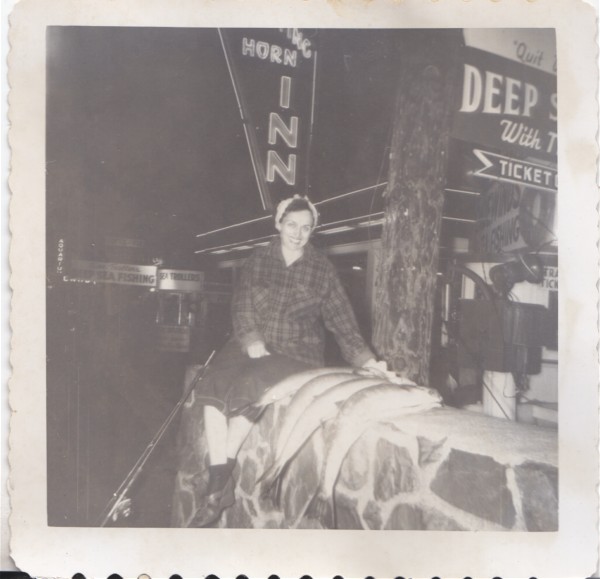
A woman with her just caught fish, Oregon, 1940s.

Read Full Post »

Recipe: Grilled Beef Bracioline with Mint and Anchovy Vinaigrette

If I relied exclusively on chefs and cooks for culinary inspiration, I’d probably be permanently stunted. I’ve learned plenty from working with chefs and from reading their recipes, don’t get me wrong. But I’ve never had a mentor. I do have a muse, and regular readers of my blog know about my relationship with Anna Magnani.  She gives me power. Power from another person’s creative force, as long as you’re able to absorb it, can energize you (it’s got to be the right kind of power, and you’ve got to be in the mood). I even get inspiration from her misguided power in the film Bellissima, where she plays a driven, desperate stage mom,. That’s because her power emanates from love.

I call on Miss Anna Magnani when I’m feeling confused or weak, such as now. I’ve been trying to create some fresh Sicilian-inspired dishes, but I keep running into heaviness. Maybe it’s winter, or maybe I’m just stuck, but I recently asked her for help and she came through, as she almost always does (the only time she told me to go to hell was when I asked her to teach me how to love the cooking of the Italian Alps, which, as it turned out, neither of us recognizes as legitimate Italian food). Admittedly Miss Magnani, Roman through and through, doesn’t know much about Sicilian food, but she knows enough to see where its greatness comes from. She loves anchovies, and she loves sharpness and sweetness. I told her I needed to get away from winter cooking without getting away from winter, kind of a confusing request but she knew what I meant. “Cook meat, make it bold, but make it quick. No long-simmered stews or tomato sauces. Make vinaigrettes to sauce meat and fish.” That was her advice. Not particularly poetic, but I was too anxious to spend time figuring out a cryptic message, and she knew it.

Sicilians love to concoct spunky stuffings for rolled packets of meat, fish, or vegetables. It’s a time-honored cucina povera trick to make a little go a long way. It’s a favorite food preparation for me, and I return to it over and over, using the same economical philosophy but always trying to change the feel of the finished product, since it’s basically an exercise in improvisation. And rolling and filling things is fun. Miss Magnani reminded me that lately I wasn’t having enough fun in cooking, or in life. She said, “Sometimes you just have to work it.” She was right, of course. Only kids have access to unlimited spontaneous fun.

I listened, I lightened up, and I fired up my grill plate. Here’s a very quick-cooked version of braciole (or bracioline, which is what you’d call this smaller version.) It’s a dish that’s usually slow-simmered in a tomatoey wine sauce, but I chose a beef top round, a cut that can be quick-cooked and stay tender. It’s a supermarket cut that I often find ready-sliced into thin cutlets. I kept the filling fairly classic, but sauced the things, as instructed, with a vinaigrette. Thanks, Miss Magnani. You’ve come through again.

Grilled Beef Bracioline with Mint and Anchovy Vinairgrette

(Serves 4)

8 thin slices beef top round, about 4 by 5 inches, pounded
Salt
Black pepper
About a tablespoon of sugar
Extra-virgin olive oil
¼ teaspoon ground allspice
½ cup blanched, lightly toasted almonds, minced
1 small garlic clove, minced
The grated zest from 1 lemon
½ cup grated pecorino Toscano cheese
5 mint sprigs, the leaves lightly chopped
10 large sprigs flat-leaf parsley, the leaves lightly chopped
Toothpicks

1 head frisée, chicory, or punterelle lettuce, torn into bite-size pieces

For the vinaigrette:

4 tablespoons extra-virgin olive oil (preferably a great Sicilian oil such as Ravida)
1 garlic clove, peeled and smashed
3 anchovies, minced
½ pint grape tomatoes, quartered
The juice from 1 small lemon
¼ teaspoon sugar
A pinch of salt
Freshly ground black pepper
A handful of fresh mint leaves, plus a few sprigs for garnish

Season the beef slices on both sides with salt, black pepper, and the sugar, and lay them out flat on a work surface.

In a small bowl, mix 2 tablespoons of olive oil with the allspice, almonds, garlic, lemon zest, pecorino, mint, and parsley. Season with a little salt and black pepper. Mix well. Press a thin layer of the filling onto each slice of beef, and roll them up from their narrower ends. Fasten each one with a toothpick.

Set up a stove-top grill plate, and get it hot over medium-high heat.

In a small bowl, mix together all the ingredients for the vinaigrette.

Drizzle the bracioline with a little olive oil, and place them on the grill, turning them a few times, until they’re browned all over and are just tender, about 5 minutes. They should still be a bit pink inside. Take them from the grill and let them rest a minute.

Set up a large platter, and line it with the frisée or chicory or puntarelle. Pull out the toothpicks, and slice the bracioline into thick pieces, on an angle, arranging them on the salad. Pour the vinaigrette over the top. Give everything a few grindings of fresh black pepper, and garnish with mint sprigs. Serve right away with good Italian bread. If you have a big appetite, this could be an antipasto, although with a side of rice or potato salad it makes a very ample main course.

Read Full Post »

Snow, Candles, Pasta

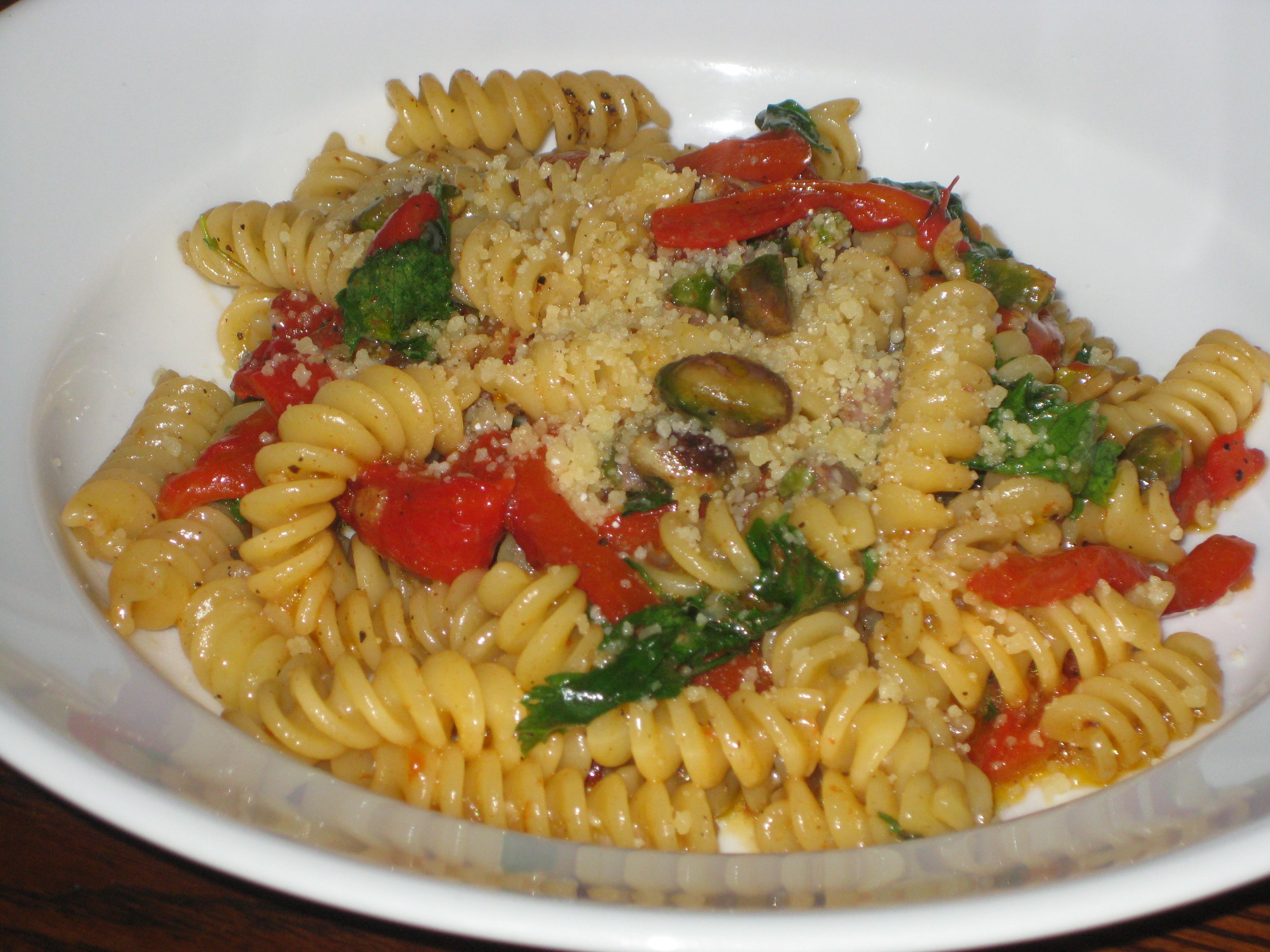
Recipe: Fusilli with Roasted Peppers, Honey, and Rosemary

Despite the beauty of yesterday’s snowstorm, I didn’t want to go out in it. I didn’t want to be cold. My apartment had been kind of cold the last few days, and I still felt chilled through, even though when the snow came the landlord finally decided to send up some heat. When darkness came, the view out my window onto 13th Street still showed pristine glistening snow with not a trace of city grime. I wanted to cook, but that would most likely involve shopping, which would mean going out. Lazy and withdrawn, and still cold was what I was. I wanted a glass of red wine. For the moment I just stared out the window at the now lightly falling snow and thought about what I could possibly cook with what I had on hand. So I turned to la dispensa, which is what Italians call their pantry.

I don’t generally stock many provisions; in fact, I don’t really have a dispensa, just a little section of restaurant shelving where I stick stuff that’s more or less food. I’m lucky if I have a bag of pasta. But wouldn’t you know it, I did have a pasta, and good pasta too, a bag of Setaro fusilli, flown all the way from sunny Napoli. I also had a half a bag of pistachios left over from my previous blog recipe.

I guess I consider anything I might have in my tiny refrigerator an extension of la dispensa, since I often store stuff in there not because it needs refrigeration but just to get it out of the way, things like calcium pills and sometimes even dishes. I did track down two very overripe red bell peppers. Winter peppers are actually better when they’re verging toward rot but not actually rotten. They’re sweeter, and if you then go ahead and char the hell out of them, which I wound up doing, you’ve really got something.

I had a few fresh rosemary sprigs and a jar of Sicilian honey from some long-ago trip. I found a great looking hunk of pecorino Toscano (I always have cheese, since that, along with red wine and pancetta, is the staff of life). All and all, these seemed meager provisions for  a decent meal. A can of tomatoes would have been a nice addition, but I didn’t seem to have one (maybe there was one under the bed somewhere). So I lit a few candles, uncorked a bottle, and went back to starring out the window, until I came up with what I thought would make a suitable and possibly even a successful pasta dinner for Fred and me with the few items I had.  What I decided was that the taste of roasted pepper would prevail, and I’d loosen up the sauce with a little white wine and some canned chicken broth (yuk), a touch of honey, and a touch of lemon. And it turned out good, very agro dolce, which was fortunate, since I figured it could qualify as one of my nuovo Siciliano creations, nuovo Sicilian being the direction my cooking is leaning toward these days. It just goes to show what you can accomplish in this big cold city without leaving your chilly apartment during a furious five-inch snowstorm.

Fusilli with Roasted Peppers, Honey, and Rosemary

(Serves 2)

2 ripe red bell peppers
Salt
½ pound fusilli
Extra-virgin olive oil
1 large garlic clove, very thinly sliced
A few sprigs of rosemary, the leaves chopped
Freshly ground black pepper
A splash of dry white wine
1 teaspoon honey
The zest from 1 small lemon
About ½ cup chicken broth (canned is fine)
A handful of shelled whole pistachios
A handful of Italian parsley, the leaves left whole
A chunk of pecorino Toscano cheese

Place the peppers on a sheet pan, and broil them about 4 inches from the heat source, turning them a few times, until they’re blackened all over. Let them cool a bit, and then peel and seed them. Cut them into thin strips.

Put up a pot of pasta cooking water, and bring it to a boil. Add a generous amount of salt, and drop in the fusilli.

In a large skillet, heat about 2 tablespoons of olive oil over medium flame. Add the garlic, and let it warm for a few seconds. Add the sliced peppers, and season them with a little salt. Sauté until the peppers are tender and fragrant, about 3 minutes. Add the rosemary and a few grindings of black pepper, and sauté a few moments longer, just to release the herb’s fragrance. Add the white wine, and let it bubble for a few seconds. Add the honey, the lemon zest, and the chicken broth, and simmer at a lively bubble to reduce the liquid slightly, about 3 minutes or so. Add the pistachios.

When al dente, drain the fusilli, and add it to the skillet. Toss well, adding a bit more chicken broth if the dish seems dry. Transfer the pasta to a warmed serving bowl. Add the parsley leaves, and grate on about a tablespoon of the pecorino Toscano. Add a drizzle of fresh olive oil, and toss gently. Serve right away, with extra pecorino if you like.

Read Full Post »

Sunny  Sicilian pleasures, compliments of Divorce Italian Style.

Recipe: Bucatini with Bottarga, Pistachios, and Mint

Do you need a little summer lightness in the midst of all this winter darkness? I do, and the easiest place for me to get it is in my kitchen. Stewed meat, as lovely as it can be, tends to eventually bring me down, making my brain feel cooked out, reduced to a very low simmer. In cold weather I like to play around with dishes that contain uncooked or flash-cooked elements. Grape and cherry tomatoes, usually pretty decent in winter months, can really lift a girl’s spirit. And I have to say that after all these years of seeing plastic packs of fresh herbs in my supermarket in January and February, I still can’t quite believe I can have them. It doesn’t seem that long ago I’d be hanging in my family kitchen watching my father go through his end-of-summer ritual of salting basil leaves from his garden, then wrapping them in plastic, then in aluminum foil, and then in more plastic (why?), and then stashing them in the freezer, hoping to prolong summer. Inevitably they’d be black when he defrosted them anyhow, but I suppose they did have a hint of fresh basil flavor, and in any case they were still better than dried ones for a winter tomato sauce.

I recently entered into a nuovo Siciliano cooking phase, probably to add some sunshine in my life. I’ve been putting energy into creating contemporary recipes using classic Sicilian ingredients like the bottarga, pistachios, and mint I incorporated in this pasta. I love Sicilian food, with its mix of Arab, Greek, Spanish, and haughty little touches of French, but I do get bored cooking the same classics. The food in Sicily is evolving, thanks mainly to a handful of innovative chefs but also in home kitchens. But you’d never know it from looking through most Sicilian or Southern Italian cookbooks written in this country. They tend to stay with the tried and true. Lately I just feel like playing around with sunny Sicilian flavors.

Buddy and Fumio check out a slab of Sardinian mullet bottarga.

Sicilian Bottarga is an interesting product, a salted, preserved roe from tuna. Think of using it where you might add uncooked anchovies but  you’re looking for a more sophisticated result (bottarga is shaved or grated and added to a dish at the last minute so it doesn’t cook and lose nuance). Classically it’s sliced thinly, drizzled with olive oil, and eaten as an antipasto. You can grate a little over a green salad; I’ve seen it done in Sicily. It can also be used as a condimento for pasta, the heat from the pasta just warming it slightly. True, bottarga is not something most people think of when they’re looking for sunny and light (if they think of it at all), but mixing it with the flash-cooked tomatoes and all the fresh herbs, I found that it along with the pistachios added a little depth to the dish, making it both rich and light—a good description generally of the Sicilian spirit.

In Sardinia, they make bottarga from mullet, and I kind of prefer the Sardinian to the Sicilian. It’s a little less straight-on salty, and it’s richer and moister. It’s also a bit more expensive, but since you use so little and it keeps, it’s really not such a splurge. Either kind will work really well in this recipe. You can purchase both Sicilian and Sardinian bottarga from buonitalia.com. Avoid the pre-ground powdered bottarga that comes in little plastic bags. That’s the dehydrated dredges of the dredges sold to tourists in overpriced food shops in Sicily (I’ve also seen it at the Buon Italia store at the Chelsea Market). That stuff is a complete waste of money.

I’ll be working on more revamped Sicilian-style dishes. The good ones I’ll pass on to you, hoping to lighten your winter load. Here is a good one.

Bucatini with Bottarga, Pistachios, and Mint

(Serves 4 as a main course or 6 a first course; I think it works best as a primo, because of its richness)

Salt
1 pound bucatini pasta
Extra-virgin olive oil
2 pints sweet grape tomatoes, halved
1 large garlic clove, very thinly sliced
A splash of sweet vermouth
A big palmful of shelled, unsalted pistachios
Freshly ground black pepper
The grated zest from 1 small lemon
About 2 ounces bottarga (you’ll want about 1/2 cup shaved)
A handful of flat-leaf parsley leaves, lightly chopped
A few large mint sprigs, the leaves lightly chopped

Put up a big pot of pasta cooking water, and bring it to a boil. Add a generous amount of salt, and drop in the bucatini.

In a large skillet, heat about 3 tablespoons of olive oil over high heat. Add the cherry tomatoes and the garlic, and cook quickly, just until the tomatoes start to soften and give off juice. Add a little salt. Now add the sweet vermouth, and let it bubble for a few seconds. Turn off the heat.

When the bucatini is al dente, drain it well. Pour it into a large pasta serving bowl, add the tomatoes with all the skillet juices, and toss gently. Shave the bottarga very thinly onto the pasta with a sharp vegetable peeler (or you could do this ahead of time and drizzle it with a litle olive oil). Add the pistachios, plenty of fresh black pepper, the lemon zest, and the parsley and mint. Add a drizzle of fresh olive oil. Toss again, lightly. Serve right away.

Read Full Post »

Too Much Salt

A shrine made from salt by the workers at the Trapani salt beds in Sicily.

I don’t eat out as much as a did when I wasn’t so tight with money, but I still do on occasion, especially when I want to check out a new Italian place in or around Manhattan that I’ve heard good things about. I feel okay shelling out for a place that is doing something new, or just doing something classic in a really fine way. I write restaurant recommendations on my blog from time to time, but I don’t write pans. I never wanted to be a restaurant critic; I don’t have the stomach for it. But a problem has arisen in, I’d say in the last ten years. It coincides with the growth of the “bam” seasoning mentality that has become such a problem with many newer chefs. They might not ever admit it, but I can taste it.

What bothers me, both as a diner and as a professional cook, is something that has become epidemic in Manhattan, and that is severe oversalting. I’m not talking about the French fries at Burger King or processed foods where you can’t control the salt content; I’m speaking of some upscale restaurants run by well-known chefs and owners.  There seems to be an unwritten assumption chefs have embraced that customers and critics won’t applaud your food unless it’s excessively salted. That is a bad assumption.

I recently ate at a very busy Italian place in my West Village neighborhood, lines out the door, people jammed together eating at the bar, noise level through the roof. Not my usual kind of atmosphere, but I’d heard good things about its Italian menu, and on paper it looked interesting. Every dish I ordered was outrageously oversalted. I thought it might just be an off night, so I went back about a week later, and I experienced the same thing. I couldn’t believe the salt level in the food, but I kept seeing the lines out the door, so I thought it only fair to try again. Same experience, especially in the appetizer department. The salt built up in the back of my throat. I started two nights with the same dish, a grilled octopus with chorizo and greens (I mean, really, how much salt do you need to add to a dish containing chorizo?). When on the second try I complained to the waiter about the salt, all he could come up with was “It’s one of our most popular dishes.” I don’t know if people are just too humiliated to complain about oversalting because they’re grateful they were able to obtain their 5:30 reservation in such a bastion of hipness, or possibly their palates have been shot to hell by chefs screaming “Attention must be paid” from their hot, steaming kitchens. I find this salt problem especially prevalent in wine bar food and appetizers, but not exclusively. I had a similar experience at one of the Batali restaurants about six months ago. Two dishes, a fritto misto and a pork ragu sauce, were not just salty but really salty. We sent the fritto misto back, but we were too embarrassed to complain about the other one as well. We should have.

I’m far from being a health freak or a saltophobe. I really like salt. I like my food well seasoned, but I’m talking here about the pleasure of taste as interpreted by trained chefs, and cooking with a fine-tuned palate, which to my palate doesn’t include being blasted with salt. (And furthermore, oversalted food makes some wines taste really bad, especially very tannic ones, so not only do these salt-happy chefs ruin your food, but they make it impossible for you to enjoy the wine you’ve paid an inflated price for too. Not fair any way you look at it.)

Please, don’t be shy. Speak out if you run into this problem. Tell your waiter. Tell the chef. These people should know when they’ve crossed the line from acceptably aggressive seasoning to flip impertinence. Or is it just a cry for help. ” Somebody get me out of this boiling, greasy kitchen”.

Read Full Post »

Recipe: Erica De Mane’s House Olives

I hardly ever have any real food in my refrigerator. I mean, I’ve got stuff like mustard, and I usually have a good stash of wine. You’d think being a food writer I’d have all sorts of delicious dishes wrapped up and ready to serve at any moment. Not so. First off, I’ve got no kids, so I don’t necessarily even stock dried pasta and canned tomatoes. I’m either cooking for Fred and me, shopping the day I cook, or I’m cooking for a big group, and shopping the day I cook. I usually send leftovers home with guests, because that’s easier than keeping them in my own refrigerator, plus I like giving friends food to go so they can think of me and my out-of-control generosity when they lunch on roast pork and cannellini beans the next day.

I like living like this. The stupid thing about it is that I often have nothing to offer friends when they stop by unannounced (I live in a street-level apartment, so they do often just show up, after looking in my window and seeing me milling around). I’ve always got booze, which is a good start, but it would be nice to offer them a little bread, cheese, salami. I  sometimes have those things, but usually just dried up odds and ends, not in a really presentable form.

If you live like me but would like to keep a few savory treats on hand, I suggest you try this: olives and taralli. Taralli, the great, dry, crumbly, savory Puglian biscotti made from semolina flour, olive oil, and white wine and often flavored with fennel seeds or rosemary, are the best way to go. They last for weeks and go extremely well with both red wine and gin. And olives, in my opinion, go with any type of booze your friends may request. They’re beautiful, they’re shiny, they’re classy and delicious, and they keep. They are grand dining at its most minimally acceptable.

I’ve now come up with what I consider our house olives. It’s a mix of the little brown Niçoise and the green Picholine varieties in about equal measure. I know it seems funny for an Italian food writer to serve French olives as her staple, but the sad truth is that even here in food-crazed Manhattan I can’t always find decent Italian ones. (The dark brown Taggiasche olives from Liguria and the green Sicilian Castelvetranos are my favorites. They’re sometimes available through buonitalia.com, or at Buon Italia’s store in the Chelsea Market, but not reliably.) I often wind up with these two French types, and they’re in no way a compromise. They’re just not Italian.

I mix them together and then grate on a bit of orange zest, a few sprigs of fresh thyme leaves, black pepper, and a drizzle of fresh olive oil, I give them a toss, and that’s it. There’s something about the orange, thyme, and black pepper trio that makes them perfect for me. I’ve tried other mixes, adding garlic, fennel seeds, hot chilies, rosemary, and various other additions, but this is the one I’ve grown to love. So if I’ve got my olives, my taralli, and my vino, I feel fully covered in the bare-bones hospitality department. At least I’m offering something. And if your friends are still hanging around after the olives are gone, you can always send out for a pizza.

Erica De Mane’s House Olives

1 cup brown Niçoise olives
1 cup green Picholine olives
The grated zest from 1 large orange
The leaves from about 8 sprigs of thyme
Freshly ground coarse black pepper
Extra-virgin olive oil

Drain the olives of whatever oil they were packed in (I find that it can sometimes be a little stale tasting). Place the olives in a nice-looking serving bowl. Grate on the orange zest, being careful not to lift up any of the white pith. Add the thyme leaves, and grind on a bit of really fresh coarsely ground black pepper. Give everything a drizzle of your best extra-virgin olive oil, and toss. They’ll last about two weeks refrigerated, but bring them back to room temperature before serving.

Read Full Post »

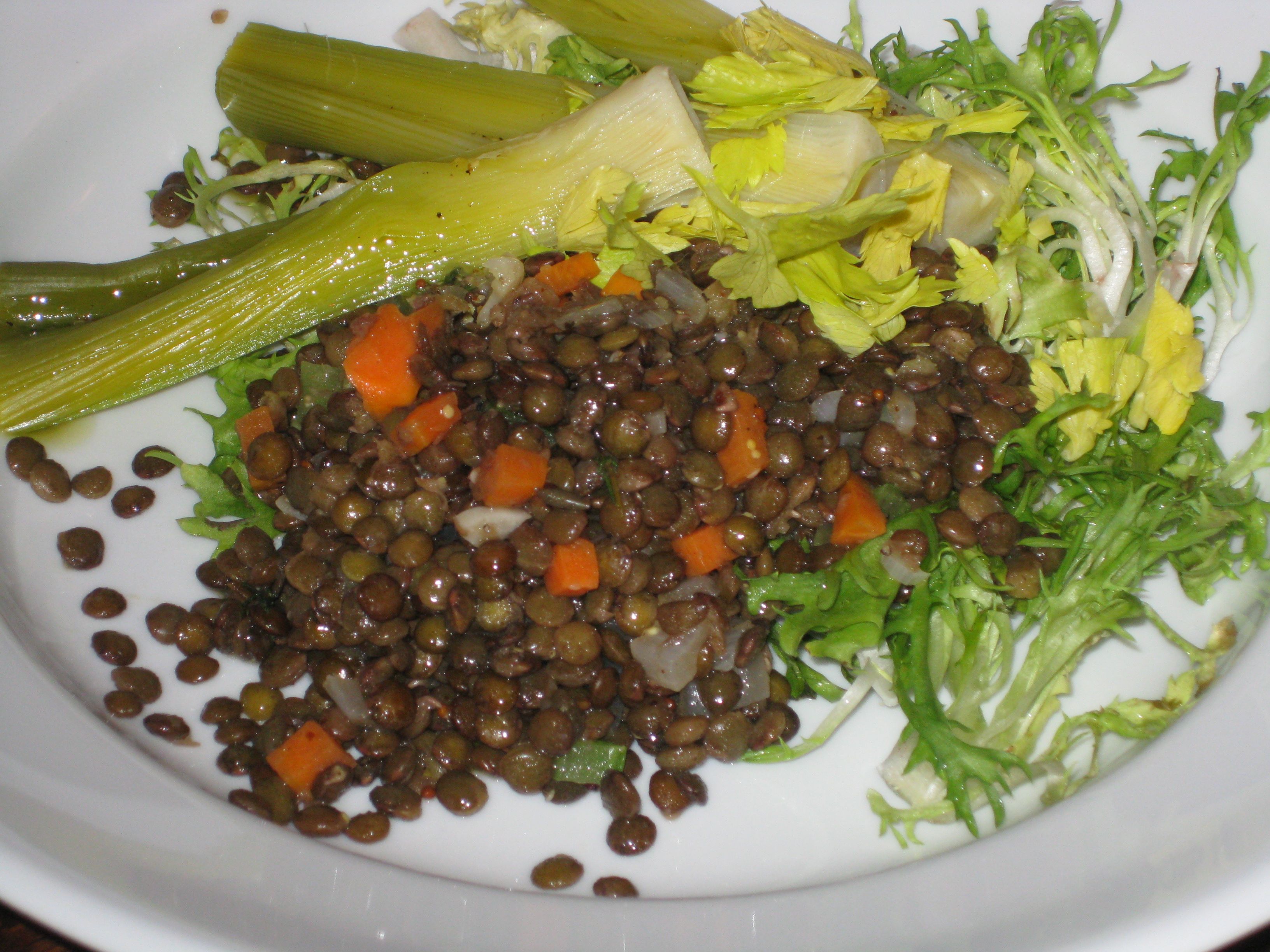
Recipe: Castelluccio Lentils with Leeks Vinaigrette

Lentils always used to be a dreary dish for me. The bowl of lentil soup my sister and I would order  because it was the only soup they had at a Midtown coffee shop was a winter tradition of ours when we were teenagers. That soup was, and still would be, mushy, gray, depressing, usually oversalted, and often studded with one choking-stiff bay leaf. It was our reward after a fine afternoon thinking of stealing but winding up paying for lipsticks at Macy’s. What usually saved the lunch was the extra-greasy grilled American cheese sandwich we’d order to share, alongside. If you’re a regular reader of my blog, you’ll probably know that I have a real aversion to mushy food. Mush aside, there’s not much flavor going on with run-of-the-mill lentils, unless you order a dish from an Indian place, where many, many spices mask the inelegance that lurks beneath.

But then one day years ago, while strolling the aisles of the old Balducci’s in the Village (boy, do I miss that store), I discovered a bag of lentils from Castelluccio, Italy. I bought them because they looked different, smaller, harder, smoother, multicolored, in shades of beige, light green and tan. They cooked up whole but tender and didn’t give off any sludgy brown film. They were pretty. I was so taken with them that I actually took a trip to that Umbrian village a few years later to watch the tiny things being harvested. (I put up an entire post about this trip a few years back, but for some reason it has temporarily vanished. When I find it I’ll let you know.) You can serve these glossy lentils for a fancy dinner and not feel you’re dishing up a mess of army rations. Castelluccio lentils are very much like the French Le Puy variety, which I discovered about a week later, also at Balducci’s, except that the French ones are dark green. Both are beautiful to cook with.

When I pick up a box of either the Castelluccio or the Le Puy lentils, what I like to do is make a salad, since cooking with lentils that stay intact is such a luxury. Here what I did was give them a brief boil (about 20 minutes) and then mix in a lightly sautéed soffritto before dressing them with a vinaigrette. I draped poached leeks over the top and wound up with what my pork-fat-loving palate found to be a vegetarian delight. (I had to restrain myself from adding pancetta. It would have been a good ingredient I’m sure, but I wanted this to be pure.)

Castelluccio Lentils with Leeks Vinaigrette

(Serves 4 as a main course)

2 cups Castelluccio or Le Puy lentils, picked over
1 fresh bay leaf
A generous pinch of sugar
Extra-virgin olive oil
Salt
1 large carrot, cut into small dice
1 large shallot, cut into small dice
1 celery stalk, cut into small dice, plus a handful of celery leaves, lightly chopped
¼ teaspoon ground allspice
Freshly ground black pepper
A few large thyme sprigs, the leaves lightly chopped, plus some extra for garnish

For the vinaigrette:

The juice and grated zest from 1  lemon
1 1/2 teaspoons Dijon mustard
Salt
A pinch of sugar
4 tablespoons extra-virgin olive oil
Freshly ground black pepper

Plus:

12 leeks, well trimmed and split down the middle, keeping the stem end intact
A big handful of mixed salad greens

Put the lentils, bay leaf, and sugar in a saucepan. Cover with cool water. Bring to a boil, lower the heat a bit, and cook at a low bubble, uncovered, until the lentils are tender but still holding their shape, about 20 minutes. Drain well, and place them in a bowl. Give them a drizzle of olive oil, and season them with a little salt.

In a small sauté pan, make a quick soffritto by sautéing the carrots, shallot, and celery in olive oil, leaving the vegetables a little crunchy. Add the vegetables to the lentils. Add the ground allspice, black pepper, and thyme . Mix, and let come to room temperature.

While you’re preparing the lentils, soak the leeks in a big pot of cold water, letting all the dirt fall to the bottom. Lift them from the water, making sure they’re very clean. Poach the leeks in boiling salted water until tender, about 20 minutes. Pull them from the pot, and lay them out on paper towels. Drizzle with a little olive oil. Season with a bit of salt.

When ready to serve,  divide the salad greens out onto four plates.  Whisk together all the ingredients for the vinaigrette, and pour about half of it over the lentils. Toss, and check for seasoning. Lay three leeks on each plate near or over the lentils (whichever looks prettiest). Drizzle the leeks with the remaining vinaigrette, and scatter on the thyme garnish and the celery leaves.

Read Full Post »

Women with Fish


Lady with a fish-bone tattoo.

Read Full Post »

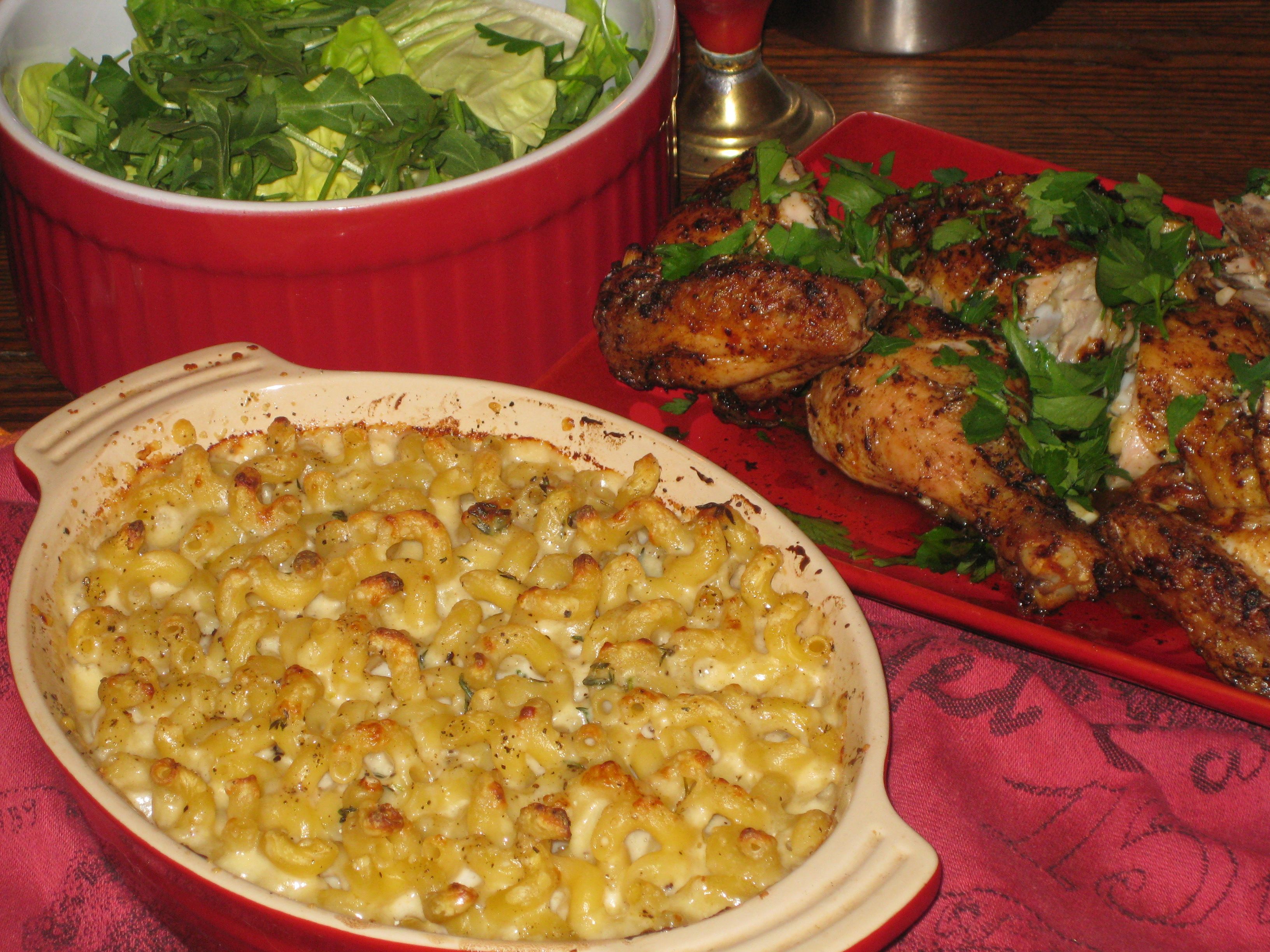
Recipe: Baked Macaroni with Fontina and Montasio

The baked mac and cheese fad that’s been winding its way through Manhattan and Brooklyn restaurants for the last ten years or so shows no sign of slowing down. I really resented this trend when it first appeared, thinking it trashy (what a sin) or, as it evolved, ridiculously highbrow, with some upscale restaurants charging big for a gooey pile of cheap cheese. Today if you’re a low-end or high-end bistro-type place, you’ve got to have a giant locavore burger, and you’ve got to have mac and cheese. The versions that upset me most are the five-cheese one (how could any palate discern five distinct cheeses when melted into one big glue ball—that’s just a waste of cheese, in my opinion), or the all-time most sickening, the mac and cheese drizzled with that terrible chemical potion known as truffle oil. The smell of that stuff floating in the air in any restaurant gives me a gag response. It should be outlawed.

Now that I’ve given you my haughty and maybe slightly stupid assessment of this food trend, wouldn’t you know it that the other night I’d find myself craving the dish. It was a very cold night, and the aroma of hot melted cheese was what I wanted in my kitchen and in my mouth. But, as you would guess, it was going to have to be a very Italian mac and cheese, and one with the utmost integrity, because I am a food snob of the highest order. Fontina Valle d’Aosta, made from the milk of cows that roam the Italian Alps, is the ultimate velvety melting cheese, a cheese that when heated releases a gorgeous mix of sweet and stinky aromas. I knew it would be my starting point, so I went out and found myself a really good hunk. Despite my issues with combining cheeses for no effect, I did feel there needed to be a counterpoint to the fontina, a slightly stronger grating cheese that would balance out all the fontina’s richness. Parmigiano Reggiano would have been a good choice, as would grana Padano, but I went with an aged Montasio, a cow’s milk cheese from Friuli that’s assertive but still contains sweetness. You might want to avoid really sharp pecorinos or aged provolone. Both in my opinion are too sour. Their tastes would throw this mellow, rich dish into the low-class food department. I’m also not crazy about including gorgonzola, as much as I love that cheese. I’ve tried it, and not only does it make the dish quite pungent, it also adds a slight soapy taste, for some reason.

So here’s my Italian mac and cheese. I’m pretty happy with it. It’s a great thing to make after a day trudging around the freezing, dirty city, exhausted from expending a lot of energy getting nothing accomplished. It’s very easy to make—you just throw the cheeses into a food processor. I’ve glammed it up with fresh thyme, a dollop of crème fraîche, and a pinch of allspice. Cook it quickly in a hot oven for the best result, a rather loose inside with a crisp browned top.  Try  it with a green salad that includes a bitter element such as escarole or radicchio. I hope it makes you happy.

Baked Macaroni with Fontina and Montasio

(Serves 5 or 6)

1 pound cavatappi or fusilli pasta (or, my favorite shape for this, cellentani, a mini cavatappi made by Barilla)
Salt
A drizzle of extra-virgin olive oil
4 tablespoons unsalted butter, plus a bit more for the baking dish
3 tablespoons all-purpose flour
1 quart whole milk
½ teaspoon ground allspice
1 fresh bay leaf
A big pinch of hot paprika
1 garlic clove, peeled and lightly crushed
A few large thyme sprigs, the leaves lightly chopped, plus a little extra for garnish
2 tablespoons crème fraîche
1½ cups grated fontina Valle d’Aosta cheese
1 cup grated aged Montasio cheese
Freshly ground black pepper
½ cup dry breadcrumbs

Boil the pasta of your choice in well-salted water until al dente. Drain it, pour it into a bowl, and toss it with a drizzle of olive oil.

Preheat the oven to 425 degrees.

Melt the butter and flour in a saucepan. Whisk until it’s smooth and the raw flour smell is gone, about 3 minutes. Add the milk, whisking all the time. Add salt, allspice, the bay leaf, the hot paprika, the garlic, and the thyme. Whisk until it just comes to a boil and is smooth and thick, about 4 minutes or so. Remove the bay leaf, and try to smash up the garlic in the sauce. Pull the pan from the heat, and add the crème fraîche, the fontina, ¾ cup of the Montasio, and some freshly ground black pepper, and whisk until smooth. Taste to see if it needs more salt.

Butter a large gratin dish or casserole (wider and shallower is better than deep for optimum crust and quick cooking).  Pour about ¾ of the sauce on the pasta, and toss. Add the pasta to the gratin dish.  Pour the rest of the sauce on top. Mix the breadcrumbs with the remaining Montasio, adding a bit of salt and black pepper. Sprinkle over the top.

Bake, uncovered, until browned and bubbly, about 15 minutes or so. Garnish with the rest of the thyme leaves. Serve right away.

Read Full Post »

« Newer Posts - Older Posts »