Feeds:
Posts
Comments

Archive for the ‘Skinny Guinea’ Category

asparagus-tart-2

Recipe: Asparagus and Ricotta Tart with Thyme

I’ve been preparing myself for the drabness of March, my least favorite month of the year, by making myself miserable so I don’t have to compete with the weather. This is generally a very dull month in forgotten old Manhattan, a time where the city is littered with clumps of dirty snow, cold winds blow, and scaffolding provides dark shelters to the forlorn. But to my surprise I woke up this morning and it was beautiful, sunny, almost 70 degrees, and crocuses were coming up on West 13th Street. How about that? And what about the misery I’d been honing so successfully? I decided to break out of it by doing a little spring-like baking.

Ricotta and asparagus are for Italians two symbols of the earth’s springtime renewal, and both of these fine ingredients figure prominently in Italian Easter recipes. I actually really dislike Easter, mainly because it’s so damned religious but also because it’s still usually too cold around here to get done up in pastels and strut around town. But I do start to crave asparagus. It is still months away at our local Greenmarkets, but sunny California’s got tons of it right now, so I went out to good old Balducci’s and bought a bunch, along with a container of very sweet-smelling store-made ricotta. A few hours later I had a good-looking asparagus and ricotta tart cooling off on my kitchen counter. I felt almost cheerful. I’m sure the crappy March weather will return, but at least I had something good to eat on this fine day.

Asparagus and Ricotta Tart with Thyme

You’ll need a 9-inch tart pan with a removable bottom

For the crust:

2 cups all-purpose flour
Salt
1 tablespoon sugar
1 teaspoon chopped fresh thyme
4 tablespoons cold, unsalted butter
3 tablespoons extra-virgin olive oil, chilled
4 or 5 tablespoons cold white wine,or  possibly a little more

For the filling:

1 big bunch medium-thick asparagus, trimmed and peeled (if you can find only really skinny ones, don’t bother peeling them)
Extra-virgin olive oil
1 shallot, thinly sliced
Salt
Freshly ground black pepper
1½ cups whole-milk ricotta
2 large eggs
3 tablespoons whole milk
½ cup grated Parmigiano Reggiano cheese, plus a little extra for the top
1 garlic clove, thinly sliced
⅛ teaspoon grated nutmeg
The grated zest from 1 small lemon
A few large thyme sprigs, the leaves chopped

To make the pastry: Put the flour in the bowl of a food processor. Add the salt, sugar, and thyme. Give it a few pulses to blend the ingredients. Add the butter and the olive oil, and pulse 2 or 3 times to break up the butter into bits. Add the white wine, and pulse once or twice more or until you have a mass of moist clumps (the dough should hold together when you pinch a bit of it). If it still seems too dry, add a tiny bit more wine and pulse again. Dump the dough out onto a work surface, and press it into a ball. Give it one or two quick kneads, and then wrap it in plastic wrap. Let the dough rest in the refrigerator at least 3 hours, or overnight.

Set up a large pot of water, and bring it to a boil. Add the asparagus, and blanch for about 3 minutes. Drain it, and run it under cold water to stop the cooking and to bring up its green color. Cut the stems into disks, leaving the tips with about an inch of stalk attached.

In a small sauté pan, heat a tablespoon of olive oil over medium heat. Add the shallot and the asparagus rounds (not the tips), and season with salt and black pepper. Sauté until the shallot has softened, about 2 minutes. Let cool.

Preheat the oven to 400 degrees.

Coat the tart pan with a little olive oil. Roll out the pastry dough on a lightly floured surface, and drape it into the pan, trimming off any overhang.

Stick the tart pan in the refrigerator while you’re preparing the filling. Mix all the remaining ingredients for the filling together in a bowl, and season well with salt and black pepper. Add the sautéed asparagus disks and shallot, and mix everything well.

Pour the filling mixture into the tart shell. Arrange the asparagus spears on top in a star pattern. Scatter a sprinkling of Parmigiano over the top, and drizzle on a little fresh olive oil.

Bake until the crust is golden and the filling is set, about 40 minutes.

Read Full Post »

norica
One of Norcia’s elaborate salumerie.

Recipe: Celery, Pistachio, and Parmigiano Salad, Served with Salami

I think I’m a salami addict. When I’m offered a platter of good salami, the same feeling comes over me as when I’m offered a great (or even not so great) glass of red wine. I get happy but a little agitated, worrying that there won’t be an endless supply. Salami, salted, air-dried sausages, mainly of pork, are served in Italy as an antipasto. They’re not a main course because they’re so rich and, I should add, fattening. As the proper Italian gal I try to be, I do make an effort to control myself, but it’s a struggle, especially if the salami is really good.

What makes me very unhappy is bad salami, the kind that’s so loaded up with nitrites it chokes you at the back of the throat and has a terrible sour aftertaste. It’s hard to find excellent salami here like the often wonderful stuff made in Italy, the local, hand-tended, funky-shaped, moldy,  gorgeous big shlongs you see hanging from pork shop ceilings. I once tasted a soppressata in Lecce, Puglia, a salami so mellow and suave it brought tears to my eyes.

Pork and tears seem to go together in my family. On a trip to Umbria with my husband and sister some years ago we settled for a few days in Norcia, a town famous for its pork butchers. We entered one of their many salumerie for sandwiches to take on a short journey up to Castelluccio, where I was dying to watch the local ladies harvest their famed lentils. We ordered slabs of salami and pecorino on rolls, and that was it. As we sat by the side of the road eating our sandwiches and sipping Oranginas, I saw a watery-eyed look on my husband’s face. The look said, essentially, this is one of the best things I’ve ever eaten, and I’m overwhelmed with emotion. And it truly was. Norcia has unfortunately become a little full of itself lately, loaded with tour buses and some hastily made salami. I’m sure you can still find excellent salami there, but it has become something of a racket. The best Italian salami I’ve eaten recently has been in Puglia and in Basilicata, where you can taste everything from the most nuanced nutmeg- and wine-scented soppressata to big fat salami loaded with garlic, hot chilies and fennel.

For years I’ve been hearing very good things about Fra’ Mani, a California company that makes handcrafted salami, but for some reason I wasn’t able to find any of their stuff in Manhattan until just recently. Fra’ Mani was started in 2006 by Paul Bertolli, a former chef at Chez Panisse, and Oliveto, in Oakland. Fra’ Mani is an Italian abbreviation for fratelli mani, meaning brothers’ hands, and the name sets the mood for this pig-friendly company (as pig-friendly as a company can be that’s in the business of butchering pigs). Mr. Bertolli set out to create the kind of salami he and I have tasted in Italy (I actually ran into him at an agroturismo place in Ostuni, Puglia, in 2004 where he and his buddies were hanging around talking about, of all things, salami—small world). Well, he has really done his homework.

I’ve finally found Fra’Mani salami at Balducci’s in Manhattan (Fra’Mani has always had a website where you can order online, www.framani.com, but somehow I never got around to using it). I was happy to see that Balducci’s carries three types of their salami. I first tried the Gentile, which is suave and subtly seasoned but with a pronounced porky flavor that I really loved. It’s based on an eighteenth-century Parma recipe. I went back later the same day (wouldn’t you know) and purchased a big chunk of their Salame Nostrano, a fatter one, more coarsely ground, and a bit gentler in flavor. I imagine it would go really well with fresh figs—or just sliced thin and piled up in an Italian-American-style hero, for that matter. Those are two of his milder offerings. Fra’ Mani also makes salami seasoned with garlic, wine, and pimenton de la Vera, the smoky Spanish pimento. And a salami called sopressa, Vicenza-style, seasoned with cloves.

Their pork is antibiotic- and hormone-free and fed on grains and natural feed, and it’s made without nitrites. This it seems is possible because Fra’ Mani closely monitors the salami during the fermentation stage, a period when lactic acid bacteria cause protein breakdown and the release of water. That is when salami starts to develop its tangy, gamy aromas. All the salami is packed in natural casings, and all is hand-tied, making it look as artisanal as it in fact is. Low temperatures are used during fermentation to encourage beneficial mold and a good nuanced flavor, a quality you’ll notice when you cut into one, even before you take a bite. Temperature, humidity, and airflow are tightly controlled during the next phase, the drying period, so that the texture turns out just right, not too mushy, not too hard. Then the salami is left to age, and soon after that you can eat it.

Since I do have a problem controlling myself when faced with great salami (and just for the record, why is it that lately everything I eat seems to want to turn directly into thigh fat?), I’m always looking for a refreshing, salady dish to serve with my salami, something that will both complement the meat and also, as a side benefit, prevent me from focusing single-mindedly on the salami and eating way too much. Here’s the cool and crunchy little something I created to accompany Fra’ Mani’s Gentile salami. It’s a mix of thin sliced celery, fennel, and scallions, with a handful of pistachios and slivers of Parmigiano tossed in. I dressed it with good olive oil and lots of lemon to balance the salami’s richness. It and the salami make a nice combination.

Celery, Pistachio, and Parmigiano Salad, Served with Salami

(Serves 4 as a first course)

1 large fennel bulb, very thinly sliced
3 celery stalks, very thinly sliced, plus a handful of celery leaves
2 scallions, cut into thin rounds, using some of the tender green part
A handful of unsalted, shelled pistachios
About a dozen big shavings of Parmigiano Reggiano cheese
The juice from 1 small lemon
2 tablespoons extra-virgin olive oil, possibly a little more
Salt
Freshly ground black pepper
A few big grating of nutmeg

Place the fennel, celery and leaves, and scallions in a shallow serving bowl. Scatter on the pistachios and the Parmigiano. In a small bowl whisk together the lemon juice and olive oil, seasoning with salt, black pepper, and the nutmeg. Pour this over the salad, and toss gently with your fingers, adding a bit more olive oil if needed to coat everything lightly. Serve right away, accompanied by a platter of really good thinly sliced salami.

Read Full Post »

8-half_saraghina

Recipe: Calamari and Shrimp Salad with Celery and Fennel

La Saraghina haunts my dreams, Fellini’s wild mistress of the Adriatic, tormentor of young boys, clumsy enticing dancer. I see her pumping that Tasmanian devil body on the sand, her dark smudged eyes rolling around in her flat face, black hair matted and sticking up straight in the hazy sun. Barefooted Saraghina, the sardine lady, so named because she traded her favors for sardines. Wilma Flintstone stole her wardrobe. I hear the music she dances to so clearly. She’s not a lady of many words (she’s actually of no words in ), but recently, I suppose because I had been thinking about her so hard, she spoke to me. Just a husky muttering, but the voice was unmistakable. She said, “I miss the sea. I want to taste the sea.”

I feel for Saraghina, long gone, even lonelier than she was in her outcast life, lived in an abandoned concrete gun casemate on the beach, where the smallest distraction, a flock of seagulls, a group of little boys throwing coins, provoked her to sway to the music. I would say she made the best of a bad situation, and because of that I loved her. I’ve always wanted to repay her for being such a positive influence on my younger life.

When I first watched , back in high school, I think at the old Elgin Theater at Eighth Avenue and 19th Street (bums admitted free in the afternoon), every minute riveted me, but when Saraghina came on the screen her ugliness was a shock, and her shimmy was self-righteous. She made me want to dance boldly. And I did, quite frequently. My mother called it “showing off.”

Years went by, and at times it’s been hard to conjure that same spirit of unbridled fun. So it makes me happy now to close my eyes and summon up an image of Saraghina, until I can see her fat form clearly. And on the occasions she speaks (this has happened only a few times), I do what she says. Saraghina, this recipe’s for you.

calamari-salad

Calamari and Shrimp Salad with Celery and Fennel

(Serves 4 or 5 as a first course)

1 fresh bay leaf
Sea salt
1 small fennel bulb, cut into small cubes
2 tender inner celery stalks, thinly sliced, plus a handful of celery leaves
1 pound large shrimp, peeled and deveined
1½ pounds small calamari, cleaned and cut into rings, the tentacles left whole
2 scallions, thinly sliced, using some of the tender green part
5 sprigs of thyme, the leaves chopped
A small handful of chervil sprigs
1 garlic clove, very thinly sliced
The juice from 1 small lemon
Extra-virgin olive oil, the best you’ve got
A few drops of Sambuca
Freshly ground black pepper

Set up a large pot of water. Add the bay leaf and a generous amount of salt. Bring to a boil, and throw in the fennel and celery. Blanch for a minute, and then scoop the vegetables out with a strainer spoon into a colander (this not only softens them but also seasons the water for the seafood to come). Run cold water over the fennel and celery to stop their cooking and to bring up their green color. Drain, and then spread  them onto paper towels.

Add the shrimp to the pot, and boil just until pink and tender, about 2 to 3 minutes. Scoop them from the water, and lay them out on  paper towels to soak up any remaining water.

Add the calamari, and boil for about a minute. Scoop the calamari from the water, and lay it out on paper towels.

When the vegetables and seafood are all more or less at room temperature, place them in a shallow serving bowl. Add the scallion, the thyme, the chervil, and the celery leaves.

In a small bowl whisk together the garlic, lemon juice, about 2 tablespoons of olive oil (or a little more), and the Sambuca (very little, a few drops only for good flavor; too much will make the dish bitter). Season with salt and black pepper. Pour the dressing over the salad, and toss gently with your fingers. Taste for seasoning, adding more black pepper or a bit more olive oil if needed, to coat everything with a good glisten. Serve right away.

Read Full Post »

ricotta-eaters-2
The Ricotta Eaters, by Vincenzo Campi, 1585 (the guy on the left looks a little ill).

Recipe: Crespelle with Ricotta and Walnut Pesto

At some point during my teenage years, my mother began making manicotti using crespelle, the Italian version of crepes, instead of the more traditional pasta sheets. I took an immediate love to this new dish, which was inspired, I believe, by her fascination with Julia Child’s TV shows. It was so light and elegant. I loved the aroma of the crespelle as they colored lightly in the pan. So I decided to cook up a batch of our new improved manicotti to bring to my grandmother, a woman who had always been somewhat remote and ornery. When I close my eyes to envision her now, I can only remember a short, big-breasted woman lying on a couch with a wet towel over her forehead. I guess I hoped the crespelle would cheer her up. I kept everything else in the dish exactly the way she would have made it—the ricotta filling, the tomato sauce, the béchamel. I worked all day on it, and it came out, I thought, very impressive.

I placed the big, bubbling-hot baking dish on my grandmother’s dinner table and served the group, which also including my remote and ornery aunt (takes one to know one) and her goofy, handsome, but hot-tempered husband, my uncle Pat. They tasted, and there was a weird silence. Then my grandmother said, “These taste different.” More silence. Then my aunt said, “They look different.” There was another nerve-racking pause, and then uncle Pat, actually shouting, said, “These ARE different.”  The rest of the evening was awkward to say the least, and, frankly, terrible for me. I sat gulping down my grandmother’s Riunite in a futile attempt to transport myself to some gentler time and place. My mother felt very sorry for me.

It’s incredible how rigid Southern Italians can be about their food. Now that I look back on it, though, the whole thing pisses me off. I wish I had had the temerity to just say, this is it. This is what you’re eating. It’s new. It’s delicious. Deal with it. Although if I had, my grandmother probably would have whacked me in the head.

That was the last time I cooked for my grandmother, but the experience obviously didn’t dissuade me from cooking altogether. In fact it turned out perversely enough to be one of the catalysts for my career in Italian food. Since then my crespelle has evolved further, to something that would be completely unrecognizable to my headachy and now deceased grandmother. I’m no longer interesting in imitating manicotti. I leave off the béchamel and the tomato sauce, a combination that I’ve grown to feel overwhelms delicate crepes. I’ve also added a thin layer of walnut pesto, which blends really well with ricotta. I made this for my mother the other night. She loved it. And it did taste different.

crespelle-best

Crespelle with Ricotta and Walnut Pesto

(Serves 4 or 5—makes about 12 7-inch crespelle)

For the crespelle:

1 cup all-purpose flour
4 large eggs
A generous pinch of salt
1 tablespoon sugar
3 tablespoons olive oil, plus extra for cooking
1 cup whole milk, possibly a little more
1 tablespoon grappa or brandy

For the ricotta:

2 cups whole-milk ricotta
1 large egg
½ cup grated Grana Padano cheese
A few big scrapings of nutmeg (about ⅛ teaspoon)
Salt
Freshly ground black pepper
A handful of basil leaves, lightly chopped

For the pesto:

1½ cups very fresh walnut halves
1 small garlic clove, roughly chopped
¼ cup extra-virgin olive oil
¼ cup grated Grana Padano cheese
Salt

For the top:

3 pints grape tomatoes
1 large garlic clove, thinly sliced
Salt
Freshly ground black pepper
A big splash of white wine
½ cup grated Grana Padano cheese
About a dozen basil leaves, lightly chopped

For the crespelle batter: Put all the crespelle ingredients into the bowl of a food processor, and pulse until very smooth. The result should be the consistency of thick cream. If it’s too thick, add a little more milk. Pour the batter into a bowl, and let it sit about 45 minutes before using (this will relax the gluten a bit, so you get a nice tender crepe).

To cook the crespelle: I used a 7-inch omelet pan, but if you’ve got a proper crepe pan, a little bigger or smaller, use that. Any small sauté pan will do the trick. With these olive oil crespelle, I never find sticking a problem, so you don’t need a non-stick pan. Put the pan over a medium flame, and let it heat up. Pour in enough olive oil to just coat the pan. Pull the pan from the heat, and ladle in a bit less than a quarter cup of batter, tilting the pan quickly in a circular movement to spread the batter. (You’ll get the hang of it. The first one usually doesn’t come out too well. Once the heat is regulated and you get the feel of it, trust me, you’ll find it fairly easy.) Let the crespelle cook just until you notice it coloring lightly at the edge. Now shake the pan, moving the crespelle away from you, and slip a spatula underneath. Give it a fast, confident flip. If it folds up a bit, just straighten it out with your fingers (these things are a lot sturdier than you would think). Cook on the other side for about 30 seconds, and then slide onto a big plate.

Make the rest of the crespelle the same way, adding a drizzle of olive oil to the pan each time. Stack the crespelle up on top of one another (they won’t stick, I swear). You can refrigerate them until you want to assemble the dish, if you like.

Mix the ingredients for the ricotta filling together in a big bowl.

Put all the ingredients for the pesto in the bowl of a food processor, and pulse until you have a rough paste.

Preheat the oven to 425 degrees.

Chose a very large shallow-sided baking dish (one that you’d use for a big lasagna is perfect). If you don’t have a big one, use two smaller ones. You want the crespelle to fit fairly snuggly. Coat the dish or dishes lightly with olive oil.

Lay out a crepe on a work surface, and coat one side lightly with the walnut pesto. Now add about 3 tablespoons of the ricotta mixture, and smear it around as best you can (it doesn’t have to be perfectly distributed). Now roll up the crepe, and place it in the baking dish. Repeat this with all the crespelle.

In a large skillet, heat about 2 tablespoons of olive oil over medium-high heat. When the oil is hot, add the grape tomatoes, and sear until they start to burst, shaking the skillet often so they cook evenly. Add the garlic, and season with salt and black pepper. Sauté a minute longer, just until they start to give off a little liquid. Add the white wine, and let it bubble for about a minute, not letting the liquid evaporate too much. Pour the tomatoes, with their liquid, over the crespelle. Sprinkle on the Grana Padano, and bake until bubbling and lightly browned at the edges, about 15 minutes. Garnish with the basil.

Serve hot. No need to let this rest. They’re quite firm. I like them served with a simple winter salad of mixed chicory-type lettuces, such as frisée and endive.

Read Full Post »

Veal and Peppers Revisited

dickalpaty-21
Dick De Mane (center) and his buddies, out on the town.

Recipe: Braised Veal with Sweet Peppers and Capers

One of my father’s favorite dishes was veal and peppers, a Neapolitan-American plate of slow simmered veal with bell peppers, tomatoes, a little wine, a sprinkling of hot pepper flakes, a handful of parsley. That’s about it, but those few ingredients produced a rich, tender stew with big flavor. Most Italian-run pizza shops made it to serve in heroes, and just about every Italian-American household, including ours, cooked up a version. Homemade was far superior, at least when prepared by my mother. And you got to enjoy the aromas while it cooked.

The dish brings back a specific patch of time, the mid-sixties, when I was right in the middle of pure childhood, with no adolescent yearnings. I remember the clothes my parents wore, my mother’s clean Jackie looks, my father’s deep ocher V-neck pullovers and sleek sport coats. Those are the clothes I prefer today for myself (a V-neck and pointy high heels will never let you down). We ate a lot of veal and peppers in those days. But then into the seventies, when my mother’s little Jackie suits turned to jeans and tees and my father started wearing turquoise, veal and peppers went away. We started eating grilled steaks. Maybe my mother still made veal and peppers every once in awhile, but I recall it from an earlier time, one I have preserved in the sweet spot in my brain.

The photo above of my father flanked by his two buddies Al Feminelli and Patty Iannicelli brings back the veal and peppers era vividly. It was a time when everyone was strong, and cigarettes, booze, and sun weren’t against the law. I don’t know where this restaurant was. It could have been in Hollywood, Florida, near the dog track, or possibly Port Chester, New York, or maybe in midtown Manhattan. Hard to say.

I know my mother thinks I have a nostalgia problem. I guess she’s right. So be it. It’s fueled my love for Italian cooking, so I can only view it as a bonus.

Here’s my new recipe for veal and peppers. It’s not my mother’s recipe; it’s just me fiddling around. I added a little sweet mix of spices I happen to like with veal, and a bit of rosemary, some Marsala, lemon zest, and capers. Despite my updated flourishes, it tastes quite the same as I remember it. Maybe the dish is so strong, so powerful, that it can’t be altered even if you try. Or if I can remember my catechism correctly, it’s incorruptible, as they say.

Braised Veal with Sweet Peppers and Capers

(Serves 4 or 5)

3 pounds boneless veal shoulder, cut into approximately 1½-inch chunks
1 tablespoon sugar
Salt
Freshly ground black pepper
2 tablespoons Wondra flour
Extra-virgin olive oil
2 tablespoons butter
½ cup chopped pancetta
3 leeks, cut into thin rounds, using the white and only tenderest green parts
3 garlic cloves, thinly sliced
⅛ teaspoon ground nutmeg
⅛ teaspoon ground cinnamon
A pinch of clove
½ teaspoon Aleppo pepper (or another medium spicy dried chili)
1 cup dry Marsala
3 sprigs rosemary, the leaves well chopped
1 28-ounce can plum tomatoes, chopped, with the juice
½ cup chicken broth, possibly a little more
3 sweet red bell peppers, roasted until charred, peeled, seeded, and cut into thick slices
The grated zest from 1 small lemon
A handful of salt-packed Sicilian capers, soaked in cool water for 20 minutes, rinsed, and drained

Dry the veal chunks well. Sprinkle them with the sugar, salt, and black pepper.

Set a large casserole fitted with a lid over a medium-high flame. Add about a tablespoon of olive oil and the butter. Sprinkle the flour over the veal chunks, and toss to coat them lightly. When the olive oil and butter are hot, add the veal, and brown lightly all over (do this in batches if you need to). Take the veal from the casserole, and put it in a bowl or on a plate (something that will catch juices).

Add the pancetta to the casserole, and sauté until crisp. Add the leeks, and sauté until soft, about 4 minutes. Add the garlic, the nutmeg, cinnamon, clove, and Aleppo or other medium-hot chili, and sauté a minute to release all their flavors. Return the veal to the casserole, along with any juices it may have given off. Add the rosemary and the Marsala, and let it bubble for a minute or so. Add the tomatoes, with their juice, and the chicken broth, and bring to a boil (the liquid should just cover the meat; if not, add more broth or a little water). Add a bit more salt and black pepper. Turn the heat to low, cover the casserole, and simmer for an hour and a half. Then add the roasted peppers, and simmer, covered, for about another half hour, or until the veal is very tender.

Skim the surface of the stew well, and then add the lemon zest and the capers. Let it all sit for about a half hour (this will help all the flavors meld). Reheat gently. Serve hot. I think this goes especially well with rice, which is how my mother usually served it, but a small pasta such as ditalini will also be a good choice.

Read Full Post »

anna-magnani-1945
Anna Magnani, with a romantic dog friend.

Recipe: Coda alla Vaccinara

Our Lady of the Eternal City, Anna Magnani, is a woman I check in with frequently, even though she is dead. I value her opinion so much, her not being flesh-and-blood live is hardly an obstacle (actually she has much more time these days). Recently I asked her what I should cook my husband for Valentine’s Day. Should I make chocolate mousse or filet mignon?, I asked. There was a pause, and she then whispered “Coda alla Vaccinara.” Well, gee, what a concept.

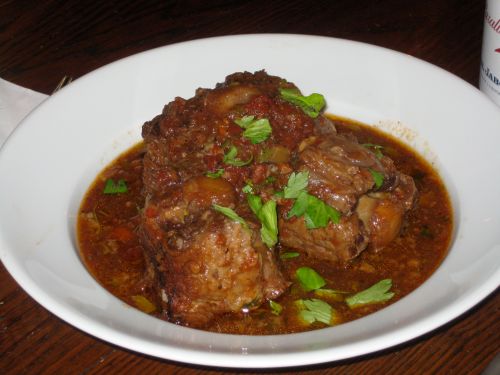
Oxtails are not something I had associated with romance, but I think Miss Magnani’s on to something. Coda alla Vaccinara, braised oxtail, is a dish I’ve eaten in trattorias in the Testaccio, the old slaughterhouse district of Rome, an area famous for its quinto-quarto, or fifth-quarter, food, dishes made from the supposedly less than desirable parts of animals, like intestine (called la pajata and served with rigatoni), trippa, lamb’s liver, and pig’s feet, all dishes of funky, dark deliciousness. I really love this food, and when you think about it, it’s  much more romantic than, say, a steak, which is so straightforward. Sort of like Miss Magnani herself, who, with her dark, baggy eyes, is infinitely more intriguing than, say, Gina Lollabrigida.

Oxtail Roman-style is richly seasoned with red wine, clove, celery, and marjoram. It smells sweet and intense while cooking, almost like chocolate (and in fact some cooks add a little cocoa to the pot), and since it has to cook a long time, about three hours, you get very intimate with the oxtails and their deepening aromas.

By the way, oxtails were originally actually cut from oxen, which are castrated bulls. Now they are cut from everyday beef cattle, but I suppose oxtail sounds more folklorico than cowtail, so the original name of the stew has endured.

Happy Valentine’s Day to you.

oxtails

Coda alla Vaccinara

(Serves 4)

Extra-virgin olive oil
4 pounds oxtails (try to get the wider, meatier middle cut, not the tiny tail ends)
Salt
Freshly ground black pepper
1 teaspoon  sugar
1 round piece of pancetta, ¼ inch thick, cut into small cubes
2 leeks
1 carrot
2 small celery stalks, cut into small dice, plus a large handful of celery leaves, lightly chopped
2 garlic cloves, thinly sliced
5 whole cloves, ground to a powder
¼ teaspoon ground cinnamon
1 bay leaf
1 cup sweet vermouth
1 cup dry red wine
1  cup homemade, or high-quality purchased, chicken broth
1 28-ounce can Italian plum tomatoes, chopped, with the juice
6 large sprigs marjoram
A splash of balsamic vinegar

Preheat the oven to 325 degrees.

Choose a large casserole that will hold the meat more or less in one layer (a little overlap is okay). Heat a few tablespoons of olive oil over medium-high heat. Season the oxtails with salt, black pepper, and the sugar, and brown them well on all sides. Add the pancetta, and let it get a little crisp. Now add the leeks, carrot, celery (but not the leaves yet), garlic, ground clove, and cinnamon, and turn the heat down to medium. Sauté a few minutes, to soften the vegetables. Add the red wine and the sweet vermouth, and cook at a lively bubble for about 4 minutes. Add the bay leaf, the chicken broth, and the tomatoes. Season with a little more salt and black pepper. The meat should be almost completely covered with liquid; if not, add more broth or water. Bring this to a boil. Cover the casserole, and place it in the oven. Let the stew cook at a low simmer until very tender, about 3 hours.

Take the casserole from the oven, and skim most of the fat from the surface of the sauce. (Oxtail throws off a lot of fat. If you like, you can make the stew the day before serving, refrigerate it overnight, and then scrape the cold fat from the surface before reheating.)

Add the celery leaves and marjoram to the sauce, and add a splash of balsamic vinegar. Reseason with salt or black pepper if needed. Serve in bowls, over polenta or pasta or farro if you like; I prefer a simple accompaniment of good Italian bread to soak up all the sauce.

Read Full Post »

Paccheri with Eggplant

eggplant-pasta

Recipe: Paccheri with Eggplant, Capers, Mint, and Ricotta Salata

I don’t often cook eggplant in winter. It’s usually withered and seedy, and it just makes me long for summer, when I can find ten different eggplant varieties at my Greenmarket. Eggplant is a strikingly beautiful vegetable. I can’t get over its varying shades of purple, from inky black to light lavender, or when it really looks like eggs, solid white, or bright green with white stripes, or electric purple with beige stripes. It is rich, creamy, and absolutely delicious, and as every Sicilian knows, it makes a luxurious pasta sauce. But in the dead of winter? Usually not.

Here I was at my musty neighborhood health food store, buying more goji juice for my mother. (She still demands it even though the last bottle I bought gave her  a dramatic case of the runs. Maybe that was the desired effect.) So I picked up her juice, and before heading out (I can’t spent much time in health food stores—that rancid grain smell depresses me) I glanced at their organic produce department, which in winter doesn’t usually look much better than my local supermarket’s. I saw something interesting: smooth, firm purple-black eggplants, not too big, but hefty. Where do these come from, I asked? Nobody knew. That’s odd. I though all these employees were supposed to be organic food experts. It didn’t matter. I bought a couple.

When I got them home and cut into them, I wasn’t disappointed. Nice, very few seeds, no brown liquid beading up, a vegetable-sweet smell. I was excited. Pasta time. I had a bag of paccheri, the Neapolitan pasta that look like ultra-huge rigatoni. These tubes are so gigantic they look like Italians are playing a joke on gullible American foodies, but they’re the real thing. (I usually buy the Neapolitan brand Setaro at Buonitalia, at the Chelsea market.) You might be tempted to stuff these big tubes, and you could, but their true charm emerges when you cook them until just floppy and sauce them with something substantial and decidedly Southern, such as eggplant. I’ve gone all-out Sicilian here (despite the choice of a Neapolitan pasta shape), with anchovies, capers, fresh chili, mint, Marsala, pine nuts, and ricotta salata.

This pasta is so substantial and meaty, I like eating it as a main course, followed by a green salad.

Note: I don’t salt eggplant. I’ve found it makes no difference whatever in controlling bitterness. If you choose firm, young eggplants, bitterness will be less of a problem.

Paccheri with Eggplant, Capers, Mint, and Ricotta Salata

(Serves 4 as a main course)

2 medium-size firm eggplants, peeled in vertical stripes with half the skin left on, and cut into small cubes
Extra-virgin olive oil
Salt
1 teaspoon sugar
1 fresh chili, seeded and minced (I used a red jalapeño)
1 shallot, cut into small dice
2 small garlic cloves, thinly sliced
3 anchovy fillets, chopped
¼ cup dry Marsala
1 28-ounce and 1 15-ounce can of San Marzano plum tomatoes, chopped, with the juice
1 pound paccheri or rigatoni pasta
A handful of salt-packed Sicilian capers, soaked for about 20 minutes and then rinsed
A handful of lightly toasted pine nuts
A handful of fresh mint leaves
A chunk of ricotta salata

In a large skillet, heat 2 tablespoons of olive oil over medium heat. When hot, add the eggplant, seasoning with salt and the sugar (this will help it brown), and sauté until lightly browned. Scatter the chili, garlic, shallot, and anchovy bits over the eggplant, and stir it around. Sauté until the seasonings are soft and fragrant, about a minute longer. Add the Marsala, and let it bubble for a minute. Add the tomatoes, with their juice, and cook uncovered at a lively bubble for about 8 minutes. Add the capers and the pine nuts.

Cook the paccheri in abundant salted water until al dente. Drain, reserving about a half cup of the cooking water.

Place the paccheri in a serving bowl, and drizzle it with a tablespoon or so of fresh olive oil. Add the mint, and give it a toss. Add the eggplant sauce, and toss lightly again. Add a little pasta water if needed. Serve right away, grating ricotta salata over each serving.

Read Full Post »

escarole1
A  fairly good-looking batch of  supermarket  escarole.

Recipe: Cavatelli with Shrimp, Escarole, and Parmigiano Breadcrumbs

Oh, where, oh where, has my Greenmarket gone? Oh, when will this long winter end? Yesterday I found myself pottering around in the chicory-related bins at my local supermarket, looking for something interesting to turn into dinner. Like many Italian-minded cooks, when I don’t know what to make I make pasta. The pastabilities are endless, as they say. Endless unless you’re having a cook’s block, which is what I momentarily experienced while starring down piles of wilted escarole.

Then I thought of my mother’s escarole with garlic and oil, a side dish she made often when I was a kid. I loved it. I’d get up in the middle of the night just to finish off any leftovers (it’s excellent heaped on top of a slice of cold pizza Margherita). It had the perfect balance of bitterness and greasiness, and with the slivers of garlic and the dried red pepper flakes she always added it was just about the perfect food. I asked the stock guy at the store where the escarole came from, and he actually knew. At least he gave me an answer. Florida, he said.

Okay, that’s not so far away, but how long has the escarole been sitting in this bin getting slimy? I didn’t ask him that. I didn’t need to. Must have been a long time, since escarole is pretty hardy. By now I just really wanted to taste escarole with olive oil and garlic again. I had settled on escarole as a component of the evening’s meal. It was a nostalgia issue. I tried not to look at the wilted, brown stuff that was before me. “Do you have any other escarole?” I asked. He smiled and opened up a big box sitting at his feet that happened to be filled with bright green, firm, crunchy, beautiful fresh escarole. What a weird world this is.

I guess the old stuff gets thrown out and replaced with newer stuff until the newer stuff gets wilty, and then that gets thrown out and then replaced again. What’s the matter with everyone? Don’t you know how delicious escarole is when gently sautéed with garlic and olive oil? What else are you supposed to eat in New York in the winter? Don’t ignore escarole. I tell you, it can make the cold months happier.

Damned, but what a waste all this wilty being tossed. I grabbed two huge fresh heads from the box (it really cooks down), trying not to think about all the wilted stuff,  and a package of cavatelli. Sounded good to me, but I sensed my husband and sister might find the resulting cucina povera dish too austere. So on my way out I picked up a pound and a half of shrimp. Pasta improvvisata time. Here’s my recipe. I hope it makes you happy.

The best way to cook up escarole: You can eat escarole raw in salad, and I love it that way, especially with a gorgonzola dressing, but it’s at its best cooked. I always give it a quick blanch in boiling salted water (very quick, about a minute), to rid it of some of its bitterness, and then plunge it into cold water to stop the cooking and bring up its beautiful light green color. Squeeze out as much water as possible, and then it’s ready for a quick sauté in good olive oil and whatever little extras you might like to add (pancetta, anchovies, olives, garlic, fresh chilies, pine nuts, raisins, fresh sausage, cooked cannellini beans). This way the escarole will be sweet and vibrant.

My grandmother, and just about every other old Italian lady I ever knew, would just throw escarole in a big pot with oil, way too much garlic, and a little water, and stew the life out of it until it was soft, gray, and depressing. That might have been traditional, but it’s not allowed anymore. I say so.

Cavatelli with Shrimp, Escarole, and Parmigiano Breadcrumbs

(Serves 4 as a main course or 6 as first course)

2 dozen large shrimp, peeled and deveined, but keep the shells
Extra-virgin olive oil
½ cup dry white wine, plus a little extra for sautéing the shrimp
1 cup chicken broth
Salt
2 large heads escarole, cut into small pieces
3/4 cup dry breadcrumbs, not too finely ground
½ cup grated Parmigiano Reggiano cheese
Freshly ground black pepper
Dried hot red pepper (I used Aleppo, which is only medium spicy)
A generous pinch of sugar
1 pound cavatelli pasta
1 large shallot, finely chopped
2 garlic cloves, thinly sliced
5 large sprigs thyme, the leaves lightly chopped
A big squeeze of lemon juice

In a small saucepan, heat a tablespoon of olive oil over medium heat. Add the shrimp shells, and sauté them until they turn pink, about 2 minutes. Add the white wine, and let it bubble for about 2 minutes. Add the chicken broth and water, if needed, to just cover the shells, season with a little salt, and cook at a lively bubble for about 10 minutes. Strain the shrimp broth into a small bowl, and set it aside.

Bring a large pot of pasta cooking water to a boil. Add a generous amount of salt. Drop in the escarole, and blanch for one minute. Scoop out the escarole into a strainer, using a large strainer spoon, and run cold water over it to bring up its green color. Squeeze out as much water as you can.

In a small sauté pan, heat a tablespoon of olive oil over medium heat. Add the breadcrumbs, and sauté until crisp, about a minute. Season with a little salt. Let the breadcrumbs cool to room temperature, and then mix in the Parmigiano Reggiano. Put this in a little bowl.

Put the shrimp in a bowl, and season well with salt, black pepper, some hot red pepper to taste, and the sugar. Toss well.

Bring the water back to a boil, and drop in the cavatelli.

In a large skillet, heat about 2 tablespoons of olive oil over medium heat. Add the shallot, and sauté until softened, about a minute or so. Add the garlic, and sauté a minute longer. Add the escarole, season with salt, black pepper, and the thyme, and sauté about 2 minutes. Add the shrimp broth, and let simmer briefly. In a smaller skillet, heat a tablespoon of olive oil over high heat. When hot, add the shrimp, sautéing quickly until it’s just tender, about 4 minutes. Add a splash of white wine, and shake the skillet. Pour the shrimp into the escarole.

When the cavatelli is al dente, drain it, leaving a bit of cooking water clinging to it, and pour it into a large serving bowl. Pour on the escarole and shrimp sauce. Add a drizzle of fresh olive oil, and toss gently. Adjust the seasoning, adding more salt or black or red pepper, if desired. Serve hot, with a tablespoon or so of the Parmigiano breadcrumbs sprinkled on each serving.

Read Full Post »

chicken-soup-2

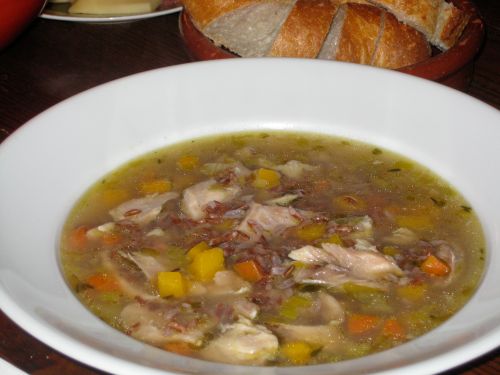
Recipe: Chicken Soup with Red Italian Rice

I love colored rice. I’ve cooked with the firm, pitch-black Forbidden rice from China and the deep red, short-grained variety from the French Carmargue. These are startlingly beautiful foods with deep flavors. Italian colored rice didn’t figure into my cooking until very recently, I think because I tend to focus on Southern Italian flavors, and rice is a northern crop. Ignoring it was a big mistake and very snobby on my part.

On a recent browse through gustiamo.com, my favorite online Italian food import shop, I fixated on several new offerings of darkly colored rices from Pacifico Crespi, an old, rice producing family in the Piemonte. Like the perfect lipstick shade I’ve just set my eyes on, I had to have them. Venere Nero (black Venus) cooked up a beautiful dark purple and smelled divine, like toasted wheat or popcorn. I used it to make Black Rice with Shrimp, Guanciale, and Rosemary, but then I forgot about the bag I’d ordered of Rosso Integrale, a red variety (really a rich mahogany color), until yesterday, when I was hunting around in my pantry for something glamorous to add to a chicken soup. There it was, waiting, in its tight, air-sealed package, looking like a bag of garnet chips. I cooked some up, and the aroma was wheaty and commanding.

Good chicken soup glistens with a shimmer of golden chicken fat. I like mine to taste rich and deep, with no eccentric edges of lemongrass or searing hot chili, so I fashioned it on the mellow side, adding some diced butternut squash, carrot, vermouth, sage, lots of fresh black pepper, and the gorgeous mahogany rice from Piemonte. The nuttiness and crunch of the rice disturbed the soup’s mellowness in a subtle way. It looked and tasted like a mild winter night, which was exactly when I served it.

A really easy chicken broth:

I know most people don’t really want to hear this, but the key to a good chicken soup is a good chicken broth, which usually means one that’s homemade. Lately I’ve been making an excellent broth using the picked-over remains from a roasted chicken—either one I’ve roasted myself or a good one purchased from a decent grocer that uses free-range birds. Ideally, for the best flavor, the carcass should have a little meat left on it. I just crack the thing into a few large pieces and stick it in a pot along with whatever soffrito and herb ingredients I’ve got hanging around—usually a carrot, some type of onion trimmings, celery leaves, parsley leaves, thyme, fennel fronds. I drizzle in a little olive oil and sauté everything for a few minutes, and then add a splash of Marsala or white wine, letting it boil away. Next I just cover the bones and whatever meat I’ve got there with water and put it on a lively simmer, uncovered, for about an hour and 15 minutes. Strain, and there it is, ready to use or freeze. Add salt and pepper now, or wait until you want to use it. This usually makes about three cups of medium-strength broth. You can boil it down to concentrate it if you like, making it more convenient for freezing.

Chicken Soup with Red Italian Rice

(Serves 4)

¾ cup Italian red Rice
Salt
2 tablespoons extra-virgin olive oil
1 ¼-inch-thick, round slice of pancetta, cut into small dice
3 whole chicken legs
1 large leek, well cleaned and cut into small dice, using only the tenderest green part
2 small carrots, cut into small dice
1 celery stalk, cut into small dice, plus a handful of celery leaves, lightly chopped
1 garlic clove, thinly sliced
About 5 thyme sprigs, the leaves chopped
5 sage leaves, lightly chopped
A few big gratings of nutmeg
Salt
Freshly ground black pepper
¼ cup dry vermouth
1 quart of homemade chicken broth
1½ cups butternut squash, cut into small cubes
A few drops of good red wine vinegar

Put the rice in a small saucepan and cover it with about 4 inches of cool water. Add some salt, and bring it to a boil. Turn the heat down to a medium simmer, and cook, uncovered, until the rice is just tender, about 30 minutes (the package says 40 minutes, but I found that with this method it was ready after 30). Drain the rice, and set it aside.

In a big soup pot, drizzle in the olive oil. Add the pancetta, and sauté over medium heat until crisp. Add the chicken, the leeks, carrot, celery and leaves, and garlic. Sauté until everything is fragrant and just starting to brown a bit. Add the thyme, sage, and the nutmeg, and season with salt and black pepper.

Add the Marsala, and let it bubble for a minute or so. Add the chicken broth and about a cup of water. Bring to a boil. Now turn the heat down and simmer, partially covered, until the chicken is tender, about ½ hour. Take the chicken from the pot. Add the butternut squash, and let it cook, uncovered, until tender, about 6 or 7 minutes.

When the chicken is cool enough to handle, remove the meat and add it to the pot, along with the rice. Heat gently for about 3 or 4 minutes, just to blend all the flavors. Skim the top of excess fat and gunk. Add a few drops of the vinegar. Taste for seasoning, adding more salt or black pepper if needed. Serve hot.

Read Full Post »

spare-ribs

Recipe: Pork Spare Ribs Braised with White Wine, Rosemary, Cinnamon, and Pine Nuts

There are many things I don’t understand about myself, but one thing I do know is that I will always find fulfillment cooking with the flavors of Southern Italy, the flavors of my heritage.

New York is not Southern Italy, despite the many Italian immigrants who have chosen to live here. New Yorkers have a completely different temperament from the people I’ve met in Sicily, with their sternness, their secrecy, or from many of the people of Naples, who seem bold and funny in contrast. These are clichés, but you know they must hold truth since you can see the reflection of them in those people’s cooking. I must have snippets of the Puglian and Sicilian temperaments, but I’m not sure what the hell they are. Growing up in New York you get hammered from every angle, so you wind up acting quite unlike your parents. Every conceivable attitude walks these streets. Knowing this about where I live, you’d think we’d always serve up insanity on a plate, and you can get that in some restaurants, but the reality is that most New York cooking is fairly orderly, with discernible roots. I know Italian-Americans who just continue to cook a handful of old family dishes over and over again, always exactly the same. Their food is wonderful to eat, but that’s not how I ever wanted to cook. That’s real Italian. What I turn out is purely Italian-American.

Here’s a hybrid creation for you to ponder: spare ribs with Sicilian flavors. In all my travels throughout Sicily, I’ve never once encountered spare ribs. I don’t know why, exactly. Possibly they consider them uncouth, since you’re so tempted to pick them up and eat them with your fingers (Sicilians use a knife and fork to eat an apple). The texture and taste of slow-cooked pork spare ribs is fabulous, so rich, so juicy, but I have never been crazy about the sticky, dark red New York–style barbecue sauce they come covered with around here. I put that clunky dish out of my mind, and instead I borrowed flavors from a Sicilian lamb dish I first tasted near Trapani, a Sicilian city  steeped in Arab culture. The Trapanese make a gentle use of sweet spices, nuts, and even couscous. The dish I tasted there was lamb shoulder braised in white wine, tomato, cinnamon, bay leaf, nutmeg I think, mild garlic, and a whiff of rosemary. It was wonderful and has stayed firmly planted in my culinary head for years. I am very happy to discover that it works really well with tough, fatty supermarket spare ribs.

I thought the perfect thing to serve with these ribs would be polenta, but I didn’t have any in the house, so I cooked up some barley and tossed it with a little olive oil and Grana Padano. Not bad. Polenta would have been better, though. I also made a side of chili-spiked broccoli rabe. It was a good meal for a snowy New York evening.

Pork Spare Ribs Braised with White Wine, Rosemary, Cinnamon, and Pine Nuts

(Serves 4)

½ teaspoon each of ground allspice, ground cinnamon, sugar, salt, black pepper, and Aleppo pepper
4 pounds pork spare ribs
Extra-virgin olive oil
1 round slice pancetta, ¼ inch thick, chopped
1 large shallot, diced
2 garlic cloves, thinly sliced
1 bay leaf
½ a cinnamon stick
4 sprigs rosemary, the leaves chopped
1 large wine glass of dry white wine
1 15-ounce can San Marzano plum tomatoes, chopped, with the juice
½ cup chicken broth
A handful of lightly toasted pine nuts

Mix all the spices together in a large bowl. Add the spare ribs, and toss them around with your hands until they’re well coated with the spices.

Preheat the oven to 325 degrees.

Set out a rectangular baking dish that will hold the ribs in one layer.

Heat 2 tablespoons of olive oil in a large skillet over medium-high heat. When the oil is hot, brown the spare ribs on both sides (do it in batches if necessary). Place the browned ribs in the baking dish.

Pour most of the oil out of the skillet (if it has become too burned, you’ll need to wipe it out). Add the pancetta, and let it get crisp. Add the shallot, and sauté until softened. Add the garlic, and let it sauté a minute, just to release its aroma. Add the bay leaf, cinnamon stick, and rosemary, and sauté a minute. Add the white wine, and let it bubble for a minute or so. Add the tomatoes and the chicken broth, and let bubble for about 3 or 4 minutes. Season with salt and black pepper. Pour the liquid over the ribs. The liquid should just about cover them (if it doesn’t, add a little more chicken broth or water).

Cover the dish tightly with aluminum foil, and place it in the oven until the ribs are very tender, about 2½ to 3 hours.

Take the ribs from the baking dish, and arrange them in a large, shallow serving bowl. Degrease the cooking liquid. Reheat the sauce briefly, and pour it over the ribs. Garnish with the pine nuts. Serve hot.

Read Full Post »

« Newer Posts - Older Posts »